

ASTM C842-05(2021)
(Specification)Standard Specification for Application of Interior Gypsum Plaster
General Information
- Abstract
ABSTRACT
This specification covers the minimum requirements for full-thickness interior gypsum plastering on gypsum, metal, masonry, or monolithic concrete bases designed or prepared to receive gypsum plaster. Gypsum plaster applied to the interior side of exterior walls of masonry or concrete shall be isolated from the exterior wall. Gypsum plasters shall not be used in exterior locations or interior wet areas. Plasters and other cementitious materials shall be kept dry until used; they shall be stored off the ground, under cover, and away from walls with condensation and other damp surfaces. Metal products shall be protected, while stored, against rusting. The surface preparations of plasters are presented in details. All plaster mixing shall be done by mechanical means unless hand mixing is specified. Plaster shall be applied by hand or machine as specified.
SCOPE
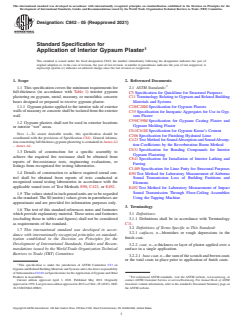
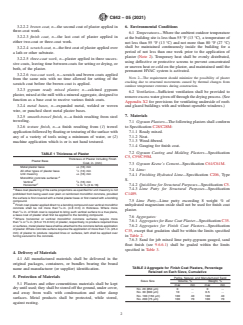
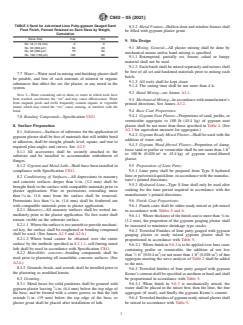
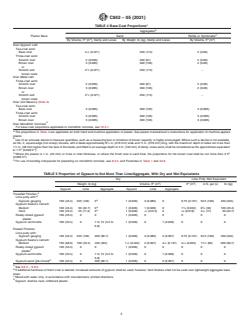
1.1 This specification covers the minimum requirements for full-thickness (in accordance with Table 1) interior gypsum plastering on gypsum, metal, masonry, or monolithic concrete bases designed or prepared to receive gypsum plaster.
1.1.1 Gypsum plaster applied to the interior side of exterior walls of masonry or concrete shall be isolated from the exterior wall.
1.2 Gypsum plasters shall not be used in exterior locations or interior “wet” areas.
Note 1: To secure desirable results, this specification should be coordinated with the provisions of Specification C841. General information concerning full thickness gypsum plastering is contained in Annex A2 – Annex A4.
1.3 Details of construction for a specific assembly to achieve the required fire resistance shall be obtained from reports of fire-resistance tests, engineering evaluations, or listings from recognized fire testing laboratories.
1.4 Details of construction to achieve required sound control shall be obtained from reports of tests conducted at recognized sound testing laboratories in accordance with the applicable sound tests of Test Methods E90, C423, or E492.
1.5 The values stated in inch-pound units are to be regarded as the standard. The SI (metric) values given in parentheses are approximate and are provided for information purposes only.
1.6 The text of this standard references notes and footnotes which provide explanatory material. These notes and footnotes (excluding those in tables and figures) shall not be considered as requirements of the standard.
1.7 This international standard was developed in accordance with internationally recognized principles on standardization established in the Decision on Principles for the Development of International Standards, Guides and Recommendations issued by the World Trade Organization Technical Barriers to Trade (TBT) Committee.
- Status
- Published
- Publication Date
- 31-Mar-2021
- Technical Committee
- C11 - Gypsum and Related Building Materials and Systems
Overview
ASTM C842-05(2021) is an internationally recognized standard specification addressing the application of interior gypsum plaster. Developed by ASTM International, this standard establishes the minimum requirements for full-thickness gypsum plastering on a variety of interior base surfaces, including gypsum, metal, masonry, and monolithic concrete. The specification covers essential guidelines for materials, environmental conditions, mixing, surface preparation, and application processes to ensure the performance and durability of interior plaster systems.
ASTM C842-05(2021) strictly limits the use of gypsum plaster to non-exterior and non-wet interior locations, ensuring its optimal use in dry interior environments.
Key Topics
- Approved Substrates: Defines acceptable base surfaces such as gypsum lath, metal lath, masonry, and monolithic concrete for gypsum plaster application.
- Material Storage and Protection: Details correct storage practices for plasters and metal components to avoid moisture and rust.
- Prohibited Uses: Explicitly prohibits gypsum plaster in exterior environments and interior wet areas.
- Surface Preparation: Specifies cleanliness, roughness, and alignment requirements for substrate surfaces before plastering.
- Mixing Methods:
- Mechanical mixing is preferred; hand mixing allowed when specified.
- Each batch must be mixed separately to ensure quality and consistency.
- Application Procedures:
- Guidance for two-coat and three-coat work, including scratch, brown, and finish coats.
- Instructions for different base materials and configuration, ensuring correct thickness and finish.
- Environmental Controls: Mandates temperature and ventilation requirements before, during, and after plaster application for proper curing and bond integrity.
- Finishes and Textures:
- Smooth-trowel and texture finishes are defined, along with mixing and finishing approaches.
- Fire and Sound Performance: Refers to coordination with fire resistance and sound control test reports where these properties are required.
Applications
ASTM C842-05(2021) is essential for construction professionals, architects, and contractors involved in:
- Commercial and Residential Construction: Ensuring high-quality gypsum plaster installation for walls, ceilings, and partitions in offices, homes, schools, and hospitals.
- Renovation Projects: Providing standardized methods for re-plastering or refurbishing existing interior walls.
- Fire-rated and Acoustic Assemblies: Working with specified plaster systems as part of assemblies designed for enhanced fire resistance or sound control, as determined by related fire and acoustic test methods.
- Institutional Settings: Adapting to strict performance requirements in environments such as healthcare and education facilities.
The standard’s specifications help to deliver durable finishes, consistent quality, and code-compliant installations, reducing the risks associated with moisture, improper mixing, or substandard applications.
Related Standards
Professionals applying ASTM C842-05(2021) should be familiar with the following related ASTM standards:
- ASTM C841: Installation of Interior Lathing and Furring
- ASTM C28/C28M: Gypsum Plasters
- ASTM C35: Inorganic Aggregates for Gypsum Plaster
- ASTM C631: Bonding Compounds for Interior Gypsum Plastering
- ASTM E90, C423, E492: Test methods for sound transmission and absorption
Understanding and coordinating ASTM C842 with these standards ensures full compliance with current best practices for the application of interior gypsum plaster, supporting lasting quality and code fulfillment in plaster systems.
Keywords: ASTM C842, interior gypsum plaster, plaster application, plaster base, gypsum lath, interior finish, ASTM standards, plaster mixing, construction standards, lath and plaster, sound control, fire resistance, building materials.
Relations
- Effective Date
- 01-Dec-2023
- Effective Date
- 01-Jun-2020
- Effective Date
- 01-Jun-2020
- Refers
ASTM C631-09(2020) - Standard Specification for Bonding Compounds for Interior Gypsum Plastering - Effective Date
- 01-Apr-2020
- Effective Date
- 01-Oct-2019
- Refers
ASTM C11-18a - Standard Terminology Relating to Gypsum and Related Building Materials and Systems - Effective Date
- 01-Oct-2018
- Refers
ASTM C11-18 - Standard Terminology Relating to Gypsum and Related Building Materials and Systems - Effective Date
- 01-Jun-2018
- Refers
ASTM C11-17a - Standard Terminology Relating to Gypsum and Related Building Materials and Systems - Effective Date
- 01-Oct-2017
- Refers
ASTM C11-17 - Standard Terminology Relating to Gypsum and Related Building Materials and Systems - Effective Date
- 15-May-2017
- Effective Date
- 01-Dec-2016
- Refers
ASTM C11-16 - Standard Terminology Relating to Gypsum and Related Building Materials and Systems - Effective Date
- 15-May-2016
- Effective Date
- 01-Oct-2015
- Effective Date
- 01-Oct-2015
- Refers
ASTM C11-15a - Standard Terminology Relating to Gypsum and Related Building Materials and Systems - Effective Date
- 01-Oct-2015
- Refers
ASTM C11-15 - Standard Terminology Relating to Gypsum and Related Building Materials and Systems - Effective Date
- 01-Apr-2015
Get Certified
Connect with accredited certification bodies for this standard

DIBt (Deutsches Institut für Bautechnik)
German Institute for Building Technology.
DIN CERTCO
DIN Group product certification.

Aboma Certification B.V.
Specialized in construction, metal, and transport sectors.
Sponsored listings
Frequently Asked Questions
ASTM C842-05(2021) is a technical specification published by ASTM International. Its full title is "Standard Specification for Application of Interior Gypsum Plaster". This standard covers: ABSTRACT This specification covers the minimum requirements for full-thickness interior gypsum plastering on gypsum, metal, masonry, or monolithic concrete bases designed or prepared to receive gypsum plaster. Gypsum plaster applied to the interior side of exterior walls of masonry or concrete shall be isolated from the exterior wall. Gypsum plasters shall not be used in exterior locations or interior wet areas. Plasters and other cementitious materials shall be kept dry until used; they shall be stored off the ground, under cover, and away from walls with condensation and other damp surfaces. Metal products shall be protected, while stored, against rusting. The surface preparations of plasters are presented in details. All plaster mixing shall be done by mechanical means unless hand mixing is specified. Plaster shall be applied by hand or machine as specified. SCOPE 1.1 This specification covers the minimum requirements for full-thickness (in accordance with Table 1) interior gypsum plastering on gypsum, metal, masonry, or monolithic concrete bases designed or prepared to receive gypsum plaster. 1.1.1 Gypsum plaster applied to the interior side of exterior walls of masonry or concrete shall be isolated from the exterior wall. 1.2 Gypsum plasters shall not be used in exterior locations or interior “wet” areas. Note 1: To secure desirable results, this specification should be coordinated with the provisions of Specification C841. General information concerning full thickness gypsum plastering is contained in Annex A2 – Annex A4. 1.3 Details of construction for a specific assembly to achieve the required fire resistance shall be obtained from reports of fire-resistance tests, engineering evaluations, or listings from recognized fire testing laboratories. 1.4 Details of construction to achieve required sound control shall be obtained from reports of tests conducted at recognized sound testing laboratories in accordance with the applicable sound tests of Test Methods E90, C423, or E492. 1.5 The values stated in inch-pound units are to be regarded as the standard. The SI (metric) values given in parentheses are approximate and are provided for information purposes only. 1.6 The text of this standard references notes and footnotes which provide explanatory material. These notes and footnotes (excluding those in tables and figures) shall not be considered as requirements of the standard. 1.7 This international standard was developed in accordance with internationally recognized principles on standardization established in the Decision on Principles for the Development of International Standards, Guides and Recommendations issued by the World Trade Organization Technical Barriers to Trade (TBT) Committee.
ABSTRACT This specification covers the minimum requirements for full-thickness interior gypsum plastering on gypsum, metal, masonry, or monolithic concrete bases designed or prepared to receive gypsum plaster. Gypsum plaster applied to the interior side of exterior walls of masonry or concrete shall be isolated from the exterior wall. Gypsum plasters shall not be used in exterior locations or interior wet areas. Plasters and other cementitious materials shall be kept dry until used; they shall be stored off the ground, under cover, and away from walls with condensation and other damp surfaces. Metal products shall be protected, while stored, against rusting. The surface preparations of plasters are presented in details. All plaster mixing shall be done by mechanical means unless hand mixing is specified. Plaster shall be applied by hand or machine as specified. SCOPE 1.1 This specification covers the minimum requirements for full-thickness (in accordance with Table 1) interior gypsum plastering on gypsum, metal, masonry, or monolithic concrete bases designed or prepared to receive gypsum plaster. 1.1.1 Gypsum plaster applied to the interior side of exterior walls of masonry or concrete shall be isolated from the exterior wall. 1.2 Gypsum plasters shall not be used in exterior locations or interior “wet” areas. Note 1: To secure desirable results, this specification should be coordinated with the provisions of Specification C841. General information concerning full thickness gypsum plastering is contained in Annex A2 – Annex A4. 1.3 Details of construction for a specific assembly to achieve the required fire resistance shall be obtained from reports of fire-resistance tests, engineering evaluations, or listings from recognized fire testing laboratories. 1.4 Details of construction to achieve required sound control shall be obtained from reports of tests conducted at recognized sound testing laboratories in accordance with the applicable sound tests of Test Methods E90, C423, or E492. 1.5 The values stated in inch-pound units are to be regarded as the standard. The SI (metric) values given in parentheses are approximate and are provided for information purposes only. 1.6 The text of this standard references notes and footnotes which provide explanatory material. These notes and footnotes (excluding those in tables and figures) shall not be considered as requirements of the standard. 1.7 This international standard was developed in accordance with internationally recognized principles on standardization established in the Decision on Principles for the Development of International Standards, Guides and Recommendations issued by the World Trade Organization Technical Barriers to Trade (TBT) Committee.
ASTM C842-05(2021) is classified under the following ICS (International Classification for Standards) categories: 91.100.10 - Cement. Gypsum. Lime. Mortar. The ICS classification helps identify the subject area and facilitates finding related standards.
ASTM C842-05(2021) has the following relationships with other standards: It is inter standard links to ASTM E90-23, ASTM C28/C28M-10(2020), ASTM C61/C61M-00(2020), ASTM C631-09(2020), ASTM C35-01(2019), ASTM C11-18a, ASTM C11-18, ASTM C11-17a, ASTM C11-17, ASTM E90-09(2016), ASTM C11-16, ASTM C28/C28M-10(2015), ASTM C61/C61M-00(2015), ASTM C11-15a, ASTM C11-15. Understanding these relationships helps ensure you are using the most current and applicable version of the standard.
ASTM C842-05(2021) is available in PDF format for immediate download after purchase. The document can be added to your cart and obtained through the secure checkout process. Digital delivery ensures instant access to the complete standard document.
Standards Content (Sample)
This international standard was developed in accordance with internationally recognized principles on standardization established in the Decision on Principles for the
Development of International Standards, Guides and Recommendations issued by the World Trade Organization Technical Barriers to Trade (TBT) Committee.
Designation:C842 −05 (Reapproved 2021)
Standard Specification for
Application of Interior Gypsum Plaster
This standard is issued under the fixed designation C842; the number immediately following the designation indicates the year of
original adoption or, in the case of revision, the year of last revision. A number in parentheses indicates the year of last reapproval. A
superscript epsilon (´) indicates an editorial change since the last revision or reapproval.
1. Scope 2. Referenced Documents
1.1 This specification covers the minimum requirements for 2.1 ASTM Standards:
full-thickness (in accordance with Table 1) interior gypsum
C5 Specification for Quicklime for Structural Purposes
plastering on gypsum, metal, masonry, or monolithic concrete
C11 Terminology Relating to Gypsum and Related Building
bases designed or prepared to receive gypsum plaster.
Materials and Systems
1.1.1 Gypsum plaster applied to the interior side of exterior
C28/C28M Specification for Gypsum Plasters
wallsofmasonryorconcreteshallbeisolatedfromtheexterior
C35 Specification for Inorganic Aggregates for Use in Gyp-
wall.
sum Plaster
C59/C59M Specification for Gypsum Casting Plaster and
1.2 Gypsum plasters shall not be used in exterior locations
Gypsum Molding Plaster
or interior “wet” areas.
C61/C61M Specification for Gypsum Keene’s Cement
NOTE 1—To secure desirable results, this specification should be
C206 Specification for Finishing Hydrated Lime
coordinated with the provisions of Specification C841. General informa-
C423 Test Method for SoundAbsorption and SoundAbsorp-
tionconcerningfullthicknessgypsumplasteringiscontainedinAnnexA2
tion Coefficients by the Reverberation Room Method
– Annex A4.
C631 Specification for Bonding Compounds for Interior
1.3 Details of construction for a specific assembly to
Gypsum Plastering
achieve the required fire resistance shall be obtained from
C841 Specification for Installation of Interior Lathing and
reports of fire-resistance tests, engineering evaluations, or
Furring
listings from recognized fire testing laboratories.
C1489 Specification for Lime Putty for Structural Purposes
1.4 Details of construction to achieve required sound con-
E90 Test Method for Laboratory Measurement of Airborne
trol shall be obtained from reports of tests conducted at
Sound Transmission Loss of Building Partitions and
recognized sound testing laboratories in accordance with the
Elements
applicable sound tests of Test Methods E90, C423,or E492.
E492 Test Method for Laboratory Measurement of Impact
Sound Transmission Through Floor-Ceiling Assemblies
1.5 The values stated in inch-pound units are to be regarded
Using the Tapping Machine
as the standard.The SI (metric) values given in parentheses are
approximate and are provided for information purposes only.
3. Terminology
1.6 The text of this standard references notes and footnotes
3.1 Definitions:
which provide explanatory material. These notes and footnotes
3.1.1 Definitions shall be in accordance with Terminology
(excluding those in tables and figures) shall not be considered
as requirements of the standard. C11.
3.2 Definitions of Terms Specific to This Standard:
1.7 This international standard was developed in accor-
3.2.1 catfaces, n—blemishes or rough depressions in the
dance with internationally recognized principles on standard-
finish coat.
ization established in the Decision on Principles for the
Development of International Standards, Guides and Recom-
3.2.2 coat, n—a thickness or layer of plaster applied over a
mendations issued by the World Trade Organization Technical
surface in a single application.
Barriers to Trade (TBT) Committee.
3.2.2.1 basecoat,n—thesumofthescratchandbrowncoats
or the total coats in place prior to application of finish coats.
This specification is under the jurisdiction of ASTM Committee C11 on
GypsumandRelatedBuildingMaterialsandSystemsandisthedirectresponsibility
ofSubcommitteeC11.03onSpecificationsfortheApplicationofGypsumandOther
Products in Assemblies. For referenced ASTM standards, visit the ASTM website, www.astm.org, or
Current edition approved April 1, 2021. Published May 2021. Originally contact ASTM Customer Service at service@astm.org. For Annual Book of ASTM
approvedin1976.Lastpreviouseditionapprovedin2015asC842– 05 (2015).DOI: Standards volume information, refer to the standard’s Document Summary page on
10.1520/C0842-05R21. the ASTM website.
Copyright © ASTM International, 100 Barr Harbor Drive, PO Box C700, West Conshohocken, PA 19428-2959. United States
C842−05 (2021)
3.2.2.2 brown coat, n—the second coat of plaster applied in 6. Environmental Conditions
three-coat work.
6.1 Temperatures—Where the ambient outdoor temperature
3.2.2.3 finish coat, n—the last coat of plaster applied in
at the building site is less than 55 °F (13 °C), a temperature of
either two-coat or three-coat work.
not less than 55 °F (13 °C) and not more than 80 °F (27 °C)
shall be maintained continuously inside the building for a
3.2.2.4 scratch coat, n—the first coat of plaster applied over
period of not less than one week prior to the application of
a lath or other substrate.
plaster (Note 2). Temporary heat shall be evenly distributed,
3.2.2.5 three-coat work, n—plaster applied in three succes-
using deflective or protective screens to prevent concentrated
sive coats, leaving time between coats for setting or drying, or
or uneven heat or cold on the plaster, and maintained until the
both, of the plaster.
permanent HVAC system is activated.
3.2.2.6 two-coat work, n—scratch and brown coats applied
NOTE 2—The requirement should minimize the possibility of plaster
from the same mix with no time allowed for setting of the
cracking due to structural movements caused by thermal changes from
scratch coat before the brown coat is applied.
outdoor temperature extremes during construction.
3.2.3 gypsum ready mixed plaster, n—calcined gypsum
6.2 Ventilation—Sufficient ventilation shall be provided to
plaster, mixed at the mill with a mineral aggregate, designed to
removeexcesswatergivenoffthroughthedryingprocess.(See
function as a base coat to receive various finish coats.
Appendix X2 for provisions for ventilating underside of roofs
3.2.4 metal bases, n—expanded metal, welded or woven
and glazed buildings with and without operable windows.)
wire, or punched sheet metal plaster bases.
7. Materials
3.2.5 smooth-trowel finish, n—a finish resulting from steel
troweling.
7.1 Gypsum Plasters—The following plasters shall conform
3.2.6 texture finish, n—a finish resulting from (1) trowel to Specification C28/C28M:
7.1.1 Ready mixed.
applicationfollowedbyfloatingortexturingofthesurfacewith
any of a variety of tools using a minimum of water, or (2) 7.1.2 Neat.
7.1.3 Wood-fibered.
machine application which is or is not hand textured.
7.1.4 Gauging for finish coat.
7.2 Gypsum Casting and Molding Plasters—Specification
TABLE 1 Thickness of Plaster
C5, C59/C59M.
Thickness of Plaster Including Finish
Plaster Base
Coat, in. (mm)
7.3 Gypsum Keene’s Cement—Specification C61/C61M.
Metal plaster base ⁄8 (16) min
7.4 Lime:
All other types of plaster base ⁄2 (13) min
Unit masonry ⁄8 (16) min
7.4.1 Finishing Hydrated Lime—Specification C206, Type
A
Monolithic concrete surfaces:
S.
BC
Vertical ⁄8 (16) min
C 1 5
7.4.2 Quicklime for Structural Purposes—Specification C5.
Horizontal ⁄8 to ⁄8 (3 to 16)
A 7.4.3 Lime Putty for Structural Purposes—Specification
Base coat plastering of the same proportions as specified for unit masonry is not
prohibited from being used over plain or reinforced monolithic concrete, provided
C1489.
the surface is first covered with a metal plaster base or first coated with a bonding
7.5 Lime Putty—Lime putty exceeding 8 weight % of
compound.
B
Finish coat plaster applied direct to a bonding compound over vertical monolithic
unhydrated magnesium oxide shall not be used for finish coat
concrete shall be not more than ⁄16 in. (4.8 mm) in thickness. Where more
plaster.
than ⁄16 in. of finish coat is required to bring such vertical surface to a true plane,
a base coat of plaster shall first be applied to the bonding compound.
7.6 Aggregates:
C
Where horizontal or vertical monolithic concrete surfaces require more
3 5 7.6.1 Aggregates for Base Coat Plaster—Specification C35.
than ⁄8 or ⁄8 in. (9.5 or 15.9 mm) of plaster, respectively, to produce required lines
orsurfaces,metalplasterbaseshallbeattachedtotheconcretebeforeapplication
7.6.2 Aggregates for Finish Coat Plasters—Specification
ofplaster.Whereconcretesurfacerequirestheapplicationofmorethan1in.(25.4
C35, except that gradation shall be within the limits specified
mm) of plaster to produce required lines or surfaces, lath shall be applied over
in Table 2.
furring secured to the concrete.
7.6.3 Sand for job mixed lime putty-gypsum gauged, sand
float finish (see 9.6.6.1) shall be graded within the limits
specified in Table 3.
4. Delivery of Materials
4.1 All manufactured materials shall be delivered in the
original packages, containers, or bundles bearing the brand
name and manufacturer (or supplier) identification. TABLE 2 Aggregate for Finish Coat Plasters, Percentage
Retained on Each Sieve, Cumulative
5. Protection of Materials
Perlite, Natural, and Manufactured Sand
Sieve Size Volume, % Weight, %
5.1 Plasters and other cementitious materials shall be kept
max min max min
dry until used; they shall be stored off the ground, under cover, No. 20 (850 µm) 0 . 0 .
No. 30 (600 µm) 10 . 0.5 .
and away from walls with condensation and other damp
No. 100 (150 µm) 100 40 100 40
surfaces. Metal products shall be protected, while stored,
No. 200 (75 µm) 100 70 100 70
against rusting.
C842−05 (2021)
TABLE 3 Sand for Job-mixed Lime Putty-gypsum Gauged Sand
8.3.2 MetalFrames—Hollowdoorandwindowframesshall
Float Finish, Percent Retained on Each Sieve by Weight,
be filled with gypsum plaster grout.
Cumulative
Sieve Size max min
9. Mix Design
No. 16 (1.18 mm) 0 0
No. 30 (600 µm) 50 20 9.1 Mixing, General—All plaster mixing shall be done by
No. 50 (300 µm) 70 50
mechanical means unless hand mixing is specified.
No. 100 (150 µm) 100 80
9.1.1 Retempered, partially set, frozen, caked or lumpy
material shall not be used.
9.1.2 Each batch shall be mixed separately and mixers shall
be free of all set and hardened materials prior to mixing each
7.7 Water—Water used in mixing and finishing plaster shall
batch.
be potable, and free of such amounts of mineral or organic
9.1.3 All tools shall be kept clean.
substances that affect the set, the plaster, or any metal in the
9.1.4 The setting time shall be not more than 4 h.
system.
9.2 Hand Mixing—see Annex A3.1.
NOTE 3—Water containing salt or alum, or water in which tools have
been washed, accelerates the “set” and may cause efflorescence. Water
9.3 MechanicalMixing—Inaccordancewithmanufacturer’s
from stagnant pools and wells frequently contain organic or vegetable
printed directions. See Annex A3.2.
matter which may retard the “set,” cause staining, or interfere with the
bond. 9.4 Base Coat Proportions:
9.4.1 Gypsum Neat Plaster—Proportions of sand, perlite, or
7.8 Bonding Compounds—Specification C631.
vermiculite aggregate to 100 lb (45.4 kg) of gypsum neat
plaster shall be not more than those specified in Table 4. (See
8. Surface Preparation
A2.3 for equivalent measure for aggregates.)
8.1 Substrates—Surfaces of substrates for the application of
9.4.2 Gypsum Ready Mixed Plaster—Shall be used with the
gypsum plaster shall be free of materials that will inhibit bond
addition of water only.
or adhesion, shall be straight, plumb, level, square, and true to
9.4.3 Gypsum Wood-fibered Plaster—Proportion of damp,
required plan angles and curves. See A2.5.
loose sand or perlite or vermiculite shall be not more than 1 ft
8.1.1 All accessories shall be securely attached to the
to 100 lb (0.028 m to 45.4 kg) of gypsum wood-fibered
substrate and be installed to accommodate embedment of
plaster.
flanges.
8.1.2 Gypsum and Metal Lath—Shall have been installed in 9.5 Preparation of Lime Putty:
compliance with Specification C841.
9.5.1 Lime putty shall be prepared from Type S hydrated
lime or pulverized quicklime, in accordance with the manufac-
8.2 Conditioning of Surfaces—All depressions in masonry
turer’s printed directions.
and concrete surfaces deeper than ⁄8 in. (3.2 mm) shall be
9.5.2 Hydrated Lime—Type S lime shall only be used after
brought flush to the surface with compatible materials prior to
soaking for the time period required in accordance with the
plaster application. Fins or protrusions extending more
manufacturer’s printed directions.
than ⁄16 in. (1.6 mm) from the surface shall be removed.
Protrusions less than ⁄16 in. (1.6 mm) shall be feathered out
9.6 Finish Coat Proportions:
with compatible materials prior to plaster application.
9.6.1 Finish coats shall be either ready mixed or job mixed
8.2.1 Masonry—All masonry surfaces shall be wetted im-
in accordance with Tables 5 and 6.
mediately prior to the plaster application. No free water shall
9.6.1.1 Wherethicknessofthefinishcoatismorethan ⁄8 in.
remain visible on the substrate surface.
(3.2 mm), the proportion of the gypsum gauging plaster shall
8.2.1.1 Wherethesurfaceistoosmoothtoprovidemechani-
be increased to minimize shrinkage type cracks.
cal key, the surface shall be roughened or bonding compound
9.6.2 Troweled Finishes of lime putty gauged with gypsum
shall be used. (See Annex A2.5 and A2.6.)
gauging plaster or ready mixed gypsum plaster shall be
8.2.1.2 Where bond cannot be obtained over the entire
proportioned in accordance with Table 5.
surface by the methods specified in 8.2.1.1, self-furring metal
9.6.2.1 Where finish in9.6.2 is to be applied over base coats
lath shall be used in accordance with Specification C841.
containing perlite or vermiculite, the addition of not less
3 3 3 3
8.2.2 Monolithic concrete—bonding compounds shall be
than ⁄2 ft (0.014 m ) or not more than 1 ft (0.028 m)offine
used prior to plastering all monolithic concrete surfaces. (See
aggregate meeting the sieve analysis of Table 2 shall be added
A2.6.)
to the mix.
8.2.3 Grounds, beads, and screeds shall be installed prior to
9.6.3 Troweled finishes of lime putty gauged with gypsum
the plastering as modified herein.
Keene’s cement shall be specified as medium or hard and shall
be proportioned in accordance with Table 5.
8.3 Grouting:
8.3.1 Metal bases for solid partitions shall be grouted with 9.6.3.1 When finish in 9.6.3 is mechanically mixed, the
water shall be placed in the mixer first, then the lime, the fine
gypsum plaster leaving ⁄4 in. (6.4 mm) below the top edge of
the base, and be formed with a center groove so that the lath aggregate (if used), and finally the gypsum Keene’s cement.
extends ⁄4 in. (19 mm) below the top edge of the base, or 9.6.4 Troweledfinishesofgypsumreadymixedplastershall
plaster grout shall be placed after installation of lath. be mixed in accordance with Table 5.
C842−05 (2021)
A
TABLE 4 Base Coat Proportions
B
Aggregates
C
Plaster Base Sand Perlite or Vermiculite
3 3 3 3
By Volume, ft (m ), Damp and Loose By Weight, lb (kg), Damp and Loose By Volume, ft (m )
Over Gypsum Lath
Two-coat work:
Base coat 2 ⁄2 (0.071) 250 (113) 2 (0.06)
Three-coat work:
Scratch coat 2 (0.056) 200 (91) 2 (0.06)
Brown coat 3 (0.085) 300 (136) 2 (0.06)
or
Scratch and 2 ⁄2 (0.071) 250 (113) .
brown coats
Over Metal Lath
Three-coat work:
Scratch coat 2 (0.056) 200 (91) 2 (0.06)
Brown coat 3 (0.085) 300 (136) 2 (0.06)
or
Scratch and 2 ⁄2 (0.071) 250 (113) .
brown coats
Over Unit Masonry (Note 6)
Two-coat work:
Base coat 3 (0.085) 300 (136) 3 (0.085)
Three-coat work:
Scratch coat 3 (0.085) 300 (136) 3 (0.085)
Brown coat 3 (0.085) 300 (136) 3 (0.085)
D
Over Monolithic Concrete
For base coat proportions applicable to monolithic concrete, see 10.2.1.
A
The proportions in Table 3 are applicable for both hand and machine application of plaster. See plaster manufacturer’s instructions for application of machine-applied
plaster.
B
Use of an accurate device to measure quantities, such as a measuring box or container of known capacity, is highly encouraged. Where such a device is not available,
six No. 2, square-edge (not scoop) shovels, with a blade approximately 8 ⁄2 in. (216 mm) wide and 11 in. (279 mm) long, with the maximum depth of sides not more than
1 ⁄2 in. (38 mm) higher than the face of the blade, and filled to an average depth of 4 in. (102 mm) of damp, loose sand, shall be considered as the approximate equivalent
3 3
to1ft (0.028 m ).
C 3
Where the plaster is 1 in. (25 mm) or more in total thickness, or where the finish coat is sand float, the proportions for the brown coat shall be not more than3ft
(0.085 m ).
D
For use of bonding compounds for plastering on monolithic concrete, see 8.2.2, and Footnotes in Table 1 and A2.6.
TABLE 5 Proportion of Gypsum to Not More Than Lime/Aggregate, With Dry and Wet Equivalents
Dry Lime Putty Wet Equivalent
3 3 3 3
Weight, lb (kg) Volume, ft (m)ft (m ) U.S. gal (L) lb (kg)
Gypsum Lime Aggregate Gypsum Lime Aggregate
A
Troweled Finishes:
B
Lime putty with:
A
Gypsum gauging 100 (45.4) 225 (102) 0 1 (0.028) 3 (0.085) 0 6.75 (0.191) 52.5 (199) 450 (204)
Gypsum Keene’s cement:
A
1 3
Medium 100 (45.4) 50 (22.7) 0 1 (0.028) 1 (0.028) 0 1 ⁄8 (0.032) 8 ⁄4 (33) 100 (45.4)
A
1 5 1
Hard 100 (45.4) 25 (11.3) 0 1 (0.028) ⁄2 (0.014) 0 ⁄8 (0.018) 4 ⁄2 (17) 50 (22.7)
Ready-mixed gypsum 100 (45.4) 0 0 1 (0.028) 0 0 0 0 0
plaster
Gypsum vermiculite 100 (45.4) 0 7 to 15 (3.2 to 1 (0.028) 0 1 (0.028) 0 0 0
6.8)
Floated Finishes:
Lime putty with:
Gypsum gauging 100 (45.4) 225 (102) 200 (90.7) 1 (0.028) 3 (0.085) 2 (0.057) 6.75 (0.191) 52.5 (199) 450 (204)
Gypsum Keene’s cement:
1 1 1 1
Medium 150 (68.0) 100 (45.4) 450 (204) 1 ⁄2 (0.042) 2 (0.057) 4 ⁄2 (0.127) 2 ⁄4 (0.064) 17 ⁄2 (66) 200 (90.7)
Ready-mixed gypsum 100 (45.4) 0 0 1 (0.028) 0 0 0 0 0
C
plaster
Gypsum-vermiculite 100 (45.4) 0 7 to 15 (3.2 to 1 (0.028) 0 1 (0.028) 0 0 0
6.8)
D
Gypsum-sand (job-mixed) 100 (45.4) 0 200 (90.7) 1 (0.028) 0 2 (0.057) 0 0 0
A
See 9.6.2 – 9.6.5.
B
If additional hardness of finish coat is desired, increased amounts of gypsum shall be used; however, hard finishes shall not be used over lightweight aggregate base
coats.
C
Mixed with water only, in accordance with manufacturers’ printed directions.
D
Gypsum shall be neat, unfibered plaster.
C842−05 (2021)
TABLE 6 Trowel Finishes of Lime Putty Gaged With Gypsum
enough pressure to form a good bond to the substrate. The
Gauging Plaster Proportions
second coat shall be applied by doubling back before the first
A,B,C
Proportions of Fine Aggregate
coat sets and with the plaster brought out to the grounds or
Not Less Than Not More Than Per
screeds or specified thickness.
3 3 3 3
⁄2 ft (0.014 m)1ft (0.028 m ) 100 lb (45.4 kg) gypsum gauging
3 3 3 3
1 1
NOTE 5—Two coat work is not recommended over any type metal
or ⁄8 ft (0.0035 m ) ⁄4 ft (0.007 m ) 50 lb (22.7 kg) dry hydrated lime
3 3
plaster base.
or 1 U.S. gal (3.78 L) 2 U.S. gal (7.57 L) 1 ft (0.028 m ) lime putty
or 1 pt (0.473 L) 1 qt (0.946 L) 1 U.S. gal (3.78 L) lime putty
10.3.1.1 The plaster shall be straightened to a true plane
A
Where such finish coats are to be applied over base coats containing perlite or
without application of water leaving the surface porous and
1 3 3
vermiculite, the addition of not less than ⁄2 ft (0.014 m ) of fine aggregate,
rough enough to provide a mechanical bond for the finish coat.
meeting the sieve analysis of Table 1 shall be added.
B 1 3 3
For any of the above proportions, up to ⁄2 ft (0.014 m ) of fine aggregate in
10.3.2 Three-coat Work (see 3.2.2.5 and Appendix
accordance with Table 1 is not prohibited from being added to the mix.
C X3)—The first coat or scratch coat shall be applied with
The largest particle size of aggregate and its proportion ratio will determine the
sufficient material and applied with enough pressure to form
degree of coarseness of the sand finish. The specifier shall indicate the maximum
size desired.
tight contact with and a good bond to solid plaster bases, or to
form full keys through metal reinforcement.The first co
...