

ASTM G91-11(2018)
(Practice)Standard Practice for Monitoring Atmospheric SO2 Deposition Rate for Atmospheric Corrosivity Evaluation
General Information
- Abstract
SIGNIFICANCE AND USE
5.1 Atmospheric corrosion of metallic materials is a function of many weather and atmospheric variables. The effect of specific corrodants, such as sulfur dioxide, can accelerate the atmospheric corrosion of metals significantly. It is important to have information available for the level of atmospheric SO2 when many metals are exposed to the atmosphere in order to determine their susceptibility to corrosion damage during their life time in the atmosphere.
5.2 Volumetric analysis of atmospheric SO2 concentration carried out on a continuous basis is considered by some investigators as the most reliable method of estimating the effects caused by this gas. However, these methods require sophisticated monitoring devices together with power supplies and other equipment that make them unsuitable for many exposure sites. These methods are beyond the scope of this practice.
5.3 The sulfation plate method provides a simple technique to independently monitor the level of SO2 in the atmosphere to yield a weighted average result. The lead peroxide cylinder is similar technique that produces comparable results, and the results are more sensitive to low levels of SO2.
5.4 Sulfation plate or lead peroxide cylinder results may be used to characterize atmospheric corrosion test sites regarding the effective average level of SO2 in the atmosphere at these locations.
5.5 Either sulfation plate or lead peroxide cylinder testing is useful in determining microclimate, seasonal, and long term variations in the effective average level of SO2.
5.6 The results of these sulfur dioxide deposition rate tests may be used in correlations of atmospheric corrosion rates with atmospheric data to determine the sensitivity of the corrosion rate to SO2 level.
5.7 The sulfur dioxide monitoring methods may also be used with other methods, such as Practice G84 for measuring time of wetness and Test Method G140 for atmospheric chloride deposition, to characterize the atmosphere at sites w...
SCOPE
1.1 This practice covers two methods of monitoring atmospheric sulfur dioxide, SO2 deposition rates with specific application for estimating or evaluating atmospheric corrosivity as it applies to metals commonly used in buildings, structures, vehicles and devices used in outdoor locations.
1.2 The values stated in SI units are to be regarded as standard. No other units of measurement are included in this standard.
1.3 This standard does not purport to address all of the safety concerns, if any, associated with its use. It is the responsibility of the user of this standard to establish appropriate safety, health, and environmental practices and determine the applicability of regulatory limitations prior to use.
1.4 This international standard was developed in accordance with internationally recognized principles on standardization established in the Decision on Principles for the Development of International Standards, Guides and Recommendations issued by the World Trade Organization Technical Barriers to Trade (TBT) Committee.
- Status
- Published
- Publication Date
- 30-Apr-2018
- Technical Committee
- G01 - Corrosion of Metals
Overview
ASTM G91-11(2018): Standard Practice for Monitoring Atmospheric SO₂ Deposition Rate for Atmospheric Corrosivity Evaluation provides practical methods for assessing the impact of sulfur dioxide (SO₂) on the corrosion of metals exposed to outdoor environments. Developed by ASTM International, this standard supports engineers, facility managers, and researchers in characterizing atmospheric corrosivity related to SO₂, offering valuable guidance for selecting appropriate materials and protective measures for constructions, vehicles, and installations exposed to the elements.
Key Topics
- Atmospheric Corrosion and SO₂: Sulfur dioxide is a key atmospheric pollutant that accelerates corrosion of metals. This standard underscores the importance of measuring SO₂ levels to evaluate the long-term durability of materials.
- Monitoring Methods: The document outlines two principal methods for monitoring atmospheric SO₂ deposition rates:
- Sulfation Plate Method: Uses lead peroxide plates exposed in an inverted position to collect SO₂ over a period (typically 30 days), providing a weighted average of SO₂ deposition.
- Lead Peroxide Cylinder Method: Similar in principle to the sulfation plate, this approach is more sensitive at detecting low concentrations of SO₂.
- Exposure Protocols: For accurate characterization, multiple exposures are recommended throughout the year to capture seasonal and microclimate variations in SO₂ levels.
- Reporting and Analysis: Guidance is provided for proper identification, exposure tracking, sulfate analysis, and calculation of SO₂ deposition rates in mg/m²/day.
- Interference and Limitations: The standard discusses potential interference from other sulfur compounds, storage and preparation of devices, and precautions related to method selection in contaminated environments.
Applications
ASTM G91-11(2018) is widely applied in the following areas:
- Material Selection and Engineering Design: Enables corrosion engineers and materials scientists to evaluate SO₂-induced atmospheric corrosivity when selecting metals for outdoor use, helping prevent premature material failure.
- Environmental Monitoring: Supports ongoing atmospheric monitoring programs at industrial, urban, and remote test sites to track changes in air quality and their impacts on infrastructure.
- Site Assessment for Construction: Assists architects and developers in determining the need for protective measures against atmospheric corrosion in new buildings, bridges, and other structures.
- Corrosion Research: Provides a basis for correlating atmospheric SO₂ data with actual corrosion rates, facilitating studies on the effects of different environmental conditions.
The standard's methods are especially valuable when sophisticated monitoring equipment is impractical due to site constraints or resource limitations.
Related Standards
ASTM G91-11(2018) references and complements several other international standards and practices relevant to corrosion and atmospheric monitoring:
- ASTM G84: Practice for Measurement of Time-of-Wetness on Surfaces Exposed to Wetting Conditions, providing additional environmental characterization.
- ASTM G140: Test Method for Determining Atmospheric Chloride Deposition Rate by Wet Candle Method, useful for comprehensive corrosivity evaluation.
- ISO 9225: Corrosion of metals and alloys – Measurement of environmental parameters affecting corrosivity of atmospheres, offering harmonized international procedures.
- ASTM G193: Terminology and Acronyms Relating to Corrosion.
These standards, when used in conjunction, provide a robust framework for environmental corrosivity classification and long-term asset management.
Keywords: ASTM G91-11, atmospheric corrosion, SO₂ deposition rate, sulfur dioxide monitoring, sulfation plate, lead peroxide cylinder, environmental corrosivity, corrosion assessment, metallic materials, outdoor structures, standard practice, ASTM International.
Relations
- Effective Date
- 01-May-2018
- Effective Date
- 01-Oct-2019
- Effective Date
- 15-Feb-2019
- Effective Date
- 01-May-2017
- Effective Date
- 01-Nov-2014
- Effective Date
- 01-Dec-2013
- Effective Date
- 01-Sep-2011
- Effective Date
- 01-Oct-2010
- Effective Date
- 01-Feb-2010
- Effective Date
- 01-May-2008
- Effective Date
- 01-Aug-2007
- Effective Date
- 01-Mar-2006
- Effective Date
- 01-Oct-2004
- Effective Date
- 01-May-2004
- Effective Date
- 10-Jun-2002
Get Certified
Connect with accredited certification bodies for this standard

CIS Institut d.o.o.
Personal Protective Equipment (PPE) certification body. Notified Body NB-2890 for EU Regulation 2016/425 PPE.

Kiwa BDA Testing
Building and construction product certification.
Kmetijski inštitut Slovenije
Agricultural Institute of Slovenia. Soil testing, plant health, agricultural product analysis.
Sponsored listings
Frequently Asked Questions
ASTM G91-11(2018) is a standard published by ASTM International. Its full title is "Standard Practice for Monitoring Atmospheric SO<inf>2</inf> Deposition Rate for Atmospheric Corrosivity Evaluation". This standard covers: SIGNIFICANCE AND USE 5.1 Atmospheric corrosion of metallic materials is a function of many weather and atmospheric variables. The effect of specific corrodants, such as sulfur dioxide, can accelerate the atmospheric corrosion of metals significantly. It is important to have information available for the level of atmospheric SO2 when many metals are exposed to the atmosphere in order to determine their susceptibility to corrosion damage during their life time in the atmosphere. 5.2 Volumetric analysis of atmospheric SO2 concentration carried out on a continuous basis is considered by some investigators as the most reliable method of estimating the effects caused by this gas. However, these methods require sophisticated monitoring devices together with power supplies and other equipment that make them unsuitable for many exposure sites. These methods are beyond the scope of this practice. 5.3 The sulfation plate method provides a simple technique to independently monitor the level of SO2 in the atmosphere to yield a weighted average result. The lead peroxide cylinder is similar technique that produces comparable results, and the results are more sensitive to low levels of SO2. 5.4 Sulfation plate or lead peroxide cylinder results may be used to characterize atmospheric corrosion test sites regarding the effective average level of SO2 in the atmosphere at these locations. 5.5 Either sulfation plate or lead peroxide cylinder testing is useful in determining microclimate, seasonal, and long term variations in the effective average level of SO2. 5.6 The results of these sulfur dioxide deposition rate tests may be used in correlations of atmospheric corrosion rates with atmospheric data to determine the sensitivity of the corrosion rate to SO2 level. 5.7 The sulfur dioxide monitoring methods may also be used with other methods, such as Practice G84 for measuring time of wetness and Test Method G140 for atmospheric chloride deposition, to characterize the atmosphere at sites w... SCOPE 1.1 This practice covers two methods of monitoring atmospheric sulfur dioxide, SO2 deposition rates with specific application for estimating or evaluating atmospheric corrosivity as it applies to metals commonly used in buildings, structures, vehicles and devices used in outdoor locations. 1.2 The values stated in SI units are to be regarded as standard. No other units of measurement are included in this standard. 1.3 This standard does not purport to address all of the safety concerns, if any, associated with its use. It is the responsibility of the user of this standard to establish appropriate safety, health, and environmental practices and determine the applicability of regulatory limitations prior to use. 1.4 This international standard was developed in accordance with internationally recognized principles on standardization established in the Decision on Principles for the Development of International Standards, Guides and Recommendations issued by the World Trade Organization Technical Barriers to Trade (TBT) Committee.
SIGNIFICANCE AND USE 5.1 Atmospheric corrosion of metallic materials is a function of many weather and atmospheric variables. The effect of specific corrodants, such as sulfur dioxide, can accelerate the atmospheric corrosion of metals significantly. It is important to have information available for the level of atmospheric SO2 when many metals are exposed to the atmosphere in order to determine their susceptibility to corrosion damage during their life time in the atmosphere. 5.2 Volumetric analysis of atmospheric SO2 concentration carried out on a continuous basis is considered by some investigators as the most reliable method of estimating the effects caused by this gas. However, these methods require sophisticated monitoring devices together with power supplies and other equipment that make them unsuitable for many exposure sites. These methods are beyond the scope of this practice. 5.3 The sulfation plate method provides a simple technique to independently monitor the level of SO2 in the atmosphere to yield a weighted average result. The lead peroxide cylinder is similar technique that produces comparable results, and the results are more sensitive to low levels of SO2. 5.4 Sulfation plate or lead peroxide cylinder results may be used to characterize atmospheric corrosion test sites regarding the effective average level of SO2 in the atmosphere at these locations. 5.5 Either sulfation plate or lead peroxide cylinder testing is useful in determining microclimate, seasonal, and long term variations in the effective average level of SO2. 5.6 The results of these sulfur dioxide deposition rate tests may be used in correlations of atmospheric corrosion rates with atmospheric data to determine the sensitivity of the corrosion rate to SO2 level. 5.7 The sulfur dioxide monitoring methods may also be used with other methods, such as Practice G84 for measuring time of wetness and Test Method G140 for atmospheric chloride deposition, to characterize the atmosphere at sites w... SCOPE 1.1 This practice covers two methods of monitoring atmospheric sulfur dioxide, SO2 deposition rates with specific application for estimating or evaluating atmospheric corrosivity as it applies to metals commonly used in buildings, structures, vehicles and devices used in outdoor locations. 1.2 The values stated in SI units are to be regarded as standard. No other units of measurement are included in this standard. 1.3 This standard does not purport to address all of the safety concerns, if any, associated with its use. It is the responsibility of the user of this standard to establish appropriate safety, health, and environmental practices and determine the applicability of regulatory limitations prior to use. 1.4 This international standard was developed in accordance with internationally recognized principles on standardization established in the Decision on Principles for the Development of International Standards, Guides and Recommendations issued by the World Trade Organization Technical Barriers to Trade (TBT) Committee.
ASTM G91-11(2018) is classified under the following ICS (International Classification for Standards) categories: 13.040.20 - Ambient atmospheres. The ICS classification helps identify the subject area and facilitates finding related standards.
ASTM G91-11(2018) has the following relationships with other standards: It is inter standard links to ASTM G91-11, ASTM G140-02(2019), ASTM G16-13(2019), ASTM D2010/D2010M-98(2017), ASTM G140-02(2014), ASTM G16-13, ASTM D516-11, ASTM D2010/D2010M-98(2010), ASTM G16-95(2010), ASTM G140-02(2008), ASTM D516-07, ASTM D1193-06, ASTM D2010/D2010M-98(2004), ASTM G16-95(2004), ASTM G140-02. Understanding these relationships helps ensure you are using the most current and applicable version of the standard.
ASTM G91-11(2018) is available in PDF format for immediate download after purchase. The document can be added to your cart and obtained through the secure checkout process. Digital delivery ensures instant access to the complete standard document.
Standards Content (Sample)
This international standard was developed in accordance with internationally recognized principles on standardization established in the Decision on Principles for the
Development of International Standards, Guides and Recommendations issued by the World Trade Organization Technical Barriers to Trade (TBT) Committee.
Designation: G91 − 11 (Reapproved 2018)
Standard Practice for
Monitoring Atmospheric SO Deposition Rate for
Atmospheric Corrosivity Evaluation
This standard is issued under the fixed designation G91; the number immediately following the designation indicates the year of original
adoption or, in the case of revision, the year of last revision.Anumber in parentheses indicates the year of last reapproval.Asuperscript
epsilon (´) indicates an editorial change since the last revision or reapproval.
1. Scope G140 Test Method for Determining Atmospheric Chloride
Deposition Rate by Wet Candle Method
1.1 This practice covers two methods of monitoring atmo-
G193 Terminology and Acronyms Relating to Corrosion
spheric sulfur dioxide, SO deposition rates with specific
2.2 ISO Standards:
application for estimating or evaluating atmospheric corrosiv-
ISO 9225 Corrosion of metals and alloys – Corrosivity of
ity as it applies to metals commonly used in buildings,
atmospheres – Measurement of environmental parameters
structures, vehicles and devices used in outdoor locations.
affecting corrosivity of atmospheres
1.2 The values stated in SI units are to be regarded as
standard. No other units of measurement are included in this
3. Terminology
standard.
3.1 Definitions—The terminology used herein shall be in
1.3 This standard does not purport to address all of the
accordance with Terminology and Acronyms G193.
safety concerns, if any, associated with its use. It is the
responsibility of the user of this standard to establish appro-
4. Summary of Practice
priate safety, health, and environmental practices and deter-
4.1 Sulfation plates consisting of a lead peroxide reagent in
mine the applicability of regulatory limitations prior to use.
an inverted dish are exposed for 30-day intervals. The plates
1.4 This international standard was developed in accor-
arerecoveredandsulfateanalysesperformedonthecontentsto
dance with internationally recognized principles on standard-
determine the extent of sulfur capture. Lead peroxide cylinders
ization established in the Decision on Principles for the
are also used for monitoring atmospheric SO in a similar
Development of International Standards, Guides and Recom-
manner. The results are reported in terms of milligrams of SO
mendations issued by the World Trade Organization Technical
per square metre per day.
Barriers to Trade (TBT) Committee.
2. Referenced Documents 5. Significance and Use
2.1 ASTM Standards:
5.1 Atmospheric corrosion of metallic materials is a func-
D516 Test Method for Sulfate Ion in Water tion of many weather and atmospheric variables. The effect of
D1193 Specification for Reagent Water
specific corrodants, such as sulfur dioxide, can accelerate the
D2010/D2010M Test Methods for Evaluation of Total Sul- atmospheric corrosion of metals significantly. It is important to
fation Activity in the Atmosphere by the Lead Dioxide have information available for the level of atmospheric SO
Technique when many metals are exposed to the atmosphere in order to
G16 Guide for Applying Statistics to Analysis of Corrosion determine their susceptibility to corrosion damage during their
Data life time in the atmosphere.
G84 Practice for Measurement of Time-of-Wetness on Sur-
5.2 Volumetric analysis of atmospheric SO concentration
faces Exposed to Wetting Conditions as in Atmospheric
carried out on a continuous basis is considered by some
Corrosion Testing
investigators as the most reliable method of estimating the
effects caused by this gas. However, these methods require
This practice is under the jurisdiction of ASTM Committee G01 on Corrosion
sophisticated monitoring devices together with power supplies
of Metals and is the direct responsibility of Subcommittee G01.04 on Corrosion of
and other equipment that make them unsuitable for many
Metals in Natural Atmospheric and Aqueous Environments.
Current edition approved May 1, 2018. Published June 2018. Originally exposure sites. These methods are beyond the scope of this
approved in 1986. Last previous edition approved in 2011 as G91 – 11. DOI:
practice.
10.1520/G0091-11R18.
For referenced ASTM standards, visit the ASTM website, www.astm.org, or
contact ASTM Customer Service at service@astm.org. For Annual Book of ASTM
Standards volume information, refer to the standard’s Document Summary page on Available from International Organization for Standardization (ISO), 1, ch. de
the ASTM website. la Voie-Creuse, CP 56, CH-1211 Geneva 20, Switzerland, http://www.iso.org.
Copyright © ASTM International, 100 Barr Harbor Drive, PO Box C700, West Conshohocken, PA 19428-2959. United States
G91 − 11 (2018)
5.3 The sulfation plate method provides a simple technique within 120 days of their preparation, and if stored they should
to independently monitor the level of SO in the atmosphere to be kept in a cool dry location.
yield a weighted average result. The lead peroxide cylinder is
8. Exposure of SO Monitoring Devices
similar technique that produces comparable results, and the
results are more sensitive to low levels of SO . 8.1 In general, the level of atmospheric sulfur dioxide varies
seasonally during the year so that a minimal exposure program
5.4 Sulfation plate or lead peroxide cylinder results may be
requires four 30-day exposures each year at roughly equal
used to characterize atmospheric corrosion test sites regarding
intervals. In order to establish the atmospheric SO level at an
the effective average level of SO in the atmosphere at these
atmospheric corrosion test site which has not been monitored
locations.
previously, a program in which six 30-day exposures per year
5.5 Either sulfation plate or lead peroxide cylinder testing is
for a period of 3 years is recommended. More extensive testing
useful in determining microclimate, seasonal, and long term
may be desirable if large variability is encountered in the
variations in the effective average level of SO .
results. Thereafter, the location should be monitored with at
least four tests in a 1-year period every 3 years. If the
5.6 The results of these sulfur dioxide deposition rate tests
maybeusedincorrelationsofatmosphericcorrosionrateswith subsequent tests are not consistent with the initial testing, then
another 3-year program of six tests per year is required. Also,
atmospheric data to determine the sensitivity of the corrosion
rate to SO level. if a major change in the general area occurs in terms of
industrial or urban development, then six tests per year for 3
5.7 The sulfur dioxide monitoring methods may also be
years should again be carried out.
used with other methods, such as Practice G84 for measuring
8.2 In monitoring exposure sites, a minimum of four plates
time of wetness and Test Method G140 for atmospheric
chloride deposition, to characterize the atmosphere at sites or two cylinders shall be used for each exposure period.
8.2.1 Sites which have a significant grade or elevation
where buildings or other construction is planned in order to
determine the extent of protective measures required for variation should be monitored with at least two plates or one
cylinder at the highest elevation and two plates or one cylinder
metallic materials.
at the lowest elevation.
6. Interferences
8.2.2 Plates and cylinders should be exposed, if possible, at
both the highest and lowest level above the ground at which
6.1 The lead peroxide reagent used in the sulfation plates or
corrosion test specimens are exposed.
lead peroxide cylinders may convert other sulfur containing
8.2.3 Sites larger than 10 000 m shall have at least eight
compounds such as mercaptans, hydrogen sulfide, and carbo-
plates or four cylinders exposed for each period. In rectangular
nyl sulfide into sulfate.
sites on level ground, it is desirable to expose two plates or one
NOTE 1—Hydrogen sulfide and mercaptans, at concentrations which
cylinder at each corner.
affect the corrosion of structural metals significantly, are relatively rare in
most atmospheric environments, but their effects regarding the corrosion
NOTE 2—Some investigators have reported significantly higher sulfa-
of metals are not equivalent to sulfur dioxide. Therefore, if H S, COS, or
tion results at locations closest to the ground.
mercaptans are present in the atmosphere, that is, the odor of rotten eggs
8.3 Installation:
is present, the lead peroxide method must not be used to assess
8.3.1 Brackets shall be used to hold the sulfation plates
atmospheric corrosivity. It should also be noted that no actual measure-
ments have been made which would establish the correlation between securely in an inverted position so that the lead peroxide
atmospheric H S, COS, or mercaptan level and sulfation as measured by
mixture faces downward. The plate shall be horizontal and
this practice.
shall be placed so that it is not protected from normal winds
6.2 The inverted exposure position of the sulfation plate is
and air currents. The bracket design should include a retaining
intended to minimize capture of sulfuric acid aerosols and
clip or other provision to hold the plate in the event of strong
sulfur bearing species from precipitation. The lead peroxide
winds. The retainer clip may be made from stainless steel,
cylinder method may be more susceptible to capturing sulfuric
spring bronze, hard aluminum alloy (3003H19), or other alloys
acid aerosol particles. However, it should be noted that such
withsufficientstrengthandatmosphericcorrosionresistance.A
aerosols are rare in most natural environments.
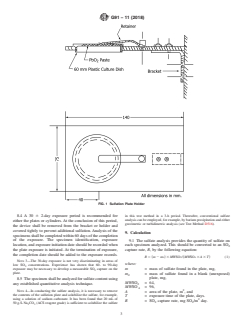
typical bracket design is shown in Fig. 1.
8.3.2 For lead peroxide cylinders, each device shall be
7. Preparation of SO Deposition Monitoring Devices
exposed in a support similar to that shown in Test Method
G140 for chloride candles. Each cylinder shall be securely
7.1 Sulfation plates can be prepared according to the
method of Huey. The plate preparation method is given in mounted in a vertical position with a clamp or other device to
hold it securely against wind or other mechanical forces. A
Appendix X1. Laboratory prepared plates should be exposed
within 120 days of preparation. cover at least 300 mm in diameter shall be securely mounted
above each cylinder with a clearance of 200 mm between the
7.2 Lead peroxide cylinders can be prepared as shown in
top on the cylinder and the bottom of the cover.The cover may
ISO 9225. The cylinder preparation procedure is also shown in
also be rectangular or square with a minimum size of 300 mm
Appendix X2. Lead peroxide cylinders should be exposed
for the smallest dimension. The stand and cover assembly
should be constructed of materials that are not degraded by
atmospheric exposure for the expected duration of their ser-
Huey, N. A., “The Lead Dioxide Estimation of Sulfur Dioxide Pollution,”
Journal of the Air Pollution Control Association, Vol 18, No. 9, 1968, pp. 610–611. vice.
G91 − 11 (2018)
FIG. 1 Sulfation Plate Holder
in this test method in a 3-h period. Thereafter, conventional sulfate
8.4 A 30 6 2-day exposure period is recommended for
analysis can be employed, for example, by barium precipitation and either
either the plates or cylinders. At the conclusion of this period,
gravimetric or turbidimetric analysis (see Test Method D516).
the device shall be removed from the bracket or holder and
covered tightly to prevent additional sulfation. Analysis of the
9. Calculation
specimensshallbecompletedwithin60daysofthecompletion
of the exposure. The specimen identification, exposure
9.1 The sulfate analysis provides the quantity of sulfate on
location, and exposure initiation date should be recorded when
each specimen analyzed. This should be converted to an SO
the plate exposure is initiated. At the termination of exposure,
capture rate, R, by the following equation:
the completion date should be added
...