


ASTM D6714-16(2021)
(Test Method)Standard Test Method for Chromic Oxide in Ashed Wet Blue (Perchloric Acid Oxidation)
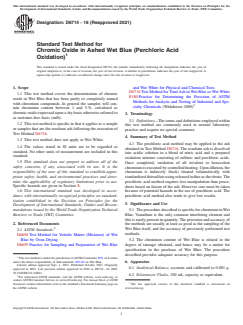
Standard Test Method for Chromic Oxide in Ashed Wet Blue (Perchloric Acid Oxidation)
SIGNIFICANCE AND USE
5.1 The procedure described is specific for chromium in Wet Blue. Vanadium is the only common interfering element and this is rarely present in quantity. The precision and accuracy of the methods are usually at least as good as the sampling of the Wet Blue itself, and the accuracy of previously performed test methods.
5.2 The chromium content of Wet Blue is related to the degree of tannage obtained, and hence may be a matter for specification in the purchase of Wet Blue. The procedure described provides adequate accuracy for this purpose.
SCOPE
1.1 This test method covers the determination of chromic oxide in Wet Blue that has been partly or completely tanned with chromium compounds. In general the samples will contain chromium content between 1 and 5 %, calculated as chromic oxide expressed upon a dry basis otherwise referred to as moisture-free basis (mfb).
1.2 This test method is specific in that it applies to a sample or samples that are the resultant ash following the execution of Test Method D6716.
1.3 This test method does not apply to Wet White.
1.4 The values stated in SI units are to be regarded as standard. No other units of measurement are included in this standard.
1.5 This standard does not purport to address all of the safety concerns, if any, associated with its use. It is the responsibility of the user of this standard to establish appropriate safety, health, and environmental practices and determine the applicability of regulatory limitations prior to use. Specific hazards are given in Section 8.
1.6 This international standard was developed in accordance with internationally recognized principles on standardization established in the Decision on Principles for the Development of International Standards, Guides and Recommendations issued by the World Trade Organization Technical Barriers to Trade (TBT) Committee.
General Information
- Status
- Published
- Publication Date
- 31-Aug-2021
- Technical Committee
- D31 - Leather
- Drafting Committee
- D31.02 - Wet Blue
Relations
- Refers
ASTM D6658-08(2020) - Standard Test Method for Volatile Matter (Moisture) of Wet Blue by Oven Drying - Effective Date
- 01-Apr-2020
- Effective Date
- 01-Apr-2020
- Effective Date
- 01-Dec-2015
- Refers
ASTM D6658-08(2013) - Standard Test Method for Volatile Matter (Moisture) of Wet Blue by Oven Drying - Effective Date
- 01-May-2013
- Effective Date
- 01-May-2013
- Effective Date
- 01-Oct-2010
- Effective Date
- 01-Nov-2008
- Refers
ASTM D6658-08 - Standard Test Method for Volatile Matter (Moisture) of Wet Blue by Oven Drying - Effective Date
- 01-Nov-2008
- Effective Date
- 01-Sep-2008
- Effective Date
- 01-Sep-2007
- Effective Date
- 01-Oct-2006
- Refers
ASTM D6658-01(2006) - Standard Test Method for Volatile Matter (Moisture) of Wet Blue by Oven Drying - Effective Date
- 01-Oct-2006
- Effective Date
- 10-Oct-2001
- Effective Date
- 10-May-2001
- Refers
ASTM D6658-01 - Standard Test Method for Volatile Matter (Moisture) of Wet Blue by Oven Drying - Effective Date
- 10-May-2001
Overview
ASTM D6714-16(2021): Standard Test Method for Chromic Oxide in Ashed Wet Blue (Perchloric Acid Oxidation) is an internationally recognized standard developed by ASTM International. This test method provides a precise procedure for determining the percentage of chromic oxide (Cr₂O₃) in Wet Blue leather, which is chrome-tanned hide that has undergone ashing according to ASTM D6716. Chromium measurement is critical for evaluating the degree of tannage-a key quality and specification parameter in leather trade and manufacturing.
This method uses perchloric acid oxidation to liberate and measure the chromium content, reporting results on a dry basis (moisture-free basis). The standard is specific to Wet Blue and does not apply to Wet White or other non-chrome-tanned leathers.
Key Topics
- Applicability: Designed for samples with chromium content between 1 and 5% (on a dry basis), this method is limited to ashed Wet Blue produced according to ASTM D6716.
- Perchloric Acid Oxidation: Employs a blend of nitric, sulfuric, and perchloric acids for the oxidation process, converting all chromium to a measurable form.
- Accuracy and Specificity: Provides sufficient precision and accuracy for procurement and specification purposes. The main potential interferent is vanadium, which is seldom found in significant quantities in these samples.
- Moisture Correction: The chromic oxide content is expressed on a moisture-free basis, requiring parallel moisture determination (ASTM D6658).
- Safety Considerations: Detailed precautions are necessary due to the hazardous nature of perchloric acid and other reagents. Use of specialized equipment (like a perchloric acid hood) and strict adherence to safety protocols are mandatory.
Applications
The ASTM D6714-16(2021) method is widely recognized for the following practical uses:
- Quality Assurance in Leather Processing: Ensures correct levels of chrome tanning, which is directly related to the functional attributes and value of Wet Blue leather.
- Trade and Procurement: Provides a standardized and reliable measure for specifying chromium content in purchase agreements for Wet Blue hides.
- Conformance Testing: Used by both producers and buyers to confirm products meet industry standards and contract requirements.
- Regulatory Compliance: Facilitates adherence to international standards on chemical analysis of leather, supporting export and import activities.
- Research and Development: Serves as a baseline method for analytical studies and quality improvements within the leather industry.
Related Standards
Several referenced standards are commonly used in conjunction with ASTM D6714-16(2021) to support comprehensive quality control in leather processing:
- ASTM D6716 - Standard Test Method for Total Ash in Wet Blue or Wet White
- ASTM D6658 - Test Method for Volatile Matter (Moisture) of Wet Blue by Oven Drying
- ASTM D6659 - Practice for Sampling and Preparation of Wet Blue
- ASTM E180 - Practice for Determining the Precision of ASTM Methods for Analysis and Testing of Industrial and Specialty Chemicals (Withdrawn 2009)
Applying these standards ensures full traceability and consistency in sampling, preparation, moisture correction, and analytical procedures, contributing to robust leather quality management systems.
Keywords: chromic oxide determination, Wet Blue, chrome-tanned leather, perchloric acid oxidation, ASTM leather standards, chromium analysis, chromic oxide test method, leather quality, chemical testing, tannage, standardization.

Get Certified
Connect with accredited certification bodies for this standard

Control Union Certifications
Global certification for agriculture and sustainability.

Bureau Veritas Bangladesh
Bureau Veritas certification services in Bangladesh.

ECOCERT France
Leader in organic and sustainability certification worldwide.
Sponsored listings
Frequently Asked Questions
ASTM D6714-16(2021) is a standard published by ASTM International. Its full title is "Standard Test Method for Chromic Oxide in Ashed Wet Blue (Perchloric Acid Oxidation)". This standard covers: SIGNIFICANCE AND USE 5.1 The procedure described is specific for chromium in Wet Blue. Vanadium is the only common interfering element and this is rarely present in quantity. The precision and accuracy of the methods are usually at least as good as the sampling of the Wet Blue itself, and the accuracy of previously performed test methods. 5.2 The chromium content of Wet Blue is related to the degree of tannage obtained, and hence may be a matter for specification in the purchase of Wet Blue. The procedure described provides adequate accuracy for this purpose. SCOPE 1.1 This test method covers the determination of chromic oxide in Wet Blue that has been partly or completely tanned with chromium compounds. In general the samples will contain chromium content between 1 and 5 %, calculated as chromic oxide expressed upon a dry basis otherwise referred to as moisture-free basis (mfb). 1.2 This test method is specific in that it applies to a sample or samples that are the resultant ash following the execution of Test Method D6716. 1.3 This test method does not apply to Wet White. 1.4 The values stated in SI units are to be regarded as standard. No other units of measurement are included in this standard. 1.5 This standard does not purport to address all of the safety concerns, if any, associated with its use. It is the responsibility of the user of this standard to establish appropriate safety, health, and environmental practices and determine the applicability of regulatory limitations prior to use. Specific hazards are given in Section 8. 1.6 This international standard was developed in accordance with internationally recognized principles on standardization established in the Decision on Principles for the Development of International Standards, Guides and Recommendations issued by the World Trade Organization Technical Barriers to Trade (TBT) Committee.
SIGNIFICANCE AND USE 5.1 The procedure described is specific for chromium in Wet Blue. Vanadium is the only common interfering element and this is rarely present in quantity. The precision and accuracy of the methods are usually at least as good as the sampling of the Wet Blue itself, and the accuracy of previously performed test methods. 5.2 The chromium content of Wet Blue is related to the degree of tannage obtained, and hence may be a matter for specification in the purchase of Wet Blue. The procedure described provides adequate accuracy for this purpose. SCOPE 1.1 This test method covers the determination of chromic oxide in Wet Blue that has been partly or completely tanned with chromium compounds. In general the samples will contain chromium content between 1 and 5 %, calculated as chromic oxide expressed upon a dry basis otherwise referred to as moisture-free basis (mfb). 1.2 This test method is specific in that it applies to a sample or samples that are the resultant ash following the execution of Test Method D6716. 1.3 This test method does not apply to Wet White. 1.4 The values stated in SI units are to be regarded as standard. No other units of measurement are included in this standard. 1.5 This standard does not purport to address all of the safety concerns, if any, associated with its use. It is the responsibility of the user of this standard to establish appropriate safety, health, and environmental practices and determine the applicability of regulatory limitations prior to use. Specific hazards are given in Section 8. 1.6 This international standard was developed in accordance with internationally recognized principles on standardization established in the Decision on Principles for the Development of International Standards, Guides and Recommendations issued by the World Trade Organization Technical Barriers to Trade (TBT) Committee.
ASTM D6714-16(2021) is classified under the following ICS (International Classification for Standards) categories: 59.140.30 - Leather and furs. The ICS classification helps identify the subject area and facilitates finding related standards.
ASTM D6714-16(2021) has the following relationships with other standards: It is inter standard links to ASTM D6658-08(2020), ASTM D6716-08(2020), ASTM D6659-10(2015), ASTM D6658-08(2013), ASTM D6716-08(2013), ASTM D6659-10, ASTM D6716-08, ASTM D6658-08, ASTM D6659-08, ASTM D6659-01(2007), ASTM D6716-06, ASTM D6658-01(2006), ASTM D6716-01, ASTM D6659-01, ASTM D6658-01. Understanding these relationships helps ensure you are using the most current and applicable version of the standard.
ASTM D6714-16(2021) is available in PDF format for immediate download after purchase. The document can be added to your cart and obtained through the secure checkout process. Digital delivery ensures instant access to the complete standard document.
Standards Content (Sample)
This international standard was developed in accordance with internationally recognized principles on standardization established in the Decision on Principles for the
Development of International Standards, Guides and Recommendations issued by the World Trade Organization Technical Barriers to Trade (TBT) Committee.
Designation: D6714 − 16 (Reapproved 2021)
Standard Test Method for
Chromic Oxide in Ashed Wet Blue (Perchloric Acid
Oxidation)
This standard is issued under the fixed designation D6714; the number immediately following the designation indicates the year of
original adoption or, in the case of revision, the year of last revision. A number in parentheses indicates the year of last reapproval. A
superscript epsilon (´) indicates an editorial change since the last revision or reapproval.
1. Scope and Wet White for Physical and Chemical Tests
D6716 Test Method for TotalAsh in Wet Blue or Wet White
1.1 This test method covers the determination of chromic
E180 Practice for Determining the Precision of ASTM
oxide in Wet Blue that has been partly or completely tanned
Methods for Analysis and Testing of Industrial and Spe-
with chromium compounds. In general the samples will con-
cialty Chemicals (Withdrawn 2009)
tain chromium content between 1 and 5 %, calculated as
chromic oxide expressed upon a dry basis otherwise referred to
3. Terminology
as moisture-free basis (mfb).
3.1 Definitions—The terms and definitions employed within
1.2 This test method is specific in that it applies to a sample
this test method are commonly used in normal laboratory
or samples that are the resultant ash following the execution of
practice and require no special comment.
Test Method D6716.
4. Summary of Test Method
1.3 This test method does not apply to Wet White.
4.1 The perchloric acid method may be applied to the ash
1.4 The values stated in SI units are to be regarded as
obtained in Test Method D6716. The resultant ash is dissolved
standard. No other units of measurement are included in this
into acidic solution in a blend of nitric acid and a prepared
standard.
oxidation mixture consisting of sulfuric and perchloric acids.
1.5 This standard does not purport to address all of the
Once completed, oxidation of all trivalent to hexavalent
safety concerns, if any, associated with its use. It is the
chromiumisexecutedbycontrolledheating.Upondilution,the
responsibility of the user of this standard to establish appro-
chromium is indirectly (back) titrated volumetrically with
priate safety, health, and environmental practices and deter-
standardizedthiosulfateusingreleasediodineasthetitrate.The
mine the applicability of regulatory limitations prior to use.
perchloric acid method requires less manipulation than proce-
Specific hazards are given in Section 8.
dures based on fusion of the ash. However care must be taken
1.6 This international standard was developed in accor-
because of potential hazards in the use of perchloric acid. The
dance with internationally recognized principles on standard-
perchloric acid method also tends to give low results.
ization established in the Decision on Principles for the
5. Significance and Use
Development of International Standards, Guides and Recom-
mendations issued by the World Trade Organization Technical 5.1 TheproceduredescribedisspecificforchromiuminWet
Blue. Vanadium is the only common interfering element and
Barriers to Trade (TBT) Committee.
this is rarely present in quantity. The precision and accuracy of
2. Referenced Documents
the methods are usually at least as good as the sampling of the
Wet Blue itself, and the accuracy of previously performed test
2.1 ASTM Standards:
methods.
D6658 Test Method for Volatile Matter (Moisture) of Wet
Blue by Oven Drying
5.2 The chromium content of Wet Blue is related to the
D6659 Practice for Sampling and Preparation of Wet Blue
degree of tannage obtained, and hence may be a matter for
specification in the purchase of Wet Blue. The procedure
described provides adequate accuracy for this purpose.
This test method is under the jurisdiction ofASTM Committee D31 on Leather
and is the direct responsibility of Subcommittee D31.02 on Wet Blue.
6. Apparatus
Current edition approved Sept. 1, 2021. Published October 2021. Originally
6.1 Analytical Balance, accurate and calibrated to 0.001 g.
approved in 2001. Last previous edition approved in 2016 as D6714 - 16. DOI:
10.1520/D6714-16R21.
6.2 Erlenmeyer Flasks, 250 mL capacity or equivalent.
For referenced ASTM standards, visit the ASTM website, www.astm.org, or
contact ASTM Customer Service at service@astm.org. For Annual Book of ASTM
Standards volume information, refer to the standard’s Document Summary page on The last approved version of this historical standard is referenced on
the ASTM website. www.astm.org.
Copyright © ASTM International, 100 Barr Harbor Drive, PO Box C700, West Conshohocken, PA 19428-2959. United States
D6714 − 16 (2021)
6.3 Burette, 50 mL capacity of suitable calibration grade, 7.11 Phosphoric Acid—(H PO ), 40 % v/v. Dilute 45 mLof
3 4
minimum calibration of 0.1 mL. 85 % phosphoric acid with water to 100 mL.
6.4 Glass Anti-bumping Beads, or equivalent.
7.12 Hydrochloric Acid—(HCl), 1:1 dilution of 37 % HCl
w/w. Used in standardization of thiosulfate solution.
6.5 Measuring Cylinders, 50 mL capacity or equivalent.
6.6 Small Glass Filter Funnel. 7.13 Potassium Dichromate—(K Cr O ). Used in standard-
2 2 7
ization of thiosulfate solution.
6.7 Dessicator, of suitable size and design and charged with
fresh dessicant.
7.14 Sodium Carbonate—(Na CO ). Used in preparation of
2 3
thiosulfate solution.
6.8 Weighing Vessels, of suitable size and design.
6.9 Drying Oven, with accurate variable temperature con- 7.15 Sodium Thiosulfate—(Na S O ·5H O). Used to pre-
2 2 3 2
pare thiosulfate solution.
trols.
6.10 Hot Plate, with accurate variable temperature controls.
7.16 Sodium Thiosulfate Standard Solution—(Na S O ),
2 2 3
0.1N (60.0002). Dissolve 24.85 g of sodium thiosulfate
6.11 Perchloric Acid Hood .
(Na S O ·5H O) in previously boiled water, add 1.00 g of
2 2 3 2
sodium carbonate (Na CO ) and dilute to 1000 mL.
2 3
7. Reagents
7.16.1 Standardization—Dry potassium dichromate
7.1 Purity of Reagents—Analytical Reagent (AR) grade
(K Cr O ) in an oven at 130°C for 2 h and cool in a dessicator.
2 2 7
chemicals shall be used in all tests. Unless otherwise indicated,
Once cool, weigh about 0.2 g (60.0001 g) of this dry
it is intended that all reagents shall conform to specifications of
potassium dichromate into a clean 250 mL, glass-stoppered
theCommitteeonAnalyticalReagentsoftheAmericanChemi-
Erlenmeyer flask. Dissolve in 50 mL of water; add 4 mL of
cal Society, where such specifications are available. Other
hydrochloricacid(HCl,1:1)and20mLofKIsolution.Stopper
grades may be used, provided it is first ascertained that the
the flask, and allow to stand 5 min in the dark. Titrate with the
reagent is of sufficiently high purity to permit its use without
thiosulfate solution to be standardized. When the color of the
lessening the accuracy of the determination.
solutionhasfadedtoabrownish-green,add2mLof2 %starch
7.2 Purity of Water—Unless otherwise indicated, reference
solutionandcontinuetitratinguntilthedeepbluecolorchanges
to water shall be understood to mean distilled water, deionized
toacleargreen.Recordthetitration.Calculatethenormalityof
water, or water of equal purity.
the thiosulfate solution as follows:
7.3 Commercial Reagents—The use of commercially avail-
Normality 5 A÷~0.04903 3B!
able pre-standardized analytical reagents and solutions is
where:
appropriate, providing those reagents and solutions have been
A =K Cr O used, g, and
prepared in accordance with and conforming to the previously 2 2 7
B = amount required for titration, mL.
mentioned specifications (see 7.1).
7.16.2 Shelf Life—The thiosulfate solution is relatively
7.4 Nitric Acid—(HNO ), 70 % w/w.
stable. However, it should be restandardized at least once a
7.5 Perchloric Acid—(HClO ), 60 to 62 % w/w. 70 or 72 %
month.
w/w perchloric acid may be substituted, however, storage is
somewhat more hazardous.
7.17 Alternatively, a commercially available pre-
standardized sodium thiosulfate analytical solution may be
7.6 Sulfuric Acid—(H SO ), 96 to 98 % w/w.
2 4
substituted.
7.7 Potassium Iodide—(KI), 99 to 100 % purity.
7.8 PotassiumIodideSolution—
...
Questions, Comments and Discussion
Ask us and Technical Secretary will try to provide an answer. You can facilitate discussion about the standard in here.
Loading comments...