

ASTM A178/A178M-19
(Specification)Standard Specification for Electric-Resistance-Welded Carbon Steel and Carbon-Manganese Steel Boiler and Superheater Tubes
General Information
- Abstract
ABSTRACT
This specification covers standards for electric-resistance-welded tubes with minimum-wall-thickness made of carbon steel and carbon-manganese steel to be used in boiler tubes, boiler flues, superheater flues, and safe ends. The steel shall be of Grades A (low-carbon steel), C (medium-carbon steel), or D (carbon-manganese steel). All tubes shall be submitted to heat treatment after welding, followed by cooling. The steel shall conform to stated compositions of carbon, manganese, phosphorus, sulphur, and silicon. Grades C and D shall conform to given tensile requirements, that is tensile strength, yield strength, and elongation. The material shall also be subjected to flattening, flange, tension, reverse flattening, and hydrostatic (or nondestructive electric) tests. Crush test shall also be performed if asked by the purchaser. Minimum elongation values are also given.
SCOPE
1.1 This specification2 covers minimum-wall-thickness, electric-resistance-welded tubes made of carbon steel and carbon-manganese steel intended for use as boiler tubes, boiler flues, superheater flues, and safe ends.
1.2 This specification covers Grades A, C, and D with differing chemical requirements (Section 6 and Table 1), differing tensile requirements (Section 9 and Table 2), and differing crush and mechanical testing requirements (Sections 10 and 11).
Note 1: Grades C and D tubes are not suitable for safe-ending for forge welding.
1.3 The tubing sizes and thicknesses usually furnished to this specification are 1/2 to 5 in. [12.7 to 127 mm] in outside diameter and 0.035 to 0.360 in. [0.9 to 9.1 mm], inclusive, in minimum wall thickness. Tubing having other dimensions may be furnished, provided such tubes comply with all other requirements of this specification.
1.4 Mechanical property requirements do not apply to tubing smaller than 1/8 in. [3.2 mm] in inside diameter or 0.015 in. [0.4 mm] in thickness.
1.5 Optional supplementary requirements are provided and when desired, shall be so stated in the order.
1.6 The values stated in either inch-pound units or SI units are to be regarded separately as standard. Within the text, the SI units are shown in brackets. The values stated in each system are not exact equivalents; therefore, each system must be used independently of the other. Combining values from the two systems may result in nonconformance with the specification. The inch-pound units shall apply unless the “M” designation of this specification is specified in the order.
1.7 This international standard was developed in accordance with internationally recognized principles on standardization established in the Decision on Principles for the Development of International Standards, Guides and Recommendations issued by the World Trade Organization Technical Barriers to Trade (TBT) Committee.
- Status
- Published
- Publication Date
- 31-Oct-2019
- Technical Committee
- A01 - Steel, Stainless Steel and Related Alloys
- Drafting Committee
- A01.09 - Carbon Steel Tubular Products
Buy Documents
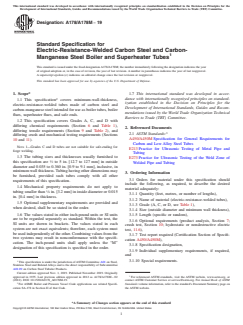
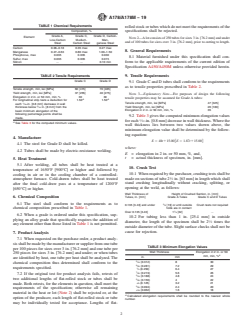
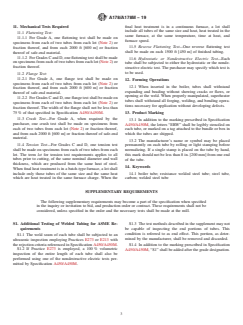

ASTM A178/A178M-19 - Standard Specification for Electric-Resistance-Welded Carbon Steel and Carbon-Manganese Steel Boiler and Superheater Tubes
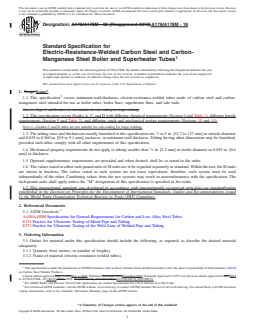
REDLINE ASTM A178/A178M-19 - Standard Specification for Electric-Resistance-Welded Carbon Steel and Carbon-Manganese Steel Boiler and Superheater Tubes
Overview
ASTM A178/A178M-19 is the internationally recognized standard covering the specification for minimum-wall-thickness electric-resistance-welded (ERW) tubes made from carbon steel and carbon-manganese steel, primarily intended for use in boiler tubes, boiler flues, superheater flues, and safe ends. Published by ASTM International, this standard details the material grades, manufacturing requirements, and specific mechanical and chemical properties to ensure suitability and safety in demanding boiler and superheater applications. It applies globally to the fabrication and procurement of steel tubing in both inch-pound and SI units.
Key Topics
- Grades Covered: Three material grades are specified-Grade A (low-carbon steel), Grade C (medium-carbon steel), and Grade D (carbon-manganese steel). Each grade has precise chemical and mechanical requirements.
- Size Range: The standard typically applies to tubes with outside diameters from 1/2 to 5 inches [12.7 to 127 mm] and minimum wall thicknesses from 0.035 to 0.360 inches [0.9 to 9.1 mm]. Other dimensions are acceptable if all requirements are met.
- Manufacture: Tubes must be produced via electric resistance welding. After welding, heat treatment at specified temperatures is mandatory, followed by controlled cooling.
- Mechanical Properties: Grades C and D have specified minimum tensile and yield strengths, as well as elongation requirements. Special tables outline the minimum required values based on tube thickness.
- Testing Requirements:
- Flattening, flange, tension, and reverse-flattening tests
- Hydrostatic or nondestructive electric testing for each tube
- Optional crush test upon purchaser’s request
- Chemical Composition: Strict limits on carbon, manganese, phosphorus, sulfur, and, for grade D, silicon ensure desired properties and performance.
- Marking & Certification: All tubes must be marked “ERW” and may include the manufacturer’s mark. Compliance with general requirements from ASTM A450/A450M is required.
Applications
The ASTM A178/A178M-19 standard is widely used across industries that demand reliable, high-strength, and safe steel tubing for elevated pressure and temperature environments, such as:
- Boilers: Primary application in water and steam boilers, where tubing is essential for heat transfer and pressure resistance.
- Superheaters: Tubes used in superheater flues must withstand additional heat and mechanical stresses.
- Power Generation: Power plants use ERW carbon and carbon-manganese tubes to ensure safety and efficiency in thermal systems.
- Industrial and Process Plants: Any facility requiring robust, standardized boiler or heat exchanger tube systems in accordance with international standards.
- Manufacture & Fabrication: Tube fabricators and OEMs specifying ASTM A178/A178M ensure global compatibility and safety in their assemblies.
Related Standards
For comprehensive compliance and optimal results, users of ASTM A178/A178M-19 should also consider these related ASTM standards:
- ASTM A450/A450M: General requirements for carbon and low-alloy steel tubes, referenced directly within ASTM A178/A178M.
- ASTM E213: Practices for ultrasonic testing of metal pipe and tubing.
- ASTM E273: Ultrasonic testing of the weld zone of welded pipe and tubing.
- ASME SA-178: Equivalent specification adopted into the ASME Boiler and Pressure Vessel Code.
Keywords: ASTM A178, boiler tubes, superheater flues, ERW steel tube, carbon-manganese steel, electric-resistance-welded tubes, industrial piping standards, mechanical testing, chemical composition standards, tube heat treatment.
Relations
- Effective Date
- 01-Nov-2019
- Effective Date
- 01-Nov-2023
- Effective Date
- 01-Sep-2018
- Effective Date
- 01-May-2015
- Refers
ASTM E273-10 - Standard Practice for Ultrasonic Testing of the Weld Zone of Welded Pipe and Tubing - Effective Date
- 01-Jun-2010
- Effective Date
- 01-May-2010
- Effective Date
- 01-Oct-2009
- Effective Date
- 01-Jun-2009
- Effective Date
- 01-Nov-2007
- Effective Date
- 01-Jun-2005
- Effective Date
- 01-Oct-2004
- Effective Date
- 01-Mar-2004
- Effective Date
- 01-Jan-2004
- Effective Date
- 10-Sep-2003
- Effective Date
- 10-Jul-2001
Buy Documents
ASTM A178/A178M-19 - Standard Specification for Electric-Resistance-Welded Carbon Steel and Carbon-Manganese Steel Boiler and Superheater Tubes
REDLINE ASTM A178/A178M-19 - Standard Specification for Electric-Resistance-Welded Carbon Steel and Carbon-Manganese Steel Boiler and Superheater Tubes
Get Certified
Connect with accredited certification bodies for this standard

Institut za varilstvo d.o.o. (Welding Institute)
Slovenia's leading welding institute since 1952. ISO 3834, EN 1090, pressure equipment certification, NDT personnel, welder qualification. Only IIW Au
Sponsored listings
Frequently Asked Questions
ASTM A178/A178M-19 is a technical specification published by ASTM International. Its full title is "Standard Specification for Electric-Resistance-Welded Carbon Steel and Carbon-Manganese Steel Boiler and Superheater Tubes". This standard covers: ABSTRACT This specification covers standards for electric-resistance-welded tubes with minimum-wall-thickness made of carbon steel and carbon-manganese steel to be used in boiler tubes, boiler flues, superheater flues, and safe ends. The steel shall be of Grades A (low-carbon steel), C (medium-carbon steel), or D (carbon-manganese steel). All tubes shall be submitted to heat treatment after welding, followed by cooling. The steel shall conform to stated compositions of carbon, manganese, phosphorus, sulphur, and silicon. Grades C and D shall conform to given tensile requirements, that is tensile strength, yield strength, and elongation. The material shall also be subjected to flattening, flange, tension, reverse flattening, and hydrostatic (or nondestructive electric) tests. Crush test shall also be performed if asked by the purchaser. Minimum elongation values are also given. SCOPE 1.1 This specification2 covers minimum-wall-thickness, electric-resistance-welded tubes made of carbon steel and carbon-manganese steel intended for use as boiler tubes, boiler flues, superheater flues, and safe ends. 1.2 This specification covers Grades A, C, and D with differing chemical requirements (Section 6 and Table 1), differing tensile requirements (Section 9 and Table 2), and differing crush and mechanical testing requirements (Sections 10 and 11). Note 1: Grades C and D tubes are not suitable for safe-ending for forge welding. 1.3 The tubing sizes and thicknesses usually furnished to this specification are 1/2 to 5 in. [12.7 to 127 mm] in outside diameter and 0.035 to 0.360 in. [0.9 to 9.1 mm], inclusive, in minimum wall thickness. Tubing having other dimensions may be furnished, provided such tubes comply with all other requirements of this specification. 1.4 Mechanical property requirements do not apply to tubing smaller than 1/8 in. [3.2 mm] in inside diameter or 0.015 in. [0.4 mm] in thickness. 1.5 Optional supplementary requirements are provided and when desired, shall be so stated in the order. 1.6 The values stated in either inch-pound units or SI units are to be regarded separately as standard. Within the text, the SI units are shown in brackets. The values stated in each system are not exact equivalents; therefore, each system must be used independently of the other. Combining values from the two systems may result in nonconformance with the specification. The inch-pound units shall apply unless the “M” designation of this specification is specified in the order. 1.7 This international standard was developed in accordance with internationally recognized principles on standardization established in the Decision on Principles for the Development of International Standards, Guides and Recommendations issued by the World Trade Organization Technical Barriers to Trade (TBT) Committee.
ABSTRACT This specification covers standards for electric-resistance-welded tubes with minimum-wall-thickness made of carbon steel and carbon-manganese steel to be used in boiler tubes, boiler flues, superheater flues, and safe ends. The steel shall be of Grades A (low-carbon steel), C (medium-carbon steel), or D (carbon-manganese steel). All tubes shall be submitted to heat treatment after welding, followed by cooling. The steel shall conform to stated compositions of carbon, manganese, phosphorus, sulphur, and silicon. Grades C and D shall conform to given tensile requirements, that is tensile strength, yield strength, and elongation. The material shall also be subjected to flattening, flange, tension, reverse flattening, and hydrostatic (or nondestructive electric) tests. Crush test shall also be performed if asked by the purchaser. Minimum elongation values are also given. SCOPE 1.1 This specification2 covers minimum-wall-thickness, electric-resistance-welded tubes made of carbon steel and carbon-manganese steel intended for use as boiler tubes, boiler flues, superheater flues, and safe ends. 1.2 This specification covers Grades A, C, and D with differing chemical requirements (Section 6 and Table 1), differing tensile requirements (Section 9 and Table 2), and differing crush and mechanical testing requirements (Sections 10 and 11). Note 1: Grades C and D tubes are not suitable for safe-ending for forge welding. 1.3 The tubing sizes and thicknesses usually furnished to this specification are 1/2 to 5 in. [12.7 to 127 mm] in outside diameter and 0.035 to 0.360 in. [0.9 to 9.1 mm], inclusive, in minimum wall thickness. Tubing having other dimensions may be furnished, provided such tubes comply with all other requirements of this specification. 1.4 Mechanical property requirements do not apply to tubing smaller than 1/8 in. [3.2 mm] in inside diameter or 0.015 in. [0.4 mm] in thickness. 1.5 Optional supplementary requirements are provided and when desired, shall be so stated in the order. 1.6 The values stated in either inch-pound units or SI units are to be regarded separately as standard. Within the text, the SI units are shown in brackets. The values stated in each system are not exact equivalents; therefore, each system must be used independently of the other. Combining values from the two systems may result in nonconformance with the specification. The inch-pound units shall apply unless the “M” designation of this specification is specified in the order. 1.7 This international standard was developed in accordance with internationally recognized principles on standardization established in the Decision on Principles for the Development of International Standards, Guides and Recommendations issued by the World Trade Organization Technical Barriers to Trade (TBT) Committee.
ASTM A178/A178M-19 is classified under the following ICS (International Classification for Standards) categories: 23.040.10 - Iron and steel pipes. The ICS classification helps identify the subject area and facilitates finding related standards.
ASTM A178/A178M-19 has the following relationships with other standards: It is inter standard links to ASTM A178/A178M-02(2012), ASTM A450/A450M-23, ASTM A450/A450M-18, ASTM A450/A450M-15, ASTM E273-10, ASTM A450/A450M-10, ASTM A450/A450M-09, ASTM E213-09, ASTM A450/A450M-07, ASTM E273-01(2005), ASTM A450/A450M-04a, ASTM A450/A450M-04, ASTM E213-04, ASTM A450/A450M-03, ASTM E273-93. Understanding these relationships helps ensure you are using the most current and applicable version of the standard.
ASTM A178/A178M-19 is available in PDF format for immediate download after purchase. The document can be added to your cart and obtained through the secure checkout process. Digital delivery ensures instant access to the complete standard document.
Standards Content (Sample)
This international standard was developed in accordance with internationally recognized principles on standardization established in the Decision on Principles for the
Development of International Standards, Guides and Recommendations issued by the World Trade Organization Technical Barriers to Trade (TBT) Committee.
Designation:A178/A178M −19
Standard Specification for
Electric-Resistance-Welded Carbon Steel and Carbon-
Manganese Steel Boiler and Superheater Tubes
This standard is issued under the fixed designationA178/A178M; the number immediately following the designation indicates the year
of original adoption or, in the case of revision, the year of last revision. A number in parentheses indicates the year of last reapproval.
A superscript epsilon (´) indicates an editorial change since the last revision or reapproval.
This standard has been approved for use by agencies of the U.S. Department of Defense.
1. Scope* 1.7 This international standard was developed in accor-
2 dance with internationally recognized principles on standard-
1.1 This specification covers minimum-wall-thickness,
ization established in the Decision on Principles for the
electric-resistance-welded tubes made of carbon steel and
Development of International Standards, Guides and Recom-
carbon-manganese steel intended for use as boiler tubes, boiler
mendations issued by the World Trade Organization Technical
flues, superheater flues, and safe ends.
Barriers to Trade (TBT) Committee.
1.2 This specification covers Grades A, C, and D with
differing chemical requirements (Section 6 and Table 1),
2. Referenced Documents
differing tensile requirements (Section 9 and Table 2), and
2.1 ASTM Standards:
differing crush and mechanical testing requirements (Sections
A450/A450M Specification for General Requirements for
10 and 11).
Carbon and Low Alloy Steel Tubes
NOTE 1—Grades C and D tubes are not suitable for safe-ending for
E213 Practice for Ultrasonic Testing of Metal Pipe and
forge welding.
Tubing
1.3 The tubing sizes and thicknesses usually furnished to
E273 Practice for Ultrasonic Testing of the Weld Zone of
this specification are ⁄2 to 5 in. [12.7 to 127 mm] in outside
Welded Pipe and Tubing
diameter and 0.035 to 0.360 in. [0.9 to 9.1 mm], inclusive, in
minimum wall thickness.Tubing having other dimensions may
3. Ordering Information
be furnished, provided such tubes comply with all other
3.1 Orders for material under this specification should
requirements of this specification.
include the following, as required, to describe the desired
1.4 Mechanical property requirements do not apply to
material adequately:
tubing smaller than ⁄8 in. [3.2 mm] in inside diameter or 0.015
3.1.1 Quantity (feet, metres, or number of lengths),
in. [0.4 mm] in thickness.
3.1.2 Name of material (electric-resistance-welded tubes),
1.5 Optional supplementary requirements are provided and
3.1.3 Grade (A, C, or D, see Table 1),
when desired, shall be so stated in the order.
3.1.4 Size (outside diameter and minimum wall thickness),
1.6 The values stated in either inch-pound units or SI units
3.1.5 Length (specific or random),
are to be regarded separately as standard. Within the text, the
3.1.6 Optional requirements (product analysis, Section 7;
SI units are shown in brackets. The values stated in each
crush test, Section 10; hydrostatic or nondestructive electric
system are not exact equivalents; therefore, each system must
test, 11.6),
be used independently of the other. Combining values from the
3.1.7 Test report required (Certification Section of Specifi-
two systems may result in nonconformance with the specifi-
cation A450/A450M),
cation. The inch-pound units shall apply unless the “M”
3.1.8 Specification designation,
designation of this specification is specified in the order.
3.1.9 Individual supplementary requirements, if required,
and
3.1.10 Special requirements.
This specification is under the jurisdiction of ASTM Committee A01 on Steel,
Stainless Steel and Related Alloys and is the direct responsibility of Subcommittee
A01.09 on Carbon Steel Tubular Products.
Current edition approved Nov. 1, 2019. Published November 2019. Originally
approved in 1935. Last previous edition approved in 2012 as A178/A178M – 02 For referenced ASTM standards, visit the ASTM website, www.astm.org, or
(2012). DOI: 10.1520/A0178_A0178M-19. contact ASTM Customer Service at service@astm.org. For Annual Book of ASTM
For ASME Boiler and Pressure Vessel Code applications see related Specifi- Standards volume information, refer to the standard’s Document Summary page on
cation SA-178 in Section II of that Code. the ASTM website.
*A Summary of Changes section appears at the end of this standard
Copyright © ASTM International, 100 Barr Harbor Drive, PO Box C700, West Conshohocken, PA 19428-2959. United States
A178/A178M−19
TABLE 1 Chemical Requirements
rolled stock or tubes which do not meet the requirements of the
Composition, % specifications shall be rejected.
Grade A, Grade C, Grade D, Carbon-
Element
NOTE 2—Alot consists of 250 tubes for sizes 3 in. [76.2 mm] and under
Low-Carbon Medium- Man-
and of 100 tubes for sizes over 3 in. [76.2 mm], prior to cutting to length.
Steel Carbon Steel ganese Steel
Carbon 0.06–0.18 0.35 max 0.27 max
8. General Requirements
Manganese 0.27–0.63 0.80 max 1.00–1.50
Phosphorus, max 0.035 0.035 0.030
8.1 Material furnished under this specification shall con-
Sulfur, max 0.035 0.035 0.015
form to the applicable requirements of the current edition of
Silicon . . 0.10 min
Specification A450/A450M unless otherwise provided herein.
TABLE 2 Tensile Requirements 9. Tensile Requirements
Grade C Grade D
9.1 Grade C and D tubes shall conform to the requirements
as to tensile properties prescribed in Table 2.
Tensile strength, min, ksi [MPa] 60 [415] 70 [485]
Yield strength, min, ksi [MPa] 37 [255] 40 [275]
NOTE 3—Explanatory Note—For purposes of design the following
Elongation in 2 in. or 50 mm, min, % 30 30
tensile properties may be assumed for Grade A tubes:
A A
For longitudinal strip tests a deduction for 1.50 1.50
Tensile strength, min, ksi [MPa] 47 [325]
each ⁄32-in. [0.8 mm] decrease in wall
5 Yield Strength, min, ksi [MPa] 26 [180]
thickness below ⁄16 in. [8 mm] from the
Elongation in 2 in. or 50 mm, min, % 35
basic minimum elongation of the
following percentage points shall be
9.2 Table 3 gives the computed minimum elongation values
made.
for each ⁄32-in. [0.8 mm] decrease in wall thickness.Where the
A
See Table 3 for the computed minimum values.
wall thickness lies between two values shown above, the
minimum elongation value shall be determined by the follow-
ing equation:
4. Manufacture
E 5 48t115.00 @E 5 1.87t115.00#
4.1 The steel for Grade D shall be killed.
where:
4.2 Tubes shall be made by electric-resistance welding.
E = elongation in 2 in. or 50 mm, %, and,
t = actual thickness of specimen, in. [mm].
5. Heat Treatment
5.1 After welding, all tubes shall be heat treated at a
10. Crush Test
temperature of 1650°F [900°C] or higher and followed by
10.1 When required by the purchaser, crushing tests shall be
cooling in air or in the cooling chamber of a controlled-
made on sections of tube 2 ⁄2 in. [63 mm] in length which shall
atmosphere furnace. Cold-drawn tubes shall be heat treated
stand crushing longitudinally without cracking, splitting, or
after the final cold-draw pass at a temperature of 1200°F
opening at the weld, as follows:
[650°C] or higher.
Wall Thickness of Height of Crushed Section, in. [mm]
6. Chemical Composition
Tubes, in. [mm] Grade A Tubes Grade C and D Tubes
6.1 The steel shall conform to the requirements as to 3
0.135 [3.43] and under ⁄4 [19] or until outside Crush tests not required
folds are in contact
chemical composition prescribed in Table
...
This document is not an ASTM standard and is intended only to provide the user of an ASTM standard an indication of what changes have been made to the previous version. Because
it may not be technically possible to adequately depict all changes accurately, ASTM recommends that users consult prior editions as appropriate. In all cases only the current version
of the standard as published by ASTM is to be considered the official document.
Designation: A178/A178M − 02 (Reapproved 2012) A178/A178M − 19
Standard Specification for
Electric-Resistance-Welded Carbon Steel and Carbon-
Manganese Steel Boiler and Superheater Tubes
This standard is issued under the fixed designation A178/A178M; the number immediately following the designation indicates the year
of original adoption or, in the case of revision, the year of last revision. A number in parentheses indicates the year of last reapproval.
A superscript epsilon (´) indicates an editorial change since the last revision or reapproval.
This standard has been approved for use by agencies of the U.S. Department of Defense.
1. Scope Scope*
1.1 This specification covers minimum-wall-thickness, electric-resistance-welded tubes made of carbon steel and carbon-
manganese steel intended for use as boiler tubes, boiler flues, superheater flues, and safe ends.
NOTE 1—Type C and D tubes are not suitable for safe-ending for forge welding.
1.2 This specification covers Grades A, C, and D with differing chemical requirements (Section 6 and Table 1), differing tensile
requirements (Section 9 and Table 2), and differing crush and mechanical testing requirements (Sections 10 and 11).
NOTE 1—Grades C and D tubes are not suitable for safe-ending for forge welding.
1.3 The tubing sizes and thicknesses usually furnished to this specification are ⁄2 to 5 in. [12.7 to 127 mm] in outside diameter
and 0.035 to 0.360 in. [0.9 to 9.1 mm], inclusive, in minimum wall thickness. Tubing having other dimensions may be furnished,
provided such tubes comply with all other requirements of this specification.
1.4 Mechanical property requirements do not apply to tubing smaller than ⁄8 in. [3.2 mm] in inside diameter or 0.015 in. [0.4
mm] in thickness.
1.5 Optional supplementary requirements are provided and when desired, shall be so stated in the order.
1.6 The values stated in either inch-pound units or SI units are to be regarded separately as standard. Within the text, the SI units
are shown in brackets. The values stated in each system are not exact equivalents; therefore, each system must be used
independently of the other. Combining values from the two systems may result in nonconformance with the specification. The
inch-pound units shall apply unless the “M” designation of this specification is specified in the order.
1.7 This international standard was developed in accordance with internationally recognized principles on standardization
established in the Decision on Principles for the Development of International Standards, Guides and Recommendations issued
by the World Trade Organization Technical Barriers to Trade (TBT) Committee.
2. Referenced Documents
2.1 ASTM Standards:
A450/A450M Specification for General Requirements for Carbon and Low Alloy Steel Tubes
E213 Practice for Ultrasonic Testing of Metal Pipe and Tubing
E273 Practice for Ultrasonic Testing of the Weld Zone of Welded Pipe and Tubing
3. Ordering Information
3.1 Orders for material under this specification should include the following, as required, to describe the desired material
adequately:
3.1.1 Quantity (feet, metres, or number of lengths),
3.1.2 Name of material (electric-resistance-welded tubes),
This specification is under the jurisdiction of ASTM Committee A01 on Steel, Stainless Steel and Related Alloys and is the direct responsibility of Subcommittee A01.09
on Carbon Steel Tubular Products.
Current edition approved Sept. 1, 2012Nov. 1, 2019. Published November 2012November 2019. Originally approved in 1935. Last previous edition approved in 20072012
as A178/A178M – 02 (2012).(2007). DOI: 10.1520/A0178_A0178M-02R12.10.1520/A0178_A0178M-19.
For ASME Boiler and Pressure Vessel Code applications see related Specification SA-178 in Section II of that Code.
For referenced ASTM standards, visit the ASTM website, www.astm.org, or contact ASTM Customer Service at service@astm.org. For Annual Book of ASTM Standards
volume information, refer to the standard’s Document Summary page on the ASTM website.
*A Summary of Changes section appears at the end of this standard
Copyright © ASTM International, 100 Barr Harbor Drive, PO Box C700, West Conshohocken, PA 19428-2959. United States
A178/A178M − 19
TABLE 2 Tensile Requirements
Grade C Grade D
Tensile strength, min, ksi [MPa] 60 [415] 70 [485]
Yield strength, min, ksi [MPa] 37 [255] 40 [275]
Elongation in 2 in. or 50 mm, min, % 30 30
A A
For longitudinal strip tests a deduction for 1.50 1.50
each ⁄32-in. [0.8 mm] decrease in wall
thickness below ⁄16 in. [8 mm] from the
basic minimum elongation of the
following percentage points shall be
made.
A
See Table 3 for the computed minimum values.
3.1.3 Grade (A, C, or D, see Table 1),
3.1.4 Size (outside diameter and minimum wall thickness),
3.1.5 Length (specific or random),
3.1.6 Optional requirements (product analysis, Section 7; crush test, Section 10; hydrostatic or nondestructive electric test,
11.6),
3.1.7 Test report required (Certification Section of Specification A450/A450M),
3.1.8 Specification designation,
3.1.9 Individual supplementary requirements, if required, and
3.1.10 Special requirements.
4. Manufacture
4.1 The steel for Grade D shall be killed.
4.2 Tubes shall be made by electric-resistance welding.
5. Heat Treatment
5.1 After welding, all tubes shall be heat treated at a temperature of 1650°F [900°C] or higher and followed by cooling in air
or in the cooling chamber of a controlled-atmosphere furnace. Cold-drawn tubes shall be heat treated after the final cold-draw pass
at a temperature of 1200°F [650°C] or higher.
6. Chemical Composition
6.1 The steel shall conform to the requirements as to chemical composition prescribed in Table 1.
6.2 When a grade is ordered under this specification, supplying an alloy grade that specifically requires the addition of any
element other than those listed in Table 1 is not permitted.
7. Product Analysis
7.1 When requested on the purchase order, a product analysis shall be made by the manufacturer or supplier from one tube per
100 pieces for sizes over 3 in. [76.2 mm] and one tube per 250 pieces for sizes 3 in. [76.2 mm] and under; or when tubes are
identified by heat, one tube per heat shall be analyzed. The chemical composition thus determined shall conform to the
requirements specified.
7.2 If the original test for product analysis fails, retests of two additional lengths of flat-rolled stock or tubes shall be made. Both
retests, for the elements in question, shall meet the requirements of the specification; otherwise all remaining material in the heat
or lot (Note 2) shall be rejected or, at the option of the producer, each length of flat-rolled stock or tube may be individually tested
for acceptance. Lengths of flat-rolled stock or tubes which do not meet the requirements of the specifications shall be rejected.
NOTE 2—A lot consists of 250 tubes for sizes 3 in. [76.2 mm] and under and of 100 tubes for sizes over 3 in. [76.2 mm], prior to cutting to length.
TABLE 1 Chemical Requirements
Composition, %
Grade A, Grade C, Grade D, Carbon-
Element
Low-Carbon Medium- Man-
Steel Carbon Steel ganese Steel
Carbon 0.06–0.18 0.35 max 0.27 max
Manganese 0.27–0.63 0.80 max 1.00–1.50
Phosphorus, max 0.035 0.035 0.030
Sulfur, max 0.035 0.035 0.015
Silicon . . 0.10 min
A178/A178M − 19
8. General Requirements
8.1 Material furnished under this specification shall conform to the applicable requirements of the current edition of
Specification A450/A450M unless
...