

ASTM D3514/D3514M-16(2020)
(Test Method)Standard Test Method for Pilling Resistance and Other Related Surface Changes of Textile Fabrics: Elastomeric Pad
General Information
- Abstract
SIGNIFICANCE AND USE
5.1 Acceptance Testing—This method of testing fabrics for resistance to pilling is not recommended for acceptance testing. If it is used for acceptance testing, it should be used with caution because interlaboratory data are not available. In some cases the purchaser and the supplier may have to test a commercial shipment of one or more specific materials by the best available method, even though the method has not been recommended for acceptance testing.
5.1.1 If there is a disagreement arising from differences in values reported by the purchaser and the supplier when using Test Method D3514 for acceptance testing, the statistical bias, if any, between the laboratory of the purchaser and the laboratory of the supplier should be determined based on testing specimens randomly drawn from one sample of material of the type being evaluated. Competent statistical assistance is recommended for the investigation of bias. A minimum of two parties should take a group of test specimens which are as homogeneous as possible and which are from a lot of material of the type in question. The test specimens should then be randomly assigned in equal numbers to each laboratory for testing. The average test results from the two laboratories should be compared using an acceptable statistical protocol and probability level chosen by the two parties before the testing begins. Appropriate statistical disciplines for comparing data must be used when the purchaser and supplier cannot agree. If a bias is found, either its cause must be found and corrected, or the purchaser and the supplier must agree to interpret future test results with consideration for the known bias.
5.2 The pilling of textile fabrics is a very complex property because it is affected by many factors which may include type of fiber or blends, fiber dimensions, yarn and fabric construction, and fabric finishing treatments. The pilling resistance of a specific fabric in actual wear varies more with general conditions ...
SCOPE
1.1 This test method covers the determination of the propensity of a fabric to form pills and other related surface changes on textiles using the Stoll Quartermaster Universal Wear Tester with the frosting attachment. The procedure is generally applicable to all types of woven and knitted fabrics.
Note 1: For other current test methods of testing the pilling resistance of textiles, refer to Test Methods D3511/D3511M, D3512/D3512M, and D4970/D4970M.
1.2 The values stated in either SI units or inch-pound units are to be regarded separately as standard. The values stated in each system are not necessarily exact equivalents; therefore, to ensure conformance with the standard, each system shall be used independently of the other, and values from the two systems shall not be combined.
1.3 The fabric may be laundered or dry cleaned before testing.
1.4 This standard does not purport to address all of the safety concerns, if any, associated with its use. It is the responsibility of the user of this standard to establish appropriate safety, health, and environmental practices and determine the applicability of regulatory limitations prior to use.
1.5 This international standard was developed in accordance with internationally recognized principles on standardization established in the Decision on Principles for the Development of International Standards, Guides and Recommendations issued by the World Trade Organization Technical Barriers to Trade (TBT) Committee.
- Status
- Published
- Publication Date
- 30-Jun-2020
- Technical Committee
- D13 - Textiles
- Drafting Committee
- D13.60 - Fabric Physical Test Methods B
Overview
ASTM D3514/D3514M-16(2020) is the internationally recognized standard test method for evaluating the pilling resistance and other related surface changes of textile fabrics using the elastomeric pad method. Published by ASTM International, this test method is vital for quality control, product development, and comparative analysis of woven and knitted textile materials. The procedure utilizes the Stoll Quartermaster Universal Wear Tester with a frosting attachment to simulate normal wear conditions, making the test applicable across a broad range of fabric types and constructions.
Key Topics
- Pilling Resistance Testing: This standard outlines procedures to determine a fabric’s tendency to form pills-those small fiber balls that appear on the surface due to abrasion during use or laundering.
- Applicability: Suitable for all types of woven and knitted textiles; however, the applicability to non-woven fabrics has not been determined.
- Test Apparatus: Utilizes the Stoll Universal Wear Tester equipped with an elastomeric pad and frosting attachment.
- Sample Preparation: Fabrics may be laundered or dry cleaned prior to testing, depending on end-use requirements.
- Evaluation and Rating: Pilling and surface changes are assessed visually, using either actual fabric standards or photographic scales, with results reported on an arbitrary five-point scale (5 = no pilling, 1 = very severe pilling).
- Statistical Considerations: While not recommended for formal acceptance testing due to lack of interlaboratory precision data, the method provides guidance for situations where agreement between supplier and purchaser is necessary.
Applications
Pilling resistance testing is vital in the textile industry for:
- Quality Assurance: Manufacturers and brands utilize this method to ensure fabric durability before releasing products to the market.
- Product Development: Designers and engineers compare pilling behavior among fabric prototypes, optimizing fiber blends, yarn structures, and finishing processes.
- Specification Compliance: Retailers and procurement professionals use the test results to compare delivered goods against specified performance requirements.
- Comparative Analysis: Provides a consistent method for benchmarking fabrics under development or post-production to assess resistance to pilling and related surface defects.
- Dispute Resolution: Offers an agreed protocol for resolving discrepancies in pilling ratings when both supplier and buyer need to assess commercial shipments.
For optimal results, users should ensure samples are collected representatively from production lots, and that both laundering and dry cleaning procedures (when applicable) mimic real-world use cases.
Related Standards
For comprehensive assessment of textile pilling resistance, ASTM D3514/D3514M-16(2020) is used in conjunction with other important standards:
- ASTM D3511/D3511M: Test Method for Pilling Resistance of Textiles: Brush Pilling Tester
- ASTM D3512/D3512M: Test Method for Pilling Resistance: Random Tumble Pilling Tester
- ASTM D4970/D4970M: Test Method for Pilling Resistance: Martindale Tester
- ASTM D4848: Terminology Related to Force, Deformation, and Related Properties of Textiles
- ASTM D4850: Terminology Relating to Fabrics and Fabric Test Methods
- ASTM D123: Basic terminology for textiles
These related standards provide alternative methods and terminologies, allowing for flexible and tailored approaches to pilling evaluation across a wide array of textile products.
This standard serves as a cornerstone for any operation focused on textile surface quality, helping organizations reduce product returns, enhance consumer satisfaction, and maintain consistent quality across global markets. For the most accurate application, users should reference the complete ASTM D3514/D3514M-16(2020) document and ensure compliance with local safety and regulatory requirements.
Relations
- Effective Date
- 01-Jul-2020
- Effective Date
- 01-Sep-2018
- Effective Date
- 15-Jul-2017
- Effective Date
- 01-Mar-2017
- Effective Date
- 01-Jan-2016
- Effective Date
- 01-Jan-2016
- Effective Date
- 01-Jan-2016
- Effective Date
- 15-Sep-2015
- Effective Date
- 01-Sep-2015
- Effective Date
- 01-Jul-2015
- Effective Date
- 01-Apr-2015
- Effective Date
- 01-Jul-2014
- Effective Date
- 01-Jul-2013
- Effective Date
- 01-Jul-2013
- Effective Date
- 15-Jun-2013
Get Certified
Connect with accredited certification bodies for this standard

Control Union Certifications
Global certification for agriculture and sustainability.

Hohenstein Institut
Textile testing and certification.

Bureau Veritas Bangladesh
Bureau Veritas certification services in Bangladesh.
Sponsored listings
Frequently Asked Questions
ASTM D3514/D3514M-16(2020) is a standard published by ASTM International. Its full title is "Standard Test Method for Pilling Resistance and Other Related Surface Changes of Textile Fabrics: Elastomeric Pad". This standard covers: SIGNIFICANCE AND USE 5.1 Acceptance Testing—This method of testing fabrics for resistance to pilling is not recommended for acceptance testing. If it is used for acceptance testing, it should be used with caution because interlaboratory data are not available. In some cases the purchaser and the supplier may have to test a commercial shipment of one or more specific materials by the best available method, even though the method has not been recommended for acceptance testing. 5.1.1 If there is a disagreement arising from differences in values reported by the purchaser and the supplier when using Test Method D3514 for acceptance testing, the statistical bias, if any, between the laboratory of the purchaser and the laboratory of the supplier should be determined based on testing specimens randomly drawn from one sample of material of the type being evaluated. Competent statistical assistance is recommended for the investigation of bias. A minimum of two parties should take a group of test specimens which are as homogeneous as possible and which are from a lot of material of the type in question. The test specimens should then be randomly assigned in equal numbers to each laboratory for testing. The average test results from the two laboratories should be compared using an acceptable statistical protocol and probability level chosen by the two parties before the testing begins. Appropriate statistical disciplines for comparing data must be used when the purchaser and supplier cannot agree. If a bias is found, either its cause must be found and corrected, or the purchaser and the supplier must agree to interpret future test results with consideration for the known bias. 5.2 The pilling of textile fabrics is a very complex property because it is affected by many factors which may include type of fiber or blends, fiber dimensions, yarn and fabric construction, and fabric finishing treatments. The pilling resistance of a specific fabric in actual wear varies more with general conditions ... SCOPE 1.1 This test method covers the determination of the propensity of a fabric to form pills and other related surface changes on textiles using the Stoll Quartermaster Universal Wear Tester with the frosting attachment. The procedure is generally applicable to all types of woven and knitted fabrics. Note 1: For other current test methods of testing the pilling resistance of textiles, refer to Test Methods D3511/D3511M, D3512/D3512M, and D4970/D4970M. 1.2 The values stated in either SI units or inch-pound units are to be regarded separately as standard. The values stated in each system are not necessarily exact equivalents; therefore, to ensure conformance with the standard, each system shall be used independently of the other, and values from the two systems shall not be combined. 1.3 The fabric may be laundered or dry cleaned before testing. 1.4 This standard does not purport to address all of the safety concerns, if any, associated with its use. It is the responsibility of the user of this standard to establish appropriate safety, health, and environmental practices and determine the applicability of regulatory limitations prior to use. 1.5 This international standard was developed in accordance with internationally recognized principles on standardization established in the Decision on Principles for the Development of International Standards, Guides and Recommendations issued by the World Trade Organization Technical Barriers to Trade (TBT) Committee.
SIGNIFICANCE AND USE 5.1 Acceptance Testing—This method of testing fabrics for resistance to pilling is not recommended for acceptance testing. If it is used for acceptance testing, it should be used with caution because interlaboratory data are not available. In some cases the purchaser and the supplier may have to test a commercial shipment of one or more specific materials by the best available method, even though the method has not been recommended for acceptance testing. 5.1.1 If there is a disagreement arising from differences in values reported by the purchaser and the supplier when using Test Method D3514 for acceptance testing, the statistical bias, if any, between the laboratory of the purchaser and the laboratory of the supplier should be determined based on testing specimens randomly drawn from one sample of material of the type being evaluated. Competent statistical assistance is recommended for the investigation of bias. A minimum of two parties should take a group of test specimens which are as homogeneous as possible and which are from a lot of material of the type in question. The test specimens should then be randomly assigned in equal numbers to each laboratory for testing. The average test results from the two laboratories should be compared using an acceptable statistical protocol and probability level chosen by the two parties before the testing begins. Appropriate statistical disciplines for comparing data must be used when the purchaser and supplier cannot agree. If a bias is found, either its cause must be found and corrected, or the purchaser and the supplier must agree to interpret future test results with consideration for the known bias. 5.2 The pilling of textile fabrics is a very complex property because it is affected by many factors which may include type of fiber or blends, fiber dimensions, yarn and fabric construction, and fabric finishing treatments. The pilling resistance of a specific fabric in actual wear varies more with general conditions ... SCOPE 1.1 This test method covers the determination of the propensity of a fabric to form pills and other related surface changes on textiles using the Stoll Quartermaster Universal Wear Tester with the frosting attachment. The procedure is generally applicable to all types of woven and knitted fabrics. Note 1: For other current test methods of testing the pilling resistance of textiles, refer to Test Methods D3511/D3511M, D3512/D3512M, and D4970/D4970M. 1.2 The values stated in either SI units or inch-pound units are to be regarded separately as standard. The values stated in each system are not necessarily exact equivalents; therefore, to ensure conformance with the standard, each system shall be used independently of the other, and values from the two systems shall not be combined. 1.3 The fabric may be laundered or dry cleaned before testing. 1.4 This standard does not purport to address all of the safety concerns, if any, associated with its use. It is the responsibility of the user of this standard to establish appropriate safety, health, and environmental practices and determine the applicability of regulatory limitations prior to use. 1.5 This international standard was developed in accordance with internationally recognized principles on standardization established in the Decision on Principles for the Development of International Standards, Guides and Recommendations issued by the World Trade Organization Technical Barriers to Trade (TBT) Committee.
ASTM D3514/D3514M-16(2020) is classified under the following ICS (International Classification for Standards) categories: 59.080.30 - Textile fabrics. The ICS classification helps identify the subject area and facilitates finding related standards.
ASTM D3514/D3514M-16(2020) has the following relationships with other standards: It is inter standard links to ASTM D3514/D3514M-16, ASTM D4848-98(2018), ASTM D4850-13(2017), ASTM D123-17, ASTM D4970/D4970M-16e1, ASTM D4970/D4970M-16, ASTM D4970/D4970M-16e2, ASTM D123-15b, ASTM D123-15a, ASTM D3511/D3511M-15, ASTM D123-15, ASTM D3512/D3512M-10(2014), ASTM D4850-13e1, ASTM D4850-13, ASTM D123-13ae1. Understanding these relationships helps ensure you are using the most current and applicable version of the standard.
ASTM D3514/D3514M-16(2020) is available in PDF format for immediate download after purchase. The document can be added to your cart and obtained through the secure checkout process. Digital delivery ensures instant access to the complete standard document.
Standards Content (Sample)
This international standard was developed in accordance with internationally recognized principles on standardization established in the Decision on Principles for the
Development of International Standards, Guides and Recommendations issued by the World Trade Organization Technical Barriers to Trade (TBT) Committee.
Designation: D3514/D3514M − 16 (Reapproved 2020)
Standard Test Method for
Pilling Resistance and Other Related Surface Changes of
Textile Fabrics: Elastomeric Pad
This standard is issued under the fixed designation D3514/D3514M; the number immediately following the designation indicates the
year of original adoption or, in the case of revision, the year of last revision. A number in parentheses indicates the year of last
reapproval. A superscript epsilon (´) indicates an editorial change since the last revision or reapproval.
1. Scope D3511/D3511MTest Method for Pilling Resistance and
Other Related Surface Changes of Textile Fabrics: Brush
1.1 This test method covers the determination of the pro-
Pilling Tester
pensity of a fabric to form pills and other related surface
D3512/D3512MTest Method for Pilling Resistance and
changes on textiles using the Stoll Quartermaster Universal
Other Related Surface Changes of Textile Fabrics: Ran-
Wear Tester with the frosting attachment. The procedure is
dom Tumble Pilling Tester
generally applicable to all types of woven and knitted fabrics.
D4848Terminology Related to Force, Deformation and
NOTE 1—For other current test methods of testing the pilling resistance
Related Properties of Textiles
of textiles, refer to Test Methods D3511/D3511M, D3512/D3512M, and
D4850Terminology Relating to Fabrics and Fabric Test
D4970/D4970M.
Methods
1.2 The values stated in either SI units or inch-pound units
D4970/D4970MTest Method for Pilling Resistance and
are to be regarded separately as standard. The values stated in
Other Related Surface Changes of Textile Fabrics: Mar-
each system are not necessarily exact equivalents; therefore, to
tindale Tester
ensure conformance with the standard, each system shall be
2.2 ASTM Adjuncts:
used independently of the other, and values from the two
ADJD3512 Set of Photographic Standards for Random
systems shall not be combined. 3
Tumble Pilling Test
1.3 The fabric may be laundered or dry cleaned before ADJD3514 Three Sets of Five Photographic Standards for
testing. Elastomeric Pad Pilling Test
1.4 This standard does not purport to address all of the
3. Terminology
safety concerns, if any, associated with its use. It is the
3.1 For all terminology relating to D13.59, Fabric Test
responsibility of the user of this standard to establish appro-
Methods, General, refer to Terminology D4850.
priate safety, health, and environmental practices and deter-
mine the applicability of regulatory limitations prior to use.
3.2 For all terminology relating to Force, Deformation and
1.5 This international standard was developed in accor-
Related Properties in Textiles, refer to Terminology D4848.
dance with internationally recognized principles on standard-
3.2.1 Thefollowingtermsarerelevanttothisstandard:fuzz,
ization established in the Decision on Principles for the
pilling resistance, pills.
Development of International Standards, Guides and Recom-
3.3 For all other terminology related to textiles, refer to
mendations issued by the World Trade Organization Technical
Terminology D123.
Barriers to Trade (TBT) Committee.
4. Summary of Test Method
2. Referenced Documents
2 4.1 Pilling and other changes in surface appearance that
2.1 ASTM Standards:
occur in normal wear are simulated on a laboratory testing
D123Terminology Relating to Textiles
machine. Fabric samples are washed or drycleaned, depending
on expected refurbishment, followed by controlled rubbing
ThistestmethodisunderthejurisdictionofASTMCommitteeD13onTextiles
against an elastomeric pad having specifically selected me-
and is the direct responsibility of Subcommittee D13.60 on Fabric Test Methods,
chanicalproperties.Thedegreeoffabricpillingisevaluatedby
Specific.
comparison of the tested specimens with visual standards that
CurrenteditionapprovedJuly1,2020.PublishedJuly2020.Originallyapproved
in 1976. Last previous edition approved in 2016 as D3514–16. DOI: 10.1520/
D3514_D3514M-16R20.
2 3
For referenced ASTM standards, visit the ASTM website, www.astm.org, or Available from ASTM International Headquarters. Order Adjunct No.
contact ASTM Customer Service at service@astm.org. For Annual Book of ASTM ADJD3512. Original adjunct produced in 1993.
Standards volume information, refer to the standard’s Document Summary page on Available from ASTM International Headquarters. Order Adjunct No.
the ASTM website. ADJD3514.
Copyright © ASTM International, 100 Barr Harbor Drive, PO Box C700, West Conshohocken, PA 19428-2959. United States
D3514/D3514M − 16 (2020)
may be actual fabrics, or photographs of fabrics, showing a not rated solely on the number of pills developed. A series of
rangeofpillingresistance.Theobservedresistancetopillingis standards,basedongraduateddegreesofsurfacechangeofthe
reported using an arbitrary rating scale. fabric type being tested, may be set up to provide a basis for
subjective ratings.The visual standards are most advantageous
when the laboratory test specimens correlate closely in appear-
5. Significance and Use
ancewithwornfabricsandshowasimilarratioofpillstofuzz.
5.1 Acceptance Testing—This method of testing fabrics for
Counting the pills and weighting their number with respect to
resistancetopillingisnotrecommendedforacceptancetesting.
their size and contrast, as a combined measure of pilling
If it is used for acceptance testing, it should be used with
resistance, is not recommended because of the excessive time
caution because interlaboratory data are not available. In some
required for counting, sizing, and calculation.
cases the purchaser and the supplier may have to test a
commercial shipment of one or more specific materials by the
5.5 The degree of fabric pilling is evaluated by comparing
best available method, even though the method has not been the tested specimens with visual standards, which may be
recommended for acceptance testing.
actual fabrics or photographs of fabrics, showing a range of
pillingresistance.Theobservedresistancetopillingisreported
5.1.1 If there is a disagreement arising from differences in
values reported by the purchaser and the supplier when using on an arbitrary scale ranging from 5 (no pilling) to 1 (very
severe pilling).
Test Method D3514 for acceptance testing, the statistical bias,
if any, between the laboratory of the purchaser and the
5.6 This test method is applicable to a wide variety of
laboratory of the supplier should be determined based on
woven and knitted fabrics that vary in pilling propensity as a
testing specimens randomly drawn from one sample of mate-
result of variations in fiber, yarn and fabric structure, and
rial of the type being evaluated. Competent statistical assis-
finish. The applicability of the test method to non-woven
tanceisrecommendedfortheinvestigationofbias.Aminimum
fabrics has not been determined.
of two parties should take a group of test specimens which are
as homogeneous as possible and which are from a lot of
6. Apparatus and Materials
materialofthetypeinquestion.Thetestspecimensshouldthen
be randomly assigned in equal numbers to each laboratory for 6.1 Stoll Quartermaster Universal Wear Tester, with frost-
testing. The average test results from the two laboratories
ing attachment.
shouldbecomparedusinganacceptablestatisticalprotocoland
6.2 Elastomeric Friction Pad, mounted on the bottom side
probability level chosen by the two parties before the testing
of the tester pressure plate. This is a pad made especially for
begins. Appropriate statistical disciplines for comparing data
this test. It is attached to the pressure plate by means of side
must be used when the purchaser and supplier cannot agree. If
clamps, and secured at the front by a strip of tape.
abiasisfound,eitheritscausemustbefoundandcorrected,or
6.2.1 Elastomeric Base Pad, attached to the specimen
the purchaser and the supplier must agree to interpret future
holder of the frosting attachment. This pad is made especially
test results with consideration for the known bias.
for this test.
5.2 The pilling of textile fabrics is a very complex property
6.3 TwillFabric,cottonorpolyester/cottonblend170to270
because it is affected by many factors which may include type
2 2
g/m [5.0 to 8.0 oz/yd ] with a moderately coarse weave.
of fiber or blends, fiber dimensions, yarn and fabric
construction, and fabric finishing treatments. The pilling resis-
6.4 Emery Paper, 150-grit, for preparation of the base pad.
tance of a specific fabric in actual wear varies more with
6.5 Rubber Ring, 50 61mm[2 6 0.1 in.] inside diameter
general conditions of use and individual wearers than in
and61 61mm[2.44 60.1in.]outsidediameter,tosecurethe
replicate fabric specimens subjected to controlled laboratory
specimen to the holder.
tests. This experience should be borne in mind when adopting
levels of acceptability for any series of standards.
6.6 Test Tube Brush, small, to remove loose fibers from
specimens after testing.
5.3 Finishes and fabric surface changes may exert a large
effect on pilling. It is recommended that fabrics be tested after
6.7 Cleaning Solvent, acetone or other appropriate solvent
laundering or drycleaning, or both.Testing before refurbishing
to clean the elastomeric pad (see 7.1).
may also be advisable. Prior agreement between interested
6.8 Facilities for Laundering Samples—If needed.
parties should determine the state of test.
5.4 Pills vary appreciably in size and appearance and 6.9 Facilities for Drycleaning Samples—If needed.
depend on the presence of lint and degree of color contrast.
6.10 Standard In-House Pilling Test Fabric, having an
These factors are not evaluated when pilling is rated solely on
established pilling resistance rating for checking machine
the number of pills. The development of pills may be accom-
performance. No universal standard fabric is available. Each
paniedbyothersurfacephenomenasuchaslossofcover,color
test facility must decide on an appropriate fabric.
change, or the development of fuzz. Since the overall accept-
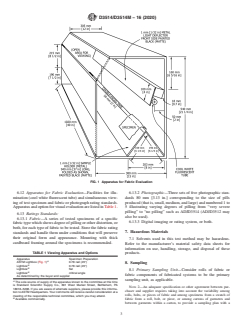
ability of a specific fabric is dependent on both the character- 6.11 OverheadLightingforTestSpecimenEvaluation—Two
istics of the pills and the other factors affecting surface 2.4 m [8 ft] Type F-96 cool-white preheat rapid-start fluores-
appearance, it is suggested that fabrics tested in the laboratory cent lamps with white enamel reflectors, and without baffles or
be evaluated subjectively with regard to their acceptability and glass (see Fig. 1).
...