

ASTM E3050-22
(Specification)Standard Specification for Denatured Ethanol for Use as Cooking and Appliance Fuel
General Information
- Abstract
ABSTRACT
This specification provides requirements and corresponding test methods for denatured ethanol intended to be used as a cooking or appliance fuel, or both. The addition of a denatonium benzoate and a colored dye is required. The minimum and maximum requirements for the amount in which denatonium benzoate must be added are specified. The hydrocarbons approved for use under this specification are gasoline, unleaded gasoline, natural gasoline, heptane, or rubber hydrocarbon solvent.
Also addressed in this specification are workmanship, sampling, sontainers, and sample handling. The test methods cover ethanol, water, and higher alcohols as well as acidity and solvent-washed gum content.
SCOPE
1.1 This specification covers denatured ethanol intended to be used as a cooking or appliance fuel, or both.
1.1.1 This product is intentionally denatured as an additional deterrent to consumption and to avoid beverage alcohol use.
1.1.2 This specification allows for various denaturants to be used for the intended purpose of cooking or appliance fuel. Jurisdictions may vary in their regulatory requirement for the allowable or prohibited types of denaturants, chemical composition of the denaturant or concentration of denaturant needed to denature the ethanol.
1.2 Nothing in this specification shall preclude observance of federal, state, or local regulations.
1.3 Denatured ethanol has many regulatory limitations that cover the production, trading, transporting, distributing, wholesale and retail sale, and use of denatured ethanol; this specification does not purport to address the regulatory compliance aspects of these activities.
1.4 The application and intent of this product is for household cooking fuel and not for on-road motor fuel use (see D4806).
1.5 Units—The values stated in SI units are to be regarded as standard. No other units of measurement are included in this standard.
1.6 This standard does not purport to address all of the safety concerns, if any, associated with its use. It is the responsibility of the user of this standard to establish appropriate safety, health, and environmental practices and determine the applicability of regulatory limitations prior to use.
1.7 This international standard was developed in accordance with internationally recognized principles on standardization established in the Decision on Principles for the Development of International Standards, Guides and Recommendations issued by the World Trade Organization Technical Barriers to Trade (TBT) Committee.
- Status
- Published
- Publication Date
- 14-Sep-2022
- Technical Committee
- E48 - Bioenergy and Industrial Chemicals from Biomass
- Drafting Committee
- E48.A0 - Product Specifications
Buy Documents

ASTM E3050-22 - Standard Specification for Denatured Ethanol for Use as Cooking and Appliance Fuel
REDLINE ASTM E3050-22 - Standard Specification for Denatured Ethanol for Use as Cooking and Appliance Fuel
Overview
ASTM E3050-22 is a standard specification issued by ASTM International that provides requirements for denatured ethanol intended for use as cooking and appliance fuel. The specification covers the composition, required additives, test methods, and quality criteria to ensure that denatured ethanol is suitable and safe for use in household cooking applications and as appliance fuel, excluding on-road motor fuel uses. This standard aims to safeguard against misuse, particularly as a beverage alcohol, by specifying the use of denaturants and dyes.
Key Topics
Denaturing Requirements:
- Ethanol must be intentionally denatured using approved denaturants to make it unsuitable for human consumption. The specification mandates the addition of denatonium benzoate within specified minimum and maximum amounts.
- Other allowable denaturants include gasoline, unleaded gasoline, natural gasoline, heptane, and rubber hydrocarbon solvent.
- The addition of a colored dye is required to provide a visual indicator that the fuel is not potable.
Quality and Purity Criteria:
- Specifications are set for minimum ethanol content, maximum water content, higher alcohols, acidity (as acetic acid), and boiling point.
- The product must be visually free of sediment, suspended matter, and unacceptable contaminants.
- Additives beyond required denaturants and colorants are discouraged due to potential combustion issues.
Sampling and Handling:
- Proper sampling procedures and suitable containers are critical to ensuring accurate testing and maintaining product integrity.
- Specific guidance is provided for sample volume, lot size, and sample handling to minimize contamination risks.
Test Methods:
- The standard references ASTM methods for determining ethanol content, water content, higher alcohols, acidity, and gum content to verify compliance with specifications.
Applications
Denatured ethanol meeting ASTM E3050-22 is primarily used for:
- Household Cooking Fuels: Suitable for use in alcohol stoves and other cooking appliances typically found in domestic settings.
- Appliance Fuels: Used in specially-designed fuel-reliant appliances such as portable stoves, chafing dishes, and heaters.
- Regulatory Compliance: Ensures producers, distributors, and retailers provide a product that meets safety and anti-diversion requirements, helping to prevent beverage alcohol misuse.
Notably, this specification is not intended for automotive or transportation fuel use. Users must also adhere to all applicable federal, state, or local regulations regarding production, handling, and sale of denatured ethanol.
Related Standards
For a comprehensive approach to the use and handling of denatured ethanol and similar fuels, the following related standards are referenced in ASTM E3050-22:
- ASTM D4806 - Specification for Denatured Fuel Ethanol for Blending with Gasolines for Use as Automotive Spark-Ignition Engine Fuel.
- ASTM D4057 - Practice for Manual Sampling of Petroleum and Petroleum Products.
- ASTM D4177 - Practice for Automatic Sampling of Petroleum and Petroleum Products.
- ASTM D5501 - Test Method for Determination of Ethanol and Methanol Content in Fuels.
- ASTM D7795 - Test Method for Acidity in Ethanol and Ethanol Blends.
- CAN/CGSB 3.516 - Denatured Fuel Ethanol for Use in Automotive Spark-Ignition Fuels (Canadian Standard).
These documents ensure comprehensive safety, quality, and sampling practices for fuels used in various applications.
Keywords: appliance fuel, cooking fuel, denatured ethanol, ethanol specification, ASTM E3050-22, fuel standard, household ethanol fuel, fuel regulations, ethanol safety.
Relations
- Effective Date
- 01-Jan-2024
- Effective Date
- 01-Jan-2024
- Effective Date
- 01-Dec-2023
- Effective Date
- 01-Dec-2023
- Effective Date
- 01-Dec-2023
- Effective Date
- 15-Sep-2019
- Effective Date
- 01-Jun-2019
- Effective Date
- 01-Mar-2019
- Effective Date
- 01-Dec-2018
- Effective Date
- 01-Jul-2018
- Effective Date
- 01-Jul-2017
- Effective Date
- 01-Jul-2017
- Effective Date
- 01-Jul-2017
- Effective Date
- 01-May-2017
- Effective Date
- 01-Jul-2016
Buy Documents
ASTM E3050-22 - Standard Specification for Denatured Ethanol for Use as Cooking and Appliance Fuel
REDLINE ASTM E3050-22 - Standard Specification for Denatured Ethanol for Use as Cooking and Appliance Fuel
Get Certified
Connect with accredited certification bodies for this standard

Element Materials Technology
Materials testing and product certification.

ABS Group Brazil
ABS Group certification services in Brazil.

ABS Quality Evaluations Inc.
American Bureau of Shipping quality certification.
Sponsored listings
Frequently Asked Questions
ASTM E3050-22 is a technical specification published by ASTM International. Its full title is "Standard Specification for Denatured Ethanol for Use as Cooking and Appliance Fuel". This standard covers: ABSTRACT This specification provides requirements and corresponding test methods for denatured ethanol intended to be used as a cooking or appliance fuel, or both. The addition of a denatonium benzoate and a colored dye is required. The minimum and maximum requirements for the amount in which denatonium benzoate must be added are specified. The hydrocarbons approved for use under this specification are gasoline, unleaded gasoline, natural gasoline, heptane, or rubber hydrocarbon solvent. Also addressed in this specification are workmanship, sampling, sontainers, and sample handling. The test methods cover ethanol, water, and higher alcohols as well as acidity and solvent-washed gum content. SCOPE 1.1 This specification covers denatured ethanol intended to be used as a cooking or appliance fuel, or both. 1.1.1 This product is intentionally denatured as an additional deterrent to consumption and to avoid beverage alcohol use. 1.1.2 This specification allows for various denaturants to be used for the intended purpose of cooking or appliance fuel. Jurisdictions may vary in their regulatory requirement for the allowable or prohibited types of denaturants, chemical composition of the denaturant or concentration of denaturant needed to denature the ethanol. 1.2 Nothing in this specification shall preclude observance of federal, state, or local regulations. 1.3 Denatured ethanol has many regulatory limitations that cover the production, trading, transporting, distributing, wholesale and retail sale, and use of denatured ethanol; this specification does not purport to address the regulatory compliance aspects of these activities. 1.4 The application and intent of this product is for household cooking fuel and not for on-road motor fuel use (see D4806). 1.5 Units—The values stated in SI units are to be regarded as standard. No other units of measurement are included in this standard. 1.6 This standard does not purport to address all of the safety concerns, if any, associated with its use. It is the responsibility of the user of this standard to establish appropriate safety, health, and environmental practices and determine the applicability of regulatory limitations prior to use. 1.7 This international standard was developed in accordance with internationally recognized principles on standardization established in the Decision on Principles for the Development of International Standards, Guides and Recommendations issued by the World Trade Organization Technical Barriers to Trade (TBT) Committee.
ABSTRACT This specification provides requirements and corresponding test methods for denatured ethanol intended to be used as a cooking or appliance fuel, or both. The addition of a denatonium benzoate and a colored dye is required. The minimum and maximum requirements for the amount in which denatonium benzoate must be added are specified. The hydrocarbons approved for use under this specification are gasoline, unleaded gasoline, natural gasoline, heptane, or rubber hydrocarbon solvent. Also addressed in this specification are workmanship, sampling, sontainers, and sample handling. The test methods cover ethanol, water, and higher alcohols as well as acidity and solvent-washed gum content. SCOPE 1.1 This specification covers denatured ethanol intended to be used as a cooking or appliance fuel, or both. 1.1.1 This product is intentionally denatured as an additional deterrent to consumption and to avoid beverage alcohol use. 1.1.2 This specification allows for various denaturants to be used for the intended purpose of cooking or appliance fuel. Jurisdictions may vary in their regulatory requirement for the allowable or prohibited types of denaturants, chemical composition of the denaturant or concentration of denaturant needed to denature the ethanol. 1.2 Nothing in this specification shall preclude observance of federal, state, or local regulations. 1.3 Denatured ethanol has many regulatory limitations that cover the production, trading, transporting, distributing, wholesale and retail sale, and use of denatured ethanol; this specification does not purport to address the regulatory compliance aspects of these activities. 1.4 The application and intent of this product is for household cooking fuel and not for on-road motor fuel use (see D4806). 1.5 Units—The values stated in SI units are to be regarded as standard. No other units of measurement are included in this standard. 1.6 This standard does not purport to address all of the safety concerns, if any, associated with its use. It is the responsibility of the user of this standard to establish appropriate safety, health, and environmental practices and determine the applicability of regulatory limitations prior to use. 1.7 This international standard was developed in accordance with internationally recognized principles on standardization established in the Decision on Principles for the Development of International Standards, Guides and Recommendations issued by the World Trade Organization Technical Barriers to Trade (TBT) Committee.
ASTM E3050-22 is classified under the following ICS (International Classification for Standards) categories: 75.160.20 - Liquid fuels. The ICS classification helps identify the subject area and facilitates finding related standards.
ASTM E3050-22 has the following relationships with other standards: It is inter standard links to ASTM E1064-24, ASTM E203-24, ASTM D7345-23, ASTM D86-23ae1, ASTM D86-23a, ASTM D4806-19a, ASTM D7923-19, ASTM D4806-19, ASTM D4806-18a, ASTM D4806-18, ASTM D4806-17, ASTM D7923-17a, ASTM D7923-17ae1, ASTM D7923-17, ASTM D7923-16. Understanding these relationships helps ensure you are using the most current and applicable version of the standard.
ASTM E3050-22 is available in PDF format for immediate download after purchase. The document can be added to your cart and obtained through the secure checkout process. Digital delivery ensures instant access to the complete standard document.
Standards Content (Sample)
This international standard was developed in accordance with internationally recognized principles on standardization established in the Decision on Principles for the
Development of International Standards, Guides and Recommendations issued by the World Trade Organization Technical Barriers to Trade (TBT) Committee.
Designation:E3050 −22
Standard Specification for
Denatured Ethanol for Use as Cooking and Appliance Fuel
This standard is issued under the fixed designation E3050; the number immediately following the designation indicates the year of
original adoption or, in the case of revision, the year of last revision. A number in parentheses indicates the year of last reapproval. A
superscript epsilon (´) indicates an editorial change since the last revision or reapproval.
1. Scope Development of International Standards, Guides and Recom-
mendations issued by the World Trade Organization Technical
1.1 This specification covers denatured ethanol intended to
Barriers to Trade (TBT) Committee.
be used as a cooking or appliance fuel, or both.
1.1.1 This product is intentionally denatured as an addi-
2. Referenced Documents
tional deterrent to consumption and to avoid beverage alcohol
2.1 ASTM Standards:
use.
D86 Test Method for Distillation of Petroleum Products and
1.1.2 This specification allows for various denaturants to be
Liquid Fuels at Atmospheric Pressure
used for the intended purpose of cooking or appliance fuel.
D381 Test Method for Gum Content in Fuels by Jet Evapo-
Jurisdictions may vary in their regulatory requirement for the
ration
allowable or prohibited types of denaturants, chemical compo-
D4057 Practice for Manual Sampling of Petroleum and
sition of the denaturant or concentration of denaturant needed
Petroleum Products
to denature the ethanol.
D4177 Practice for Automatic Sampling of Petroleum and
1.2 Nothing in this specification shall preclude observance
Petroleum Products
of federal, state, or local regulations.
D4306 Practice for Aviation Fuel Sample Containers for
1.3 Denatured ethanol has many regulatory limitations that Tests Affected by Trace Contamination
covertheproduction,trading,transporting,distributing,whole- D4806 Specification for Denatured Fuel Ethanol for Blend-
sale and retail sale, and use of denatured ethanol; this specifi- ing with Gasolines for Use as Automotive Spark-Ignition
cation does not purport to address the regulatory compliance Engine Fuel
aspects of these activities. D4815 Test Method for Determination of MTBE, ETBE,
TAME, DIPE, tertiary-Amyl Alcohol and C to C Alco-
1 4
1.4 The application and intent of this product is for house-
hols in Gasoline by Gas Chromatography
hold cooking fuel and not for on-road motor fuel use (see
D5501 Test Method for Determination of Ethanol and
D4806).
Methanol Content in Fuels Containing Greater than 20 %
1.5 Units—The values stated in SI units are to be regarded
Ethanol by Gas Chromatography
as standard. No other units of measurement are included in this
D5854 Practice for Mixing and Handling of Liquid Samples
standard.
of Petroleum and Petroleum Products
1.6 This standard does not purport to address all of the D7345 Test Method for Distillation of Petroleum Products
safety concerns, if any, associated with its use. It is the
and Liquid Fuels at Atmospheric Pressure (Micro Distil-
responsibility of the user of this standard to establish appro- lation Method)
priate safety, health, and environmental practices and deter-
D7795 Test Method for Acidity in Ethanol and Ethanol
mine the applicability of regulatory limitations prior to use. Blends by Titration
1.7 This international standard was developed in accor-
D7923 Test Method for Water in Ethanol and Hydrocarbon
dance with internationally recognized principles on standard- Blends by Karl Fischer Titration
ization established in the Decision on Principles for the
E203 Test Method for Water Using Volumetric Karl Fischer
Titration
E300 Practice for Sampling Industrial Chemicals
This specification is under the jurisdiction of ASTM Committee E48 on
Bioenergy and Industrial Chemicals from Biomass and is the direct responsibility of
Subcommittee E48.A0 on Product Specifications. For referenced ASTM standards, visit the ASTM website, www.astm.org, or
Current edition approved Sept. 15, 2022. Published September 2022. Originally contact ASTM Customer Service at service@astm.org. For Annual Book of ASTM
approved in 2016. Last previous edition approved in 2021 as E3050 – 21. DOI: Standards volume information, refer to the standard’s Document Summary page on
10.1520/E3050-22. the ASTM website.
Copyright © ASTM International, 100 Barr Harbor Drive, PO Box C700, West Conshohocken, PA 19428-2959. United States
E3050−22
E1064 Test Method for Water in Organic Liquids by Coulo- 4.2.3 The denaturant is added as deterrent to consumption.
metric Karl Fischer Titration The denatonium benzoate addition is recommended in an
amount that meets the minimum and maximum requirements
2.2 CGSB Standard:
listed in Table 2.
CAN/CGSB 3.516 Denatured Fuel Ethanol for use in Auto-
4.2.4 The addition of a colored dye is also recommended.
motive Spark-ignition Fuels
The colored dye must be added in a concentration sufficient to
3. Terminology
enable the visual detection of the color in the fuel but should
not render the fuel non-translucent.
3.1 Definitions:
4.2.5 The colored dye can be added to visually indicate that
3.1.1 denaturants, n—materials added to ethanol to make it
the product is not potable.
unsuitable for beverage use under a formula approved by a
4.2.6 Small amounts of the same or similar hydrocarbons
regulatory agency to prevent the imposition of beverage
absorbed by the denatured fuel ethanol as it moves through the
alcohol tax.
distribution system is not denaturant.
3.1.1.1 Discussion—Denaturants are only those materials
added by the denaturer to comply with the approved formula;
5. Workmanship
any materials absorbed later are not denaturants.
5.1 The product described by this specification shall be
3.1.2 denatured ethanol, n—ethanolmadeunfitforbeverage
visually free of sediment and suspended matter.
use by the addition of toxic or noxious materials.
5.2 The product described by this specification shall be free
3.1.3 higher alcohols, n—aliphatic alcohols of general for-
of any adulterant or contaminant that can render the material
mula C H +1OH with n being 3 to 8.
n 2n
unacceptable for its commonly used applications.
3.1.4 hydrocarbon, n—those components in an ethanol-
5.3 Additives beyond the denaturants and colorants are
hydrocarbon blend containing only hydrogen and carbon.
discouraged. Higher molecular weight additives can create
3.1.5 methanol, n—methyl alcohol, the chemical compound
issues with combustion or lead to deposits on the fuel canisters
CH OH.
at the point of combustion, or both. Monitoring the fuel using
Test Method D381 for unwashed gum content is one way to
4. Fuel Specifications
determine if additives other than denaturants and colorants are
4.1 Denatured ethanol for use as cooking and appliance fuel
being added. Such monitoring can provide an early indication
shall conform to the specifications in Table 1.
of contaminatio
...
This document is not an ASTM standard and is intended only to provide the user of an ASTM standard an indication of what changes have been made to the previous version. Because
it may not be technically possible to adequately depict all changes accurately, ASTM recommends that users consult prior editions as appropriate. In all cases only the current version
of the standard as published by ASTM is to be considered the official document.
Designation: E3050 − 21 E3050 − 22
Standard Specification for
Denatured Ethanol for Use as Cooking and Appliance Fuel
This standard is issued under the fixed designation E3050; the number immediately following the designation indicates the year of
original adoption or, in the case of revision, the year of last revision. A number in parentheses indicates the year of last reapproval. A
superscript epsilon (´) indicates an editorial change since the last revision or reapproval.
1. Scope
1.1 This specification covers denatured ethanol intended to be used as a cooking or appliance fuel, or both.
1.1.1 This product is intentionally denatured as an additional deterrent to consumption and to avoid beverage alcohol use.
1.1.2 This specification allows for various denaturants to be used for the intended purpose of cooking or appliance fuel.
Jurisdictions may vary in their regulatory requirement for the allowable or prohibited types of denaturants, chemical composition
of the denaturant or concentration of denaturant needed to denature the ethanol.
1.2 Nothing in this specification shall preclude observance of federal, state, or local regulations.
1.3 Denatured ethanol has many regulatory limitations that cover the production, trading, transporting, distributing, wholesale and
retail sale, and use of denatured ethanol; this specification does not purport to address the regulatory compliance aspects of these
activities.
1.4 The application and intent of this product is for household cooking fuel and not for on-road motor fuel use (see D4806).
1.5 Units—The values stated in SI units are to be regarded as standard. No other units of measurement are included in this
standard.
1.6 This standard does not purport to address all of the safety concerns, if any, associated with its use. It is the responsibility
of the user of this standard to establish appropriate safety, health, and environmental practices and determine the applicability of
regulatory limitations prior to use.
1.7 This international standard was developed in accordance with internationally recognized principles on standardization
established in the Decision on Principles for the Development of International Standards, Guides and Recommendations issued
by the World Trade Organization Technical Barriers to Trade (TBT) Committee.
2. Referenced Documents
2.1 ASTM Standards:
D86 Test Method for Distillation of Petroleum Products and Liquid Fuels at Atmospheric Pressure
D381 Test Method for Gum Content in Fuels by Jet Evaporation
This specification is under the jurisdiction of ASTM Committee E48 on Bioenergy and Industrial Chemicals from Biomass and is the direct responsibility of
Subcommittee E48.A0 on Product Specifications.
Current edition approved Dec. 1, 2021Sept. 15, 2022. Published January 2022September 2022. Originally approved in 2016. Last previous edition approved in 20162021
as E3050 – 16.E3050 – 21. DOI: 10.1520/E3050-21.10.1520/E3050-22.
For referenced ASTM standards, visit the ASTM website, www.astm.org, or contact ASTM Customer Service at service@astm.org. For Annual Book of ASTM Standards
volume information, refer to the standard’s Document Summary page on the ASTM website.
Copyright © ASTM International, 100 Barr Harbor Drive, PO Box C700, West Conshohocken, PA 19428-2959. United States
E3050 − 22
D4057 Practice for Manual Sampling of Petroleum and Petroleum Products
D4177 Practice for Automatic Sampling of Petroleum and Petroleum Products
D4306 Practice for Aviation Fuel Sample Containers for Tests Affected by Trace Contamination
D4806 Specification for Denatured Fuel Ethanol for Blending with Gasolines for Use as Automotive Spark-Ignition Engine Fuel
D4815 Test Method for Determination of MTBE, ETBE, TAME, DIPE, tertiary-Amyl Alcohol and C to C Alcohols in
1 4
Gasoline by Gas Chromatography
D5854 Practice for Mixing and Handling of Liquid Samples of Petroleum and Petroleum Products
D5501 Test Method for Determination of Ethanol and Methanol Content in Fuels Containing Greater than 20 % Ethanol by Gas
Chromatography
D5854 Practice for Mixing and Handling of Liquid Samples of Petroleum and Petroleum Products
D7345 Test Method for Distillation of Petroleum Products and Liquid Fuels at Atmospheric Pressure (Micro Distillation
Method)
D7795 Test Method for Acidity in Ethanol and Ethanol Blends by Titration
D7923 Test Method for Water in Ethanol and Hydrocarbon Blends by Karl Fischer Titration
E203 Test Method for Water Using Volumetric Karl Fischer Titration
E300 Practice for Sampling Industrial Chemicals
E1064 Test Method for Water in Organic Liquids by Coulometric Karl Fischer Titration
2.2 CGSB Standard:
CAN/CGSB 3.516 Denatured Fuel Ethanol for use in Automotive Spark-ignition Fuels
3. Terminology
3.1 Definitions:
3.1.1 denaturants, n—materials added to ethanol to make it unsuitable for beverage use under a formula approved by a regulatory
agency to prevent the imposition of beverage alcohol tax.
3.1.1.1 Discussion—
Denaturants are only those materials added by the denaturer to comply with the approved formula; any materials absorbed later
are not denaturants.
3.1.2 denatured ethanol, n—ethanol made unfit for beverage use by the addition of toxic or noxious materials.
3.1.3 higher alcohols, n—aliphatic alcohols of general formula C H +1OH with n being 3 to 8.
n 2n
3.1.4 hydrocarbon, n—those components in an ethanol-hydrocarbon blend containing only hydrogen and carbon.
3.1.5 methanol, n—methyl alcohol, the chemical compound CH OH.
4. Fuel Specifications
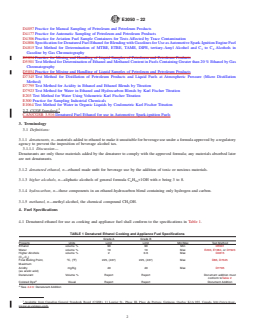
4.1 Denatured ethanol for use as cooking and appliance fuel shall conform to the specifications in Table 1.
TABLE 1 Denatured Ethanol Cooking and Appliance Fuel Specifications
Grade A Grade B
Property Units Limit Limit Min/Max Test Method
Ethanol volume % 90 90 Min D5501
Water volume % 10 10 Max E203, E1064, or D7923
Higher Alcohols volume % 2 0.6 Max D4815
(C –C )
3 8
Final Boiling Point, ºC, (ºF) 225, (437) 225, (437) Max D86, D7345
Maximum
Acidity mg/Kg 40 40 Max D7795
(as acetic acid)
Denaturant Volume % Report Report Document addition must
conform toTable 2
A
Colored Dye Visual Report Report Document Addition
A
See 4.2.3: Denaturant Addition
Available from Canadian General Standards Board (CGSB), 11 Laurier St., Phase III, Place du Portage, Gatineau, Quebec K1A 0S5, Canada, http://www.tpsgc-
pwgsc.gc.ca/ongc-cgsb.
E3050 − 22
4.2 Discussion on Denaturant and Colored Dye—
4.2.1 While a denaturant and a colored dye can be used to indicate a tax liability status, the two products are not identical
functionally. A denaturant may or may not add color to ethanol while rendering the ethanol unpotable. A colored dye intentionally
adds color for a visual indication.
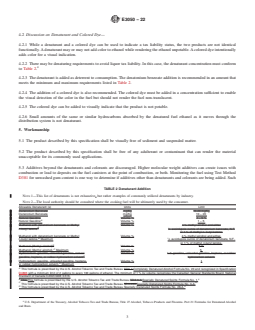
4.2.2 There may be denaturing requirements to avoid liquor tax liability. In this case, the denaturant concentration must conform
to Table 2.
4.2.3 The denaturant is added as deterrent to consumption. The denatonium benzoate addition is recommended in an amount that
meets the minimum and maximum requirements listed in Table 2.
4.2.4 The addition of a colored dye is also recommended. The colored dye must be added in a concentra
...