

ASTM C1658/C1658M-19e1
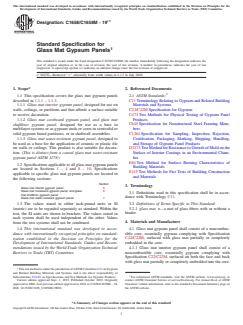
(Specification)Standard Specification for Glass Mat Gypsum Panels
General Information
- Abstract
ABSTRACT
This specification covers the glass mat gypsum panels. Glass mat interior gypsum panel, designed for use on walls, ceilings, or partitions and that affords a surface suitable to receive decoration. Glass mat coreboard gypsum panel, and glass mat shaftliner gypsum panel, designed for use as a base in multilayer systems or as gypsum studs or cores in semisolid or solid gypsum board partitions, or in shaftwall assemblies. Glass mat water-resistant gypsum panel, designed to be used as a base for the application of ceramic or plastic tile on walls or ceilings. Glass mat gypsum panel shall consist of a noncombustible core, gypsum, surfaced with glass mat partially or completely embedded in the core. Flexural strength, humidified deflection, null pull resistance, water resistance, and surface water absorption and shall conform to the physical property requirements of the materials specified.
SCOPE
1.1 This specification covers the glass mat gypsum panels described in 1.1.1 – 1.1.3.
1.1.1 Glass mat interior gypsum panel, designed for use on walls, ceilings, or partitions and that affords a surface suitable to receive decoration.
1.1.2 Glass mat coreboard gypsum panel, and glass mat shaftliner gypsum panel, designed for use as a base in multilayer systems or as gypsum studs or cores in semisolid or solid gypsum board partitions, or in shaftwall assemblies.
1.1.3 Glass mat water-resistant gypsum panel, designed to be used as a base for the application of ceramic or plastic tile on walls or ceilings. This product is also suitable for decoration. (This is distinct from a coated glass mat water-resistant gypsum panel ASTM 1178.)
1.2 Specifications applicable to all glass mat gypsum panels are located in Sections 1 – 4 and 8 – 10. Specifications applicable to specific glass mat gypsum panels are located in the following sections:
Section
Glass mat interior gypsum panel
5
Glass mat coreboard gypsum panel, and glass
mat shaftliner gypsum panel
6
Glass mat water-resistant gypsum panel
7
1.3 The values stated in either inch-pound units or SI (metric) are to be regarded separately as standard. Within the text, the SI units are shown in brackets. The values stated in each system shall be used independent of the other. Values from the two systems shall not be combined.
1.4 This international standard was developed in accordance with internationally recognized principles on standardization established in the Decision on Principles for the Development of International Standards, Guides and Recommendations issued by the World Trade Organization Technical Barriers to Trade (TBT) Committee.
- Status
- Published
- Publication Date
- 31-Aug-2019
- Technical Committee
- C11 - Gypsum and Related Building Materials and Systems
- Drafting Committee
- C11.01 - Specifications and Test Methods for Gypsum Products

Overview
ASTM C1658/C1658M-19e1 is the internationally recognized standard specification for glass mat gypsum panels. Developed by ASTM International, this specification defines the requirements and performance criteria for several types of glass mat gypsum panels, including those designed for interiors, coreboard and shaftliner applications, and water-resistant applications. The panels covered by this standard are used extensively in walls, ceilings, partitions, multilayer systems, and as a substrate for tile or other decorative finishes.
Glass mat gypsum panels manufactured according to ASTM C1658/C1658M-19e1 feature a noncombustible gypsum core with glass mat surfacing. Their enhanced physical properties - such as flexural strength, nail pull resistance, water resistance, surface water absorption, and mold resistance - ensure suitability in a broad range of commercial and residential construction projects.
Key Topics
Panel Types Covered:
- Glass mat interior gypsum panels: Ideal for wall, ceiling, or partition use, and ready for decoration.
- Glass mat coreboard and shaftliner panels: Serve as base layers in multilayer partition systems, gypsum studs or cores, or in shaftwall assemblies.
- Glass mat water-resistant gypsum panels: Purpose-built as a base for ceramic or plastic tile installation on walls and ceilings and suitable for decorative finishes.
Physical and Performance Requirements:
- Noncombustible gypsum core with glass mat surfacing.
- Rigorous flexural (bending) strength and nail pull resistance.
- Humidified deflection, dimensional tolerances, and water resistance for specific panel types.
- Mold resistance for panels designated for improved indoor air quality.
Dimensional and Quality Standards:
- Panels are available in various nominal thicknesses, widths, and edge profiles to fit construction needs.
- Tolerances for length, width, thickness, and squareness are defined.
- Surface finish must be suitable for decoration and free from defects affecting usability.
Fire Resistance:
- Type X (special fire-resistant) panels, which meet minimum fire resistance ratings when tested in accordance with ASTM E119.
- Distinction between Type X and regular panels ensures appropriate fire-rated assemblies.
Applications
Glass mat gypsum panels specified by ASTM C1658/C1658M-19e1 are widely used across the construction industry for:
Interior Wall and Ceiling Systems
- Ideal as a substrate for paint, wallpaper, or textured finishes in commercial and residential buildings.
- Used in areas where higher impact and moisture resistance is required compared to traditional paper-faced gypsum board.
Shaftwall and Multilayer Partition Systems
- Glass mat coreboard and shaftliner panels serve as internal layers in fire-rated, non-loadbearing partitions and shaft walls, essential for stairwells, elevators, and mechanical shafts in high-rise buildings.
Tile Substrates and Wet Areas
- Water-resistant panels provide a stable, durable base for tile installations in bathrooms, kitchens, and utility areas, enhancing mold and moisture management.
Fire-Rated Assemblies
- Type X panels contribute to fire resistance in wall and ceiling assemblies, helping meet building code requirements for occupant safety.
Related Standards
Professionals specifying glass mat gypsum panels may reference these related ASTM standards to ensure comprehensive system performance:
- ASTM C11 – Terminology Relating to Gypsum and Related Building Materials and Systems
- ASTM C22/C22M – Specification for Gypsum
- ASTM C473 – Test Methods for Physical Testing of Gypsum Panel Products
- ASTM C645 – Specification for Nonstructural Steel Framing Members
- ASTM C1264 – Specification for Sampling, Inspection, Rejection, Certification, Packaging, Marking, Shipping, Handling, and Storage of Gypsum Panel Products
- ASTM D3273 – Test Method for Resistance to Mold Growth on the Surface of Interior Coatings
- ASTM E84 – Test Method for Surface Burning Characteristics of Building Materials
- ASTM E119 – Test Methods for Fire Tests of Building Construction and Materials
By adhering to ASTM C1658/C1658M-19e1, manufacturers, architects, and contractors ensure the use of high-quality, durable, and safe glass mat gypsum panels in modern construction. This promotes best practices in fire safety, moisture management, and long-term building performance.
Relations
- Effective Date
- 01-Sep-2019
- Effective Date
- 01-Dec-2023
- Effective Date
- 01-Sep-2023
- Effective Date
- 01-Oct-2019
- Effective Date
- 01-Oct-2019
- Effective Date
- 01-Jul-2019
- Effective Date
- 15-Apr-2019
- Effective Date
- 01-Mar-2019
- Effective Date
- 01-Nov-2018
- Effective Date
- 01-Nov-2018
- Refers
ASTM C11-18a - Standard Terminology Relating to Gypsum and Related Building Materials and Systems - Effective Date
- 01-Oct-2018
- Effective Date
- 01-Oct-2018
- Effective Date
- 01-Sep-2018
- Effective Date
- 01-Jul-2018
- Effective Date
- 01-Jun-2018
Get Certified
Connect with accredited certification bodies for this standard

DIBt (Deutsches Institut für Bautechnik)
German Institute for Building Technology.
DIN CERTCO
DIN Group product certification.

Aboma Certification B.V.
Specialized in construction, metal, and transport sectors.
Sponsored listings
Frequently Asked Questions
ASTM C1658/C1658M-19e1 is a technical specification published by ASTM International. Its full title is "Standard Specification for Glass Mat Gypsum Panels". This standard covers: ABSTRACT This specification covers the glass mat gypsum panels. Glass mat interior gypsum panel, designed for use on walls, ceilings, or partitions and that affords a surface suitable to receive decoration. Glass mat coreboard gypsum panel, and glass mat shaftliner gypsum panel, designed for use as a base in multilayer systems or as gypsum studs or cores in semisolid or solid gypsum board partitions, or in shaftwall assemblies. Glass mat water-resistant gypsum panel, designed to be used as a base for the application of ceramic or plastic tile on walls or ceilings. Glass mat gypsum panel shall consist of a noncombustible core, gypsum, surfaced with glass mat partially or completely embedded in the core. Flexural strength, humidified deflection, null pull resistance, water resistance, and surface water absorption and shall conform to the physical property requirements of the materials specified. SCOPE 1.1 This specification covers the glass mat gypsum panels described in 1.1.1 – 1.1.3. 1.1.1 Glass mat interior gypsum panel, designed for use on walls, ceilings, or partitions and that affords a surface suitable to receive decoration. 1.1.2 Glass mat coreboard gypsum panel, and glass mat shaftliner gypsum panel, designed for use as a base in multilayer systems or as gypsum studs or cores in semisolid or solid gypsum board partitions, or in shaftwall assemblies. 1.1.3 Glass mat water-resistant gypsum panel, designed to be used as a base for the application of ceramic or plastic tile on walls or ceilings. This product is also suitable for decoration. (This is distinct from a coated glass mat water-resistant gypsum panel ASTM 1178.) 1.2 Specifications applicable to all glass mat gypsum panels are located in Sections 1 – 4 and 8 – 10. Specifications applicable to specific glass mat gypsum panels are located in the following sections: Section Glass mat interior gypsum panel 5 Glass mat coreboard gypsum panel, and glass mat shaftliner gypsum panel 6 Glass mat water-resistant gypsum panel 7 1.3 The values stated in either inch-pound units or SI (metric) are to be regarded separately as standard. Within the text, the SI units are shown in brackets. The values stated in each system shall be used independent of the other. Values from the two systems shall not be combined. 1.4 This international standard was developed in accordance with internationally recognized principles on standardization established in the Decision on Principles for the Development of International Standards, Guides and Recommendations issued by the World Trade Organization Technical Barriers to Trade (TBT) Committee.
ABSTRACT This specification covers the glass mat gypsum panels. Glass mat interior gypsum panel, designed for use on walls, ceilings, or partitions and that affords a surface suitable to receive decoration. Glass mat coreboard gypsum panel, and glass mat shaftliner gypsum panel, designed for use as a base in multilayer systems or as gypsum studs or cores in semisolid or solid gypsum board partitions, or in shaftwall assemblies. Glass mat water-resistant gypsum panel, designed to be used as a base for the application of ceramic or plastic tile on walls or ceilings. Glass mat gypsum panel shall consist of a noncombustible core, gypsum, surfaced with glass mat partially or completely embedded in the core. Flexural strength, humidified deflection, null pull resistance, water resistance, and surface water absorption and shall conform to the physical property requirements of the materials specified. SCOPE 1.1 This specification covers the glass mat gypsum panels described in 1.1.1 – 1.1.3. 1.1.1 Glass mat interior gypsum panel, designed for use on walls, ceilings, or partitions and that affords a surface suitable to receive decoration. 1.1.2 Glass mat coreboard gypsum panel, and glass mat shaftliner gypsum panel, designed for use as a base in multilayer systems or as gypsum studs or cores in semisolid or solid gypsum board partitions, or in shaftwall assemblies. 1.1.3 Glass mat water-resistant gypsum panel, designed to be used as a base for the application of ceramic or plastic tile on walls or ceilings. This product is also suitable for decoration. (This is distinct from a coated glass mat water-resistant gypsum panel ASTM 1178.) 1.2 Specifications applicable to all glass mat gypsum panels are located in Sections 1 – 4 and 8 – 10. Specifications applicable to specific glass mat gypsum panels are located in the following sections: Section Glass mat interior gypsum panel 5 Glass mat coreboard gypsum panel, and glass mat shaftliner gypsum panel 6 Glass mat water-resistant gypsum panel 7 1.3 The values stated in either inch-pound units or SI (metric) are to be regarded separately as standard. Within the text, the SI units are shown in brackets. The values stated in each system shall be used independent of the other. Values from the two systems shall not be combined. 1.4 This international standard was developed in accordance with internationally recognized principles on standardization established in the Decision on Principles for the Development of International Standards, Guides and Recommendations issued by the World Trade Organization Technical Barriers to Trade (TBT) Committee.
ASTM C1658/C1658M-19e1 is classified under the following ICS (International Classification for Standards) categories: 91.100.10 - Cement. Gypsum. Lime. Mortar. The ICS classification helps identify the subject area and facilitates finding related standards.
ASTM C1658/C1658M-19e1 has the following relationships with other standards: It is inter standard links to ASTM C1658/C1658M-19, ASTM E84-23d, ASTM E84-23c, ASTM E119-19, ASTM C473-19, ASTM E84-19b, ASTM E84-19a, ASTM E84-19, ASTM E119-18ce1, ASTM E119-18c, ASTM C11-18a, ASTM E84-18b, ASTM E119-18b, ASTM E84-18a, ASTM E119-18a. Understanding these relationships helps ensure you are using the most current and applicable version of the standard.
ASTM C1658/C1658M-19e1 is available in PDF format for immediate download after purchase. The document can be added to your cart and obtained through the secure checkout process. Digital delivery ensures instant access to the complete standard document.
Standards Content (Sample)
This international standard was developed in accordance with internationally recognized principles on standardization established in the Decision on Principles for the
Development of International Standards, Guides and Recommendations issued by the World Trade Organization Technical Barriers to Trade (TBT) Committee.
´1
Designation: C1658/C1658M −19
Standard Specification for
Glass Mat Gypsum Panels
This standard is issued under the fixed designation C1658/C1658M; the number immediately following the designation indicates the
year of original adoption or, in the case of revision, the year of last revision. A number in parentheses indicates the year of last
reapproval. A superscript epsilon (´) indicates an editorial change since the last revision or reapproval.
ε NOTE—Removed “6” editorially from width values in 6.2.2 in July 2020.
1. Scope* 2. Referenced Documents
2.1 ASTM Standards:
1.1 This specification covers the glass mat gypsum panels
described in 1.1.1 – 1.1.3. C11 Terminology Relating to Gypsum and Related Building
Materials and Systems
1.1.1 Glass mat interior gypsum panel, designed for use on
walls, ceilings, or partitions and that affords a surface suitable C22/C22M Specification for Gypsum
C473 Test Methods for Physical Testing of Gypsum Panel
to receive decoration.
1.1.2 Glass mat coreboard gypsum panel, and glass mat Products
C645 Specification for Nonstructural Steel Framing Mem-
shaftliner gypsum panel, designed for use as a base in
multilayer systems or as gypsum studs or cores in semisolid or bers
C1264 Specification for Sampling, Inspection, Rejection,
solid gypsum board partitions, or in shaftwall assemblies.
1.1.3 Glass mat water-resistant gypsum panel, designed to Certification, Packaging, Marking, Shipping, Handling,
and Storage of Gypsum Panel Products
be used as a base for the application of ceramic or plastic tile
on walls or ceilings. This product is also suitable for decora- D3273 TestMethodforResistancetoGrowthofMoldonthe
Surface of Interior Coatings in an Environmental Cham-
tion. (This is distinct from a coated glass mat water-resistant
gypsum panel ASTM 1178.) ber
E84 Test Method for Surface Burning Characteristics of
1.2 Specifications applicable to all glass mat gypsum panels
Building Materials
are located in Sections 1–4 and 8–10. Specifications
E119 Test Methods for Fire Tests of Building Construction
applicable to specific glass mat gypsum panels are located in
and Materials
the following sections:
Section
3. Terminology
Glass mat interior gypsum panel 5
Glass mat coreboard gypsum panel, and glass 6
3.1 Definitions used in this specification shall be in accor-
mat shaftliner gypsum panel
dance with Terminology C11.
Glass mat water-resistant gypsum panel 7
1.3 The values stated in either inch-pound units or SI 3.2 Definitions of Terms Specific to This Standard:
3.2.1 glass mat, n—a mat of glass fibers with or without a
(metric) are to be regarded separately as standard. Within the
text, the SI units are shown in brackets. The values stated in binder.
each system shall be used independent of the other. Values
4. Materials and Manufacture
from the two systems shall not be combined.
4.1 Glass mat gypsum panel shall consist of a noncombus-
1.4 This international standard was developed in accor-
tible core, essentially gypsum complying with Specification
dance with internationally recognized principles on standard-
C22/C22M, surfaced with glass mat partially or completely
ization established in the Decision on Principles for the
Development of International Standards, Guides and Recom- embedded in the core.
4.1.1 Glass mat interior gypsum panel shall consist of a
mendations issued by the World Trade Organization Technical
Barriers to Trade (TBT) Committee. noncombustible core, essentially gypsum complying with
Specification C22/C22M, surfaced on both the face and back
with glass mat partially or completely embedded into the core.
This test method is under the jurisdiction ofASTM Committee C11 on Gypsum
and Related Building Materials and Systems and is the direct responsibility of
Subcommittee C11.01 on Specifications and Test Methods for Gypsum Products. For referenced ASTM standards, visit the ASTM website, www.astm.org, or
Current edition approved Sept. 1, 2019. Published October 2019. Originally contact ASTM Customer Service at service@astm.org. For Annual Book of ASTM
approved in 2006. Last previous edition approved in 2018 as C1658/C1658M – 18. Standards volume information, refer to the standard’s Document Summary page on
DOI: 10.1520/C1658_C1658M-19E01. the ASTM website.
*A Summary of Changes section appears at the end of this standard
Copyright © ASTM International, 100 Barr Harbor Drive, PO Box C700, West Conshohocken, PA 19428-2959. United States
´1
C1658/C1658M − 19
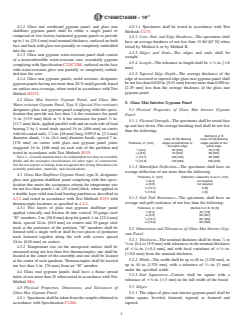
4.1.2 Glass mat coreboard gypsum panel, and glass mat 4.5.1.1 Specimens shall be tested in accordance with Test
shaftliner gypsum panel shall be either a single panel or Methods C473.
composed of two factory-laminated gypsum panels to provide
4.5.2 Core, End, and Edge Hardness—The specimens shall
up to 1 in. [25.4 mm] total nominal thickness, surfaced on both
have an average hardness of not less than 15 lbf [67 N] when
face and back with glass mat partially or completely embedded
tested by Method A or by Method B.
into the core.
4.5.3 Edges and Ends—The edges and ends shall be
4.1.3 Glass mat gypsum water-resistant panel shall consist
straight.
of a noncombustible water-resistant core, essentially gypsum
4.5.4 Length—The tolerance in length shall be 6 ⁄4 in. [66
complying with Specification C22/C22M, surfaced on the face
mm].
with water-resistant glass mat partially or completely embed-
4.5.5 Tapered Edge Depth—The average thickness of the
ded into the core.
edge of recessed or tapered edge glass mat gypsum panel shall
4.1.4 Glass mat gypsum panels, mold resistant, designates
benotlessthan0.020in.[0.51mm]butnotmorethan0.090 in.
gypsum panels having not more than 20 % mold growth, based
[2.29 mm] less than the average thickness of the glass mat
on surface area coverage, when tested in accordance with Test
gypsum panel.
Method D3273.
4.2 Glass Mat Interior Gypsum Panel, and Glass Mat
5. Glass Mat Interior Gypsum Panel
Water-resistant Gypsum Panel, Type X (Special Fire-resistant)
designates glass mat gypsum panel complying with this speci-
5.1 Physical Properties of Glass Mat Interior Gypsum
fication that provide not less than 1 h fire resistance for panel
Panel:
5 3 1
⁄8 in. [15.9 mm] thick or ⁄4 h fire resistance for panel ⁄2 in.
5.1.1 Flexural Strength—The specimens shall be tested face
[12.7 mm] thick, applied parallel with and on each side of load
up and face down. The average breaking load shall be not less
bearing 2 by 4 wood studs spaced 16 in. [406 mm] on center
than the following:
with6dcoatednails,1 ⁄8in.[48mm]long,0.0915in.[2.3mm]
Method A or B
diameter shank, ⁄4 in. [6.4 mm] diameter heads, spaced 7 in.
Load, lbf [N] Bearing Load, lbf [N] Bearing
Thickness, in. [mm] edges perpendicular to edges parallel to the
[178 mm] on center with glass mat gypsum panel joints
the panel edge panel edge
staggered 16 in. [406 mm] on each side of the partition and
⁄4 [6.4] 50 [222] 40 [178]
tested in accordance with Test Methods E119. 3
⁄8 [9.5] 75 [334] 60 [267]
NOTE 1—Consult manufacturers for independent test data on assembly ⁄2 [12.7] 100 [445] 80 [356]
⁄8 [15.9] 140 [623] 100 [445]
details and fire resistance classifications for other types of construction.
See fire test reports or listings from recognized fire testing laboratories for
5.1.2 Humidified Deflection—The specimens shall have an
assembly particulars, materials, and classifications.
average deflection of not more than the following:
4.3 Glass Mat Shaftliner Gypsum Panel, type X, designates
Thickness, in. [mm] Deflection, sixteenths of an in. [mm]
glass mat gypsum shaftliner panel complying with this speci-
⁄4 [6.4] not required
⁄8 [9.5] not required
fication that meets the acceptance criteria for temperature rise
⁄2 [12.7] 5 [8]
for not less than panels 1-in. [25.4 mm] thick, when applied in
⁄8 [15.9] 4 [6]
a double layer solid non-load bearing partition as described in
5.1.3 Nail Pull Resistance—The specimens shall have an
4.3.2 and tested in accordance with Test Methods E119 with
average nail-pull resistance of not less than the following:
thermocouple locations as specified in 4.3.2.
4.3.1 Two layers of glass mat gypsum shaftliner panel Thickness, in. [mm] Method A or B, lbf [N]
⁄4 [6.4] 40 [178]
applied vertically and friction fit into vertical 25-gauge steel
⁄8 [9.5] 60 [267]
“H” members, 2-in. [50.8 mm] deep for panels 1-in. [25.4 mm] 1
⁄2 [12.7] 80 [356]
⁄8 [15.9] 90 [400]
thick, spaced 24-in. [610 mm] on centers and 25-gauge steel
track at the perimeter of the partition. “H” members shall be
5.2 Dimensions and Tolerances of Glass Mat Interior Gyp-
formed with a single web or shall be two pieces of perimeter
sum Panel:
track fastened together along the web with screws spaced
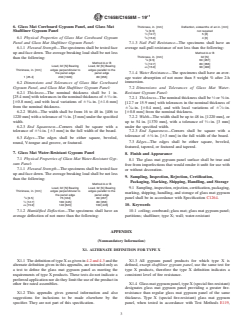
5.2.1 Thickness—The nominal thickness shall be from ⁄4 to
24-in. [610 mm] on centers.
⁄8 in.[6.4to15.9mm]withtolerancesinthenominalthickness
4.3.2 Temperature rise on the unexposed surface shall be
1 1
...