

ASTM E947-22
(Specification)Standard Specification for Sampling Single-Phase Geothermal Liquid or Steam for Purposes of Chemical Analysis
General Information
- Abstract
ABSTRACT
This specification covers the basic requirements for equipment to be used for the collection of uncontaminated and representative samples from single-phase geothermal liquid or steam. Sample probes shall be used to extract liquid or steam from the main part of the geothermal flow rather than using a wall-accessing valve and pipe arrangement. Sampling lines shall be as short as practical and of sufficient strength to prevent structural failure. Valves which control access to the sampling point shall have straight throats. The tube through which the sample flows shall be continuous through the cooling location so there will be no possibility of sample contamination or dilution from the cooling water. Liquid sample containers and compatible closures shall not bias the sample components of interest. Devices used to collect and transport the gas component of the samples shall be resistant to chemical reactions and to gaseous diffusion or adsorption. Filters, when used, shall be housed in a pressure-tight container assuring that the full flow passes through the filter. The sampling apparatus shall be kept clean.
SCOPE
1.1 This specification covers the basic requirements for equipment and the techniques to be used for the collection of uncontaminated and representative samples from single-phase geothermal liquid or steam. Geopressured liquids are included.
1.2 The values stated in SI units are to be regarded as standard. The values given in parentheses after SI units are provided for information only and are not considered standard.
1.3 This standard does not purport to address all of the safety concerns, if any, associated with its use. It is the responsibility of the user of this standard to establish appropriate safety, health, and environmental practices and determine the applicability of regulatory limitations prior to use.
1.4 This international standard was developed in accordance with internationally recognized principles on standardization established in the Decision on Principles for the Development of International Standards, Guides and Recommendations issued by the World Trade Organization Technical Barriers to Trade (TBT) Committee.
- Status
- Published
- Publication Date
- 31-Dec-2021
- Technical Committee
- E44 - Solar, Geothermal and Other Alternative Energy Sources
- Drafting Committee
- E44.15 - Geothermal Field Development, Utilization and Materials
Buy Documents
ASTM E947-22 - Standard Specification for Sampling Single-Phase Geothermal Liquid or Steam for Purposes of Chemical Analysis
REDLINE ASTM E947-22 - Standard Specification for Sampling Single-Phase Geothermal Liquid or Steam for Purposes of Chemical Analysis
Overview
ASTM E947-22 is the Standard Specification for Sampling Single-Phase Geothermal Liquid or Steam for Purposes of Chemical Analysis. Published by ASTM International, this standard details essential requirements and equipment guidelines for collecting uncontaminated and representative samples from single-phase geothermal liquid or steam flows, including geopressured liquids. The standard is intended to support accurate chemical analysis by ensuring that the collection process preserves the integrity of the geothermal sample throughout extraction, cooling, and storage.
This specification emphasizes the use of dedicated sample probes, appropriate materials, robust safety practices, and precise control over sampling conditions to prevent contamination, bias, or sample losses. It also addresses the need for clean and well-designed sampling apparatus for reliable analysis in geothermal energy exploration, monitoring, and research.
Key Topics
Sample Probe Design and Placement: Probes are inserted directly into the central flow of piping to ensure samples are truly representative of the single-phase fluid, not affected by wall deposits or stagnant areas.
Sampling Line Construction: Short, sturdy lines made of corrosion-resistant materials are recommended to retain sample quality and avoid structural failures.
Valves and Fittings: Full-port ball or gate valves are required to give probes unrestricted access to fluid flow. Specialized valves and fittings must prevent sample contamination and allow access for temperature and pressure measurements.
Sample Cooling: The specification outlines continuous tubing through the cooling coil to prevent contamination or dilution, with proper regulation of cooling rates for both liquid and steam.
Container Requirements: Sample containers and closures for both liquids and gases must not leach or adsorb analytes, thereby ensuring analytical accuracy.
Cleaning and Maintenance: All sampling equipment must be kept clean, rinsed with distilled water, and free from lubricants or residues that could influence chemical results.
Safety Practices: The standard addresses the importance of safe probe insertion and removal, as well as leak-free operation during high-pressure geothermal sampling.
Applications
ASTM E947-22 is widely applicable in the geothermal energy sector for operations such as:
- Resource assessment: Collecting baseline data for geothermal reservoir evaluation and exploration.
- Plant monitoring: Regular sampling for operational control and chemical monitoring in geothermal power plants.
- Environmental compliance: Ensuring samples collected are suitable for regulatory reporting and environmental impact analyses.
- Research and development: Supporting laboratory and field studies on the chemical composition of geothermal fluids for improved exploitation methods.
Using the correct sampling techniques defined by this standard helps eliminate errors due to contamination, phase separation, or chemical changes during sampling, making it indispensable for those working with geothermal steam or liquids.
Related Standards
Professionals using ASTM E947-22 should also be aware of the following ASTM standards and guides:
- ASTM E1675 - Practice for Sampling Two-Phase Geothermal Fluid for Purposes of Chemical Analysis (useful for cases involving two-phase fluid flows).
- ASTM D1192 (Withdrawn) - Former guide for equipment used in sampling water and steam in closed conduits.
These documents, alongside ASTM E947-22, provide a comprehensive framework for geothermal sampling, ensuring sample integrity whether the target is single-phase steam, liquid, or more complex multi-phase conditions.
Keywords: geothermal sampling standard, geothermal steam analysis, single-phase geothermal liquid, chemical analysis of geothermal fluids, ASTM E947-22, geothermal plant monitoring, sampling probe specification, geothermal field sampling, sample quality assurance.
Relations
- Effective Date
- 01-Mar-2004
- Effective Date
- 10-Jul-1998
- Effective Date
- 01-Jan-1995
Buy Documents
ASTM E947-22 - Standard Specification for Sampling Single-Phase Geothermal Liquid or Steam for Purposes of Chemical Analysis
REDLINE ASTM E947-22 - Standard Specification for Sampling Single-Phase Geothermal Liquid or Steam for Purposes of Chemical Analysis
Frequently Asked Questions
ASTM E947-22 is a technical specification published by ASTM International. Its full title is "Standard Specification for Sampling Single-Phase Geothermal Liquid or Steam for Purposes of Chemical Analysis". This standard covers: ABSTRACT This specification covers the basic requirements for equipment to be used for the collection of uncontaminated and representative samples from single-phase geothermal liquid or steam. Sample probes shall be used to extract liquid or steam from the main part of the geothermal flow rather than using a wall-accessing valve and pipe arrangement. Sampling lines shall be as short as practical and of sufficient strength to prevent structural failure. Valves which control access to the sampling point shall have straight throats. The tube through which the sample flows shall be continuous through the cooling location so there will be no possibility of sample contamination or dilution from the cooling water. Liquid sample containers and compatible closures shall not bias the sample components of interest. Devices used to collect and transport the gas component of the samples shall be resistant to chemical reactions and to gaseous diffusion or adsorption. Filters, when used, shall be housed in a pressure-tight container assuring that the full flow passes through the filter. The sampling apparatus shall be kept clean. SCOPE 1.1 This specification covers the basic requirements for equipment and the techniques to be used for the collection of uncontaminated and representative samples from single-phase geothermal liquid or steam. Geopressured liquids are included. 1.2 The values stated in SI units are to be regarded as standard. The values given in parentheses after SI units are provided for information only and are not considered standard. 1.3 This standard does not purport to address all of the safety concerns, if any, associated with its use. It is the responsibility of the user of this standard to establish appropriate safety, health, and environmental practices and determine the applicability of regulatory limitations prior to use. 1.4 This international standard was developed in accordance with internationally recognized principles on standardization established in the Decision on Principles for the Development of International Standards, Guides and Recommendations issued by the World Trade Organization Technical Barriers to Trade (TBT) Committee.
ABSTRACT This specification covers the basic requirements for equipment to be used for the collection of uncontaminated and representative samples from single-phase geothermal liquid or steam. Sample probes shall be used to extract liquid or steam from the main part of the geothermal flow rather than using a wall-accessing valve and pipe arrangement. Sampling lines shall be as short as practical and of sufficient strength to prevent structural failure. Valves which control access to the sampling point shall have straight throats. The tube through which the sample flows shall be continuous through the cooling location so there will be no possibility of sample contamination or dilution from the cooling water. Liquid sample containers and compatible closures shall not bias the sample components of interest. Devices used to collect and transport the gas component of the samples shall be resistant to chemical reactions and to gaseous diffusion or adsorption. Filters, when used, shall be housed in a pressure-tight container assuring that the full flow passes through the filter. The sampling apparatus shall be kept clean. SCOPE 1.1 This specification covers the basic requirements for equipment and the techniques to be used for the collection of uncontaminated and representative samples from single-phase geothermal liquid or steam. Geopressured liquids are included. 1.2 The values stated in SI units are to be regarded as standard. The values given in parentheses after SI units are provided for information only and are not considered standard. 1.3 This standard does not purport to address all of the safety concerns, if any, associated with its use. It is the responsibility of the user of this standard to establish appropriate safety, health, and environmental practices and determine the applicability of regulatory limitations prior to use. 1.4 This international standard was developed in accordance with internationally recognized principles on standardization established in the Decision on Principles for the Development of International Standards, Guides and Recommendations issued by the World Trade Organization Technical Barriers to Trade (TBT) Committee.
ASTM E947-22 is classified under the following ICS (International Classification for Standards) categories: 07.060 - Geology. Meteorology. Hydrology. The ICS classification helps identify the subject area and facilitates finding related standards.
ASTM E947-22 has the following relationships with other standards: It is inter standard links to ASTM E1675-04e1, ASTM D1192-98, ASTM E1675-95a. Understanding these relationships helps ensure you are using the most current and applicable version of the standard.
ASTM E947-22 is available in PDF format for immediate download after purchase. The document can be added to your cart and obtained through the secure checkout process. Digital delivery ensures instant access to the complete standard document.
Standards Content (Sample)
This international standard was developed in accordance with internationally recognized principles on standardization established in the Decision on Principles for the
Development of International Standards, Guides and Recommendations issued by the World Trade Organization Technical Barriers to Trade (TBT) Committee.
Designation: E947 −22
Standard Specification for
Sampling Single-Phase Geothermal Liquid or Steam for
Purposes of Chemical Analysis
This standard is issued under the fixed designation E947; the number immediately following the designation indicates the year of
original adoption or, in the case of revision, the year of last revision.Anumber in parentheses indicates the year of last reapproval.A
superscript epsilon (´) indicates an editorial change since the last revision or reapproval.
1. Scope geothermal liquid or steam. It does not cover specialized
equipmentrequiredfor,anduniqueto,aspecifictestormethod
1.1 This specification covers the basic requirements for
of analysis. The specification covers items such as valves,
equipment and the techniques to be used for the collection of
fittings, tubing, cooling coils and condensers, sample
uncontaminated and representative samples from single-phase
containers,andsampleprobes,butexcludesequipmentusedin
geothermal liquid or steam. Geopressured liquids are included.
specific testing and analysis.
1.2 The values stated in SI units are to be regarded as
3.2 The sampling procedure applies to sampling of single-
standard. The values given in parentheses after SI units are
phase steam or liquid streams, including single-phase steam or
provided for information only and are not considered standard.
liquid streams separated from two-phase flow as described in
1.3 This standard does not purport to address all of the
Practice E1675, dry saturated steam, superheated steam, and
safety concerns, if any, associated with its use. It is the
pumped geothermal liquid. The sampling procedure is not
responsibility of the user of this standard to establish appro-
applicable to the collection of liquid droplets and entrained
priate safety, health, and environmental practices and deter-
solids in steam (steam quality and purity), which must be
mine the applicability of regulatory limitations prior to use.
collected by isokinetic sampling utilizing different equipment
1.4 This international standard was developed in accor-
and techniques. The single-phase steam sampling specification
dance with internationally recognized principles on standard-
applies to vapor-phase species in the steam only (noncondens-
ization established in the Decision on Principles for the
able gases, HCl and boric acid). The single-phase liquid
Development of International Standards, Guides and Recom-
sampling specification applies to fully dissolved species in the
mendations issued by the World Trade Organization Technical
liquid only, including noncondensable gases if no gas bubbles
Barriers to Trade (TBT) Committee.
are present (gas breakout).
2. Referenced Documents
3.3 For most geothermal and geopressured fluids tested by
the procedures outlined in this specification, both liquid and
2.1 ASTM Standards:
steam samples may be collected.
D1192Guide for Equipment for Sampling Water and Steam
in Closed Conduits (Withdrawn 2003)
4. Sample Probes
E1675Practice for Sampling Two-Phase Geothermal Fluid
for Purposes of Chemical Analysis
4.1 Sampling probes shall be used to extract liquid or steam
from the main part of the geothermal flow rather than using a
3. Application
wall-accessing valve and pipe arrangement. This allows a
3.1 The equipment specification covers only that equipment
representative sample to be collected of a homogeneous,
which is commonly used for the sampling of single-phase single-phasefluid.Theprobesarenotdesignedformulti-phase
sampling or sampling under isokinetic conditions (see Fig. 1).
Consideration should be given to the force generated by any
This specification is under the jurisdiction ofASTM Committee E44 on Solar,
specific combination of probe diameter and system pressure
GeothermalandOtherAlternativeEnergySourcesandisthedirectresponsibilityof
andtothelimitationsandsafetyofslidingseals.Acombination
SubcommitteeE44.15onGeothermalFieldDevelopment,UtilizationandMaterials.
of probe tip bead and safety chain are recommended to restrict
Current edition approved Jan. 1, 2022. Published February 2022. Originally
approvedin1983.Lastspreviouseditionapprovedin2015asE947-83(2015).DOI: forcible ejection of the probe from the line being sampled. In
10.1520/E0947-22.
some cases, a permanently installed sampling probe is pre-
For referenced ASTM standards, visit the ASTM website, www.astm.org, or
ferred.
contact ASTM Customer Service at service@astm.org. For Annual Book of ASTM
Standards volume information, refer to the standard’s Document Summary page on
4.2 Sample probes shall be designed to extract representa-
the ASTM website.
tive samples from homogeneous single-phase fluid flow. Spe-
The last approved version of this historical standard is referenced on
www.astm.org. cialattentionduringconstructionoftheprobeshallbegivento
Copyright © ASTM International, 100 Barr Harbor Drive, PO Box C700, West Conshohocken, PA 19428-2959. United States
E947 − 22
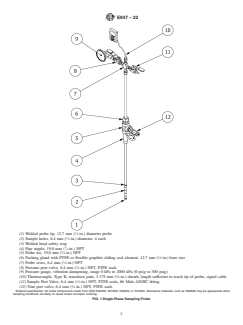
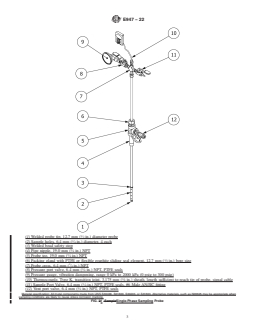
(1)Welded probe tip, 12.7 mm ( ⁄2in.) diameter probe
(2)Sample holes, 6.4 mm ( ⁄4in.) diameter, 4 each
(3)Welded bead safety stop
(4)Pipe nipple, 19.0 mm ( ⁄4in.) NPT
(5)Probe tee, 19.0 mm ( ⁄4in.) NPT
(6)Packing gland with PTFE or flexible graphite sliding seal element, 12.7 mm ( ⁄2in.) bore size
(7)Probe cross, 6.4 mm ( ⁄4in.) NPT
(8)Pressure port valve, 6.4 mm ( ⁄4in.) NPT, PTFE seals
(9)Pressure gauge, vibration dampening, range 0 kPa to 2000 kPa (0 psig to 300 psig)
(10)Thermocouple, Type K, transition joint, 3.175 mm ( ⁄8in.) sheath, length sufficient to reach tip of probe, signal cable
(11)Sample Port Valve, 6.4 mm ( ⁄4in.) NPT, PTFE seals, #6 Male AN/JIC fitting
(12)Vent port valve, 6.4 mm ( ⁄4in.) NPT, PTFE seals
Material specification: All metal components made from UNS S30400, S31600, S30403, or S31603. Alternative materials, such as N06625 may be appropriate when
sampling conditions are likely to cause stress corrosion cracking.
FIG. 1 Single-Phase Sampling Probe
E947 − 22
the stresses that the probe will later be subjected to during 5.4.2 Pressure measurements are made with a calibrated
insertion into, and operation in, a pressurized flowing system. digital pressure transducer. A pressure-snubbing device is
4.2.1 The sampling probe shaft should be constructed of recommended to minimize the pressure spikes and surges
UNS S30400, S31600, S30403, or S31603 tubing, or another common in geothermal flow lines. Minimum accuracy of the
suitable material. Its outer diameter should be 9.5 mm gauge should be 61% of full-scale. The gauge should be
(0.375in.) to 12.7 mm (0.500in.) with a wall thickness of at calibrated at monthly intervals when in routine use and every
least 1.25 mm (0.049in.). six months for intermittent use. All gauges require permanent
4.2.2 The probe shaft must be of sufficient length to reach identification numbers so that field data and calibration data
the center of the pipeline. can be traced to each specific instrument.
4.3 The probe shall be equipped with a sliding seal mecha- 5.5 Sample ports on the probe often need to be replumbed,
nism that will allow the probe shaft to slide into and out of the andfittingsmayneedtobereplaced.Aselectionofpipefittings
flow stream, while under pressure. including reducer bushings, pipe nipples, couplings, and
4.3.1 Thetemperatureandpressureratingoftheslidingseal elbows, plus those needed for sample equipment maintenance,
is required on site.
shall be at least 1.5 times greater than that of the fluid or vapor
to be sampled.
6. Sampling Lines
4.4 Thesamplingprobeshaftpassesthroughtheslidingseal
6.1 Sampling lines shall be as short as practical and of
and access valve in order that liquid or steam can be sampled
sufficient strength to prevent structural failure.
from the central stream of the flow line.Thereafter, the sample
contacts only surfaces that the operator can verify are non-
6.2 Standard sample lines are perfluoroalkoxy alkane (PFA)
contaminating and non-absorbing.
tubing with UNS S30400, S31600, S30403, or S31603 over-
braid rated to 1378kPag and 243°C (500psig and 470°F).
5. Valves, Gauges, and Fittings
Joint Industry Council/Army-Navy (JIC/AN) type fittings at-
5.1 Valves which control access to the sampling point shall
tachhosestotheprobeoutletandcondenser/coolerinlet.Hoses
have straight throats (frequently designated as ball, plug, and
are dedicated to either steam or liquid service to prevent
gate valves). Gate valves and ball valves shall be full-port
cross-contamination.
style.This permits a probe to be inserted directly into the flow.
6.2.1 The inner diameter of hose used for liquid sampling
should not exceed 9.5mm (0.375in.).
5.2 The sample probe shall be equipped with at least one
6.2.2 The inner diameter of hose used for vapor sampling
full-port shut-off valve on the downstream end so that the
should not exceed 6.4mm (0.250in.).
sampling line may be isolated when necessary.
6.2.3 When sampling pressure exceeds 1378kPag, UNS
5.3 For single-phase liquid sampling, the throttling devices
S30400, S31600, S30403, or S31603 tubing should be used
such as valves, capillary tubes, or orifices, if used, shall be
(6.4 mm to 9.5 mm (0.25-in. to 0.375-in.) outside diameter),
placed at the sample outlet of the cooler or condenser.Ahead
although it is less convenient. Convoluted, flexible stainless
column such as that recommended for normal water and steam
steel hose is specifically excluded due to potential entrapment
sampling (Specification D1192, for Equipment for Sampling
and contamination problems caused by the internal convolu-
Water and Steam) shall not be used because it provides a
tions.AlternativematerialssuchasN06625maybeappropriate
mechanism for gas separation and escape prior to sample
when the fluid being sampled is likely to have high concen-
collection.
trations of halides.
5.4 Equipment adequate to determine the pressure and
7. Sample Cooler
temperature of the mainstream liquid or steam flow may be
utilized.
7.1 The tube through which the sample flows shall be
5.4.1 Temperaturemeasurementsaremadewitharesistance
continuous through the cooling location so there will be no
temperature detector (RTD) or a Type-K thermocouple. 4-wire
possibility of sample contamination or dilution from the
RTD probes are preferred due to the large linear range and
coolingwater.Theinternaldiameterofthetubeissuggestedto
stable signal. Minimum accuracy of the meter should be at
benolargerthanthatofthesampleprobesothatstoragewithin
least 60.6°C (61°F). Meters and temperature probes should
the coil is low and the time lag of sample through the cooling
be calibrated at the same intervals as the pressure transducers
phase will be a minimum.
to ensure consistency between the measurements of pressure
7.2 Whenthetemperatureofthesampleisabovetheboiling
and temperature. All meters and probes require permanent
point of water, it may be advantageous to use a precooler
identification numbers so that field data and calibration data
containingwatertolowerthetemperatureofthesamplebefore
can be traced to each specific instrument.
it enters the cooler. The temperature of the sample can then be
5.4.1.1 The temperature sensing element shall be housed in
controlled by the flow rate and the temperature of the final
a sealed, ungrounded sheath of sufficient length to reach the
cooling bath (frequently an ice water bath).
inletendoftheprobe.Thesheathshallbeconstructedfromthe
same material as the probe, or other suitable inert material. 7.3 The steam cooling coil has a regulating valve at the
5.4.1.2 The sheath must be of small enough diameter so as inlet.Regulatingtheflowatthecondenserinletmaintainsfluid
not to occlude more than 20% of the interior cross-sectional velocityonthecondensateandpreventsfluidholdupinsidethe
area of the probe shaft. condenser. The outside diameter of the steam cooling coil is
E947 − 22
typically 6.4mm (0.250in.). Outside diameters larger than outlet. This allows the small volume of condensate to drain
6.4mm (0.250in.) should not be used, as larger tubing sizes freely out of the condenser and prevents hold-up within the
decrease fluid velocities and increase residence times within coils. Smaller diameter coils may be necessary if noncondens-
the tubing. (See Fig. 2.) able gas concentrations exceed 5% by weight. In these cases,
7.3.1 The steam cooling coil is arranged as a downward tubing with an outer diameter of 3.2mm (0.125in.) will
spiral with the inlet at the top. This maintains the thermal maintain flow velocities without excessive restriction of fluid
gradient in the cooling container, allowing the coolant at the flow.
surface to boil and radiate as much heat as possible, while 7.3.3 It is necessary to ensure the cooling system for steam
preserving the cooler fluids at the bottom of the vessel. The collection is free of leaks where atmospheric gases could enter
cooled sample fluid exits through a straight tube rising to the the system and contaminate the sample. Effective ways to
top of the cooler. check for leaks are to pressurize the system or subject it to
7.3.2 In cases where the noncondensable gas concentration vacuum and monitor any change in pressure over a few
in steam exceeds approximately 5% by weight, the outlet of minutes of time. If there is no change in pressure from the
the steam condenser coil should be at an elevation below the initial pressurization, then the system is free of leaks and
inlet with a continuous down-slope in the tubing from inlet to adequate for sampling.
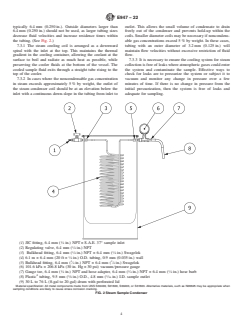
(1)JIC fitting, 6.4 mm ( ⁄4in.) NPT×S.A.E. 37° sample inlet
(2)Regulating valve, 6.4 mm ( ⁄4in.) NPT
1 1
(3) Bulkhead fitting, 6.4 mm ( ⁄4in.) NPT × 6.4 mm ( ⁄4in.) Swagelok
(4)6.1 m × 6.4 mm (20 ft× ⁄4in.) O.D. tubing, 0.9 mm (0.035in.) wall
1 1
(5)Bulkhead fitting, 6.4 mm ( ⁄4in.) NPT × 6.4 mm ( ⁄4in.) Swagelok
(6)101.6 kPa × 206.8 kPa (30in. Hg×30psi) vacuum⁄pressure gauge
1 1 1
(7)Gauge tee, 6.4 mm ( ⁄4in.) NPT and hose adapter, 6.4 mm ( ⁄4in.) NPT × 6.4 mm ( ⁄4in.) hose barb
3 3
(8)Plastic tubing, 9.5 mm ( ⁄8in.) O.D., 4.8 mm ( ⁄16in.) I.D. sample outlet
(9)30 L to 76 L (8-gal to 20-gal) drum with perforated lid
Material specification: All metal components made from UNS S30400, S31600, S30403, or S31603. Alternative materials, such as N06625 may be appropriate when
sampling conditions are likely to cause stress corrosion cracking.
FIG. 2 Steam Sample Condenser
E947 − 22
7.4 The liquid cooling coil has a regulating valve at the preserving the cooler fluids at the bottom of the vessel. The
outlet. Regulating the flow at the condenser outlet maintains cooled sample liquid exits through a straight tube rising to the
pressureontheliquidasitcoolsandpreventsflashingofliquid top of the cooler.
inside the condenser which could result in gas break-out or
7.5 Cooling is achieved by an ice/water bath surrounding
chemicaldeposition,orboth.Theoutsidediameteroftheliquid
the coils or by a continuous overflow of cooling water running
cooling coil is typically 6.4mm (0.250in.). In cases where the
into the vessel holding the coils.Alternate configurations may
liquid contains substantial quantities of particulate matter,
include a water-tight jacket around the coils through which a
9.5mm (0.375in.) outside diameter tubing coils may be used
constant source of cooling water flows. A source of coolant
tominimizecoolingcoilpluggingproblems.Outsidediameters
may be a glycol/water mixture circulated through the con-
larger than 9.5mm (0.375in.) should not be used, as larger
denser jacket and an external fan-cooled heat e
...
This document is not an ASTM standard and is intended only to provide the user of an ASTM standard an indication of what changes have been made to the previous version. Because
it may not be technically possible to adequately depict all changes accurately, ASTM recommends that users consult prior editions as appropriate. In all cases only the current version
of the standard as published by ASTM is to be considered the official document.
Designation: E947 − 83 (Reapproved 2015) E947 − 22
Standard Specification for
Sampling Single-Phase Geothermal Liquid or Steam for
Purposes of Chemical Analysis
This standard is issued under the fixed designation E947; the number immediately following the designation indicates the year of
original adoption or, in the case of revision, the year of last revision. A number in parentheses indicates the year of last reapproval. A
superscript epsilon (´) indicates an editorial change since the last revision or reapproval.
1. Scope
1.1 This specification covers the basic requirements for equipment and the techniques to be used for the collection of
uncontaminated and representative samples from single-phase geothermal liquid or steam. Geopressured liquids are included. See
Fig. 1.
1.2 The values stated in SI units are to be regarded as standard. The values given in parentheses after SI units are provided for
information only and are not considered standard.
1.3 This standard does not purport to address all of the safety concerns, if any, associated with its use. It is the responsibility
of the user of this standard to establish appropriate safety, health, and environmental practices and determine the applicability of
regulatory limitations prior to use.
1.4 This international standard was developed in accordance with internationally recognized principles on standardization
established in the Decision on Principles for the Development of International Standards, Guides and Recommendations issued
by the World Trade Organization Technical Barriers to Trade (TBT) Committee.
2. Referenced Documents
2.1 ASTM Standards:
D1192 Guide for Equipment for Sampling Water and Steam in Closed Conduits (Withdrawn 2003)
E1675 Practice for Sampling Two-Phase Geothermal Fluid for Purposes of Chemical Analysis
3. Application
3.1 This The equipment specification covers only that equipment which is commonly used for the sampling of single-phase
geothermal liquid or steam. It does not cover specialized equipment required for, and unique to, a specific test or method of
analysis. The specification covers items such as valves, fittings, tubing, cooling coils and condensers, pumps, degassers, sample
containers, and sample probes, and packaging materials, but excludes equipment used in specific testing and analysis.
3.2 This The sampling procedure applies to sampling of single-phase steam or liquid streams prior streams, including single-phase
steam or liquid streams separated from two-phase flow as described in Practice E1675to separation and to separated single-phase
This specification is under the jurisdiction of ASTM Committee E44 on Solar, Geothermal and Other Alternative Energy Sources and is the direct responsibility of
Subcommittee E44.15 on Geothermal Field Development, Utilization and Materials.
Current edition approved March 1, 2015Jan. 1, 2022. Published April 2015February 2022. Originally approved in 1983. Lasts previous edition approved in 20072015 as
E947-83(2007).E947-83(2015). DOI: 10.1520/E0947-83R15.10.1520/E0947-22.
For referenced ASTM standards, visit the ASTM website, www.astm.org, or contact ASTM Customer Service at service@astm.org. For Annual Book of ASTM Standards
volume information, refer to the standard’s Document Summary page on the ASTM website.
The last approved version of this historical standard is referenced on www.astm.org.
Copyright © ASTM International, 100 Barr Harbor Drive, PO Box C700, West Conshohocken, PA 19428-2959. United States
E947 − 22
steam or liquid streams., dry saturated steam, superheated steam, and pumped geothermal liquid. The sampling procedure is not
applicable to the collection of liquid droplets and entrained solids in steam (steam quality and purity), which must be collected by
isokinetic sampling utilizing different equipment and techniques. The single-phase steam sampling specification applies to
vapor-phase species in the steam only (noncondensable gases, HCl and boric acid). The single-phase liquid sampling specification
applies to fully dissolved species in the liquid only, including noncondensable gases if no gas bubbles are present (gas breakout).
3.3 For most geothermal and geopressured fluids tested by the procedures outlined in this specification, both liquid and gassteam
samples may be collected.
4. Sample Probes
4.1 SampleSampling probes shall be used to extract liquid or steam from the main part of the geothermal flow rather than using
a wall-accessing valve and pipe arrangement. This allows a representative sample to be collected of a homogeneous, single-phase
fluid. The probes are not designed for multi-phase sampling or sampling under isokinetic conditions (see Fig. 1). Consideration
should be given to the force generated by any specific combination of probe diameter and system pressure and to the limitations
and safety of sliding seals. A combination of probe tip bead and safety chain are recommended to restrict forcible ejection of the
probe from the line being sampled. In some cases, a permanently installed sampling probe is preferred.
4.1.1 The probe permits the sampling of various positions within the flow to determine whether stratified or annular two-phase
flow is present which would bias a single-point sample.
4.2 Sample probes shall be designed to extract representative samples from flowing systems. homogeneous single-phase fluid flow.
Special attention during construction of the probe shall be given to the stresses that the probe will later be subjected to during
insertion into, and operation in, a pressurized flowing system.
4.2.1 The sampling probe shaft should be constructed of UNS S30400, S31600, S30403, or S31603 tubing, or another suitable
material. Its outer diameter should be 9.5 mm (0.375 in.) to 12.7 mm (0.500 in.) with a wall thickness of at least 1.25 mm
(0.049 in.).
4.2.2 The probe shaft must be of sufficient length to reach the center of the pipeline.
4.3 The probe shall be equipped with a sliding seal mechanism that will allow the probe shaft to slide into and out of the flow
stream, while under pressure.
4.3.1 The temperature and pressure rating of the sliding seal shall be at least 1.5 times greater than that of the fluid or vapor to
be sampled.
4.4 The sampling probe (seeshaft Fig. 2) passes through the sliding seal and access valve in order that liquid or steam can be
sampled from the mainstream central stream of the flow line. Thereafter, the sample contacts only surfaces that the operator can
verify are noncontaminatingnon-contaminating and nonabsorbing. non-absorbing.
4.3.1 Moving the probe tip across the diameter of the pipe may allow the operator to determine the existence of stratification or
multiphase sampling problems.
4.3.2 Flow regulation is accomplished downstream of the cooling coils in order to avoid residual flashing into steam at the point
of pressure reduction. Flashing may cause scale deposition which would preclude the accurate determination of certain
constituents.
5. Sampling Lines
5.1 Safety—Sampling lines shall be as short as practical and of sufficient strength to prevent structural failure.
5.2 Construction—All sample lines shall be constructed to eliminate traps in which condensate, entrained particulates, or scale
precipitates might settle since they may be partially emptied with changes in flow conditions and may result in sample
contamination. Allow for thermal expansion.
E947 − 22
(1) Welded probe tip, 12.7 mm ( ⁄2 in.) diameter probe
(2) Sample holes, 6.4 mm ( ⁄4 in.) diameter, 4 each
(3) Welded bead safety stop
(4) Pipe nipple, 19.0 mm ( ⁄4 in.) NPT
(5) Probe tee, 19.0 mm ( ⁄4 in.) NPT
(6) Packing gland with PTFE or flexible graphite sliding seal element, 12.7 mm ( ⁄2 in.) bore size
(7) Probe cross, 6.4 mm ( ⁄4 in.) NPT
(8) Pressure port valve, 6.4 mm ( ⁄4 in.) NPT, PTFE seals
(9) Pressure gauge, vibration dampening, range 0 kPa to 2000 kPa (0 psig to 300 psig)
(10) Thermocouple, Type K, transition joint, 3.175 mm ( ⁄8 in.) sheath, length sufficient to reach tip of probe, signal cable
(11) Sample Port Valve, 6.4 mm ( ⁄4 in.) NPT, PTFE seals, #6 Male AN/JIC fitting
(12) Vent port valve, 6.4 mm ( ⁄4 in.) NPT, PTFE seals
Material specification: All metal components made from UNS S30400, S31600, S30403, or S31603. Alternative materials, such as N06625 may be appropriate when
sampling conditions are likely to cause stress corrosion cracking.
FIG. 21 SampleSingle-Phase Sampling Probe
E947 − 22
5. Valves, Fittings,Gauges, and GagesFittings
5.1 Valves which control access to the sampling point shall have straight throats (frequently designated as ball, plug, and gate
valves). Gate valves and ball valves shall be full-port style. This permits a probe to be inserted directly into the flow.
5.2 It is recommended that The sample probe shall be equipped with at least one full-port shut-off valve be placed on the
downstream end of the sample probe so that the sampling line may be isolated when desired.necessary.
5.3 Throttling For single-phase liquid sampling, the throttling devices such as valves, capillary tubes, or orifices, if used, shall be
placed at the sample outlet of the cooler or condenser. This practice will ensure cooling at the highest pressure and will minimize
the possibility of fluid flashing or scale forming in the cooling coil. A head column such as that recommended for normal water
and steam sampling (Specification D1192, for Equipment for Sampling Water and Steam) shall not be used because it provides
a mechanism for gas separation and escape prior to sample collection.
5.4 Equipment adequate to determine the pressure and temperature of the mainstremmainstream liquid or steam flow shallmay be
utilized.
5.4.1 Temperature measurements are made with a resistance temperature detector (RTD) or a Type-K thermocouple. 4-wire RTD
probes are preferred due to the large linear range and stable signal. Minimum accuracy of the meter should be at least 60.6 °C
(61 °F). Meters and temperature probes should be calibrated at the same intervals as the pressure transducers to ensure consistency
between the measurements of pressure and temperature. All meters and probes require permanent identification numbers so that
field data and calibration data can be traced to each specific instrument.
5.4.1.1 The temperature sensing element shall be housed in a sealed, ungrounded sheath of sufficient length to reach the inlet end
of the probe. The sheath shall be constructed from the same material as the probe, or other suitable inert material.
5.4.1.2 The sheath must be of small enough diameter so as not to occlude more than 20 % of the interior cross-sectional area of
the probe shaft.
5.4.2 Pressure measurements are made with a calibrated digital pressure transducer. A pressure-snubbing device is recommended
to minimize the pressure spikes and surges common in geothermal flow lines. Minimum accuracy of the gauge should be 61 %
of full-scale. The gauge should be calibrated at monthly intervals when in routine use and every six months for intermittent use.
All gauges require permanent identification numbers so that field data and calibration data can be traced to each specific instrument.
5.5 Sample ports on the probe often need to be replumbed, and fittings may need to be replaced. A selection of pipe fittings
including reducer bushings, pipe nipples, couplings, and elbows, plus those needed for sample equipment maintenance, is required
on site.
6. Sampling Lines
6.1 Sampling lines shall be as short as practical and of sufficient strength to prevent structural failure.
6.2 Standard sample lines are perfluoroalkoxy alkane (PFA) tubing with UNS S30400, S31600, S30403, or S31603 overbraid rated
to 1378 kPag and 243 °C (500 psig and 470 °F). Joint Industry Council/Army-Navy (JIC/AN) type fittings attach hoses to the
probe outlet and condenser/cooler inlet. Hoses are dedicated to either steam or liquid service to prevent cross-contamination.
6.2.1 The inner diameter of hose used for liquid sampling should not exceed 9.5 mm (0.375 in.).
6.2.2 The inner diameter of hose used for vapor sampling should not exceed 6.4 mm (0.250 in.).
6.2.3 When sampling pressure exceeds 1378 kPag, UNS S30400, S31600, S30403, or S31603 tubing should be used (6.4 mm to
9.5 mm (0.25-in. to 0.375-in.) outside diameter), although it is less convenient. Convoluted, flexible stainless steel hose is
specifically excluded due to potential entrapment and contamination problems caused by the internal convolutions. Alternative
materials such as N06625 may be appropriate when the fluid being sampled is likely to have high concentrations of halides.
E947 − 22
7. Sample Cooler
7.1 The tube through which the sample flows shall be continuous through the cooling location so there will be no possibility of
sample contamination or dilution from the cooling water. The internal diameter of the tube is suggested to be no larger than that
of the sample probe so that storage within the coil is low and the time lag of sample through the cooling phase will be a minimum.
7.2 When the temperature of the sample is above the boiling point of water, it may be advantageous, in order to conserve ice, to
advantageous to use a precooler containing water to lower the temperature of the sample before it enters the cooler. The
temperature of the sample can then be controlled by the flow rate and the temperature of the final cooling bath (frequently an ice
water bath).
7.3 The steam cooling coil has a regulating valve at the inlet. Regulating the flow at the condenser inlet maintains fluid velocity
on the condensate and prevents fluid holdup inside the condenser. The outside diameter of the steam cooling coil is typically
6.4 mm (0.250 in.). Outside diameters larger than 6.4 mm (0.250 in.) should not be used, as larger tubing sizes decrease fluid
velocities and increase residence times within the tubing. (See Fig. 2.)
(1) JIC fitting, 6.4 mm ( ⁄4 in.) NPT × S.A.E. 37° sample inlet
(2) Regulating valve, 6.4 mm ( ⁄4 in.) NPT
1 1
(3) Bulkhead fitting, 6.4 mm ( ⁄4 in.) NPT × 6.4 mm ( ⁄4 in.) Swagelok
(4) 6.1 m × 6.4 mm (20 ft × ⁄4 in.) O.D. tubing, 0.9 mm (0.035 in.) wall
1 1
(5) Bulkhead fitting, 6.4 mm ( ⁄4 in.) NPT × 6.4 mm ( ⁄4 in.) Swagelok
(6) 101.6 kPa × 206.8 kPa (30 in. Hg × 30 psi) vacuum ⁄pressure gauge
1 1 1
(7) Gauge tee, 6.4 mm ( ⁄4 in.) NPT and hose adapter, 6.4 mm ( ⁄4 in.) NPT × 6.4 mm ( ⁄4 in.) hose barb
3 3
(8) Plastic tubing, 9.5 mm ( ⁄8 in.) O.D., 4.8 mm ( ⁄16 in.) I.D. sample outlet
(9) 30 L to 76 L (8-gal to 20-gal) drum with perforated lid
Material specification: All metal components made from UNS S30400, S31600, S30403, or S31603. Alternative materials, such as N06625 may be appropriate when
sampling conditions are likely to cause stress corrosion cracking.
FIG. 32 Example Assembly (Particularly Suited for Steam Flows)Steam Sample Condenser
E947 − 22
7.3.1 The steam cooling coil is arranged as a downward spiral with the inlet at the top. This maintains the thermal gradient in the
cooling container, allowing the coolant at the surface to boil and radiate as much heat as possible, while preserving the cooler fluids
at the bottom of the vessel. The cooled sample fluid exits through a straight tube rising to the top of the cooler.
7.3.2 In cases where the noncondensable gas concentration in steam exceeds approximately 5 % by weight, the outlet of the steam
condenser coil should be at an elevation below the inlet with a continuous down-slope in the tubing from inlet to outlet. This allows
the small volume of condensate to drain freely out of the condenser and prevents hold-up within the coils. Smaller diameter coils
may be necessary if noncondensable gas concentrations exceed 5 % by weight. In these cases, tubing with an outer diameter of
3.2 mm (0.125 in.) will maintain flow velocities without excessive restriction of fluid flow.
7.3.3 It is necessary to ensure the cooling system for steam collection is free of leaks where atmospheric gases could enter the
system and contaminate the sample. Effective ways to check for leaks are to pressurize the system or subject it to vacuum and
monitor any change in pressure over a few minutes of time. If there is no change in pressure from the initial pressurization, then
the system is free of leaks and adequate for sampling.
7.4 The liquid cooling coil has a regulating valve at the outlet. Regulating the flow at the condenser outlet maintains pressure on
the liquid as it cools and prevents flashing of liquid inside the condenser which could result in gas break-out or chemical deposition,
or both. The outside diameter of the liquid cooling coil is typically 6.4 mm (0.250 in.). In cases where the liquid contains
substantial quantities of particulate matter, 9.5 mm (0.375 in.) outside diameter tubing coils may be used to minimize cooling coil
plugging problems. Outside diameters larger than 9.5 mm (0.375 in.) should not be use
...