

ASTM D4733-17
(Test Method)Standard Test Methods for Solventless Electrical Insulating Varnishes
General Information
- Abstract
SIGNIFICANCE AND USE
4.1 The test methods referenced in these test methods are useful for control purposes during the manufacture and use of solventless varnishes.
SCOPE
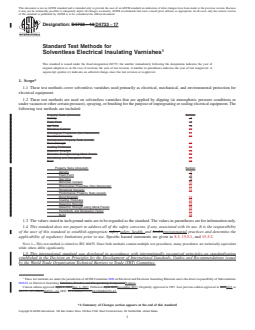
1.1 These test methods cover solventless varnishes used primarily as electrical, mechanical, and environmental protection for electrical equipment.
1.2 These test methods are used on solventless varnishes that are applied by dipping (at atmospheric pressure conditions or under vacuum or other certain pressure), spraying, or brushing for the purpose of impregnating or sealing electrical equipment. The following test methods are included:
Property Tests (Uncured):
Section
Density
7
Flash Point
8
Gel Time
9
Monomer Content
10
Rheological Properties (Non-Newtonian)
11
Rotational Viscosity
12
Performance Property Tests (cured):
Bond Strength
13
Coating Thickness
14
Dielectric Strength
15
Dielectric Strength-Using Metal Panels
16
Permittivity and Dissipation Factor
17
Build
18
1.3 The values stated in inch-pound units are to be regarded as the standard. The values in parentheses are for information only.
1.4 This standard does not purport to address all of the safety concerns, if any, associated with its use. It is the responsibility of the user of this standard to establish appropriate safety, health, and environmental practices and determine the applicability of regulatory limitations prior to use. Specific hazard statements are given in 8.3, 15.5.1, and 15.5.2.
Note 1: This test method is related to IEC 60455. Since both methods contain multiple test procedures, many procedures are technically equivalent while others differ significantly.
1.5 This international standard was developed in accordance with internationally recognized principles on standardization established in the Decision on Principles for the Development of International Standards, Guides and Recommendations issued by the World Trade Organization Technical Barriers to Trade (TBT) Committee.
- Status
- Published
- Publication Date
- 31-Oct-2017
- Technical Committee
- D09 - Electrical and Electronic Insulating Materials
- Drafting Committee
- D09.01 - Electrical Insulating Products
Overview
ASTM D4733-17: Standard Test Methods for Solventless Electrical Insulating Varnishes provides comprehensive procedures for evaluating the performance and properties of solventless varnishes used primarily for electrical, mechanical, and environmental protection in electrical equipment. Developed by ASTM International, this standard is critical for manufacturers, quality control professionals, and users involved in the production and application of electrical insulating varnishes. The specified test methods ensure product reliability, consistency, and suitability for electrical insulation applications.
Key Topics
ASTM D4733-17 covers both uncured and cured properties of solventless electrical insulating varnishes through various test methods, including:
Uncured Property Tests:
- Density - Measurement using a pycnometer.
- Flash Point - Assessment of fire safety.
- Gel Time - Determination for processing and shelf-life control.
- Monomer Content - Analysis affecting viscosity and application.
- Rheological Properties (Non-Newtonian) - Assessment of thixotropy and flow characteristics.
- Rotational Viscosity - Measurement for material handling consistency.
Cured/Performance Property Tests:
- Bond Strength - Evaluation of adhesion on electrical windings.
- Coating Thickness - Measurement to ensure adequate protection.
- Dielectric Strength - Testing the ability to withstand electrical stress.
- Dielectric Strength Using Metal Panels - Ensuring uniformity and comparative performance.
- Permittivity and Dissipation Factor - Electrical property measurement affecting insulation behavior.
- Build - Assessment following prescribed methodologies.
The standard also outlines detailed procedures for sample preparation, conditioning, and report writing to ensure standardized test results.
Applications
These test methods are applicable throughout the lifecycle of solventless electrical insulating varnishes:
Manufacturing Quality Control:
Regular use of the defined tests enables producers to monitor physical and electrical properties batch-to-batch, enhance process control, and ensure compliance with technical specifications.Product Development:
Researchers and formulators use these procedures to evaluate new varnish formulations, ensuring they meet required electrical and physical performance criteria.Electrical Equipment Impregnation:
Solventless varnishes are widely used by dipping, spraying, or brushing to impregnate and seal electrical components such as motors, coils, transformers, and generators, providing moisture, chemical, and mechanical protection.Performance Verification:
Electrical equipment manufacturers rely on these standardized tests to verify that the applied varnish coatings deliver the expected dielectric strength and environmental protection in real-life operating conditions.
Related Standards
ASTM D4733-17 references and is related to several other key standards in electrical insulation:
- IEC 60455: Resin-Based Reactive Compounds Used for Electrical Insulation - Technically similar for many test procedures.
- ASTM D149: Dielectric Breakdown Voltage and Dielectric Strength of Solid Electrical Insulating Materials.
- ASTM D115: Testing Solvent Containing Varnishes Used for Electrical Insulation.
- ASTM D150: AC Loss Characteristics and Permittivity (Dielectric Constant) of Solid Electrical Insulation.
- ASTM D1475: Density of Liquid Coatings, Inks, and Related Products.
- ASTM D2196: Rheological Properties of Non-Newtonian Materials by Rotational Viscometer.
- ASTM D2519: Bond Strength of Electrical Insulating Varnishes by the Helical Coil Test.
- ASTM D3056, D3312, D374, D3278: Various test methods for evaluating specific properties of varnishes and resins.
Practical Value
By adhering to ASTM D4733-17, stakeholders ensure that solventless electrical insulating varnishes consistently meet industry requirements for density, viscosity, composition, electrical, and mechanical strength. This standard supports improved product quality, safety, traceability, and international market acceptance of insulating varnishes for electrical and electronics industries. Proper implementation aligns with global best practices as outlined by the WTO Technical Barriers to Trade (TBT) Committee.
Keywords: ASTM D4733-17, solventless varnishes, electrical insulation, dielectric strength, bond strength, viscosity, coating thickness, permittivity, dissipation factor, quality control, electrical equipment protection
Relations
- Effective Date
- 01-Nov-2017
- Effective Date
- 01-Mar-2024
- Effective Date
- 01-Mar-2024
- Effective Date
- 01-Jan-2024
- Effective Date
- 01-Dec-2023
- Effective Date
- 01-Oct-2023
- Effective Date
- 01-Aug-2020
- Effective Date
- 01-Jan-2020
- Effective Date
- 01-Nov-2019
- Effective Date
- 01-Apr-2019
- Effective Date
- 01-Mar-2019
- Effective Date
- 15-Dec-2018
- Effective Date
- 01-Nov-2018
- Effective Date
- 01-Nov-2018
- Effective Date
- 01-Nov-2018
Get Certified
Connect with accredited certification bodies for this standard

IMQ S.p.A. (Certification)
Italian electrical product certification.

SLG Prüf- und Zertifizierungs GmbH
German testing and certification body.

UL Solutions
Global safety science company with testing, inspection and certification.
Sponsored listings
Frequently Asked Questions
ASTM D4733-17 is a standard published by ASTM International. Its full title is "Standard Test Methods for Solventless Electrical Insulating Varnishes". This standard covers: SIGNIFICANCE AND USE 4.1 The test methods referenced in these test methods are useful for control purposes during the manufacture and use of solventless varnishes. SCOPE 1.1 These test methods cover solventless varnishes used primarily as electrical, mechanical, and environmental protection for electrical equipment. 1.2 These test methods are used on solventless varnishes that are applied by dipping (at atmospheric pressure conditions or under vacuum or other certain pressure), spraying, or brushing for the purpose of impregnating or sealing electrical equipment. The following test methods are included: Property Tests (Uncured): Section Density 7 Flash Point 8 Gel Time 9 Monomer Content 10 Rheological Properties (Non-Newtonian) 11 Rotational Viscosity 12 Performance Property Tests (cured): Bond Strength 13 Coating Thickness 14 Dielectric Strength 15 Dielectric Strength-Using Metal Panels 16 Permittivity and Dissipation Factor 17 Build 18 1.3 The values stated in inch-pound units are to be regarded as the standard. The values in parentheses are for information only. 1.4 This standard does not purport to address all of the safety concerns, if any, associated with its use. It is the responsibility of the user of this standard to establish appropriate safety, health, and environmental practices and determine the applicability of regulatory limitations prior to use. Specific hazard statements are given in 8.3, 15.5.1, and 15.5.2. Note 1: This test method is related to IEC 60455. Since both methods contain multiple test procedures, many procedures are technically equivalent while others differ significantly. 1.5 This international standard was developed in accordance with internationally recognized principles on standardization established in the Decision on Principles for the Development of International Standards, Guides and Recommendations issued by the World Trade Organization Technical Barriers to Trade (TBT) Committee.
SIGNIFICANCE AND USE 4.1 The test methods referenced in these test methods are useful for control purposes during the manufacture and use of solventless varnishes. SCOPE 1.1 These test methods cover solventless varnishes used primarily as electrical, mechanical, and environmental protection for electrical equipment. 1.2 These test methods are used on solventless varnishes that are applied by dipping (at atmospheric pressure conditions or under vacuum or other certain pressure), spraying, or brushing for the purpose of impregnating or sealing electrical equipment. The following test methods are included: Property Tests (Uncured): Section Density 7 Flash Point 8 Gel Time 9 Monomer Content 10 Rheological Properties (Non-Newtonian) 11 Rotational Viscosity 12 Performance Property Tests (cured): Bond Strength 13 Coating Thickness 14 Dielectric Strength 15 Dielectric Strength-Using Metal Panels 16 Permittivity and Dissipation Factor 17 Build 18 1.3 The values stated in inch-pound units are to be regarded as the standard. The values in parentheses are for information only. 1.4 This standard does not purport to address all of the safety concerns, if any, associated with its use. It is the responsibility of the user of this standard to establish appropriate safety, health, and environmental practices and determine the applicability of regulatory limitations prior to use. Specific hazard statements are given in 8.3, 15.5.1, and 15.5.2. Note 1: This test method is related to IEC 60455. Since both methods contain multiple test procedures, many procedures are technically equivalent while others differ significantly. 1.5 This international standard was developed in accordance with internationally recognized principles on standardization established in the Decision on Principles for the Development of International Standards, Guides and Recommendations issued by the World Trade Organization Technical Barriers to Trade (TBT) Committee.
ASTM D4733-17 is classified under the following ICS (International Classification for Standards) categories: 29.035.60 - Varnished fabrics. The ICS classification helps identify the subject area and facilitates finding related standards.
ASTM D4733-17 has the following relationships with other standards: It is inter standard links to ASTM D4733-13, ASTM D115-17(2024), ASTM D1711-24, ASTM E176-24, ASTM D923-15(2023), ASTM D3056-23, ASTM D93-20, ASTM D149-20, ASTM D2519-19a, ASTM D3636-19, ASTM D2519-19, ASTM E176-18a, ASTM D3312-18, ASTM D3056-14(2018), ASTM D2519-18. Understanding these relationships helps ensure you are using the most current and applicable version of the standard.
ASTM D4733-17 is available in PDF format for immediate download after purchase. The document can be added to your cart and obtained through the secure checkout process. Digital delivery ensures instant access to the complete standard document.
Standards Content (Sample)
This international standard was developed in accordance with internationally recognized principles on standardization established in the Decision on Principles for the
Development of International Standards, Guides and Recommendations issued by the World Trade Organization Technical Barriers to Trade (TBT) Committee.
Designation: D4733 − 17
Standard Test Methods for
Solventless Electrical Insulating Varnishes
This standard is issued under the fixed designation D4733; the number immediately following the designation indicates the year of
original adoption or, in the case of revision, the year of last revision. A number in parentheses indicates the year of last reapproval. A
superscript epsilon (´) indicates an editorial change since the last revision or reapproval.
1. Scope* mendations issued by the World Trade Organization Technical
Barriers to Trade (TBT) Committee.
1.1 These test methods cover solventless varnishes used
primarily as electrical, mechanical, and environmental protec-
2. Referenced Documents
tion for electrical equipment.
2.1 ASTM Standards:
1.2 These test methods are used on solventless varnishes
D93 Test Methods for Flash Point by Pensky-Martens
that are applied by dipping (at atmospheric pressure conditions
Closed Cup Tester
or under vacuum or other certain pressure), spraying, or
D115 Test Methods for Testing Solvent Containing Var-
brushing for the purpose of impregnating or sealing electrical
nishes Used for Electrical Insulation
equipment. The following test methods are included:
D149 Test Method for Dielectric Breakdown Voltage and
Property Tests (Uncured): Section
DielectricStrengthofSolidElectricalInsulatingMaterials
Density 7
at Commercial Power Frequencies
Flash Point 8
D150 Test Methods forAC Loss Characteristics and Permit-
Gel Time 9
Monomer Content 10
tivity (Dielectric Constant) of Solid Electrical Insulation
Rheological Properties (Non-Newtonian) 11
D374 Test Methods for Thickness of Solid Electrical Insu-
Rotational Viscosity 12
Performance Property Tests (cured): lation (Metric) D0374_D0374M
Bond Strength 13
D923 Practices for Sampling Electrical Insulating Liquids
Coating Thickness 14
D1475 Test Method for Density of Liquid Coatings, Inks,
Dielectric Strength 15
Dielectric Strength-Using Metal Panels 16 and Related Products
Permittivity and Dissipation Factor 17
D1711 Terminology Relating to Electrical Insulation
Build 18
D2196 Test Methods for Rheological Properties of Non-
1.3 The values stated in inch-pound units are to be regarded
Newtonian Materials by Rotational Viscometer
as the standard. The values in parentheses are for information
D2519 Test Method for Bond Strength of Electrical Insulat-
only.
ing Varnishes by the Helical Coil Test
1.4 This standard does not purport to address all of the D3056 Test Method for Gel Time of Solventless Varnishes
safety concerns, if any, associated with its use. It is the D3278 Test Methods for Flash Point of Liquids by Small
responsibility of the user of this standard to establish appro- Scale Closed-Cup Apparatus
priate safety, health, and environmental practices and deter- D3312 Test Method for Percent Reactive Monomer in Sol-
mine the applicability of regulatory limitations prior to use. ventless Varnishes
Specific hazard statements are given in 8.3, 15.5.1, and 15.5.2. D3487 Specification for Mineral Insulating Oil Used in
Electrical Apparatus
NOTE 1—This test method is related to IEC 60455. Since both methods
D3636 Practice for Sampling and Judging Quality of Solid
contain multiple test procedures, many procedures are technically equiva-
Electrical Insulating Materials
lent while others differ significantly.
D6054 Practice for Conditioning Electrical Insulating Mate-
1.5 This international standard was developed in accor-
rials for Testing (Withdrawn 2012)
dance with internationally recognized principles on standard-
E176 Terminology of Fire Standards
ization established in the Decision on Principles for the
Development of International Standards, Guides and Recom-
1 2
These test methods are under the jurisdiction of ASTM Committee D09 on For referenced ASTM standards, visit the ASTM website, www.astm.org, or
Electrical and Electronic Insulating Materials and is the direct responsibility of contact ASTM Customer Service at service@astm.org. For Annual Book of ASTM
Subcommittee D09.01 on Electrical Insulating Products. Standards volume information, refer to the standard’s Document Summary page on
Current edition approved Nov. 1, 2017. Published November 2017. Originally theASTM website.
approved in 1987. Last previous edition approved in 2013 as D4733 – 13. DOI: The last approved version of this historical standard is referenced on
10.1520/D4733-17. www.astm.org.
*A Summary of Changes section appears at the end of this standard
Copyright © ASTM International, 100 Barr Harbor Drive, PO Box C700, West Conshohocken, PA 19428-2959. United States
D4733 − 17
2.2 IEC Standards homogeneous, take samples from two or three places on the
IEC 60455 Resin Based Reactive Compounds Used for surface and mix together.
Electrical Insulation
5.3 Sampling Fluids Exhibiting Non-Newtonian Viscosity:
5.3.1 Sample solventless varnishes exhibiting non-
3. Terminology
Newtonian viscosity in accordance with 5.2.3.
3.1 Definitions:
5.4 Use sample containers and sampling procedures in
3.1.1 For definitions of terms used in these test methods,
accordance with Test Method D923.
refer to Terminology D1711. For definitions of terms associ-
5.5 When a sampling method is needed to determine
ated with fire issues, refer to Terminology E176.
whether a lot meets the requirements of a material
3.1.2 gel time, n—of solventless varnish, the time required
specification, use Practice D3636 as a guide.
at a specified temperature for a solventless varnish to be
transformed from a liquid state to a gel as measured with a
6. Conditioning
suitable gel time apparatus.
6.1 Condition test specimens at standard laboratory condi-
3.1.3 thixotropy, n—the property of a material to thin upon
tion as specified in Practice D6054.
isothermal agitation and to thicken upon subsequent rest.
3.1.4 varnish, electrical insulating, n—a liquid resin system 6.2 Deaerate specimens to be used for property evaluation
beforecuringusingthevacuumtechniquerecommendedbythe
that is applied to and cured on electrical components providing
electrical, mechanical, and environmental protection. varnish manufacturer.
3.1.4.1 Discussion—There are two types of electrical insu-
TEST METHODS
lating varnish—solvent-containing and solventless. The
solvent-containing varnish is solution, dispersion, or emulsion
7. Density
of a polymer or a mixture of polymers in a volatile, nonre-
actable liquid.The solventless type is a liquid resin system free
7.1 Scope—This test method covers the measurement of the
of volatile, nonreactable solvents.
density using a pycnometer. It is particularly applicable where
the fluid has too high a viscosity for other methods of testing
4. Significance and Use
density. In this test method the density will be expressed as
pounds per gallon (grams per millilitre) at 70 to 77°F (20 to
4.1 The test methods referenced in these test methods are
25°C).
useful for control purposes during the manufacture and use of
solventless varnishes.
7.2 Procedure—Test for density in accordance with Test
Method D1475.
5. Sampling
7.3 Report—Report the following information:
5.1 Accurate sampling, whether of the complete contents or
7.3.1 Identification of the test sample,
only parts thereof, is extremely important from the standpoint
7.3.2 The test temperature to the nearest 0.2°F (0.1°C),
of evaluating the quality of the product sampled. In most cases,
7.3.3 Density to the nearest 0.01 lb/gal (0.001 g/mL), and
the detection of contaminants that are not ordinarily dispersed
7.3.4 The mean, the range, and the number of replicate
uniformly through the liquid being sampled such as water or
determinations.
solid particles, necessitates taking samples at specific locations
where the contaminants are likely to be found. For a liquid
8. Flash Point
having a specific gravity less than one, water and other
8.1 Scope—Thistestmethodcoversthedeterminationofthe
impurities are most likely to be found on the bottom; whereas
flash point of solventless varnishes. There are two types of
in the case of liquids having a specific gravity greater than one,
materials involved:
these impurities are most likely to be found on the surface.
8.1.1 Those varnishes having a flash point above 230°F
5.2 Sampling Fluids Exhibiting Newtonian Viscosity:
(110°C), and
5.2.1 Sample solventless varnishes having an approximate
8.1.2 Those varnishes having a flash point below 230°F
viscosity of 25 cP (0.025 Pa·s) or less at 100°F (37.8°C) using
(110°C).
the sampling device shown in Fig. 1 of Test Method D923.
8.2 SummaryofTestMethod—Aspecifiedamountofsample
However, if the temperature of the material is below room
is added to the instrument. The temperature of the material is
temperature or if the humidity is above 75 % relative humidity,
increasedataconstantrateuntilasmallflameignitesthevapor
sample using an aspirator-type sampling device as shown in
of the specimen in the tester and propagates a flame across its
Fig. 2 of Test Method D923.
surface. The temperature at ignition is taken as the flash point.
5.2.2 Sample solventless varnishes having a viscosity from
25 to 650 cP (0.025 to 0.65 Pa·s) at 100°F (37.8°C) and where 8.3 This standard is used to measure and describe the
contact with the atmosphere must be avoided, use a pressure- response of materials, products, or assemblies to heat and
type sampling device as shown in Fig. 3 of Test Method D923. flame under controlled conditions, but does not by itself
5.2.3 Sample solventless varnishes having a viscosity above incorporate all factors required for fire hazard or fire risk
650 cP at 100°F at 73 6 10°F (23 6 5°C). Open the container assessment of the materials, products or assemblies under
and mix slowly so as not to entrap air. When the material is actual fire conditions.
D4733 − 17
8.4 Fire testing is inherently hazardous. Adequate safe- 11.4 Report—Report information as specified in Test
guards for personnel and property shall be employed in Method D2196.
conducting these tests.
12. Rotational Viscosity
8.5 Procedure:
8.5.1 Test the materials of 8.1.1 in accordance with Test 12.1 Scope—This test method covers the determination of
Methods D93. viscosity for liquids having flow properties approaching those
8.5.2 Test the materials of 8.1.2 in accordance with Test of the newtonian solutions.
Method D3278.
12.2 Apparatus:
12.2.1 Rotational Viscometer.
8.6 Report—Report information in accordance with the
report section of the test method used. 12.2.2 Thermometer.
12.2.3 Water Bath.
9. Gel Time 12.2.4 Stirrer.
12.3 Procedure:
9.1 Scope—Thistestmethodcoversthedeterminationofgel
time of a solventless varnish mixed with a reactor or catalyst 12.3.1 Bring the specimen to a temperature of 77 6 2°F (25
6 1.0°C) using a water bath and stirrer if necessary.Allow the
and exposed to elevated temperatures.
specimen to sit in the water bath at 77 6 2°F until no bubbles
9.2 Significance and Use—Knowledge of gel time is impor-
are visible in the specimen.
tantfordeterminingshelflife,batchuniformity,andprocessing
12.3.2 Make all measurements with the rotation viscometer
characteristics.
at 77 6 2°F (25 6 1.0°C).
9.3 Procedure—Test for gel time in accordance with Test
12.4 Report—Report information as specified in Test
Method D3056.
Method D2196.
9.4 Report—Report the following information:
12.5 Precision and Bias:
9.4.1 Identification of the material,
12.5.1 Precision—See Test Method D2196 for a statement
9.4.2 The reactor or catalyst and quantity used shall be
of precision.
described if the reactor or catalyst is supplied in a separate
12.5.2 Bias—See Test Method D2196 for a statement of
package,
bias.
9.4.3 Gel time to the nearest 0.1 min,
9.4.4 Temperature of the bath, and
13. Bond Strength
9.4.5 Liquid used in the bath.
13.1 Scope—This test method covers the determination of
the bond strength of an electrical insulating varnish when
10. Monomer Content
applied to a helical coil.
10.1 Scope—This test method covers the determination of
13.2 Significance and Use—Values obtained by flexural test
the percent monomer having a vapor pressure exceeding 0.1
can provide information with regard to the bond strength of a
Torr (13 Pa) at 77°F (25°C).
particular varnish in combination with a particular wire when
10.2 Significance and Use—The percent of reactive mono-
measured under the prescribed conditions.
mer in
...
This document is not an ASTM standard and is intended only to provide the user of an ASTM standard an indication of what changes have been made to the previous version. Because
it may not be technically possible to adequately depict all changes accurately, ASTM recommends that users consult prior editions as appropriate. In all cases only the current version
of the standard as published by ASTM is to be considered the official document.
Designation: D4733 − 13 D4733 − 17
Standard Test Methods for
Solventless Electrical Insulating Varnishes
This standard is issued under the fixed designation D4733; the number immediately following the designation indicates the year of
original adoption or, in the case of revision, the year of last revision. A number in parentheses indicates the year of last reapproval. A
superscript epsilon (´) indicates an editorial change since the last revision or reapproval.
1. Scope*
1.1 These test methods cover solventless varnishes used primarily as electrical, mechanical, and environmental protection for
electrical equipment.
1.2 These test methods are used on solventless varnishes that are applied by dipping (at atmospheric pressure conditions or
under vacuum or other certain pressure), spraying, or brushing for the purpose of impregnating or sealing electrical equipment. The
following test methods are included:
Property Tests (Uncured): Section
Density 7
Flash Point 8
Gel Time 9
Monomer Content 10
Rheological Properties (Non-Newtonian) 11
Brookfield Viscosity 12
Performance Property Tests (cured):
Bond Strength 13
Coating Thickness 14
Dielectric Strength 15
Dielectric Strength-Using Metal Panels 16
Permittivity and Dissipation Factor 17
Build 18
Property Tests (Uncured): Section
Density 7
Flash Point 8
Gel Time 9
Monomer Content 10
Rheological Properties (Non-Newtonian) 11
Rotational Viscosity 12
Performance Property Tests (cured):
Bond Strength 13
Coating Thickness 14
Dielectric Strength 15
Dielectric Strength-Using Metal Panels 16
Permittivity and Dissipation Factor 17
Build 18
1.3 The values stated in inch-pound units are to be regarded as the standard. The values in parentheses are for information only.
1.4 This standard does not purport to address all of the safety concerns, if any, associated with its use. It is the responsibility
of the user of this standard to establish appropriate safety safety, health, and healthenvironmental practices and determine the
applicability of regulatory limitations prior to use. Specific hazard statements are given in 8.3, 15.5.1, and 15.5.2.
NOTE 1—This test method is related to IEC 60455. Since both methods contain multiple test procedures, many procedures are technically equivalent
while others differ significantly.
1.5 This international standard was developed in accordance with internationally recognized principles on standardization
established in the Decision on Principles for the Development of International Standards, Guides and Recommendations issued
by the World Trade Organization Technical Barriers to Trade (TBT) Committee.
These test methods are under the jurisdiction of ASTM Committee D09 on Electrical and Electronic Insulating Materials and is the direct responsibility of Subcommittee
D09.01 on Electrical Insulating Varnishes, Powders and Encapsulating CompoundsProducts.
Current edition approved April 1, 2013Nov. 1, 2017. Published April 2013November 2017. Originally approved in 1987. Last previous edition approved in 20092013 as
D4733 – 03 (2009).D4733 – 13. DOI: 10.1520/D4733-13.10.1520/D4733-17.
*A Summary of Changes section appears at the end of this standard
Copyright © ASTM International, 100 Barr Harbor Drive, PO Box C700, West Conshohocken, PA 19428-2959. United States
D4733 − 17
2. Referenced Documents
2.1 ASTM Standards:
D93 Test Methods for Flash Point by Pensky-Martens Closed Cup Tester
D115 Test Methods for Testing Solvent Containing Varnishes Used for Electrical Insulation
D149 Test Method for Dielectric Breakdown Voltage and Dielectric Strength of Solid Electrical Insulating Materials at
Commercial Power Frequencies
D150 Test Methods for AC Loss Characteristics and Permittivity (Dielectric Constant) of Solid Electrical Insulation
D168 Test Method for Coke Residue of Creosote (Withdrawn 2006)
D374 Test Methods for Thickness of Solid Electrical Insulation (Metric) D0374_D0374M
D923 Practices for Sampling Electrical Insulating Liquids
D1475 Test Method for Density of Liquid Coatings, Inks, and Related Products
D1711 Terminology Relating to Electrical Insulation
D2196 Test Methods for Rheological Properties of Non-Newtonian Materials by Rotational Viscometer
D2519 Test Method for Bond Strength of Electrical Insulating Varnishes by the Helical Coil Test
D3056 Test Method for Gel Time of Solventless Varnishes
D3278 Test Methods for Flash Point of Liquids by Small Scale Closed-Cup Apparatus
D3312 Test Method for Percent Reactive Monomer in Solventless Varnishes
D3487 Specification for Mineral Insulating Oil Used in Electrical Apparatus
D3636 Practice for Sampling and Judging Quality of Solid Electrical Insulating Materials
D6054 Practice for Conditioning Electrical Insulating Materials for Testing (Withdrawn 2012)
E176 Terminology of Fire Standards
For referenced ASTM standards, visit the ASTM website, www.astm.org, or contact ASTM Customer Service at service@astm.org. For Annual Book of ASTM Standards
volume information, refer to the standard’s Document Summary page on the ASTM website.
The last approved version of this historical standard is referenced on www.astm.org.
D4733 − 17
2.2 IEC Standards
IEC 60455 Resin Based Reactive CompundsCompounds Used for Electrical Insulation
3. Terminology
3.1 Definitions:
3.1.1 For definitions of terms used in these test methods, refer to Terminology D1711. For definitions of terms associated with
fire issues, refer to Terminology E176.
3.1.2 gel time, n—of solventless varnish, the time required at a specified temperature for a solventless varnish to be transformed
from a liquid state to a gel as measured with a suitable gel time apparatus.
3.1.3 thixotropy, n—the property of a material to thin upon isothermal agitation and to thicken upon subsequent rest.
3.1.4 varnish, electrical insulating, n—a liquid resin system that is applied to and cured on electrical components providing
electrical, mechanical, and environmental protection.
3.1.4.1 Discussion—
There are two types of electrical insulating varnish—solvent-containing and solventless. The solvent-containing varnish is
solution, dispersion, or emulsion of a polymer or a mixture of polymers in a volatile, nonreactable liquid. The solventless type is
a liquid resin system free of volatile, nonreactable solvents.
4. Significance and Use
4.1 The test methods referenced in these test methods are useful for control purposes during the manufacture and use of
solventless varnishes.
5. Sampling
5.1 Accurate sampling, whether of the complete contents or only parts thereof, is extremely important from the standpoint of
evaluating the quality of the product sampled. In most cases, the detection of contaminants that are not ordinarily dispersed
uniformly through the liquid being sampled such as water or solid particles, necessitates taking samples at specific locations where
the contaminants are likely to be found. For a liquid having a specific gravity less than one, water and other impurities are most
likely to be found on the bottom; whereas in the case of liquids having a specific gravity greater than one, these impurities are most
likely to be found on the surface.
5.2 Sampling Fluids Exhibiting Newtonian Viscosity:
5.2.1 Sample solventless varnishes having an approximate viscosity of 25 cP (0.025 Pa·s) or less at 100°F (37.8°C) using the
sampling device shown in Fig. 1 of Test Method D923. However, if the temperature of the material is below room temperature
or if the humidity is above 75 % relative humidity, sample using an aspirator-type sampling device as shown in Fig. 2 of Test
Method D923.
5.2.2 Sample solventless varnishes having a viscosity from 25 to 650 cP (0.025 to 0.65 Pa·s) at 100°F (37.8°C) and where
contact with the atmosphere must be avoided, use a pressure-type sampling device as shown in Fig. 3 of Test Method D923.
5.2.3 Sample solventless varnishes having a viscosity above 650 cP at 100°F at 73 6 10°F (23 6 5°C). Open the container and
mix slowly so as not to entrap air. When the material is homogeneous, take samples from two or three places on the surface and
mix together.
5.3 Sampling Fluids Exhibiting Non-Newtonian Viscosity:
5.3.1 Sample solventless varnishes exhibiting non-Newtonian viscosity in accordance with 5.2.3.
5.4 Use sample containers and sampling procedures in accordance with Test Method D923.
5.5 When a sampling method is needed to determine whether a lot meets the requirements of a material specification, use
Practice D3636 as a guide.
6. Conditioning
6.1 Condition test specimens at standard laboratory condition as specified in Practice D6054.
6.2 Deaerate specimens to be used for property evaluation before curing using the vacuum technique recommended by the
varnish manufacturer.
TEST METHODS
7. Density
7.1 Scope—This test method covers the measurement of the density using a pycnometer. It is particularly applicable where the
fluid has too high a viscosity for other methods of testing density. In this test method the density will be expressed as pounds per
gallon (grams per millilitre) at 70 to 77°F (20 to 25°C).
D4733 − 17
7.2 Procedure—Test for density in accordance with Test Method D1475.
7.3 Report—Report the following information:
7.3.1 Identification of the test sample,
7.3.2 The test temperature to the nearest 0.2°F (0.1°C),
7.3.3 Density to the nearest 0.01 lb/gal (0.001 g/mL), and
7.3.4 The mean, the range, and the number of replicate determinations.
8. Flash Point
8.1 Scope—This test method covers the determination of the flash point of solventless varnishes. There are two types of
materials involved:
8.1.1 Those varnishes having a flash point above 230°F (110°C), and
8.1.2 Those varnishes having a flash point below 230°F (110°C).
8.2 Summary of Test Method—A specified amount of sample is added to the instrument. The temperature of the material is
increased at a constant rate until a small flame ignites the vapor of the specimen in the tester and propagates a flame across its
surface. The temperature at ignition is taken as the flash point.
8.3 This standard is used to measure and describe the response of materials, products, or assemblies to heat and flame under
controlled conditions, but does not by itself incorporate all factors required for fire hazard or fire risk assessment of the materials,
products or assemblies under actual fire conditions.
8.4 Fire testing is inherently hazardous. Adequate safeguards for personnel and property shall be employed in conducting these
tests.
8.5 Procedure:
8.5.1 Test the materials of 8.1.1 in accordance with Test Methods D93.
8.5.2 Test the materials of 8.1.2 in accordance with Test Method D3278.
8.6 Report—Report information in accordance with the report section of the test method used.
9. Gel Time
9.1 Scope—This test method covers the determination of gel time of a solventless varnish mixed with a reactor or catalyst and
exposed to elevated temperatures.
9.2 Significance and Use—Knowledge of gel time is important for determining shelf life, batch uniformity, and processing
characteristics.
9.3 Procedure—Test for gel time in accordance with Test Method D3056.
9.4 Report—Report the following information:
9.4.1 Identification of the material,
9.4.2 The reactor or catalyst and quantity used shall be described if the reactor or catalyst is supplied in a separate package,
9.4.3 Gel time to the nearest 0.1 min,
9.4.4 Temperature of the bath, and
9.4.5 Liquid used in the bath.
10. Monomer Content
10.1 Scope—This test method covers the determination of the percent monomer having a vapor pressure exceeding 0.1 Torr (13
Pa) at 77°F (25°C).
10.2 Significance and Use—The percent of reactive monomer in a solventless varnish will affect the viscosity, handling, and
processing properties of the uncured resin. The amount of reactive monomer also has the potential to affect the physical and
electrical properties of the cured resin.
10.3 Procedure—Test for the monomer content in accordance with Test Method D3312.
10.4 Report—Report the following information:
10.4.1 Identification of the solventless varnish, and
10.4.2 Percent reactive monomer.
11. Rheological Properties (Non-Newtonian)
11.1 Scope—This test method covers the determination of the rheological properties of solventless varnishes that are
non-newtonian in character.
11.2 Significance and Use—This test method is used to test solventless varnishes that are thixotropic in nature and require
specific treatment of the sample in order to determine this property.
D4733 − 17
11.3 Procedure—Test for thixotropy in accordance with Test Method D2196, Method B or C.
11.4 Report—Report information as specified in Test Method D2196.
12. BrookfieldRo
...