

ASTM D3257-22
(Test Method)Standard Test Methods for Aromatics in Mineral Spirits by Gas Chromatography
General Information
- Abstract
SIGNIFICANCE AND USE
4.1 These test methods were developed to measure the types and amounts of aromatics in mineral spirits to determine compliance with air pollution regulations that restrict the aromatic content of solvents. They have been demonstrated to be workable and to produce accurate results. However, due to the sensitivity of the tests to operating variables, some laboratories having limited experience with gas chromatographic analyses of hydrocarbons may experience difficulty in performing the tests.
SCOPE
1.1 These test methods cover the determination of ethylbenzene and total eight-carbon (C8) and heavier aromatics in the concentration range from 0.1 to 30 % in mineral spirits having a distillation range from 149 to 210 °C (300 to 410 °F) as determined by Test Method D86. The procedures permit the identification and calculation of concentrations of aromatic components to 0.1 volume %.
1.2 It is recognized by analytical chemists that a single column gas chromatography analysis of an unknown sample is risky. In such cases, multiple and different analytical techniques must be used for absolutely positive identification, for example, several different gas chromatography columns, gas chromatography/mass spectrometer, or gas chromatography/infrared, etc. In these test methods the material is known and is clearly defined.
1.3 Oxygenated compounds, if present, may interfere and cause erroneous results. Such oxygenated compounds are not normally present in mineral spirits.
1.4 Three test methods are covered as follows:
1.4.1 Test Method A, measurement of ethylbenzene content, C8 plus higher aromatics (except ethylbenzene), and total aromatics by means of a single packed column gas chromatographic analysis.
1.4.2 Test Method B, measurement of ethylbenzene content by means of a rapid packed column gas chromatographic analysis.
1.4.3 Test Method C, measurement of ethylbenzene content, C8 plus higher aromatics (except ethylbenzene) and total aromatics by means of a capillary column gas chromatographic analysis.
1.5 The values stated in SI units are to be regarded as the standard. The values given in parentheses are for information only.
1.6 For purposes of determining conformance of an observed or a calculated value using this test method to relevant specifications, test result(s) shall be rounded off “to the nearest unit” in the last right-hand digit used in expressing the specification limit, in accordance with the rounding-off method of Practice E29.
1.7 For hazard information and guidance, see the supplier’s Material Safety Data Sheet.
1.8 This standard does not purport to address all of the safety concerns, if any, associated with its use. It is the responsibility of the user of this standard to establish appropriate safety, health, and environmental practices and determine the applicability of regulatory limitations prior to use.
1.9 This international standard was developed in accordance with internationally recognized principles on standardization established in the Decision on Principles for the Development of International Standards, Guides and Recommendations issued by the World Trade Organization Technical Barriers to Trade (TBT) Committee.
- Status
- Published
- Publication Date
- 31-Dec-2021
- Technical Committee
- D01 - Paint and Related Coatings, Materials, and Applications
- Drafting Committee
- D01.35 - Solvents, Plasticizers, and Chemical Intermediates
Overview
ASTM D3257-22: Standard Test Methods for Aromatics in Mineral Spirits by Gas Chromatography establishes procedures for the quantitative determination of ethylbenzene and other eight-carbon (C8) and heavier aromatics in mineral spirits. Developed by ASTM International, this standard supports regulatory compliance by enabling accurate measurement of aromatic content, which is important for meeting air pollution regulations related to solvents. ASTM D3257-22 applies to mineral spirits with a distillation range from 149 to 210°C (300 to 410°F) and covers concentration ranges from 0.1% to 30% by volume.
Key Topics
- Aromatic Content Determination: The standard provides three distinct gas chromatography (GC) test methods (packed column and capillary column) for identifying and quantifying ethylbenzene and total aromatics in mineral spirits.
- Regulatory Compliance: Designed to facilitate conformance to air pollution controls, specifically where volatile organic compound (VOC) limits include restrictions on aromatic hydrocarbons.
- Test Methods:
- Method A: Simultaneous measurement of ethylbenzene and total C8+ aromatics using a single packed column.
- Method B: Rapid assessment of ethylbenzene content via packed column GC.
- Method C: Measurement of ethylbenzene and total C8+ aromatics by capillary column GC.
- Precision and Accuracy: The test methods are validated for reproducibility and repeatability across different laboratories, although user experience in hydrocarbon GC analysis is beneficial for reliable results.
- Safety and Environmental Considerations: Users must ensure safe laboratory practices and consult material safety data sheets (MSDS) to address hazards and regulatory requirements.
Applications
- Quality Control in Manufacturing: Used by producers of mineral spirits, paint thinners, and related solvents to monitor and adjust aromatic hydrocarbon levels during blending and production.
- Environmental Compliance Testing: Applied by laboratories and environmental professionals to verify solvent aromatic content and ensure products meet local and international air emission standards.
- Research and Development: Supports R&D efforts where formulation of low-aromatic mineral spirits is needed, such as in coatings and cleaning products targeting reduced environmental impact.
- Third-Party Testing Laboratories: Utilized for independent verification of mineral spirits specifications prior to distribution or export, especially when entering regions with strict aromatic content caps.
- Reference for Contract Specifications: Provides a standardized approach for specifying and verifying aromatic content in procurement contracts related to solvents and mineral spirits.
Related Standards
- ASTM D86: Test Method for Distillation of Petroleum Products and Liquid Fuels at Atmospheric Pressure - referenced for determining distillation range.
- ASTM E260: Practice for Packed Column Gas Chromatography - supports information on column selection and GC techniques.
- ASTM E29: Practice for Using Significant Digits in Test Data to Determine Conformance with Specifications - governs rounding of test results.
- ASTM E180 (Withdrawn): Practice for Determining the Precision of ASTM Methods for Analysis and Testing of Industrial and Specialty Chemicals.
- ASTM D2PP: Determination of Precision and Bias Data (ASTM Adjunct).
- Material Safety Data Sheets (MSDS): Required for safe handling and hazard communication as referenced in the standard.
Practical Value
ASTM D3257-22 is a crucial document for stakeholders in the petroleum, chemical, environmental, and regulatory sectors. By standardizing the determination of aromatics in mineral spirits using well-defined gas chromatography methods, the standard ensures reliable results for product quality assurance and environmental compliance. Its widespread recognition makes it essential for international trade, laboratory accreditation, and regulatory submissions involving solvent aromatic content.
Relations
- Effective Date
- 01-Dec-2023
- Effective Date
- 01-Dec-2023
- Effective Date
- 01-Sep-2019
- Effective Date
- 01-Jul-2016
- Refers
ASTM D86-11b - Standard Test Method for Distillation of Petroleum Products at Atmospheric Pressure - Effective Date
- 01-Dec-2011
- Effective Date
- 01-Nov-2011
- Refers
ASTM D86-09 - Standard Test Method for Distillation of Petroleum Products at Atmospheric Pressure - Effective Date
- 15-Apr-2009
- Refers
ASTM D86-08a - Standard Test Method for Distillation of Petroleum Products at Atmospheric Pressure - Effective Date
- 15-Dec-2008
- Refers
ASTM D86-08 - Standard Test Method for Distillation of Petroleum Products at Atmospheric Pressure - Effective Date
- 15-Nov-2008
- Effective Date
- 01-Oct-2008
- Refers
ASTM D86-07b - Standard Test Method for Distillation of Petroleum Products at Atmospheric Pressure - Effective Date
- 15-Nov-2007
- Refers
ASTM D86-07a - Standard Test Method for Distillation of Petroleum Products at Atmospheric Pressure - Effective Date
- 01-Apr-2007
- Refers
ASTM D86-07 - Standard Test Method for Distillation of Petroleum Products at Atmospheric Pressure - Effective Date
- 15-Jan-2007
- Effective Date
- 15-Nov-2006
- Effective Date
- 15-Sep-2006
Frequently Asked Questions
ASTM D3257-22 is a standard published by ASTM International. Its full title is "Standard Test Methods for Aromatics in Mineral Spirits by Gas Chromatography". This standard covers: SIGNIFICANCE AND USE 4.1 These test methods were developed to measure the types and amounts of aromatics in mineral spirits to determine compliance with air pollution regulations that restrict the aromatic content of solvents. They have been demonstrated to be workable and to produce accurate results. However, due to the sensitivity of the tests to operating variables, some laboratories having limited experience with gas chromatographic analyses of hydrocarbons may experience difficulty in performing the tests. SCOPE 1.1 These test methods cover the determination of ethylbenzene and total eight-carbon (C8) and heavier aromatics in the concentration range from 0.1 to 30 % in mineral spirits having a distillation range from 149 to 210 °C (300 to 410 °F) as determined by Test Method D86. The procedures permit the identification and calculation of concentrations of aromatic components to 0.1 volume %. 1.2 It is recognized by analytical chemists that a single column gas chromatography analysis of an unknown sample is risky. In such cases, multiple and different analytical techniques must be used for absolutely positive identification, for example, several different gas chromatography columns, gas chromatography/mass spectrometer, or gas chromatography/infrared, etc. In these test methods the material is known and is clearly defined. 1.3 Oxygenated compounds, if present, may interfere and cause erroneous results. Such oxygenated compounds are not normally present in mineral spirits. 1.4 Three test methods are covered as follows: 1.4.1 Test Method A, measurement of ethylbenzene content, C8 plus higher aromatics (except ethylbenzene), and total aromatics by means of a single packed column gas chromatographic analysis. 1.4.2 Test Method B, measurement of ethylbenzene content by means of a rapid packed column gas chromatographic analysis. 1.4.3 Test Method C, measurement of ethylbenzene content, C8 plus higher aromatics (except ethylbenzene) and total aromatics by means of a capillary column gas chromatographic analysis. 1.5 The values stated in SI units are to be regarded as the standard. The values given in parentheses are for information only. 1.6 For purposes of determining conformance of an observed or a calculated value using this test method to relevant specifications, test result(s) shall be rounded off “to the nearest unit” in the last right-hand digit used in expressing the specification limit, in accordance with the rounding-off method of Practice E29. 1.7 For hazard information and guidance, see the supplier’s Material Safety Data Sheet. 1.8 This standard does not purport to address all of the safety concerns, if any, associated with its use. It is the responsibility of the user of this standard to establish appropriate safety, health, and environmental practices and determine the applicability of regulatory limitations prior to use. 1.9 This international standard was developed in accordance with internationally recognized principles on standardization established in the Decision on Principles for the Development of International Standards, Guides and Recommendations issued by the World Trade Organization Technical Barriers to Trade (TBT) Committee.
SIGNIFICANCE AND USE 4.1 These test methods were developed to measure the types and amounts of aromatics in mineral spirits to determine compliance with air pollution regulations that restrict the aromatic content of solvents. They have been demonstrated to be workable and to produce accurate results. However, due to the sensitivity of the tests to operating variables, some laboratories having limited experience with gas chromatographic analyses of hydrocarbons may experience difficulty in performing the tests. SCOPE 1.1 These test methods cover the determination of ethylbenzene and total eight-carbon (C8) and heavier aromatics in the concentration range from 0.1 to 30 % in mineral spirits having a distillation range from 149 to 210 °C (300 to 410 °F) as determined by Test Method D86. The procedures permit the identification and calculation of concentrations of aromatic components to 0.1 volume %. 1.2 It is recognized by analytical chemists that a single column gas chromatography analysis of an unknown sample is risky. In such cases, multiple and different analytical techniques must be used for absolutely positive identification, for example, several different gas chromatography columns, gas chromatography/mass spectrometer, or gas chromatography/infrared, etc. In these test methods the material is known and is clearly defined. 1.3 Oxygenated compounds, if present, may interfere and cause erroneous results. Such oxygenated compounds are not normally present in mineral spirits. 1.4 Three test methods are covered as follows: 1.4.1 Test Method A, measurement of ethylbenzene content, C8 plus higher aromatics (except ethylbenzene), and total aromatics by means of a single packed column gas chromatographic analysis. 1.4.2 Test Method B, measurement of ethylbenzene content by means of a rapid packed column gas chromatographic analysis. 1.4.3 Test Method C, measurement of ethylbenzene content, C8 plus higher aromatics (except ethylbenzene) and total aromatics by means of a capillary column gas chromatographic analysis. 1.5 The values stated in SI units are to be regarded as the standard. The values given in parentheses are for information only. 1.6 For purposes of determining conformance of an observed or a calculated value using this test method to relevant specifications, test result(s) shall be rounded off “to the nearest unit” in the last right-hand digit used in expressing the specification limit, in accordance with the rounding-off method of Practice E29. 1.7 For hazard information and guidance, see the supplier’s Material Safety Data Sheet. 1.8 This standard does not purport to address all of the safety concerns, if any, associated with its use. It is the responsibility of the user of this standard to establish appropriate safety, health, and environmental practices and determine the applicability of regulatory limitations prior to use. 1.9 This international standard was developed in accordance with internationally recognized principles on standardization established in the Decision on Principles for the Development of International Standards, Guides and Recommendations issued by the World Trade Organization Technical Barriers to Trade (TBT) Committee.
ASTM D3257-22 is classified under the following ICS (International Classification for Standards) categories: 87.060.30 - Solvents. The ICS classification helps identify the subject area and facilitates finding related standards.
ASTM D3257-22 has the following relationships with other standards: It is inter standard links to ASTM D86-23a, ASTM D86-23ae1, ASTM E260-96(2019), ASTM D86-16, ASTM D86-11b, ASTM E260-96(2011), ASTM D86-09, ASTM D86-08a, ASTM D86-08, ASTM E29-08, ASTM D86-07b, ASTM D86-07a, ASTM D86-07, ASTM E29-06b, ASTM E29-06a. Understanding these relationships helps ensure you are using the most current and applicable version of the standard.
ASTM D3257-22 is available in PDF format for immediate download after purchase. The document can be added to your cart and obtained through the secure checkout process. Digital delivery ensures instant access to the complete standard document.
Standards Content (Sample)
This international standard was developed in accordance with internationally recognized principles on standardization established in the Decision on Principles for the
Development of International Standards, Guides and Recommendations issued by the World Trade Organization Technical Barriers to Trade (TBT) Committee.
Designation: D3257 − 22
Standard Test Methods for
Aromatics in Mineral Spirits by Gas Chromatography
This standard is issued under the fixed designation D3257; the number immediately following the designation indicates the year of
original adoption or, in the case of revision, the year of last revision.Anumber in parentheses indicates the year of last reapproval.A
superscript epsilon (´) indicates an editorial change since the last revision or reapproval.
This standard has been approved for use by agencies of the U.S. Department of Defense.
1. Scope 1.6 For purposes of determining conformance of an ob-
served or a calculated value using this test method to relevant
1.1 Thesetestmethodscoverthedeterminationofethylben-
specifications, test result(s) shall be rounded off “to the nearest
zene and total eight-carbon (C ) and heavier aromatics in the
unit” in the last right-hand digit used in expressing the
concentration range from 0.1 to 30% in mineral spirits having
specificationlimit,inaccordancewiththerounding-offmethod
a distillation range from 149 to 210°C (300 to 410°F) as
of Practice E29.
determined by Test Method D86. The procedures permit the
identification and calculation of concentrations of aromatic
1.7 For hazard information and guidance, see the supplier’s
components to 0.1 volume%.
Material Safety Data Sheet.
1.2 It is recognized by analytical chemists that a single
1.8 This standard does not purport to address all of the
column gas chromatography analysis of an unknown sample is
safety concerns, if any, associated with its use. It is the
risky. In such cases, multiple and different analytical tech-
responsibility of the user of this standard to establish appro-
niques must be used for absolutely positive identification, for
priate safety, health, and environmental practices and deter-
example, several different gas chromatography columns, gas
mine the applicability of regulatory limitations prior to use.
chromatography/mass spectrometer, or gas chromatography/
1.9 This international standard was developed in accor-
infrared,etc.Inthesetestmethodsthematerialisknownandis
dance with internationally recognized principles on standard-
clearly defined.
ization established in the Decision on Principles for the
1.3 Oxygenated compounds, if present, may interfere and
Development of International Standards, Guides and Recom-
cause erroneous results. Such oxygenated compounds are not
mendations issued by the World Trade Organization Technical
normally present in mineral spirits.
Barriers to Trade (TBT) Committee.
1.4 Three test methods are covered as follows:
1.4.1 Test Method A, measurement of ethylbenzene content, 2. Referenced Documents
C plus higher aromatics (except ethylbenzene), and total
8 2
2.1 ASTM Standards:
aromatics by means of a single packed column gas chromato-
D86Test Method for Distillation of Petroleum Products and
graphic analysis.
Liquid Fuels at Atmospheric Pressure
1.4.2 Test Method B, measurement of ethylbenzene content
E29Practice for Using Significant Digits in Test Data to
by means of a rapid packed column gas chromatographic
Determine Conformance with Specifications
analysis.
E180Practice for Determining the Precision of ASTM
1.4.3 Test Method C, measurement of ethylbenzene content,
Methods for Analysis and Testing of Industrial and Spe-
C plus higher aromatics (except ethylbenzene) and total
8 3
cialty Chemicals (Withdrawn 2009)
aromaticsbymeansofacapillarycolumngaschromatographic
E260Practice for Packed Column Gas Chromatography
analysis.
2.2 ASTM Adjuncts:
1.5 The values stated in SI units are to be regarded as the
D2PP Determination of Precision and Bias Data
standard. The values given in parentheses are for information
only.
1 2
These test methods are under the jurisdiction of ASTM Committee D01 on For referenced ASTM standards, visit the ASTM website, www.astm.org, or
Paint and Related Coatings, Materials, and Applications and are the direct contact ASTM Customer Service at service@astm.org. For Annual Book of ASTM
responsibility of Subcommittee D01.35 on Solvents, Plasticizers, and Chemical Standards volume information, refer to the standard’s Document Summary page on
Intermediates. the ASTM website.
Current edition approved Jan. 1, 2022. Published January 2022. Originally The last approved version of this historical standard is referenced on
approved in 1973. Last previous edition approved in 2012 as D3257–06 (2012) www.astm.org.
which was withdrawn January 2021 and reinstated in January 2022. DOI: 10.1520/ Available from ASTM International Headquarters. Order Adjunct No.
D3257-22. ADJD6300.
Copyright © ASTM International, 100 Barr Harbor Drive, PO Box C700, West Conshohocken, PA 19428-2959. United States
D3257 − 22
3. Summary of Test Methods tories having limited experience with gas chromatographic
analysesofhydrocarbonsmayexperiencedifficultyinperform-
3.1 The material, with an internal standard, is introduced
ing the tests.
into a gas chromatographic column containing a strongly polar
liquid phase. The polar phase has very little affinity for
TEST METHOD A—ETHYLBENZENE AND TOTAL
saturated and olefinic hydrocarbons while exhibiting a pro-
AROMATICS CONTENTS BY MEANS OF A SINGLE
nounced retention of aromatics. This selectivity, which is
PACKED COLUMN GAS CHROMATOGRAPHIC
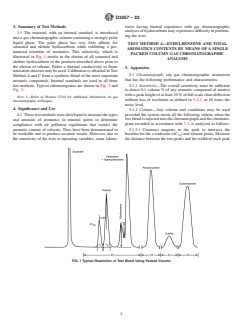
illustrated in Fig. 1 results in the elution of all saturated and
ANALYSIS
olefinic hydrocarbons in the products described above prior to
the elution of toluene. Either a thermal conductivity or flame
5. Apparatus
ionizationdetectormaybeused.CalibrationisobtainedinTest
5.1 Chromatograph, any gas chromatographic instrument
MethodAand C from a synthetic blend of the most important
that has the following performance and characteristics:
aromatic compounds. Internal standards are used in all three
test methods. Typical chromatograms are shown in Fig. 2 and 5.1.1 Sensitivity—The overall sensitivity must be sufficient
to detect 0.1 volume% of any aromatic compound of interest
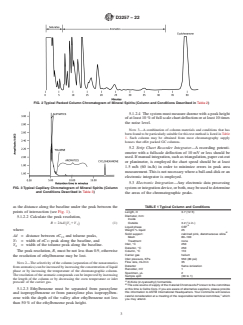
Fig. 3.
withapeakheightofatleast10%offull-scalechartdeflection
NOTE 1—Refer to Practice E260 for additional information on gas
without loss of resolution as defined in 5.1.2, or 10 times the
chromatography techniques.
noise level.
4. Significance and Use
5.1.2 Column—Any column and conditions may be used
provided the system meets all the following criteria when the
4.1 Thesetestmethodsweredevelopedtomeasurethetypes
testblendisinjectedintothechromatographandthechromato-
and amounts of aromatics in mineral spirits to determine
gram recorded in accordance with 7.2, is analyzed as follows:
compliance with air pollution regulations that restrict the
aromatic content of solvents. They have been demonstrated to 5.1.2.1 Construct tangents to the peak to intersect the
be workable and to produce accurate results. However, due to baseline for the n-tridecane (nC ) and toluene peaks. Measure
the sensitivity of the tests to operating variables, some labora- the distance between the two peaks and the width of each peak
FIG. 1 Typical Resolution of Test Blend Using Packed Column
D3257 − 22
FIG. 2 Typical Packed Column Chromatogram of Mineral Spirits (Column and Conditions Described in Table 2)
5.1.2.4 The system must measure durene with a peak height
ofatleast10%offullscalechartdeflectionoratleast10times
the noise level.
NOTE 3—A combination of column materials and conditions that has
beenfoundtobeparticularlysuitableforthistestmethodislistedinTable
1. Such column may be obtained from most chromatography supply
houses that offer packed GC columns.
5.2 Strip Chart Recorder Integrator—A recording potenti-
ometer with a fullscale deflection of 10 mV or less should be
used.Ifmanualintegration,suchastriangulation,papercut-out
or planimeter, is employed the chart speed should be at least
1.5 m/h (60 in./h) in order to minimize errors in peak area
measurement.Thisisnotnecessarywhereaball-and-diskoran
electronic integrator is employed.
5.3 Electronic Integration—Any electronic data processing
FIG. 3 Typical Capillary Chromatogram of Mineral Spirits (Column systemorintegrationdevice,orboth,maybeusedtodetermine
and Conditions Described in Table 3)
the areas of the chromatographic peaks.
TABLE 1 Typical Column and Conditions
as the distance along the baseline under the peak between the
points of intersection (see Fig. 1).
Length, m 3.7 (12 ft)
Diameter, mm:
5.1.2.2 Calculate the peak resolution,
Inside .
R 5 2∆d/ Y 1Y (1) Outside 3.2 ( ⁄8 in.)
~ 1 2!
A
Liquid phase CEF
Weight % liquid 25
where:
B
Solid support: calcined pink, diatomaceous silica
∆d = distance between nC and toluene peaks,
13 Mesh 80–100
Y = width of nC peak along the baseline, and
Treatment none
1 13
Inlet, °C 250
Y = width of the toluene peak along the baseline.
Detector, °C 250
The peak resolution, R, must be not less than 0.9, otherwise
Column, °C 110
Carrier gas helium
the resolution of ethylbenzene may be lost.
Inlet pressure, KPa 550 (80 psi)
Flow rate, mL/min 35
NOTE 2—The selectivity of the column (separation of the nonaromatics
Detector flame ionization
fromaromatics)canbeincreasedbyincreasingtheconcentrationofliquid
Recorder, mV 1
phase or by increasing the temperature of the chromatographic column.
Specimen, µL 2
The resolution of the aromatic compounds can be improved by increasing
Sample split (30 to 1)
the length of the column or by decreasing the oven temperature or inlet
A
N,N-bis (2-cyanoethyl) formamide.
pressure of the carrier gas.
B
ThesolesourceofsupplyofthematerialChromosorb-Pknowntothecommittee
5.1.2.3 Ethylbenzene must be separated from paraxylene at this time is Celite Corp. If you are aware of alternative suppliers, please provide
this information to ASTM International Headquarters. Your comments will receive
and isopropylbenzene or from paraxylene plus isopropylben-
careful consideration at a meeting of the responsible technical committee, which
zene with the depth of the valley after ethylbenzene not less
you may attend.
than 50% of the ethylbenzene peak height.
D3257 − 22
5.4 Micro Syringe—A10-µL micro syringe for specimen where:
introduction.
r = relative response factor for aromatics,
A = area of the internal standard peak in arbitrary units
IS
6. Reagents and Materials
corrected for attenuation,
V = volume % of the internal standard in the blend,
IS
6.1 Aromatic Hydrocarbons—Toluene, ethylbenzene,
A = area of the pseudocumene peak in arbitrary units
a
paraxylene, isopropylbenzene (cumene), 1,2,4-
corrected for attenuation, and
trimethylbenzene (pseudocumene), and 1,2,4,5-
V = volume % of pseudocumene in the blend.
a
tetramethylbenzene (durene) 99.5 mol% minimum.
6.2 Carrier Gas (Note 3). 8. Procedure
8.1 Using the exact instrument conditions as were used in
6.3 Internal Standard—Cyclohexanone, 99.5 mol% mini-
mum (see 1.7). the calibration, inject the test material. Inspect the chromato-
gramtodeterminethatthereiscompleteresolutionbetweenthe
6.4 Chromatographic Column (Note 3).
saturated and the aromatic peaks.
6.5 Normal Paraffın—n-Tridecane, 99.5 mol% minimum.
8.2 Pipetexactly1.0mLofcyclohexanoneinternalstandard
6.6 Solid Support (Note 3).
intoa10-mLvolumetricflask.Filltothemarkwiththesample
and mix by inverting several times.
6.7 Paraffın Solvent for Test Blend—n-Hexane, n-heptane,
or iso-octane 99 mol% minimum.
8.3 With the exact instrumental conditions used in the
calibration, inject the same volume of sample containing the
7. Calibration
internal standard. Change the attenuation, if necessary, so as to
measure the area of the internal standard and aromatic peaks
7.1 Preparation of Test Blend—Prepare a test blend to
withnotlessthan25%normorethan95%chartdeflectionon
evaluatethesensitivityandresolutionoftheequipmentandtest
attenuated peaks.
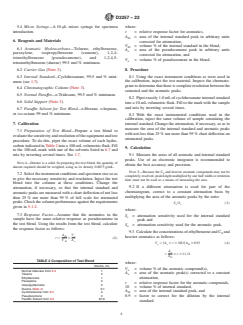
procedure. To do this, pipet the exact volume of each hydro-
carbonindicatedinTable2intoa100-mLvolumetricflask.Fill
9. Calculation
to the 100-mL mark with one of the solvents listed in 6.7 and
mix by inverting several times. See 1.7.
9.1 Measure the areas of all aromatic and internal standard
peaks. Use of an electronic integrator is recommended to
NOTE 4—Durene is a solid. In preparing the test blend, the quantity of
obtain the best accuracy and precision.
durene required should be weighed, using as its density 0.8875 g/mL.
NOTE 5—Because the C and heavier aromatic compounds may not be
7.2 Selecttheinstrumentconditionsandspecimensizesoas
completelyresolved,peakheightmultipliedbyonehalfwidthorretention
to give the necessary sensitivity and resolution. Inject the test
time must not be used as a means of measuring the area.
blend into the column at these conditions. Change the
9.2 If a different attenuation is used for part of the
attenuation, if necessary, so that the internal standard and
chromatogram, correct to a constant attenuation basis by
aromatic peaks are measured with a chart deflection of not less
multiplying the area of the aromatic peaks by the ratio:
than 25% nor more than 95% of full scale for attenuated
peaks.Checkthecolumnperformanceagainsttherequirements
S /S (3)
a s
given in 5.1.2.
where:
7.3 Response Factor—Assume that the aromatics in the
S = attenuation sensitivity used for the internal standard
s
sample have the same relative response as pseudocumene in
peak and
the test blend. Using the results from the test blend, calculate
S = attenuation sensitivity used for the aromatic peak.
a
the response factor as follows:
9.3 CalculatetheconcentrationsofethylbenzeneandC and
A V
IS a
heavier aromatics as follows:
r 5 3 (2)
V A
IS a
V 5 ~A 3 r 310!/~A 30.9! (4)
a a IS
A
a
5 3 r 311.11
A
IS
TABLE 2 Composition of Test Blend
where:
Volume, mL
V = volume% of the aromatic compound(s),
a
Normal tridecane from 6.5 1
A = area of the aromatic peak(s) corrected to a constant
Toluene 2 a
Ethylbenzene 1
attenuation,
Paraxylene 2
r = relative response factor for the aromatic compounds,
Isopropylbenzene 2
10 = volume% of internal standard,
Durene (Note 4) 0.1
A = area of the internal standard peak, and
Cyclohexanone from 6.3 2
IS
Pseudocumene 2
0.9 = factor to correct for the dilution by the internal
Paraffin Solvent from 6.5 87.9
standard.
D3257 − 22
9.4 Total Aromatics—Add the amounts of the aromatic 12.4 Micro Syringe—See 5.4.
compounds found to obtain the volume percent of total
13. Reagents and Materials
aromatics in the sample.
13.1 Aromatic Hydrocarbons—Benzene, toluene and ethyl-
10. Report
benzene of 99.5 mol% minimum purity (see 1.7).
10.1 Report the following information: concentrations of
13.2 Carrier Gas—Helium.
ethylbenzene, total aromatics, and C plus higher aromatics
14. Procedure
(except ethylbenzene) in volume percent to the nearest 0.1%.
14.1 Set the gas chromatograph instrument conditions as
11. Precision and Bias
follows:
11.1 Theprecisionestimatesarebasedonaninterlaboratory
Detector cell temperature, °C 300
studyonfoursamples,containingapproximately6.5,8.5,11.8,
Detector cell current, mA 150
Injection port temperature, °C 300
and 16.5% total aromatics and 0.0, 1.0, 4.0, and 0.3%
Helium flow at exit, mL/min 110
ethylbenzene. One analyst in each of six laboratories per-
Column temperature, °C 100
formedduplicatedeterminationsondifferentdays,foratotalof
14.2 Pipetexactly1.0mLoftolueneinternalstandardintoa
48 determinations of total aromatics content and 48 determi-
10-mL volumetric flask. Fill to the mark with the mineral
nations of ethylbenzene content. The within-laboratory coeffi-
spirits sample, and mix thoroughly by inverting several times.
cient of variation was found to be 1.7% relative with 23 df,
See 1.7.
andthebetween-laboratoriescoefficientofvariationwas4.4%
relative with 5 df. Based on these coefficients the following NOTE 7—Both ethyl benzene and toluene contents may be determined,
if present, by using benzene as the internal standard.
criteria should be used for judging the acceptability of results
at the 95% confidence level. 14.3 Inject 3 µLof sample containing the internal standard,
...