

ASTM F3146-18
(Test Method)Standard Test Method for Impact Attenuation of Turf Playing Systems Designated for Rugby
General Information
- Abstract
SIGNIFICANCE AND USE
5.1 This test method is to be used to measure the impact attenuation of synthetic turf rugby fields and to estimate the CFH performance.
5.2 It is acceptable for this test method to be specified for use by other organizations, specifiers, or facility owners where it is deemed appropriate.
SCOPE
1.1 This standard establishes a test method to be used when testing a synthetic turf field’s impact attenuation property for assessing its suitability for rugby.
1.2 The surface being tested will be located indoors or outdoors and typically includes the entire surface, both within the boundary lines of the playing area and outside of it. Where non-turf surfaces exist within these areas, they shall be excluded from the scope of this standard, unless they are covered either permanently or temporarily with synthetic turf.
1.3 It is acceptable to use this test method, where appropriate, as a test method for laboratory based testing of synthetic turf surfaces.
1.4 The definition of a minimum performance requirement for this test method is outside of the scope of this standard. Where reference is made to a minimum requirement this is intended for demonstration and clarification purposes only.
1.5 This test method establishes a method of reporting test results.
1.6 The values stated in SI units are to be regarded as standard. Where values are given in parenthesis they are mathematical conversions to inch-pound units that are provided for information purposes only and are not considered standard.
1.7 This standard does not purport to address all of the safety concerns, if any, associated with its use. It is the responsibility of the user of this standard to establish appropriate safety, health, and environmental practices and determine the applicability of regulatory limitations prior to use.
1.8 This international standard was developed in accordance with internationally recognized principles on standardization established in the Decision on Principles for the Development of International Standards, Guides and Recommendations issued by the World Trade Organization Technical Barriers to Trade (TBT) Committee.
- Status
- Published
- Publication Date
- 31-Jul-2018
- Technical Committee
- F08 - Sports Equipment, Playing Surfaces, and Facilities
- Drafting Committee
- F08.65 - Artificial Turf Surfaces and Systems
Overview
ASTM F3146-18 - Standard Test Method for Impact Attenuation of Turf Playing Systems Designated for Rugby is an internationally recognized test method published by ASTM International. This standard establishes procedures to assess the impact attenuation property of synthetic turf fields, evaluating their suitability for rugby use based on head injury criterion (HIC) and critical fall height (CFH) measures. The test can be performed on both indoor and outdoor turf systems and is designed to help facility owners, specifiers, and other organizations verify the safety and performance characteristics of artificial turf used for rugby playing surfaces.
Key Topics
- Impact Attenuation Measurement: This standard specifically outlines the methodology for measuring how synthetic turf surfaces absorb impacts, an important factor in preventing player injuries, especially concussions.
- Critical Fall Height (CFH) Estimation: Results from impact attenuation tests are used to estimate CFH, offering a quantifiable measure of the surface’s safety performance.
- Applicability: While intended for rugby-specific synthetic turf systems, the method can also be employed for laboratory testing and in other contexts where assessment of impact performance is relevant.
- Test Coverage and Scope: Testing generally includes the playing area within the boundary lines and any other synthetic turf surface, whether indoors or outdoors. Non-turf zones are excluded unless covered by synthetic turf.
- Reporting and Units: Test results are to be reported in SI units, with conversions to inch-pound for reference only. Reports must detail test conditions, drop heights, HIC values, CFH, and a statement addressing the influence of environment and location on results.
- Safety Considerations: Users of the standard are responsible for ensuring appropriate safety, health, and environmental practices during test implementation.
Applications
ASTM F3146-18 is a valuable tool for:
- Field Owners and Managers: Ensuring their rugby turf field surfaces meet recognized safety and performance benchmarks.
- Product Manufacturers: Demonstrating compliance of their synthetic turf products with industry standards for impact attenuation.
- Sports Organizations and Specifiers: Including as part of facility certification programs or maintenance regimes for player welfare.
- Accredited Testing Laboratories: Conducting laboratory-based evaluations of artificial turf systems as a part of product development, quality control, or third-party certification.
- Regulatory and Standards Bodies: Citing ASTM F3146-18 in specifications for new construction or refurbishment projects involving rugby fields.
Compliance with this standard supports efforts to minimize injury risk, particularly head injuries, associated with falls on synthetic turf. However, it is important to note that HIC and CFH are only two aspects of a comprehensive player safety profile for a rugby field. Additional factors such as shock absorption, surface deformation, and rotational resistance should also be considered for a complete safety assessment.
Related Standards
- ASTM F355 - Test Method for Impact Attenuation of Playing Surface Systems, Other Protective Sport Systems, and Materials Used for Athletics, Recreation, and Play
- ASTM F2650 - Terminology Relating to Impact Testing of Sports Surfaces and Equipment
- World Rugby Regulation 22 & Artificial Turf Performance Specification - Governing artificial turf use for rugby worldwide
- EN 1177 - Impact attenuating playground surfacing - Methods of test for determination of impact attenuation
- ASTM F1292 - Impact Attenuation of Surfacing Materials Within the Use Zone of Playground Equipment
- ISO 6487 - Measurement techniques in impact tests
- ISO 17025 - General requirements for the competence of testing and calibration laboratories
By applying ASTM F3146-18, stakeholders in the sports surface industry can provide safer, higher-quality synthetic turf fields for rugby, thereby protecting player welfare and supporting the long-term integrity of the sport.
Relations
- Effective Date
- 01-Dec-2023
- Refers
ASTM F2650-17 - Standard Terminology Relating to Impact Testing of Sports Surfaces and Equipment - Effective Date
- 15-Sep-2017
- Refers
ASTM F2650-17e1 - Standard Terminology Relating to Impact Testing of Sports Surfaces and Equipment - Effective Date
- 15-Sep-2017
- Effective Date
- 01-Jul-2016
- Effective Date
- 01-Jul-2016
- Refers
ASTM F2650-13 - Standard Terminology Relating to Impact Testing of Sports Surfaces and Equipment - Effective Date
- 01-Jun-2013
- Refers
ASTM F355-10a - Standard Test Method for Impact Attenuation of Playing Surface Systems and Materials - Effective Date
- 01-Jul-2010
- Refers
ASTM F355-10 - Standard Test Method for Impact Attenuation of Playing Surface Systems and Materials - Effective Date
- 15-Apr-2010
- Refers
ASTM F355-09 - Standard Test Method for Impact Attenuation of Playing Surface Systems and Materials - Effective Date
- 15-Nov-2009
- Refers
ASTM F2650-07 - Standard Terminology Relating to Impact Testing of Sports Surfaces and Equipment - Effective Date
- 01-Aug-2007
- Effective Date
- 10-Nov-2001
- Effective Date
- 10-Nov-2001
Frequently Asked Questions
ASTM F3146-18 is a standard published by ASTM International. Its full title is "Standard Test Method for Impact Attenuation of Turf Playing Systems Designated for Rugby". This standard covers: SIGNIFICANCE AND USE 5.1 This test method is to be used to measure the impact attenuation of synthetic turf rugby fields and to estimate the CFH performance. 5.2 It is acceptable for this test method to be specified for use by other organizations, specifiers, or facility owners where it is deemed appropriate. SCOPE 1.1 This standard establishes a test method to be used when testing a synthetic turf field’s impact attenuation property for assessing its suitability for rugby. 1.2 The surface being tested will be located indoors or outdoors and typically includes the entire surface, both within the boundary lines of the playing area and outside of it. Where non-turf surfaces exist within these areas, they shall be excluded from the scope of this standard, unless they are covered either permanently or temporarily with synthetic turf. 1.3 It is acceptable to use this test method, where appropriate, as a test method for laboratory based testing of synthetic turf surfaces. 1.4 The definition of a minimum performance requirement for this test method is outside of the scope of this standard. Where reference is made to a minimum requirement this is intended for demonstration and clarification purposes only. 1.5 This test method establishes a method of reporting test results. 1.6 The values stated in SI units are to be regarded as standard. Where values are given in parenthesis they are mathematical conversions to inch-pound units that are provided for information purposes only and are not considered standard. 1.7 This standard does not purport to address all of the safety concerns, if any, associated with its use. It is the responsibility of the user of this standard to establish appropriate safety, health, and environmental practices and determine the applicability of regulatory limitations prior to use. 1.8 This international standard was developed in accordance with internationally recognized principles on standardization established in the Decision on Principles for the Development of International Standards, Guides and Recommendations issued by the World Trade Organization Technical Barriers to Trade (TBT) Committee.
SIGNIFICANCE AND USE 5.1 This test method is to be used to measure the impact attenuation of synthetic turf rugby fields and to estimate the CFH performance. 5.2 It is acceptable for this test method to be specified for use by other organizations, specifiers, or facility owners where it is deemed appropriate. SCOPE 1.1 This standard establishes a test method to be used when testing a synthetic turf field’s impact attenuation property for assessing its suitability for rugby. 1.2 The surface being tested will be located indoors or outdoors and typically includes the entire surface, both within the boundary lines of the playing area and outside of it. Where non-turf surfaces exist within these areas, they shall be excluded from the scope of this standard, unless they are covered either permanently or temporarily with synthetic turf. 1.3 It is acceptable to use this test method, where appropriate, as a test method for laboratory based testing of synthetic turf surfaces. 1.4 The definition of a minimum performance requirement for this test method is outside of the scope of this standard. Where reference is made to a minimum requirement this is intended for demonstration and clarification purposes only. 1.5 This test method establishes a method of reporting test results. 1.6 The values stated in SI units are to be regarded as standard. Where values are given in parenthesis they are mathematical conversions to inch-pound units that are provided for information purposes only and are not considered standard. 1.7 This standard does not purport to address all of the safety concerns, if any, associated with its use. It is the responsibility of the user of this standard to establish appropriate safety, health, and environmental practices and determine the applicability of regulatory limitations prior to use. 1.8 This international standard was developed in accordance with internationally recognized principles on standardization established in the Decision on Principles for the Development of International Standards, Guides and Recommendations issued by the World Trade Organization Technical Barriers to Trade (TBT) Committee.
ASTM F3146-18 is classified under the following ICS (International Classification for Standards) categories: 97.220.10 - Sports facilities. The ICS classification helps identify the subject area and facilitates finding related standards.
ASTM F3146-18 has the following relationships with other standards: It is inter standard links to ASTM F355-23, ASTM F2650-17, ASTM F2650-17e1, ASTM F355-16, ASTM F355-16e1, ASTM F2650-13, ASTM F355-10a, ASTM F355-10, ASTM F355-09, ASTM F2650-07, ASTM F355-01, ASTM F355-95. Understanding these relationships helps ensure you are using the most current and applicable version of the standard.
ASTM F3146-18 is available in PDF format for immediate download after purchase. The document can be added to your cart and obtained through the secure checkout process. Digital delivery ensures instant access to the complete standard document.
Standards Content (Sample)
This international standard was developed in accordance with internationally recognized principles on standardization established in the Decision on Principles for the
Development of International Standards, Guides and Recommendations issued by the World Trade Organization Technical Barriers to Trade (TBT) Committee.
Designation: F3146 − 18
Standard Test Method for
Impact Attenuation of Turf Playing Systems Designated for
Rugby
This standard is issued under the fixed designation F3146; the number immediately following the designation indicates the year of
original adoption or, in the case of revision, the year of last revision. A number in parentheses indicates the year of last reapproval. A
superscript epsilon (´) indicates an editorial change since the last revision or reapproval.
1. Scope 2. Referenced Documents
1.1 This standard establishes a test method to be used when 2.1 ASTM Standards:
testing a synthetic turf field’s impact attenuation property for F355 TestMethodforImpactAttenuationofPlayingSurface
assessing its suitability for rugby. Systems, Other Protective Sport Systems, and Materials
Used for Athletics, Recreation and Play
1.2 The surface being tested will be located indoors or
F2650 Terminology Relating to Impact Testing of Sports
outdoors and typically includes the entire surface, both within
Surfaces and Equipment
the boundary lines of the playing area and outside of it. Where
2.2 World Rugby Documents:
non-turf surfaces exist within these areas, they shall be
Regulation 22 Standard Relating to the Use of Rugby Turf
excluded from the scope of this standard, unless they are
World Rugby’s Artificial Turf Performance Specification
covered either permanently or temporarily with synthetic turf.
1.3 It is acceptable to use this test method, where
3. Terminology
appropriate, as a test method for laboratory based testing of
3.1 Except as noted, definitions in this standard are in
synthetic turf surfaces.
accordance with terms defined in Terminology F2650.
1.4 The definition of a minimum performance requirement
3.2 Definitions:
for this test method is outside of the scope of this standard.
3.2.1 synthetic turf system, n—a synthetic surface intended
Where reference is made to a minimum requirement this is
for use in sport consisting of varying elements including but
intended for demonstration and clarification purposes only.
not limited to a stitched or woven carpet, stabilizing infill,
1.5 This test method establishes a method of reporting test
performance infill and a shock absorbing sub-material.
results.
3.2.2 critical fall height (CFH), n—a measure of the impact
1.6 The values stated in SI units are to be regarded as
attenuation performance of a surface; defined as the highest
standard. Where values are given in parenthesis they are
theoretical drop height from which a surface is estimated to
mathematical conversions to inch-pound units that are pro-
meet the impact attenuation performance criterion specified.
vided for information purposes only and are not considered
3.2.3 critical time value, n—t –t where t and t are the
2 1 1 2
standard.
initial and final times (in seconds) of the interval during which
1.7 This standard does not purport to address all of the
HIC attains maximum value.
safety concerns, if any, associated with its use. It is the
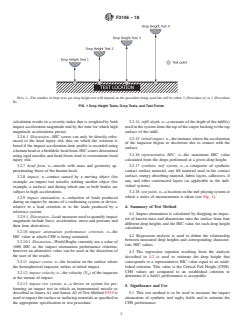
3.2.4 drop height test, n—the combined drop test(s) per-
responsibility of the user of this standard to establish appro-
formed at one specific drop height (see Fig. 1).
priate safety, health, and environmental practices and deter-
3.2.5 drop test, n—an individual drop of the E missile (as
mine the applicability of regulatory limitations prior to use.
definedinTestMethodF355)atatestpoint,wherethedrophas
1.8 This international standard was developed in accor-
been performed and recorded in accordance with prescribed
dance with internationally recognized principles on standard-
methodology (see Fig. 1).
ization established in the Decision on Principles for the
3.2.6 head injury criterion (HIC), n—weighted impulse
Development of International Standards, Guides and Recom-
criterion calculated from a head impact acceleration-time
mendations issued by the World Trade Organization Technical
profile and used to quantify head impact severity. The HIC
Barriers to Trade (TBT) Committee.
1 2
This test method is under the jurisdiction of ASTM Committee F08 on Sports For referenced ASTM standards, visit the ASTM website, www.astm.org, or
Equipment, Playing Surfaces, and Facilities and is the direct responsibility of contact ASTM Customer Service at service@astm.org. For Annual Book of ASTM
Subcommittee F08.65 on Artificial Turf Surfaces and Systems. Standards volume information, refer to the standard’s Document Summary page on
Current edition approved Aug. 1, 2018. Published November 2018. DOI: the ASTM website.
10.1520/F3146-18. Available from World Rugby, https://www.worldrugby.org/.
Copyright © ASTM International, 100 Barr Harbor Drive, PO Box C700, West Conshohocken, PA 19428-2959. United States
F3146 − 18
NOTE 1—The number of drop tests per drop height test will depend on the procedure being used but will be either 3 (Procedure A) or 1 (Procedure
B).
FIG. 1 Drop Height Tests, Drop Tests, and Test Points
calculation results in a severity index that is weighted by both 3.2.14 infill depth, n—a measure of the depth of the infill(s)
impact acceleration magnitude and by the time for which high used in the system from the top of the carpet backing to the top
magnitude accelerations persist. surface of the infill.
3.2.6.1 Discussion—HIC scores can only be directly refer-
3.2.15 initial impact, n—the instance where the acceleration
enced to the head injury risk data on which the criterion is
of the impactor begins to decelerate due to contact with the
based if the impact acceleration-time profile is recorded using
surface.
ahumanheadorabiofidelicheadform.HICscoresdetermined
3.2.16 representative HIC, n—the maximum HIC value
using rigid missiles and head forms tend to overestimate head
calculated from the drops performed at a given drop height.
injury risk.
3.2.7 head form, n—missile with mass and geometry ap- 3.2.17 synthetic turf system, n—a composite of synthetic
proximating those of the human head. contact surface material, any fill material used in the contact
surface, energy absorbing material, fabric layers, adhesives, if
3.2.8 impact, n—contact caused by a moving object (for
any, and other constructed layers (as applicable to the indi-
example, an impact test missile) striking another object (for
vidual system).
example, a surface) and during which one or both bodies are
subject to high accelerations.
3.2.18 test point, n—a location on the turf playing system at
which a series of measurements is taken (see Fig. 1).
3.2.9 impact attenuation, n—reduction of loads produced
during an impact by means of a cushioning system or device,
relative to a load criterion or to the loads produced by a 4. Summary of Test Method
reference system.
4.1 Impact attenuation is calculated by dropping an impac-
3.2.9.1 Discussion—Load measures used to quantify impact
tor of known mass and dimensions onto the surface from four
magnitude include force, acceleration, stress and pressure and
different drop heights and the HIC value for each drop height
their time derivatives.
calculated.
3.2.10 impact attenuation performance criterion, n—the
4.2 Regression analysis is used to define the relationship
HIC value at which CFH is being estimated.
between measured drop heights and corresponding character-
3.2.10.1 Discussion—World Rugby currently use a value of
istic HIC values.
1000 HIC as the impact attenuation performance criterion,
however an alternative value can be used at the discretion of
4.3 The regression equation resulting from the analysis
the user of the results.
described in 4.2 is used to estimate the drop height that
3.2.11 impact centre, n—the location on the surface where corresponds to a representative HIC value equal to an estab-
lished criterion. This value is the Critical Fall Height (CFH).
the hemispherical impactor strikes at initial impact.
CFH values are compared to an established criterion to
3.2.12 impact velocity, n—the velocity (V ) of the impactor
determine if a field’s performance is acceptable.
at the instant of impact.
3.2.13 impact test system, n—a device or system for per-
5. Significance and Use
forming an impact test in which an instrumented missile as
described in Annex A1 and Annex A2 of Test Method F355 is 5.1 This test method is to be used to measure the impact
usedtoimpactthesurfaceorsurfacingmaterialsasspecifiedin attenuation of synthetic turf rugby fields and to estimate the
the appropriate specification or test procedure. CFH performance.
F3146 − 18
5.2 It is acceptable for this test method to be specified for measuring stick, a steel tape or other appropriate means where
use by other organizations, specifiers, or facility owners where possible.An indirect means of determining the theoretical drop
it is deemed appropriate. height may also be used. Such indirect means are the velocity
measuring system via both:
6. Apparatus
8.12.1.1 A means of measuring the impact velocity with an
accuracy of 1m/s, and
6.1 The impact test system used must be appropriate for the
levels of performance expected. 8.12.1.2 A means of measuring the time interval between
release of the missile and the onset of impact (the fall time), in
7. Hazards which case the time interval shall be determined with a
resolution and accuracy of 1.0 ms. Both the measured drop
7.1 Any person using this test method needs to take appro-
height and the theoretical drop height shall be reported.
priate measures to ensure that the dropping mass does not pose
8.12.2 The two measurements above must agree within 61
any additional risk to any person during testing.This should be
% for the values to be valid.
done through the wearing of appropriate footwear, headgear
8.12.3 For a guided impact test, the theoretical drop height
and any other PPE.
must be determined by measuring the velocity of the missile
immediately prior to the onset of an impact; at a point in the
8. Procedure
missile’s trajectory no more than 51 mm above the first point
8.1 Record the infill depth at a representative place within
of contact between the missile and the surface under test. The
the test point area using an infill depth gauge or probe capable
velocitymeasuringsystemmayconsistofalightgatedeviceto
ofmeasuringtothenearest1mm.Makethreemeasurementsat
measure the time an opaque flag interrupts a light sensor or
each test point, within or immediately adjacent to the footprint
other appropriate means. The velocity measuring device shall
of the test apparatus; calculate and report the average.
not interfere with or impede the trajectory of the missile and
8.2 Set up the impact test system and prepare it for use in
shall be capable of recording impact velocity with a resolution
accordance with the manufacturer’s instructions.
of 0.03 m/s and an accuracy of 61 % of the true value.
8.3 Drop the E Missile on the surface ensuring that there are 8.12.4 Since theoretical drop height is proportional to the
no obstructions between the
...