

ASTM F1378-18e1
(Specification)Standard Specification for Shoulder Prostheses
General Information
- Abstract
ABSTRACT
This specification covers shoulder prostheses for total or hemiarthroplasty used to provide functioning articulation by employing glenoid and humeral components. The prostheses may be constrained, partially constrained, or unconstrained. Modular prostheses are included in this specification, but devices for custom applications are not covered. The prostheses are required to meet the prescribed mechanical strength, corrosion resistance, biocompatibility, wear of alternative, and range of motion.
SCOPE
1.1 This specification covers shoulder prostheses for total or hemiarthroplasty used to provide functioning articulation by employing glenoid and humeral components.
1.2 Devices for custom applications are not covered by this specification. Modular prostheses are included in this specification.
1.3 The values stated in SI units are to be regarded as standard. No other units of measurement are included in this standard.
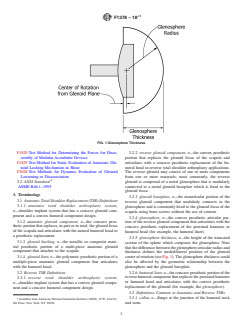
FIG. 1 Glenosphere Thickness
1.4 This international standard was developed in accordance with internationally recognized principles on standardization established in the Decision on Principles for the Development of International Standards, Guides and Recommendations issued by the World Trade Organization Technical Barriers to Trade (TBT) Committee.
- Status
- Published
- Publication Date
- 14-Dec-2018
- Technical Committee
- F04 - Medical and Surgical Materials and Devices
- Drafting Committee
- F04.22 - Arthroplasty
Overview
ASTM F1378-18e1: Standard Specification for Shoulder Prostheses provides comprehensive guidelines for the design, manufacture, and performance requirements of shoulder prostheses intended for total or hemiarthroplasty procedures. Developed by ASTM International, this specification applies to prostheses employing glenoid and humeral components, covering both modular and non-custom devices. Products compliant with this standard must meet rigorous criteria for mechanical strength, corrosion resistance, biocompatibility, wear of material pairs, and range of motion. By adhering to these criteria, manufacturers and clinicians can ensure that shoulder implants offer safe and effective functioning articulation for arthroplasty patients.
Key Topics
- Scope of Application: Applies to shoulder prostheses used in total or partial joint replacement utilizing glenoid and humeral components. Modular designs are included; however, custom devices are excluded.
- Classification: Identifies prostheses as constrained, partially constrained, or unconstrained, according to their ability to restrict joint movement and prevent dislocation.
- Materials: Specifies suitable surgical implant materials with a proven track record, including cobalt-chromium alloys, titanium alloys, stainless steels, and high-purity ceramics and polymers. All materials must demonstrate mechanical strength, corrosion resistance, and biocompatibility.
- Performance Requirements:
- Mechanical Strength: Components must endure static and dynamic physiological loads typically encountered in clinical use.
- Corrosion and Wear: Implants are tested for corrosion and must not exceed accepted wear rates for specified material couples, such as cobalt-chromium alloy versus ultra-high molecular weight polyethylene.
- Range of Motion: Shoulder prostheses must provide minimum movement ranges in flexion, abduction, internal and external rotation, and extension to mimic natural shoulder function.
- Testing Methods: Details laboratory test procedures and dimensional requirements, including surface finish standards for both metallic and polymeric bearing surfaces.
- Product Marking and Labeling: Requires clear marking of manufacturer, material, lot number, catalog number, and size. Package labeling must include dimensional and material specifications.
Applications
ASTM F1378-18e1 serves as a critical reference for the following practical scenarios:
- Medical Device Manufacturers: Guides the development and quality assurance of shoulder implants to meet clinical expectations for safety and efficacy.
- Regulatory Compliance: Assists manufacturers and regulatory bodies in verifying that devices satisfy globally recognized performance and safety benchmarks before market approval.
- Clinical Practice: Enables clinicians and orthopedic surgeons to select prostheses with documented strength, reliability, and performance characteristics suitable for various arthroplasty procedures.
- Research and Development: Provides a foundation for innovations in shoulder implant technology, supporting the design of new prosthetic materials, geometries, and modular configurations while ensuring adherence to essential performance properties.
Related Standards
ASTM F1378-18e1 references several related standards, ensuring comprehensive coverage of both materials and testing methods for surgical implants, such as:
- ASTM F75 - Cobalt-28 Chromium-6 Molybdenum Alloy for Surgical Implants
- ASTM F136 - Titanium-6Aluminum-4Vanadium ELI Alloy for Surgical Implant Applications
- ASTM F648 - Ultra-High-Molecular-Weight Polyethylene for Surgical Implants
- ASTM F746 - Test Method for Pitting or Crevice Corrosion of Metallic Surgical Implant Materials
- ASTM F1044, F1147, F2028 - Test Methods for mechanical evaluation and wear testing of implant surfaces
By referencing ASTM F1378-18e1 and its associated standards, stakeholders can ensure that shoulder prostheses are developed and applied in accordance with internationally accepted practices in orthopedic arthroplasty, promoting patient safety and optimal prosthetic function.
Keywords: shoulder prostheses, shoulder replacement implants, total shoulder arthroplasty, glenoid component, humeral component, ASTM shoulder implant standards, biocompatibility, modular prostheses, surgical implants, prosthetic material testing.
Relations
- Effective Date
- 15-Dec-2018
- Effective Date
- 01-Aug-2020
- Effective Date
- 01-Mar-2020
- Effective Date
- 01-Dec-2019
- Effective Date
- 15-May-2019
- Refers
ASTM F983-86(2018) - Standard Practice for Permanent Marking of Orthopaedic Implant Components - Effective Date
- 01-Feb-2018
- Effective Date
- 01-Dec-2017
- Refers
ASTM F2028-17 - Standard Test Methods for Dynamic Evaluation of Glenoid Loosening or Disassociation - Effective Date
- 01-Dec-2017
- Effective Date
- 01-Oct-2016
- Effective Date
- 01-Apr-2016
- Effective Date
- 01-Mar-2016
- Refers
ASTM F2028-14 - Standard Test Methods for Dynamic Evaluation of Glenoid Loosening or Disassociation - Effective Date
- 01-Mar-2014
- Effective Date
- 01-Oct-2013
- Refers
ASTM F983-86(2013) - Standard Practice for Permanent Marking of Orthopaedic Implant Components - Effective Date
- 01-Oct-2013
- Effective Date
- 01-Jul-2013
Get Certified
Connect with accredited certification bodies for this standard

BSI Group
BSI (British Standards Institution) is the business standards company that helps organizations make excellence a habit.

TÜV Rheinland
TÜV Rheinland is a leading international provider of technical services.

TÜV SÜD
TÜV SÜD is a trusted partner of choice for safety, security and sustainability solutions.
Sponsored listings
Frequently Asked Questions
ASTM F1378-18e1 is a technical specification published by ASTM International. Its full title is "Standard Specification for Shoulder Prostheses". This standard covers: ABSTRACT This specification covers shoulder prostheses for total or hemiarthroplasty used to provide functioning articulation by employing glenoid and humeral components. The prostheses may be constrained, partially constrained, or unconstrained. Modular prostheses are included in this specification, but devices for custom applications are not covered. The prostheses are required to meet the prescribed mechanical strength, corrosion resistance, biocompatibility, wear of alternative, and range of motion. SCOPE 1.1 This specification covers shoulder prostheses for total or hemiarthroplasty used to provide functioning articulation by employing glenoid and humeral components. 1.2 Devices for custom applications are not covered by this specification. Modular prostheses are included in this specification. 1.3 The values stated in SI units are to be regarded as standard. No other units of measurement are included in this standard. FIG. 1 Glenosphere Thickness 1.4 This international standard was developed in accordance with internationally recognized principles on standardization established in the Decision on Principles for the Development of International Standards, Guides and Recommendations issued by the World Trade Organization Technical Barriers to Trade (TBT) Committee.
ABSTRACT This specification covers shoulder prostheses for total or hemiarthroplasty used to provide functioning articulation by employing glenoid and humeral components. The prostheses may be constrained, partially constrained, or unconstrained. Modular prostheses are included in this specification, but devices for custom applications are not covered. The prostheses are required to meet the prescribed mechanical strength, corrosion resistance, biocompatibility, wear of alternative, and range of motion. SCOPE 1.1 This specification covers shoulder prostheses for total or hemiarthroplasty used to provide functioning articulation by employing glenoid and humeral components. 1.2 Devices for custom applications are not covered by this specification. Modular prostheses are included in this specification. 1.3 The values stated in SI units are to be regarded as standard. No other units of measurement are included in this standard. FIG. 1 Glenosphere Thickness 1.4 This international standard was developed in accordance with internationally recognized principles on standardization established in the Decision on Principles for the Development of International Standards, Guides and Recommendations issued by the World Trade Organization Technical Barriers to Trade (TBT) Committee.
ASTM F1378-18e1 is classified under the following ICS (International Classification for Standards) categories: 11.040.40 - Implants for surgery, prosthetics and orthotics. The ICS classification helps identify the subject area and facilitates finding related standards.
ASTM F1378-18e1 has the following relationships with other standards: It is inter standard links to ASTM F1378-18, ASTM F603-12(2020), ASTM F1537-20, ASTM F138-19, ASTM F799-19, ASTM F983-86(2018), ASTM F1044-05(2017)e1, ASTM F2028-17, ASTM F603-12(2016), ASTM F748-16, ASTM F1829-16, ASTM F2028-14, ASTM F138-13a, ASTM F983-86(2013), ASTM F648-13. Understanding these relationships helps ensure you are using the most current and applicable version of the standard.
ASTM F1378-18e1 is available in PDF format for immediate download after purchase. The document can be added to your cart and obtained through the secure checkout process. Digital delivery ensures instant access to the complete standard document.
Standards Content (Sample)
This international standard was developed in accordance with internationally recognized principles on standardization established in the Decision on Principles for the
Development of International Standards, Guides and Recommendations issued by the World Trade Organization Technical Barriers to Trade (TBT) Committee.
´1
Designation: F1378 −18
Standard Specification for
Shoulder Prostheses
This standard is issued under the fixed designation F1378; the number immediately following the designation indicates the year of
original adoption or, in the case of revision, the year of last revision. A number in parentheses indicates the year of last reapproval. A
superscript epsilon (´) indicates an editorial change since the last revision or reapproval.
ε NOTE—Corrected editorially in June 2019.
1. Scope 2.5Molybdenum Stainless Steel Bar and Wire for Surgical
Implants (UNS S31673)
1.1 This specification covers shoulder prostheses for total or
F562 Specification for Wrought 35Cobalt-35Nickel-
hemiarthroplasty used to provide functioning articulation by
20Chromium-10Molybdenum Alloy for Surgical Implant
employing glenoid and humeral components.
Applications (UNS R30035)
1.2 Devices for custom applications are not covered by this
F563 Specification for Wrought Cobalt-20Nickel-
specification. Modular prostheses are included in this specifi-
20Chromium-3.5Molybdenum-3.5Tungsten-5Iron Alloy
cation.
for Surgical Implant Applications (UNS R30563) (With-
1.3 The values stated in SI units are to be regarded as drawn 2005)
F603 Specification for High-Purity Dense Aluminum Oxide
standard. No other units of measurement are included in this
standard. for Medical Application
F648 Specification for Ultra-High-Molecular-Weight Poly-
1.4 This international standard was developed in accor-
ethylene Powder and Fabricated Form for Surgical Im-
dance with internationally recognized principles on standard-
plants
ization established in the Decision on Principles for the
F745 Specification for 18Chromium-12.5Nickel-
Development of International Standards, Guides and Recom-
2.5Molybdenum Stainless Steel for Cast and Solution-
mendations issued by the World Trade Organization Technical
Annealed Surgical Implant Applications (Withdrawn
Barriers to Trade (TBT) Committee.
2012)
F746 Test Method for Pitting or Crevice Corrosion of
2. Referenced Documents
Metallic Surgical Implant Materials
2.1 ASTM Standards:
F748 PracticeforSelectingGenericBiologicalTestMethods
F75 Specification for Cobalt-28 Chromium-6 Molybdenum
for Materials and Devices
Alloy Castings and Casting Alloy for Surgical Implants
F799 Specification for Cobalt-28Chromium-6Molybdenum
(UNS R30075)
Alloy Forgings for Surgical Implants (UNS R31537,
F86 Practice for Surface Preparation and Marking of Metal-
R31538, R31539)
lic Surgical Implants
F981 Practice for Assessment of Compatibility of Biomate-
F90 Specification for Wrought Cobalt-20Chromium-
rials for Surgical Implants with Respect to Effect of
15Tungsten-10NickelAlloy for Surgical ImplantApplica-
Materials on Muscle and Insertion into Bone
tions (UNS R30605)
F983 Practice for Permanent Marking of Orthopaedic Im-
F136 Specification for Wrought Titanium-6Aluminum-
plant Components
4Vanadium ELI (Extra Low Interstitial)Alloy for Surgical
F1044 Test Method for Shear Testing of Calcium Phosphate
Implant Applications (UNS R56401)
Coatings and Metallic Coatings
F138 Specification for Wrought 18Chromium-14Nickel-
F1108 Specification for Titanium-6Aluminum-4Vanadium
Alloy Castings for Surgical Implants (UNS R56406)
F1147 Test Method for Tension Testing of Calcium Phos-
This specification is under the jurisdiction of ASTM Committee F04 on
phate and Metallic Coatings
Medical and Surgical Materials and Devices and is the direct responsibility of
F1537 Specification for Wrought Cobalt-28Chromium-
Subcommittee F04.22 on Arthroplasty.
Current edition approved Dec. 15, 2018. Published March 2019. Originally
6Molybdenum Alloys for Surgical Implants (UNS
approved in 1992. Last previous edition approved in 2017 as F1378 – 17. DOI:
R31537, UNS R31538, and UNS R31539)
10.1520/F1378-18E01.
For referenced ASTM standards, visit the ASTM website, www.astm.org, or
contact ASTM Customer Service at service@astm.org. For Annual Book of ASTM
Standards volume information, refer to the standard’s Document Summary page on The last approved version of this historical standard is referenced on
the ASTM website. www.astm.org.
Copyright © ASTM International, 100 Barr Harbor Drive, PO Box C700, West Conshohocken, PA 19428-2959. United States
´1
F1378 − 18
FIG. 1 Glenosphere Thickness
F1820 Test Method for Determining the Forces for Disas- 3.2.2 reverse glenoid component, n—the convex prosthetic
sembly of Modular Acetabular Devices portion that replaces the glenoid fossa of the scapula and
F1829 Test Method for Static Evaluation of Anatomic Gle- articulates with a concave prosthetic replacement of the hu-
noid Locking Mechanism in Shear meral head in reverse total shoulder arthroplasty applications.
F2028 Test Methods for Dynamic Evaluation of Glenoid The reverse glenoid may consist of one or more components
Loosening or Disassociation from one or more materials; most commonly, the reverse
2.2 ANSI Standard: glenoid is composed of a metal glenosphere that is modularly
ASME B46.1–1995 connected to a metal glenoid baseplate which is fixed to the
glenoid fossa.
3. Terminology
3.2.3 glenoid baseplate, n—the nonarticular portion of the
3.1 Anatomic Total Shoulder Replacement (TSR) Definitions
reverse glenoid component that modularly connects to the
3.1.1 anatomic total shoulder arthroplasty system,
glenosphere and is commonly fixed to the glenoid fossa of the
n—shoulder implant system that has a concave glenoid com-
scapula using bone screws without the use of cement.
ponent and a convex humeral component design.
3.2.4 glenosphere, n—the convex prosthetic articular por-
3.1.2 anatomic glenoid component, n—the concave pros-
tion of the reverse glenoid component that articulates with the
thetic portion that replaces, in part or in total, the glenoid fossa
concave prosthetic replacement of the proximal humerus or
of the scapula and articulates with the natural humeral head or
humeral head (for example, the humeral liner).
a prosthetic replacement.
3.2.5 glenosphere thickness, n—the height of the truncated
3.1.3 glenoid backing, n—the metallic or composite mate-
section of the sphere which composes the glenosphere. Note
rial prosthetic portion of a multi-piece anatomic glenoid
thatthedifferencebetweentheglenospherearticularradiusand
component that attaches to the scapula.
thickness defines the medial/lateral position of the glenoid
center of rotation (see Fig. 1).The glenosphere thickness could
3.1.4 glenoid liner, n—the polymeric prosthetic portion of a
multiple-piece anatomic glenoid component that articulates also be affected by the geometric relationship between the
glenosphere and the glenoid baseplate.
with the humeral head.
3.2.6 humeral liner, n—theconcaveprostheticportionofthe
3.2 Reverse TSR Definitions
reversehumeralcomponentthatreplacestheproximalhumerus
3.2.1 reverse total shoulder arthroplasty system,
or humeral head and articulates with the convex prosthetic
n—shoulder implant system that has a convex glenoid compo-
replacement of the glenoid (for example, the glenosphere).
nent and a concave humeral component design.
3.3 Definitions Common to Anatomic and Reverse TSRs
3.3.1 collar, n—flange at the junction of the humeral neck
Available fromAmerican National Standards Institute (ANSI), 25 W. 43rd St.,
4th Floor, New York, NY 10036. and stem.
´1
F1378 − 18
3.3.2 keel (or pegs), n—single or multiple projections that mally prosthesis movement in one or more planes. Its compo-
provide resistance to translation or rotation of the glenoid nents have no across-the-joint linkage.
component, or both, by mating with cavities created in the
glenoid fossa. 5. Materials and Manufacture
3.3.3 neck, n—segment connecting the head and the stem.
5.1 The choice of materials is understood to be a necessary
but not sufficient ensurance of function of the device made
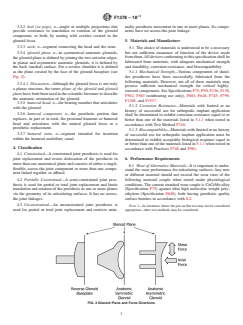
3.3.4 glenoid plane, n—in symmetrical anatomic glenoids,
fromthem.Alldevicesconformingtothisspecificationshallbe
the glenoid plane is defined by joining the two articular edges;
fabricated from materials, with adequate mechanical strength
in planar and asymmetric anatomic glenoids, it is defined by
and durability, corrosion resistance, and biocompatibility.
the back (medial) surface. For a reverse shoulder it is defined
5.1.1 Mechanical Strength—Various components of shoul-
as the plane created by the face of the glenoid baseplate (see
Fig. 2). der prostheses have been successfully fabricated from the
following materials. However, not all of these materials may
3.3.4.1 Discussion—Although the glenoid fossa is not truly
possess sufficient mechanical strength for critical highly-
a planar structure, the terms plane of the glenoid and glenoid
stressed components. See Specifications F75, F90, F136, F138,
planehavebothbeenusedinthescientificliteraturetodescribe
F562, F563 (nonbearing use only), F603, F648, F745, F799,
the anatomic orientation of the glenoid.
F1108, and F1537.
3.3.5 humeral head, n—the bearing member that articulates
5.1.2 Corrosion Resistance—Materials with limited or no
with the glenoid.
history of successful use for orthopedic implant application
3.3.6 humeral component, n—the prosthetic portion that
shall be determined to exhibit corrosion resistance equal to or
replaces, in part or in total, the proximal humerus or humeral
better than one of the materials listed in 5.1.1 when tested in
head and articulates with the natural glenoid fossa or a
accordance with Test Method F746.
prosthetic replacement.
5.1.3 Biocompatibility—Materials with limited or no history
3.3.7 humeral stem, n—segment intended for insertion
of successful use for orthopedic implant application must be
within the humeral medullary canal.
determined to exhibit acceptable biological response equal to
or better than one of the materials listed in 5.1.1 when tested in
4. Classification
accordance with Practices F748 and F981.
4.1 Constrained—A constrained joint prosthesis is used for
6. Performance Requirements
joint replacement and resists dislocation of the prosthesis in
more than one anatomical plane and consists of either a single,
6.1 Wear of Alternative Materials—It is important to under-
flexible, across-the-joint component or more than one compo-
stand the wear performance for articulating surfaces.Any new
nent linked together or affined.
or different material should not exceed the wear rates of the
4.2 Partially Constrained—A semi-constrained joint pros-
following material couple when tested under physiological
thesis is used for partial or total joint replacement and limits conditions. The current standard wear couple is CoCrMo alloy
translation and rotation of the prosthesis in one or more planes
(Specification F75) against ultra high molecular weight poly-
via the geometry of its articulating surfaces. It has no across- ethylene (Specification F648), both having prosthetic quality
the-joint linkages.
surface finishes in accordance with 8.2.
4.3 Unconstrained—An unconstrained joint prosthesis is
NOTE 1—In situations where the pin-on-flat test may not be considered
used for partial or total joint replacement and restricts mini- appropriate, other test methods may be considered.
FIG. 2 Glenoid Plane and Force Directions
´1
F1378 − 18
6.2 Range of Motion of Shoulder Prosthesis Prior to of up to 1 times body weight (per 6.4.1) without compromise
Implantation—Flexion shall be equal to or greater than 90°. of their function for the intended use and environment. All
Abduction shall be equal to or greater than 90°. Internal implants should be tested for loosening for a clinically relevant
rotation shall be equal to or greater than 90°. External rotation number of cycles. It has been suggested by Anglin et al that
shall be equal to or greater than 45°. Extension shall be equal 100 000 cycles is a suitable number of cycles.Alarger number
to or gre
...