

ASTM D7501-22
(Test Method)Standard Test Method for Determination of Fuel Filter Blocking Potential of Biodiesel Fuel Blendstock (B100) by Cold Soak Filtration Test (CSFT)
General Information
- Abstract
SIGNIFICANCE AND USE
5.1 Some substances that are soluble or appear to be soluble in biodiesel fuel blendstock (B100) at room temperature will, upon cooling to temperatures above the cloud point or standing at room temperature for extended periods, come out of solution. This phenomenon has been observed in both B100 and biodiesel blends. These substances can cause filter plugging. This method provides an accelerated means of assessing the presence of these substances in B100 and their propensity to plug filters.
5.1.1 Biodiesel fuel blendstocks that yield short filtration times are expected to give satisfactory operation of biodiesel blends at least down to the cloud point of the biodiesel blends.
5.2 The test method can be used in specifications as a means of controlling levels of minor filter plugging components in biodiesel and biodiesel blends.
SCOPE
1.1 This test method covers the determination by filtration time after cold soak for the suitability of biodiesel fuel blendstock (B100) that meets all other requirements of Specification D6751 and has a cloud point below 20 °C (68 °F) to provide adequate low temperature operability performance to at least the cloud point of the finished blend.
1.2 The values stated in SI units are to be regarded as standard. Non-SI units are given for information only.
1.3 This standard does not purport to address all of the safety concerns, if any, associated with its use. It is the responsibility of the user of this standard to establish appropriate safety, health, and environmental practices and determine the applicability of regulatory limitations prior to use.
1.4 This international standard was developed in accordance with internationally recognized principles on standardization established in the Decision on Principles for the Development of International Standards, Guides and Recommendations issued by the World Trade Organization Technical Barriers to Trade (TBT) Committee.
- Status
- Published
- Publication Date
- 31-Mar-2022
- Technical Committee
- D02 - Petroleum Products, Liquid Fuels, and Lubricants
- Drafting Committee
- D02.14 - Stability, Cleanliness and Compatibility of Liquid Fuels
Buy Documents
ASTM D7501-22 - Standard Test Method for Determination of Fuel Filter Blocking Potential of Biodiesel Fuel Blendstock (B100) by Cold Soak Filtration Test (CSFT)
REDLINE ASTM D7501-22 - Standard Test Method for Determination of Fuel Filter Blocking Potential of Biodiesel Fuel Blendstock (B100) by Cold Soak Filtration Test (CSFT)
Overview
ASTM D7501-22 is the standard test method for determining the fuel filter blocking potential of biodiesel fuel blendstock (B100) using the Cold Soak Filtration Test (CSFT). Published by ASTM International, this standard provides a critical assessment of B100’s low-temperature operability and its propensity to plug fuel filters due to the presence of insoluble substances. The method is essential for ensuring the reliable performance of biodiesel and its blends in real-world applications, particularly under colder conditions where impurities may precipitate out of the fuel.
Key Topics
- Biodiesel Filter Blocking Potential: This test identifies and quantifies the tendency of certain substances in B100 to precipitate at lower temperatures and potentially clog fuel filters. Such filter plugging can lead to operational issues in diesel engines.
- Cold Soak Filtration Test (CSFT): The CSFT accelerates the precipitation process by exposing B100 samples to controlled cooling, then measuring the filtration time through a 0.7 μm glass fiber filter.
- Minor Components and Thermal History: The method considers minor components present at low concentrations and the effects of “thermal history” (the range of temperatures a fuel has experienced) on their solubility and precipitation.
- Precision and Reporting: Clear guidelines exist for the repeatability and reproducibility of results, as well as for reporting filtration times as a measure of filterability under specified test conditions.
Applications
- Biodiesel Production and Quality Assurance: Producers use ASTM D7501-22 to qualify B100 for blending and distribution, ensuring filter blocking substances are controlled prior to making biodiesel blends for commercial use.
- Specification Compliance: Regulatory agencies and industry stakeholders utilize this standard in fuel specification requirements to maintain consistent biodiesel quality, targeting the reduction of minor filter-plugging components for improved low-temperature operability.
- Operational Reliability: Fleet operators and distributors benefit from fuels tested under this standard by reducing the risk of filter clogging and ensuring uninterrupted fuel flow, especially in colder climates.
- Research and Development: Laboratory researchers and quality assurance professionals apply this method while improving biodiesel processes or evaluating new feedstocks for B100 production.
Related Standards
- ASTM D6751: Specification for Biodiesel Fuel Blend Stock (B100) for Middle Distillate Fuels – establishes general requirements for B100 covered in D7501-22.
- ASTM D4057: Practice for Manual Sampling of Petroleum and Petroleum Products – relevant for proper sample collection during CSFT analysis.
- ASTM D4175: Terminology Relating to Petroleum Products, Liquid Fuels, and Lubricants – provides standardized definitions for terms used in biodiesel testing.
- ASTM D6217: Test Method for Particulate Contamination in Middle Distillate Fuels by Laboratory Filtration – used for reference regarding filtration apparatus set-up and operation.
- ASTM D6300: Practice for Determination of Precision and Bias Data for Use in Test Methods for Petroleum Products, Liquid Fuels, and Lubricants – referenced for precision and statistical analysis in CSFT results.
Adopting ASTM D7501-22 helps the biodiesel industry deliver fuel that meets both regulatory and performance demands, ensuring cleaner operation and reduced maintenance concerns related to fuel filter plugging, especially during low temperature operations. This standard is a key component in the broader framework of fuel quality and biofuels sustainability.
Relations
- Effective Date
- 01-Mar-2024
- Refers
ASTM D4175-23a - Standard Terminology Relating to Petroleum Products, Liquid Fuels, and Lubricants - Effective Date
- 15-Dec-2023
- Effective Date
- 01-Dec-2023
- Refers
ASTM D4175-23e1 - Standard Terminology Relating to Petroleum Products, Liquid Fuels, and Lubricants - Effective Date
- 01-Jul-2023
- Effective Date
- 01-Dec-2019
- Effective Date
- 01-Oct-2018
- Effective Date
- 01-Apr-2016
- Effective Date
- 01-Dec-2015
- Effective Date
- 01-Oct-2015
- Effective Date
- 01-Jun-2015
- Effective Date
- 01-Jun-2015
- Effective Date
- 01-Jan-2015
- Effective Date
- 01-Oct-2014
- Effective Date
- 01-Jun-2014
- Effective Date
- 01-Jun-2014
Buy Documents
ASTM D7501-22 - Standard Test Method for Determination of Fuel Filter Blocking Potential of Biodiesel Fuel Blendstock (B100) by Cold Soak Filtration Test (CSFT)
REDLINE ASTM D7501-22 - Standard Test Method for Determination of Fuel Filter Blocking Potential of Biodiesel Fuel Blendstock (B100) by Cold Soak Filtration Test (CSFT)
Get Certified
Connect with accredited certification bodies for this standard

Element Materials Technology
Materials testing and product certification.

ABS Group Brazil
ABS Group certification services in Brazil.

ABS Quality Evaluations Inc.
American Bureau of Shipping quality certification.
Sponsored listings
Frequently Asked Questions
ASTM D7501-22 is a standard published by ASTM International. Its full title is "Standard Test Method for Determination of Fuel Filter Blocking Potential of Biodiesel Fuel Blendstock (B100) by Cold Soak Filtration Test (CSFT)". This standard covers: SIGNIFICANCE AND USE 5.1 Some substances that are soluble or appear to be soluble in biodiesel fuel blendstock (B100) at room temperature will, upon cooling to temperatures above the cloud point or standing at room temperature for extended periods, come out of solution. This phenomenon has been observed in both B100 and biodiesel blends. These substances can cause filter plugging. This method provides an accelerated means of assessing the presence of these substances in B100 and their propensity to plug filters. 5.1.1 Biodiesel fuel blendstocks that yield short filtration times are expected to give satisfactory operation of biodiesel blends at least down to the cloud point of the biodiesel blends. 5.2 The test method can be used in specifications as a means of controlling levels of minor filter plugging components in biodiesel and biodiesel blends. SCOPE 1.1 This test method covers the determination by filtration time after cold soak for the suitability of biodiesel fuel blendstock (B100) that meets all other requirements of Specification D6751 and has a cloud point below 20 °C (68 °F) to provide adequate low temperature operability performance to at least the cloud point of the finished blend. 1.2 The values stated in SI units are to be regarded as standard. Non-SI units are given for information only. 1.3 This standard does not purport to address all of the safety concerns, if any, associated with its use. It is the responsibility of the user of this standard to establish appropriate safety, health, and environmental practices and determine the applicability of regulatory limitations prior to use. 1.4 This international standard was developed in accordance with internationally recognized principles on standardization established in the Decision on Principles for the Development of International Standards, Guides and Recommendations issued by the World Trade Organization Technical Barriers to Trade (TBT) Committee.
SIGNIFICANCE AND USE 5.1 Some substances that are soluble or appear to be soluble in biodiesel fuel blendstock (B100) at room temperature will, upon cooling to temperatures above the cloud point or standing at room temperature for extended periods, come out of solution. This phenomenon has been observed in both B100 and biodiesel blends. These substances can cause filter plugging. This method provides an accelerated means of assessing the presence of these substances in B100 and their propensity to plug filters. 5.1.1 Biodiesel fuel blendstocks that yield short filtration times are expected to give satisfactory operation of biodiesel blends at least down to the cloud point of the biodiesel blends. 5.2 The test method can be used in specifications as a means of controlling levels of minor filter plugging components in biodiesel and biodiesel blends. SCOPE 1.1 This test method covers the determination by filtration time after cold soak for the suitability of biodiesel fuel blendstock (B100) that meets all other requirements of Specification D6751 and has a cloud point below 20 °C (68 °F) to provide adequate low temperature operability performance to at least the cloud point of the finished blend. 1.2 The values stated in SI units are to be regarded as standard. Non-SI units are given for information only. 1.3 This standard does not purport to address all of the safety concerns, if any, associated with its use. It is the responsibility of the user of this standard to establish appropriate safety, health, and environmental practices and determine the applicability of regulatory limitations prior to use. 1.4 This international standard was developed in accordance with internationally recognized principles on standardization established in the Decision on Principles for the Development of International Standards, Guides and Recommendations issued by the World Trade Organization Technical Barriers to Trade (TBT) Committee.
ASTM D7501-22 is classified under the following ICS (International Classification for Standards) categories: 75.160.20 - Liquid fuels. The ICS classification helps identify the subject area and facilitates finding related standards.
ASTM D7501-22 has the following relationships with other standards: It is inter standard links to ASTM D6300-24, ASTM D4175-23a, ASTM D6300-23a, ASTM D4175-23e1, ASTM D6300-19a, ASTM D6751-18, ASTM D6300-16, ASTM D6751-15c, ASTM D6751-15b, ASTM D6751-15a, ASTM D6300-15, ASTM D6751-15, ASTM D6751-14, ASTM D6300-14ae1, ASTM D6300-14a. Understanding these relationships helps ensure you are using the most current and applicable version of the standard.
ASTM D7501-22 is available in PDF format for immediate download after purchase. The document can be added to your cart and obtained through the secure checkout process. Digital delivery ensures instant access to the complete standard document.
Standards Content (Sample)
This international standard was developed in accordance with internationally recognized principles on standardization established in the Decision on Principles for the
Development of International Standards, Guides and Recommendations issued by the World Trade Organization Technical Barriers to Trade (TBT) Committee.
Designation: D7501 − 22
Standard Test Method for
Determination of Fuel Filter Blocking Potential of Biodiesel
Fuel Blendstock (B100) by Cold Soak Filtration Test (CSFT)
This standard is issued under the fixed designation D7501; the number immediately following the designation indicates the year of
original adoption or, in the case of revision, the year of last revision. A number in parentheses indicates the year of last reapproval. A
superscript epsilon (´) indicates an editorial change since the last revision or reapproval.
1. Scope* D6751 Specification for Biodiesel Fuel Blend Stock (B100)
for Middle Distillate Fuels
1.1 This test method covers the determination by filtration
time after cold soak for the suitability of biodiesel fuel
3. Terminology
blendstock (B100) that meets all other requirements of Speci-
fication D6751 and has a cloud point below 20 °C (68 °F) to 3.1 Definitions:
provide adequate low temperature operability performance to
3.1.1 For definitions of terms used in this test method, refer
at least the cloud point of the finished blend.
to Terminology D4175.
3.1.2 biodiesel, n—fuel comprised of mono-alkyl esters of
1.2 The values stated in SI units are to be regarded as
long chain fatty acids derived from vegetable oils or animal
standard. Non-SI units are given for information only.
fats, designated as B100.
1.3 This standard does not purport to address all of the
3.1.3 biodiesel blend (BXX), n—a homogeneous mixture of
safety concerns, if any, associated with its use. It is the
hydrocarbon oils and mono-alkyl esters of long chain fatty
responsibility of the user of this standard to establish appro-
acids.
priate safety, health, and environmental practices and deter-
3.1.3.1 Discussion—In the abbreviation, BXX, the XX rep-
mine the applicability of regulatory limitations prior to use.
resents the volume percentage of biodiesel fuel in the blend.
1.4 This international standard was developed in accor-
dance with internationally recognized principles on standard-
3.1.4 bond, v—to connect two parts of a system electrically
ization established in the Decision on Principles for the
bymeansofaconductivewiretoeliminatevoltagedifferences.
Development of International Standards, Guides and Recom-
3.2 Definitions of Terms Specific to This Standard:
mendations issued by the World Trade Organization Technical
3.2.1 air chamber, n—unit to control temperature of sample
Barriers to Trade (TBT) Committee.
for cooling with maximum 0.5 °C variation from set point.The
unit shall use a microprocessor temperature controller with
2. Referenced Documents
digitalsetpointandreadout.Afood-graderefrigeratordoesnot
2.1 ASTM Standards:
provide adequate temperature stability for this test method.
D4057 Practice for Manual Sampling of Petroleum and
3.2.2 minor component, n—material present in B100, typi-
Petroleum Products
cally at concentrations well below 1 % by mass.
D4175 Terminology Relating to Petroleum Products, Liquid
Fuels, and Lubricants 3.2.3 thermal history, n—range of temperatures that a batch
or sample of B100 has experienced which can result in
D6217 Test Method for Particulate Contamination in Middle
Distillate Fuels by Laboratory Filtration separation or precipitation of minor components.
D6300 Practice for Determination of Precision and Bias 3.2.3.1 Discussion—Cooling some biodiesel fuels can result
Data for Use in Test Methods for Petroleum Products, in precipitation or separation of minor components that have
limited solubility in B100. Heating these biodiesel fuels above
Liquid Fuels, and Lubricants
40 °C is believed to redissolve most of these minor compo-
nents and thus erase the thermal history of the sample.
This test method is under the jurisdiction of ASTM Committee D02 on
3.3 Abbreviations:
Petroleum Products, Liquid Fuels, and Lubricants and is the direct responsibility of
Subcommittee D02.14 on Stability, Cleanliness and Compatibility of Liquid Fuels.
3.3.1 CSFT—Cold Soak Filtration Test
Current edition approved April 1, 2022. Published April 2022. Originally
approved in 2009. Last previous edition approved in 2021 as D7501 – 21. DOI:
4. Summary of Test Method
10.1520/D7501-22.
For referenced ASTM standards, visit the ASTM website, www.astm.org, or
4.1 Inthistestmethod,300 mLofbiodiesel(B100)isstored
contact ASTM Customer Service at service@astm.org. For Annual Book of ASTM
at 4.5 °C 6 0.5 °C (40 °F 6 1 °F) for 16 h, allowed to warm to
Standards volume information, refer to the standard’s Document Summary page on
the ASTM website. 25 °C 6 1 °C (77 °F 6 2 °F), and vacuum filtered through a
*A Summary of Changes section appears at the end of this standard
Copyright © ASTM International, 100 Barr Harbor Drive, PO Box C700, West Conshohocken, PA 19428-2959. United States
D7501 − 22
FIG. 1 Schematic of Filtration System
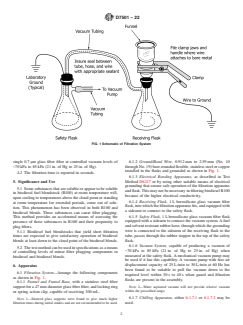
single 0.7 µm glass fiber filter at controlled vacuum levels of 6.1.2 Ground/Bond Wire, 0.912 mm to 2.59 mm (No. 10
~70 kPa to 85 kPa (21 in. of Hg to 25 in. of Hg). through No. 19) bare stranded flexible, stainless steel or copper
installed in the flasks and grounded as shown in Fig. 1.
4.2 The filtration time is reported in seconds.
6.1.3 Electrical Bonding Apparatus, as described in Test
Method D6217 or by using other suitable means of electrical
5. Significance and Use
grounding that ensure safe operation of the filtration apparatus
5.1 Some substances that are soluble or appear to be soluble
andflask.ThismaynotbenecessaryinfilteringbiodieselB100
in biodiesel fuel blendstock (B100) at room temperature will,
because of the higher electrical conductivity.
upon cooling to temperatures above the cloud point or standing
6.1.4 Receiving Flask, 1 L borosilicate glass vacuum filter
at room temperature for extended periods, come out of solu-
flask, into which the filtration apparatus fits, and equipped with
tion. This phenomenon has been observed in both B100 and
a sidearm to connect to the safety flask.
biodiesel blends. These substances can cause filter plugging.
6.1.5 Safety Flask, 1 Lborosilicate glass vacuum filter flask
This method provides an accelerated means of assessing the
equipped with a sidearm to connect the vacuum system.Afuel
presence of these substances in B100 and their propensity to
and solvent resistant rubber hose, through which the grounding
plug filters.
wire is connected to the sidearm of the receiving flask to the
5.1.1 Biodiesel fuel blendstocks that yield short filtration
tube, passes through the rubber stopper in the top of the safety
times are expected to give satisfactory operation of biodiesel
flask.
blends at least down to the cloud point of the biodiesel blends.
6.1.6 Vacuum System, capable of producing a vacuum of
5.2 Thetestmethodcanbeusedinspecificationsasameans
~70 kPa to 85 kPa (21 in. of Hg to 25 in. of Hg) when
of controlling levels of minor filter plugging components in
measured at the safety flask.Amechanical vacuum pump may
biodiesel and biodiesel blends.
be used if it has this capability. A vacuum pump with free air
displacement capacity of 25 L⁄min to 30 L⁄min at 60 Hz has
6. Apparatus
been found to be suitable to pull the vacuum down to the
6.1 Filtration System—Arrange the following components
required level within 30 s to 40 s when guard and filtration
as shown in Fig. 1.
flasks are present in the assembly.
6.1.1 Funnel and Funnel Base, with a stainless steel filter
supportfora47 mmdiameterglassfiberfilter,andlockingring NOTE 2—Water aspirated vacuum will not provide relative vacuum
within the prescribed range.
or spring action clip, capable of receiving 300 mL.
6.1.7 Chilling Apparatus, either 6.1.7.1 or 6.1.7.2 may be
NOTE 1—Sintered glass supports were found to give much higher
filtration times during initial studies and are not recommended to be used. used.
D7501 − 22
6.1.7.1 Circulating Water Bath, capable of sustaining a dynamicallyfromasamplingloopinadistributionlineorfrom
temperature of 4.5 °C 6 0.5 °C (40 °F 6 1 °F). the flushing line of a field sampling kit. Ensure that the line to
6.1.7.2 Air Chamber, capable of sustaining a temperature of be sampled is flushed with fuel before collecting the sample.
4.5 °C 6 0.5 °C (40 °F 6 1 °F). The unit shall use micropro- Alternatively, circulate or agitate the contents of the tank in
cessor temperature control and have a digital temperature order to collect a representative sample that includes any
control/display. precipitates that might have settled in the tank. One option is to
6.1.8 Circulating Water Bath, capable of sustaining a tem- sample the tank immediately after filling, before the contents
perature of 25 °C 6 0.5 °C (77 °F 6 1 °F). have time to settle.
6.1.9 Whatman Glass Fiber Filters (GF/F), plain, 47 mm
8.1.1 Where it is necessary to obtain samples from static
diameter, nominal pore size 0.7 µm. Acid treated low metal
storage using a sampling container or intermediate containers,
TCLP filters are not suitable for this purpose.
follow the procedures given in Practice D4057 or equivalent,
taking precautions for cleanliness of all equipment used. This
6.2 Other Apparatus:
is interpreted to mean a representative sample in accordance
6.2.1 Forceps, approximately 12 cm long, flat-bladed, with
with Practice D4057, and refers to an “all-levels” sample.
non-serrated, non-pointed tips.
(Warning—Samples obtained from static storage can give
6.2.2 Graduated Cylinders, to contain at least 0.5 L of fluid
results which are not representative of the bulk contents of the
and marked at 10 mL intervals. Samples that filter slowly may
tank because of particulate matter settling.)
require 100 mL graduated cylinders.
6.2.3 Petri Dishes, approximately 12.5 cm in diameter, with
8.2 Precautions—to avoid sample contamination include:
removable glass supports for glass fiber filters.
8.2.1 Selection of an appropriate sampling point.
6.2.3.1 Small Watch Glasses,approximately5 cmto7 cmin
8.2.2 Use of clean sample containers. Visually inspect the
diameter, have been found suitable to support the glass fiber
sample container before taking the samples to verify that there
filters.
are no visible particles present inside the container.
8.2.3 Keeping a clean protective cover over the top of the
NOTE 3—B100 will dissolve some plastics. This can cause the filters to
adhere to the plastic.
sample container until the cap is replaced after filling.
8.2.4 If the primary sample container cannot be selected
6.2.4 ProtectiveCover,polyethylenefilmorcleanaluminum
foil. such that it is suitable for this test procedure, the sample shall
pass through only a minimum number of intermediate contain-
6.2.5 Timer, capable of displaying elapsed times of at least
900 s to the nearest 0.1 s. ers prior to placement in the final container.
6.2.6 Thermometer or RTD Sensor, for measuring sample 8.2.5 After filling the sample container with 300 mL of
temperature, should be capable of measurement 60.5 °C sample, protect the fuel sample from prolonged exposure to
(61 °F). light by wrapping the container in aluminum foil or storing it
in the dark to reduce the possibility of particulate formation by
7. Reagents and Materials
light-promoted reactions.
7.1 Purity of Reagents—Reagent grade chemicals shall be
8.3 If 300 mL of sample is not received in a 500 mL bottle
used in all tests. Unless otherwise indicated, it is intended that
or the sample has been received in a container not suitable for
all reagents shall conform to the specifications of the Commit-
this test, follow the sampling condition procedure in 8.4.
tee onAnalytical Reagents of theAmerican Chemical Society,
8.4 Sample Conditioning—for samples received that might
where such specifications are available. Other grades may be
have been cooled to temperatures below 20 °C (68 °F):
used, provided it is first ascertained that the reagent is of
8.4.1 Upon receipt of a biodiesel blend stock (B100)
sufficient purity to permit its use without lessening the accu-
sample, the entire sample is to be heated to 40 °C (104 °F) for
racy of the determination.
at least 3 h under an inert atmosphere to erase any thermal
7.2 FlushingFluids—Flushingfluidsarenotrequiredforthe
history and to dissolve any solids that might have precipitated
test as the filter is not weighed. However, heptane or isooctane
during transit. After heating for the required time, allow the
may be used to wash the apparatus after filtration to remove
sample to sit for 24 h at a temperature no lower than 20 °C
any residue.
(68 °F).
7.2.1 Heptane, (Warning—Flammable.)
8.4.2 This sample conditioning step may be omitted if the
7.2.2 2,2,4-trimethylpentane (isooctane), (Warning—
sample was collected from a heated tank at a production
Flammable.)
facility. In this case, proceed directly to 8.5.
7.3 Liquid or Powder Detergent, water-soluble, for cleaning
8.4.3 If there is any doubt about the thermal history of the
glassware.
sample, the sample conditioning step shall be performed.
8.5 Analyzefuelsamplesassoonaspossibleaftersampling.
8. Sampling
8.6 Shake the sample
...
This document is not an ASTM standard and is intended only to provide the user of an ASTM standard an indication of what changes have been made to the previous version. Because
it may not be technically possible to adequately depict all changes accurately, ASTM recommends that users consult prior editions as appropriate. In all cases only the current version
of the standard as published by ASTM is to be considered the official document.
Designation: D7501 − 21 D7501 − 22
Standard Test Method for
Determination of Fuel Filter Blocking Potential of Biodiesel
Fuel Blendstock (B100) by Cold Soak Filtration Test (CSFT)
This standard is issued under the fixed designation D7501; the number immediately following the designation indicates the year of
original adoption or, in the case of revision, the year of last revision. A number in parentheses indicates the year of last reapproval. A
superscript epsilon (´) indicates an editorial change since the last revision or reapproval.
1. Scope*
1.1 This test method covers the determination by filtration time after cold soak for the suitability of biodiesel fuel blendstock
(B100) that meets all other requirements of Specification D6751 and has a cloud point below 20 °C (68 °F) to provide adequate
low temperature operability performance to at least the cloud point of the finished blend.
1.2 The values stated in SI units are to be regarded as standard. Non-SI units are given for information only.
1.3 This standard does not purport to address all of the safety concerns, if any, associated with its use. It is the responsibility
of the user of this standard to establish appropriate safety, health, and environmental practices and determine the applicability of
regulatory limitations prior to use.
1.4 This international standard was developed in accordance with internationally recognized principles on standardization
established in the Decision on Principles for the Development of International Standards, Guides and Recommendations issued
by the World Trade Organization Technical Barriers to Trade (TBT) Committee.
2. Referenced Documents
2.1 ASTM Standards:
D4057 Practice for Manual Sampling of Petroleum and Petroleum Products
D4175 Terminology Relating to Petroleum Products, Liquid Fuels, and Lubricants
D6217 Test Method for Particulate Contamination in Middle Distillate Fuels by Laboratory Filtration
D6300 Practice for Determination of Precision and Bias Data for Use in Test Methods for Petroleum Products, Liquid Fuels, and
Lubricants
D6751 Specification for Biodiesel Fuel Blend Stock (B100) for Middle Distillate Fuels
3. Terminology
3.1 Definitions:
3.1.1 For definitions of terms used in this test method, refer to Terminology D4175.
3.1.2 biodiesel, n—fuel comprised of mono-alkyl esters of long chain fatty acids derived from vegetable oils or animal fats,
designated as B100.
This test method is under the jurisdiction of ASTM Committee D02 on Petroleum Products, Liquid Fuels, and Lubricants and is the direct responsibility of Subcommittee
D02.14 on Stability, Cleanliness and Compatibility of Liquid Fuels.
Current edition approved Dec. 1, 2021April 1, 2022. Published December 2021April 2022. Originally approved in 2009. Last previous edition approved in 20182021 as
D7501 – 18a.D7501 – 21. DOI: 10.1520/D7501-21.10.1520/D7501-22.
For referenced ASTM standards, visit the ASTM website, www.astm.org, or contact ASTM Customer Service at service@astm.org. For Annual Book of ASTM Standards
volume information, refer to the standard’s Document Summary page on the ASTM website.
*A Summary of Changes section appears at the end of this standard
Copyright © ASTM International, 100 Barr Harbor Drive, PO Box C700, West Conshohocken, PA 19428-2959. United States
D7501 − 22
3.1.3 biodiesel blend (BXX), n—a homogeneous mixture of hydrocarbon oils and mono-alkyl esters of long chain fatty acids.
3.1.3.1 Discussion—
In the abbreviation, BXX, the XX represents the volume percentage of biodiesel fuel in the blend.
3.1.4 bond, v—to connect two parts of a system electrically by means of a conductive wire to eliminate voltage differences.
3.2 Definitions of Terms Specific to This Standard:
3.2.1 air chamber, n—unit to control temperature of sample for cooling with maximum 0.5 °C variation from set point. The unit
shall use a microprocessor temperature controller with digital set point and readout. A food-grade refrigerator does not provide
adequate temperature stability for this test method.
3.2.2 minor component, n—material present in B100, typically at concentrations well below 1 % by mass.
3.2.3 thermal history, n—range of temperatures that a batch or sample of B100 has experienced which can result in separation or
precipitation of minor components.
3.2.3.1 Discussion—
Cooling some biodiesel fuels can result in precipitation or separation of minor components that have limited solubility in B100.
Heating these biodiesel fuels above 40 °C is believed to redissolve most of these minor components and thus erase the thermal
history of the sample.
3.3 Abbreviations:
3.3.1 CSFT—Cold Soak Filtration Test
4. Summary of Test Method
4.1 In this test method, 300 mL of biodiesel (B100) is stored at 4.5 °C 6 0.5 °C (40 °F 6 1 °F) for 16 h, allowed to warm to 25 °C
6 1 °C (77 °F 6 2 °F), and vacuum filtered through a single 0.7 μm glass fiber filter at controlled vacuum levels of ~70 kPa to
85 kPa (21 in. of Hg to 25 in. of Hg).
4.2 The filtration time is reported in seconds.
5. Significance and Use
5.1 Some substances that are soluble or appear to be soluble in biodiesel fuel blendstock (B100) at room temperature will, upon
cooling to temperatures above the cloud point or standing at room temperature for extended periods, come out of solution. This
phenomenon has been observed in both B100 and biodiesel blends. These substances can cause filter plugging. This method
provides an accelerated means of assessing the presence of these substances in B100 and their propensity to plug filters.
5.1.1 Biodiesel fuel blendstocks that yield short filtration times are expected to give satisfactory operation of biodiesel blends at
least down to the cloud point of the biodiesel blends.
5.2 The test method can be used in specifications as a means of controlling levels of minor filter plugging components in biodiesel
and biodiesel blends.
6. Apparatus
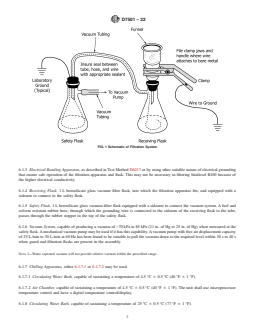
6.1 Filtration System—Arrange the following components as shown in Fig. 1.
6.1.1 Funnel and Funnel Base, with a stainless steel filter support for a 47 mm diameter glass fiber filter, and locking ring or spring
action clip, capable of receiving 300 mL.
NOTE 1—Sintered glass supports were found to give much higher filtration times during initial studies and are not recommended to be used.
6.1.2 Ground/Bond Wire, 0.912 mm to 2.59 mm (No. 10 through No. 19) bare stranded flexible, stainless steel or copper installed
in the flasks and grounded as shown in Fig. 1.
D7501 − 22
FIG. 1 Schematic of Filtration System
6.1.3 Electrical Bonding Apparatus, as described in Test Method D6217 or by using other suitable means of electrical grounding
that ensure safe operation of the filtration apparatus and flask. This may not be necessary in filtering biodiesel B100 because of
the higher electrical conductivity.
6.1.4 Receiving Flask, 1 L borosilicate glass vacuum filter flask, into which the filtration apparatus fits, and equipped with a
sidearm to connect to the safety flask.
6.1.5 Safety Flask, 1 L borosilicate glass vacuum filter flask equipped with a sidearm to connect the vacuum system. A fuel and
solvent resistant rubber hose, through which the grounding wire is connected to the sidearm of the receiving flask to the tube,
passes through the rubber stopper in the top of the safety flask.
6.1.6 Vacuum System, capable of producing a vacuum of ~70 kPa to 85 kPa (21 in. of Hg to 25 in. of Hg) when measured at the
safety flask. A mechanical vacuum pump may be used if it has this capability. A vacuum pump with free air displacement capacity
of 25 L ⁄min to 30 L ⁄min at 60 Hz has been found to be suitable to pull the vacuum down to the required level within 30 s to 40 s
when guard and filtration flasks are present in the assembly.
NOTE 2—Water aspirated vacuum will not provide relative vacuum within the prescribed range.
6.1.7 Chilling Apparatus, either 6.1.7.1 or 6.1.7.2 may be used.
6.1.7.1 Circulating Water Bath, capable of sustaining a temperature of 4.5 °C 6 0.5 °C (40 °F 6 1 °F).
6.1.7.2 Air Chamber, capable of sustaining a temperature of 4.5 °C 6 0.5 °C (40 °F 6 1 °F). The unit shall use microprocessor
temperature control and have a digital temperature control/display.
6.1.8 Circulating Water Bath, capable of sustaining a temperature of 25 °C 6 0.5 °C (77 °F 6 1 °F).
D7501 − 22
6.1.9 Whatman Glass Fiber Filters (GF/F), plain, 47 mm diameter, nominal pore size 0.7 μm. Acid treated low metal TCLP filters
are not suitable for this purpose.
6.2 Other Apparatus:
6.2.1 Forceps, approximately 12 cm long, flat-bladed, with non-serrated, non-pointed tips.
6.2.2 Graduated Cylinders, to contain at least 0.5 L of fluid and marked at 10 mL intervals. Samples that filter slowly may require
100 mL graduated cylinders.
6.2.3 Petri Dishes, approximately 12.5 cm in diameter, with removable glass supports for glass fiber filters.
6.2.3.1 Small Watch Glasses, approximately 5 cm to 7 cm in diameter, have been found suitable to support the glass fiber filters.
NOTE 3—B100 will dissolve some plastics. This can cause the filters to adhere to the plastic.
6.2.4 Protective Cover, polyethylene film or clean aluminum foil.
6.2.5 Timer, capable of displaying elapsed times of at least 900 s to the nearest 0.1 s.
6.2.6 Thermometer or RTD Sensor, for measuring sample temperature, should be capable of measurement 60.5 °C (61 °F).
7. Reagents and Materials
7.1 Purity of Reagents—Reagent grade chemicals shall be used in all tests. Unless otherwise indicated, it is intended that all
reagents shall conform to the specifications of the Committee on Analytical Reagents of the American Chemical Society, where
such specifications are available. Other grades may be used, provided it is first ascertained that the reagent is of sufficient purity
to permit its use without lessening the accuracy of the determination.
7.2 Flushing Fluids—Flushing fluids are not required for the test as the filter is not weighed. However, heptane or isooctane may
be used to wash the apparatus after filtration to remove any residue.
7.2.1 Heptane, (Warning—Flammable.)
7.2.2 2,2,4-trimethylpentane (isooctane), (Warning—Flammable.)
7.3 Liquid or Powder Detergent, water-soluble, for cleaning glassware.
8. Sampling
8.1 A separate representative sample shall be collected for this test method. Samples may preferentially be obtained dynamically
from a sampling loop in a distribution line or from the flushing line of a field sampling kit. Ensure that the line to be sampled is
flushed with fuel before collecting the sample. Alternatively, circulate or agitate the contents of the tank in order to collect a
representative sample that includes any precipitates that might have settled in the tank. One option is to sample the tank
immediately after filling, before the contents have time to settle.
8.1.1 Where it is necessary to obtain samples from static storage using a sampling container or intermediate containers, follow the
procedures given in Practice D4057 or equivalent, taking precautions for cleanliness of all equipment used. This is interpreted to
mean a representative sample in accordance with Practice D4057, and refers to an “all-levels” sample. (Warning—Samples
obtained from static storage can give results which are not representative of the bulk contents of the tank because of particulate
matter settling.)
8.2 Precautions—to avoid sample contamination include:
Whatman filters were used in the ILS. See Section 13.
D7501 − 22
8.2.1 Selection of an appropriate sampling point.
8.2.2 Use of clean sample containers. Visually inspect the sample container before taking the samples to verify that there are no
visible particles present inside the container.
8.2.3 Keeping a clean protective cover over the top of the sample container until the cap is replaced after filling.
8.2.4 If the primary sample container cannot be selected such that it is suitable for this test procedure, the sample shall pass
through only a minimum number of intermediate containers prior to placement in the final container.
8.2.5 After filling the sample container with 300 mL of sample, protect the fuel sample from prolonged exposure to light by
wrapping the container in aluminum foil or storing it in the dark to reduce the possibility of particulate formation by light-promoted
reactions.
8.3 If 300 mL of sample is not received in a 500 mL bottle or the sample has been received in a container not suitable for this
test, follow the sampling condition procedure in 8.4.
8.4 Sample Conditioning—for samples received that might have been cooled to temperatures below 20 °C (68 °F):
8.4.1 Upon receipt of a biodiesel blend stock (B100) sample, the entire sample is to be heated to 40 °C (104 °F) for at least 3 h
under an inert atmosphere to erase any thermal history and to dissolve any solids that might have precipitated during transit. After
heating for the required time, allow the sample to sit for 24 h at a temperature no lower than 20 °C (68 °F).
8.4.2 This sample conditioning step may be omitted if the sample was co
...