

ASTM E2178-21a
(Test Method)Standard Test Method for Determining Air Leakage Rate and Calculation of Air Permeance of Building Materials
General Information
- Abstract
SIGNIFICANCE AND USE
4.1 The purpose of this test is to calculate an assigned air permeance of flexible sheet or rigid panel-type materials at a reference air pressure differential of 75 Pa. The results may be useful in determining suitability of that material as a component of an air retarder system.
4.2 This method does not address the installed air leakage performance of building materials. The installed performance of air retarder materials and air retarder systems is addressed in Specification E1677, Test Method D8052/D8052M, and Test Method E2357.
SCOPE
1.1 This test method is to determine the air leakage rate of building materials at various pressure differentials with the intent of calculating an assigned air permeance rate of the material at the reference pressure difference (ΔP) of 75 Pa.
1.2 The method is intended to assess flexible sheet or rigid panel-type materials using a 1 m × 1 m specimen size.
1.3 The values stated in SI units are to be regarded as standard. No other units of measurements are included in this standard.
1.4 This standard does not purport to address all of the safety concerns, if any, associated with its use. It is the responsibility of the user of this standard to establish appropriate safety, health, and environmental practices and determine the applicability of regulatory limitations prior to use.
1.5 This international standard was developed in accordance with internationally recognized principles on standardization established in the Decision on Principles for the Development of International Standards, Guides and Recommendations issued by the World Trade Organization Technical Barriers to Trade (TBT) Committee.
- Status
- Published
- Publication Date
- 31-Mar-2021
- Technical Committee
- E06 - Performance of Buildings
- Drafting Committee
- E06.41 - Air Leakage and Ventilation Performance
Buy Documents
ASTM E2178-21a - Standard Test Method for Determining Air Leakage Rate and Calculation of Air Permeance of Building Materials
REDLINE ASTM E2178-21a - Standard Test Method for Determining Air Leakage Rate and Calculation of Air Permeance of Building Materials
Overview
ASTM E2178-21a, Standard Test Method for Determining Air Leakage Rate and Calculation of Air Permeance of Building Materials, is an internationally recognized standard developed by ASTM International. This standard specifies laboratory test methods intended to determine the air leakage rate and calculate the air permeance of both flexible sheet and rigid panel-type building materials. Test results, expressed at a reference pressure differential of 75 Pascals (Pa), are vital to assess the suitability of these materials as components of air control or air retarder systems in building envelopes.
By providing a consistent approach for testing air permeance, ASTM E2178-21a helps manufacturers, architects, engineers, and building professionals compare the performance of building materials for use in energy-efficient and airtight building designs.
Key Topics
- Air Leakage Rate and Air Permeance: Measurement of air leakage per unit area of a building material specimen and calculation of air permeance, which is the rate of airflow per unit area and pressure difference.
- Controlled Pressure Differentials: The method involves applying specified pressure differences (commonly up to 300 Pa) to a 1 m × 1 m material sample, with a focus on reporting values at 75 Pa.
- Material Suitability: Results are useful for determining the appropriateness of a material as an air barrier or retarder but do not reflect performance after installation.
- Specimen Preparation and Testing: Prepares both flexible and rigid materials with specific procedures to ensure airtightness during measurement.
- Calibration and Error Analysis: Test apparatus must be accurately calibrated and error analysis conducted to ensure the reliability of results.
Applications
ASTM E2178-21a is widely applied in:
- Building Material Qualification: Evaluating whether flexible sheets (such as membranes) or rigid panels (such as sheathing boards) meet air leakage requirements for use in building envelope systems.
- Air Barrier System Design: Supplying critical performance data to inform the design of effective air barrier assemblies that contribute to building energy efficiency and durability.
- Product Development and Quality Control: Allowing manufacturers to benchmark and optimize products for air tightness, respond to regulatory codes, and support product certification.
- Specification Compliance: Facilitating construction specification conformance to ensure that chosen materials can contribute to achieving high-performance building standards.
- Building Codes and Rating Systems: Supporting compliance with green building certifications and energy codes that include air leakage or air permeance requirements.
Note: ASTM E2178-21a only evaluates the intrinsic properties of building materials in laboratory conditions and does not represent the air leakage performance of fully installed assemblies. Installed material performance is separately addressed in standards such as ASTM E1677 and E2357.
Related Standards
The following standards are referenced in ASTM E2178-21a or are relevant for related evaluations:
- ASTM E1677: Specification for Air Barrier (AB) Material or Assemblies for Low-Rise Framed Building Walls
- ASTM D8052/D8052M: Test Method for Quantification of Air Leakage in Low-Sloped Membrane Roof Assemblies
- ASTM E283/E283M: Test Method for Determining Rate of Air Leakage Through Exterior Windows, Skylights, Curtain Walls, and Doors Under Specified Pressure Differences
- ASTM E2357: Test Method for Determining Air Leakage Rate of Air Barrier Assemblies
- ASTM E631: Terminology Relating to Building Constructions
Summary
ASTM E2178-21a is an essential laboratory standard for quantifying the air permeance and leakage rate of building materials, supporting the critical selection and specification of air barrier components. Use of this standard ensures consistency, reliability, and comparability in performance data, facilitating energy-efficient, durable, and code-compliant building designs. For evaluating air barrier systems’ installed performance, consult related ASTM standards.
Relations
- Refers
ASTM E2357-24 - Standard Test Method for Determining Air Leakage Rate of Air Barrier Assemblies - Effective Date
- 01-Jan-2024
- Effective Date
- 01-Jun-2017
- Effective Date
- 01-Mar-2015
- Effective Date
- 01-Nov-2014
- Effective Date
- 01-Sep-2011
- Effective Date
- 01-Sep-2011
- Effective Date
- 01-Jun-2006
- Effective Date
- 01-Nov-2005
- Effective Date
- 01-Oct-2005
- Effective Date
- 28-Jul-2000
- Effective Date
- 10-Apr-2000
Buy Documents
ASTM E2178-21a - Standard Test Method for Determining Air Leakage Rate and Calculation of Air Permeance of Building Materials
REDLINE ASTM E2178-21a - Standard Test Method for Determining Air Leakage Rate and Calculation of Air Permeance of Building Materials
Get Certified
Connect with accredited certification bodies for this standard

DIBt (Deutsches Institut für Bautechnik)
German Institute for Building Technology.
DIN CERTCO
DIN Group product certification.

Aboma Certification B.V.
Specialized in construction, metal, and transport sectors.
Sponsored listings
Frequently Asked Questions
ASTM E2178-21a is a standard published by ASTM International. Its full title is "Standard Test Method for Determining Air Leakage Rate and Calculation of Air Permeance of Building Materials". This standard covers: SIGNIFICANCE AND USE 4.1 The purpose of this test is to calculate an assigned air permeance of flexible sheet or rigid panel-type materials at a reference air pressure differential of 75 Pa. The results may be useful in determining suitability of that material as a component of an air retarder system. 4.2 This method does not address the installed air leakage performance of building materials. The installed performance of air retarder materials and air retarder systems is addressed in Specification E1677, Test Method D8052/D8052M, and Test Method E2357. SCOPE 1.1 This test method is to determine the air leakage rate of building materials at various pressure differentials with the intent of calculating an assigned air permeance rate of the material at the reference pressure difference (ΔP) of 75 Pa. 1.2 The method is intended to assess flexible sheet or rigid panel-type materials using a 1 m × 1 m specimen size. 1.3 The values stated in SI units are to be regarded as standard. No other units of measurements are included in this standard. 1.4 This standard does not purport to address all of the safety concerns, if any, associated with its use. It is the responsibility of the user of this standard to establish appropriate safety, health, and environmental practices and determine the applicability of regulatory limitations prior to use. 1.5 This international standard was developed in accordance with internationally recognized principles on standardization established in the Decision on Principles for the Development of International Standards, Guides and Recommendations issued by the World Trade Organization Technical Barriers to Trade (TBT) Committee.
SIGNIFICANCE AND USE 4.1 The purpose of this test is to calculate an assigned air permeance of flexible sheet or rigid panel-type materials at a reference air pressure differential of 75 Pa. The results may be useful in determining suitability of that material as a component of an air retarder system. 4.2 This method does not address the installed air leakage performance of building materials. The installed performance of air retarder materials and air retarder systems is addressed in Specification E1677, Test Method D8052/D8052M, and Test Method E2357. SCOPE 1.1 This test method is to determine the air leakage rate of building materials at various pressure differentials with the intent of calculating an assigned air permeance rate of the material at the reference pressure difference (ΔP) of 75 Pa. 1.2 The method is intended to assess flexible sheet or rigid panel-type materials using a 1 m × 1 m specimen size. 1.3 The values stated in SI units are to be regarded as standard. No other units of measurements are included in this standard. 1.4 This standard does not purport to address all of the safety concerns, if any, associated with its use. It is the responsibility of the user of this standard to establish appropriate safety, health, and environmental practices and determine the applicability of regulatory limitations prior to use. 1.5 This international standard was developed in accordance with internationally recognized principles on standardization established in the Decision on Principles for the Development of International Standards, Guides and Recommendations issued by the World Trade Organization Technical Barriers to Trade (TBT) Committee.
ASTM E2178-21a is classified under the following ICS (International Classification for Standards) categories: 91.100.01 - Construction materials in general. The ICS classification helps identify the subject area and facilitates finding related standards.
ASTM E2178-21a has the following relationships with other standards: It is inter standard links to ASTM E2357-24, ASTM E2357-17, ASTM E631-15, ASTM E631-14, ASTM E1677-11, ASTM E2357-11, ASTM E631-06, ASTM E1677-05, ASTM E2357-05, ASTM E631-93a(1998)e1, ASTM E1677-95(2000). Understanding these relationships helps ensure you are using the most current and applicable version of the standard.
ASTM E2178-21a is available in PDF format for immediate download after purchase. The document can be added to your cart and obtained through the secure checkout process. Digital delivery ensures instant access to the complete standard document.
Standards Content (Sample)
This international standard was developed in accordance with internationally recognized principles on standardization established in the Decision on Principles for the
Development of International Standards, Guides and Recommendations issued by the World Trade Organization Technical Barriers to Trade (TBT) Committee.
Designation:E2178 −21a
Standard Test Method for
Determining Air Leakage Rate and Calculation of Air
Permeance of Building Materials
This standard is issued under the fixed designation E2178; the number immediately following the designation indicates the year of
original adoption or, in the case of revision, the year of last revision.Anumber in parentheses indicates the year of last reapproval.A
superscript epsilon (´) indicates an editorial change since the last revision or reapproval.
1. Scope E1677SpecificationforAirBarrier(AB)MaterialorAssem-
blies for Low-Rise Framed Building Walls
1.1 This test method is to determine the air leakage rate of
E2357TestMethodforDeterminingAirLeakageRateofAir
building materials at various pressure differentials with the
Barrier Assemblies
intent of calculating an assigned air permeance rate of the
material at the reference pressure difference (∆P)of75Pa.
3. Terminology
1.2 The method is intended to assess flexible sheet or rigid
3.1 Definitions:
panel-type materials using a1m×1m specimen size.
3.1.1 For definitions of general terms related to building
1.3 The values stated in SI units are to be regarded as
construction used in this test method, refer to Terminology
standard. No other units of measurements are included in this
E631.
standard.
3.2 Definitions of Terms Specific to This Standard:
3.2.1 air leakage rate (Q), L/(s·m )—theairleakageperunit
1.4 This standard does not purport to address all of the
safety concerns, if any, associated with its use. It is the specimen area (A).
responsibility of the user of this standard to establish appro-
3.2.2 air permeance, L/s—the rate of air flow per unit area
priate safety, health, and environmental practices and deter-
(m ) and per unit static pressure differential (Pa).
mine the applicability of regulatory limitations prior to use.
1.5 This international standard was developed in accor-
4. Significance and Use
dance with internationally recognized principles on standard-
4.1 The purpose of this test is to calculate an assigned air
ization established in the Decision on Principles for the
permeance of flexible sheet or rigid panel-type materials at a
Development of International Standards, Guides and Recom-
reference air pressure differential of 75Pa. The results may be
mendations issued by the World Trade Organization Technical
useful in determining suitability of that material as a compo-
Barriers to Trade (TBT) Committee.
nent of an air retarder system.
4.2 This method does not address the installed air leakage
2. Referenced Documents
performance of building materials. The installed performance
2.1 ASTM Standards:
ofairretardermaterialsandairretardersystemsisaddressedin
D8052/D8052M Test Method for Quantification of Air
Specification E1677, Test Method D8052/D8052M, and Test
Leakage in Low-Sloped Membrane Roof Assemblies
Method E2357.
E283/E283MTest Method for Determining Rate of Air
Leakage Through Exterior Windows, Skylights, Curtain
5. Sampling
Walls, and Doors Under Specified Pressure Differences
5.1 The number of specimens to be tested shall be suitable
Across the Specimen
to establish an air leakage rate which is representative of the
E631Terminology of Building Constructions
product. In no case shall less than five specimens be tested.
NOTE1—Becauseofthevariabilityinthemanufactureofaproduct,the
number of specimens to be tested may vary from product to product.
This test method is under the jurisdiction of ASTM Committee E06 on
Certain materials may have standard methods for sampling that shall be
Performance of Buildings and is the direct responsibility of Subcommittee E06.41
used to sample these materials.
on Air Leakage and Ventilation Performance.
Current edition approved April 1, 2021. Published May 2021. Originally
6. Test Apparatus
approved in 2001. Last previous edition approved in 2021 as E2178–21. DOI:
10.1520/E2178-21A.
6.1 A schematic of the air leakage rate test apparatus is
For referenced ASTM standards, visit the ASTM website, www.astm.org, or
presented in Fig. 1.
contact ASTM Customer Service at service@astm.org. For Annual Book of ASTM
6.1.1 Airtight Test Chamber—The airtight test chamber
Standards volume information, refer to the standard’s Document Summary page on
the ASTM website. shall be at least 320 mm deep and capable of receivinga1m
Copyright © ASTM International, 100 Barr Harbor Drive, PO Box C700, West Conshohocken, PA 19428-2959. United States
E2178−21a
FIG. 1General Configuration of Test Apparatus
by 1 m test specimen, anchored to the test chamber by means 6.1.4 Piping—The piping connecting the flow measuring
of a compression frame and clamping devices. The test devices and the vacuum blower shall be airtight and contain
chamber and compression frame shall be stiff enough to limit flow control devices to regulate the static pressure across the
deflectionwithintheoperatingflexibilityofthegasketsusedto test specimen within 60.5% of the pressure reading.The pipe
seal the test specimen to the chamber. Two parallel ribbons of connection to the test chamber shall contain an air filter to
self-adhesive gasket material shall be applied at all sealing prevent dust or particulate matter from affecting the flow
points of the apparatus/test specimen assembly. The gasket measuring device reading. The piping downstream and up-
ribbons shall be made of medium-density gasket material that stream of the flow measuring device shall be designed so the
can be fused or glued at joints.The test apparatus shall contain flow regime does not affect the device’s accuracy. The piping
an over-pressure control device and windows to verify the shall contain a temperature measuring device capable of
specimen installation. measuring air temperature within 60.5°C to convert all flow
6.1.2 Flow Measuring Devices—The flow measuring de- rate measurement to standard temperature and pressure (STP).
vices used to gage the air flow through the test specimen shall 6.1.5 Vacuum Blower—The blower used to create a vacuum
-6 3
becapableofmeasuringairflowratefrom1×10 m /s(0.001 in the test chamber shall be able to produce static pressure
-2 3
L/s) up to 1.88 × 10 m /s (18.8 L/s), with an accuracy of differential across the test specimen within 60.5% of the
63% of the reading. pressure reading.
6.1.3 Pressure Measuring Devices—The static pressure dif-
7. Specimen Preparation
ferentialacrossthetestspecimenshallbemeasuredbypressure
measuring devices with an accuracy of 60.5% of the pressure 7.1 Conditioning for Tests—Unless otherwise stated, all
reading. The laboratory barometric pressure shall be measured specimens to be tested shall be conditioned for a minimum
with a device capable of measuring barometric pressure within periodofsevendaysat21°C 61°Cand40% 65%relative
63% of the reading. humidity.
E2178−21a
7.2 Flexible Sheet Materials—Due to lack of rigidity, flex- 7.2.10 Cut the polyethylene film at each corner as in
ible materials shall be tested over a rigid support having an air accordance with Fig. 3;
permeance much greater than the test specimen.An open grill
7.2.11 Apply two self-adhesive gaskets to the underside of
or wire mesh/screen, fabricated with welded wire having a
the wire mesh/screen support (the gaskets shall line up below
minimum of 25 mm × 25mm square grid (or an alternative
the first ribbon installed in 7.2.1);
means that provides an equivalent degree of support and air
7.2.12 Upon removal of the protective paper over the
permeance) shall be used for this purpose. The wire mesh
gasket, fold and tape each corner of the film with construction
portion of the support shall be welded or otherwise mechani-
tape to ensure complete airtightness as in accordance with Fig.
cally secured to a solid metal frame which shall be gasketed
4;
andcompressedwithinthetestframe.Adetaileddescriptionof
7.2.13 From the interior line of the adhesive gasket, cut and
the support grill, including the gage wire used, shall be
remove all the excess polyethylene film.
included in the test report. Fig. 2 shows the preparation for a
typical flexible sheet material. The following procedure shall
7.3 Rigid Panel-Type Materials—Fig. 5 shows the prepara-
be used to seal the perimeter of the specimen:
tion for a typical rigid panel-type material. The following
7.2.1 Apply a self-adhesive gasket ribbon over the frame of
procedure shall be used to seal the perimeter of the specimen:
the wire mesh/screen around the entire perimeter of the test
7.3.1 Apply a self-adhesive gasket ribbon over the rigid
area under investigation (1m×1m);
panel-typetestspecimenaroundtheentireperimeterofthearea
7.2.2 Apply a second self-adhesive gasket ribbon along the
under investigation (1m×1m);
perimeter of the first ribbon in 7.2.1;
7.2.3 Alljointsinthegasketribbonsshallbefusedorglued;
7.3.2 Alljointsinthegasketribbonsshallbefusedorglued;
7.2.4 Cuttheflexiblesheetmaterialspecimento1100mm×
7.3.3 Cut polyethylene film (0.15 mm (6 mils)) to 1400 mm
1100 mm;
× 1400 mm;
7.2.5 Upon removal of the protective paper over the self-
7.3.4 Upon removal of the protective paper over the self-
adhesive gasket, install the specimen over the wire mesh/
adhesive gasket ribbon, cover the specimen with the polyeth-
screen;
ylene film;
7.2.6 Applytheself-adhesivegasketoverthespecimensoit
7.3.5 Cut the polyethylene film at each corner as in accor-
lines up with the first ribbon in 7.2.1, and then apply a second
dance with Fig. 3;
self-adhesive gasket along its perimeter;
7.2.7 Alljointsinthegasketribbonsshallbefusedorglued;
7.3.6 Apply a second self-adhesive gasket ribbon to the
7.2.8 Cut polyethylene film (0.15 mm (6 mils)) to 1400 mm
underside of the specimen (the ribbon shall be applied directly
× 1400 mm;
below the first ribbon installed in 7.3.1), and seal corner
7.2.9 Upon removal of the protective paper over the ribbon,
junctions by fusing or gluing;
cover the specimen with the polyethylene film;
FIG. 2Flexible Sheet Test Specimen
E2178−21a
FIG. 3Top View of Polyethylene Placement Over Specimen with Double Perimeter Gaskets
FIG. 4Bottom View of Polyethylene Seal at Double-Perimeter Gaskets on Underside of Rigid Panel-Type Specimen or
Open Mesh/Screen for Flexible Sheet Specimen Set-up
7.3.7 Upon removal of the protective paper over the self- 8.2.1 Install the sealed test specimen on the test chamber;
adhesive gasket ribbon, fold and tape each corner of the film
8.2.2 Install the compression frame over the specimen;
with construction tape to ensure complete airtightness as in
8.2.3 Checkthroughthewindowifthespecimenisproperly
accordance with Fig. 4;
placed;
7.3.8 From the interior line of the self-adhesive gasket
8.2.4 Anchor the specimen to the test chamber and com-
ribbon, cut and remove all the excess polyethylene film.
press the gaskets, as required;
8. Test Procedure
8.2.5 Measure the extraneous air leakage
...
This document is not an ASTM standard and is intended only to provide the user of an ASTM standard an indication of what changes have been made to the previous version. Because
it may not be technically possible to adequately depict all changes accurately, ASTM recommends that users consult prior editions as appropriate. In all cases only the current version
of the standard as published by ASTM is to be considered the official document.
Designation: E2178 − 21 E2178 − 21a
Standard Test Method for
Determining Air Leakage Rate and Calculation of Air
Permeance of Building Materials
This standard is issued under the fixed designation E2178; the number immediately following the designation indicates the year of
original adoption or, in the case of revision, the year of last revision. A number in parentheses indicates the year of last reapproval. A
superscript epsilon (´) indicates an editorial change since the last revision or reapproval.
1. Scope
1.1 This test method is to determine the air leakage rate of building materials at various pressure differentials with the intent of
calculating an assigned air permeance rate of the material at the reference pressure difference (ΔP) of 75 Pa.
1.2 The method is intended to assess flexible sheet or rigid panel-type materials using a 1 m × 1 m specimen size.
1.3 The values stated in SI units are to be regarded as standard. No other units of measurements are included in this standard.
1.4 This standard does not purport to address all of the safety concerns, if any, associated with its use. It is the responsibility
of the user of this standard to establish appropriate safety, health, and environmental practices and determine the applicability of
regulatory limitations prior to use.
1.5 This international standard was developed in accordance with internationally recognized principles on standardization
established in the Decision on Principles for the Development of International Standards, Guides and Recommendations issued
by the World Trade Organization Technical Barriers to Trade (TBT) Committee.
2. Referenced Documents
2.1 ASTM Standards:
D8052/D8052M Test Method for Quantification of Air Leakage in Low-Sloped Membrane Roof Assemblies
E283/E283M Test Method for Determining Rate of Air Leakage Through Exterior Windows, Skylights, Curtain Walls, and
Doors Under Specified Pressure Differences Across the Specimen
E631 Terminology of Building Constructions
E1677 Specification for Air Barrier (AB) Material or Assemblies for Low-Rise Framed Building Walls
E2357 Test Method for Determining Air Leakage Rate of Air Barrier Assemblies
3. Terminology
3.1 Definitions:
3.1.1 For definitions of general terms related to building construction used in this test method, refer to Terminology E631.
3.2 Definitions of Terms Specific to This Standard:
This test method is under the jurisdiction of ASTM Committee E06 on Performance of Buildings and is the direct responsibility of Subcommittee E06.41 on Air Leakage
and Ventilation Performance.
Current edition approved Feb. 1, 2021April 1, 2021. Published February 2021May 2021. Originally approved in 2001. Last previous edition approved in 20132021 as
E2178 – 13.E2178 – 21. DOI: 10.1520/E2178-21.10.1520/E2178-21A.
For referenced ASTM standards, visit the ASTM website, www.astm.org, or contact ASTM Customer Service at service@astm.org. For Annual Book of ASTM Standards
volume information, refer to the standard’s Document Summary page on the ASTM website.
Copyright © ASTM International, 100 Barr Harbor Drive, PO Box C700, West Conshohocken, PA 19428-2959. United States
E2178 − 21a
3.2.1 air leakage rate (Q), L/(s·m )—the air leakage per unit specimen area (A).
3.2.2 air permeance, L/s—the rate of air flow per unit area (m ) and per unit static pressure differential (Pa).
4. Significance and Use
4.1 The purpose of this test is to calculate an assigned air permeance of flexible sheet or rigid panel-type materials at a reference
air pressure differential of 75 Pa. The results of this test may be useful in determining suitability of that material as a component
of an air retarder system.
4.2 This method does not address the installed air leakage performance of building materials. The installed performance of air
retarder materials and air retarder systems in low-rise framed wall construction is addressed in Specification E1677, Test Method
D8052/D8052M, and Test Method E2357.
5. Sampling
5.1 The number of specimens to be tested shall be suitable to establish an air leakage rate which is representative of the product.
In no case shall less than five specimens be tested.
NOTE 1—Because of the variability in the manufacture of a product, the number of specimens to be tested may vary from product to product. Certain
materials may have standard methods for sampling that shall be used to sample these materials.
6. Test Apparatus
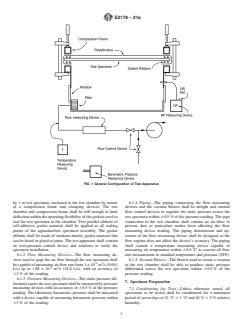
6.1 A schematic of the air leakage rate test apparatus is presented in Fig. 1.
6.1.1 Airtight Test Chamber—The airtight test chamber shall be at least 320 mm deep and capable of receiving a 1 m by 1 m test
specimen, anchored to the test chamber by means of a compression frame and clamping devices. The test chamber and compression
frame shall be stiff enough to limit deflection within the operating flexibility of the gaskets used to seal the test specimen to the
chamber. Two parallel ribbons of self-adhesive gasket material shall be applied at all sealing points of the apparatus/test specimen
assembly. The gasket ribbons shall be made of medium-density gasket material that can be fused or glued at joints. The test
apparatus shall contain an over-pressure control device and windows to verify the specimen installation.
6.1.2 Flow Measuring Devices—The flow measuring devices used to gage the air flow through the test specimen shall be capable
-6 3 -2 3
of measuring air flow rate from 1 × 10 m /s (0.001 L/s) up to 1.88 × 10 m /s (18.8 L/s), with an accuracy of 63 % of the
reading.
6.1.3 Pressure Measuring Devices—The static pressure differential across the test specimen shall be measured by pressure
measuring devices with an accuracy of 60.5 % of the pressure reading. The laboratory barometric pressure shall be measured with
a device capable of measuring barometric pressure within 63 % of the reading.
6.1.4 Piping—The piping connecting the flow measuring devices and the vacuum blower shall be airtight and contain flow control
devices to regulate the static pressure across the test specimen within 60.5 % of the pressure reading. The pipe connection to the
test chamber shall contain an air filter to prevent dust or particulate matter from affecting the flow measuring device reading. The
piping downstream and upstream of the flow measuring device shall be designed so the flow regime does not affect the device’s
accuracy. The piping shall contain a temperature measuring device capable of measuring air temperature within 60.5 °C to convert
all flow rate measurement to standard temperature and pressure (STP).
6.1.5 Vacuum Blower—The blower used to create a vacuum in the test chamber shall be able to produce static pressure differential
across the test specimen within 60.5 % of the pressure reading.
7. Specimen Preparation
7.1 Conditioning for Tests—Unless otherwise stated, all specimens to be tested shall be conditioned for a minimum period of seven
days at 21 °C 6 1 °C and 40 % 6 5 % relative humidity.
7.2 Flexible Sheet Materials—Due to lack of rigidity, flexible materials shall be tested over a rigid support having an air
E2178 − 21a
FIG. 1 General Configuration of Test Apparatus
permeance much greater than the test specimen. An open grill or wire mesh/screen, fabricated with welded wire having a minimum
of 25 mm × 25 mm square grid (or an alternative means that provides an equivalent degree of support and air permeance) shall
be used for this purpose. The wire mesh portion of the support shall be welded or otherwise mechanically secured to a solid metal
frame which shall be gasketed and compressed within the test frame. A detailed description of the support grill, including the gage
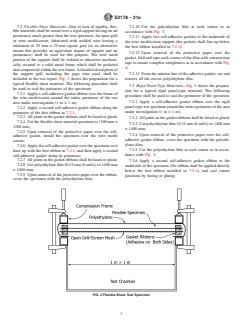
wire used, shall be included in the test report. Fig. 2 shows the preparation for a typical flexible sheet material. The following
procedure shall be used to seal the perimeter of the specimen:
7.2.1 Apply a self-adhesive gasket ribbon over the frame of the wire mesh/screen around the entire perimeter of the test area under
investigation (1 m × 1 m);
7.2.2 Apply a second self-adhesive gasket ribbon along the perimeter of the first ribbon in 7.2.1;
7.2.3 All joints in the gasket ribbons shall be fused or glued;
7.2.4 Cut the flexible sheet material specimen to 1100 mm × 1100 mm;
7.2.5 Upon removal of the protective paper over the self-adhesive gasket, install the specimen over the wire mesh/screen;
7.2.6 Apply the self-adhesive gasket over the specimen so it lines up with the first ribbon in 7.2.1, and then apply a second
self-adhesive gasket along its perimeter;
7.2.7 All joints in the gasket ribbons shall be fused or glued;
E2178 − 21a
FIG. 2 Flexible Sheet Test Specimen
7.2.8 Cut polyethylene film (0.15 mm (6 mils)) to 1400 mm × 1400 mm;
7.2.9 Upon removal of the protective paper over the ribbon, cover the specimen with the polyethylene film;
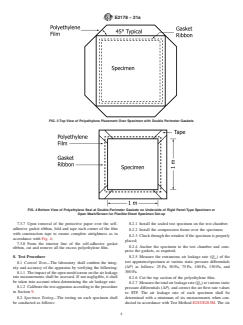
7.2.10 Cut the polyethylene film at each corner as in accordance with Fig. 3;
7.2.11 Apply two self-adhesive gaskets to the underside of the wire mesh/screen support (the gaskets shall line up below the first
ribbon installed in 7.2.1);
7.2.12 Upon removal of the protective paper over the gasket, fold and tape each corner of the film with construction tape to ensure
complete airtightness as in accordance with Fig. 4;
FIG. 3 Top View of Polyethylene Placement Over Specimen with Double Perimeter Gaskets
E2178 − 21a
FIG. 4 Bottom View of Polyethylene Seal at Double-Perimeter Gaskets on Underside of Rigid Panel-Type Specimen or
Open Mesh/Screen for Flexible Sheet Specimen Set-up
7.2.13 From the interior line of the adhesive gasket, cut and remove all the excess polyethylene film.
7.3 Rigid Panel-Type Materials—Fig. 5 shows the preparation for a typical rigid panel-type material. The following procedure
shall be used to seal the perimeter of the specimen:
7.3.1 Apply a self-adhesive gasket ribbon over the rigid panel-type test specimen around the entire perimeter of the area under
investigation (1 m × 1 m);
7.3.2 All joints in the gasket ribbons shall be fused or glued;
FIG. 5 Rigid Panel-Type Specimen Test Set-up
E2178 − 21a
7.3.3 Cut polyethylene film (0.15 mm (6 mils)) to 1400 mm × 1400 mm;
7.3.4 Upon removal of the protective paper over the self-adhesive gasket ribbon, cover the specimen with the polyethylene film;
7.3.5 Cut the polyethylene film at each corner as in accordance with Fig. 3;
7.3.6 Apply a second self-adhesive gasket ribbon to the underside of the specimen (the ribbon shall be applied directly below the
first ribbon installed in 7.3.1), and seal corner junctions by fusing or gluing;
E2178 − 21a
7.3.7 Upon removal of the protective paper over the self-adhesive gasket ribbon, fold and tape each corner of the film with
construction tape to ensure complete airtightness as in accordance with Fig. 4;
7.3.8 From the interior line of the self-adhesive gasket ribbon, cut and remove all the excess polyethylene film.
8. Test Procedure
8.1 Control Tests—The laboratory shall confirm the integrity and accuracy of the apparatus by
...