

ASTM A409/A409M-24
(Specification)Standard Specification for Welded Large Diameter Austenitic Steel Pipe for Corrosive or High-Temperature Service
General Information
- Abstract
ABSTRACT
This guide covers standard specification for straight seam or spinal seam electric-fusion-welded, light-wall, austenitic chromium-nickel alloy steel pipe for corrosive or high-temperature service. The sizes covered shall include NPS 14 to 30 with extra light (Schedule 5S) and light (Schedule 10S) wall thickness. Several grades of alloy steel shall be covered and shall conform to the required chemical composition for carbon, manganese, phosphorus, sulfur, silicon, nickel, chromium, molybdenum, titanium, columbium, cerium, and other elements. The chemical composition of the welding filler metal shall also conform to the requirements of the applicable AWS specification for the corresponding grade. Tensile properties of the plate or sheet used in making the pipe shall conform to the prescribed values of tensile strength and yield strength. Mechanical tests such as tension test and transverse guided-bend weld test shall be conducted. Pressure or nondestructive electric test shall also be performed.
SCOPE
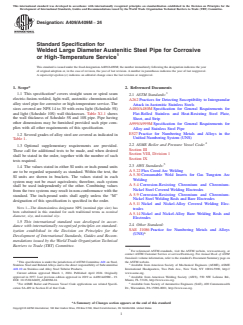
1.1 This specification2 covers straight seam or spiral seam electric-fusion-welded, light-wall, austenitic chromium-nickel alloy steel pipe for corrosive or high-temperature service. The sizes covered are NPS 14 to 30 with extra light (Schedule 5S) and light (Schedule 10S) wall thicknesses. Table X1.1 shows the wall thickness of Schedule 5S and 10S pipe. Pipe having other dimensions may be furnished provided such pipe complies with all other requirements of this specification.
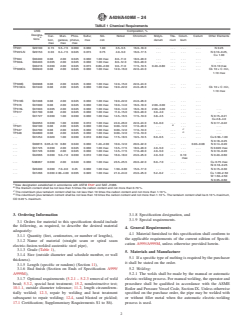
1.2 Several grades of alloy steel are covered as indicated in Table 1.
1.3 Optional supplementary requirements are provided. These call for additional tests to be made, and when desired shall be stated in the order, together with the number of such tests required.
1.4 The values stated in either SI units or inch-pound units are to be regarded separately as standard. Within the text, the SI units are shown in brackets. The values stated in each system may not be exact equivalents; therefore, each system shall be used independently of the other. Combining values from the two systems may result in non-conformance with the standard. The inch-pound units shall apply unless the “M” designation of this specification is specified in the order.
Note 1: The dimensionless designator NPS (nominal pipe size) has been substituted in this standard for such traditional terms as nominal diameter, size, and nominal size.
1.5 This international standard was developed in accordance with internationally recognized principles on standardization established in the Decision on Principles for the Development of International Standards, Guides and Recommendations issued by the World Trade Organization Technical Barriers to Trade (TBT) Committee.
- Status
- Published
- Publication Date
- 29-Feb-2024
- Technical Committee
- A01 - Steel, Stainless Steel and Related Alloys
- Drafting Committee
- A01.10 - Stainless and Alloy Steel Tubular Products
Buy Documents
ASTM A409/A409M-24 - Standard Specification for Welded Large Diameter Austenitic Steel Pipe for Corrosive or High-Temperature Service
REDLINE ASTM A409/A409M-24 - Standard Specification for Welded Large Diameter Austenitic Steel Pipe for Corrosive or High-Temperature Service
Overview
ASTM A409/A409M-24 is the Standard Specification for Welded Large Diameter Austenitic Steel Pipe for Corrosive or High-Temperature Service, issued by ASTM International. This specification covers straight seam or spiral seam electric-fusion-welded, light-wall, austenitic chromium-nickel alloy steel pipe, ideal for applications requiring resistance to corrosion and the ability to withstand high temperatures. The standard applies to nominal pipe sizes (NPS) 14 to 30 in extra light (Schedule 5S) and light (Schedule 10S) wall thicknesses. ASTM A409/A409M-24 is widely referenced for constructing pipelines and process lines in environments where both durability and chemical resistance are critical.
Key Topics
Material Grades and Composition
The standard covers multiple grades of austenitic stainless steel alloys, each conforming to precise limits for elements such as carbon, manganese, phosphorus, sulfur, silicon, nickel, chromium, molybdenum, titanium, columbium, and others. Chemical composition is essential to ensuring corrosion resistance and mechanical properties.Manufacturing and Welding
Pipes can be fabricated with straight or spiral seams using electric-fusion-welding. Both manual and automatic welding processes are allowed, with requirements for the qualification of procedures and welders. Welding must meet specific workmanship and quality criteria to guarantee joint integrity.Mechanical Properties and Heat Treatment
The steel plate or sheet used in pipe manufacture must conform to minimum tensile strength and yield strength values, which vary depending on the grade. Heat treatment, typically solution annealing, is required to enhance corrosion resistance and mechanical properties. Special provisions address heat treatment requirements for certain alloy grades.Testing and Inspection
The specification mandates mechanical tests, including tension and guided-bend weld tests, for each production lot. Pipes must undergo pressure testing or nondestructive electric testing to check for leaks or internal defects. Optional supplementary requirements support additional testing such as radiographic inspection and corrosion testing.Dimensional Tolerances and Marking
Limits for wall thickness, diameter, out-of-roundness, and alignment ensure pipes meet strict dimensional accuracy. Each pipe must be clearly marked with manufacturer details, grade, size, schedule, and relevant heat treatment or certification information.
Applications
Chemical Processing and Petrochemical Industries
ASTM A409/A409M-24 welded stainless steel pipes are widely used in chemical processing plants and refineries where they are exposed to corrosive chemicals and elevated temperatures.Power Generation
The standard supports applications in power plant construction, particularly in steam supply and condensate systems subject to high pressure and temperature cycles.Oil and Gas
Large diameter, corrosion-resistant pipes specified by ASTM A409/A409M-24 are ideal for transporting oil, gas, and other hydrocarbon products, especially where aggressive service conditions are present.Water Treatment and Desalination
Facilities that require high-quality piping for corrosive water and brine systems benefit from using austenitic stainless steel pipes conforming to this standard.General Industrial Use
The specification is also applicable in general industrial settings wherever robust, reliable, and chemically-resistant pipework is required.
Related Standards
- ASTM A262 - Practices for Detecting Susceptibility to Intergranular Attack in Austenitic Stainless Steels
- ASTM A480/A480M - Specifications for General Requirements for Flat-Rolled Stainless and Heat-Resisting Steel Plate, Sheet, and Strip
- ASTM A999/A999M - General Requirements for Alloy and Stainless Steel Pipe
- ASME Boiler and Pressure Vessel Code (SA-409) - Recognized for design and construction in code-regulated pressure applications
- AWS A5 Series - Specifications for welding filler materials
- SAE J1086 - Practice for Numbering Metals and Alloys (UNS)
Conclusion
ASTM A409/A409M-24 delivers comprehensive requirements for welded, large diameter austenitic steel pipes designed for corrosive and high-temperature services. Its rigorous chemical, mechanical, and testing criteria ensure safety and reliability in demanding industrial environments, supporting critical infrastructure across a variety of sectors.
Relations
- Effective Date
- 01-Mar-2024
- Effective Date
- 01-Mar-2024
- Effective Date
- 01-Mar-2024
Buy Documents
ASTM A409/A409M-24 - Standard Specification for Welded Large Diameter Austenitic Steel Pipe for Corrosive or High-Temperature Service
REDLINE ASTM A409/A409M-24 - Standard Specification for Welded Large Diameter Austenitic Steel Pipe for Corrosive or High-Temperature Service
Get Certified
Connect with accredited certification bodies for this standard

Institut za varilstvo d.o.o. (Welding Institute)
Slovenia's leading welding institute since 1952. ISO 3834, EN 1090, pressure equipment certification, NDT personnel, welder qualification. Only IIW Au
Sponsored listings
Frequently Asked Questions
ASTM A409/A409M-24 is a technical specification published by ASTM International. Its full title is "Standard Specification for Welded Large Diameter Austenitic Steel Pipe for Corrosive or High-Temperature Service". This standard covers: ABSTRACT This guide covers standard specification for straight seam or spinal seam electric-fusion-welded, light-wall, austenitic chromium-nickel alloy steel pipe for corrosive or high-temperature service. The sizes covered shall include NPS 14 to 30 with extra light (Schedule 5S) and light (Schedule 10S) wall thickness. Several grades of alloy steel shall be covered and shall conform to the required chemical composition for carbon, manganese, phosphorus, sulfur, silicon, nickel, chromium, molybdenum, titanium, columbium, cerium, and other elements. The chemical composition of the welding filler metal shall also conform to the requirements of the applicable AWS specification for the corresponding grade. Tensile properties of the plate or sheet used in making the pipe shall conform to the prescribed values of tensile strength and yield strength. Mechanical tests such as tension test and transverse guided-bend weld test shall be conducted. Pressure or nondestructive electric test shall also be performed. SCOPE 1.1 This specification2 covers straight seam or spiral seam electric-fusion-welded, light-wall, austenitic chromium-nickel alloy steel pipe for corrosive or high-temperature service. The sizes covered are NPS 14 to 30 with extra light (Schedule 5S) and light (Schedule 10S) wall thicknesses. Table X1.1 shows the wall thickness of Schedule 5S and 10S pipe. Pipe having other dimensions may be furnished provided such pipe complies with all other requirements of this specification. 1.2 Several grades of alloy steel are covered as indicated in Table 1. 1.3 Optional supplementary requirements are provided. These call for additional tests to be made, and when desired shall be stated in the order, together with the number of such tests required. 1.4 The values stated in either SI units or inch-pound units are to be regarded separately as standard. Within the text, the SI units are shown in brackets. The values stated in each system may not be exact equivalents; therefore, each system shall be used independently of the other. Combining values from the two systems may result in non-conformance with the standard. The inch-pound units shall apply unless the “M” designation of this specification is specified in the order. Note 1: The dimensionless designator NPS (nominal pipe size) has been substituted in this standard for such traditional terms as nominal diameter, size, and nominal size. 1.5 This international standard was developed in accordance with internationally recognized principles on standardization established in the Decision on Principles for the Development of International Standards, Guides and Recommendations issued by the World Trade Organization Technical Barriers to Trade (TBT) Committee.
ABSTRACT This guide covers standard specification for straight seam or spinal seam electric-fusion-welded, light-wall, austenitic chromium-nickel alloy steel pipe for corrosive or high-temperature service. The sizes covered shall include NPS 14 to 30 with extra light (Schedule 5S) and light (Schedule 10S) wall thickness. Several grades of alloy steel shall be covered and shall conform to the required chemical composition for carbon, manganese, phosphorus, sulfur, silicon, nickel, chromium, molybdenum, titanium, columbium, cerium, and other elements. The chemical composition of the welding filler metal shall also conform to the requirements of the applicable AWS specification for the corresponding grade. Tensile properties of the plate or sheet used in making the pipe shall conform to the prescribed values of tensile strength and yield strength. Mechanical tests such as tension test and transverse guided-bend weld test shall be conducted. Pressure or nondestructive electric test shall also be performed. SCOPE 1.1 This specification2 covers straight seam or spiral seam electric-fusion-welded, light-wall, austenitic chromium-nickel alloy steel pipe for corrosive or high-temperature service. The sizes covered are NPS 14 to 30 with extra light (Schedule 5S) and light (Schedule 10S) wall thicknesses. Table X1.1 shows the wall thickness of Schedule 5S and 10S pipe. Pipe having other dimensions may be furnished provided such pipe complies with all other requirements of this specification. 1.2 Several grades of alloy steel are covered as indicated in Table 1. 1.3 Optional supplementary requirements are provided. These call for additional tests to be made, and when desired shall be stated in the order, together with the number of such tests required. 1.4 The values stated in either SI units or inch-pound units are to be regarded separately as standard. Within the text, the SI units are shown in brackets. The values stated in each system may not be exact equivalents; therefore, each system shall be used independently of the other. Combining values from the two systems may result in non-conformance with the standard. The inch-pound units shall apply unless the “M” designation of this specification is specified in the order. Note 1: The dimensionless designator NPS (nominal pipe size) has been substituted in this standard for such traditional terms as nominal diameter, size, and nominal size. 1.5 This international standard was developed in accordance with internationally recognized principles on standardization established in the Decision on Principles for the Development of International Standards, Guides and Recommendations issued by the World Trade Organization Technical Barriers to Trade (TBT) Committee.
ASTM A409/A409M-24 is classified under the following ICS (International Classification for Standards) categories: 23.040.10 - Iron and steel pipes. The ICS classification helps identify the subject area and facilitates finding related standards.
ASTM A409/A409M-24 has the following relationships with other standards: It is inter standard links to ASTM A409/A409M-19, ASTM A778/A778M-24, ASTM A999/A999M-23. Understanding these relationships helps ensure you are using the most current and applicable version of the standard.
ASTM A409/A409M-24 is available in PDF format for immediate download after purchase. The document can be added to your cart and obtained through the secure checkout process. Digital delivery ensures instant access to the complete standard document.
Standards Content (Sample)
This international standard was developed in accordance with internationally recognized principles on standardization established in the Decision on Principles for the
Development of International Standards, Guides and Recommendations issued by the World Trade Organization Technical Barriers to Trade (TBT) Committee.
Designation: A409/A409M − 24
Standard Specification for
Welded Large Diameter Austenitic Steel Pipe for Corrosive
or High-Temperature Service
This standard is issued under the fixed designation A409/A409M; the number immediately following the designation indicates the year
of original adoption or, in the case of revision, the year of last revision. A number in parentheses indicates the year of last reapproval.
A superscript epsilon (´) indicates an editorial change since the last revision or reapproval.
1. Scope* 2. Referenced Documents
1.1 This specification covers straight seam or spiral seam
2.1 ASTM Standards:
electric-fusion-welded, light-wall, austenitic chromium-nickel
A262 Practices for Detecting Susceptibility to Intergranular
alloy steel pipe for corrosive or high-temperature service. The
Attack in Austenitic Stainless Steels
sizes covered are NPS 14 to 30 with extra light (Schedule 5S)
A480/A480M Specification for General Requirements for
and light (Schedule 10S) wall thicknesses. Table X1.1 shows
Flat-Rolled Stainless and Heat-Resisting Steel Plate,
the wall thickness of Schedule 5S and 10S pipe. Pipe having
Sheet, and Strip
other dimensions may be furnished provided such pipe com-
A999/A999M Specification for General Requirements for
plies with all other requirements of this specification.
Alloy and Stainless Steel Pipe
E527 Practice for Numbering Metals and Alloys in the
1.2 Several grades of alloy steel are covered as indicated in
Unified Numbering System (UNS)
Table 1.
2.2 ASME Boiler and Pressure Vessel Code:
1.3 Optional supplementary requirements are provided.
Section III
These call for additional tests to be made, and when desired
Section VIII, Division 1
shall be stated in the order, together with the number of such
Section IX
tests required.
2.3 AWS Standards:
1.4 The values stated in either SI units or inch-pound units
A 5.22 Flux Cored Arc Welding
are to be regarded separately as standard. Within the text, the
A 5.30 Consumable Weld Inserts for Gas Tungsten Arc
SI units are shown in brackets. The values stated in each
Welding
system may not be exact equivalents; therefore, each system
A 5.4 Corrosion-Resisting Chromium and Chromium-
shall be used independently of the other. Combining values
Nickel Steel Covered Welding Electrodes
from the two systems may result in non-conformance with the
A 5.9 Corrosion-Resisting Chromium and Chromium-
standard. The inch-pound units shall apply unless the “M”
Nickel Steel Welding Rods and Bare Electrodes
designation of this specification is specified in the order.
A 5.11 Nickel and Nickel-Alloy Covered Welding Elec-
NOTE 1—The dimensionless designator NPS (nominal pipe size) has
trodes
been substituted in this standard for such traditional terms as nominal
A 5.14 Nickel and Nickel-Alloy Bare Welding Rods and
diameter, size, and nominal size.
Electrodes
1.5 This international standard was developed in accor-
2.4 Other Standard:
dance with internationally recognized principles on standard-
SAE J1086 Practice for Numbering Metals and Alloys
ization established in the Decision on Principles for the
(UNS)
Development of International Standards, Guides and Recom-
mendations issued by the World Trade Organization Technical
Barriers to Trade (TBT) Committee.
For referenced ASTM standards, visit the ASTM website, www.astm.org, or
contact ASTM Customer Service at service@astm.org. For Annual Book of ASTM
Standards volume information, refer to the standard’s Document Summary page on
This specification is under the jurisdiction of ASTM Committee A01 on Steel, the ASTM website.
Stainless Steel and Related Alloys and is the direct responsibility of Subcommittee Available from American Society of Mechanical Engineers (ASME), ASME
A01.10 on Stainless and Alloy Steel Tubular Products. International Headquarters, Two Park Ave., New York, NY 10016-5990, http://
Current edition approved March 1, 2024. Published April 2024. Originally www.asme.org.
approved in 1957. Last previous edition approved in 2019 as A409/A409M – 19. Available from American Welding Society (AWS), 550 NW LeJeune Rd.,
DOI: 10.1520/A0409_A0409M-24. Miami, FL 33126, http://www.aws.org.
2 6
For ASME Boiler and Pressure Vessel Code applications see related Specifi- Available from Society of Automotive Engineers (SAE), 400 Commonwealth
cation SA-409 in Section II of that Code. Dr., Warrendale, PA 15096-0001, http://www.sae.org.
*A Summary of Changes section appears at the end of this standard
Copyright © ASTM International, 100 Barr Harbor Drive, PO Box C700, West Conshohocken, PA 19428-2959. United States
A409/A409M − 24
TABLE 1 Chemical Requirements
UNS Composition, %
Designa-
Car- Man- Phos- Sulfur, Sili- Nickel Chromium Molyb- Tita- Colum- Cerium Other Elements
A
tions
bon, ganese, phorus, max con denum nium bium
max max max
TP201 S20100 0.15 5.5–7.5 0.060 0.030 1.00 3.5–5.5 16.0–18.0 . . . . . . . . . . . . N 0.25
TP201LN S20153 0.03 6.4–7.5 0.045 0.015 0.75 4.0–5.0 16.0–17.5 . . . . . . . . . . . . N 0.10–0.25,
Cu 1.00
TP304 S30400 0.08 2.00 0.045 0.030 1.00 max 8.0–11.0 18.0–20.0 . . . . . . . . . . . . . . .
TP304L S30403 0.035 2.00 0.045 0.030 1.00 max 8.0–12.0 18.0–20.0 . . . . . . . . . . . . . . .
. . . S30416 0.030 2.00 0.045 0.015 0.80–2.00 9.0–11.0 17.5–19.5 0.40–0.80 . . . . . . . . . N 0.10 max
TP309Cb S30940 0.08 2.00 0.045 0.030 1.00 max 12.0–16.0 22.0–24.0 . . . . . . . . . Cb 10 × C min,
1.10 max
TP309S S30908 0.08 2.00 0.045 0.030 1.00 max 12.0–15.0 22.0–24.0 . . . . . . . . .
TP310Cb S31040 0.08 2.00 0.045 0.030 1.00 max 19.0–22.0 24.0–26.0 . . . . . . . . . Cb 10 × C min,
1.10 max
TP310S S31008 0.08 2.00 0.045 0.030 1.00 max 19.0–22.0 24.0–26.0 . . . . . . . . .
TP316 S31600 0.08 2.00 0.045 0.030 1.00 max 10.0–14.0 16.0–18.0 2.00–3.00 . . . . . . . . .
TP316L S31603 0.035 2.00 0.045 0.030 1.00 max 10.0–14.0 16.0–18.0 2.00–3.00 . . . . . . . . . . . .
TP317 S31700 0.08 2.00 0.045 0.030 1.00 max 11.0–15.0 18.0–20.0 3.0–4.0 . . . . . . . . . .
. . . S31727 0.030 1.00 0.030 0.030 1.00 max 14.5–16.5 17.5–19.0 3.8–4.5 . . . . . . . . . N 0.15–0.21
Cu 2.8–4.0
. . . S32053 0.030 1.00 0.030 0.010 1.00 max 24.0–26.0 22.0–24.0 5.0–6.0 . . . . . . . . . N 0.17–0.22
B
TP321 S32100 0.08 2.00 0.045 0.030 1.00 max 9.00–12.0 17.0–20.0 . . . . . . . . . . . .
C
TP347 S34700 0.08 2.00 0.045 0.030 1.00 max 9.00–12.0 17.0–19.0 . . . . . . . . . . . .
D
TP348 S34800 0.08 2.00 0.045 0.030 1.00 max 9.00–12.0 17.0–19.0 . . . . . . . . . . . .
. . . S31254 0.020 1.00 0.030 0.010 0.80 max 17.5–18.5 19.5–19.5 6.0–6.5 . . . . . . . . . Cu 0.50–1.00
N 0.18–0.25
. . . S30815 0.05–0.10 0.80 0.040 0.030 1.40–2.00 10.0–12.0 20.0–22.0 . . . . . . . . . 0.03–0.08 N 0.14–0.20
. . . S31725 0.030 2.00 0.045 0.030 1.00 max 13.5–17.5 18.0–20.0 4.0–5.0 . . . . . . . . . N 0.020 max
. . . S31726 0.030 2.00 0.045 0.030 1.00 max 14.5–17.5 17.0–20.0 4.0–5.0 . . . . . . . . . N 0.10–0.20
. . . S34565 0.030 5.0–7.0 0.030 0.010 1.00 max 16.0–18.0 23.0–25.0 4.0–5.0 . . . 0.10 . . . N 0.40–0.60
max
. . . N08367 0.030 2.00 0.040 0.030 1.00 max 23.5–25.5 20.0–22.0 6.0–7.0 . . . . . . . . . Cu 0.75 max
Ni 0.18–0.25
. . . S20400 0.030 7.0–9.0 0.45 0.030 1.00 max 1.50–3.00 15.0–17.0 . . . . . . . . . . . . N 0.15–0.30
. . . S31266 0.030 2.00–4.00 0.035 0.020 1.00 max 21.0–24.0 23.0–25.0 5.2–6.2 . . . . . . . . . Cu 1.00–2.50
W 1.50–2.50
N 0.35–0.60
A
New designation established in accordance with ASTM E527 and SAE J1086.
B
The titanium content shall be not less than 5 times the carbon content and not more than 0.70 %.
C
The columbium plus tantalum content shall be not less than 10 times the carbon content and not more than 1.10 %.
D
The columbium plus tantalum content shall be not less than 10 times the carbon content and not more than 1.10 %. The tantalum content shall be 0.10 % maximum,
CO 0.20 % maximum.
3. Ordering Information 3.1.8 Specification designation, and
3.1.9 Special requirements.
3.1 Orders for material to this specification should include
the following, as required, to describe the desired material
4. General Requirements
adequately:
4.1 Material furnished to this specification shall conform to
3.1.1 Quantity (feet, centimetres, or number of lengths),
the applicable requirements of the current edition of Specifi-
3.1.2 Name of material (straight seam or spiral seam
cation A999/A999M, unless otherwise provided herein.
electric-fusion-welded austenitic steel pipe),
3.1.3 Grade (Table 1),
5. Materials and Manufacture
3.1.4 Size (outside diameter and schedule number, or wall
5.1 If a specific type of melting is required by the purchaser
thickness).
it shall be stated on the order.
3.1.5 Length (specific or random) (Section 11),
3.1.6 End finish (Section on Ends of Specification A999/ 5.2 Welding:
A999M), 5.2.1 The welds shall be made by the manual or automatic
3.1.7 Optional requirements (5.2.1 – 5.2.3 removal of weld electric-welding process. For manual welding, the operator and
bead; 5.3.2, special heat treatment; 15.2, nondestructive test; procedure shall be qualified in accordance with the ASME
10.1.1, outside diameter tolerance; 11.2, length circumferen- Boiler and Pressure Vessel Code, Section IX. Unless otherwise
tially welded; 12.3, repair by welding and heat treatment specified on the purchase order, the pipe may be welded with
subsequent to repair welding; 12.4, sand blasted or pickled; or without filler metal when the automatic electric-welding
17.1 Certification; Supplementary Requirements S1 to S6). process is used.
A409/A409M − 24
5.2.2 The weld surface on either side of the weld may be 6.3 Unless otherwise specified in the purchase order, the
flush with the base plate or may have a reasonably uniform chemical composition of the welding filler metal shall conform
crown, not to exceed ⁄16 in. [2 mm]. Any weld reinforcement to the requirements of the applicable AWS specification for the
may be removed at the manufacturer’s option or by agreement corresponding grade shown in Table 2. Grades with no filler
between the manufacturer and purchaser. The contour of the metal classification indicated shall be welded with filler metals
reinforcement should be reasonably smooth and free from producing deposited weld metal having a composition in
irregularities. The weld metal shall be fused uniformly into the accordance with the chemical composition specified in Table 1.
plate surface. No concavity of contour is permitted unless the The method of analysis for nitrogen and cerium shall be a
resulting thickness of weld metal is equal to or greater than the matter of agreement between the purchaser and manufacturer.
minimum thickness of the adjacent base metal. The purchaser may choose a higher-alloy filler metal when
5.2.3 Weld defects, as determined by specified inspection needed for corrosion resistance.
requirements, shall be repaired by removal to sound metal and
7. Tensile Requirements
rewelding.
7.1 The tensile properties of the plate or sheet used in
5.3 Heat Treatment:
making the pipe shall conform to the requirements prescribed
5.3.1 Except as provided in 5.3.2, all pipe shall be furnished
in Table 3. Certified mill test reports shall be submitted to the
in the heat-treated condition. The heat-treatment procedure
pipe manufacturer.
shall consist of heating the material to a minimum temperature
of 1900 °F [1040 °C], except for S31254, S31266, and S30815
7.2 A transverse tension test taken across the welded joint of
which shall be heat treated to 2100 °F [1150 °C] and 1920 °F
the finished pipe shall meet the same minimum tensile strength
[1050 °C] respectively, S31727 and S32053 which shall be
requirements as the sheet or plate. The weld section on the
heat treated in the range 1975 to 2155 °F [1080 to 1180 °C],
tension specimen shall be in the same condition as the finished
S34565 which shall be heat treated in the range 2050 °F
pipe (with or without bead as specified).
[1120 °C] to 2140 °F [1170 °C], and N08367, which shall be
heated to a minimum temperature of 2025 °F [1107 °C], all
8. Mechanical Tests Required
materials to be followed by quenching in water or rapidly
8.1 Tension Test—One transverse tension test of the weld
cooling by other means.
shall be made on each lot (Note 2) of finished pipe.
5.3.2 The purchase order shall specify one of the following
NOTE 2—The term “lot” applies to each 200 ft [60 m] or less of pipe of
conditions if the heat-treated condition specified in 5.3.1 is not
the same NPS and wall thickness (or schedule number) which is produced
desired by the purchaser:
from the same heat of steel and subjected to the same finishing treatment
5.3.2.1 A final heat-treatment temperature under 1900 °F
in a continuous furnace. When final heat treatment is in a batch-type
[1040 °C]. Each pipe supplied under this requirement shall be
furnace, the lot shall include only that pipe which is heat treated in the
stenciled with the final heat-treatment temperature in degrees same furnace charge. When no heat treatment is performed following final
forming operations, the lot shall include each 200 ft [60 m] or less of pipe
Fahrenheit or degrees Celsius after the suffix “HT.” Controlled
of the same NPS and wall thickness (or schedule number) which is
structural or special service characteristics may be specified as
produced from the same heat of steel.
a guide for the most suitable heat treatment.
8.2 Transverse Guided-Bend Weld Test—One test (two
5.3.2.2 No final heat treatment of pipe fabricated of plate,
specimens) of the weld shall be made on each lot (Note 2) of
that has been solution heat treated at temperatures required by
finished pipe.
this specification. Each pipe supplied under this requirement
shall be stenciled with the suffix “HT-O.”
8.3 Pressure or Nondestructive Electric Test—Each length
5.3.2.3 No final heat treatment of pipe fabricated of plate,
of pipe shall be subjected to a pressure test or a nondestructive
that has not been solution heat treated. Each pipe supplied
electric test as prescribed in Section 5.
under this requirement shall be stenciled with the suffix
9. Permissible Variations in Wall Thickness
“HT-SO.”
5.4 A solution annealing temperature above 1950 °F 9.1 The minimum wall thickness at any point shall not be
more than 0.018 in. [0.46 mm] under the specified wall
[1065 °C] may impair the resistance to intergranular corrosion
after subsequent exposure to sensitizing conditions in TP321, thickness. (This tolerance is slightly more than commercial
tolerances on sheet and plate to allow for possible loss of
TP347, and TP348. When specified by the purchaser, a lower
temperature stabilization or re-solution anneal shall be used thickness caused by manufacturing operations.)
subsequent to the initial high temperature solution anneal (see
10. Permissible Variations in Dimensions
Supplementary Requirement S5).
10.1 Permissible variations in dimensions shall not exceed
6. Chemical Composition
the following at any point in each length of pipe.
6.1 The steel shall conform to the chemical composition in
10.1.1 Specified Diameter—Where the specified wall thick-
Table 1.
ness is less than 0.188 in. [4.8 mm], the actual outside
6.2 When specified on the purchase order, a product analy- diameter, based on circumferential measurement, shall not vary
sis shall be supplied from one tube or coil of steel per heat. The more than 60.20 % from the specified outside diameter. Where
product analysis tolerance of Specification A480/A480M shall the specified wall thickness is 0.188 in. [4.8 mm] and heavier,
apply. the actual outside diameter, based on circumferential
A409/A409M − 24
TABLE 2 Filler Metal Specifications
A B
Filler Metal Classification and UNS Designation for Applicable AWS Specification
UNS
Grade A5.4 A5.9 A5.11 A5.14 A5.22 A5.30
Designation
Class. UNS Class. UNS Class. UNS Class. UNS Class. UNS Class. UNS
TP201 S20100 . . . . . . . . . . . . . . . . . . . . . . . . . . . . . . . . . . . .
TP201LN S20153 . . . . . . . . . . . . . . . . . . . . . . . . . . . . . . . . . . . .
S30880
TP304 S30400 E308 W30810 ER308 . . . . . . . . . . . . E308T W30831 IN308 S30880
W30840
S30883
TP304L S30403 E308L W30813 ER308L . . . . . . . . . . . . E308T W30835 IN308L S30883
W30843
S31683
. . . S30416 E316L W31603 ER316L . . . . . . . . . . . . E316LT W31635 IN316L S31683
W31643
TP309Cb S30940 E309Cb W30917 . . . . . . . . . . . . . . . . . . . . . . . . . . . . . .
TP310Cb S31040 E310Cb W31017 . . . . . . . . . . . . . . . . . . . . . . . . .
...
This document is not an ASTM standard and is intended only to provide the user of an ASTM standard an indication of what changes have been made to the previous version. Because
it may not be technically possible to adequately depict all changes accurately, ASTM recommends that users consult prior editions as appropriate. In all cases only the current version
of the standard as published by ASTM is to be considered the official document.
Designation: A409/A409M − 19 A409/A409M − 24
Standard Specification for
Welded Large Diameter Austenitic Steel Pipe for Corrosive
or High-Temperature Service
This standard is issued under the fixed designation A409/A409M; the number immediately following the designation indicates the year
of original adoption or, in the case of revision, the year of last revision. A number in parentheses indicates the year of last reapproval.
A superscript epsilon (´) indicates an editorial change since the last revision or reapproval.
1. Scope*
1.1 This specification covers straight seam or spiral seam electric-fusion-welded, light-wall, austenitic chromium-nickel alloy
steel pipe for corrosive or high-temperature service. The sizes covered are NPS 14 to 30 with extra light (Schedule 5S) and light
(Schedule 10S) wall thicknesses. Table X1.1 shows the wall thickness of Schedule 5S and 10S pipe. Pipe having other dimensions
may be furnished provided such pipe complies with all other requirements of this specification.
1.2 Several grades of alloy steel are covered as indicated in Table 1.
1.3 Optional supplementary requirements are provided. These call for additional tests to be made, and when desired shall be stated
in the order, together with the number of such tests required.
1.4 The values stated in either SI units or inch-pound units are to be regarded separately as standard. Within the text, the SI units
are shown in brackets. The values stated in each system may not be exact equivalents; therefore, each system shall be used
independently of the other. Combining values from the two systems may result in non-conformance with the standard. The
inch-pound units shall apply unless the “M” designation of this specification is specified in the order.
NOTE 1—The dimensionless designator NPS (nominal pipe size) has been substituted in this standard for such traditional terms as nominal diameter,size,
and nominal size.
1.5 This international standard was developed in accordance with internationally recognized principles on standardization
established in the Decision on Principles for the Development of International Standards, Guides and Recommendations issued
by the World Trade Organization Technical Barriers to Trade (TBT) Committee.
2. Referenced Documents
2.1 ASTM Standards:
A262 Practices for Detecting Susceptibility to Intergranular Attack in Austenitic Stainless Steels
A480/A480M Specification for General Requirements for Flat-Rolled Stainless and Heat-Resisting Steel Plate, Sheet, and Strip
A999/A999M Specification for General Requirements for Alloy and Stainless Steel Pipe
E527 Practice for Numbering Metals and Alloys in the Unified Numbering System (UNS)
This specification is under the jurisdiction of ASTM Committee A01 on Steel, Stainless Steel and Related Alloys and is the direct responsibility of Subcommittee A01.10
on Stainless and Alloy Steel Tubular Products.
Current edition approved Nov. 1, 2019March 1, 2024. Published November 2019April 2024. Originally approved in 1957. Last previous edition approved in 20152019
as A409/A409M – 15.A409/A409M – 19. DOI: 10.1520/A0409_A0409M-19.10.1520/A0409_A0409M-24.
For ASME Boiler and Pressure Vessel Code applications see related Specification SA-409 in Section II of that Code.
For referenced ASTM standards, visit the ASTM website, www.astm.org, or contact ASTM Customer Service at service@astm.org. For Annual Book of ASTM Standards
volume information, refer to the standard’s Document Summary page on the ASTM website.
*A Summary of Changes section appears at the end of this standard
Copyright © ASTM International, 100 Barr Harbor Drive, PO Box C700, West Conshohocken, PA 19428-2959. United States
A409/A409M − 24
TABLE 1 Chemical Requirements
UNS Composition, %
Designa-
Car- Man- Phos- Sulfur, Sili- Nickel Chromium Molyb- Tita- Colum- Cerium Other Elements
A
tions
bon, ganese, phorus, max con denum nium bium
max max max
TP201 S20100 0.15 5.5–7.5 0.060 0.030 1.00 3.5–5.5 16.0–18.0 . . . . . . . . . . . . N 0.25
TP201LN S20153 0.03 6.4–7.5 0.045 0.015 0.75 4.0–5.0 16.0–17.5 . . . . . . . . . . . . N 0.10–0.25,
Cu 1.00
TP304 S30400 0.08 2.00 0.045 0.030 1.00 max 8.0–11.0 18.0–20.0 . . . . . . . . . . . . . . .
TP304L S30403 0.035 2.00 0.045 0.030 1.00 max 8.0–12.0 18.0–20.0 . . . . . . . . . . . . . . .
. . . S30416 0.030 2.00 0.045 0.015 0.80–2.00 9.0–11.0 17.5–19.5 0.40–0.80 . . . . . . . . . N 0.10 max
TP309Cb S30940 0.08 2.00 0.045 0.030 1.00 max 12.0–16.0 22.0–24.0 . . . . . . . . . Cb 10 × C min,
1.10 max
TP309S S30908 0.08 2.00 0.045 0.030 1.00 max 12.0–15.0 22.0–24.0 . . . . . . . . .
TP310Cb S31040 0.08 2.00 0.045 0.030 1.00 max 19.0–22.0 24.0–26.0 . . . . . . . . . Cb 10 × C min,
1.10 max
TP310S S31008 0.08 2.00 0.045 0.030 1.00 max 19.0–22.0 24.0–26.0 . . . . . . . . .
TP316 S31600 0.08 2.00 0.045 0.030 1.00 max 10.0–14.0 16.0–18.0 2.00–3.00 . . . . . . . . .
TP316L S31603 0.035 2.00 0.045 0.030 1.00 max 10.0–14.0 16.0–18.0 2.00–3.00 . . . . . . . . . . . .
TP317 S31700 0.08 2.00 0.045 0.030 1.00 max 11.0–15.0 18.0–20.0 3.0–4.0 . . . . . . . . . .
. . . S31727 0.030 1.00 0.030 0.030 1.00 max 14.5–16.5 17.5–19.0 3.8–4.5 . . . . . . . . . N 0.15–0.21
Cu 2.8–4.0
. . . S32053 0.030 1.00 0.030 0.010 1.00 max 24.0–26.0 22.0–24.0 5.0–6.0 . . . . . . . . . N 0.17–0.22
B
TP321 S32100 0.08 2.00 0.045 0.030 1.00 max 9.00–12.0 17.0–20.0 . . . . . . . . . . . .
C
TP347 S34700 0.08 2.00 0.045 0.030 1.00 max 9.00–12.0 17.0–19.0 . . . . . . . . . . . .
D
TP348 S34800 0.08 2.00 0.045 0.030 1.00 max 9.00–12.0 17.0–19.0 . . . . . . . . . . . .
. . . S31254 0.020 1.00 0.030 0.010 0.80 max 17.5–18.5 19.5–19.5 6.0–6.5 . . . . . . . . . Cu 0.50–1.00
N 0.18–0.25
. . . S30815 0.05–0.10 0.80 0.040 0.030 1.40–2.00 10.0–12.0 20.0–22.0 . . . . . . . . . 0.03–0.08 N 0.14–0.20
. . . S31725 0.030 2.00 0.045 0.030 1.00 max 13.5–17.5 18.0–20.0 4.0–5.0 . . . . . . . . . N 0.020 max
. . . S31726 0.030 2.00 0.045 0.030 1.00 max 14.5–17.5 17.0–20.0 4.0–5.0 . . . . . . . . . N 0.10–0.20
. . . S34565 0.030 5.0–7.0 0.030 0.010 1.00 max 16.0–18.0 23.0–25.0 4.0–5.0 . . . 0.10 . . . N 0.40–0.60
max
. . . N08367 0.030 2.00 0.040 0.030 1.00 max 23.5–25.5 20.0–22.0 6.0–7.0 . . . . . . . . . Cu 0.75 max
Ni 0.18–0.25
. . . S20400 0.030 7.0–9.0 0.45 0.030 1.00 max 1.50–3.00 15.0–17.0 . . . . . . . . . . . . N 0.15–0.30
. . . S31266 0.030 2.00–4.00 0.035 0.020 1.00 max 21.0–24.0 23.0–25.0 5.2–6.2 . . . . . . . . . Cu 1.00–2.50
W 1.50–2.50
N 0.35–0.60
A
New designation established in accordance with ASTM E527 and SAE J1086.
B
The titanium content shall be not less than 5 times the carbon content and not more than 0.70 %.
C
The columbium plus tantalum content shall be not less than 10 times the carbon content and not more than 1.10 %.
D
The columbium plus tantalum content shall be not less than 10 times the carbon content and not more than 1.10 %. The tantalum content shall be 0.10 % maximum,
CO 0.20 % maximum.
2.2 ASME Boiler and Pressure Vessel Code:
Section III
Section VIII, Division 1
Section IX
2.3 AWS Standards:
A 5.22 Flux Cored Arc Welding
A 5.30 Consumable Weld Inserts for Gas Tungsten Arc Welding
A 5.4 Corrosion-Resisting Chromium and Chromium-Nickel Steel Covered Welding Electrodes
A 5.9 Corrosion-Resisting Chromium and Chromium-Nickel Steel Welding Rods and Bare Electrodes
A 5.11 Nickel and Nickel-Alloy Covered Welding Electrodes
A 5.14 Nickel and Nickel-Alloy Bare Welding Rods and Electrodes
2.4 Other Standard:
SAE J1086 Practice for Numbering Metals and Alloys (UNS)
Available from American Society of Mechanical Engineers (ASME), ASME International Headquarters, Two Park Ave., New York, NY 10016-5990, http://
www.asme.org.
Available from American Welding Society (AWS), 550 NW LeJeune Rd., Miami, FL 33126, http://www.aws.org.
Available from Society of Automotive Engineers (SAE), 400 Commonwealth Dr., Warrendale, PA 15096-0001, http://www.sae.org.
A409/A409M − 24
3. Ordering Information
3.1 Orders for material to this specification should include the following, as required, to describe the desired material adequately:
3.1.1 Quantity (feet, centimetres, or number of lengths),
3.1.2 Name of material (straight seam or spiral seam electric-fusion-welded austenitic steel pipe),
3.1.3 Grade (Table 1),
3.1.4 Size (outside diameter and schedule number, or wall thickness).
3.1.5 Length (specific or random) (Section 11),
3.1.6 End finish (Section on Ends of Specification A999/A999M),
3.1.7 Optional requirements (5.2.1 – 5.2.3 removal of weld bead; 5.3.2, special heat treatment; 15.2, nondestructive test; 10.1.1,
outside diameter tolerance; 11.2, length circumferentially welded; 12.3, repair by welding and heat treatment subsequent to repair
welding; 12.4, sand blasted or pickled; 17.1 Certification; Supplementary Requirements S1 to S6).
3.1.8 Specification designation, and
3.1.9 Special requirements.
4. General Requirements
4.1 Material furnished to this specification shall conform to the applicable requirements of the current edition of Specification
A999/A999M, unless otherwise provided herein.
5. Materials and Manufacture
5.1 If a specific type of melting is required by the purchaser it shall be stated on the order.
5.2 Welding:
5.2.1 The welds shall be made by the manual or automatic electric-welding process. For manual welding, the operator and
procedure shall be qualified in accordance with the ASME Boiler and Pressure Vessel Code, Section IX. Unless otherwise specified
on the purchase order, the pipe may be welded with or without filler metal when the automatic electric-welding process is used.
5.2.2 The weld surface on either side of the weld may be flush with the base plate or may have a reasonably uniform crown, not
to exceed ⁄16 in. [2 mm]. Any weld reinforcement may be removed at the manufacturer’s option or by agreement between the
manufacturer and purchaser. The contour of the reinforcement should be reasonably smooth and free from irregularities. The weld
metal shall be fused uniformly into the plate surface. No concavity of contour is permitted unless the resulting thickness of weld
metal is equal to or greater than the minimum thickness of the adjacent base metal.
5.2.3 Weld defects, as determined by specified inspection requirements, shall be repaired by removal to sound metal and
rewelding.
5.3 Heat Treatment:
5.3.1 Except as provided in 5.3.2, all pipe shall be furnished in the heat-treated condition. The heat-treatment procedure shall
consist of heating the material to a minimum temperature of 1900 °F [1040 °C], except for S31254, S31266, and S30815 which
shall be heat treated to 2100 °F [1150 °C] and 1920 °F [1050 °C] respectively, S31727 and S32053 which shall be heat treated in
the range 1975 to 2155 °F [1080 to 1180 °C], S34565 which shall be heat treated in the range 2050 °F [1120 °C] to 2140 °F
[1170 °C], and N08367, which shall be heated to a minimum temperature of 2025 °F [1107 °C], all materials to be followed by
quenching in water or rapidly cooling by other means.
A409/A409M − 24
5.3.2 The purchase order shall specify one of the following conditions if the heat-treated condition specified in 5.3.1 is not desired
by the purchaser:
5.3.2.1 A final heat-treatment temperature under 1900 °F [1040 °C]. Each pipe supplied under this requirement shall be stenciled
with the final heat-treatment temperature in degrees Fahrenheit or degrees Celsius after the suffix “HT.” Controlled structural or
special service characteristics may be specified as a guide for the most suitable heat treatment.
5.3.2.2 No final heat treatment of pipe fabricated of plate, that has been solution heat treated at temperatures required by this
specification. Each pipe supplied under this requirement shall be stenciled with the suffix “HT-O.”
5.3.2.3 No final heat treatment of pipe fabricated of plate, that has not been solution heat treated. Each pipe supplied under this
requirement shall be stenciled with the suffix “HT-SO.”
5.4 A solution annealing temperature above 1950 °F [1065 °C] may impair the resistance to intergranular corrosion after
subsequent exposure to sensitizing conditions in TP321, TP347, and TP348. When specified by the purchaser, a lower temperature
stabilization or re-solution anneal shall be used subsequent to the initial high temperature solution anneal (see Supplementary
Requirement S5).
6. Chemical Composition
6.1 The steel shall conform to the chemical composition in Table 1.
6.2 When specified on the purchase order, a product analysis shall be supplied from one tube or coil of steel per heat. The product
analysis tolerance of Specification A480/A480M shall apply.
6.3 Unless otherwise specified in the purchase order, the chemical composition of the welding filler metal shall conform to the
requirements of the applicable AWS specification for the corresponding grade shown in Table 2. Grades with no filler metal
classification indicated shall be welded with filler metals producing deposited weld metal having a composition in accordance with
the chemical composition specified in Table 1. The method of analysis for nitrogen and cerium shall be a matter of agreement
between the purchaser and manufacturer. The purchaser may choose a higher-alloy filler metal when needed for corrosion
resistance.
7. Tensile Requirements
7.1 The tensile properties of the plate or sheet used in making the pipe shall conform to the requirements prescribed in Table 3.
Certified mill test reports shall be submitted to the pipe manufacturer.
7.2 A transverse tension test taken across the welded joint of the finished pipe shall meet the same minimum tensile strength
requirements as the sheet or plate. The weld section on the tension specimen shall be in the same condition as the finished pipe
(with or without bead as specified).
8. Mechanical Tests Required
8.1 Tension Test—One transverse tension test of the weld shall be made on each lot (Note 2) of finished pipe.
NOTE 2—The term “lot” applies to each 200 ft [60 m] or less of pipe of the same NPS and wall thickness (or schedule number) which is produced from
the same heat of steel and subjected to the same finishing treatment in a continuous furnace. When final heat treatment is in a batch-type furnace, the
lot shall include only that pipe which is heat treated in the same furnace charge. When no heat treatment is performed following final forming operations,
the lot shall include each 200 ft [60 m] or less of pipe of the same NPS and wall thickness (or schedule number) which is produced from the same heat
of steel.
8.2 Transverse Guided-Bend Weld Test—One test (two specimens) of the weld shall be made on each lot (Note 2) of finished pipe.
8.3 Pressure or Nondestructive Electric Test—Each length of pipe shall be subjected to a pressure test or a nondestructive electric
test as prescribed in Section 5.
A409/A409M − 24
TABLE 2 Filler Metal Specifications
A B
Filler Metal Classification and UNS Designation for Applicable AWS Specification
UNS
Grade A5.4 A5.9 A5.11 A5.14 A5.22 A5.30
Designation
Class. UNS Class. UNS Class. UNS Class. UNS Class. UNS Class. UNS
TP201 S20100 . . . . . . . . . . . . . . . . . . . . . . . . . . . . . . . . . . . .
TP201LN S20153 . . . . . . . . . . . . . . . . . . . . . . . . . . . . . . . . . . . .
S30880
TP304 S30400 E308 W30810 ER308 . . . . . . . . . . . . E308T W30831 IN308 S30880
W30840
S30883
TP304L S30403 E308L W30813 ER308L . . . . . . . . . . . . E308T W30835 IN308L S30883
W30843
S31683
. . . S30416 E316L W31603 ER316L . . . . . . . . . . . . E316LT W31635 IN316L S31683
W31643
TP309Cb S30940 E309Cb W30917 . . . . . . . . . . . . . . . . . . . . . . . . . . . . . .
TP310Cb S31040 E310Cb W31017 . . . . . . . . . . . . . . . . . . . . . . . . . . . . . .
S31680
TP316 S31600 E316 W31610 ER316 . . . . . . . . . . . . E316T W31631 IN316 S31680
W31640
S31683
TP316L S31603 E316L W31603 ER316L . . . . . . . . . . . . E316LT W31635 IN316L S31683
W31643
S31783
TP317 S31700 E317 W31700 ER317 . . . . . . . . . . . . E317T W31731 IN317 S31780
W31743
. . . S31727 . . . . . . . . . . . . . . . . . . . . . . . . . . . . . . . . . . . .
. . . S32053 . . . . . . . . . . . . . . . . . . . . . . . . . . . . . . . . . . . .
S32180
ER321
W32140
TP321 S32100 E347 W34710 . . . . . . . . . . . . E347T W34733 IN348 S34780
H
S34780
ER347
W34740
S34780
TP347 S34700 E347 W34710 ER347 . . . . . . . . . . . . E347T W34733 IN348 S34780
W34740
S34780
TP348 S34800 E347 W34710 ER347 . . . . . . . . . . . . E347T W34733 IN348 S34780
W34740
. . . S31254 . . . . . . . . . . . . ENiCrMo-3
...