


ASTM F3413-19e1
(Guide)Guide for Additive Manufacturing - Design - Directed Energy Deposition
Guide for Additive Manufacturing - Design - Directed Energy Deposition
SCOPE
1.1 This document specifies the features of Directed Energy Deposition (DED) and provides detailed design recommendations. This document also provides a state-of-the-art review of design guidelines associated with the use of DED by bringing together relevant knowledge about this process and by extending the scope of ISO/ASTM 52910.
Some of the fundamental principles are also applicable to other additive manufacturing (AM) processes, provided that due consideration is given to process-specific features.
1.2 This international standard was developed in accordance with internationally recognized principles on standardization established in the Decision on Principles for the Development of International Standards, Guides and Recommendations issued by the World Trade Organization Technical Barriers to Trade (TBT) Committee.
General Information
Relations
Frequently Asked Questions
ASTM F3413-19e1 is a guide published by ASTM International. Its full title is "Guide for Additive Manufacturing - Design - Directed Energy Deposition". This standard covers: SCOPE 1.1 This document specifies the features of Directed Energy Deposition (DED) and provides detailed design recommendations. This document also provides a state-of-the-art review of design guidelines associated with the use of DED by bringing together relevant knowledge about this process and by extending the scope of ISO/ASTM 52910. Some of the fundamental principles are also applicable to other additive manufacturing (AM) processes, provided that due consideration is given to process-specific features. 1.2 This international standard was developed in accordance with internationally recognized principles on standardization established in the Decision on Principles for the Development of International Standards, Guides and Recommendations issued by the World Trade Organization Technical Barriers to Trade (TBT) Committee.
SCOPE 1.1 This document specifies the features of Directed Energy Deposition (DED) and provides detailed design recommendations. This document also provides a state-of-the-art review of design guidelines associated with the use of DED by bringing together relevant knowledge about this process and by extending the scope of ISO/ASTM 52910. Some of the fundamental principles are also applicable to other additive manufacturing (AM) processes, provided that due consideration is given to process-specific features. 1.2 This international standard was developed in accordance with internationally recognized principles on standardization established in the Decision on Principles for the Development of International Standards, Guides and Recommendations issued by the World Trade Organization Technical Barriers to Trade (TBT) Committee.
ASTM F3413-19e1 is classified under the following ICS (International Classification for Standards) categories: 25.030 - Additive manufacturing. The ICS classification helps identify the subject area and facilitates finding related standards.
ASTM F3413-19e1 has the following relationships with other standards: It is inter standard links to ASTM F3187-16(2023), ASTM F3187-16. Understanding these relationships helps ensure you are using the most current and applicable version of the standard.
You can purchase ASTM F3413-19e1 directly from iTeh Standards. The document is available in PDF format and is delivered instantly after payment. Add the standard to your cart and complete the secure checkout process. iTeh Standards is an authorized distributor of ASTM standards.
Standards Content (Sample)
This international standard was developed in accordance with internationally recognized principles on standardization established in the Decision on Principles for the
Development of International Standards, Guides and Recommendations issued by the World Trade Organization Technical Barriers to Trade (TBT) Committee.
´1
Designation: F3413 − 19
Guide for
Additive Manufacturing — Design — Directed Energy
Deposition
This standard is issued under the fixed designation F3413; the number immediately following the designation indicates the year of
original adoption or, in the case of revision, the year of last revision. A number in parentheses indicates the year of last reapproval. A
superscript epsilon (´) indicates an editorial change since the last revision or reapproval.
ε NOTE—Copyright permission information was added to Fig. 8 in January 2022.
INTRODUCTION
Directed energy deposition (DED) describes a class of additive manufacturing (AM) processes in
which focused thermal energy is used to fuse materials by melting as they are being deposited,
described in detail in Guide F3187, and offers an additional manufacturing option alongside
establishedprocesses.DEDhasthepotentialtoreducemanufacturingtimeandcosts,andincreasepart
functionality.Typically,DEDisusedtoprocessmetalfeedstocktoperformoneofthefollowingtasks:
fabricate net and near-net shape parts, fabricate features on conventionally processed parts, surface
modification (cladding) for wear and corrosion protection, or repair metal parts by adding metal to a
broken or worn part.
DED processes differ according to several dimensions, including feedstock type (wire or powder),
energysource(laser,electronbeam,arc,plasma),numberofenergysources,andmachinearchitecture.
Someimplementationsincludeasubtractiveprocesstomachinepartsandfeaturestofinaldimensions.
Some implementations utilize one or more real-time sensors to monitor various indications of
performance, such as melt pool temperature or size.
Practitioners are aware of the strengths and weaknesses of conventional, long-established
manufacturing processes, such as cutting, joining and shaping processes (for example, by machining,
welding or casting), and of giving them appropriate consideration at the design stage and when
selectingthemanufacturingprocess.InthecaseofDEDandAMingeneral,designandmanufacturing
engineersonlyhavealimitedpoolofexperience.Withoutthelimitationsassociatedwithconventional
processes, the use of DED offers designers and manufacturers a high degree of freedom, and this
requires an understanding about the possibilities and limitations of the process.
ThisdesignguideprovidesguidancefordifferentDEDtechnologiesbyprovidinginformationabout
typical characteristics of DED parts and features, insights into the process-based causes of these
characteristics, and an understanding of process capabilities and limitations. The information and
understanding should provide guidance to designers that they can exploit to take advantage of DED
capabilities, design around limitations, and avoid process disadvantages. This document extends
ISO/ASTM 52910, the general design guide, and complements powder bed fusion design guides for
metal and polymer materials (ISO/ASTM 52911-1 and -2), as well as other process-specific design
guides that are under development. In addition, it specializes and builds upon the general DED
descriptions in Guide F3187.
1. Scope tions. This document also provides a state-of-the-art review of
design guidelines associated with the use of DED by bringing
1.1 This document specifies the features of Directed Energy
together relevant knowledge about this process and by extend-
Deposition (DED) and provides detailed design recommenda-
ing the scope of ISO/ASTM 52910.
Some of the fundamental principles are also applicable to
This guide is under the jurisdiction of ASTM Committee F42 on Additive
other additive manufacturing (AM) processes, provided that
Manufacturing Technologies and is the direct responsibility of Subcommittee
F42.04 on Design. due consideration is given to process-specific features.
Current edition approved Dec. 1, 2019. Published April 2020. DOI: 10.1520/
F3413-19E01.
Copyright © ASTM International, 100 Barr Harbor Drive, PO Box C700, West Conshohocken, PA 19428-2959. United States
´1
F3413 − 19
1.2 This international standard was developed in accor- 3.2.2 blown powder—a variant of DED systems with a
dance with internationally recognized principles on standard- deposition head that uses powder as feedstock material and
ization established in the Decision on Principles for the pressurized gas to eject the powder feedstock.
Development of International Standards, Guides and Recom-
3.2.3 buy-to-fly ratio—the ratio of the mass of material
mendations issued by the World Trade Organization Technical
purchased to the mass of the finished component.
Barriers to Trade (TBT) Committee.
3.2.3.1 Discussion—The term originated in the aerospace
industry and refers to the finished component mass that is
2. Normative references
flown on the aircraft.
2.1 The following documents are referred to in the text in
3.2.4 deposition axis—the direction in which the deposition
such a way that some or all of their content constitutes
head deposits material.
requirements of this document. For dated references, only the
3.2.5 hybrid system—an additive manufacturing machine
edition cited applies. For undated references, the latest edition
that has both additive and subtractive processes; in the context
of the referenced document (including any amendments) ap-
of DED, the term typically indicates that a machining capabil-
plies.
ity has been added to the DED additive process.
2.2 ASTM Standards:
3.2.6 overhang—a feature with a downfacing surface that is
F3187 Guide for Directed Energy Deposition of Metals
a candidate to be supported with support structure.
2.3 ISO/ASTM Standards:
3.2.7 symmetric build, symmetric build configuration—a
52900 Additive Manufacturing — General Principles —
build where two parts are fabricated on opposite sides of the
Terminology
substrate, typically alternating between parts after each layer.
52904 Additive Manufacturing — Process Characteristics
3.2.8 tool path—the set of scan vectors that the deposition
and Performance: Practice for Metal Powder Bed Fusion
head traverses when fabricating a part.
Process to Meet Critical Applications
52910 Additive Manufacturing — Design — Requirements, 3.2.9 wire-fed—a variant of DED systems with a deposition
Guidelines and Recommendations head that uses metal wire as feedstock material.
52911-1 Additive Manufacturing — Design — Part 1:
4. Symbols and abbreviated terms
Laser-based powder bed fusion of metals
52911-2 Additivemanufacturing—Design—Part2:Laser-
4.1 Symbols
based powder bed fusion of polymers The symbols given in Table 1 are used in this document.
52915:2014(E) Specification for Additive Manufacturing
File Format (AMF) Version 1.2
TABLE 1 Symbols
52921 Terminology for Additive Manufacturing Coordinate
Symbol Designation Unit
Systems and Test Methodologies
A
Ra roughness average (1, 2) µm
Rz average maximum height of µm
2.4 VDI Standard:
the profile (1, 2)
VDI 3405 Part 3:2015 Additive manufacturing processes,
A
Wa waviness average (1, 2)
rapid manufacturing - Design rules for part production
θ angle degrees
using laser sintering and laser beam melting A
The boldface numbers in parentheses refer to a list of references at the end of
this standard.
3. Terms and definitions
3.1 General Sources of Terms
4.2 Abbreviated terms
For the purposes of this document, the terms and definitions
The following abbreviated terms are used in this document:
given in ISO/ASTM 52900, Guide F3187, and the following
AM additive manufacturing
apply.
AMF additive manufacturing file format
ISO and IEC maintain terminological databases for use in
BTF buy-to-fly
standardization at the following addresses:
DED directed energy deposition
DED-LB laser-based DED
— IEC Electropedia: available at http://
DED-EB electron-beam-based DED
www.electropedia.org/
DED-Arc wire-arc DED
— ISO Online browsing platform: available at http://
DOF degree of freedom
HIP hot isostatic pressing
www.iso.org/obp
PBF powder bed fusion
3.2 Definitions of Terms Specific to This Standard:
PBF-LB laser-based powder bed fusion
PBF/M laser-based powder bed fusion of metals (also known as, for
3.2.1 5+ axis system—a DED system with five or more
example, laser beam melting, selective laser melting)
degrees of freedom.
STL stereolithography format or surface tessellation language
5. Characteristics of directed energy deposition processes
For referenced ASTM standards, visit the ASTM website, www.astm.org, or
5.1 General
contact ASTM Customer Service at service@astm.org. For Annual Book of ASTM
Consideration should be given to the specific characteristics
Standards volume information, refer to the standard’s Document Summary page on
of the manufacturing process used in order to optimize the
the ASTM website.
VDI - The Association of German Engineers; available online. design of a part. Examples of the features of AM processes
´1
F3413 − 19
which need to be taken into consideration during the design For tasks related to building features on existing parts,
and process planning stages are listed in 5.2 to 5.12. With surface modifications, or repair, build options are more limited
regards to metal processing, a distinction can be made between than for building net-shape or near-net-shape parts. In the
powder and wire feedstocks, energy source options of laser, former cases, the existing part should be oriented and fixtured
electron beam, and arc, and usage of several different types of in a manner that facilitates metal deposition efficiently and to
post-processing operations such as machining or rolling. achieve objectives. Guidelines are provided in Section 6.
DED describes a class of AM processes and offers an For part fabrication, many options are available. Consider
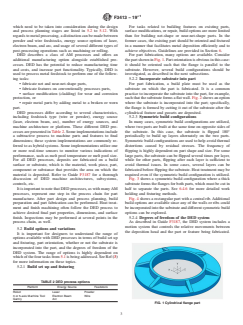
additional manufacturing option alongside established pro- thepartshowninFig.1.Partorientationisobviousinthiscase:
cesses. DED has the potential to reduce manufacturing time it should be oriented such that the flange is parallel to the
and costs, and increase part functionality. Typically, DED is substrate. However, several build configurations should be
used to process metal feedstock to perform one of the follow- investigated, as described in the next subsections.
ing tasks: 5.2.2 Incorporate substrate into part
• fabricate net and near-net-shape parts, For part fabrication, a build plate must be used as the
• fabricate features on conventionally processes parts, substrate on which the part is fabricated. It is a common
• surface modification (cladding) for wear and corrosion practice to incorporate the substrate into the part, for example,
protection, or such that the substrate forms a flat wall. Fig. 2 shows an option
• repair metal parts by adding metal to a broken or worn where the substrate is incorporated into the part; specifically,
part. the flange is formed by cutting it out of the substrate after the
DED processes differ according to several characteristics, cylindrical feature and gussets are deposited.
including feedstock type (wire or powder), energy source 5.2.3 Symmetric build configurations
(laser, electron beam, arc), number of energy sources, and In many cases, symmetric build configurations are utilized,
machine architecture or platform. These different DED pro- where two parts are built at the same time on opposite sides of
cesses are presented in Table 2. Some implementations include the substrate. In this case, the substrate is flipped 180°
a subtractive process to machine parts and features to final periodically to build up layers alternately on the two parts.
dimensions; these system implementations are commonly re- Symmetric build configurations are used to help avoid thermal
ferred to as hybrid systems. Some implementations utilize one distortions caused by residual stresses. The frequency of
or more real-time sensors to monitor various indications of flipping is highly dependent on part shape and size. For some
performance, such as melt pool temperature or melt pool size. large parts, the substrate can be flipped several times per layer,
For all DED processes, deposits are fabricated on a build while for other parts, flipping after each layer is sufficient to
surface or substrate, which is the material, work piece, part, avoid thermal issues. In some cases, several layers can be
component or substance that provides the area on which the fabricated before flipping the substrate. Heat treatment may be
material is deposited. Refer to Guide F3187 for a thorough required even if the symmetric build configuration is utilized.
discussion of DED machine architectures, subsystems, Fig. 3 shows a symmetric build configuration where a thick
controls, etc. substrate forms the flanges for both parts, which must be cut in
ItisimportanttonotethatDEDprocesses,aswithmanyAM half to separate the parts. See 6.4.6 for more detailed work
processes, represent one step in the process chain for part holding and fixturing methods.
manufacture. After part design and process planning, build Fig. 4 shows a rectangular part with a central rib.Additional
preparation and part fabrication can be performed. Heat treat- build options are available since any of the walls or ribs could
ment and finish machining often follow the DED process to beincorporatedintothesubstrateanddifferentsymmetricbuild
achieve desired final part properties, dimensions, and surface options can be explored.
finish. Inspections may be performed at several points in the 5.2.4 Degrees of freedom of the DED system
process chain, as well. As described in Guide F3187, the DED system includes a
motion system that controls the relative movements between
5.2 Build options and variations
the deposition head and the part or feature being fabricated.
It is important for designers to understand the range of
options available with DED processes in terms of build set up
and fixturing, part orientation, whether or not the substrate is
incorporated into the part, and the degrees of freedom of the
DED system. The range of options is highly dependent on
whichofthefourtasksfrom5.1isbeingaddressed.SeeRef (3)
for more information on these topics.
5.2.1 Build set up and fixturing
TABLE 2 DED process options
Platform Energy Source Feedstock
Robot Laser Powder
3 or 5-axis Machine Tool Electron Beam Wire
Gantry Arc
FIG. 1 Cylindrical flange part
´1
F3413 − 19
all excess powder is scrapped. Excess powder is defined as all
powder that was deposited but was not melted into the part,
which can be in the range of 30-50 % of total powder
deposited. Wire-fed processes are less prone to this issue,
because the entirety of the raw material is melted at the point
of deposition.
5.4 Typical advantages of the DED process
DED processes can be advantageous for manufacturing and
repairing parts where the following points are relevant:
– Many materials are available. As a general rule, any
weldable metal alloys that are prepared as powder or wire
feedstocks can be processed. Since feedstock material is fused
as it is deposited, DED systems may have higher power lasers
or electron-beam sources, compared to PBF systems, which
FIG. 2 Incorporating the substrate into the part
can enable a broader range of feedstock materials.
– Multiple materials can be used for one part. This is
The motion system is characterized by the number of degrees
achievable readily by feeding multiple powders into the
of freedom between the deposition head and the part and by
deposition head for blown-powder systems, by using multiple
how those degrees of freedom (DOF) are allocated to the head
wires for wire-fed systems, or by utilizing both blown-powder
and the part. Typical DED machine configurations have either
and wire deposition heads. With this capability, functionally
3 or 5 axes of motion, unless a robot arm is used to carry the
graded materials (FGMs) and composites can be fabricated.
deposition head or manipulate the substrate and part. 3-axis
– Denser and mechanically stronger printed materials
systems usually provide three translational DOF in the global
compared to PBF-M in many cases.
x, y, and z directions (see ISO/ASTM 52921 for explanations).
– Tailored mechanical and material properties can be
5-axis systems typically contain additional rotations to change
achievedbychangingprocessparametersettings,evenwiththe
the relative orientation of the deposition head and the part.
same material.
These rotations may be incorporated into the manipulator for
– Part characteristics can be selectively configured by
the deposition head, or may be provided by separate stages for
adjusting process parameters locally, including tailored me-
the substrate and part. When building parts symmetrically, as
chanical and material properties, surface characteristics, and
shown in Fig. 3 and Fig. 4, the substrate is rotated after each
feature dimensions.
layer to balance the residual stresses during building. If a robot
– Printing either full parts or local features, coatings, or
arm carries the deposition head, the robot typically has 5 or 6
repair in a single machine.
DOF. Even with a robot arm, a separate rotary table may be
– High deposition rates are achievable.
used to rotate the substrate and part, giving up to 8 DOF. The
notation 5+axis system will denote DED systems with at least – Suitable for large parts.
– Applicable to 3D substrates. Deposition of parts and
5 axes of DOF.
5.2.5 Avoidance of overhangs features can be accomplished on arbitrarily shaped substrates.
If overhangs are present in a part, several approaches can be This is particularly useful for repair applications. It is also
pursued to fabricate them. Sacrificial support structures could useful for fabrication of features on parts produced using other
be utilized to support the overhang as it is fabricated. manufacturing processes.
Alternatively, the part could be reoriented relative to the
– Integration of multiple functions in the same part.
deposition head if 5 or more DOF are available in the DED – Parts can be manufactured to net shape or near-net shape
system. This reorientation is illustrated in Fig. 5. Note that
(that is, close to the finished shape and size).
guidance on overhang fabrication and the use of support
– Design freedom is typically high relative to conventional
structures is provided in Section 6, and deposition head
manufacturing processes. For DED machines with 3 axes of
accessibility is addressed in 5.8.4.
motion (3 degrees of freedom), 3D complexity is limited, but
complexity in each layer is achievable. For DED machines
5.3 Size of the parts
with additional DOF, greater design freedom is available. Note
Part size is limited by the working area/working volume of
that geometric capabilities are related to both the DED process
the DED machine and depends significantly on the machine
and to any additional machining steps.
architecture. DED machines based on gantry systems or with
– A wide range of complex geometries can be produced,
translating substrates can have working volumes measured in
such as
several meters. However, thermal management plays a role in
(a) – free-form geometries, for example, organic
part size. The occurrence of cracks and deformation due to
structures,
residualstressescanlimitpartsize.Anotherimportantpractical
(b) – topologically optimised structures, in order to re-
factor that can limit the maximal part size is the cost of
production having a direct relation to the size and volume of duce mass and optimize mechanical properties, and
(c) – internal features, although post-fabrication machin-
thepart.Forblownpowdersystems,powderreuserulesimpact
part fabrication cost significantly. If no reuse is allowed, then ing considerations may be important.
´1
F3413 − 19
FIG. 3 Symmetric build configuration
FIG. 4 Build configuration options for rectangular part (a), showing three alternative symmetric build configurations (b-d)
– For wire-fed systems, DED processes are significantly
safertooperatethanPBF-Msystemssincefinepowdersarenot
being used.
– Printing in zero-gravity environment is possible when
combining wire feed, electron beam and vacuum environment.
5.5 Typical disadvantages of the DED process
Certain disadvantages typically associated with DED pro-
cesses should be taken into consideration during product
design:
– Shrinkage, residual stress and deformation can occur due
FIG. 5 Taking advantage of 5+ axis motion capability for non-
to local temperature differences.
vertical feature fabrication. Vertical orientation (a) is used to de-
– DED has lower dimensional resolution (and sometimes
posit most of the features, including the cylindrical extensions,
accuracy) that PBF-LB/M with larger surface waviness.
while orientation (b) fabricates the tabs on the extensions.
– In blown powder systems, higher surface roughness
compared to PBF-LB is typical since DED systems utilize
– Assembly and joining processes can be reduced through
powders that have larger particle sizes than powders used in
part consolidation, potentially achieving en-bloc construction.
PBF-LB processes.
– High technology readiness level (TRL)/manufacturing
– Complexity of parts can be limited depending on the
readiness level (MRL) compared to some otherAM processes.
DED system, particularly for 3-DOF machines.
– Reduction in lead-time for production runs, for example,
– In many cases, DED processes are used for near-net-
compared to traditional machining from forging or billet
shape fabrication, which means that post-fabrication machin-
routes.
ing is required.
– Reduced waste material compared to conventional ma-
–Ifanear-net-shapefabricationstrategyisadoptedforpart
chining from billet.
manufacture, additional material must be deposited in the form
– Some DED machines include machining capability to
of a machining allowance. Then, specified geometric toler-
achieve hybrid additive-subtractive manufacturing (i.e., a hy-
ances can be achieved by precision post-processing.
brid system).
– Process planning can become complicated particularly
– DED feedstock materials are typically less expensive
than PBF-M powders. Powders for DED can be larger; wire for complex part geometry that takes advantage of 5+axis
feedstock is significantly less expensive than powder. deposition or hybrid systems.
´1
F3413 − 19
– Anisotropic material characteristics can arise due to the help in evenly distributing the heat, so that the material
layer-wise build-up and shall be taken into account during microstructure can be homogenized and the residual stresses
process planning and to identify needs for post-processing. can be reduced.
– Material properties can differ from expected values
Some other considerations of economic and time efficiency
known from other technologies like welding, forging and
are given here.
casting. Material properties can be influenced significantly due
–Iftheintentionistomanufacturealargernumberofunits,
to process settings and control.
then the build space should be used as efficiently as possible.
– Substrates and fixturing may need to be incorporated into
Parts should be oriented so as to minimize the number of build
build preparation process, which can lead to an increase in
runs required. If the same parts are oriented differently for best
manufacturing lead time compared to PBF-M.
packing, i.e. results in building at different angles, then the
– Often, lower recyclability of powders compared to PBF.
mechanical properties can vary from part to part. Heat man-
agement and cooling considerations are important when pack-
5.6 Material, economic and time efficiency
ing parts on the substrate.
The efficiency of a DED build in terms of waste material,
– Many poorly designed parts (particularly those designed
cost and time is highly dependent on the build orientation,
for conventional processes with little or no adaptation) neces-
substrate location and build sequence.Various different criteria
sitate a specific orientation either to minimize the use of
for optimization are available depending on the number of
supports or to increase the likelihood of build success. Indeed,
units planned.
parts designed for AM should be devised such that build
The material efficiency is referred to in the Aerospace
orientation is obvious or specified, or both.
industry as the buy-to-fly (BTF) ratio, which is defined as the
– With an optimized tool path, machine idle times and
ratio of the mass of material purchased for a component to the
other inefficiencies of the process can be minimized.
mass of the finished component that is flown on the aircraft.
– Designers should consider the effects of heat build-up
The BTF can be used to compare the efficiency of different
and cooling when designing parts and laying out builds,
build options and to compare the efficiency of DED with
particularly as they impact wait times and other delays.
conventional manufacturing processes.
Some considerations related to material efficiency include:
5.7 Design feature types
– The substrate is often incorporated into the final part in
5.7.1 General
order to reduce the amount of material that must be deposited.
Design features are intended to indicate typical shapes with
Parts should be designed with this in mind to aid material
which designers design parts. They are also known as form
efficiency. A corollary to this is that DED processes are often
features or geometric features.
used to deposit features onto conventionally manufactured
When incorporating the substrate into the final part, the
parts, where the conventional manufacturing process would
interface between the deposited part material and the substrate
exhibit difficulties or excess costs if it was used for those
should include a fillet in order to minimize the stress accumu-
features.
lation and avoid delamination of the built material from the
– It is common to build on both sides of the substrate due
substrate. The designer should select a proper radius for this
to the significant heat input in the process, which causes
fillet to avoid delamination, while not adding needlessly to part
residualstresses.Sinceshrinkageduringcoolinghasthelargest
weight.
affect in the deposition direction, a symmetrical deposition
5.7.2 Design feature hierarchy
strategycanbeusedwherelayersaredepositedalternativelyon
each side of the substrate by rotating it between layers. This In DED, most design features can be considered as some
balances the build up of residual stresses and minimizes the
type of wall.Awall feature can be considered as a high-aspect
risk of distortions during the manufacturing process. For parts ratio geometric region, where the feature thickness is small
without a suitable plane of symmetry, it may be possible to compared to its lateral dimensions. One or several deposited
build two parts in a back-to-back manner to achieve a beads typically comprise the wall thickness. In addition to
near-symmetrical build. walls,othertypesofpositiveandnegativefeaturesarefoundin
– The strategies of incorporating the substrate in the part many DED parts, such as bosses, thick sections, pockets, and
and utilizing symmetric builds have significant impacts on the holes. The high levels of a design feature hierarchy are shown
selection of suitable build orientation. Furthermore, the de- in Fig. 6. Walls are varied enough that they will be considered
signer may want to redesign parts to incorporate the substrate, in 5.7.3. Bosses are typically positive, cylindrical features that
provide symmetric builds, and other aspects of build orienta- may be solid or hollow (can be considered a short closed wall).
tion when designing the part in order to achieve material, Thick sections can be considered short, very wide walls. They
economic, and time efficiencies. representbulkmaterialregionsthatmaytakeonmanydifferent
– Material utilization depends on the size of the powder kinds of shapes. Pockets are relatively shallow negative fea-
focusdiameter,wirediameter,andthesizeofheatsourceofthe turesthatoccurinwallsorthicksections.Theyareoftenadded
DED process. In order to maximize the material efficiency, the into a part to reduce weight or to provide clearance for other
heat source size needs to be bigger than the powder focus parts when assembled. Holes are common negative features.
diameter or wire diameter. The distinction between large and small holes is intended to
– Tool path planning and optimization need to be consid- indicate whether or not the hole will be fabricated during the
ered during the design stage. An optimized tool path should DED process (large hole) or will be produced by a secondary
´1
F3413 − 19
FIG. 6 Top levels of a design feature hierarchy (wall features are expanded in Fig. 7)
operation, such as drilling, punching, or machining, after DED Parts to be fabricated by DED processes would typically be
fabrication of the part (small hole). designed using the features in Fig. 6 and Fig. 7. Wall
5.7.3 Wall features intersections are highlighted so that designers are aware of the
A useful hierarchy of wall features is shown in Fig. 7. complications that arise in their fabrication.
Broadly, features involving walls can be divided into walls,
5.8 Manufacturing features and effects
wall intersections, and wall connections. A wall intersection
Manufacturing features represent shapes that manufacturing
occurs when two walls cross one another. This situation is
personnel associate with potential manufacturability limita-
noteworthy since they are sites of high deposits if deposition
tions. These include overhangs, islands, and wall intersections.
occurs twice at the intersection site. In contrast, wall connec-
Manufacturing effects represent part geometric characteris-
tionsoccurwhenwallsarejoinededgewise.Broadly,wallscan
tics that emerge as a result of the process, such as the stair-step
be classified as closed, meaning that cross-sections are cylin-
effect that leads to surface roughness, and limitations on
drical such as a tube (which can be produced using continuous
accessibility.
deposition), or open, meaning that they would be fabricated by
5.8.1 Overhang
rastering back-and-forth along the wall. Walls can be further
classified according to their orientation (for example, vertical Not all overhangs can be fabricated. Their success depends
versus inclined) and according to their shape. on many factors, including the design of the overhang feature,
FIG. 7 Hierarchy of features related to walls (an earlier version of the feature hierarchy appeared in (4))
´1
F3413 − 19
the DED machine architecture and numbers of degrees of original geometry is described as the stair-step effect. The
freedom, and the design of the deposition head (nozzle for extent of this is largely dependent on the layer thickness (see
blown powder systems; welding torch for wire-arc systems). Fig. 9).
For blown powder systems, it is often better to tilt the Thinner layers have an additional benefit related to DED
substrate to keep the powder nozzle at a vertical position. If it processes in that better surface finishes enable less finish
is not possible to tilt the substrate, the maximum tilting angle machining to achieve desired finishes. Hence, an important
of the nozzle needs to be considered during the part design tradeoff exists between build rate, surface finish, and extent of
stage. machining. Note that in some cases, machining will not be
For wire-fed systems, it is often better to tilt the substrate or needed to achieve desired finishes. Additionally, adaptive
part to achieve a horizontal build plane. The deposition head slicing can be used to adjust layer thicknesses in order to use
could be tilted at various angles from vertical to avoid the largest layers when local shape and finish requirements
fabrication problems. allow.
It is important to control heat inputs when fabricating 5.8.5 Accessibility
overhangs, since their heat transfer characteristics will be Accessibility concerns in DED are analogous to those of
different than bulk regions that conduct heat directly to the CNC milling. That is, the deposition axis requires a clear line
substrate. This is important for feature shape quality as well as of sight to the work surface as well as sufficient radial
material microstructure. clearance from the deposition axis for the geometry of the
5.8.2 Islands deposition head (powder nozzle or welding torch and associ-
Islands (I) are features that connect to form a part (P) only ated components). In most cases, the deposition axis direction
at a later stage of the build process. How this connection will is kept close to normal to the current working surface. Fig. 10
occur should be taken into consideration at the design stage. illustrates the issue of deposition head collision with the
Shapes such as the inverted V part are not common for DED workpiece and avoidance strategies for 3-axis and 5+axis
since the apex region will likely have some shape errors. Parts deposition.
that are stable in terms of their overall design can be unstable In the classical 3-axisAM part production case, accessibility
during the build process (see Fig. 8, left and center). isnotnormallyanissueasallpreviouslayerswillbebelowthe
5.8.3 Wall intersections plane of the current layer’s tool path (barring some severe
As highlighted in Fig. 7, wall intersections are an important distortion issues). However, when the substrate is not a simple
class of features. If nominal process settings are used for two planar surface, such as in the case of DED-based repair
intersecting walls, twice the amount of metal will be deposited applications,thesafetyofthedepositionheadisnotguaranteed
around the wall intersection point, resulting in a raised region. by the nature of the process. For 3- axis systems, clearance can
Processsettingscanbeadjusted,oralternativetoolpathscanbe be provided by pre-machining to an appropriate relief angle
utilized in order to compensate. The designer should be aware (see Fig. 10b). 5+axis systems can often achieve better
that intersections can cause manufacturability issues. accessibility in repair applications by altering the angle of
5.8.4 Stair-step effect incidenceofthedepositionhead.Ingeneral,collisiondetection
Due to the layer-wise build-up, the 3D geometry of the part checks can be worthwhile to evaluate proposed tool paths. For
is converted into a series of extruded layers before production, the 5+axis case in 3D, collision detection can be computation-
with discrete steps in the build direction. The resulting error ally expensive and is still an active area of research. However,
caused by deviations of these extruded layers compared to the some commercial tool path generation software can perform
Source: VDI 3405 Part 3:2015.
Reproduced with permission of the Verein Deutscher Ingenieure e. V.
FIG. 8 Islands l (left) and overhang a (right) during the construction of part P in z-axis Z
´1
F3413 − 19
representation into build preparation software to perform
process planning and generate an executable build file.
Several variations to this workflow may arise, depending on
the situation and software available. Increasingly,AM modules
are being added to CAD/CAE/CAM software that enables
process simulation, residual stress prediction, distortion
prediction, build time estimation, and recognition of manufac-
turabilityissues.Additionally,processplanningcapabilitiesare
being added to some of these software systems that provide
slicing, tool path generation, and code generation capabilities,
which could eliminate the need to generate neutral data
exchange files. Note that this is a rapidly changing area, so
designers will benefit by keeping up-to-date on AM software
offerings.
Different workflows can arise in repair scenarios, where a
3D representation of the material to be added on the part is
needed to facilitate tool path planning.
5.11 Data quality, resolution, representation
Twobroadtypesofneutraldataexchangerepresentationsare
FIG. 9 Impact of different layer thicknesses on the stair-step ef-
fect used in AM: curved geometry representations (such as STEP
and IGES) and tessellations, which consist of sets of triangles
to approximate part surfaces. Curved geometry representations
typically need to be converted to tessellations for process
collision detection in 2D based on slices, which is far less
planning. As such, a tessellated model is commonly used in
computationally demanding. See Refs (5, 6) for tool path
process planning for AM, but other representations that can
generation issues and approaches.
also be used include voxels or sliced layer representations. For
5.9 Dimensional, form and positional accuracy
hybrid DED / CNC machining systems, a boundary represen-
It is very critical to maintain constant deposition layer
tation model (often abbreviated B-rep or BREP) can be used to
thickness to match the pre-set layer thickness. Even small
avoid faceting effects in the final machined component caused
deviations can accumulate and amplify small errors when large
by the tessellation process
numbers of layers are deposited. This will cause poor dimen-
Therearetwoimportantcharacteristicstoconsiderformodel
sional accuracy or even print failures.
representation:
Typically, it is not possible to produce the tolerances and
• The model should be a manifold surface (sometimes
surface finish that can be achieved with conventional subtrac-
referred to as “water tight”). A non-manifold model can have
tive manufacturing processes. For this reason, machining and
undesired effects on the computer-aided manufacturing (CAM)
other post-processing steps may be necessary to meet geo-
system.
metrical requirements. These additional steps may include
• If a tessellated model is used, the resolution of the
post-process machining, or in-process machining if a hybrid
tessellation is generally influenced by a tolerance measure,
system is being used, surface finishing, thermal processing, or
often called “chord height”, which describes the maximum
other operations according to ISO/ASTM 52910.
deviation of a point on the surface of the part from the triangle
In this respect, it is particularly important to be aware of and
face. Therefore, smaller tolerance values lead to lower devia-
consider process parameters that will influence the character-
tions from the actual part surface. If the resolution is too low,
istics of the final part. Machining and surface finishing opera-
the sides of the triangles defined in the STL file will be visible
tions necessitate the addition of a machining allowance to part
on the finished surface (that is, it will appear faceted).
surfaces. Additionally, build orientation to some extent deter-
However, a tessellation with a resolution that is too high
mines the level of accuracy that can be achieved. Directionally
requiresalotofdigitalstoragespaceandisslowtotransferand
dependent (anisotropic) shrinkage of the part can occur due to
handle using processing software. The tolerance should be set
the layer-wise build-up. As another example, layer-wise con-
sistency can be affected by the location of the deposit on the to be appropriate to the CAM requirements of the DED
substrate. Residual stresses and heat treatments are considered process.
further in 6.4 and 6.6.
Common tessellation formats include STL, AMF (ISO/
ASTM 52915), and 3MF from the 3MF Consortium. STLfiles
5.10 Software workflow for DED
contain only facet geometry (vertex coordinates and facet
The use of DED requires 3D geometric data to represent the
normal vectors), while AMF supports the representation of
component to be produced. The digital workflow typically
involves creating a 3D model in a solid modeling based information beyond just geometry. For example, part units
(millimetres, meters, inches), colors, materials and lattice
computer-aideddesign(CAD)system,convertingitintooneor
more neutral data exchange representations, and loading the structures are supported. 3MF files have some of the metadata
´1
F3413 − 19
FIG. 10 Accessibility problem (a) and example strategies for collision avoidance in 3-axis (b) and 5+axis (c) deposition
representation capabilities of AMF. Having units incorporated that were fabricated using conventional manufacturing pro-
into the data exchange file is very important in communicating cesses. An example is the fabrication of rib and boss features
part size. onalargecylindricalforgedpart.Althoughthesimpleshapeof
the forging may preclude its fabrication via DED, the fabrica-
5.12 DED processes
tionofthefeaturesbyDEDeliminatestheneedtoforgeathick
The key to DED processes is to balance heat and material
housing that requires substantial machining in order to achieve
inputs so that the deposited bead has correct size, shape, and
those features. DED also reduces the lead-times for such
position. A typical DED machine has dozens of process
components, and potentially eliminates the non-recurring costs
variablesthatcanbeadjustedtoachievethisbalance,relatedto
associated with expensive forging dies.
heat input from the deposition head, material feed, movement
Important constraints can be the availability of the required
speeds, atmosphere, and others. Of these many process
materials, limited size of the part, the approval of the technol-
variables,thedepositionheadpowersetting,materialfeed-rate,
ogy in critical applications, the production costs, and the
scan speed, hatch spacing, and layer thickness tend to be the
possible need for extensive post processing treatments. In
most important.
comparison with PBF processes, PBF may be selected for
To fabricate a given part geometry, many different process
smaller parts with high geometric complexity, or applications
plans may be available to achieve the desired shapes and
where extensive machining is not preferred.
material characteristics.As part of each process plan, a specific
6.1.2 Design and test cycles
scan pattern should be generated and selected. It is important
Partoptimizationmaybeconstrainedbythecurrentlimitsof
that the designer is aware of the potentially broad range of
the DED process. This might differ from material to material,
process plans and settings that are available for their part
from machine to machine, and from service provider to service
designs.
provider. Often this means that practical testing of part features
The reader may refer to Guide F3187 for additional infor-
can be an aspect of the design cycle.
mation about DED processes, process variables, and process
The general design guide, ISO/ASTM 52910, contains many
specification, as well as ISO/ASTM 52904 on process charac-
design considerations that the designer should take into
teristics for metal PBF to meet critical applications.
account, including the topics of product usage, sustainability,
business, geometry, material property, communication, and
6. Design guidelines for DED of metals
process-specific topics.
6.1 General
6.2 Materials and structural characteristics
6.1.1 Selecting DED
DEDisaprocesswithtypicaladvantagesanddisadvantages, 6.2.1 Feedstock materials
as described in Section 5. DED processes are often advanta- Metals and alloys are the materials most commonly used for
geous for large parts with thin features, such as walls, ribs, and DED. Similar to metal PBF, the successful processing of
bosses, that would otherwise be very time consuming to individual materials depends on a variety of factors, such as
machine from stock. The technology offers some opportunities weldability, melting temperature, thermal conductivity, melt
in complex design with integrated functions in one part, viscosity and surface tension of the melt. These factors will all
materials with internal structures or channels, or features with affect the characteristics of the part being manufactured.
undercuts or structures, or both, that cannot be realized by Common metals include titanium and its alloys, aluminium-
casting, forging, or metal cutting processes. Hence, the flex- silicon-magnesium alloys, nickel-based superalloys (for
ibility of DED offers opportunities for production of unique example, Inconel 718), cobalt-based superalloys (for example,
products with properties that cannot be realized with other Stellite 21), tool steels, precipitation hardening (PH) and other
technologies. stainless steels. A wide range of other materials has been
DED has applications in part re
...
Questions, Comments and Discussion
Ask us and Technical Secretary will try to provide an answer. You can facilitate discussion about the standard in here.
Loading comments...