

ASTM ISO/ASTM51401-21
(Practice)Standard Practice for Use of a Dichromate Dosimetry System
General Information
- Abstract
SIGNIFICANCE AND USE
4.1 The dichromate system provides a reliable means for measuring absorbed dose to water. It is based on a process of reduction of dichromate ions to chromic ions in acidic aqueous solution by ionizing radiation.
4.2 The dosimeter is a solution containing silver and dichromate ions in perchloric acid in an appropriate container such as a sealed glass ampoule. The solution indicates absorbed dose by a change (decrease) in optical absorbance at a specified wavelength(s) ((3), ICRU Report 80). A calibrated spectrophotometer is used to measure the absorbance.
SCOPE
1.1 This practice covers the preparation, testing, and procedure for using the acidic aqueous silver dichromate dosimetry system to measure absorbed dose to water when exposed to ionizing radiation. The system consists of a dosimeter and appropriate analytical instrumentation. For simplicity, the system will be referred to as the dichromate system. The dichromate dosimeter is classified as a type I dosimeter on the basis of the effect of influence quantities. The dichromate system may be used as either a reference standard dosimetry system or a routine dosimetry system.
1.2 This document is one of a set of standards that provides recommendations for properly implementing dosimetry in radiation processing, and describes a means of achieving compliance with the requirements of ISO/ASTM Practice 52628 for the dichromate dosimetry system. It is intended to be read in conjunction with ISO/ASTM Practice 52628.
1.3 This practice describes the spectrophotometric analysis procedures for the dichromate system.
1.4 This practice applies only to gamma radiation, X-radiation/bremsstrahlung, and high energy electrons.
1.5 This practice applies provided the following conditions are satisfied:
1.5.1 The absorbed dose range is from 2 × 10 3 to 5 × 10⁴ Gy.
1.5.2 The absorbed dose rate does not exceed 600 Gy/pulse (12.5 pulses per second), or does not exceed an equivalent dose rate of 7.5 kGy/s from continuous sources (1).2
1.5.3 For radionuclide gamma sources, the initial photon energy shall be greater than 0.6 MeV. For bremsstrahlung photons, the initial energy of the electrons used to produce the bremsstrahlung photons shall be equal to or greater than 2 MeV. For electron beams, the initial electron energy shall be greater than 8 MeV.
Note 1: The lower energy limits given are appropriate for a cylindrical dosimeter ampoule of 12 mm diameter. Corrections for displacement effects and dose gradient across the ampoule may be required for electron beams (2). The dichromate system may be used at lower energies by employing thinner (in the beam direction) dosimeter containers (see ICRU Report 35).
1.5.4 The irradiation temperature of the dosimeter shall be above 0 °C and should be below 80 °C.
Note 2: The temperature coefficient of dosimeter response is known only in the range of 5 to 50 °C (see 5.2). Use outside this range requires determination of the temperature coefficient.
1.6 This standard does not purport to address all of the safety concerns, if any, associated with its use. It is the responsibility of the user of this standard to establish appropriate safety, health, and environmental practices and determine the applicability of regulatory limitations prior to use. Specific precautionary statements are given in 9.3.
1.7 This international standard was developed in accordance with internationally recognized principles on standardization established in the Decision on Principles for the Development of International Standards, Guides and Recommendations issued by the World Trade Organization Technical Barriers to Trade (TBT) Committee.
- Status
- Published
- Publication Date
- 30-Sep-2021
- Technical Committee
- E61 - Radiation Processing
- Drafting Committee
- E61.02 - Dosimetry Systems
Overview
ASTM ISO/ASTM51401-21: Standard Practice for Use of a Dichromate Dosimetry System establishes best practices for the preparation, testing, and operation of dichromate dosimeters to measure the absorbed dose to water when exposed to ionizing radiation. Developed jointly by ASTM and ISO, this international standard is vital for radiation processing industries requiring accurate and traceable dose measurements.
The dichromate dosimetry system operates by tracking the reduction of dichromate ions to chromic ions in an acidic aqueous solution under ionizing radiation. The measurement of absorbed dose is achieved by monitoring changes in optical absorbance at specified wavelengths using a calibrated spectrophotometer.
Key Topics
- Dichromate Dosimeter Composition: The dosimeter solution contains silver and dichromate ions in perchloric acid, typically contained within sealed glass ampoules.
- Measurement Method: Absorbed dose is indicated by a decrease in optical absorbance at specific wavelengths, requiring the use of a precise spectrophotometer.
- Applicability: This standard is designed for use with gamma radiation, X-radiation/bremsstrahlung, and high energy electrons.
- Dose Range and Energy Requirements:
- Applicable for absorbed doses from 2 × 10³ to 5 × 10⁴ Gy.
- Suitable for dose rates up to 600 Gy/pulse or 7.5 kGy/s from continuous sources.
- Minimum photon or electron energies depend on the radiation source and dosimeter ampoule geometry.
- Operational Limits: The dichromate dosimeter is reliable between 5 °C and 50 °C, with a full usable range from above 0 °C to below 80 °C.
- Calibration and Traceability: Emphasizes the need for regular calibration using approved laboratories with traceability to national or international standards.
- Measurement Uncertainty: Guidance is provided for estimating and minimizing measurement uncertainty, targeting an expanded uncertainty of less than 3%.
Applications
The dichromate dosimetry system’s main application is in radiation processing, serving both as a reference and a routine dosimetry system. Its use cases include:
- Sterilization of medical devices and pharmaceuticals: Ensuring accurate dose delivery for quality and regulatory compliance.
- Research laboratories: Acting as a primary or reference dosimetry system for inter-laboratory comparisons and radiation research.
- Radiation facilities: Monitoring and validating radiation sources and processing lines for food, polymers, and other industrial products.
- Calibration of other dosimetry systems: Due to its reliability and metrological quality, the dichromate dosimeter is often used as a benchmark in calibrating secondary dosimeters.
Related Standards
For comprehensive implementation and to ensure compliance with international best practices, users should refer to the following related standards and documents:
- ISO/ASTM 52628: Practice for Dosimetry in Radiation Processing
- ISO/ASTM 51261: Practice for Calibration of Routine Dosimetry Systems for Radiation Processing
- ASTM E170 & E3083: Terminology Relating to Radiation Measurements and Dosimetry
- ASTM E666 & E668: Calculating Absorbed Dose from Gamma or X Radiation and Application of TLD systems
- ISO/IEC 17025: General requirements for the competence of testing and calibration laboratories
- ICRU Reports 35, 80, and 85a: Guidance on dosimetry systems and quantities for ionizing radiation
Practical Value
By following ASTM ISO/ASTM51401-21, organizations benefit from:
- Standardized and reproducible measurement of absorbed dose to water
- Traceability and international recognition in dose measurement and calibration procedures
- Increased confidence in radiation processing quality assurance
- Reduced uncertainty and improved safety through proper dosimetry, documentation, and adherence to recommended practices
This standard is essential for radiation processing stakeholders aiming to meet regulatory, safety, and quality requirements through accurate, reliable dosimetry.
Relations
- Effective Date
- 01-Oct-2021
Get Certified
Connect with accredited certification bodies for this standard

BSMI (Bureau of Standards, Metrology and Inspection)
Taiwan's standards and inspection authority.
Sponsored listings
Frequently Asked Questions
ASTM ISO/ASTM51401-21 is a standard published by ASTM International. Its full title is "Standard Practice for Use of a Dichromate Dosimetry System". This standard covers: SIGNIFICANCE AND USE 4.1 The dichromate system provides a reliable means for measuring absorbed dose to water. It is based on a process of reduction of dichromate ions to chromic ions in acidic aqueous solution by ionizing radiation. 4.2 The dosimeter is a solution containing silver and dichromate ions in perchloric acid in an appropriate container such as a sealed glass ampoule. The solution indicates absorbed dose by a change (decrease) in optical absorbance at a specified wavelength(s) ((3), ICRU Report 80). A calibrated spectrophotometer is used to measure the absorbance. SCOPE 1.1 This practice covers the preparation, testing, and procedure for using the acidic aqueous silver dichromate dosimetry system to measure absorbed dose to water when exposed to ionizing radiation. The system consists of a dosimeter and appropriate analytical instrumentation. For simplicity, the system will be referred to as the dichromate system. The dichromate dosimeter is classified as a type I dosimeter on the basis of the effect of influence quantities. The dichromate system may be used as either a reference standard dosimetry system or a routine dosimetry system. 1.2 This document is one of a set of standards that provides recommendations for properly implementing dosimetry in radiation processing, and describes a means of achieving compliance with the requirements of ISO/ASTM Practice 52628 for the dichromate dosimetry system. It is intended to be read in conjunction with ISO/ASTM Practice 52628. 1.3 This practice describes the spectrophotometric analysis procedures for the dichromate system. 1.4 This practice applies only to gamma radiation, X-radiation/bremsstrahlung, and high energy electrons. 1.5 This practice applies provided the following conditions are satisfied: 1.5.1 The absorbed dose range is from 2 × 10 3 to 5 × 10⁴ Gy. 1.5.2 The absorbed dose rate does not exceed 600 Gy/pulse (12.5 pulses per second), or does not exceed an equivalent dose rate of 7.5 kGy/s from continuous sources (1).2 1.5.3 For radionuclide gamma sources, the initial photon energy shall be greater than 0.6 MeV. For bremsstrahlung photons, the initial energy of the electrons used to produce the bremsstrahlung photons shall be equal to or greater than 2 MeV. For electron beams, the initial electron energy shall be greater than 8 MeV. Note 1: The lower energy limits given are appropriate for a cylindrical dosimeter ampoule of 12 mm diameter. Corrections for displacement effects and dose gradient across the ampoule may be required for electron beams (2). The dichromate system may be used at lower energies by employing thinner (in the beam direction) dosimeter containers (see ICRU Report 35). 1.5.4 The irradiation temperature of the dosimeter shall be above 0 °C and should be below 80 °C. Note 2: The temperature coefficient of dosimeter response is known only in the range of 5 to 50 °C (see 5.2). Use outside this range requires determination of the temperature coefficient. 1.6 This standard does not purport to address all of the safety concerns, if any, associated with its use. It is the responsibility of the user of this standard to establish appropriate safety, health, and environmental practices and determine the applicability of regulatory limitations prior to use. Specific precautionary statements are given in 9.3. 1.7 This international standard was developed in accordance with internationally recognized principles on standardization established in the Decision on Principles for the Development of International Standards, Guides and Recommendations issued by the World Trade Organization Technical Barriers to Trade (TBT) Committee.
SIGNIFICANCE AND USE 4.1 The dichromate system provides a reliable means for measuring absorbed dose to water. It is based on a process of reduction of dichromate ions to chromic ions in acidic aqueous solution by ionizing radiation. 4.2 The dosimeter is a solution containing silver and dichromate ions in perchloric acid in an appropriate container such as a sealed glass ampoule. The solution indicates absorbed dose by a change (decrease) in optical absorbance at a specified wavelength(s) ((3), ICRU Report 80). A calibrated spectrophotometer is used to measure the absorbance. SCOPE 1.1 This practice covers the preparation, testing, and procedure for using the acidic aqueous silver dichromate dosimetry system to measure absorbed dose to water when exposed to ionizing radiation. The system consists of a dosimeter and appropriate analytical instrumentation. For simplicity, the system will be referred to as the dichromate system. The dichromate dosimeter is classified as a type I dosimeter on the basis of the effect of influence quantities. The dichromate system may be used as either a reference standard dosimetry system or a routine dosimetry system. 1.2 This document is one of a set of standards that provides recommendations for properly implementing dosimetry in radiation processing, and describes a means of achieving compliance with the requirements of ISO/ASTM Practice 52628 for the dichromate dosimetry system. It is intended to be read in conjunction with ISO/ASTM Practice 52628. 1.3 This practice describes the spectrophotometric analysis procedures for the dichromate system. 1.4 This practice applies only to gamma radiation, X-radiation/bremsstrahlung, and high energy electrons. 1.5 This practice applies provided the following conditions are satisfied: 1.5.1 The absorbed dose range is from 2 × 10 3 to 5 × 10⁴ Gy. 1.5.2 The absorbed dose rate does not exceed 600 Gy/pulse (12.5 pulses per second), or does not exceed an equivalent dose rate of 7.5 kGy/s from continuous sources (1).2 1.5.3 For radionuclide gamma sources, the initial photon energy shall be greater than 0.6 MeV. For bremsstrahlung photons, the initial energy of the electrons used to produce the bremsstrahlung photons shall be equal to or greater than 2 MeV. For electron beams, the initial electron energy shall be greater than 8 MeV. Note 1: The lower energy limits given are appropriate for a cylindrical dosimeter ampoule of 12 mm diameter. Corrections for displacement effects and dose gradient across the ampoule may be required for electron beams (2). The dichromate system may be used at lower energies by employing thinner (in the beam direction) dosimeter containers (see ICRU Report 35). 1.5.4 The irradiation temperature of the dosimeter shall be above 0 °C and should be below 80 °C. Note 2: The temperature coefficient of dosimeter response is known only in the range of 5 to 50 °C (see 5.2). Use outside this range requires determination of the temperature coefficient. 1.6 This standard does not purport to address all of the safety concerns, if any, associated with its use. It is the responsibility of the user of this standard to establish appropriate safety, health, and environmental practices and determine the applicability of regulatory limitations prior to use. Specific precautionary statements are given in 9.3. 1.7 This international standard was developed in accordance with internationally recognized principles on standardization established in the Decision on Principles for the Development of International Standards, Guides and Recommendations issued by the World Trade Organization Technical Barriers to Trade (TBT) Committee.
ASTM ISO/ASTM51401-21 is classified under the following ICS (International Classification for Standards) categories: 17.240 - Radiation measurements. The ICS classification helps identify the subject area and facilitates finding related standards.
ASTM ISO/ASTM51401-21 has the following relationships with other standards: It is inter standard links to ASTM ISO/ASTM51401-13. Understanding these relationships helps ensure you are using the most current and applicable version of the standard.
ASTM ISO/ASTM51401-21 is available in PDF format for immediate download after purchase. The document can be added to your cart and obtained through the secure checkout process. Digital delivery ensures instant access to the complete standard document.
Standards Content (Sample)
This international standard was developed in accordance with internationally recognized principles on standardization established in the Decision on Principles for the
Development of International Standards, Guides and Recommendations issued by the World Trade Organization Technical Barriers to Trade (TBT) Committee.
Designation: 51401 − 21
Standard Practice for
Use of a Dichromate Dosimetry System
This standard is issued under the fixed designation 51401; the number immediately following the designation indicates the year of
original adoption or, in the case of revision, the year of last revision. A number in parentheses indicates the year of last reapproval. A
superscript epsilon (´) indicates an editorial change since the last revision or reapproval.
NOTE 1—The lower energy limits given are appropriate for a cylindrical
1. Scope
dosimeter ampoule of 12 mm diameter. Corrections for displacement
1.1 This practice covers the preparation, testing, and proce-
effects and dose gradient across the ampoule may be required for electron
dure for using the acidic aqueous silver dichromate dosimetry beams (2). The dichromate system may be used at lower energies by
employing thinner (in the beam direction) dosimeter containers (see ICRU
system to measure absorbed dose to water when exposed to
Report 35).
ionizing radiation. The system consists of a dosimeter and
appropriate analytical instrumentation. For simplicity, the sys- 1.5.4 The irradiation temperature of the dosimeter shall be
above 0 °C and should be below 80 °C.
tem will be referred to as the dichromate system. The dichro-
mate dosimeter is classified as a type I dosimeter on the basis
NOTE 2—The temperature coefficient of dosimeter response is known
of the effect of influence quantities. The dichromate system
only in the range of 5 to 50 °C (see 5.2). Use outside this range requires
may be used as either a reference standard dosimetry system or
determination of the temperature coefficient.
a routine dosimetry system.
1.6 This standard does not purport to address all of the
safety concerns, if any, associated with its use. It is the
1.2 This document is one of a set of standards that provides
responsibility of the user of this standard to establish appro-
recommendations for properly implementing dosimetry in
priate safety, health, and environmental practices and deter-
radiation processing, and describes a means of achieving
mine the applicability of regulatory limitations prior to use.
compliance with the requirements of ISO/ASTM Practice
Specific precautionary statements are given in 9.3.
52628 for the dichromate dosimetry system. It is intended to be
1.7 This international standard was developed in accor-
read in conjunction with ISO/ASTM Practice 52628.
dance with internationally recognized principles on standard-
1.3 This practice describes the spectrophotometric analysis
ization established in the Decision on Principles for the
procedures for the dichromate system.
Development of International Standards, Guides and Recom-
1.4 This practice applies only to gamma radiation,
mendations issued by the World Trade Organization Technical
X-radiation/bremsstrahlung, and high energy electrons.
Barriers to Trade (TBT) Committee.
1.5 This practice applies provided the following conditions
2. Referenced documents
are satisfied:
1.5.1 The absorbed dose range is from 2 × 10 to
2.1 ASTM Standards:
5 × 10 Gy.
E178 Practice for Dealing With Outlying Observations
1.5.2 The absorbed dose rate does not exceed 600 Gy/pulse
E275 Practice for Describing and Measuring Performance of
(12.5 pulses per second), or does not exceed an equivalent dose
Ultraviolet and Visible Spectrophotometers
rate of 7.5 kGy/s from continuous sources (1).
E666 Practice for Calculating Absorbed Dose From Gamma
1.5.3 For radionuclide gamma sources, the initial photon
or X Radiation
energy shall be greater than 0.6 MeV. For bremsstrahlung
E668 Practice for Application of Thermoluminescence-
photons, the initial energy of the electrons used to produce the
Dosimetry (TLD) Systems for Determining Absorbed
bremsstrahlung photons shall be equal to or greater than 2
Dose in Radiation-Hardness Testing of Electronic Devices
MeV. For electron beams, the initial electron energy shall be
E925 Practice for Monitoring the Calibration of Ultraviolet-
greater than 8 MeV.
Visible Spectrophotometers whose Spectral Bandwidth
does not Exceed 2 nm
1 E958 Practice for Estimation of the Spectral Bandwidth of
This practice is under the jurisdiction of ASTM Committee E61 on Radiation
Processing and is the direct responsibility of Subcommittee E61.02 on Dosimetry Ultraviolet-Visible Spectrophotometers
Systems. Originally developed as a joint ASTM/ISO standard in conjunction with
ISO/TC 85/WG 3.
Current edition approved Oct. 1, 2021. Published May 2024. Originally approved
in 1991. Last previous edition approved in 2013 as ISO/ASTM 51401:2013(E). For referenced ASTM and ISO/ASTM standards, visit the ASTM website,
DOI: 10.1520/51401-21. www.astm.org, or contact ASTM Customer Service at service@astm.org. For
The boldface numbers in parentheses refer to the bibliography at the end of this Annual Book of ASTM Standards volume information, refer to the standard’s
practice. Document Summary page on the ASTM website.
Copyright © ASTM International, 100 Barr Harbor Drive, PO Box C700, West Conshohocken, PA 19428-2959. United States
51401 − 21
E3083 Terminology Relating to Radiation Processing: Do- derived from, and are consistent with definitions in ICRU
simetry and Applications Report 85a, and general metrological definitions given in the
VIM.
2.2 ISO/ASTM Standards:
51261 Practice for Calibration of Routine Dosimetry Sys-
4. Significance and use
tems for Radiation Processing
4.1 The dichromate system provides a reliable means for
51707 Guide for Estimating Uncertainties in Dosimetry for
measuring absorbed dose to water. It is based on a process of
Radiation Processing
reduction of dichromate ions to chromic ions in acidic aqueous
52628 Practice for Dosimetry in Radiation Processing
solution by ionizing radiation.
52701 Guide for Performance Characterization of Dosim-
eters and Dosimetry Systems for Use in Radiation Pro-
4.2 The dosimeter is a solution containing silver and dichro-
cessing
mate ions in perchloric acid in an appropriate container such as
2.3 ISO/IEC Standards:
a sealed glass ampoule. The solution indicates absorbed dose
17025 General Requirements for the Competence of Testing
by a change (decrease) in optical absorbance at a specified
and Calibration Laboratories
wavelength(s) ((3), ICRU Report 80). A calibrated spectropho-
12749-4 Nuclear energy — Vocabulary — Part 4: Dosimetry
tometer is used to measure the absorbance.
for radiation processing
5. Effect of influence quantities
2.4 Joint Committee for Guides in Metrology (JCGM)
Reports:
5.1 Guidance on the determination of the performance
JCGM 100:2008, GUM 1995, with minor corrections,
characteristics of dosimeters and dosimetry systems can be
Evaluation of measurement data – Guide to the Expres-
found in ASTM Guide 52701. The relevant influence quantities
sion of Uncertainty in Measurement
that need to be considered when using the dichromate dosim-
JCGM 200:2012, VIM International Vocabulary of Metrol-
etry system are given below.
ogy - Basic and General Concepts and Associated Terms
5.2 The dosimeter response has a temperature dependence
2.5 International Commission on Radiation Units and Mea-
during irradiation that is approximately equal to −0.2 % per
surements (ICRU) Reports:
degree Celsius between 25 and 50 °C. At temperatures below
ICRU Report 35 Radiation Dosimetry: Electrons With Initial
25 °C, the dependence is smaller. The dosimeter response
Energies Between 1 and 50 MeV
between 5 and 50 °C is shown in Table 1, where the response
ICRU Report 80 Dosimetry Systems for Use in Radiation
at a given temperature is tabulated relative to the response at 25
Processing
°C (4, 5).
ICRU Report 85a Fundamental Quantities and Units for
5.2.1 The data in Table 1 may be fitted with an appropriate
Ionizing Radiation
formula for convenience of interpolation as follows:
b
R 5 b 1 b t (1)
3. Terminology t 0 1
3.1 Definitions: where:
3.1.1 reference standard dosimetry system—dosimetry
R = dosimeter response at temperature t relative to that at 25
t
system, generally having the highest metrological quality
°C.
available at a given location or in a given organization, from
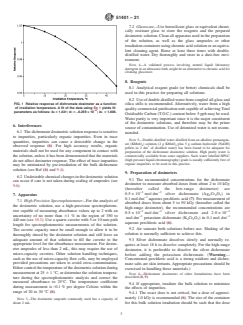
The curve generated from the fitted data is shown in Fig. 1.
which measurements made there are derived.
5.3 No effect of ambient light (even direct sunlight) has
3.1.2 type I dosimeter—dosimeter of high metrological
been observed on dichromate solutions in glass ampoules (6).
quality, the response of which is affected by individual influ-
5.4 The dosimeter response is dependent on the type and
ence quantities in a way that is well-defined and capable of
energy of the radiation employed. For example, the response in
expression in terms of independent correction factors.
high energy (10 MeV) electron beams is reported to be
3.2 Definitions of other terms used in this standard that
approximately 3 % lower than the response in cobalt-60
pertain to radiation measurement and dosimetry may be found
radiation (2).
in ISO/ASTM Practice 52628. Other terms that pertain to
5.5 Provided the dosimeter solution is prepared as described
radiation measurement and dosimetry may be found in ASTM
in this document, and steps are taken to avoid contamination,
Terminology E3083 and ISO Terminology 12749-4. Where
the dosimeter solution stored, or sealed, in glass vessels (for
appropriate, definitions used in these standards have been
example, ampoules) is stable for several years before and after
irradiation.
Available from International Organization for Standardization (ISO), 1, ch. de
la Voie-Creuse, CP 56, CH-1211 Geneva 20, Switzerland, http://www.iso.org.
TABLE 1 Effect of irradiation temperature on dosimeter response
Document produced by Working Group 1 of the Joint Committee for Guides in
Metrology (JCGM/WG 1). Available free of charge at the BIPM website (http:// Temperature, °C Relative Response Temperature, °C Relative Response
www.bipm.org).
5 1.020 30 0.992
Document produced by Working Group 2 of the Joint Committee for Guides in
10 1.017 35 0.983
Metrology (JCGM/WG 1). Available free of charge at the BIPM website (http://
15 1.013 40 0.972
www.bipm.org).
20 1.007 45 0.960
Available from the International Commission on Radiation Units and Measure- 25 1.000 50 0.948
ments (ICRU), 7910 Woodmont Ave., Bethesda, MD 20814, U.S.A.
51401 − 21
7.2 Glassware—Use borosilicate glass or equivalent chemi-
cally resistant glass to store the reagents and the prepared
dosimetric solution. Clean all apparatus used in the preparation
of the solution, as well as the glass ampoules or other
irradiation containers using chromic acid solution or an equiva-
lent cleaning agent. Rinse at least three times with double-
distilled water. Dry thoroughly and store in a dust-free envi-
ronment.
NOTE 4—A validated process involving neutral liquid laboratory
detergent in an ultrasonic bath, might be an alternative to chromic acid for
cleaning glassware.
8. Reagents
8.1 Analytical reagent grade (or better) chemicals shall be
used in this practice for preparing all solutions.
8.2 Use of double-distilled water from coupled all-glass and
FIG. 1 Relative response of dichromate dosimeter as a function
silica stills is recommended. Alternatively, water from a high
of irradiation temperature. A fit of the data using Eq 1 yields fit
quality commercial purification unit capable of achieving Total
−5
parameters as follows: b = 1.021; b = −6.259 × 10 ; b = 1.806.
0 1 2
Oxidisable Carbon (T.O.C.) content below 5 ppb may be used.
Water purity is very important since it is the major constituent
of the dosimetric solutions, and therefore may be the prime
6. Interferences
source of contamination. Use of deionized water is not recom-
6.1 The dichromate dosimetric solution response is sensitive
mended.
to impurities, particularly organic impurities. Even in trace
NOTE 5—Double-distilled water distilled from an alkaline permangan-
quantities, impurities can cause a detectable change in the
ate (KMnO ) solution (2 g KMnO plus 5 g sodium hydroxide (NaOH)
4 4
observed response (6). For high accuracy results, organic 3
pellets in 2 dm of distilled water) has been found to be adequate for
materials shall not be used for any component in contact with
preparation of the dichromate dosimetric solution. High purity water is
the solution, unless it has been demonstrated that the materials commercially available from some suppliers. Such water labelled HPLC
(high pressure liquid chromatography) grade is usually sufficiently free of
do not affect dosimeter response. The effect of trace impurities
organic impurities to be used in this practice.
may be minimized by pre-irradiation of the bulk dichromate
solution (see Ref (6) and 9.4).
9. Preparation of dosimeters
6.2 Undesirable chemical changes in the dosimetric solution
9.1 The recommended concentrations for the dichromate
can occur if care is not taken during sealing of ampoules (see
dosimeter to measure absorbed doses from about 2 to 10 kGy
9.6).
(hereafter called the low-range dosimeter) are
−3 −3
0.5 × 10 mol dm silver dichromate (Ag Cr O ) in
2 2 7
7. Apparatus
−3
0.1 mol dm aqueous perchloric acid (7). For measurement of
7.1 High-Precision Spectrophotometer—For the analysis of
absorbed doses from about 5 to 50 kGy (hereafter called the
the dosimetric solution, use a high-precision spectrophotom-
high-range dosimeter), the recommended concentrations are
eter capable of measuring absorbance values up to 2 with an
−3 −3 −3
0.5 × 10 mol dm silver dichromate and 2.0 × 10
uncertainty of no more than 61 % in the region of 350 to −3 −3
mol dm potassium dichromate (K Cr O ) in 0.1 mol dm
2 2 7
440 nm (see 10.3). Use a quartz cuvette with 5 or 10 mm path
aqueous perchloric acid (6).
length for spectrophotometric measurements of the solution.
9.2 Air saturate both solutions before use. Shaking of the
The cuvette capacity must be small enough to allow it to be
solution is normally sufficient to achieve this.
thoroughly rinsed by the dosimeter solution and still leave an
adequate amount of that solution to fill the cuvette to the
9.3 Silver dichromate dissolves slowly and normally re-
appropriate level for the absorbance measurement. For dosim-
quires at least 18 h to dissolve completely. For the high-range
eter ampoules of less than 2 mL, this may require the use of
dosimeter, it is preferable to dissolve the silver dichromate
micro-capacity cuvettes. Other solution handling techniques,
before adding the potassium dichromate. (Warning—
such as the use of micro-capacity flow cells, may be employed
Concentrated perchloric acid is a strong oxidizer and dichro-
provided precautions are taken to avoid cross-contamination.
mate salts are skin irritants. Appropriate precautions should be
Either control the temperature of the dosimetric solution during
exercised in handling these materials.)
measurement at 25 6 1 °C, or determine the solution tempera-
NOTE 6—Dichromate dosimeters of other formulations have been
described (8, 9).
ture during the spectrophotometric analysis and correct the
measured absorbance to 25°C. The temperature coefficient
9.4 If appropriate, irradiate the bulk solution to minimize
during measurement is −0.1 % per degree Celsius within the
the effects of impurities.
range of 20 to 30 °C (6).
9.4.1 The exact dose is not critical, but a dose of approxi-
mately 1.0 kGy is recommended (6). The size of the container
NOTE 3—The dosimetric ampoule commonly used has a capacity of
about 2 mL. for this bulk solution irradiation should be such that the dose
51401 − 21
variation to the solution is less than 610 %. Mix the solution 10.3 Measurement Instrument Calibration and Perfor-
thoroughly after irradiation. mance Verification—For the calibration of the instruments, and
for the verification of instrument performance between
9.5 Rinse the dosimeter ampoules or other containers as
calibrati
...
This document is not an ASTM standard and is intended only to provide the user of an ASTM standard an indication of what changes have been made to the previous version. Because
it may not be technically possible to adequately depict all changes accurately, ASTM recommends that users consult prior editions as appropriate. In all cases only the current version
of the standard as published by ASTM is to be considered the official document.
Designation: ISO/ASTM 51401 − 2013(E) 51401 − 21
Standard Practice for
Use of a Dichromate Dosimetry System
This standard is issued under the fixed designation ISO/ASTM 51401; the number immediately following the designation indicates the
year of original adoption or, in the case of revision, the year of last revision. A number in parentheses indicates the year of last
reapproval. A superscript epsilon (´) indicates an editorial change since the last revision or reapproval.
1. Scope
1.1 This practice covers the preparation, testing, and procedure for using the acidic aqueous silver dichromate dosimetry system
to measure absorbed dose to water when exposed to ionizing radiation. The system consists of a dosimeter and appropriate
analytical instrumentation. For simplicity, the system will be referred to as the dichromate system. The dichromate dosimeter is
classified as a type I dosimeter on the basis of the effect of influence quantities. The dichromate system may be used as either a
reference standard dosimetry system or a routine dosimetry system.
1.2 This document is one of a set of standards that provides recommendations for properly implementing dosimetry in radiation
processing, and describes a means of achieving compliance with the requirements of ISO/ASTM Practice 52628 for the dichromate
dosimetry system. It is intended to be read in conjunction with ISO/ASTM Practice 52628.
1.3 This practice describes the spectrophotometric analysis procedures for the dichromate system.
1.4 This practice applies only to gamma radiation, X-radiation/bremsstrahlung, and high energy electrons.
1.5 This practice applies provided the following conditions are satisfied:
3 4
1.5.1 The absorbed dose range is from 2 × 10 to 5 × 10 Gy.
1.5.2 The absorbed dose rate does not exceed 600 Gy/pulse (12.5 pulses per second), or does not exceed an equivalent dose rate
of 7.5 kGy/s from continuous sources (1).
1.5.3 For radionuclide gamma sources, the initial photon energy shall be greater than 0.6 MeV. For bremsstrahlung photons, the
initial energy of the electrons used to produce the bremsstrahlung photons shall be equal to or greater than 2 MeV. For electron
beams, the initial electron energy shall be greater than 8 MeV.
NOTE 1—The lower energy limits given are appropriate for a cylindrical dosimeter ampoule of 12 mm diameter. Corrections for displacement effects and
dose gradient across the ampoule may be required for electron beams (2). The dichromate system may be used at lower energies by employing thinner
(in the beam direction) dosimeter containers (see ICRU Report 35).
1.5.4 The irradiation temperature of the dosimeter shall be above 0°C 0 °C and should be below 80°C. 80 °C.
This practice is under the jurisdiction of ASTM Committee E61 on Radiation Processing and is the direct responsibility of Subcommittee E61.02 on Dosimetry Systems,
and is also under the jurisdiction of . Originally developed as a joint ASTM/ISO standard in conjunction with ISO/TC 85/WG 3.
ε1
Current edition approved Sept. 14, 2013Oct. 1, 2021. Published November 2013May 2024. Originally published as ASTM E 1401 – 91. ASTM E 1401 – 96approved
was adopted by ISO in 1998 with the intermediate designation ISO 15561:1998(E). The present International Standard ISO/ASTM 51401:2013(E) replaces ISO 15561 and
is a major revision of the last previous edition ISO/ASTM 51401:2003(E).in 1991. Last previous edition approved in 2013 as ISO/ASTM 51401:2013(E). DOI:
10.1520/51401-21.
The boldface numbers in parentheses refer to the bibliography at the end of this practice.
Copyright © ASTM International, 100 Barr Harbor Drive, PO Box C700, West Conshohocken, PA 19428-2959. United States
51401 − 21
NOTE 2—The temperature coefficient of dosimeter response is known only in the range of 5 to 50°C 50 °C (see 5.2). Use outside this range requires
determination of the temperature coefficient.
1.6 This standard does not purport to address all of the safety concerns, if any, associated with its use. It is the responsibility
of the user of this standard to establish appropriate safety and healthsafety, health, and environmental practices and determine
the applicability of regulatory limitations prior to use. Specific precautionary statements are given in 9.3.
1.7 This international standard was developed in accordance with internationally recognized principles on standardization
established in the Decision on Principles for the Development of International Standards, Guides and Recommendations issued
by the World Trade Organization Technical Barriers to Trade (TBT) Committee.
2. Referenced documents
2.1 ASTM Standards:
E170 Terminology Relating to Radiation Measurements and Dosimetry
E178 Practice for Dealing With Outlying Observations
E275 Practice for Describing and Measuring Performance of Ultraviolet and Visible Spectrophotometers
E666 Practice for Calculating Absorbed Dose From Gamma or X Radiation
E668 Practice for Application of Thermoluminescence-Dosimetry (TLD) Systems for Determining Absorbed Dose in
Radiation-Hardness Testing of Electronic Devices
E925 Practice for Monitoring the Calibration of Ultraviolet-Visible Spectrophotometers whose Spectral Bandwidth does not
Exceed 2 nm
E958 Practice for Estimation of the Spectral Bandwidth of Ultraviolet-Visible Spectrophotometers
E3083 Terminology Relating to Radiation Processing: Dosimetry and Applications
2.2 ISO/ASTM Standards:
51261 Practice for Calibration of Routine Dosimetry Systems for Radiation Processing
51707 Guide for Estimating Uncertainties in Dosimetry for Radiation Processing
52628 Practice for Dosimetry in Radiation Processing
52701 Guide for Performance Characterization of Dosimeters and Dosimetry Systems for Use in Radiation Processing
2.3 ISO/IEC Standards:
17025 General Requirements for the Competence of Testing and Calibration Laboratories
12749-4 Nuclear energy — Vocabulary — Part 4: Dosimetry for radiation processing
2.4 Joint Committee for Guides in Metrology (JCGM) Reports:
JCGM 100:2008, GUM 1995, with minor corrections, Evaluation of measurement data – Guide to the Expression of Uncertainty
in Measurement
JCGM 200:2012, VIM International Vocabulary of Metrology - Basic and General Concepts and Associated Terms
2.5 International Commission on Radiation Units and Measurements (ICRU) Reports:
ICRU Report 35 Radiation Dosimetry: Electrons With Initial Energies Between 1 and 50 MeV
ICRU Report 80 Dosimetry Systems for Use in Radiation Processing
ICRU Report 85a Fundamental Quantities and Units for Ionizing Radiation
3. Terminology
3.1 Definitions:
3.1.1 approved laboratory—laboratory that is a recognized national metrology institute; or has been formally accredited to
ISO/IEC 17025; or has a quality system consistent with the requirements of ISO/IEC 17025.
3.1.1.1 Discussion—
A recognized national metrology institute or other calibration laboratory accredited to ISO/IEC 17025 should be used in order to
ensure traceability to a national or international standard. A calibration certificate provided by a laboratory not having formal
recognition or accreditation will not necessarily be proof of traceability to a national or international standard.
For referenced ASTM and ISO/ASTM standards, visit the ASTM website, www.astm.org, or contact ASTM Customer Service at service@astm.org. For Annual Book
of ASTM Standards volume information, refer to the standard’s Document Summary page on the ASTM website.
Available from International Organization for Standardization (ISO), 1, ch. de la Voie-Creuse, CP 56, CH-1211 Geneva 20, Switzerland, http://www.iso.org.
Document produced by Working Group 1 of the Joint Committee for Guides in Metrology (JCGM/WG 1). Available free of charge at the BIPM website
(http://www.bipm.org).
Document produced by Working Group 2 of the Joint Committee for Guides in Metrology (JCGM/WG 1). Available free of charge at the BIPM website
(http://www.bipm.org).
Available from the International Commission on Radiation Units and Measurements (ICRU), 7910 Woodmont Ave., Bethesda, MD 20814, U.S.A.
51401 − 21
3.1.1 reference standard dosimetry system—dosimetry system, generally having the highest metrological quality available at a
given location or in a given organization, from which measurements made there are derived.
3.1.2 type I dosimeter—dosimeter of high metrological quality, the response of which is affected by individual influence quantities
in a well-defined way that can be expressed way that is well-defined and capable of expression in terms of independent correction
factors.
3.2 Definitions of other terms used in this practicestandard that pertain to radiation measurement and dosimetry may be found in
ISO/ASTM Practice 52628. Other terms that pertain to radiation measurement and dosimetry may be found in ASTM Terminology
E170E3083. Definitions and ISO Terminology 12749-4. Where appropriate, definitions used in E170 are compatible with ICRU
Report 85a; that document, therefore, may be used as an alternative reference.these standards have been derived from, and are
consistent with definitions in ICRU Report 85a, and general metrological definitions given in the VIM.
4. Significance and use
4.1 The dichromate system provides a reliable means for measuring absorbed dose to water. It is based on a process of reduction
of dichromate ions to chromic ions in acidic aqueous solution by ionizing radiation.
4.2 The dosimeter is a solution containing silver and dichromate ions in perchloric acid in an appropriate container such as a sealed
glass ampoule. The solution indicates absorbed dose by a change (decrease) in optical absorbance at a specified wavelength(s) ((3),
ICRU Report 80). A calibrated spectrophotometer is used to measure the absorbance.
5. Effect of influence quantities
5.1 Guidance on the determination of the performance characteristics of dosimeters and dosimetry systems can be found in ASTM
Guide 52701. The relevant influence quantities that need to be considered when using the dichromate dosimetry system are given
below.
5.2 The dosimeter response has a temperature dependence during irradiation that is approximately equal to −0.2 % per degree
Celsius between 25 and 50°C. 50 °C. At temperatures below 25°C, 25 °C, the dependence is smaller. The dosimeter response
between 5 and 50°C 50 °C is shown in Table 1, where the response at a given temperature is tabulated relative to the response
at 25°C 25 °C (4, 5).
5.2.1 The data in Table 1 may be fitted with an appropriate formula for convenience of interpolation as follows:
b
R 5 b 1b t (1)
t 0 1
where:
R = dosimeter response at temperature t relative to that at 25°C.
t
R = dosimeter response at temperature t relative to that at 25 °C.
t
The curve generated from the fitted data is shown in Fig. 1.
5.3 No effect of ambient light (even direct sunlight) has been observed on dichromate solutions in glass ampoules (6).
5.4 The dosimeter response is dependent on the type and energy of the radiation employed. For example, the response in high
energy (10 MeV) electron beams is reported to be approximately 3 % lower than the response in cobalt-60 radiation (2).
TABLE 1 Effect of irradiation temperature on dosimeter response
Temperature, °C Relative Response Temperature, °C Relative Response
5 1.020 30 0.992
10 1.017 35 0.983
15 1.013 40 0.972
20 1.007 45 0.960
25 1.000 50 0.948
51401 − 21
FIG. 1 Relative response of dichromate dosimeter as a function of irradiation temperature. A fit of the data using Eq 1 yields fit param-
−5
eters as follows: b = 1.021;b = −6.259 × 10 ;b = 1.806.
0 1 2
5.5 Provided the dosimeter solution is prepared as described in this document, and steps are taken to avoid contamination, the
dosimeter solution stored, or sealed, in glass vessels (for example, ampoules) is stable for several years before and after irradiation.
6. Interferences
6.1 The dichromate dosimetric solution response is sensitive to impurities, particularly organic impurities. Even in trace quantities,
impurities can cause a detectable change in the observed response (6). For high accuracy results, organic materials shall not be used
for any component in contact with the solution, unless it has been demonstrated that the materials do not affect dosimeter response.
The effect of trace impurities may be minimized by pre-irradiation of the bulk dichromate solution (see Ref (6) and 9.4).
6.2 Undesirable chemical changes in the dosimetric solution can occur if care is not taken during sealing of ampoules (see 9.6).
7. Apparatus
7.1 High-Precision Spectrophotometer—For the analysis of the dosimetric solution, use a high-precision spectrophotometer
capable of measuring absorbance values up to 2 with an uncertainty of no more than 61 % in the region of 350 to 440 nm. 440 nm
(see 10.3). Use a quartz cuvette with 5 or 10 mm path length for spectrophotometric measurements of the solution. The cuvette
capacity must be small enough to allow it to be thoroughly rinsed by the dosimeter solution and still leave an adequate amount
of that solution to fill the cuvette to the appropriate level for the absorbance measurement. For dosimeter ampoules of less than
2 mL, this may require the use of micro-capacity cuvettes. Other solution handling techniques, such as the use of micro-capacity
flow cells, may be employed provided precautions are taken to avoid cross-contamination. Either control the temperature of the
dosimetric solution during measurement at 25 6 1°C, 1 °C, or determine the solution temperature during the spectrophotometric
analysis and correct the measured absorbance to 25°C. The temperature coefficient during measurement is −0.1 % per degree
Celsius within the range of 20 to 30°C 30 °C (6).
NOTE 3—The dosimetric ampoule commonly used has a capacity of about 2 mL.
7.2 Glassware—Use borosilicate glass or equivalent chemically resistant glass to store the reagents and the prepared dosimetric
solution. Clean all apparatus used in the preparation of the solution, as well as the glass ampoules or other irradiation containers
using chromic acid solution or an equivalent cleaning agent. Rinse at least three times with double-distilled water. Dry thoroughly
and store in a dust-free environment.
NOTE 4—A validated process involving neutral liquid laboratory detergent in an ultrasonic bath, might be an alternative to chromic acid for cleaning
glassware.
8. Reagents
8.1 Analytical reagent grade (or better) chemicals shall be used in this practice for preparing all solutions.
51401 − 21
8.2 Use of double-distilled water from coupled all-glass and silica stills is recommended. Alternatively, water from a high quality
commercial purification unit capable of achieving Total Oxidisable Carbon (T.O.C.) content below 5 ppb may be used. Water purity
is very important since it is the major constituent of the dosimetric solutions, and therefore may be the prime source of
contamination. Use of deionized water is not recommended.
NOTE 5—Double-distilled water distilled from an alkaline permanganate (KMnO ) solution (2 g KMnO plus 5 g sodium hydroxide (NaOH) pellets in
4 4
2 dm of distilled water) has been found to be adequate for preparation of the dichromate dosimetric solution. High purity water is commercially available
from some suppliers. Such water labelled HPLC (high pressure liquid chromatography) grade is usually sufficiently free of organic impurities to be used
in this practice.
9. Preparation of dosimeters
9.1 The recommended concentrations for the dichromate dosimeter to measure absorbed doses from about 2 to 10 kGy (hereafter
−3 −3 −3
called the low-range dosimeter) are 0.5 × 10 mol dm silver dichromate (Ag Cr O ) in 0.1 mol dm aqueous perchloric acid
2 2 7
(7). For measurement of absorbed doses from about 5 to 50 kGy (hereafter called the high-range dosimeter), the recommended
−3 −3 −3 −3
concentrations are 0.5 × 10 mol dm silver dichromate and 2.0 × 10 mol dm potassium dichromate (K Cr O ) in 0.1 mol
2 2 7
−3
dm aqueous perchloric acid (6).
9.2 Air saturate both solutions before use. Shaking of the solution is normally sufficient to achieve this.
9.3 Silver dichromate dissolves slowly and normally requires at least 18 h to dissolve completely. For the high-range dosimeter,
it is preferable to dissolve the silver dichromate before adding the potassium dichromate. (Warning—Concentrated perchloric acid
is a strong oxidizer and dichromate salts are skin irritants. Appropriate precautions should be exercised in handling these materials.)
NOTE 6—Dichromate dosimeters of other formulations have been described (8, 9).
9.4 If appropriate, irradiate the bulk solution to minimize the effects of impurities.
9.4.1 The exact dose is not critical, but a dose of approximately 1.0 kGy is recommended (6). The size of the container for this
bulk solution irradiation should be such that the dose variation to the solution is less than 610 %. Mix the solution thoroughly after
irradiation.
9.5 Rinse the dosimeter ampoules or other containers as prepared in 7.2 at least once with the dosimeter solution before filling
them for irradiation.
9.6 Exercise care in filling ampoules to avoid depositing solution in the ampoule neck. neck, or
...