

ASTM ISO/ASTM51956-21
(Practice)Standard Practice for Use of a Thermoluminescence-Dosimetry System (TLD System) for Radiation Processing
General Information
- Abstract
SIGNIFICANCE AND USE
4.1 In radiation processing, TLDs are mainly used in the irradiation of blood products (see ISO/ASTM Practice 51939) and insects for sterile insect release programs (see ISO/ASTM Guide 51940). TLDs may also be used in other radiation processing applications such as the sterilization of medical products, food irradiation, modification of polymers, irradiation of electronic devices, and curing of inks, coatings and adhesives. (See ISO/ASTM Practices 51608, 51649, and 51702.)
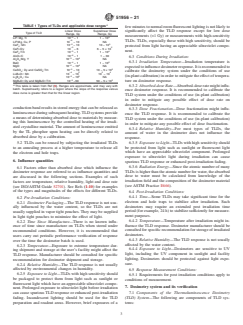
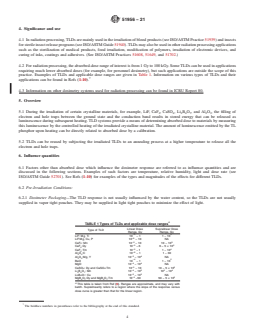
4.2 For radiation processing, the absorbed-dose range of interest is from 1 Gy to 100 kGy. Some TLDs can be used in applications requiring much lower absorbed doses (for example, for personnel dosimetry), but such applications are outside the scope of this practice. Examples of TLDs and applicable dose ranges are given in Table 1. Information on various types of TLDs and their applications can be found in Refs (1-10).7 (A) This table is taken from Ref (6). Ranges are approximate, and may vary with batch. Supralinearity refers to a region where the slope of the response versus dose curve is greater than that for the linear region.
4.3 Information on other dosimetry systems used for radiation processing can be found in ICRU Report 80.
SCOPE
1.1 This practice covers procedures for the use of thermoluminescence dosimeters (TLDs) to measure the absorbed dose in materials irradiated by photons or electrons in terms of absorbed dose to water. Thermoluminescence-dosimetry systems (TLD systems) are generally used as routine dosimetry systems.
1.2 The thermoluminescence dosimeter (TLD) is classified as a type II dosimeter on the basis of the complex effect of influence quantities on the dosimeter response. See ISO/ASTM Practice 52628.
1.3 This document is one of a set of standards that provides recommendations for properly implementing dosimetry in radiation processing, and describes a means of achieving compliance with the requirements of ISO/ASTM 52628 “Practice for Dosimetry in Radiation Processing” for a TLD system. It is intended to be read in conjunction with ISO/ASTM 52628.
1.4 This practice covers the use of TLD systems under the following conditions:
1.4.1 The absorbed-dose range is from 1 Gy to 10 kGy.
1.4.2 The absorbed-dose rate is between 1 × 10⁻² and 1 × 10¹⁰ Gy s-1.
1.4.3 The radiation-energy range for photons and electrons is from 0.1 to 50 MeV.
1.5 This practice does not cover measurements of absorbed dose in materials subjected to neutron irradiation.
1.6 This practice does not cover procedures for the use of TLDs for determining absorbed dose in radiation-hardness testing of electronic devices or for clinical dosimetry. Procedures for the use of TLDs for radiation-hardness testing are given in ASTM Practice E668. Procedures for use of TLDs in clinical dosimetry are given in ISO 28057.
1.7 This standard does not purport to address all of the safety concerns, if any, associated with its use. It is the responsibility of the user of this standard to establish appropriate safety, health, and environmental practices and determine the applicability of regulatory limitations prior to use.
1.8 This international standard was developed in accordance with internationally recognized principles on standardization established in the Decision on Principles for the Development of International Standards, Guides and Recommendations issued by the World Trade Organization Technical Barriers to Trade (TBT) Committee.
- Status
- Published
- Publication Date
- 30-Sep-2021
- Technical Committee
- E61 - Radiation Processing
- Drafting Committee
- E61.02 - Dosimetry Systems
Buy Documents
ASTM ISO/ASTM51956-21 - Standard Practice for Use of a Thermoluminescence-Dosimetry System (TLD System) for Radiation Processing
REDLINE ASTM ISO/ASTM51956-21 - Standard Practice for Use of a Thermoluminescence-Dosimetry System (TLD System) for Radiation Processing
Overview
ASTM ISO/ASTM51956-21: Standard Practice for Use of a Thermoluminescence-Dosimetry System (TLD System) for Radiation Processing establishes guidelines for using TLD systems to accurately measure absorbed radiation dose in materials processed with ionizing photons or electrons. Developed by ASTM, this international standard provides essential procedures to ensure effective and consistent dosimetry practices in the context of industrial and scientific radiation processing.
Thermoluminescence dosimeters (TLDs) are widely used as routine dosimetry systems due to their reliability and the ability to measure doses in a broad range-from 1 Gray (Gy) to 10 kilogray (kGy)-making them suitable for many crucial radiation processing applications. The standard outlines procedures for calibration, verification, use, and maintenance of TLDs to maintain measurement quality and meet regulatory and quality management requirements.
Key Topics
- Scope of Use: Specifies the use of TLD systems for absorbed doses between 1 Gy and 10 kGy, excluding clinical dosimetry, neutron irradiation, and hardness testing for electronics.
- TLD System Components: Covers the components-TLDs, TLD readers, calibration protocols, quality assurance, and routine procedures.
- Influence Quantities: Discusses factors such as temperature, humidity, light, and dose rate that can affect TLD system response and emphasizes the importance of controlling and documenting these variables.
- Calibration and Verification: Details on the importance of system calibration to process conditions, management of batch calibration, and the need for periodic verification to ensure ongoing accuracy.
- Measurement Management: Addresses preparation, storage, and handling of TLDs, plus the requirements for regular performance verification, documentation, and uncertainty evaluation.
- Uncertainty and Quality: Institutes the use of uncertainty budgets to identify and quantify all measurement uncertainties impacting the dosimetry results.
Applications
Thermoluminescence dosimetry as specified in ISO/ASTM51956-21 is integral to many radiation processing operations, including:
- Blood Product Irradiation: Ensures proper dosing for transfusion safety, in compliance with blood irradiation dosimetry standards.
- Sterile Insect Release Programs: Enables effective irradiation of insects for population control.
- Medical Product Sterilization: Assures sterilization of medical devices and pharmaceuticals through precise dose delivery.
- Food Irradiation: Provides verification of absorbed doses to ensure food safety and compliance with regulatory standards.
- Polymer Modification: Facilitates the control of dose delivery in processes that modify the properties of plastics and polymers.
- Curing of Inks, Coatings, and Adhesives: Supports the consistent treatment of materials where radiation-induced curing is required.
The standard also highlights the necessity of proper documentation, storage, and instrument maintenance, as well as the need to estimate and manage measurement uncertainties within these applications.
Related Standards
For comprehensive compliance and best practices, users of ISO/ASTM51956-21 should consult the following related standards:
- ISO/ASTM 52628: Dosimetry in Radiation Processing (companion standard covering general dosimetry system requirements)
- ISO/ASTM 51261: Calibration of Routine Dosimetry Systems for Radiation Processing
- ISO/ASTM 51608, 51649, 51702: Dosimetry in X-Ray, Electron-Beam, and Gamma Irradiation Facilities
- ISO/ASTM 51707: Uncertainty Estimation in Dosimetry for Radiation Processing
- ISO/ASTM 51939: Blood Irradiation Dosimetry
- ISO/ASTM 51940: Dosimetry for Sterile Insect Release
- ISO/ASTM 52701: Guide for Performance Characterization of Dosimeters and Systems
- ICRU Report 80: Dosimetry Systems for Use in Radiation Processing
Practical Value
Adhering to ASTM ISO/ASTM51956-21 ensures that radiation processing facilities can perform precise, reliable, and documented absorbed dose measurements, supporting regulatory compliance and high-quality assurance across industries such as healthcare, food safety, materials processing, and environmental management. Routine use of TLD systems, along with robust calibration, environmental controls, and systematic documentation, helps organizations minimize error, maintain safety, and achieve consistent output in all radiation processing applications.
Keywords: Thermoluminescence dosimeter, TLD system, radiation processing, absorbed dose measurement, calibration, quality assurance, industrial dosimetry, ionizing radiation, ASTM standards, routine dosimetry system.
Relations
- Effective Date
- 01-Oct-2021
Buy Documents
ASTM ISO/ASTM51956-21 - Standard Practice for Use of a Thermoluminescence-Dosimetry System (TLD System) for Radiation Processing
REDLINE ASTM ISO/ASTM51956-21 - Standard Practice for Use of a Thermoluminescence-Dosimetry System (TLD System) for Radiation Processing
Get Certified
Connect with accredited certification bodies for this standard

BSMI (Bureau of Standards, Metrology and Inspection)
Taiwan's standards and inspection authority.
Sponsored listings
Frequently Asked Questions
ASTM ISO/ASTM51956-21 is a standard published by ASTM International. Its full title is "Standard Practice for Use of a Thermoluminescence-Dosimetry System (TLD System) for Radiation Processing". This standard covers: SIGNIFICANCE AND USE 4.1 In radiation processing, TLDs are mainly used in the irradiation of blood products (see ISO/ASTM Practice 51939) and insects for sterile insect release programs (see ISO/ASTM Guide 51940). TLDs may also be used in other radiation processing applications such as the sterilization of medical products, food irradiation, modification of polymers, irradiation of electronic devices, and curing of inks, coatings and adhesives. (See ISO/ASTM Practices 51608, 51649, and 51702.) 4.2 For radiation processing, the absorbed-dose range of interest is from 1 Gy to 100 kGy. Some TLDs can be used in applications requiring much lower absorbed doses (for example, for personnel dosimetry), but such applications are outside the scope of this practice. Examples of TLDs and applicable dose ranges are given in Table 1. Information on various types of TLDs and their applications can be found in Refs (1-10).7 (A) This table is taken from Ref (6). Ranges are approximate, and may vary with batch. Supralinearity refers to a region where the slope of the response versus dose curve is greater than that for the linear region. 4.3 Information on other dosimetry systems used for radiation processing can be found in ICRU Report 80. SCOPE 1.1 This practice covers procedures for the use of thermoluminescence dosimeters (TLDs) to measure the absorbed dose in materials irradiated by photons or electrons in terms of absorbed dose to water. Thermoluminescence-dosimetry systems (TLD systems) are generally used as routine dosimetry systems. 1.2 The thermoluminescence dosimeter (TLD) is classified as a type II dosimeter on the basis of the complex effect of influence quantities on the dosimeter response. See ISO/ASTM Practice 52628. 1.3 This document is one of a set of standards that provides recommendations for properly implementing dosimetry in radiation processing, and describes a means of achieving compliance with the requirements of ISO/ASTM 52628 “Practice for Dosimetry in Radiation Processing” for a TLD system. It is intended to be read in conjunction with ISO/ASTM 52628. 1.4 This practice covers the use of TLD systems under the following conditions: 1.4.1 The absorbed-dose range is from 1 Gy to 10 kGy. 1.4.2 The absorbed-dose rate is between 1 × 10⁻² and 1 × 10¹⁰ Gy s-1. 1.4.3 The radiation-energy range for photons and electrons is from 0.1 to 50 MeV. 1.5 This practice does not cover measurements of absorbed dose in materials subjected to neutron irradiation. 1.6 This practice does not cover procedures for the use of TLDs for determining absorbed dose in radiation-hardness testing of electronic devices or for clinical dosimetry. Procedures for the use of TLDs for radiation-hardness testing are given in ASTM Practice E668. Procedures for use of TLDs in clinical dosimetry are given in ISO 28057. 1.7 This standard does not purport to address all of the safety concerns, if any, associated with its use. It is the responsibility of the user of this standard to establish appropriate safety, health, and environmental practices and determine the applicability of regulatory limitations prior to use. 1.8 This international standard was developed in accordance with internationally recognized principles on standardization established in the Decision on Principles for the Development of International Standards, Guides and Recommendations issued by the World Trade Organization Technical Barriers to Trade (TBT) Committee.
SIGNIFICANCE AND USE 4.1 In radiation processing, TLDs are mainly used in the irradiation of blood products (see ISO/ASTM Practice 51939) and insects for sterile insect release programs (see ISO/ASTM Guide 51940). TLDs may also be used in other radiation processing applications such as the sterilization of medical products, food irradiation, modification of polymers, irradiation of electronic devices, and curing of inks, coatings and adhesives. (See ISO/ASTM Practices 51608, 51649, and 51702.) 4.2 For radiation processing, the absorbed-dose range of interest is from 1 Gy to 100 kGy. Some TLDs can be used in applications requiring much lower absorbed doses (for example, for personnel dosimetry), but such applications are outside the scope of this practice. Examples of TLDs and applicable dose ranges are given in Table 1. Information on various types of TLDs and their applications can be found in Refs (1-10).7 (A) This table is taken from Ref (6). Ranges are approximate, and may vary with batch. Supralinearity refers to a region where the slope of the response versus dose curve is greater than that for the linear region. 4.3 Information on other dosimetry systems used for radiation processing can be found in ICRU Report 80. SCOPE 1.1 This practice covers procedures for the use of thermoluminescence dosimeters (TLDs) to measure the absorbed dose in materials irradiated by photons or electrons in terms of absorbed dose to water. Thermoluminescence-dosimetry systems (TLD systems) are generally used as routine dosimetry systems. 1.2 The thermoluminescence dosimeter (TLD) is classified as a type II dosimeter on the basis of the complex effect of influence quantities on the dosimeter response. See ISO/ASTM Practice 52628. 1.3 This document is one of a set of standards that provides recommendations for properly implementing dosimetry in radiation processing, and describes a means of achieving compliance with the requirements of ISO/ASTM 52628 “Practice for Dosimetry in Radiation Processing” for a TLD system. It is intended to be read in conjunction with ISO/ASTM 52628. 1.4 This practice covers the use of TLD systems under the following conditions: 1.4.1 The absorbed-dose range is from 1 Gy to 10 kGy. 1.4.2 The absorbed-dose rate is between 1 × 10⁻² and 1 × 10¹⁰ Gy s-1. 1.4.3 The radiation-energy range for photons and electrons is from 0.1 to 50 MeV. 1.5 This practice does not cover measurements of absorbed dose in materials subjected to neutron irradiation. 1.6 This practice does not cover procedures for the use of TLDs for determining absorbed dose in radiation-hardness testing of electronic devices or for clinical dosimetry. Procedures for the use of TLDs for radiation-hardness testing are given in ASTM Practice E668. Procedures for use of TLDs in clinical dosimetry are given in ISO 28057. 1.7 This standard does not purport to address all of the safety concerns, if any, associated with its use. It is the responsibility of the user of this standard to establish appropriate safety, health, and environmental practices and determine the applicability of regulatory limitations prior to use. 1.8 This international standard was developed in accordance with internationally recognized principles on standardization established in the Decision on Principles for the Development of International Standards, Guides and Recommendations issued by the World Trade Organization Technical Barriers to Trade (TBT) Committee.
ASTM ISO/ASTM51956-21 is classified under the following ICS (International Classification for Standards) categories: 17.240 - Radiation measurements. The ICS classification helps identify the subject area and facilitates finding related standards.
ASTM ISO/ASTM51956-21 has the following relationships with other standards: It is inter standard links to ASTM ISO/ASTM51956-13. Understanding these relationships helps ensure you are using the most current and applicable version of the standard.
ASTM ISO/ASTM51956-21 is available in PDF format for immediate download after purchase. The document can be added to your cart and obtained through the secure checkout process. Digital delivery ensures instant access to the complete standard document.
Standards Content (Sample)
This international standard was developed in accordance with internationally recognized principles on standardization established in the Decision on Principles for the
Development of International Standards, Guides and Recommendations issued by the World Trade Organization Technical Barriers to Trade (TBT) Committee.
Designation: 51956 − 21
Standard Practice for
Use of a Thermoluminescence-Dosimetry System (TLD
System) for Radiation Processing
This standard is issued under the fixed designation 51956; the number immediately following the designation indicates the year of
original adoption or, in the case of revision, the year of last revision. A number in parentheses indicates the year of last reapproval. A
superscript epsilon (´) indicates an editorial change since the last revision or reapproval.
1. Scope 1.7 This standard does not purport to address all of the
safety concerns, if any, associated with its use. It is the
1.1 This practice covers procedures for the use of thermo-
responsibility of the user of this standard to establish appro-
luminescence dosimeters (TLDs) to measure the absorbed dose
priate safety, health, and environmental practices and deter-
in materials irradiated by photons or electrons in terms of
mine the applicability of regulatory limitations prior to use.
absorbed dose to water. Thermoluminescence-dosimetry sys-
1.8 This international standard was developed in accor-
tems (TLD systems) are generally used as routine dosimetry
dance with internationally recognized principles on standard-
systems.
ization established in the Decision on Principles for the
1.2 The thermoluminescence dosimeter (TLD) is classified
Development of International Standards, Guides and Recom-
as a type II dosimeter on the basis of the complex effect of
mendations issued by the World Trade Organization Technical
influence quantities on the dosimeter response. See ISO/ASTM
Barriers to Trade (TBT) Committee.
Practice 52628.
2. Referenced documents
1.3 This document is one of a set of standards that provides
recommendations for properly implementing dosimetry in 2.1 ASTM Standards:
radiation processing, and describes a means of achieving E666 Practice for Calculating Absorbed Dose From Gamma
compliance with the requirements of ISO/ASTM 52628 “Prac- or X Radiation
tice for Dosimetry in Radiation Processing” for a TLD system. E668 Practice for Application of Thermoluminescence-
It is intended to be read in conjunction with ISO/ASTM 52628. Dosimetry (TLD) Systems for Determining Absorbed
Dose in Radiation-Hardness Testing of Electronic Devices
1.4 This practice covers the use of TLD systems under the
E3083 Terminology Relating to Radiation Processing: Do-
following conditions:
simetry and Applications
1.4.1 The absorbed-dose range is from 1 Gy to 10 kGy.
-2 2.2 ISO/ASTM Standards:
1.4.2 The absorbed-dose rate is between 1 × 10 and 1 ×
10 -1 51261 Practice for Calibration of Routine Dosimetry Sys-
10 Gy s .
tems for Radiation Processing
1.4.3 The radiation-energy range for photons and electrons
51608 Practice for Dosimetry in an X-Ray (Bremsstrahlung)
is from 0.1 to 50 MeV.
Facility for Radiation Processing
1.5 This practice does not cover measurements of absorbed
51649 Practice for Dosimetry in an Electron-Beam Facility
dose in materials subjected to neutron irradiation.
for Radiation Processing at Energies Between 300 keV
and 25 MeV
1.6 This practice does not cover procedures for the use of
51702 Practice for Dosimetry in Gamma Irradiation Facili-
TLDs for determining absorbed dose in radiation-hardness
ties for Radiation Processing
testing of electronic devices or for clinical dosimetry. Proce-
51707 Guide for Estimating Uncertainties in Dosimetry for
dures for the use of TLDs for radiation-hardness testing are
Radiation Processing
given in ASTM Practice E668. Procedures for use of TLDs in
51939 Practice for Blood Irradiation Dosimetry
clinical dosimetry are given in ISO 28057.
51940 Guide for Dosimetry for Sterile Insect Release Pro-
grams
52628 Practice for Dosimetry in Radiation Processing
This practice is under the jurisdiction of ASTM Committee E61 on Radiation
Processing and is the direct responsibility of Subcommittee E61.02 on Dosimetry
Systems. Originally developed as a joint ASTM/ISO standard in conjunction with
ISO/TC 85/WG 3. For referenced ASTM and ISO/ASTM standards, visit the ASTM website,
Current edition approved Oct. 1, 2021. Published May 2024. Originally approved www.astm.org, or contact ASTM Customer Service at service@astm.org. For
in 1998. Last previous edition approved in 2013 as ISO/ASTM 51956:2013(E). Annual Book of ASTM Standards volume information, refer to the standard’s
DOI: 10.1520/51956-21. Document Summary page on the ASTM website.
Copyright © ASTM International, 100 Barr Harbor Drive, PO Box C700, West Conshohocken, PA 19428-2959. United States
51956 − 21
52701 Guide for Performance Characterization of Dosim- 3.1.5.1 Discussion—For example, the TL phosphor is some-
eters and Dosimetry Systems for Use in Radiation Pro- times incorporated in a TFE-fluorocarbon matrix.
cessing
3.1.6 thermoluminescence dosimeter reader (TLD reader)—
2.3 Joint Committee for Guides in Metrology (JCGM)
instrument used to measure the light emitted from a TLD
Reports:
consisting essentially of a heating element, a light-measuring
JCGM 100:2008, GUM 1995, with minor corrections,
device, and appropriate electronics.
Evaluation of measurement data—Guide to the Expres-
3.1.7 thermoluminescence dosimeter response (TLD
sion of Uncertainty in Measurement
response)—light emitted by the TLD and read out during its
JCGM 200:2008, VIM, International Vocabulary of
heating cycle consisting of one of the following: (a) the total
Metrology—Basis and general concepts and associated
light output over the entire heating cycle, (b) a part of that total
terms
light output, or (c) the peak amplitude of the light output.
2.4 ISO Standards:
3.1.8 thermoluminescence phosphor (TL phosphor)—
ISO 10012 Measurement Management Systems—
material that stores, upon irradiation, a fraction of its absorbed
Requirements for Measurement Processes and Measuring
dose in various excited energy states and when thermally
Equipment
stimulated, it emits this stored energy as ultraviolet, visible,
ISO 12749-4 Nuclear energy—Vocabulary—Part 4: Dosim-
and infrared lights.
etry for radiation processing
ISO 28057 Clinical dosimetry – Dosimetry with solid ther-
3.1.9 TLD preparation—procedure of cleaning, annealing,
moluminescence detectors for photon and electron radia- and encapsulating the TL phosphor prior to irradiation.
tions in radiotherapy
3.2 Definitions of other terms used in this standard that
2.5 International Commission on Radiation Units and Mea-
pertain to radiation measurement and dosimetry may be found
surements (ICRU) Report:
in ISO/ASTM Practice 52628. Other terms that pertain to
ICRU Report 80 Dosimetry Systems for Use in Radiation
radiation measurement and dosimetry may be found in ASTM
Processing
Terminology E3083 and ISO Terminology ISO 12749-4.
ICRU Report 85a Fundamental Quantities and Units for
Where appropriate, definitions used in these standards have
Ionizing Radiation
been derived from, and are consistent with definitions in ICRU
Report 85a, and general metrological definitions given in the
3. Terminology
VIM.
3.1 Definitions:
3.1.1 annealing—thermal treatment of a TLD prior to irra-
4. Significance and use
diation or prior to readout.
4.1 In radiation processing, TLDs are mainly used in the
3.1.1.1 Discussion—Pre-irradiation annealing of TLDs is
irradiation of blood products (see ISO/ASTM Practice 51939)
usually done to erase the effects of previous irradiation and to
and insects for sterile insect release programs (see ISO/ASTM
readjust the sensitivity of the phosphor; pre-readout annealing
Guide 51940). TLDs may also be used in other radiation
usually is done to reduce low-temperature TLD response.
processing applications such as the sterilization of medical
3.1.2 dosimeter batch—quantity of dosimeters made from a
products, food irradiation, modification of polymers, irradia-
specific mass of material with uniform composition, fabricated
tion of electronic devices, and curing of inks, coatings and
in a single production run under controlled, consistent
adhesives. (See ISO/ASTM Practices 51608, 51649, and
conditions, and having a unique identification code.
51702.)
3.1.3 dosimeter stock—part of a dosimeter batch held by the
4.2 For radiation processing, the absorbed-dose range of
user.
interest is from 1 Gy to 100 kGy. Some TLDs can be used in
3.1.4 routine dosimetry system—dosimetry system cali-
applications requiring much lower absorbed doses (for
brated against a reference standard dosimetry system and used
example, for personnel dosimetry), but such applications are
for routine absorbed dose measurements, including dose map-
outside the scope of this practice. Examples of TLDs and
ping and process monitoring.
applicable dose ranges are given in Table 1. Information on
various types of TLDs and their applications can be found in
3.1.5 thermoluminescence dosimeter (TLD)—TL phosphor,
Refs (1-10).
alone or incorporated in a material, used for determining the
absorbed dose to materials.
4.3 Information on other dosimetry systems used for radia-
tion processing can be found in ICRU Report 80.
Document produced by Working Group 1 of the Joint Committee for Guides in
Metrology (JCGM/WG 1). Available free of charge at the BIPM website (http://
5. Overview
www.bipm.org.
Document produced by Working Group 2 of the Joint Committee for Guides in 5.1 During the irradiation of certain crystalline materials,
Metrology (JCGM/WG 2). Available free of charge at the BIPM website (http://
for example, LiF, CaF , CaSO , Li B O , and Al O , the filling
2 4 2 4 7 2 3
www.bipm.org.
of electron and hole traps between the ground state and the
Available from International Organization for Standardization (ISO), ISO
Central Secretariat, Chemin de Blandonnet 8, CP 401, 1214 Vernier, Geneva,
Switzerland, https://www.iso.org.
6 7
Available from International Commission on Radiation Units and The boldface numbers in parentheses refer to the bibliography at the end of this
Measurements, 7910 Woodmont Ave., Suite 800, Bethesda, MD 20814, USA. standard.
51956 − 21
A
TABLE 1 Types of TLDs and applicable dose ranges
few minutes to normal room fluorescent lighting is not likely to
Linear Dose Supralinear Dose
significantly affect the TLD response except for low dose
Type of TLD
Range, Gy Range, Gy
measurements (<1 Gy) or measurements with high-sensitivity
−5 3
LiF: Mg, Ti 10 − 1 1 − 10
−6
TLDs. TLDs, especially those with high sensitivity, should be
LiF:Mg, Cu, P 10 − 10 NA
−5 3
CaF : Mn 10 − 10 10 − 10
2 protected from light having an appreciable ultraviolet compo-
−5 2
CaF :Dy 10 − 6 6 − 5 × 10
nent.
−5 4
CaF :Tm 10 − 1 1 − 10
−6
Al O :C 10 − 1 1 − 30
2 3
6.3 Conditions During Irradiation:
−3 4
Al O :Mg, Y 10 − 10 NA
2 3
−4 2 6.3.1 Irradiation Temperature—Irradiation temperature is
BeO 10 − 1 1 − 10
−4 4
MgO 10 − 10 NA expected to influence dosimeter response. It is recommended to
−5 3
CaSO : Dy and CaSO :Tm 10 − 10 10 − 5 × 10
4 4
calibrate the dosimetry system under the conditions of use
−4 2 2 4
Li B O : Mn 10 − 10 10 − 10
2 4 7
−5 3 (in-plant calibration) in order to mitigate the effect of tempera-
Li B O : Cu 10 − 10 NA
2 4 7
−5 3
MgB O :Dy and MgB O :Tm 10 −50 50 − 5 × 10 ture on dosimeter response.
4 7 4 7
A
6.3.2 Absorbed-dose Rate—Absorbed-dose rate might influ-
This table is taken from Ref (6). Ranges are approximate, and may vary with
batch. Supralinearity refers to a region where the slope of the response versus
ence dosimeter response. It is recommended to calibrate the
dose curve is greater than that for the linear region.
TLD system under the conditions of use (in-plant calibration)
in order to mitigate any possible effect of dose rate on
dosimeter response.
conduction band results in stored energy that can be released as
6.3.3 Dose Fractionation—Dose fractionation might influ-
luminescence during subsequent heating. TLD systems provide
ence the TLD response. It is recommended to calibrate the
a means of determining absorbed dose to materials by measur-
TLD system under the conditions of use (in-plant calibration)
ing this luminescence by the controlled heating of the irradi-
in order to mitigate any possible effect of dose fractionation.
ated crystalline material. The amount of luminescence emitted
6.3.4 Relative Humidity—For most types of TLDs, the
by the TL phosphor upon heating can be directly related to
amount of water in the dosimeter does not influence the
absorbed dose by a calibration.
response.
5.2 TLDs can be reused by subjecting the irradiated TLDs 6.3.5 Exposure to Light—TLDs with high sensitivity should
be protected from light such as sunlight or fluorescent light
to an annealing process at a higher temperature to release all
the electron and hole traps. which have an appreciable ultraviolet component. Prolonged
exposure to ultraviolet light during irradiation can cause
6. Influence quantities
spurious TLD response or enhanced post-irradiation fading.
6.3.6 Radiation Energy—Since the atomic number of many
6.1 Factors other than absorbed dose which influence the
TLDs is higher than the atomic number for water, the absorbed
dosimeter response are referred to as influence quantities and
dose to water must be calculated from knowledge of the
are discussed in the following sections. Examples of such
irradiation field and the composition of the dosimeter material
factors are temperature, relative humidity, light and dose rate
(see ASTM Practice E666).
(see ISO/ASTM Guide 52701). See Refs (1-10) for examples
of the types and magnitudes of the effects for different TLDs.
6.4 Post-Irradiation Conditions:
6.4.1 Time—Some TLDs may take significant time for the
6.2 Pre-Irradiation Conditions:
electron and hole traps to stabilize after irradiation. Such
6.2.1 Dosimeter Packaging—The TLD response is not usu-
dosimeters may require an extended post irradiation time
ally influenced by the water content, so the TLDs are not
period (for example, 24 h) to stabilize sufficiently for measure-
usually supplied in vapor tight pouches. They may be supplied
ment purposes.
in light tight pouches to minimize the effect of light.
6.4.2 Temperature—Temperature after irradiation might in-
6.2.2 Time Since Manufacture—There is no known influ-
fluence the TLD response. Dosimeter manufacturer should be
ence of time since manufacture on TLDs when stored under
consulted for specific recommendation for storage of irradiated
recommended conditions. However, it is recommended that
dosimeters.
users carry out periodic performance verification of response
6.4.3 Relative Humidity—The TLD response is not usually
over the time the dosimeter batch is used.
affected by the water content.
6.2.3 Temperature—Exposure to extreme temperature dur-
6.4.4 Exposure to Light—Dosimeters are sensitive to UV
ing shipment and storage at the user’s facility might affect the
light, including the UV component in sunlight and facility
TLD response. Manufacturer should be consulted for specific
lighting. Dosimeters should be protected against light expo-
recommendation for dosimeter shipment and storage.
sure.
6.2.4 Relative Humidity—The TLD response is not usually
affected by environmental changes in humidity.
6.5 Response Measurement Conditions:
6.2.5 Exposure to Light—TLDs with high sensitivity should
6.5.1 Requirements for post irradiation conditions apply to
be packaged to protect them from light such as sunlight or
conditions of measurement.
fluorescent light which have an appreciable ultraviolet compo-
7. Dosimetry system and its verification
nent. Prolonged exposure to ultraviolet light before irradiation
can cause spurious TLD response or enhanced post-irradiation 7.1 Components of the Thermoluminescence Dosimetry
fading. Incandescent lighting should be used for the TLD (TLD) System—The following are components of TLD sys-
preparation and readout areas. However, brief exposures of a tems:
51956 − 21
7.1.1 Thermoluminescence Dosimeters (TLDs)—TLDs are 9.2 The user’s dosimetry system calibration shall take into
available from commercial suppliers in different forms such as account the influence quantities associated with pre-irradiation,
loose powder, chips or crystals encapsulated in glass or plastic. irradiation, and post-irradiation conditions applicable to the
7.1.2 Instrumentation—The thermoluminescence dosimeter process in the user’s facility (see Section 6).
(TLD) reader is a special instrument used to measure TLDs. It NOTE 1—Successful calibration of a TLD system requires use of
calibration conditions that approximate those expected to be encountered
consists of a heating element that subjects the TLD to a
during use. If large seasonal temperature differences are anticipated, then
carefully controlled heating program that allows the freed
the calibration should be conducted during periods that may better reflect
electrons and holes from traps to recombine with the emission
the middle of the temperature range expected to be encountered over the
of characteristic light. The emission of light as a function of
life of the calibration. Periodic or seasonal calibration verification is also
recommended to determine any effects of seasonal variation and confirm
temperature produces a glow curve that is measured by the
continued use of a batch specific calibration.
TLD reader and related to the absorbed dose.
7.1.3 Procedures for Its Use.
9.3 Multiple calibration curves can be used instead of using
a single calibration curve over the entire dose range as a means
7.2 Measurement Management System specifying details of
of reducing the level of calibration uncertainty.
the preparation and handling of the TLDs and the verification,
calibration and quality assurance requirements for the TLD
9.4 If reusable TLDs are irradiated (for either calibration or
system shall be in place.
production use) to high single or accumulated absorbed-dose
levels (>10 Gy) recalibration may be required after each
7.3 Performance Verification of Instrumentation:
anneal-irradiation cycle because of possible changes in
7.3.1 At prescribed time intervals, or in the event of
absorbed-dose sensitivity (7). If the TLD system being used is
suspected performance issues during periods of use, measure-
subject to this effect, it is recommended that each TLD in the
ment instruments should be checked against their calibration
batch be irradiated only once until the entire batch has been
standards.
used after which the entire batch can be annealed and a new
7.3.2 Implementation of a daily check program intended to
calibration performed. In addition, because of possible changes
verify instrument performance before and after measurement
in batch response uniformity due to high absorbed-dose
sessions is also recommended.
irradiations, periodically repeat the tests.
8. Incoming dosimeter stock assessment
10. Routine use
8.1 A protocol shall be established for the purchase, receipt,
10.1 Before Irradiation:
acceptance and storage of dosimeters.
10.1.1 TLDs may be used either as reusable or as single-use
8.2 The user shall perform an incoming inspection and
dosimeters. Single-use dosimeters are irradiated once, read out,
acceptance testing for each shipment of dosimeters received.
and then discarded; they are generally used as received from
Samples should be selected from all or as many incoming
the manufacturer. Dosimeters that are reused are cycled repeat-
boxes as is possible.
edly through an anneal-irradiation-readout procedure.
8.2.1 Verify and document details such as batch ID,
10.1.2 Preparation of the TLDs for irradiation may require
quantity, date received, miscellaneous descriptions (such as
cleaning, annealing, or encapsulation, or combinations thereof,
average mass) and status of any shipping controls (such as
depending on the type and form of the TL phosphor.
temperature device’s indication of whether temperature limits
10.1.3 Reusable TLDs require careful treatment during
may have been exceeded during shipping).
annealing in order to obtain reliable results in dose measure-
8.2.2 Perform random sampling per documented procedures
ments. The annealing procedure should in
...
This document is not an ASTM standard and is intended only to provide the user of an ASTM standard an indication of what changes have been made to the previous version. Because
it may not be technically possible to adequately depict all changes accurately, ASTM recommends that users consult prior editions as appropriate. In all cases only the current version
of the standard as published by ASTM is to be considered the official document.
Designation: ISO/ASTM 51956 − 2013(E) 51956 − 21
Standard Practice for
Use of a Thermoluminescence-Dosimetry System (TLD
System) for Radiation Processing
This standard is issued under the fixed designation ISO/ASTM 51956; the number immediately following the designation indicates the
year of original adoption or, in the case of revision, the year of last revision. A number in parentheses indicates the year of last
reapproval. A superscript epsilon (´) indicates an editorial change since the last revision or reapproval.
1. Scope
1.1 This practice covers procedures for the use of thermoluminescence dosimeters (TLDs) to measure the absorbed dose in
materials irradiated by photons or electrons in terms of absorbed dose to water. Thermoluminescence-dosimetry systems (TLD
systems) are generally used as routine dosimetry systems.
1.2 The thermoluminescence dosimeter (TLD) is classified as a type II dosimeter on the basis of the complex effect of influence
quantities on the dosimeter response. See ISO/ASTM Practice 52628.
1.3 This document is one of a set of standards that provides recommendations for properly implementing dosimetry in radiation
processing, and describes a means of achieving compliance with the requirements of ISO/ASTM 52628 “Practice for Dosimetry
in Radiation Processing” for a TLD system. It is intended to be read in conjunction with ISO/ASTM 52628.
1.4 This practice covers the use of TLD systems under the following conditions:
1.4.1 The absorbed-dose range is from 1 Gy to 10 kGy.
-2 10 -1
1.4.2 The absorbed-dose rate is between 1 × 10 and 1 × 10 Gy s .
1.4.3 The radiation-energy range for photons and electrons is from 0.1 to 50 MeV.
1.5 This practice does not cover measurements of absorbed dose in materials subjected to neutron irradiation.
1.6 This practice does not cover procedures for the use of TLDs for determining absorbed dose in radiation-hardness testing of
electronic devices. devices or for clinical dosimetry. Procedures for the use of TLDs for radiation-hardness testing are given in
ASTM Practice E668. Procedures for use of TLDs in clinical dosimetry are given in ISO 28057.
1.7 This standard does not purport to address all of the safety concerns, if any, associated with its use. It is the responsibility
of the user of this standard to establish appropriate safety and healthsafety, health, and environmental practices and determine
the applicability of regulatory limitations prior to use.
1.8 This international standard was developed in accordance with internationally recognized principles on standardization
established in the Decision on Principles for the Development of International Standards, Guides and Recommendations issued
by the World Trade Organization Technical Barriers to Trade (TBT) Committee.
This practice is under the jurisdiction of ASTM Committee E61 on Radiation Processing and is the direct responsibility of Subcommittee E61.02 on Dosimetry Systems,
and is also under the jurisdiction of . Originally developed as a joint ASTM/ISO standard in conjunction with ISO/TC 85/WG 3.
Current edition approved Aug. 1, 2013Oct. 1, 2021. Published November 2013May 2024. Originally published as ASTM E 1956–98. The present International Standard
ISO/ASTM 51956:2013(E) is a major revision of the last previous edition ISO/ASTM 51956:2005(E).approved in 1998. Last previous edition approved in 2013 as ISO/ASTM
51956:2013(E). DOI: 10.1520/51956-21.
Copyright © ASTM International, 100 Barr Harbor Drive, PO Box C700, West Conshohocken, PA 19428-2959. United States
51956 − 21
2. Referenced documents
2.1 ASTM Standards:
E170 Terminology Relating to Radiation Measurements and Dosimetry
E666 Practice for Calculating Absorbed Dose From Gamma or X Radiation
E668 Practice for Application of Thermoluminescence-Dosimetry (TLD) Systems for Determining Absorbed Dose in
Radiation-Hardness Testing of Electronic Devices
E3083 Terminology Relating to Radiation Processing: Dosimetry and Applications
2.2 ISO/ASTM Standards:
51261 Practice for Calibration of Routine Dosimetry Systems for Radiation Processing
51608 Practice for Dosimetry in an X-Ray (Bremsstrahlung) Facility for Radiation Processing
51649 Practice for Dosimetry in an Electron-Beam Facility for Radiation Processing at Energies Between 300 keV and 25 MeV
51702 Practice for Dosimetry in Gamma Irradiation Facilities for Radiation Processing
51707 Guide for Estimating Uncertainties in Dosimetry for Radiation Processing
51939 Practice for Blood Irradiation Dosimetry
51940 Guide for Dosimetry for Sterile Insect Release Programs
52628 Practice for Dosimetry in Radiation Processing
52701 Guide for Performance Characterization of Dosimeters and Dosimetry Systems for Use in Radiation Processing
2.3 Joint Committee for Guides in Metrology (JCGM) Reports:
JCGM 100:2008, GUM 1995, with minor corrections, Evaluation of measurement data—Guide to the Expression of Uncertainty
in Measurement
JCGM 200:2008, VIM, International Vocabulary of Metrology—Basis and general concepts and associated terms
2.4 ISO Standard:Standards:
ISO 10012 Measurement Management Systems—Requirements for Measurement Processes and Measuring Equipment
ISO 12749-4 Nuclear energy—Vocabulary—Part 4: Dosimetry for radiation processing
ISO 28057 Clinical dosimetry – Dosimetry with solid thermoluminescence detectors for photon and electron radiations in
radiotherapy
2.5 International Commission on Radiation Units and Measurements (ICRU) Report:
ICRU Report 80 Dosimetry Systems for Use in Radiation Processing
ICRU Report 85a Fundamental Quantities and Units for Ionizing Radiation
3. Terminology
3.1 Definitions:
3.1.1 annealing—thermal treatment of a TLD prior to irradiation or prior to readout.
3.1.1.1 Discussion—
Pre-irradiation annealing of TLDs is usually done to erase the effects of previous irradiation and to readjust the sensitivity of the
phosphor; pre-readout annealing usually is done to reduce low-temperature TLD response.
3.1.2 calibration—set of operations that establish, under specified conditions, the relationship between values of quantities
indicated by a measuring instrument or measuring system, or values represented by a material measure or a reference material, and
the corresponding values realized by standards.
3.1.2.1 Discussion—
Calibration conditions include environmental and irradiation conditions present during irradiation, storage and measurement of the
dosimeters that are used for the generation of a calibration curve. To achieve stable environmental conditions, it may be necessary
to condition the dosimeters before performing the calibration procedure.
3.1.3 calibration curve—expression of the relation between indication and corresponding measured quantity value. (VIM)
For referenced ASTM and ISO/ASTM standards, visit the ASTM website, www.astm.org, or contact ASTM Customer Service at service@astm.org. For Annual Book
of ASTM Standards volume information, refer to the standard’s Document Summary page on the ASTM website.
Document produced by Working Group 1 of the Joint Committee for Guides in Metrology (JCGM/WG 1). Available free of charge at the BIPM website
(http://www.bipm.org.
Document produced by Working Group 2 of the Joint Committee for Guides in Metrology (JCGM/WG 2). Available free of charge at the BIPM website
(http://www.bipm.org.
Available from American National Standards Institute (ANSI), 25 W. 43rd St., 4th Floor, New York, NY 10036, http://www.ansi.org.International Organization for
Standardization (ISO), ISO Central Secretariat, Chemin de Blandonnet 8, CP 401, 1214 Vernier, Geneva, Switzerland, https://www.iso.org.
Available from International Commission on Radiation Units and Measurements, 7910 Woodmont Ave., Suite 800, Bethesda, MD 20814, USA.
51956 − 21
3.1.4 charged-particle equilibrium—condition in which the kinetic energy of charged particles (or electrons), excluding rest mass,
entering an infinitesimal volume of the irradiated material equals the kinetic energy of charge particles (or electrons) emerging
from it.
3.1.4.1 Discussion—
When electrons are the predominant charged particles, the term “electron equilibrium” is often used to describe charged-particle
equilibrium.
3.1.2 dosimeter batch—quantity of dosimeters made from a specific mass of material with uniform composition, fabricated in a
single production run under controlled, consistent conditions, and having a unique identification code.
3.1.3 dosimeter stock—part of a dosimeter batch held by the user.
3.1.7 dosimetry system—system used for measuring absorbed dose, consisting of dosimeters, measurement instruments and their
associated reference standards, and procedures for the system’s use.
3.1.8 electron equilibrium—charged-particle equilibrium for electrons. See charged-particle equilibrium.
3.1.9 measurement management system—set of interrelated or interacting elements necessary to achieve metrological confirmation
and continual control of measurement processes. (ISO 10012)
3.1.10 quality assurance—all systematic actions necessary to provide adequate confidence that a calibration, measurement, or
process is performed to a predefined level of quality.
3.1.11 reference standard dosimetry system—dosimetry system, generally having the highest metrological quality available at a
given location or in a given organization, from which measurements made there are derived.
3.1.4 routine dosimetry system—dosimetry system calibrated against a reference standard dosimetry system and used for routine
absorbed dose measurements, including dose mapping and process monitoring.
3.1.5 thermoluminescence dosimeter (TLD)—TL phosphor, alone or incorporated in a material, used for determining the absorbed
dose to materials.
3.1.5.1 Discussion—
For example, the TL phosphor is sometimes incorporated in a TFE-fluorocarbon matrix.
3.1.6 thermoluminescence dosimeter reader (TLD reader)—instrument used to measure the light emitted from a TLD consisting
essentially of a heating element, a light-measuring device, and appropriate electronics.
3.1.7 thermoluminescence dosimeter response (TLD response)—light emitted by the TLD and read out during its heating cycle
consisting of one of the following: (a) the total light output over the entire heating cycle, (b) a part of that total light output, or
(c) the peak amplitude of the light output.
3.1.8 thermoluminescence phosphor (TL phosphor)—material that stores, upon irradiation, a fraction of its absorbed dose in
various excited energy states and when thermally stimulated, it emits this stored energy as ultraviolet, visible, and infrared lights.
3.1.9 TLD preparation—procedure of cleaning, annealing, and encapsulating the TL phosphor prior to irradiation.
3.2 Definitions of other terms used in this standard that pertain to radiation measurement and dosimetry may be found in ASTM
TerminologyISO/ASTM Practice E17052628. Definitions Other terms that pertain to radiation measurement and dosimetry may
be found in ASTM Terminology E170E3083 are compatible with ICRU Report 85a; that document, therefore, may be used as an
alternative reference.and ISO Terminology ISO 12749-4. Where appropriate, definitions used in these standards have been derived
from, and are consistent with definitions in ICRU Report 85a, and general metrological definitions given in the VIM.
51956 − 21
4. Significance and use
4.1 In radiation processing, TLDs are mainly used in the irradiation of blood products (see ISO/ASTM Practice 51939) and insects
for sterile insect release programs (see ISO/ASTM Guide 51940). TLDs may also be used in other radiation processing applications
such as the sterilization of medical products, food irradiation, modification of polymers, irradiation of electronic devices, and
curing of inks, coatings and adhesives. (See ISO/ASTM Practices 51608, 51649, and 51702.)
4.2 For radiation processing, the absorbed-dose range of interest is from 1 Gy to 100 kGy. Some TLDs can be used in applications
requiring much lower absorbed doses (for example, for personnel dosimetry), but such applications are outside the scope of this
practice. Examples of TLDs and applicable dose ranges are given in Table 1. Information on various types of TLDs and their
applications can be found in Refs (1-10).
4.3 Information on other dosimetry systems used for radiation processing can be found in ICRU Report 80.
5. Overview
5.1 During the irradiation of certain crystalline materials, for example, LiF, CaF , CaSO , Li B O , and Al O , the filling of
2 4 2 4 7 2 3
electron and hole traps between the ground state and the conduction band results in stored energy that can be released as
luminescence during subsequent heating. TLD systems provide a means of determining absorbed dose to materials by measuring
this luminescence by the controlled heating of the irradiated crystalline material. The amount of luminescence emitted by the TL
phosphor upon heating can be directly related to absorbed dose by a calibration.
5.2 TLDs can be reused by subjecting the irradiated TLDs to an annealing process at a higher temperature to release all the
electron and hole traps.
6. Influence quantities
6.1 Factors other than absorbed dose which influence the dosimeter response are referred to as influence quantities and are
discussed in the following sections. Examples of such factors are temperature, relative humidity, light and dose rate (see
ISO/ASTM Guide 52701). See Refs (1-10) for examples of the types and magnitudes of the effects for different TLDs.
6.2 Pre-Irradiation Conditions:
6.2.1 Dosimeter Packaging—The TLD response is not usually influenced by the water content, so the TLDs are not usually
supplied in vapor tight pouches. They may be supplied in light tight pouches to minimize the effect of light.
A
TABLE 1 Types of TLDs and applicable dose ranges
Linear Dose Supralinear Dose
Type of TLD
Range, Gy Range, Gy
−5 3
LiF: Mg, Ti 10 − 1 1 − 10
−6
LiF:Mg, Cu, P 10 − 10 NA
−5 3
CaF : Mn 10 − 10 10 − 10
−5 2
CaF :Dy 10 − 6 6 − 5 × 10
−5 4
CaF :Tm 10 − 1 1 − 10
−6
Al O :C 10 − 1 1 − 30
2 3
−3 4
Al O :Mg, Y 10 − 10 NA
2 3
−4 2
BeO 10 − 1 1 − 10
−4 4
MgO 10 − 10 NA
−5 3
CaSO : Dy and CaSO :Tm 10 − 10 10 − 5 × 10
4 4
−4 2 2 4
Li B O : Mn 10 − 10 10 − 10
2 4 7
−5 3
Li B O : Cu 10 − 10 NA
2 4 7
−5 3
MgB O :Dy and MgB O :Tm 10 −50 50 − 5 × 10
4 7 4 7
A
This table is taken from Ref (6). Ranges are approximate, and may vary with
batch. Supralinearity refers to a region where the slope of the response versus
dose curve is greater than that for the linear region.
The boldface numbers in parentheses refer to the bibliography at the end of this standard.
51956 − 21
6.2.2 Time Since Manufacture—There is no known influence of time since manufacture on TLDs when stored under recommended
conditions. However, it is recommended that users carry out periodic performance verification of response over the time the
dosimeter batch is used.
6.2.3 Temperature—Exposure to extreme temperature during shipment and storage at the user’s facility might affect the TLD
response. Manufacturer should be consulted for specific recommendation for dosimeter shipment and storage.
6.2.4 Relative Humidity—The TLD response is not usually affected by environmental changes in humidity.
6.2.5 Exposure to Light—TLDs with high sensitivity should be packaged to protect them from light such as sunlight or fluorescent
light which have an appreciable ultraviolet component. Prolonged exposure to ultraviolet light before irradiation can cause spurious
TLD response or enhanced post-irradiation fading. Incandescent lighting should be used for the TLD preparation and readout areas.
However, brief exposures of a few minutes to normal room fluorescent lighting is not likely to significantly affect the TLD response
except for low dose measurements (<1 Gy) or measurements with high-sensitivity TLDs. TLDs, especially those with high
sensitivity, should be protected from light having an appreciable ultraviolet component.
6.3 Conditions During Irradiation:
6.3.1 Irradiation Temperature—Irradiation temperature is expected to influence dosimeter response. It is recommended to
calibrate the dosimetry system under the conditions of use (in-plant calibration) in order to mitigate the effect of temperature on
dosimeter response.
6.3.2 Absorbed-dose Rate—Absorbed-dose rate might influence dosimeter response. It is recommended to calibrate the TLD
system under the conditions of use (in-plant calibration) in order to mitigate any possible effect of dose rate on dosimeter response.
6.3.3 Dose Fractionation—Dose fractionation might influence the TLD response. It is recommended to calibrate the TLD system
under the conditions of use (in-plant calibration) in order to mitigate any possible effect of dose fractionation.
6.3.4 Relative Humidity—For most types of TLDs, the amount of water in the dosimeter does not influence the response.
6.3.5 Exposure to Light—TLDs with high sensitivity should be protected from light such as sunlight or fluorescent light which
have an appreciable ultraviolet component. Prolonged exposure to ultraviolet light during irradiation can cause spurious TLD
response or enhanced post-irradiation fading.
6.3.6 Radiation Energy—Since the atomic number of many TLDs is higher than the atomic number for water, the absorbed dose
to water must be calculated from knowledge of the irradiation field and the composition of the dosimeter material (see ASTM
Practice E666).
6.4 Post-Irradiation Conditions:
6.4.1 Time—Some TLDs may take significant time for the electron and hole traps to stabilize after irradiation. Such dosimeters
may require an extended post irradiation time period (for example, 24 h) to stabilize sufficiently for measurement purposes.
6.4.2 Temperature—Temperature after irradiation might influence the TLD response. Dosimeter manufacturer should be consulted
for specific recommendation for storage of irradiated dosimeters.
6.4.3 Relative Humidity—The TLD response is not usually affected by the water content.
6.4.4 Exposure to Light—Dosimeters are sensitive to UV light, including the UV component in sunlight and facility lighting.
Dosimeters should be protected against light exposure.
6.5 Response Measurement Conditions:
6.5.1 Requirements for post irradiation conditions apply to conditions of measurement.
51956 − 21
7. Dosimetry system and its verification
7.1 Components of the Thermoluminescence Dosimetry (TLD) System—The following are components of TLD systems:
7.1.1 Thermoluminescence Dosimeters (TLDs)—TLDs are available from commercial suppliers in different forms such as loose
powder, chips or crystals encapsulated in glass or plastic.
7.1.2 Instrumentation—The thermoluminescence dosimeter (TLD) reader is a special instrument used to measure TLDs. It consists
of a heating element that subjects the TLD to a carefully controlled heating program that allows the freed electrons and holes from
traps to recombine with the emission of characteristic light. The emission of light as a function of temperature produces a glow
curve that is measured by the TLD reader and related to the absorbed dose.
7.1.3 Procedures for Its Use.
7.2 Measurement Management System specifying details of the preparation and handling of the TLDs and the verification,
calibration and quality assurance requirements for the TLD system shall be in place.
7.3 Performance Verification of Instrumentation:
7.3.1 At prescribed time intervals, or in the event of suspected performance issues during periods of use, measurement instruments
should be checked against their calibration standards.
7.3.2 Implementation of a daily check program intended to verify instrument performance before and after measurement sessions
is also recommended.
8. Incoming dosimeter stock assessment
8.1 A protocol shall be established for the purchase, receipt, acceptance and storage of dosimeters.
8.2 The user shall perform an incoming inspection and acceptance testing for each shipment of dosimeters received. Samples
should be selected from all or as many incoming boxes as is possible.
8.2.1 Verify and document details such as batch ID, quantity, date received, miscellaneous descriptions (such as average mass) and
status of any shipping controls (such as temperature device’s indication of whether temperature limits may have been exceeded
during shipping).
8.2.2 Perform random sampling per documented procedures to verify dosimeter integrity.
8.2.3 It is also recommended that the user conduct dosimeter response testing at or near the planned high, medium and low doses
either to determine that the batch samples respond within expectation or to verify the batch response of a new dosimeter stock
against the results obtained with samples from a prior stock.
8.3 Retain sufficient dosimeters for additional investigations, for use during verification or for recalibration.
8.4 Store dosimeters according to the manufacturer’s recommendations, or specific user determined practices.
9. Calibration
9.1 Prior to initial use of each batch of dosimeters, the dosimetry system shall be calibrated in accordance with ISO/ASTM
Practice 51261 and the user’s procedures, which should specify details of the calibration and quality assurance requirements.
9.2 The user’s dosimetry system calibration shall take into account the influence quantities associated with pre-irradiation,
irradiation, and post-irradiation conditions applicable to the process in the user’s facility (see Section 6).
NOTE 1—Successful calibration of a TLD system requires use of calibration conditions that approximate those expected to be encountered during use.
If large seasonal temperature differences are anticipated, then the calibration should be conducted during periods that may better reflect
...