

ASTM D3985-17
(Test Method)Standard Test Method for Oxygen Gas Transmission Rate Through Plastic Film and Sheeting Using a Coulometric Sensor
General Information
- Abstract
SIGNIFICANCE AND USE
5.1 The OTR is an important determinant of the packaging protection afforded by barrier materials. It is not, however, the sole determinant, and additional tests, based on experience, must be used to correlate packaging performance with OTR. It is suitable as a referee method of testing, provided that the purchaser and the seller have agreed on sampling procedures, standardization procedures, test conditions, and acceptance criteria.
5.2 Limited statistical data on correlations with Test Method D1434 methods are available4; however, the oxygen transmission rate of a standard reference material (see 12.1) as determined manometrically by NIST, is in good agreement with the values obtained in the coulometric interlaboratory test using material from the same manufacturing lot. Thus, this test method may be used as a referee method.
SCOPE
1.1 This test method covers a procedure for determination of the steady-state rate of transmission of oxygen gas through plastics in the form of film, sheeting, laminates, coextrusions, or plastic-coated papers or fabrics. It provides for the determination of (1) oxygen gas transmission rate (OTR), (2) the permeance of the film to oxygen gas (PO2), and (3) oxygen permeability coefficient (P′O2) in the case of homogeneous materials.
1.2 This test method does not purport to be the only method for measurement of OTR. There may be other methods of OTR determination that use other oxygen sensors and procedures.
1.3 The values stated in SI units are to be regarded as standard. No other units of measurement are included in this standard.
1.4 This standard does not purport to address all of the safety problems, if any, associated with its use. It is the responsibility of the user of this standard to establish appropriate safety and health practices and determine the applicability of regulatory limitations prior to use.
1.5 This international standard was developed in accordance with internationally recognized principles on standardization established in the Decision on Principles for the Development of International Standards, Guides and Recommendations issued by the World Trade Organization Technical Barriers to Trade (TBT) Committee.
- Status
- Published
- Publication Date
- 14-Nov-2017
- Technical Committee
- F02 - Primary Barrier Packaging
- Drafting Committee
- F02.10 - Permeation
Buy Documents
ASTM D3985-17 - Standard Test Method for Oxygen Gas Transmission Rate Through Plastic Film and Sheeting Using a Coulometric Sensor
REDLINE ASTM D3985-17 - Standard Test Method for Oxygen Gas Transmission Rate Through Plastic Film and Sheeting Using a Coulometric Sensor
Overview
ASTM D3985-17, titled Standard Test Method for Oxygen Gas Transmission Rate Through Plastic Film and Sheeting Using a Coulometric Sensor, establishes a precise method for determining the steady-state rate of oxygen gas transmission through plastic films and sheeting. Developed by ASTM International, this standard provides manufacturers, laboratories, and quality assurance professionals with a referee method to measure how effectively barrier materials block oxygen permeation-a critical determinant of packaging performance.
The standard covers testing procedures for various plastic formats including film, sheeting, laminates, coextrusions, and plastic-coated papers or fabrics. It enables the calculation of the Oxygen Transmission Rate (OTR), as well as the oxygen permeance and permeability coefficient for homogeneous materials. All measurements are reported in SI units, ensuring consistency for international compliance and reporting.
Key Topics
- Oxygen Transmission Rate (OTR): Measures how much oxygen gas passes through a material under controlled conditions-crucial for evaluating the barrier properties of packaging.
- Coulometric Sensor Technology: Employs an oxygen-sensitive sensor for highly accurate, direct quantification of transmitted oxygen.
- Test Method Procedure: Details sample preparation, apparatus setup, conditioning regimens, purging, and calibration to deliver consistent, reproducible results.
- Interferences & Precautions: Identifies sources of error such as contaminating substances (e.g., chlorine, CO₂) and the need for careful temperature and humidity control.
- Reporting and Calibration: Sets forth the necessary documentation, such as sample description, conditioning procedure, temperature, calibration constants, and test apparatus details.
Applications
ASTM D3985-17 is widely used in:
- Flexible packaging industries: To verify the oxygen barrier properties of films for food, pharmaceuticals, and electronics, where oxygen sensitivity can affect shelf life and product integrity.
- Quality control: Serves as a referee method for dispute resolution when parties have agreed upon the procedures and criteria to ensure accurate, reproducible OTR measurements.
- Research and development: Assists material scientists and engineers in evaluating new barrier materials, optimizing product formulations, and benchmarking against industry standards.
- Regulatory compliance: Supports adherence to global packaging and material safety requirements by providing testing under internationally recognized procedures.
By following this standard, stakeholders can make informed decisions about material suitability, predict packaging shelf life, and validate claims regarding barrier performance.
Related Standards
Several ASTM and related standards complement or compare to ASTM D3985-17:
- ASTM D1434: Test Method for Determining Gas Permeability Characteristics of Plastic Film and Sheeting.
- ASTM F1927: Test Method for Determination of Oxygen Gas Transmission Rate, Permeability and Permeance at Controlled Relative Humidity Through Barrier Materials Using a Coulometric Detector.
- ASTM E691: Practice for Conducting an Interlaboratory Study to Determine the Precision of a Test Method.
These standards collectively support comprehensive testing of gas transmission rates and barrier properties, ensuring that packaging materials meet stringent industry and regulatory demands.
Keywords: ASTM D3985-17, oxygen transmission rate, OTR, oxygen permeance, coulometric sensor, plastic film, packaging barrier properties, permeability testing, ASTM International, quality control.
Relations
- Effective Date
- 29-Sep-2023
- Effective Date
- 01-Jun-2020
- Effective Date
- 01-Apr-2014
- Effective Date
- 01-May-2013
- Effective Date
- 01-Nov-2011
- Effective Date
- 01-Oct-2008
- Effective Date
- 01-Aug-2007
- Effective Date
- 01-Nov-2005
- Effective Date
- 15-Feb-2000
- Effective Date
- 10-May-1999
- Effective Date
- 10-Nov-1998
- Effective Date
- 10-Oct-1998
- Effective Date
- 30-Jul-1982
Buy Documents
ASTM D3985-17 - Standard Test Method for Oxygen Gas Transmission Rate Through Plastic Film and Sheeting Using a Coulometric Sensor
REDLINE ASTM D3985-17 - Standard Test Method for Oxygen Gas Transmission Rate Through Plastic Film and Sheeting Using a Coulometric Sensor
Get Certified
Connect with accredited certification bodies for this standard

DIN CERTCO
DIN Group product certification.

Smithers Quality Assessments
US management systems and product certification.
Sponsored listings
Frequently Asked Questions
ASTM D3985-17 is a standard published by ASTM International. Its full title is "Standard Test Method for Oxygen Gas Transmission Rate Through Plastic Film and Sheeting Using a Coulometric Sensor". This standard covers: SIGNIFICANCE AND USE 5.1 The OTR is an important determinant of the packaging protection afforded by barrier materials. It is not, however, the sole determinant, and additional tests, based on experience, must be used to correlate packaging performance with OTR. It is suitable as a referee method of testing, provided that the purchaser and the seller have agreed on sampling procedures, standardization procedures, test conditions, and acceptance criteria. 5.2 Limited statistical data on correlations with Test Method D1434 methods are available4; however, the oxygen transmission rate of a standard reference material (see 12.1) as determined manometrically by NIST, is in good agreement with the values obtained in the coulometric interlaboratory test using material from the same manufacturing lot. Thus, this test method may be used as a referee method. SCOPE 1.1 This test method covers a procedure for determination of the steady-state rate of transmission of oxygen gas through plastics in the form of film, sheeting, laminates, coextrusions, or plastic-coated papers or fabrics. It provides for the determination of (1) oxygen gas transmission rate (OTR), (2) the permeance of the film to oxygen gas (PO2), and (3) oxygen permeability coefficient (P′O2) in the case of homogeneous materials. 1.2 This test method does not purport to be the only method for measurement of OTR. There may be other methods of OTR determination that use other oxygen sensors and procedures. 1.3 The values stated in SI units are to be regarded as standard. No other units of measurement are included in this standard. 1.4 This standard does not purport to address all of the safety problems, if any, associated with its use. It is the responsibility of the user of this standard to establish appropriate safety and health practices and determine the applicability of regulatory limitations prior to use. 1.5 This international standard was developed in accordance with internationally recognized principles on standardization established in the Decision on Principles for the Development of International Standards, Guides and Recommendations issued by the World Trade Organization Technical Barriers to Trade (TBT) Committee.
SIGNIFICANCE AND USE 5.1 The OTR is an important determinant of the packaging protection afforded by barrier materials. It is not, however, the sole determinant, and additional tests, based on experience, must be used to correlate packaging performance with OTR. It is suitable as a referee method of testing, provided that the purchaser and the seller have agreed on sampling procedures, standardization procedures, test conditions, and acceptance criteria. 5.2 Limited statistical data on correlations with Test Method D1434 methods are available4; however, the oxygen transmission rate of a standard reference material (see 12.1) as determined manometrically by NIST, is in good agreement with the values obtained in the coulometric interlaboratory test using material from the same manufacturing lot. Thus, this test method may be used as a referee method. SCOPE 1.1 This test method covers a procedure for determination of the steady-state rate of transmission of oxygen gas through plastics in the form of film, sheeting, laminates, coextrusions, or plastic-coated papers or fabrics. It provides for the determination of (1) oxygen gas transmission rate (OTR), (2) the permeance of the film to oxygen gas (PO2), and (3) oxygen permeability coefficient (P′O2) in the case of homogeneous materials. 1.2 This test method does not purport to be the only method for measurement of OTR. There may be other methods of OTR determination that use other oxygen sensors and procedures. 1.3 The values stated in SI units are to be regarded as standard. No other units of measurement are included in this standard. 1.4 This standard does not purport to address all of the safety problems, if any, associated with its use. It is the responsibility of the user of this standard to establish appropriate safety and health practices and determine the applicability of regulatory limitations prior to use. 1.5 This international standard was developed in accordance with internationally recognized principles on standardization established in the Decision on Principles for the Development of International Standards, Guides and Recommendations issued by the World Trade Organization Technical Barriers to Trade (TBT) Committee.
ASTM D3985-17 is classified under the following ICS (International Classification for Standards) categories: 83.140.10 - Films and sheets. The ICS classification helps identify the subject area and facilitates finding related standards.
ASTM D3985-17 has the following relationships with other standards: It is inter standard links to ASTM D1898-68(1989), ASTM F1927-20, ASTM F1927-14, ASTM E691-13, ASTM E691-11, ASTM E691-08, ASTM F1927-07, ASTM E691-05, ASTM F1927-98e1, ASTM E691-99, ASTM D1434-82(1998), ASTM F1927-98(2004), ASTM D1434-82(2003). Understanding these relationships helps ensure you are using the most current and applicable version of the standard.
ASTM D3985-17 is available in PDF format for immediate download after purchase. The document can be added to your cart and obtained through the secure checkout process. Digital delivery ensures instant access to the complete standard document.
Standards Content (Sample)
This international standard was developed in accordance with internationally recognized principles on standardization established in the Decision on Principles for the
Development of International Standards, Guides and Recommendations issued by the World Trade Organization Technical Barriers to Trade (TBT) Committee.
Designation: D3985 − 17
Standard Test Method for
Oxygen Gas Transmission Rate Through Plastic Film and
Sheeting Using a Coulometric Sensor
This standard is issued under the fixed designation D3985; the number immediately following the designation indicates the year of
original adoption or, in the case of revision, the year of last revision.Anumber in parentheses indicates the year of last reapproval.A
superscript epsilon (´) indicates an editorial change since the last revision or reapproval.
1. Scope D1898Practice for Sampling of Plastics (Withdrawn 1998)
E691Practice for Conducting an Interlaboratory Study to
1.1 This test method covers a procedure for determination
Determine the Precision of a Test Method
of the steady-state rate of transmission of oxygen gas through
F1927TestMethodforDeterminationofOxygenGasTrans-
plastics in the form of film, sheeting, laminates, coextrusions,
mission Rate, Permeability and Permeance at Controlled
or plastic-coated papers or fabrics. It provides for the determi-
Relative Humidity Through Barrier Materials Using a
nation of (1) oxygen gas transmission rate (OTR), (2) the
Coulometric Detector
permeance of the film to oxygen gas (PO ), and (3) oxygen
permeability coefficient (P'O ) in the case of homogeneous
3. Terminology
materials.
3.1 Definitions:
1.2 Thistestmethoddoesnotpurporttobetheonlymethod
3.1.1 oxygen permeability coeffıcient (P'O )—the product of
formeasurementofOTR.TheremaybeothermethodsofOTR
the permeance and the thickness of film. The permeability is
determination that use other oxygen sensors and procedures.
meaningfulonlyforhomogeneousmaterials,inwhichcaseitis
1.3 The values stated in SI units are to be regarded as
a property characteristic of the bulk material. This quantity
standard. No other units of measurement are included in this
should not be used, unless the relationship between thickness
standard.
andpermeancehasbeenverifiedontestsusingseveraldifferent
1.4 This standard does not purport to address all of the
thicknessesofthematerial.TheSIunitofoxygenpermeability
safety problems, if any, associated with its use. It is the is the mol/(m·s·Pa). The test conditions (see 3.1.3) must be
responsibility of the user of this standard to establish appro-
stated.
priate safety and health practices and determine the applica- 3.1.2 oxygen permeance (PO )—the ratio of the OTR to the
bility of regulatory limitations prior to use.
difference between the partial pressure of O on the two sides
1.5 This international standard was developed in accor-
of the film.The SI unit of permeance is the mol/(m ·s·Pa).The
dance with internationally recognized principles on standard-
test conditions (see 5.1) must be stated.
ization established in the Decision on Principles for the
3.1.3 oxygen transmission rate (OTR)—the quantity of
Development of International Standards, Guides and Recom-
oxygen gas passing through a unit area of the parallel surfaces
mendations issued by the World Trade Organization Technical
of a plastic film per unit time under the conditions of test. The
Barriers to Trade (TBT) Committee.
SI unit of transmission rate is the mol/(m ·s). The test
conditions, including temperature and oxygen partial pressure
2. Referenced Documents
on both sides of the film must be stated.
3.1.3.1 A commonly used unit of OTR is the cm (STP)/
2.1 ASTM Standards:
2 3
(m ·d) at one atmosphere pressure difference where 1 cm
D1434TestMethodforDeterminingGasPermeabilityChar-
(STP) is 44.62 µmol, 1 atm is 0.1013 MPa, and one day is
acteristics of Plastic Film and Sheeting
86.4×10 s.TheOTRinSIunitsisobtainedbymultiplyingthe
−10
value in inch-pound units by 5.163×10 .
ThistestmethodisunderthejurisdictionofASTMCommitteeF02onPrimary
4. Summary of Test Method
Barrier Packaging and is the direct responsibility of Subcommittee F02.10 on
Permeation.
4.1 Theoxygengastransmissionrateisdeterminedafterthe
Current edition approved Nov. 15, 2017. Published December 2017. Originally
ε1 sample has equilibrated in a dry test environment. In this
approved in 1981. Last previous edition approved in 2010 as D3985–05 (2010) .
DOI: 10.1520/D3985-17.
For referenced ASTM standards, visit the ASTM website, www.astm.org, or
contact ASTM Customer Service at service@astm.org. For Annual Book of ASTM
Standards volume information, refer to the standard’s Document Summary page on The last approved version of this historical standard is referenced on
the ASTM website. www.astm.org.
Copyright © ASTM International, 100 Barr Harbor Drive, PO Box C700, West Conshohocken, PA 19428-2959. United States
D3985 − 17
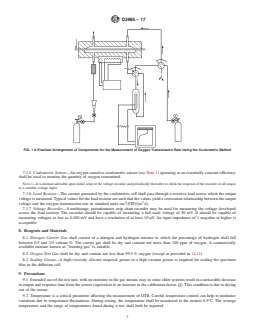
FIG. 1 A Practical Arrangement of Components for the Measurement of Oxygen Transmission Rate Using the Coulometric Method
context, a “dry” environment is considered to be one in which using material from the same manufacturing lot.Thus, this test
the relative humidity is less than 1%. method may be used as a referee method.
4.2 The specimen is mounted as a sealed semi-barrier
6. Interferences
between two chambers at ambient atmospheric pressure. One
6.1 The presence of certain interfering substances in the
chamberisslowlypurgedbyastreamofnitrogenandtheother
carrier gas stream may give rise to unwanted electrical outputs
chamber contains oxygen. As oxygen gas permeates through
and error factors. Interfering substances include free chlorine
the film into the nitrogen carrier gas, it is transported to the
and some strong oxidizing agents. Exposure to carbon dioxide
coulometric detector where it produces an electrical current,
should also be minimized to avoid damage to the sensor
the magnitude of which is proportional to the amount of
through reaction with the potassium hydroxide electrolyte.
oxygen flowing into the detector per unit time.
7. Apparatus
5. Significance and Use
7.1 Oxygen Gas Transmission Apparatus,asdiagrammedin
5.1 The OTR is an important determinant of the packaging
Fig. 1 with the following:
protection afforded by barrier materials. It is not, however, the
7.1.1 Diffusion Cell shall consist of two metal halves,
sole determinant, and additional tests, based on experience,
which, when closed upon the test specimen, will accurately
must be used to correlate packaging performance with OTR. It
define a circular area. The volume enclosed by each cell half,
is suitable as a referee method of testing, provided that the
when clamped, is not critical; it should be small enough to
purchaser and the seller have agreed on sampling procedures,
allow for rapid gas exchange, but not so small that an
standardization procedures, test conditions, and acceptance
unsupported film which happens to sag or bulge will contact
criteria.
the top or bottom of the cell. The diffusion cell shall be
5.2 LimitedstatisticaldataoncorrelationswithTestMethod
provided with a thermometer well for measuring temperature.
D1434 methods are available ; however, the oxygen transmis-
7.1.1.1 O-Ring—An appropriately sized groove, machined
sion rate of a standard reference material (see 12.1)as
into the oxygen (or test gas) side of the diffusion cell, retains a
determined manometrically by NIST, is in good agreement
neoprene O-ring. The test area is considered to be that area
with the values obtained in the coulometric interlaboratory test
established by the inside contact diameter of the compressed
O-ring when the diffusion cell is clamped shut against the test
specimen.Thearea, A,canbeobtainedbymeasuringtheinside
Supporting data have been filed atASTM International Headquarters and may
diameteroftheimprintleftbytheO-ringonthespecimenafter
beobtainedbyrequestingResearchReportRR:D20-1085.ContactASTMCustomer
Service at service@astm.org. it has been removed from the diffusion cell.
D3985 − 17
7.1.1.2 Thenitrogen(orcarriergas)sideofthediffusioncell andcontainnotmorethan100ppmofoxygen.Acommercially
shall have a flat raised rim. Since this rim is a critical sealing available mixture known as “forming gas” is suitable.
surface against which the test specimen is pressed, it shall be
8.2 Oxygen Test Gas shall be dry and contain not less than
smooth and flat, without radial scratches.
99.5% oxygen (except as provided in 14.11).
7.1.1.3 Diffusion Cell Pneumatic Fittings—The diffusion
8.3 Sealing Grease—A high-viscosity silicone stopcock
cell shall incorporate suitable fittings for the introduction and
grease or a high-vacuum grease is required for sealing the
exhaust of gases without significant loss or leakage.
specimen film in the diffusion cell.
7.1.1.4 It is desirable to thermostatically control the diffu-
sioncell.Asimpleheatingorheating/coolingsystemregulated
9. Precautions
to 60.5°C, is adequate for this purpose. A thermistor sensor
9.1 Extendeduseofthetestunit,withnomoistureinthegas
andanappropriatecontrolcircuitwillservetoregulatethecell
stream, may in some older systems result in a noticeable
temperature unless measurements are being made close to
decrease in output and response time from the sensor (equiva-
ambient temperature. In this case, it is desirable to provide
lent to an increase in the calibration factor, Q). This condition
cooling capability to remove some of the heat.
is due to drying out of the sensor.
7.1.1.5 Experience has shown that arrangements using mul-
tiple diffusion cells are a practical way to increase the number
9.2 Temperature is a critical parameter affecting the mea-
of measurements which can be obtained from a coulometric
surement of OTR. Careful temperature control can help to
sensor.Valving connects the carrier gas side of each individual
minimize variations due to temperature fluctuations. During
diffusion cell to the sensor in a predetermined pattern. Carrier
testing, the temperature shall be monitored to the nearest
gas is continually purging the carrier gas sides of those cells
0.5°C. The average temperature and the range of temperatures
that are not connected to the sensor. Either test gas or carrier
found during a test shall both be reported.
gas, as is appropriate, purges the test gas chamber of any
9.3 Thesensorwillrequirearelativelylongtimetostabilize
individual cell.
to a low reading characteristic of a good barrier after it has
7.1.2 Catalyst Bed—A small metal tube with fittings for
been used to test a barrier such as low-density polyethylene.
attachmenttotheinletonthenitrogensideofthediffusioncell
For this reason, materials of comparable gas transmission
shall contain 3 to5gof0.5% platinum or palladium catalysts
qualities should be tested together.
on alumina to provide an essentially oxygen-free carrier gas.
9.4 Back diffusion of air into the unit is undesirable. Care
7.1.3 Flowmeter—A flowmeter having an operating range
should therefore be taken to ensure that there is a flow of
from 5 to 100 mL/min is required to monitor the flow rate of
nitrogen through the system at all times. This flow can be low
the nitrogen carrier gas.
when the instrument is not being used.
7.1.4 Flow Switching Valves—Valves for the switching of
9.5 Elevated temperatures can be used to hasten specimen
the nitrogen and test gas flow streams.
outgassing, provided that the treatment does not alter the basic
7.1.5 Coulometric Sensor—An oxygen-sensitive coulomet-
structure of the specimen (crystallinity, density, and so forth).
ric sensor (see Note 1) operating at an essentially constant
This can be accomplished by the use of the heaters in the
efficiency shall be used to monitor the quantity of oxygen
diffusion cells.
transmitted.
NOTE 1—It is deemed advisable upon initial setup of the voltage
10. Sampling
recorder and periodically thereafter to check the response of the recorder
10.1 The sampling units used for the determination of OTR
on all ranges to a suitable voltage input.
shall be representative of the quantity of product for which the
7.1.6 Load Resistor—The current generated by the coulo-
data are required, in accordance with Practice D1898. Care
metric cell shall pass through a resistive load across which the
shall be taken to ensure that samples are representative of
output voltage is measured.Typical values for the load resistor
conditions across the width and along the length of a roll of
aresuchthatthevaluesyieldaconvenientrelationshipbetween
film.
theoutputvoltageandtheoxygentransmissionrateinstandard
3 2
units cm (STP)/(m ·d).
11. Test Specimens
7.1.7 Voltage Recorder—A multirange, potentiometer strip
11.1 Test specimens shall be representative of the material
chart recorder may be used for measuring the voltage devel-
being tested and shall be free of defects, including wrinkles,
opedacrosstheloadresistor.Therecordershouldbecapableof
creases, and pinholes, unless these are a characteristic of the
measuring a full-scale voltage of 50 mV. It should be capable
material being tested.
of measuring voltages as low as 0.100 mV and have a
resolution of at least 10 µV.An input impedance of 1 megohm
11.2 Average thickness shall be determined to the nearest
or higher is acceptable.
2.5µm(0.0001in.),usingacalibrateddialgage(orequivalent)
ataminimumoffivepointsdistributedovertheentiretestarea.
8. Reagents and Materials
Maximum, minimum, and average values shall be recorded.
8.1 Nitrogen Carrier Gas shall consist of a nitrogen and 11.3 Ifthetestspecimenisofanasymmetricalconstruction,
hydrogen mixture in which the percentage of hydrogen shall the two surfaces shall be marked by appropriate distinguishing
fallbetween0.5and3.0volume%.Thecarriergasshallbedry marks and the orientation of the test specimen in the diffusion
D3985 − 17
cell shall be reported (for example, “side II was mounted reproducible. Previous experience should serve as the primary
facing the oxygen side of the diffusion cell”). guide to the suitability of a given conditioning regimen. If a
material is being tested with which the user has no previous
12. Calibration
experience, the effect of conditioning time should be investi-
gated and a regimen selected such that there is no significant
12.1 General Approach—The oxygen sensor used in this
effect due to conditioning time. In any case, the conditioning
test method is a coulometric device that yields a linear output
procedure used should be included in the report section.
as predicted by Faraday’s Law. In principle, four electrons are
producedbythesensorforeachmoleculeofoxygenthatpasses
13.2 MeasureOTRinatemperature-controlledenvironment
into it. Considering that the sensor is known to have a basic
with the apparatus placed in a draft
...
This document is not an ASTM standard and is intended only to provide the user of an ASTM standard an indication of what changes have been made to the previous version. Because
it may not be technically possible to adequately depict all changes accurately, ASTM recommends that users consult prior editions as appropriate. In all cases only the current version
of the standard as published by ASTM is to be considered the official document.
´1
Designation: D3985 − 05 (Reapproved 2010) D3985 − 17
Standard Test Method for
Oxygen Gas Transmission Rate Through Plastic Film and
Sheeting Using a Coulometric Sensor
This standard is issued under the fixed designation D3985; the number immediately following the designation indicates the year of
original adoption or, in the case of revision, the year of last revision. A number in parentheses indicates the year of last reapproval. A
superscript epsilon (´) indicates an editorial change since the last revision or reapproval.
ε NOTE—Editorial changes were made throughout in November 2010.
1. Scope
1.1 This test method covers a procedure for determination of the steady-state rate of transmission of oxygen gas through plastics
in the form of film, sheeting, laminates, coextrusions, or plastic-coated papers or fabrics. It provides for the determination of (1)
oxygen gas transmission rate (OTR), (2) the permeance of the film to oxygen gas (PO ), and (3) oxygen permeability coefficient
(P'O ) in the case of homogeneous materials.
1.2 This test method does not purport to be the only method for measurement of OTR. There may be other methods of OTR
determination that use other oxygen sensors and procedures.
1.3 The values stated in SI units are to be regarded as standard. No other units of measurement are included in this standard.
1.4 This standard does not purport to address all of the safety problems, if any, associated with its use. It is the responsibility
of the user of this standard to establish appropriate safety and health practices and determine the applicability of regulatory
limitations prior to use.
1.5 This international standard was developed in accordance with internationally recognized principles on standardization
established in the Decision on Principles for the Development of International Standards, Guides and Recommendations issued
by the World Trade Organization Technical Barriers to Trade (TBT) Committee.
2. Referenced Documents
2.1 ASTM Standards:
D1434 Test Method for Determining Gas Permeability Characteristics of Plastic Film and Sheeting
D1898 Practice for Sampling of Plastics (Withdrawn 1998)
E691 Practice for Conducting an Interlaboratory Study to Determine the Precision of a Test Method
F1927 Test Method for Determination of Oxygen Gas Transmission Rate, Permeability and Permeance at Controlled Relative
Humidity Through Barrier Materials Using a Coulometric Detector
3. Terminology
3.1 Definitions:
3.1.1 oxygen permeability coeffıcient (P'O )—the product of the permeance and the thickness of film. The permeability is
meaningful only for homogeneous materials, in which case it is a property characteristic of the bulk material. This quantity should
not be used, unless the relationship between thickness and permeance has been verified on tests using several different thicknesses
of the material. The SI unit of oxygen permeability is the mol/(m·s·Pa). The test conditions (see 3.1.3) must be stated.
3.1.2 oxygen permeance (PO )—the ratio of the OTR to the difference between the partial pressure of O on the two sides of
2 2
the film. The SI unit of permeance is the mol/(m ·s·Pa). The test conditions (see 5.1) must be stated.
3.1.3 oxygen transmission rate (OTR)—the quantity of oxygen gas passing through a unit area of the parallel surfaces of a
plastic film per unit time under the conditions of test. The SI unit of transmission rate is the mol/(m ·s). The test conditions,
including temperature and oxygen partial pressure on both sides of the film must be stated.
This test method is under the jurisdiction of ASTM Committee F02 on FlexiblePrimary Barrier Packaging and is the direct responsibility of Subcommittee F02.10 on
Permeation.
Current edition approved Oct. 1, 2010Nov. 15, 2017. Published November 2010December 2017. Originally approved in 1981. Last previous edition approved in 20052010
ε1
as D3985 – 05 (2010) . DOI: 10.1520/D3985-05R10E01.10.1520/D3985-17.
For referenced ASTM standards, visit the ASTM website, www.astm.org, or contact ASTM Customer Service at service@astm.org. For Annual Book of ASTM Standards
volume information, refer to the standard’s Document Summary page on the ASTM website.
The last approved version of this historical standard is referenced on www.astm.org.
Copyright © ASTM International, 100 Barr Harbor Drive, PO Box C700, West Conshohocken, PA 19428-2959. United States
D3985 − 17
3 2 3
3.1.3.1 A commonly used unit of OTR is the cm (STP)/(m ·d) at one atmosphere pressure difference where 1 cm (STP) is
44.62 μmol, 1 atm is 0.1013 MPa, and one day is 86.4 × 10 s. The OTR in SI units is obtained by multiplying the value in
−10
inch-pound units by 5.160 × 105.163 × 10 .
4. Summary of Test Method
4.1 The oxygen gas transmission rate is determined after the sample has equilibrated in a dry test environment. In this context,
a “dry” environment is considered to be one in which the relative humidity is less than 1 %.
4.2 The specimen is mounted as a sealed semi-barrier between two chambers at ambient atmospheric pressure. One chamber
is slowly purged by a stream of nitrogen and the other chamber contains oxygen. As oxygen gas permeates through the film into
the nitrogen carrier gas, it is transported to the coulometric detector where it produces an electrical current, the magnitude of which
is proportional to the amount of oxygen flowing into the detector per unit time.
5. Significance and Use
5.1 The OTR is an important determinant of the packaging protection afforded by barrier materials. It is not, however, the sole
determinant, and additional tests, based on experience, must be used to correlate packaging performance with OTR. It is suitable
as a referee method of testing, provided that the purchaser and the seller have agreed on sampling procedures, standardization
procedures, test conditions, and acceptance criteria.
5.2 Limited statistical data on correlations with Test Method D1434 methods are available ; however, the oxygen transmission
rate of a standard reference material (see 12.1) as determined manometrically by NIST, is in good agreement with the values
obtained in the coulometric interlaboratory test using material from the same manufacturing lot. Thus, this test method may be used
as a referee method.
6. Interferences
6.1 The presence of certain interfering substances in the carrier gas stream may give rise to unwanted electrical outputs and error
factors. Interfering substances include free chlorine and some strong oxidizing agents. Exposure to carbon dioxide should also be
minimized to avoid damage to the sensor through reaction with the potassium hydroxide electrolyte.
7. Apparatus
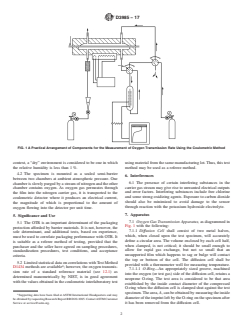
7.1 Oxygen Gas Transmission Apparatus, as diagrammed in Fig. 1 with the following:
7.1.1 Diffusion Cell shall consist of two metal halves, which, when closed upon the test specimen, will accurately define a
circular area. The volume enclosed by each cell half, when clamped, is not critical; it should be small enough to allow for rapid
gas exchange, but not so small that an unsupported film which happens to sag or bulge will contact the top or bottom of the cell.
The diffusion cell shall be provided with a thermometer well for measuring temperature.
7.1.1.1 O-Ring—An appropriately sized groove, machined into the oxygen (or test gas) side of the diffusion cell, retains a
neoprene O-ring. The test area is considered to be that area established by the inside contact diameter of the compressed O-ring
when the diffusion cell is clamped shut against the test specimen. The area, A, can be obtained by measuring the inside diameter
of the imprint left by the O-ring on the specimen after it has been removed from the diffusion cell.
7.1.1.2 The nitrogen (or carrier gas) side of the diffusion cell shall have a flat raised rim. Since this rim is a critical sealing
surface against which the test specimen is pressed, it shall be smooth and flat, without radial scratches.
7.1.1.3 Diffusion Cell Pneumatic Fittings—The diffusion cell shall incorporate suitable fittings for the introduction and exhaust
of gases without significant loss or leakage.
7.1.1.4 It is desirable to thermostatically control the diffusion cell. A simple heating or heating/cooling system regulated to
60.5°C, is adequate for this purpose. A thermistor sensor and an appropriate control circuit will serve to regulate the cell
temperature unless measurements are being made close to ambient temperature. In this case, it is desirable to provide cooling
capability to remove some of the heat.
7.1.1.5 Experience has shown that arrangements using multiple diffusion cells are a practical way to increase the number of
measurements which can be obtained from a coulometric sensor. Valving connects the carrier gas side of each individual diffusion
cell to the sensor in a predetermined pattern. Carrier gas is continually purging the carrier gas sides of those cells that are not
connected to the sensor. Either test gas or carrier gas, as is appropriate, purges the test gas chamber of any individual cell.
7.1.2 Catalyst Bed—A small metal tube with fittings for attachment to the inlet on the nitrogen side of the diffusion cell shall
contain 3 to 5 g of 0.5 % platinum or palladium catalysts on alumina to provide an essentially oxygen-free carrier gas.
7.1.3 Flowmeter—A flowmeter having an operating range from 5 to 100 mL/min is required to monitor the flow rate of the
nitrogen carrier gas.
7.1.4 Flow Switching Valves—Valves for the switching of the nitrogen and test gas flow streams.
Supporting data have been filed at ASTM International Headquarters and may be obtained by requesting Research Report RR:D20-1085. Contact ASTM Customer
Service at service@astm.org.
D3985 − 17
FIG. 1 A Practical Arrangement of Components for the Measurement of Oxygen Transmission Rate Using the Coulometric Method
7.1.5 Coulometric Sensor—An oxygen-sensitive coulometric sensor (see Note 1) operating at an essentially constant efficiency
shall be used to monitor the quantity of oxygen transmitted.
NOTE 1—It is deemed advisable upon initial setup of the voltage recorder and periodically thereafter to check the response of the recorder on all ranges
to a suitable voltage input.
7.1.6 Load Resistor—The current generated by the coulometric cell shall pass through a resistive load across which the output
voltage is measured. Typical values for the load resistor are such that the values yield a convenient relationship between the output
3 2
voltage and the oxygen transmission rate in standard units cm (STP)/(m ·d).
7.1.7 Voltage Recorder—A multirange, potentiometer strip chart recorder may be used for measuring the voltage developed
across the load resistor. The recorder should be capable of measuring a full-scale voltage of 50 mV. It should be capable of
measuring voltages as low as 0.100 mV and have a resolution of at least 10 μV. An input impedance of 1 megohm or higher is
acceptable.
8. Reagents and Materials
8.1 Nitrogen Carrier Gas shall consist of a nitrogen and hydrogen mixture in which the percentage of hydrogen shall fall
between 0.5 and 3.0 volume %. The carrier gas shall be dry and contain not more than 100 ppm of oxygen. A commercially
available mixture known as “forming gas” is suitable.
8.2 Oxygen Test Gas shall be dry and contain not less than 99.5 % oxygen (except as provided in 14.11).
8.3 Sealing Grease—A high-viscosity silicone stopcock grease or a high-vacuum grease is required for sealing the specimen
film in the diffusion cell.
9. Precautions
9.1 Extended use of the test unit, with no moisture in the gas stream, may in some older systems result in a noticeable decrease
in output and response time from the sensor (equivalent to an increase in the calibration factor, Q). This condition is due to drying
out of the sensor.
9.2 Temperature is a critical parameter affecting the measurement of OTR. Careful temperature control can help to minimize
variations due to temperature fluctuations. During testing, the temperature shall be monitored to the nearest 0.5°C. The average
temperature and the range of temperatures found during a test shall both be reported.
D3985 − 17
9.3 The sensor will require a relatively long time to stabilize to a low reading characteristic of a good barrier after it has been
used to test a barrier such as low-density polyethylene. For this reason, materials of comparable gas transmission qualities should
be tested together.
9.4 Back diffusion of air into the unit is undesirable. Care should therefore be taken to ensure that there is a flow of nitrogen
through the system at all times. This flow can be low when the instrument is not being used.
9.5 Elevated temperatures can be used to hasten specimen outgassing, provided that the treatment does not alter the basic
structure of the specimen (crystallinity, density, and so forth). This can be accomplished by the use of the heaters in the diffusion
cells.
10. Sampling
10.1 The sampling units used for the determination of OTR shall be representative of the quantity of product for which the data
are required, in accordance with Practice D1898. Care shall be taken to ensure that samples are representative of conditions across
the width and along the length of a roll of film.
11. Test Specimens
11.1 Test specimens shall be representative of the material being tested and shall be free of defects, including wrinkles, creases,
and pinholes, unless these are a characteristic of the material being tested.
11.2 Average thickness shall be determined to the nearest 2.5 μm (0.0001 in.), using a calibrated dial gage (or equivalent) at
a minimum of five points distributed over the entire test area. Maximum, minimum, and average values shall be recorded.
11.3 If the test specimen is of an asymmetrical construction, the two surfaces shall be marked by appropriate distinguishing
marks and the orientation of the test specimen in the diffusion cell shall be reported (for example, “side II was mounted facing
the oxygen side of the diffusion cell”).
12. Calibration
12.1 General Approach—The oxygen sensor used in this test method is a coulometric device that yields a linear output as
predicted by Faraday’s Law. In principle, four electrons are produced by the sensor for each molecule of oxygen that passes into
it. Considering that the sensor is known to have a basic efficiency of 95 to 98 %, it may be considered an “intrinsic” standard that
does not require calibration, and can thus be used as a reference method.
12.2 Experience has shown, however, that under some circumstances the sensor may become depleted or damaged to the extent
that efficiency and response are impaired. For that reason, this test method incorporates means for a periodic sensor evaluation.
This evaluation is derived from measurements of a known-value “reference package.” Experience indicates however, that a
specimen-to-specimen variability of the reference material is such that a change should never be made in the calibration factor,
as the result of a measurement using a single sheet of the reference material.
12.3 Es
...