

ASTM F3299-18(2023)
(Test Method)Standard Test Method for Water Vapor Transmission Rate Through Plastic Film and Sheeting Using an Electrolytic Detection Sensor (Coulometric P2O5 Sensor)
General Information
- Abstract
SIGNIFICANCE AND USE
5.1 The purpose of this test method is to obtain reliable values for the WVTR of plastic film and sheeting.
5.2 WVTR is an important property of packaging materials and can be directly related to shelf life and packaged product stability.
5.3 Data from this test method is suitable as a referee method of testing, provided that the purchaser and seller have agreed on sampling procedures, standardization procedures, test conditions, and acceptance criteria.
SCOPE
1.1 This test method covers a procedure for determining the rate of water vapor transmission through flexible barrier materials. The method is applicable to sheets and films consisting of single or multilayer synthetic or natural polymers and foils, including coated materials. It provides for the determination of water vapor transmission rate (WVTR).
1.2 The values stated in SI units are to be regarded as standard. No other units of measurement are included in this standard.
1.3 This standard does not purport to address all of the safety concerns, if any, associated with its use. It is the responsibility of the user of this standard to establish appropriate safety, health, and environmental practices and determine the applicability of regulatory limitations prior to use.
1.4 This international standard was developed in accordance with internationally recognized principles on standardization established in the Decision on Principles for the Development of International Standards, Guides and Recommendations issued by the World Trade Organization Technical Barriers to Trade (TBT) Committee.
- Status
- Published
- Publication Date
- 30-Apr-2023
- Technical Committee
- F02 - Primary Barrier Packaging
- Drafting Committee
- F02.10 - Permeation

Overview
ASTM F3299-18(2023): Standard Test Method for Water Vapor Transmission Rate Through Plastic Film and Sheeting Using an Electrolytic Detection Sensor (Coulometric P₂O₅ Sensor) provides a standardized procedure to determine the water vapor transmission rate (WVTR) of flexible barrier materials, including plastic films, sheets, and coated materials. Developed by ASTM International, this test method utilizes a coulometric sensor to accurately measure moisture permeability, which is critical for evaluating and comparing the barrier properties of materials used in packaging. The test is conducted under specific conditions of relative humidity and temperature and is recognized as a referee method when buyer and seller have mutually agreed upon procedures and acceptance criteria.
Key Topics
- Water Vapor Transmission Rate (WVTR): The main metric measured by this standard, WVTR is reported as the mass (g) of water vapor passing through a known area (m²) of material per day under steady-state conditions.
- Applicability: Covers single or multilayer synthetic or natural polymer films, coated materials, and foils, making it widely useful for the packaging industry and material developers.
- Electrolytic Detection (Coulometric P₂O₅) Sensor: The method employs a phosphorous pentoxide moisture sensor, providing an absolute measurement based on Faraday’s Law with no need for calibration against a moisture standard.
- Test Apparatus: Involves a sealed test cell separating dry and humid chambers, with humidity controlled via RH generator, and sample area typically defined as 50 cm². Carrier gas (nitrogen) delivers water vapor to the sensor for measurement.
- Reliability and Precision: Includes repeatability and reproducibility criteria based on interlaboratory studies, ensuring data traceability and confidence in results.
- Sample Preparation: Careful selection and handling of film samples are required to guarantee representative and defect-free testing, except when material defects are characteristic and within the scope of assessment.
Applications
- Packaging Material Selection: WVTR data directly inform decisions on material suitability for food, pharmaceuticals, electronics, and other sensitive products where moisture control is essential for product shelf life and quality.
- Quality Control and Compliance: Enables manufacturers and buyers to verify that barrier films meet contractual and regulatory requirements regarding moisture permeation.
- Product Development: Supports R&D teams in comparing new barrier materials, optimizing formulations, and benchmarking performance across different film constructions.
- Dispute Resolution: Serves as an agreed referee method for resolving material property disputes between parties, provided standardized procedures are observed.
Related Standards
- ASTM E96/E96M: Standard Test Methods for Gravimetric Determination of Water Vapor Transmission Rate of Materials - a widely used comparative method.
- ASTM E177: Practice for Use of the Terms Precision and Bias in ASTM Test Methods.
- ASTM E178: Practice for Dealing With Outlying Observations in Statistical Data.
- ASTM E691: Practice for Conducting an Interlaboratory Study to Determine the Precision of a Test Method.
Practical Value
ASTM F3299-18(2023) delivers robust, repeatable, and internationally acknowledged methodology for assessing water vapor transmission in plastic films and flexible sheeting. Accurate WVTR measurement is indispensable for packaging engineers, material scientists, and quality assurance professionals focused on barrier performance, regulatory compliance, and optimizing packaged product stability. Adopting this standard enhances confidence in data integrity, supports global trade, and safeguards product quality across various supply chains.
Relations
- Effective Date
- 01-Mar-2024
- Effective Date
- 15-Nov-2023
- Effective Date
- 01-Jun-2016
- Effective Date
- 01-May-2015
- Effective Date
- 15-Oct-2014
- Effective Date
- 01-May-2014
- Effective Date
- 01-Nov-2013
- Effective Date
- 01-May-2013
- Effective Date
- 01-May-2013
- Effective Date
- 15-Dec-2012
- Effective Date
- 01-Nov-2011
- Effective Date
- 01-Oct-2010
- Effective Date
- 01-Oct-2010
- Effective Date
- 01-Oct-2008
- Effective Date
- 01-Oct-2008
Get Certified
Connect with accredited certification bodies for this standard

DIN CERTCO
DIN Group product certification.

Smithers Quality Assessments
US management systems and product certification.
Sponsored listings
Frequently Asked Questions
ASTM F3299-18(2023) is a standard published by ASTM International. Its full title is "Standard Test Method for Water Vapor Transmission Rate Through Plastic Film and Sheeting Using an Electrolytic Detection Sensor (Coulometric P<inf>2</inf>O<inf >5</inf> Sensor)". This standard covers: SIGNIFICANCE AND USE 5.1 The purpose of this test method is to obtain reliable values for the WVTR of plastic film and sheeting. 5.2 WVTR is an important property of packaging materials and can be directly related to shelf life and packaged product stability. 5.3 Data from this test method is suitable as a referee method of testing, provided that the purchaser and seller have agreed on sampling procedures, standardization procedures, test conditions, and acceptance criteria. SCOPE 1.1 This test method covers a procedure for determining the rate of water vapor transmission through flexible barrier materials. The method is applicable to sheets and films consisting of single or multilayer synthetic or natural polymers and foils, including coated materials. It provides for the determination of water vapor transmission rate (WVTR). 1.2 The values stated in SI units are to be regarded as standard. No other units of measurement are included in this standard. 1.3 This standard does not purport to address all of the safety concerns, if any, associated with its use. It is the responsibility of the user of this standard to establish appropriate safety, health, and environmental practices and determine the applicability of regulatory limitations prior to use. 1.4 This international standard was developed in accordance with internationally recognized principles on standardization established in the Decision on Principles for the Development of International Standards, Guides and Recommendations issued by the World Trade Organization Technical Barriers to Trade (TBT) Committee.
SIGNIFICANCE AND USE 5.1 The purpose of this test method is to obtain reliable values for the WVTR of plastic film and sheeting. 5.2 WVTR is an important property of packaging materials and can be directly related to shelf life and packaged product stability. 5.3 Data from this test method is suitable as a referee method of testing, provided that the purchaser and seller have agreed on sampling procedures, standardization procedures, test conditions, and acceptance criteria. SCOPE 1.1 This test method covers a procedure for determining the rate of water vapor transmission through flexible barrier materials. The method is applicable to sheets and films consisting of single or multilayer synthetic or natural polymers and foils, including coated materials. It provides for the determination of water vapor transmission rate (WVTR). 1.2 The values stated in SI units are to be regarded as standard. No other units of measurement are included in this standard. 1.3 This standard does not purport to address all of the safety concerns, if any, associated with its use. It is the responsibility of the user of this standard to establish appropriate safety, health, and environmental practices and determine the applicability of regulatory limitations prior to use. 1.4 This international standard was developed in accordance with internationally recognized principles on standardization established in the Decision on Principles for the Development of International Standards, Guides and Recommendations issued by the World Trade Organization Technical Barriers to Trade (TBT) Committee.
ASTM F3299-18(2023) is classified under the following ICS (International Classification for Standards) categories: 83.140.10 - Films and sheets. The ICS classification helps identify the subject area and facilitates finding related standards.
ASTM F3299-18(2023) has the following relationships with other standards: It is inter standard links to ASTM E96/E96M-24, ASTM E96/E96M-23, ASTM E178-16, ASTM E96/E96M-15, ASTM E96/E96M-14, ASTM E177-14, ASTM E96/E96M-13, ASTM E177-13, ASTM E691-13, ASTM E96/E96M-12, ASTM E691-11, ASTM E96/E96M-10, ASTM E177-10, ASTM E691-08, ASTM E177-08. Understanding these relationships helps ensure you are using the most current and applicable version of the standard.
ASTM F3299-18(2023) is available in PDF format for immediate download after purchase. The document can be added to your cart and obtained through the secure checkout process. Digital delivery ensures instant access to the complete standard document.
Standards Content (Sample)
This international standard was developed in accordance with internationally recognized principles on standardization established in the Decision on Principles for the
Development of International Standards, Guides and Recommendations issued by the World Trade Organization Technical Barriers to Trade (TBT) Committee.
Designation: F3299 − 18 (Reapproved 2023)
Standard Test Method for
Water Vapor Transmission Rate Through Plastic Film and
Sheeting Using an Electrolytic Detection Sensor
(Coulometric P O Sensor)
2 5
This standard is issued under the fixed designation F3299; the number immediately following the designation indicates the year of
original adoption or, in the case of revision, the year of last revision. A number in parentheses indicates the year of last reapproval. A
superscript epsilon (´) indicates an editorial change since the last revision or reapproval.
1. Scope 3. Terminology
1.1 This test method covers a procedure for determining the 3.1 Definitions:
rate of water vapor transmission through flexible barrier 3.1.1 water vapor transmission rate (WVTR), n—the time
materials. The method is applicable to sheets and films rate of water vapor flow normal to the surfaces, under
consisting of single or multilayer synthetic or natural polymers steady-state conditions, per unit area.
and foils, including coated materials. It provides for the 3.1.1.1 Discussion—An accepted unit of WVTR is g/m per
determination of water vapor transmission rate (WVTR). day (g/m ·24h). The test conditions of relative humidity and
temperature, where the humidity is the difference in relative
1.2 The values stated in SI units are to be regarded as
humidity across the specimens, must be stated.
standard. No other units of measurement are included in this
standard.
4. Summary of Test Method
1.3 This standard does not purport to address all of the
4.1 A dry chamber is separated from a wet chamber of
safety concerns, if any, associated with its use. It is the
known temperature and humidity by the barrier material to be
responsibility of the user of this standard to establish appro-
tested. The dry chamber and the wet chamber make up a test
priate safety, health, and environmental practices and deter-
cell in which the test film is sealed. Water vapor permeating
mine the applicability of regulatory limitations prior to use.
through the film mixes with the dry carrier gas in the dry
1.4 This international standard was developed in accor-
chamber and is carried to an electrolytic sensor. The carrier gas
dance with internationally recognized principles on standard-
is passed through the sensor where water vapor it holds is
ization established in the Decision on Principles for the
absorbed by phosphorous pentoxide (P O ). Direct current,
2 5
Development of International Standards, Guides and Recom-
applied to electrodes of the sensor, dissociates the water into
mendations issued by the World Trade Organization Technical
hydrogen and oxygen. Two electrons are required to electro-
Barriers to Trade (TBT) Committee.
lyze each water molecule, and the current in the cell represents
the number of molecules dissociated per unit time.
2. Referenced Documents
2.1 ASTM Standards:
5. Significance and Use
E96/E96M Test Methods for Gravimetric Determination of
5.1 The purpose of this test method is to obtain reliable
Water Vapor Transmission Rate of Materials
values for the WVTR of plastic film and sheeting.
E177 Practice for Use of the Terms Precision and Bias in
ASTM Test Methods 5.2 WVTR is an important property of packaging materials
E178 Practice for Dealing With Outlying Observations and can be directly related to shelf life and packaged product
E691 Practice for Conducting an Interlaboratory Study to stability.
Determine the Precision of a Test Method
5.3 Data from this test method is suitable as a referee
method of testing, provided that the purchaser and seller have
agreed on sampling procedures, standardization procedures,
This test method is under the jurisdiction of ASTM Committee F02 on Primary
Barrier Packaging and is the direct responsibility of Subcommittee F02.10 on
test conditions, and acceptance criteria.
Permeation.
Current edition approved May 1, 2023. Published June 2023. Originally
6. Apparatus
approved in 2018. Last previous edition approved in 2018 as F3299 – 18. DOI:
10.1520/F3299-18R23.
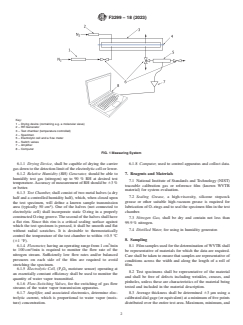
6.1 An example of a suitable apparatus is shown in Fig. 1.
For referenced ASTM standards, visit the ASTM website, www.astm.org, or
It includes a test chamber consisting of two metal halves, an
contact ASTM Customer Service at service@astm.org. For Annual Book of ASTM
electrolytic cell to determine the amount of water vapor
Standards volume information, refer to the standard’s Document Summary page on
the ASTM website. transmitted, a flow meter, a drying device, and switch valves.
Copyright © ASTM International, 100 Barr Harbor Drive, PO Box C700, West Conshohocken, PA 19428-2959. United States
F3299 − 18 (2023)
Key:
1 – Drying device (containing e.g. a molecular sieve)
2 – RH Generator
3 – Test chamber (temperature controlled)
4 – Specimen
5 – Electrolytic cell and a flow meter
6 – Switch valves
7 – Amplifier
8 – Computer
FIG. 1 Measuring System
6.1.1 Drying Device, shall be capable of drying the carrier 6.1.8 Computer, used to control apparatus and collect data.
gas down to the detection limit of the electrolytic cell or lower.
6.1.2 Relative Humidity (RH) Generator, should be able to
7. Reagents and Materials
humidify test gas (nitrogen) up to 90 % RH at desired test
7.1 National Institute of Standards and Technology (NIST)
temperature. Accuracy of measurement of RH should be 63 %
traceable calibration gas or reference film (known WVTR
or better.
material) for system evaluation.
6.1.3 Test Chamber, shall consist of two metal halves (a dry
7.2 Sealing Grease, a high-viscosity, silicone stopcock
half and a controlled humidity half), which, when closed upon
grease or other suitable high-vacuum grease is required for
the test specimen, will define a known sample transmission
lubrication of O–rings and to seal the specimen film in the test
area (typically 50 cm ). One of the halves (not connected to
chamber.
electrolytic cell) shall incorporate static O-ring in a properly
constructed O-ring groove. The second of the halves shall have
7.3 Nitrogen Gas, shall be dry and contain not less than
a flat rim. Since this rim is a critical sealing surface against
99.9 % nitrogen.
which the test specimen is pressed, it shall be smooth and flat
7.4 Distilled Water, for using in humidity generator.
without radial scratches. It is desirable to thermostatically
control the temperature of the test chamber to within 60.5 °C
8. Sampling
(61 °F).
6.1.4 Flowmeter, having an operating range from 1 cm /min
8.1 Film samples used for the determination of WVTR shall
to 100 cm /min is required to monitor the flow rate of the
be representative of materials for which the data are required.
nitrogen stream. Sufficiently low flow rates and/or balanced
Care shall be taken to ensure that samples are representative of
pressures on each side of the film are required to avoid
conditions across the width and along the length of a roll of
stretching the specimen.
film.
6.1.5 Electrolytic Cell, (P O moisture sensor) operating at
2 5
8.2 Test specimens shall be representative of the material
an essentially constant efficiency shall be used to monitor the
and shall be free of defects including wrinkles, creases, and
quantity of water vapor transmitted.
pinholes, unless these are characteristics of the material being
6.1.6 Flow-Switching Valves, for the switching of gas flow
tested and included in the material description.
streams of the water vapor transmission apparatus.
6.1.7 Amplifier, and associated electronics, determine elec- 8.3 Average thickness shall be determined 63 μm using a
trolytic current, which is proportional to water vapor (mois- calibrated dial gage (or equivalent) at a minimum of five points
ture) concentration. distributed over the entire test area. Maximum, minimum, and
---------------------
...