

ASTM A1060/A1060M-22
(Specification)Standard Specification for Zinc-Coated (Galvanized) Steel Welded Wire Reinforcement, Plain and Deformed, for Concrete
General Information
- Abstract
SCOPE
1.1 This specification covers zinc-coated steel welded wire reinforcement, plain and deformed, or a combination of deformed and plain wires, for reinforcement of concrete, in sizes not less than 0.080 in. [2.03 mm] and over nominal diameter for plain wire and 0.113 in. [2.87 mm] and over for deformed wire.
1.2 This specification is intended to be applicable to cold-worked wire, drawn or rolled, plain or deformed, coated in a continuous process.
1.3 An alternative to a continuous coating process of wire before fabrication is a hot-dip process, where the welded wire reinforcement is immersed in a bath of molten zinc.
Note 1: Data on the corrosion resistance of galvanized steels in concrete are limited. The user is cautioned that the laboratory testing performed on this material has been insufficient and may not accurately reflect the performance of the material when embedded in concrete as reinforcement.
1.4 The values stated in either SI units or inch-pound units are to be regarded separately as standard. The values stated in each system may not be exact equivalents; therefore, each system shall be used independently of the other. Combining values from the two systems may result in non-conformance with the standard.
1.5 This standard does not purport to address all of the safety concerns, if any, associated with its use. It is the responsibility of the user of this standard to establish appropriate safety, health, and environmental practices and determine the applicability of regulatory limitations prior to use.
1.6 This international standard was developed in accordance with internationally recognized principles on standardization established in the Decision on Principles for the Development of International Standards, Guides and Recommendations issued by the World Trade Organization Technical Barriers to Trade (TBT) Committee.
- Status
- Published
- Publication Date
- 31-Oct-2022
- Technical Committee
- A01 - Steel, Stainless Steel and Related Alloys
- Drafting Committee
- A01.05 - Steel Reinforcement
Buy Documents

ASTM A1060/A1060M-22 - Standard Specification for Zinc-Coated (Galvanized) Steel Welded Wire Reinforcement, Plain and Deformed, for Concrete
REDLINE ASTM A1060/A1060M-22 - Standard Specification for Zinc-Coated (Galvanized) Steel Welded Wire Reinforcement, Plain and Deformed, for Concrete
Overview
ASTM A1060/A1060M-22 is the internationally recognized standard specification established by ASTM International for zinc-coated (galvanized) steel welded wire reinforcement, both plain and deformed, for use in concrete construction. This specification applies to cold-worked steel wire that is either drawn or rolled, coated in a continuous process before fabrication, or alternatively, hot-dip galvanized after fabrication. The standard addresses products with nominal diameters starting at 0.080 in. [2.03 mm] for plain wire and 0.113 in. [2.87 mm] for deformed wire, ensuring a consistent baseline for reinforcement used in concrete applications.
Key Topics
- Product Scope: Covers galvanized steel welded wire reinforcement used to strengthen concrete, in both plain and deformed configurations.
- Coating Processes: Recognizes two primary galvanizing methods:
- Continuous process where wire is coated before fabrication
- Hot-dip process where wire reinforcement is immersed in molten zinc after fabrication
- Coating Thickness and Weight: Specifies various coating classes and grades, with requirements for minimum zinc coating thickness and weight. Testing methods include magnetic thickness, stripping, weighing before/after galvanizing, and microscopy.
- Inspection and Testing: Defines protocols for sampling, testing frequency, and criteria for acceptance or rejection of material, ensuring quality control.
- Packaging and Marking: Provides guidelines for packaging, labeling, and shipment markings to ensure traceability and correct identification.
- Safety and Compliance: Users are responsible for adhering to applicable safety and regulatory practices; the standard does not address all health and safety concerns.
Applications
ASTM A1060/A1060M-22 is widely utilized in civil and structural engineering projects where protection against corrosion and structural integrity in concrete reinforcements are required. Typical applications include:
- Reinforced Concrete Slabs: Used in floors, pavements, and bridge decks to provide lateral strength and prevent cracking.
- Precast Concrete Elements: Enhances durability in products such as wall panels, pipes, and barriers.
- Structural Beams and Columns: Improves performance under tensile loads and helps extend the life of critical infrastructure components.
- Corrosive Environments: The zinc coating is particularly valuable in marine, industrial, or de-icing salt exposure situations due to its protective properties.
- Infrastructure Projects: Bridges, highways, parking structures, and water treatment facilities benefit from the enhanced longevity and reduced maintenance needs.
Related Standards
Several other ASTM and industry standards are referenced and closely related to ASTM A1060/A1060M-22, ensuring comprehensive coverage of welded wire reinforcement and galvanizing processes:
- ASTM A1064/A1064M: Standard Specification for Carbon-Steel Wire and Welded Wire Reinforcement, Plain and Deformed, for Concrete
- ASTM A90/A90M: Test Method for Weight [Mass] of Coating on Iron and Steel Articles with Zinc or Zinc-Alloy Coatings
- ASTM B6: Specification for Zinc used in galvanizing processes
- ASTM A780: Practice for Repair of Damaged and Uncoated Areas of Hot-Dip Galvanized Coatings
- ASTM B487 & E376: Methods for measuring coating thickness by microscopy and electromagnetic testing, respectively
- MIL-STD-129 / Fed. Std. No. 123: Marking for shipment and storage for military and federal agencies
Conclusion
ASTM A1060/A1060M-22 provides a thorough framework for specifying and ensuring quality, durability, and traceability in galvanized steel welded wire reinforcement for concrete. Compliance with this standard supports enhanced corrosion resistance, reliable performance, and helps meet the demands of modern construction and infrastructure projects. For best results and compliance, users should follow the standard’s testing, packaging, and certification requirements, and reference related ASTM specifications as needed.
Keywords: galvanized wire reinforcement, steel welded wire, concrete reinforcement, ASTM A1060, zinc coating, corrosion resistance, structural steel standards
Relations
- Effective Date
- 15-Apr-2024
- Effective Date
- 01-May-2019
- Effective Date
- 01-Nov-2018
- Effective Date
- 01-Nov-2017
- Effective Date
- 15-Mar-2017
- Effective Date
- 01-Sep-2016
- Effective Date
- 01-May-2016
- Effective Date
- 01-Mar-2016
- Effective Date
- 01-Nov-2015
- Effective Date
- 01-Mar-2015
- Effective Date
- 01-Nov-2014
- Effective Date
- 01-Oct-2013
- Effective Date
- 01-Feb-2013
- Effective Date
- 15-Nov-2012
- Effective Date
- 01-May-2012
Buy Documents
ASTM A1060/A1060M-22 - Standard Specification for Zinc-Coated (Galvanized) Steel Welded Wire Reinforcement, Plain and Deformed, for Concrete
REDLINE ASTM A1060/A1060M-22 - Standard Specification for Zinc-Coated (Galvanized) Steel Welded Wire Reinforcement, Plain and Deformed, for Concrete
Get Certified
Connect with accredited certification bodies for this standard

Element Materials Technology
Materials testing and product certification.

Inštitut za kovinske materiale in tehnologije
Institute of Metals and Technology. Materials testing, metallurgical analysis, NDT.
Sponsored listings
Frequently Asked Questions
ASTM A1060/A1060M-22 is a technical specification published by ASTM International. Its full title is "Standard Specification for Zinc-Coated (Galvanized) Steel Welded Wire Reinforcement, Plain and Deformed, for Concrete". This standard covers: SCOPE 1.1 This specification covers zinc-coated steel welded wire reinforcement, plain and deformed, or a combination of deformed and plain wires, for reinforcement of concrete, in sizes not less than 0.080 in. [2.03 mm] and over nominal diameter for plain wire and 0.113 in. [2.87 mm] and over for deformed wire. 1.2 This specification is intended to be applicable to cold-worked wire, drawn or rolled, plain or deformed, coated in a continuous process. 1.3 An alternative to a continuous coating process of wire before fabrication is a hot-dip process, where the welded wire reinforcement is immersed in a bath of molten zinc. Note 1: Data on the corrosion resistance of galvanized steels in concrete are limited. The user is cautioned that the laboratory testing performed on this material has been insufficient and may not accurately reflect the performance of the material when embedded in concrete as reinforcement. 1.4 The values stated in either SI units or inch-pound units are to be regarded separately as standard. The values stated in each system may not be exact equivalents; therefore, each system shall be used independently of the other. Combining values from the two systems may result in non-conformance with the standard. 1.5 This standard does not purport to address all of the safety concerns, if any, associated with its use. It is the responsibility of the user of this standard to establish appropriate safety, health, and environmental practices and determine the applicability of regulatory limitations prior to use. 1.6 This international standard was developed in accordance with internationally recognized principles on standardization established in the Decision on Principles for the Development of International Standards, Guides and Recommendations issued by the World Trade Organization Technical Barriers to Trade (TBT) Committee.
SCOPE 1.1 This specification covers zinc-coated steel welded wire reinforcement, plain and deformed, or a combination of deformed and plain wires, for reinforcement of concrete, in sizes not less than 0.080 in. [2.03 mm] and over nominal diameter for plain wire and 0.113 in. [2.87 mm] and over for deformed wire. 1.2 This specification is intended to be applicable to cold-worked wire, drawn or rolled, plain or deformed, coated in a continuous process. 1.3 An alternative to a continuous coating process of wire before fabrication is a hot-dip process, where the welded wire reinforcement is immersed in a bath of molten zinc. Note 1: Data on the corrosion resistance of galvanized steels in concrete are limited. The user is cautioned that the laboratory testing performed on this material has been insufficient and may not accurately reflect the performance of the material when embedded in concrete as reinforcement. 1.4 The values stated in either SI units or inch-pound units are to be regarded separately as standard. The values stated in each system may not be exact equivalents; therefore, each system shall be used independently of the other. Combining values from the two systems may result in non-conformance with the standard. 1.5 This standard does not purport to address all of the safety concerns, if any, associated with its use. It is the responsibility of the user of this standard to establish appropriate safety, health, and environmental practices and determine the applicability of regulatory limitations prior to use. 1.6 This international standard was developed in accordance with internationally recognized principles on standardization established in the Decision on Principles for the Development of International Standards, Guides and Recommendations issued by the World Trade Organization Technical Barriers to Trade (TBT) Committee.
ASTM A1060/A1060M-22 is classified under the following ICS (International Classification for Standards) categories: 77.140.15 - Steels for reinforcement of concrete. The ICS classification helps identify the subject area and facilitates finding related standards.
ASTM A1060/A1060M-22 has the following relationships with other standards: It is inter standard links to ASTM A1064/A1064M-24, ASTM E376-19, ASTM A1064/A1064M-18, ASTM E376-17, ASTM A1064/A1064M-17, ASTM A1064/A1064M-16b, ASTM A1064/A1064M-16a, ASTM A1064/A1064M-16, ASTM A1064/A1064M-15a, ASTM A1064/A1064M-15, ASTM A1064/A1064M-14, ASTM A1064/A1064M-13, ASTM B6-13, ASTM A1064/A1064M-12, ASTM B6-12. Understanding these relationships helps ensure you are using the most current and applicable version of the standard.
ASTM A1060/A1060M-22 is available in PDF format for immediate download after purchase. The document can be added to your cart and obtained through the secure checkout process. Digital delivery ensures instant access to the complete standard document.
Standards Content (Sample)
This international standard was developed in accordance with internationally recognized principles on standardization established in the Decision on Principles for the
Development of International Standards, Guides and Recommendations issued by the World Trade Organization Technical Barriers to Trade (TBT) Committee.
Designation: A1060/A1060M −22
Standard Specification for
Zinc-Coated (Galvanized) Steel Welded Wire Reinforcement,
Plain and Deformed, for Concrete
This standard is issued under the fixed designation A1060/A1060M; the number immediately following the designation indicates the
year of original adoption or, in the case of revision, the year of last revision. A number in parentheses indicates the year of last
reapproval. A superscript epsilon (´) indicates an editorial change since the last revision or reapproval.
1. Scope* 2. Referenced Documents
1.1 This specification covers zinc-coated steel welded wire 2.1 ASTM Standards:
reinforcement, plain and deformed, or a combination of de- A90/A90M Test Method for Weight [Mass] of Coating on
formed and plain wires, for reinforcement of concrete, in sizes Iron and Steel Articles with Zinc or Zinc-Alloy Coatings
not less than 0.080 in. [2.03 mm] and over nominal diameter A780 Practice for Repair of Damaged and Uncoated Areas
for plain wire and 0.113 in. [2.87 mm] and over for deformed of Hot-Dip Galvanized Coatings
wire. A1064/A1064M Specification for Carbon-Steel Wire and
Welded Wire Reinforcement, Plain and Deformed, for
1.2 This specification is intended to be applicable to cold-
Concrete
worked wire, drawn or rolled, plain or deformed, coated in a
B6 Specification for Zinc
continuous process.
B487 Test Method for Measurement of Metal and Oxide
1.3 An alternative to a continuous coating process of wire
Coating Thickness by Microscopical Examination of
before fabrication is a hot-dip process, where the welded wire
Cross Section
reinforcement is immersed in a bath of molten zinc.
E376 Practice for Measuring Coating Thickness by
Magnetic-Field or Eddy Current (Electromagnetic) Test-
NOTE 1—Data on the corrosion resistance of galvanized steels in
concrete are limited. The user is cautioned that the laboratory testing ing Methods
performed on this material has been insufficient and may not accurately
2.2 Military Standard:
reflect the performance of the material when embedded in concrete as
MIL-STD-129 Marking for Shipment and Storage
reinforcement.
2.3 Federal Standard:
1.4 The values stated in either SI units or inch-pound units
Fed. Std. No. 123 Marking for Shipments (Civil Agencies)
are to be regarded separately as standard. The values stated in
each system may not be exact equivalents; therefore, each
3. Terminology
system shall be used independently of the other. Combining
3.1 Definitions of Terms Specific to this Specification:
values from the two systems may result in non-conformance
3.1.1 continuous coating, n—of metallic coated steel
with the standard.
products, the process of uninterrupted passage of long lengths
1.5 This standard does not purport to address all of the
of steel products, usually steel sheet, tube, pipe, or wire,
safety concerns, if any, associated with its use. It is the
through the various processing steps such as cleaning and
responsibility of the user of this standard to establish appro-
coating.
priate safety, health, and environmental practices and deter-
mine the applicability of regulatory limitations prior to use.
4. Ordering Information
1.6 This international standard was developed in accor-
4.1 Orders for zinc-coated welded wire reinforcement under
dance with internationally recognized principles on standard-
this specification shall contain the following information:
ization established in the Decision on Principles for the
4.1.1 Quantity (weight [mass] or square area),
Development of International Standards, Guides and Recom-
4.1.2 Name of material (galvanized welded wire
mendations issued by the World Trade Organization Technical
reinforcement),
Barriers to Trade (TBT) Committee.
For referenced ASTM standards, visit the ASTM website, www.astm.org, or
This specification is under the jurisdiction ofASTM Committee A01 on Steel, contact ASTM Customer Service at service@astm.org. For Annual Book of ASTM
Stainless Steel and Related Alloys and is the direct responsibility of Subcommittee Standards volume information, refer to the standard’s Document Summary page on
A01.05 on Steel Reinforcement. the ASTM website.
Current edition approved Nov. 1, 2022. Published November 2022. Originally AvailablefromU.S.GovernmentPrintingOfficeSuperintendentofDocuments,
approvedin2010.Lastpreviouseditionapprovedin2016asA1060/A1060M – 16b. 732 N. Capitol St., NW, Mail Stop: SDE, Washington, DC 20401, http://
DOI:10.1520/A1060_A1060M-22. www.access.gpo.gov.
*A Summary of Changes section appears at the end of this standard
Copyright © ASTM International, 100 Barr Harbor Drive, PO Box C700, West Conshohocken, PA 19428-2959. United States
A1060/A1060M − 22
full surface covered with zinc, but there is no specified minimum weight
4.1.3 Required zinc coating weight [mass] (coated before
of coating.
fabrication) or zinc coating thickness (coated after fabrication),
4.1.4 Packaging (see Section 13), and
6.1.1.2 When the product is coated after fabrication in a
4.1.5 ASTM designation A1060 [A1060M] and year of
hot-dip process, coating thickness are given in Table 3 for
issue.
various zinc coating grades.
4.2 Thepurchasershallhavetheoptiontospecifyadditional
NOTE 3—At the purchaser’s request the galvanized coating may be
requirements, including but not limited to, the following:
chromate treated. This is to minimize a reaction between the reinforcing
4.2.1 Wire size number, wire spacing, and sheet or roll
steel and fresh portland cement paste. Proprietary chromating solutions of
width and length,
equivalent strength are permitted in place of the generic chemical
treatment specified.
4.2.2 Minimum yield strength or Grade, and
4.2.3 Requirements for inspection (see Section 9),
6.1.2 Magnetic Thickness Measurements—The weight
[mass]ofthecoatingmaybedeterminedbymagneticthickness
5. General Requirements
gage measurements in accordance with Practice E376. The
5.1 The wire used in the manufacture of welded wire
thickness measurement is used to calculate the weight [mass]
reinforcement shall conform to Specification A1064/A1064M.
by multiplying it by the surface area of coated wire and by the
After galvanizing, the welded wire reinforcement shall meet
zincdensity.Becausethisformoftestingcanyieldinconsistent
the required mechanical properties of Specification A1064/
and potentially unreliable results on smaller sizes of wire, one
A1064M except for the bend test requirements as prescribed in
or more of the following methods shall be permitted to be used
Table 1 of this specification.
to referee and take precedence over the results obtained by
5.2 Welded wire reinforcement shall be furnished either in magnetic thickness measurements.
flat sheets, or in rolls, as specified by the purchaser.
6.1.2.1 Stripping Method—The weight [mass] shall be de-
termined by stripping the coating from the steel wire specimen
5.3 The zinc used for coating shall be any grade that
in accordance with Section 8 and Test Method A90/A90M.
conforms to Specification B6.
6.1.2.2 Weighing Before and After Galvanizing—The
6. Galvanizing
weight [mass] shall be determined by weighing the sample
before and after galvanizing. The difference between the two
6.1 Mass [Weight] Thickness of Coating and Test:
measurements divided by the surface area of the sample
6.1.1 This specification includes six classes of coating
provides the weight [mass]. The original weighing shall occur
weight [mass] when the welded wire reinforcement is coated
after pickling and drying. The second weighing shall occur
before fabrication and four coating thickness grades when the
welded wire reinforcement is coated after fabrication. The after cooling to ambient temperature.
weight [mass] of zinc coating is based on the measured
6.1.2.3 Microscopy—Theweight[mass]shallbedetermined
diameter of the wire when the stripping method is performed
by cross-sectional and optical measurement in accordance with
and the nominal diameter for all other methods, and shall
Test Method B487.Across-section sample of the steel shall be
conform to the requirements shown in Table 2 or Table 3.
polished and examined with an optical microscope to deter-
Individual results not more than 10 % below the minimum
mine the coating thickness. The coating weight [mass] shall be
valuesspecifiedinTable2orTable3areallowediftheaverage
determined by multiplying coating thickness by the surface
of at least two samples from the same coil are equal to or
area of the coated sample and by the density of zinc.
greater than the minimum, individual results shall be not less
6.1.3 Number of Tests—For determination of the coating
2 2
than 1.08 oz/ft [330 g/m ].
weight [mass], three random samples shall be tested from each
6.1.1.1 When the product is coated before fabrication in a
lot. For each magnetic thickness measurement sample, five or
continuous coating process, coating weights are given in Table
more measurements shall be made along the length and width
2 for various zinc coating classes.
of the sample so as to represent the entire surface of the
NOTE 2—Zinc coated wire produced as “regular coating” shall have the
sample. A total of at least fifteen measurements shall be
averaged to obtain the coating thickness. For the microscopy
method, five samples shall be tested per lot. Each sample shall
TABLE 1 Mandrel Diameters for Test for Adherence of Zinc
be measured on four sides and the total of twenty measure-
Coating Inch-Pound Units [SI Units]
mentsshallbeaver
...
This document is not an ASTM standard and is intended only to provide the user of an ASTM standard an indication of what changes have been made to the previous version. Because
it may not be technically possible to adequately depict all changes accurately, ASTM recommends that users consult prior editions as appropriate. In all cases only the current version
of the standard as published by ASTM is to be considered the official document.
Designation: A1060/A1060M − 16b A1060/A1060M − 22
Standard Specification for
Zinc-Coated (Galvanized) Steel Welded Wire Reinforcement,
Plain and Deformed, for Concrete
This standard is issued under the fixed designation A1060/A1060M; the number immediately following the designation indicates the
year of original adoption or, in the case of revision, the year of last revision. A number in parentheses indicates the year of last
reapproval. A superscript epsilon (´) indicates an editorial change since the last revision or reapproval.
1. Scope*
1.1 This specification covers zinc-coated steel welded wire reinforcement, plain and deformed, or a combination of deformed and
plain wires, for reinforcement of concrete, in sizes not less than 0.080 in. [2.03 mm] and over nominal diameter for plain wire and
0.113 in. [2.87 mm] and over for deformed wire.
1.2 This specification is intended to be applicable to cold-worked wire, drawn or rolled, plain or deformed, coated in a continuous
process.
1.3 An alternative to a continuous coating process of wire before fabrication is a hot-dip process, where the welded wire
reinforcement is immersed in a bath of molten zinc.
NOTE 1—Data on the corrosion resistance of galvanized steels in concrete are limited. The user is cautioned that the laboratory testing performed on this
material has been insufficient and may not accurately reflect the performance of the material when embedded in concrete as reinforcement.
1.4 The values stated in either SI units or inch-pound units are to be regarded separately as standard. The values stated in each
system may not be exact equivalents; therefore, each system shall be used independently of the other. Combining values from the
two systems may result in non-conformance with the standard.
1.5 This standard does not purport to address all of the safety concerns, if any, associated with its use. It is the responsibility
of the user of this standard to establish appropriate safety safety, health, and healthenvironmental practices and determine the
applicability of regulatory limitations prior to use.
1.6 This international standard was developed in accordance with internationally recognized principles on standardization
established in the Decision on Principles for the Development of International Standards, Guides and Recommendations issued
by the World Trade Organization Technical Barriers to Trade (TBT) Committee.
2. Referenced Documents
2.1 ASTM Standards:
A90/A90M Test Method for Weight [Mass] of Coating on Iron and Steel Articles with Zinc or Zinc-Alloy Coatings
A780 Practice for Repair of Damaged and Uncoated Areas of Hot-Dip Galvanized Coatings
A1064/A1064M Specification for Carbon-Steel Wire and Welded Wire Reinforcement, Plain and Deformed, for Concrete
This specification is under the jurisdiction of ASTM Committee A01 on Steel, Stainless Steel and Related Alloys and is the direct responsibility of Subcommittee A01.05
on Steel Reinforcement.
Current edition approved Sept. 1, 2016Nov. 1, 2022. Published September 2016November 2022. Originally approved in 2010. Last previous edition approved in 2016 as
A1060/A1060M – 16a.A1060/A1060M – 16b. DOI:10.1520/A1060_A1060M-16B.DOI:10.1520/A1060_A1060M-22.
For referenced ASTM standards, visit the ASTM website, www.astm.org, or contact ASTM Customer Service at service@astm.org. For Annual Book of ASTM Standards
volume information, refer to the standard’s Document Summary page on the ASTM website.
*A Summary of Changes section appears at the end of this standard
Copyright © ASTM International, 100 Barr Harbor Drive, PO Box C700, West Conshohocken, PA 19428-2959. United States
A1060/A1060M − 22
B6 Specification for Zinc
B487 Test Method for Measurement of Metal and Oxide Coating Thickness by Microscopical Examination of Cross Section
E376 Practice for Measuring Coating Thickness by Magnetic-Field or Eddy Current (Electromagnetic) Testing Methods
2.2 Military Standard:
MIL-STD-129 Marking for Shipment and Storage
2.3 Federal Standard:
Fed. Std. No. 123 Marking for Shipments (Civil Agencies)
3. Terminology
3.1 Definitions of Terms Specific to This Standard:this Specification:
3.1.1 continuous coating, n—of metallic coated steel products, the process of uninterrupted passage of long lengths of steel
products, usually steel sheet, tube, pipe, or wire, through the various processing steps such as cleaning and coating.
4. Ordering Information
4.1 Orders for zinc-coated welded wire reinforcement under this specification shall contain the following information:
4.1.1 Quantity (weight [mass] or square area),
4.1.2 Name of material (galvanized welded wire reinforcement),
4.1.3 Required zinc coating weight [mass] (coated before fabrication) or zinc coating thickness (coated after fabrication),
4.1.4 Packaging (see Section 13), and
4.1.5 ASTM designation A1060 [A1060M] and year of issue.
4.2 The purchaser shall have the option to specify additional requirements, including but not limited to, the following:
4.2.1 Wire size number, wire spacing, and sheet or roll width and length,
4.2.2 Minimum yield strength or Grade, and
4.2.3 Requirements for inspection (see Section 9),
5. General Requirements
5.1 The wire used in the manufacture of welded wire reinforcement shall conform to Specification A1064/A1064M. After
galvanizing, the welded wire reinforcement shall meet the required mechanical properties of Specification A1064/A1064M except
for the bend test requirements as prescribed in Table 1 of this specification.
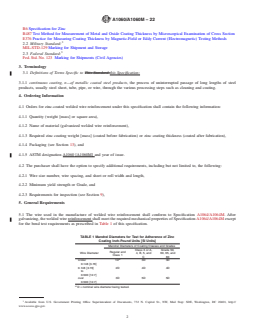
TABLE 1 Mandrel Diameters for Test for Adherence of Zinc
Coating Inch-Pound Units [SI Units]
Mandrel Diameters of Coating Classes and Grades
Class 3 or A, Grade 50,
Regular and
Wire Diameter 4, B, 5, and 60, 65, and
Class 1
C 80
A
Under 1D 3D 3D
0.148 [3.70]
0.148 [3.70] 2D 4D 4D
to
0.500 [12.7]
over 3D 5D 5D
0.500 [12.7]
A
D = nominal wire diameter being tested.
Available from U.S. Government Printing Office Superintendent of Documents, 732 N. Capitol St., NW, Mail Stop: SDE, Washington, DC 20401, http://
www.access.gpo.gov.
A1060/A1060M − 22
5.2 Welded wire reinforcement shall be furnished either in flat sheets, or in rolls, as specified by the purchaser.
5.3 The zinc used for coating shall be any grade that conforms to Specification B6.
6. Galvanizing
6.1 Mass [Weight] Thickness of Coating and Test:
6.1.1 This specification includes six classes of coating weight [mass] when the welded wire reinforcement is coated before
fabrication and four coating thickness grades when the welded wire reinforcement is coated after fabrication. The weight [mass]
of zinc coating is based on the measured diameter of the wire when the stripping method is performed and the nominal diameter
for all other methods, and shall conform to the requirements shown in Table 2 or Table 3. Individual results not more than 10 %
below the minimum values specified in Table 2 or Table 3 are allowed if the average of at least two samples from the same coil
2 2
are equal to or greater than the minimum, individual results shall be not less than 1.08 oz/ft [330 g/m ].
6.1.1.1 When the product is coated before fabrication in a continuous coating process, coating weights are given in Table 2 for
various zinc coating classes.
NOTE 2—Zinc coated wire produced as “regular coating” shall have the full surface covered with zinc, but there is no specified minimum weight of
coating.
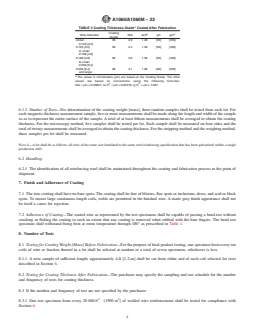
6.1.1.2 When the product is coated after fabrication in a hot-dip process, coating thickness are given in Table 3 for various zinc
coating grades.
NOTE 3—At the purchaser’s request the galvanized coating may be chromate treated. This is to minimize a reaction between the reinforcing steel and fresh
portland cement paste. Proprietary chromating solutions of equivalent strength are permitted in place of the generic chemical treatment specified.
6.1.2 Magnetic Thickness Measurements—The weight [mass] of the coating may be determined by magnetic thickness gage
measurements in accordance with Practice E376. The thickness measurement is used to calculate the weight [mass] by multiplying
it by the surface area of coated wire and by the zinc density. Because this form of testing can yield inconsistent and potentially
unreliable results on smaller sizes of wire, one or more of the following methods shall be permitted to be used to referee and take
precedence over the results obtained by magnetic thickness measurements.
6.1.2.1 Stripping Method—The weight [mass] shall be determined by stripping the coating from the steel wire specimen in
accordance with Section 8 and Test Method A90/A90M.
6.1.2.2 Weighing Before and After Galvanizing—The weight [mass] shall be determined by weighing the sample before and after
galvanizing. The difference between the two measurements divided by the surface area of the sample provides the weight [mass].
The original weighing shall occur after pickling and drying. The second weighing shall occur after cooling to ambient temperature.
6.1.2.3 Microscopy—The weight [mass] shall be determined by cross-sectional and optical measurement in accordance with Test
Method B487. A cross-section sample of the steel shall be polished and examined with an optical microscope to determine the
coating thickness. The coating weight [mass] shall be determined by multiplying coating thickness by the surface area of the coated
sample and by the density of zinc.
2 2
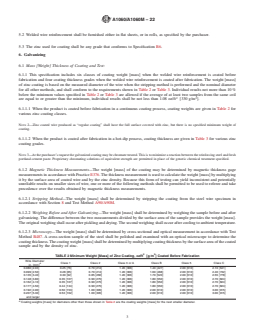
TABLE 2 Minimum Weight [Mass] of Zinc Coating, oz/ft [g ⁄m ] Coated Before Fabrication
Wire Diameter
Class 1 Class 2 Class 3 or A Class B Class 5 Class C
A
in. [mm]
0.080 [2.03] 0.25 [76] 0.70 [214] 1.20 [366] 1.40 [427] 2.00 [610] 2.10 [641]
0.099 [2.50] 0.28 [85] 0.70 [214] 1.20 [366] 1.60 [488] 2.00 [610] 2.40 [732]
0.135 [3.40] 0.30 [92] 0.85 [260] 1.20 [366] 1.70 [520] 2.00 [610] 2.55 [778]
0.148 [3.80] 0.35 [107] 0.90 [275] 1.20 [366] 1.80 [550] 2.00 [610] 2.70 [824]
0.162 [4.10] 0.35 [107] 0.90 [275] 1.20 [366] 1.80
...