

ASTM B539-20
(Test Method)Standard Test Methods for Measuring Resistance of Electrical Connections (Static Contacts)
General Information
- Abstract
SIGNIFICANCE AND USE
5.1 As stated in Terminology B542, contact resistance is comprised of a constriction resistance and a film resistance. When present, the latter of these is usually much greater in value and dominates the contact resistance. For a given contact spot, when the film resistance is zero or negligible the contact resistance for that spot is nearly the same as the constriction resistance and therefore, as a practical matter, has a minimum value which represents a clean metal-to-metal contact spot. As real contact surfaces exhibit varying degrees of roughness, real contacts are necessarily composed of many contact spots which are electrically parallel. In practical cases the clean metal-to-metal contact spots will carry most of the current and the total contact resistance is primarily dependent on the size and number of metallic contact spots present (see Note 1). In addition, acceptably low values of contact resistance are often obtained with true areas of contact being significantly less than the apparent contact area. This is the result of having a large number of small contact spots spread out over a relatively large apparent contact area.
Note 1: The term metallic contact as used here is intended to include the so called quasi-metallic contact spots as well. The latter case was discussed in Electric Contacts by Holm. 3
5.2 The practical evaluation and comparison of electrical connections depend in large part on their contact resistance characteristics. On the one hand, the absolute value of contact resistance is greatly dependent on the size and distribution of the metallic conducting spots within the apparent area of load-bearing contact. On the other hand, a comparison of the initial resistance to the resistance after aging indicates how stable the system is in maintaining the initial contact area. Both of these characteristics should be considered when evaluating contact systems. The criteria employed in evaluating contact resistance and stability are not a par...
SCOPE
1.1 These test methods cover equipment and techniques for measuring the resistance of static electrical connections such as wire terminations or splices, friction connectors, soldered joints, and wrapped-wire connections.
1.2 Measurements under two distinct levels of electrical loading are described. These levels are: (1) dry circuit, (2) and rated current. One or both of these levels of loading may be required in specific cases.
1.3 This standard does not purport to address all of the safety concerns, if any, associated with its use. It is the responsibility of the user of this standard to become familiar with all hazards including those identified in the appropriate Safety Data Sheet (SDS) for this product/material as provided by the manufacturer, to establish appropriate safety, health, and environmental practices, and determine the applicability of regulatory limitations prior to use.
1.4 This international standard was developed in accordance with internationally recognized principles on standardization established in the Decision on Principles for the Development of International Standards, Guides and Recommendations issued by the World Trade Organization Technical Barriers to Trade (TBT) Committee.
- Status
- Published
- Publication Date
- 31-Mar-2020
- Technical Committee
- B02 - Nonferrous Metals and Alloys
Buy Documents
ASTM B539-20 - Standard Test Methods for Measuring Resistance of Electrical Connections (Static Contacts)
REDLINE ASTM B539-20 - Standard Test Methods for Measuring Resistance of Electrical Connections (Static Contacts)
Overview
ASTM B539-20, titled Standard Test Methods for Measuring Resistance of Electrical Connections (Static Contacts), is a critical ASTM standard for evaluating the electrical resistance found in static electrical connections. Developed by ASTM International, this standard details the apparatus, test circuits, and procedures necessary to accurately measure low-level resistance in connections such as wire terminations, soldered joints, splices, and friction connectors. Accurate measurement of contact resistance is essential for assessing electrical performance, reliability, and longevity in a broad range of electronic and electrical applications.
The methods described in ASTM B539-20 are particularly significant for industries where the durability and quality of static contacts directly impact system performance, such as electrical wiring, automotive, electronics, and power distribution. By defining standardized techniques, the document ensures reproducible and comparable results for professionals involved in the manufacturing, testing, or qualification of electrical connectors.
Key Topics
- Contact Resistance: ASTM B539-20 distinguishes between film resistance (typically higher, caused by surface layers) and constriction resistance (minimum achievable with clean metal-to-metal contacts).
- Measurement Techniques: The standard outlines four-terminal resistance measurement methods, minimizing errors due to thermal effects and bulk resistance.
- Electrical Loading Conditions: Tests are conducted under two main scenarios:
- Dry Circuit: For low-level circuits, measurements are made with open-circuit voltage ≤20 mV and current ≤100 mA to avoid altering the surface films or contacts.
- Rated Current: These measurements simulate real operational currents, potentially causing heating, to evaluate performance under load.
- Test Apparatus: Requirements for test setups, including power supplies (both AC and DC), voltmeters, current measuring devices, and probe positioning, are covered.
- Sample Preparation: Guidance on specimen configuration and preparation ensures test relevance to actual application conditions.
- Statistical Considerations: Recommendations for sample sizes and result analysis support robust, statistically meaningful conclusions.
- Precision and Reporting: Instructions for documenting test conditions, instrument accuracy, probe placement, and calculation methods to promote result transparency and repeatability.
Applications
The standardized test methods of ASTM B539-20 are essential across various sectors where reliable electrical connections are critical. Noteworthy applications include:
- Wire Terminations and Splices: Ensuring low resistance and performance stability in electrical wiring for automotive, aerospace, and industrial equipment.
- Friction and Soldered Connectors: Verifying contact quality and consistency in electronic assemblies, circuit board connections, and consumer electronics.
- Qualification of Connectors: Supporting design validation and quality assurance for new connector models in manufacturing and component sourcing.
- Maintenance and Troubleshooting: Diagnosing degradation or failure in existing systems by comparing initial resistance values to those obtained after environmental aging or mechanical stress.
- Research and Development: Providing credible, comparable resistance data during the development of new materials and contact interfaces for advanced electrical connectivity.
Related Standards
- ASTM B542 – Terminology Relating to Electrical Contacts and Their Use, which supports clear definitions for terms like contact resistance, film resistance, and constriction resistance.
- ASTM E122 – Practice for Calculating Sample Size to Estimate, With Specified Precision, the Average for a Characteristic of a Lot or Process, aiding in statistical planning for test campaigns.
- Other Relevant Standards:
- Industry-specific requirements for electrical connector tests (e.g., IEC, MIL-STD, and other ASTM standards addressing electrical contact and connector reliability).
Adhering to ASTM B539-20 enables organizations to control quality, prevent failures from high contact resistance, and conform to international best practices in electrical connection testing. This standard is foundational for ensuring the performance, reliability, and safety of static electrical connections in modern electronic and electrical systems.
Relations
- Effective Date
- 01-Nov-2019
- Effective Date
- 01-Feb-2013
- Effective Date
- 01-Aug-2011
- Effective Date
- 01-Aug-2009
- Effective Date
- 01-Oct-2007
- Effective Date
- 01-May-2007
- Effective Date
- 01-May-2004
- Effective Date
- 10-Oct-2000
- Effective Date
- 10-Oct-2000
- Effective Date
- 10-Oct-2000
Buy Documents
ASTM B539-20 - Standard Test Methods for Measuring Resistance of Electrical Connections (Static Contacts)
REDLINE ASTM B539-20 - Standard Test Methods for Measuring Resistance of Electrical Connections (Static Contacts)
Get Certified
Connect with accredited certification bodies for this standard

IMQ S.p.A. (Certification)
Italian electrical product certification.

SLG Prüf- und Zertifizierungs GmbH
German testing and certification body.

UL Solutions
Global safety science company with testing, inspection and certification.
Sponsored listings
Frequently Asked Questions
ASTM B539-20 is a standard published by ASTM International. Its full title is "Standard Test Methods for Measuring Resistance of Electrical Connections (Static Contacts)". This standard covers: SIGNIFICANCE AND USE 5.1 As stated in Terminology B542, contact resistance is comprised of a constriction resistance and a film resistance. When present, the latter of these is usually much greater in value and dominates the contact resistance. For a given contact spot, when the film resistance is zero or negligible the contact resistance for that spot is nearly the same as the constriction resistance and therefore, as a practical matter, has a minimum value which represents a clean metal-to-metal contact spot. As real contact surfaces exhibit varying degrees of roughness, real contacts are necessarily composed of many contact spots which are electrically parallel. In practical cases the clean metal-to-metal contact spots will carry most of the current and the total contact resistance is primarily dependent on the size and number of metallic contact spots present (see Note 1). In addition, acceptably low values of contact resistance are often obtained with true areas of contact being significantly less than the apparent contact area. This is the result of having a large number of small contact spots spread out over a relatively large apparent contact area. Note 1: The term metallic contact as used here is intended to include the so called quasi-metallic contact spots as well. The latter case was discussed in Electric Contacts by Holm. 3 5.2 The practical evaluation and comparison of electrical connections depend in large part on their contact resistance characteristics. On the one hand, the absolute value of contact resistance is greatly dependent on the size and distribution of the metallic conducting spots within the apparent area of load-bearing contact. On the other hand, a comparison of the initial resistance to the resistance after aging indicates how stable the system is in maintaining the initial contact area. Both of these characteristics should be considered when evaluating contact systems. The criteria employed in evaluating contact resistance and stability are not a par... SCOPE 1.1 These test methods cover equipment and techniques for measuring the resistance of static electrical connections such as wire terminations or splices, friction connectors, soldered joints, and wrapped-wire connections. 1.2 Measurements under two distinct levels of electrical loading are described. These levels are: (1) dry circuit, (2) and rated current. One or both of these levels of loading may be required in specific cases. 1.3 This standard does not purport to address all of the safety concerns, if any, associated with its use. It is the responsibility of the user of this standard to become familiar with all hazards including those identified in the appropriate Safety Data Sheet (SDS) for this product/material as provided by the manufacturer, to establish appropriate safety, health, and environmental practices, and determine the applicability of regulatory limitations prior to use. 1.4 This international standard was developed in accordance with internationally recognized principles on standardization established in the Decision on Principles for the Development of International Standards, Guides and Recommendations issued by the World Trade Organization Technical Barriers to Trade (TBT) Committee.
SIGNIFICANCE AND USE 5.1 As stated in Terminology B542, contact resistance is comprised of a constriction resistance and a film resistance. When present, the latter of these is usually much greater in value and dominates the contact resistance. For a given contact spot, when the film resistance is zero or negligible the contact resistance for that spot is nearly the same as the constriction resistance and therefore, as a practical matter, has a minimum value which represents a clean metal-to-metal contact spot. As real contact surfaces exhibit varying degrees of roughness, real contacts are necessarily composed of many contact spots which are electrically parallel. In practical cases the clean metal-to-metal contact spots will carry most of the current and the total contact resistance is primarily dependent on the size and number of metallic contact spots present (see Note 1). In addition, acceptably low values of contact resistance are often obtained with true areas of contact being significantly less than the apparent contact area. This is the result of having a large number of small contact spots spread out over a relatively large apparent contact area. Note 1: The term metallic contact as used here is intended to include the so called quasi-metallic contact spots as well. The latter case was discussed in Electric Contacts by Holm. 3 5.2 The practical evaluation and comparison of electrical connections depend in large part on their contact resistance characteristics. On the one hand, the absolute value of contact resistance is greatly dependent on the size and distribution of the metallic conducting spots within the apparent area of load-bearing contact. On the other hand, a comparison of the initial resistance to the resistance after aging indicates how stable the system is in maintaining the initial contact area. Both of these characteristics should be considered when evaluating contact systems. The criteria employed in evaluating contact resistance and stability are not a par... SCOPE 1.1 These test methods cover equipment and techniques for measuring the resistance of static electrical connections such as wire terminations or splices, friction connectors, soldered joints, and wrapped-wire connections. 1.2 Measurements under two distinct levels of electrical loading are described. These levels are: (1) dry circuit, (2) and rated current. One or both of these levels of loading may be required in specific cases. 1.3 This standard does not purport to address all of the safety concerns, if any, associated with its use. It is the responsibility of the user of this standard to become familiar with all hazards including those identified in the appropriate Safety Data Sheet (SDS) for this product/material as provided by the manufacturer, to establish appropriate safety, health, and environmental practices, and determine the applicability of regulatory limitations prior to use. 1.4 This international standard was developed in accordance with internationally recognized principles on standardization established in the Decision on Principles for the Development of International Standards, Guides and Recommendations issued by the World Trade Organization Technical Barriers to Trade (TBT) Committee.
ASTM B539-20 is classified under the following ICS (International Classification for Standards) categories: 29.120.20 - Connecting devices. The ICS classification helps identify the subject area and facilitates finding related standards.
ASTM B539-20 has the following relationships with other standards: It is inter standard links to ASTM B542-13(2019), ASTM B542-13, ASTM E122-09e1, ASTM E122-09, ASTM E122-07, ASTM B542-07, ASTM B542-04, ASTM B542-00, ASTM E122-99, ASTM E122-00. Understanding these relationships helps ensure you are using the most current and applicable version of the standard.
ASTM B539-20 is available in PDF format for immediate download after purchase. The document can be added to your cart and obtained through the secure checkout process. Digital delivery ensures instant access to the complete standard document.
Standards Content (Sample)
This international standard was developed in accordance with internationally recognized principles on standardization established in the Decision on Principles for the
Development of International Standards, Guides and Recommendations issued by the World Trade Organization Technical Barriers to Trade (TBT) Committee.
Designation: B539 − 20
Standard Test Methods for
Measuring Resistance of Electrical Connections (Static
Contacts)
This standard is issued under the fixed designation B539; the number immediately following the designation indicates the year of
original adoption or, in the case of revision, the year of last revision. A number in parentheses indicates the year of last reapproval. A
superscript epsilon (´) indicates an editorial change since the last revision or reapproval.
1. Scope 3. Terminology
3.1 Definitions:
1.1 These test methods cover equipment and techniques for
measuring the resistance of static electrical connections such as
3.1.1 See Terminology B542 for definitions of contact
wire terminations or splices, friction connectors, soldered resistance, film resistance, and constriction resistance.
joints, and wrapped-wire connections.
3.1.2 bulk resistance, n—the resistance a contact assembly
would have if it were solid metal of an identical geometry so
1.2 Measurements under two distinct levels of electrical
that the nominal contact area offered zero resistance. When
loading are described. These levels are: (1) dry circuit, (2) and
measuring contact resistance one attempts to include as little
rated current. One or both of these levels of loading may be
bulk resistance as possible in the measurement, by placing
required in specific cases.
measuring probes as close to the contact interface as practical.
1.3 This standard does not purport to address all of the
3.1.3 connection resistance, n—the resistance from the ter-
safety concerns, if any, associated with its use. It is the
mination point on one end of a device containing static
responsibility of the user of this standard to become familiar
contacts, through the contacts to the termination point on the
with all hazards including those identified in the appropriate
other end of the device. The termination point is the location on
Safety Data Sheet (SDS) for this product/material as provided
a terminal of a device where a wire or printed circuit path
by the manufacturer, to establish appropriate safety, health,
electrically connects to the terminal. This resistance is the
and environmental practices, and determine the applicability
value of resistance displayed by the device in a circuit
of regulatory limitations prior to use.
application.
1.4 This international standard was developed in accor-
3.1.3.1 Discussion—The term contact resistance is often
dance with internationally recognized principles on standard-
used in commercial literature to indicate the connection resis-
ization established in the Decision on Principles for the
tance displayed by the device in a standard application. In the
Development of International Standards, Guides and Recom-
more rigorous usage of contact resistance, the connection
mendations issued by the World Trade Organization Technical
resistance is the sum of the contact resistance plus the bulk
Barriers to Trade (TBT) Committee.
resistance of leads within the device that go to the static
contacts from the point that the leads are connected to the
2. Referenced Documents
external circuitry. Measurement of contact resistance indepen-
2.1 ASTM Standards:
dent of all bulk resistance is very difficult for most commercial
B542 Terminology Relating to Electrical Contacts and Their
devices.
Use
3.1.4 dry circuit, n—a circuit in which the open-circuit
E122 Practice for Calculating Sample Size to Estimate, With
voltage is less than or equal to 20 mV. Current is usually low
Specified Precision, the Average for a Characteristic of a
in a dry circuit, but a low-current circuit is not necessarily a
Lot or Process
dry circuit. When the applied voltage (open-circuit voltage) is
too low to cause any physical changes in the contact junction,
such as break-down of thin insulating films or softening of
These test methods are under the jurisdiction of ASTM Committee B02 on
contact asperities, the circuit is said to be a dry circuit.
Nonferrous Metals and Alloys and are the direct responsibility of Subcommittee
B02.05 on Precious Metals and Electrical Contact Materials and Test Methods.
3.1.5 open-circuit voltage, n—the steady-state voltage
Current edition approved April 1, 2020. Published April 2020. Originally
which would appear across the contacts if they were opened.
approved in 1970. Last previous edition approved in 2018 as B539 – 18. DOI:
10.1520/B0539-20.
3.1.6 static contacts, n—electric junctions designed for
For referenced ASTM standards, visit the ASTM website, www.astm.org, or
infrequent separation and connection, and intended to perform
contact ASTM Customer Service at service@astm.org. For Annual Book of ASTM
their function only when contacting members are stationary
Standards volume information, refer to the standard’s Document Summary page on
the ASTM website. relative to each other. This definition includes crimped,
Copyright © ASTM International, 100 Barr Harbor Drive, PO Box C700, West Conshohocken, PA 19428-2959. United States
B539 − 20
welded, brazed, riveted, or soldered joints; friction connections value and dominates the contact resistance. For a given contact
such as pin and socket connectors or taper pins, twisted-wire spot, when the film resistance is zero or negligible the contact
splices; and connections made with screws, or bolts and nuts resistance for that spot is nearly the same as the constriction
between electrical wiring and components. The definition resistance and therefore, as a practical matter, has a minimum
excludes relay contacts, slip rings and commutators, and value which represents a clean metal-to-metal contact spot. As
switches and circuit breakers. real contact surfaces exhibit varying degrees of roughness, real
contacts are necessarily composed of many contact spots which
3.2 Descriptions of Terms for Levels of Electrical Loading:
are electrically parallel. In practical cases the clean metal-to-
3.2.1 dry circuit, n—This method provides for measurement
metal contact spots will carry most of the current and the total
of contact resistance under very low levels of electrical
contact resistance is primarily dependent on the size and
excitation, with applied voltages and currents selected to be too
number of metallic contact spots present (see Note 1). In
low to cause breakdown of thin oxide films or other contami-
addition, acceptably low values of contact resistance are often
nates in the contact interface or to cause formation of metallic
obtained with true areas of contact being significantly less than
bridges across the interface where none may otherwise exist.
the apparent contact area. This is the result of having a large
Dry circuit testing is intended to determine whether the test
number of small contact spots spread out over a relatively large
contact will function properly in circuits of arbitrarily low
apparent contact area.
levels of electrical excitation. Dry circuit testing procedures
should be used when the possibility of films or contaminants in
NOTE 1—The term metallic contact as used here is intended to include
the so called quasi-metallic contact spots as well. The latter case was
the contact interface exists or when the test sample is ulti-
discussed in Electric Contacts by Holm.
mately intended for use in a low-level circuit. This testing must
precede other tests on the same samples at high levels of 5.2 The practical evaluation and comparison of electrical
electrical loading. connections depend in large part on their contact resistance
characteristics. On the one hand, the absolute value of contact
3.2.2 rated current, n—The rated current for a static contact
resistance is greatly dependent on the size and distribution of
device is determined or specified by the vendor or user of the
the metallic conducting spots within the apparent area of
device. The rated current may be large enough to cause
load-bearing contact. On the other hand, a comparison of the
significant heating of the test samples. When rated current
initial resistance to the resistance after aging indicates how
measurements of contact resistance are required, using either
stable the system is in maintaining the initial contact area. Both
ac or dc test currents, the procedures outlined for temperature
of these characteristics should be considered when evaluating
stabilization in 9.5.3 must be followed.
contact systems. The criteria employed in evaluating contact
resistance and stability are not a part of these test methods as
4. Summary of Test Methods
they depend on specific applications and therefore, will not be
4.1 The test methods described herein are characterized as
quantitatively stated. However, an estimate of contact resis-
four-terminal resistance measuring techniques, wherein a mea-
tance resulting from good metallic contact can be made for a
sured and controlled test current is introduced into the sample
given physical situation and used as a comparison to actual
using two“ terminals” or connecting points, and two other
measurements to determine how effective the system is in
points are selected on the sample across which a voltage drop
establishing stable metallic contact. Resistances measured by
is measured. This voltage drop, divided by the test current, is
these methods before, during and after simulated life tests are
the effective overall resistance of the sample included between
used as a means of determining the stability of contacts within
the voltage probes. The voltage-measuring points are chosen so
a device.
as to measure as closely as possible the voltage drop due only
to the contact resistance of the sample and to eliminate from
6. Interferences
the measurement as much as possible the resistance of the
6.1 Measurement of Low Resistance:
metal pieces comprising the contact and the resistance of the
6.1.1 Contact resistances are normally very small, ranging
wires and connections used to introduce the test current into the
from microohms to a few milliohms in cases of practical
sample.
interest. The measurement of resistance in this range requires
4.2 Two different levels of test current are specified. The
special techniques to eliminate effects of thermal potentials,
choice of which level to use is governed by the application and
external interference, and resistance of connections and wires
requirements of the electrical connection being tested. Elec-
leading to the test sample.
tronic signal-circuit connections may require low-level (dry-
6.1.2 The resistance-measuring procedures in these test
circuit) testing, whereas power-handling wire connectors
methods are four-terminal techniques. Test current in the
should be tested at rated current.
sample is measured and controlled, and made independent of
4.3 Either ac or dc test currents may be used, with appro- the sample resistance. Voltage-measuring probes are attached
to the sample so as to eliminate the effects of connections of the
priate instrumentation.
sample into the test circuit. If the purpose of the measurement
5. Significance and Use
5.1 As stated in Terminology B542, contact resistance is
Calculations and formulae for contact resistance of various types of contacts are
comprised of a constriction resistance and a film resistance.
covered very thoroughly in Holm’s Electric Contacts, 4th Edition, Springer-Verlag,
When present, the latter of these is usually much greater in New York.
B539 − 20
is to determine the contact resistance, the voltage measuring specimen. To measure connection resistance, move the voltage
probes are attached as close as feasible to the static contacts, so probes away from the contact point to the very end of each
as to include as little of the bulk resistance of the sample as contact member where the current leads are attached. To
possible in the measurement of the contact resistance. attempt to measure contact resistance, move the voltage probes
6.1.3 Two wire measurements of resistance are not suitable as close as possible to the contact point. The equipment
because connections to the sample will contribute part of the consists of the following elements:
measured resistance, and these may be large, unknown, and
7.1.1 Power Supply—A supply capable of providing the
variable.
required current and, in the case of the dry circuit measurement
6.1.4 Because the resistance being measured is often in the
capable of limiting the current to 100 milliamps and the open
microohm or milliohm range, and it is determined by measur-
circuit voltage to 20mV. The supply may be dc or ac, but the
ing the potential across the static contacts, the value of the
voltage measuring device must match the type of current from
potential is often in the microvolt or millivolt range. As a
the supply.
result, thermal potentials may be significant in relation to the
7.1.2 Voltmeters and ammeters built into power supplies
potential being measured and appropriate measures are re-
may or may not meet the requirements of these methods with
quired to cancel or eliminate their effects.
respect to accuracy or precision. External metering should be
6.1.5 In the dry circuit method, high potential may change a
used when necessary.
resistance by breaking down a film. Appropriate caution is
7.1.3 Both output terminals of the dc supply must be
required to obtain valid dry circuit resistance measurements
isolated from the power line, the case of the supply, and the
including limiting the open circuit voltage of the measuring
building ground. This prevents “ground loops” or undesired
apparatus that is connected to the device under test.
connections through ground, between the power supply and
other measuring instruments (such as an electronic voltmeter)
6.2 ac Versus dc Measurements:
6.2.1 Either method described herein can be used with ac or attached to the sample.
dc test currents, with appropriate changes in instrumentation to
7.1.4 The current capacity of the power supply must be
correspond with the power supply. The methods are described
sufficient for the highest rating of the devices being tested.
as using dc test currents, and the following comments apply
7.1.5 The output current of the power supply should be
when ac is used.
variable and readily and accurately adjustable.
6.2.2 ac measurements should be expressed as RMS unless
7.2 Current Measuring Device—a meter, ac or dc, to match
otherwise defined in the test report. Take appropriate measures
the power supply current type or suitable alternate measuring
to isolate the measurements from stray signals, especially sixty
circuitry is needed. The accuracy of the device must be 1 % or
hertz power line noise. Commercial resistance measuring
better of the measured current. Some power supplies include
instruments that use ac test currents generally are suitable
measurement capability of sufficient accuracy. An external
providing that they meet other requirements of the standard.
arrangement of a calibrated fixed resistor wired in series with
the test current and a voltmeter across the resistor is suitable
7. Apparatus and Test Circuits
provided that it achieves the accuracy required.
7.1 Fig. 1 shows the basic arrangement of a four wire circuit
for measuring. In the illustration, the measured resistance is the 7.3 Reversing Switch—Since millivolt-drop readings across
resistance between the points where the voltmeter is attached to the sample are to be taken with both forward and reverse dc
the test specimen, that is, between the points of V1 and V2. The current, a double-pole-double-throw switch of suitable current-
meas
...
This document is not an ASTM standard and is intended only to provide the user of an ASTM standard an indication of what changes have been made to the previous version. Because
it may not be technically possible to adequately depict all changes accurately, ASTM recommends that users consult prior editions as appropriate. In all cases only the current version
of the standard as published by ASTM is to be considered the official document.
Designation: B539 − 18 B539 − 20
Standard Test Methods for
Measuring Resistance of Electrical Connections (Static
Contacts)
This standard is issued under the fixed designation B539; the number immediately following the designation indicates the year of
original adoption or, in the case of revision, the year of last revision. A number in parentheses indicates the year of last reapproval. A
superscript epsilon (´) indicates an editorial change since the last revision or reapproval.
1. Scope
1.1 These test methods cover equipment and techniques for measuring the resistance of static electrical connections such as wire
terminations or splices, friction connectors, soldered joints, and wrapped-wire connections.
1.2 Measurements under two distinct levels of electrical loading are described. These levels are: (1) dry circuit, (2) and rated
current. One or both of these levels of loading may be required in specific cases.
1.3 This standard does not purport to address all of the safety concerns, if any, associated with its use. It is the responsibility
of the user of this standard to become familiar with all hazards including those identified in the appropriate Safety Data Sheet
(SDS) for this product/material as provided by the manufacturer, to establish appropriate safety, health, and environmental
practices, and determine the applicability of regulatory limitations prior to use.
1.4 This international standard was developed in accordance with internationally recognized principles on standardization
established in the Decision on Principles for the Development of International Standards, Guides and Recommendations issued
by the World Trade Organization Technical Barriers to Trade (TBT) Committee.
2. Referenced Documents
2.1 ASTM Standards:
B542 Terminology Relating to Electrical Contacts and Their Use
E122 Practice for Calculating Sample Size to Estimate, With Specified Precision, the Average for a Characteristic of a Lot or
Process
3. Terminology
3.1 Definitions:
3.1.1 See Terminology B542 for definitions of contact resistance, film resistance, and constriction resistance.
3.1.2 bulk resistance, n—the resistance a contact assembly would have if it were solid metal of an identical geometry so that
the nominal contact area offered zero resistance. When measuring contact resistance one attempts to include as little bulk resistance
as possible in the measurement, by placing measuring probes as close to the contact interface as practical.
3.1.3 connection resistance, n—the resistance from the termination point on one end of a device containing static contacts,
through the contacts to the termination point on the other end of the device. The termination point is the location on a terminal
of a device where a wire or printed circuit path electrically connects to the terminal. This resistance is the value of resistance
displayed by the device in a circuit application.
3.1.3.1 Discussion—
The term contact resistance is often used in commercial literature to indicate the connection resistance displayed by the device in
a standard application. In the more rigorous usage of contact resistance, the connection resistance is the sum of the contact
These test methods are under the jurisdiction of ASTM Committee B02 on Nonferrous Metals and Alloys and are the direct responsibility of Subcommittee B02.11 on
Electrical Contact Test Methods.
Current edition approved Nov. 1, 2018April 1, 2020. Published December 2018April 2020. Originally approved in 1970. Last previous edition approved in 20132018 as
B539 – 02 (2013).B539 – 18. DOI: 10.1520/B0539-18.10.1520/B0539-20.
For referenced ASTM standards, visit the ASTM website, www.astm.org, or contact ASTM Customer Service at service@astm.org. For Annual Book of ASTM Standards
volume information, refer to the standard’s Document Summary page on the ASTM website.
Copyright © ASTM International, 100 Barr Harbor Drive, PO Box C700, West Conshohocken, PA 19428-2959. United States
B539 − 20
resistance plus the bulk resistance of leads within the device that go to the static contacts from the point that the leads are connected
to the external circuitry. Measurement of contact resistance independent of all bulk resistance is very difficult for most commercial
devices.
3.1.4 dry circuit, n—a circuit in which the open-circuit voltage is less than or equal to 20 mV. Current is usually low in a dry
circuit, but a low-current circuit is not necessarily a dry circuit. When the applied voltage (open-circuit voltage) is too low to cause
any physical changes in the contact junction, such as break-down of thin insulating films or softening of contact asperities, the
circuit is said to be a dry circuit.
3.1.5 open-circuit voltage, n—the steady-state voltage which would appear across the contacts if they were opened.
3.1.6 static contacts, n—electric junctions designed for infrequent separation and connection, and intended to perform their
function only when contacting members are stationary relative to each other. This definition includes crimped, welded, brazed,
riveted, or soldered joints; friction connections such as pin and socket connectors or taper pins, twisted-wire splices; and
connections made with screws, or bolts and nuts between electrical wiring and components. The definition excludes relay contacts,
slip rings and commutators, and switches and circuit breakers.
3.2 Descriptions of Terms for Levels of Electrical Loading:
3.2.1 dry circuit, n—This method provides for measurement of contact resistance under very low levels of electrical excitation,
with applied voltages and currents selected to be too low to cause breakdown of thin oxide films or other contaminates in the
contact interface or to cause formation of metallic bridges across the interface where none may otherwise exist. Dry circuit testing
is intended to determine whether the test contact will function properly in circuits of arbitrarily low levels of electrical excitation.
Dry circuit testing procedures should be used when the possibility of films or contaminants in the contact interface exists or when
the test sample is ultimately intended for use in a low-level circuit. This testing must precede other tests on the same samples at
high levels of electrical loading.
3.2.2 rated current, n—The rated current for a static contact device is determined or specified by the vendor or user of the
device. The rated current may be large enough to cause significant heating of the test samples. When rated current measurements
of contact resistance are required, using either ac or dc test currents, the procedures outlined for temperature stabilization in 9.5.3
must be followed.
4. Summary of Test Methods
4.1 The test methods described herein are characterized as four-terminal resistance measuring techniques, wherein a measured
and controlled test current is introduced into the sample using two“ terminals” or connecting points, and two other points are
selected on the sample across which a voltage drop is measured. This voltage drop, divided by the test current, is the effective
overall resistance of the sample included between the voltage probes. The voltage-measuring points are chosen so as to measure
as closely as possible the voltage drop due only to the contact resistance of the sample and to eliminate from the measurement as
much as possible the resistance of the metal pieces comprising the contact and the resistance of the wires and connections used
to introduce the test current into the sample.
4.2 Two different levels of test current are specified. The choice of which level to use is governed by the application and
requirements of the electrical connection being tested. Electronic signal-circuit connections may require low-level (dry-circuit)
testing, whereas power-handling wire connectors should be tested at rated current.
4.3 Either ac or dc test currents may be used, with appropriate instrumentation.
5. Significance and Use
5.1 As stated in Terminology B542, contact resistance is comprised of a constriction resistance and a film resistance. When
present, the latter of these is usually much greater in value and dominates the contact resistance. For a given contact spot, when
the film resistance is zero or negligible the contact resistance for that spot is nearly the same as the constriction resistance and
therefore, as a practical matter, has a minimum value which represents a clean metal-to-metal contact spot. As real contact surfaces
exhibit varying degrees of roughness, real contacts are necessarily composed of many contact spots which are electrically parallel.
In practical cases the clean metal-to-metal contact spots will carry most of the current and the total contact resistance is primarily
dependent on the size and number of metallic contact spots present (see Note 1). In addition, acceptably low values of contact
resistance are often obtained with true areas of contact being significantly less than the apparent contact area. This is the result of
having a large number of small contact spots spread out over a relatively large apparent contact area.
NOTE 1—The term metallic contact as used here is intended to include the so called quasi-metallic contact spots as well. The latter case was discussed
in Electric Contacts by Holm.
5.2 The practical evaluation and comparison of electrical connections depend in large part on their contact resistance
characteristics. On the one hand, the absolute value of contact resistance is greatly dependent on the size and distribution of the
Calculations and formulae for contact resistance of various types of contacts are covered very thoroughly in Holm’s Electric Contacts, 4th Edition, Springer-Verlag, New
York.
B539 − 20
metallic conducting spots within the apparent area of load-bearing contact. On the other hand, a comparison of the initial resistance
to the resistance after aging indicates how stable the system is in maintaining the initial contact area. Both of these characteristics
should be considered when evaluating contact systems. The criteria employed in evaluating contact resistance and stability are not
a part of these test methods as they depend on specific applications and therefore, will not be quantitatively stated. However, an
estimate of contact resistance resulting from good metallic contact can be made for a given physical situation and used as a
comparison to actual measurements to determine how effective the system is in establishing stable metallic contact. Resistances
measured by these methods before, during and after simulated life tests are used as a means of determining the stability of contacts
within a device.
6. Interferences
6.1 Measurement of Low Resistance:
6.1.1 Contact resistances are normally very small, ranging from microohms to a few milliohms in cases of practical interest.
The measurement of resistance in this range requires special techniques to eliminate effects of thermal potentials, external
interference, and resistance of connections and wires leading to the test sample.
6.1.2 The resistance-measuring procedures in these test methods are four-terminal techniques. Test current in the sample is
measured and controlled, and made independent of the sample resistance. Voltage-measuring probes are attached to the sample so
as to eliminate the effects of connections of the sample into the test circuit. If the purpose of the measurement is to determine the
contact resistance, the voltage measuring probes are attached as close as feasible to the static contacts, so as to include as little of
the bulk resistance of the sample as possible in the measurement of the contact resistance.
6.1.3 Two wire measurements of resistance are not suitable because connections to the sample will contribute part of the
measured resistance, and these may be large, unknown, and variable.
6.1.4 Because the resistance being measured is often in the microohm or milliohm range, and it is determined by measuring the
potential across the static contacts, the value of the potential is often in the microvolt or millivolt range. As a result, thermal
potentials may be significant in relation to the potential being measured and appropriate measures are required to cancel or
eliminate their effects.
6.1.5 In the dry circuit method, high potential may change a resistance by breaking down a film. Appropriate caution is required
to obtain valid dry circuit resistance measurements including limiting the open circuit voltage of the measuring apparatus that is
connected to the device under test.
6.2 ac Versus dc Measurements:
6.2.1 Either method described herein can be used with ac or dc test currents, with appropriate changes in instrumentation to
correspond with the power supply. The methods are described as using dc test currents, and the following comments apply when
ac is used.
6.2.2 ac measurements should be expressed as RMS unless otherwise defined in the test report. Take appropriate measures to
isolate the measurements from stray signals, especially sixty hertz power line noise. Commercial resistance measuring instruments
that use ac test currents generally are suitable providing that they meet other requirements of the standard.
7. Apparatus and Test Circuits
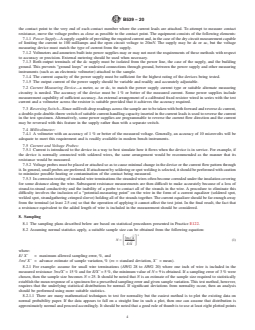
7.1 Fig. 1 shows the basic arrangement of a four wire circuit for measuring. In the illustration, the measured resistance is the
resistance between the points where the voltmeter is attached to the test specimen, that is, between the points of V1 and V2. The
measured resistance includes the contact resistance at the contact between the two rounded points and the bulk resistance out to
the point where the voltage probes touch the test specimen. To measure connection resistance, move the voltage probes away from
FIG. 1 Schematic Representation of 4 Wire Measurement Circuit
B539 − 20
the contact point to the very end of each contact member where the current leads are attached. To attempt to measure contact
resistance, move the voltage probes as close as possible to the contact point. The equipment consists of the following elements:
7.1.1 Power Supply—A supply capable of providing the required current and, in the case of the dry circuit measurement capable
of limiting the current to 100 milliamps and the open circuit voltage to 20mV. The supply may be dc or ac, but the voltage
measuring device must match the type of current from the supply.
7.1.2 Voltmeters and ammeters built into power supplies may or may not meet the requirements of these methods with respect
to accuracy or precision. External metering should be used when necessary.
7.1.3 Both output terminals of the dc supply must be isolated from the power line, the case of the supply, and the building
ground. This prevents “ground loops” or undesired connections through ground, between the power supply and other measuring
instruments (such as an electronic voltmeter) attached to the sample.
7.1.4 The current capacity of the power supply must be sufficient for the highest rating of the devices being tested.
7.1.5 The output current of the power supply should be variable and readily and accurately adjustable.
7.2 Current Measuring Device—a meter, ac or dc, to match the power supply current type or suitable alternate measuring
circuitry is needed. The accuracy of the device must be 1 % or better of the measured current. Some power supplies include
measurement capability of sufficient accuracy. An external arrangement of a calibrated fixed resistor wired in series with the test
current and a voltmeter across the resistor is suitable provided that it achieves the accuracy required.
7.3 Reversing Switch—Since millivolt-drop readings across the sample are to be taken with both forward and reverse dc current,
a double-pole-double-throw switch of suitable current-handling capacity inserted in the current leads is used to reverse the current
in the test specimen. Alternatively, some power supplies are programmable to reverse the current flow direction and the current
may be reversed with this feature in the supply rather than with a separate switch.
7.4 Millivoltmeter:
7.4.1 A voltmeter with an accuracy of 1 % or better of the measured voltage. Generally, an accuracy of 10 microvolts will be
adequate to meet this requirement and is readily available in modern
...