

ASTM F860-24
(Specification)Standard Specification for Hot Water Sanitizing Commercial Dishwashing Machines, Multiple Tank, Rackless Conveyor Type
General Information
- Abstract
ABSTRACT
This specification covers multiple tank, automatic rack less conveyor type, commercial dishwashing machines. These machines can be classified into two types: Type 1 machines shall be designed and supplied to accept the feeding of soiled tableware from the right side, when facing the front of the machine while Type II shall be designed and supplied to accept the feeding of soiled tableware from the left side, when facing the front of the machine. The dishwashing machines have three kinds of styles: Style 1 is a steam heated machine, with two classes namely Class A which uses injectors and Class B which uses heat exchange coils. Style 2 is an electrically heated dishwashing machine. Style 3 on the other hand is gas heated with two classes namely Class C which uses natural gas and Class D which uses LP gas. In addition, these dishwashing machines can be classified into three groups according to size and capacity: Group A, Group B, and Group C. Materials used in the manufacture of these machines shall consist of corrosion-resistant steel, corrosion resisting material, nickel-copper alloy and plastics. The dishwashing machine shall be complete so that when connected to the specified source of power, water supply, heating means (steam, electric, or gas), drainage, detergent, and rinse agent feeder as applicable, the unit can be used for its intended function. Dishwashers shall be rigid, quiet in operation, free from objectionable vibration, and so constructed as to prevent objectionable splashing of water to the outside of the machine. Operational test, leakage test, and performance profiles shall be done in order to determine the overall efficiency of the dishwashing machine.
SCOPE
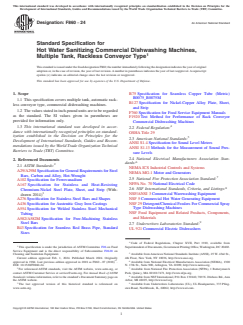
1.1 This specification covers multiple tank, automatic rackless conveyor type, commercial dishwashing machines.
1.2 The values stated in inch-pound units are to be regarded as the standard. The SI values given in parentheses are provided for information only.
1.3 This international standard was developed in accordance with internationally recognized principles on standardization established in the Decision on Principles for the Development of International Standards, Guides and Recommendations issued by the World Trade Organization Technical Barriers to Trade (TBT) Committee.
- Status
- Published
- Publication Date
- 31-Jan-2024
- Technical Committee
- F26 - Food Service Equipment
- Drafting Committee
- F26.01 - Cleaning and Sanitation Equipment
Buy Documents
ASTM F860-24 - Standard Specification for Hot Water Sanitizing Commercial Dishwashing Machines, Multiple Tank, Rackless Conveyor Type
REDLINE ASTM F860-24 - Standard Specification for Hot Water Sanitizing Commercial Dishwashing Machines, Multiple Tank, Rackless Conveyor Type
Overview
ASTM F860-24 is the international standard specification developed by ASTM for hot water sanitizing commercial dishwashing machines, specifically covering multiple tank, rackless conveyor type models. These machines are widely used in commercial food service operations, such as restaurants, institutional kitchens, and catering facilities, to ensure thorough cleaning, rinsing, and sanitizing of tableware and utensils. The standard provides comprehensive requirements related to construction, classification, materials, performance, and testing, ensuring reliable operation and safety compliance.
Key Topics
Classification and Types
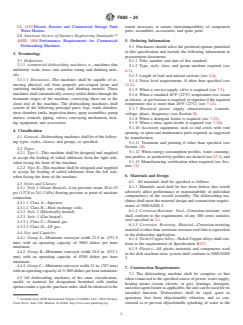
ASTM F860-24 classifies machines by the direction of soiled tableware feeding:- Type I: Soiled tableware fed from the right side (when facing the front)
- Type II: Soiled tableware fed from the left side
The machines are also grouped by heating method:
- Style 1 (Steam heated): With Class A (injectors) and Class B (heat exchange coils)
- Style 2 (Electrically heated)
- Style 3 (Gas heated): With Class C (natural gas) and Class D (LP gas)
Capacity is further categorized as Group A, B, or C based on conveyor width and hourly dish capacity.
Materials and Construction
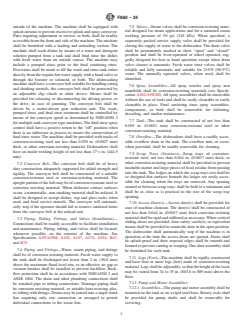
- Use of corrosion-resistant materials such as stainless steel, nickel-copper alloys, and plastics compliant with NSF/ANSI 3
- Construction features for quiet, vibration-free operation and prevention of water splashing
- Requirements for accessibility, adjustment, safety interlocks, and sanitation
Performance Requirements and Testing
- Machines must meet performance criteria for cleaning, sanitizing, noise, and leak resistance
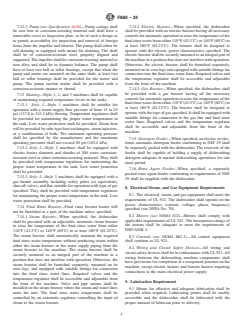
- Compliance with safety (UL 921), sanitation (NSF/ANSI 3), and national codes (National Electrical Code)
Certification and Product Identification
- Requirements for product certification, UL listing, and NSF marking
- Clear product marking for model identification and operating instructions
Applications
ASTM F860-24 is essential for the commercial warewashing industry, providing a robust specification for manufacturers, purchasers, and operators of rackless conveyor type dishwashers. Core applications include:
- Restaurants and Food Service Facilities: Ensuring high-capacity, reliable dishwashing that meets food safety and sanitation requirements.
- Hospitals and Institutional Kitchens: Supporting hygienic cycles and efficient operations in high-volume environments.
- Catering and Events: Maintaining throughput and cleanliness for large-scale meal service.
This standard assists:
- Manufacturers in designing compliant, safe, and durable equipment
- Procurement professionals in accurately specifying requirements for new equipment
- Facility managers in ensuring regulatory and operational compliance
Related Standards
ASTM F860-24 references and aligns with several key standards to ensure quality, safety, and interoperability:
- NSF/ANSI 3: Commercial Warewashing Equipment (sanitation requirements)
- UL 921: Commercial Electric Dishwashers (electrical safety)
- NFPA 70: National Electrical Code (wiring and safety)
- NEMA ICS, NEMA MG-1: Motor controls and generator standards
- ANSI S1.4, ANSI S1.13: Sound level measurement for noise compliance
- NSF 5 and NSF 29: Hot water equipment and chemical feeder requirements
Other related material and performance standards include ASTM specifications for steel, copper, nickel-copper alloys, and food service equipment manuals (ASTM F760).
Adopting ASTM F860-24 ensures that commercial dishwashing operations remain safe, efficient, and compliant, driving both hygiene and operational excellence in modern food service environments. For detailed specifications, compliance verification, and ordering requirements, referencing the full standard is essential for all stakeholders in the foodservice equipment industry.
Relations
- Effective Date
- 01-Feb-2024
Buy Documents
ASTM F860-24 - Standard Specification for Hot Water Sanitizing Commercial Dishwashing Machines, Multiple Tank, Rackless Conveyor Type
REDLINE ASTM F860-24 - Standard Specification for Hot Water Sanitizing Commercial Dishwashing Machines, Multiple Tank, Rackless Conveyor Type
Frequently Asked Questions
ASTM F860-24 is a technical specification published by ASTM International. Its full title is "Standard Specification for Hot Water Sanitizing Commercial Dishwashing Machines, Multiple Tank, Rackless Conveyor Type". This standard covers: ABSTRACT This specification covers multiple tank, automatic rack less conveyor type, commercial dishwashing machines. These machines can be classified into two types: Type 1 machines shall be designed and supplied to accept the feeding of soiled tableware from the right side, when facing the front of the machine while Type II shall be designed and supplied to accept the feeding of soiled tableware from the left side, when facing the front of the machine. The dishwashing machines have three kinds of styles: Style 1 is a steam heated machine, with two classes namely Class A which uses injectors and Class B which uses heat exchange coils. Style 2 is an electrically heated dishwashing machine. Style 3 on the other hand is gas heated with two classes namely Class C which uses natural gas and Class D which uses LP gas. In addition, these dishwashing machines can be classified into three groups according to size and capacity: Group A, Group B, and Group C. Materials used in the manufacture of these machines shall consist of corrosion-resistant steel, corrosion resisting material, nickel-copper alloy and plastics. The dishwashing machine shall be complete so that when connected to the specified source of power, water supply, heating means (steam, electric, or gas), drainage, detergent, and rinse agent feeder as applicable, the unit can be used for its intended function. Dishwashers shall be rigid, quiet in operation, free from objectionable vibration, and so constructed as to prevent objectionable splashing of water to the outside of the machine. Operational test, leakage test, and performance profiles shall be done in order to determine the overall efficiency of the dishwashing machine. SCOPE 1.1 This specification covers multiple tank, automatic rackless conveyor type, commercial dishwashing machines. 1.2 The values stated in inch-pound units are to be regarded as the standard. The SI values given in parentheses are provided for information only. 1.3 This international standard was developed in accordance with internationally recognized principles on standardization established in the Decision on Principles for the Development of International Standards, Guides and Recommendations issued by the World Trade Organization Technical Barriers to Trade (TBT) Committee.
ABSTRACT This specification covers multiple tank, automatic rack less conveyor type, commercial dishwashing machines. These machines can be classified into two types: Type 1 machines shall be designed and supplied to accept the feeding of soiled tableware from the right side, when facing the front of the machine while Type II shall be designed and supplied to accept the feeding of soiled tableware from the left side, when facing the front of the machine. The dishwashing machines have three kinds of styles: Style 1 is a steam heated machine, with two classes namely Class A which uses injectors and Class B which uses heat exchange coils. Style 2 is an electrically heated dishwashing machine. Style 3 on the other hand is gas heated with two classes namely Class C which uses natural gas and Class D which uses LP gas. In addition, these dishwashing machines can be classified into three groups according to size and capacity: Group A, Group B, and Group C. Materials used in the manufacture of these machines shall consist of corrosion-resistant steel, corrosion resisting material, nickel-copper alloy and plastics. The dishwashing machine shall be complete so that when connected to the specified source of power, water supply, heating means (steam, electric, or gas), drainage, detergent, and rinse agent feeder as applicable, the unit can be used for its intended function. Dishwashers shall be rigid, quiet in operation, free from objectionable vibration, and so constructed as to prevent objectionable splashing of water to the outside of the machine. Operational test, leakage test, and performance profiles shall be done in order to determine the overall efficiency of the dishwashing machine. SCOPE 1.1 This specification covers multiple tank, automatic rackless conveyor type, commercial dishwashing machines. 1.2 The values stated in inch-pound units are to be regarded as the standard. The SI values given in parentheses are provided for information only. 1.3 This international standard was developed in accordance with internationally recognized principles on standardization established in the Decision on Principles for the Development of International Standards, Guides and Recommendations issued by the World Trade Organization Technical Barriers to Trade (TBT) Committee.
ASTM F860-24 is classified under the following ICS (International Classification for Standards) categories: 97.040.40 - Dishwashers. The ICS classification helps identify the subject area and facilitates finding related standards.
ASTM F860-24 has the following relationships with other standards: It is inter standard links to ASTM F860-07(2018)e1. Understanding these relationships helps ensure you are using the most current and applicable version of the standard.
ASTM F860-24 is available in PDF format for immediate download after purchase. The document can be added to your cart and obtained through the secure checkout process. Digital delivery ensures instant access to the complete standard document.
Standards Content (Sample)
This international standard was developed in accordance with internationally recognized principles on standardization established in the Decision on Principles for the
Development of International Standards, Guides and Recommendations issued by the World Trade Organization Technical Barriers to Trade (TBT) Committee.
Designation: F860 − 24 An American National Standard
Standard Specification for
Hot Water Sanitizing Commercial Dishwashing Machines,
Multiple Tank, Rackless Conveyor Type
This standard is issued under the fixed designation F860; the number immediately following the designation indicates the year of original
adoption or, in the case of revision, the year of last revision. A number in parentheses indicates the year of last reapproval. A superscript
epsilon (´) indicates an editorial change since the last revision or reapproval.
This standard has been approved for use by agencies of the U.S. Department of Defense.
1. Scope B75 Specification for Seamless Copper Tube (Metric)
B0075_B0075M
1.1 This specification covers multiple tank, automatic rack-
B127 Specification for Nickel-Copper Alloy Plate, Sheet,
less conveyor type, commercial dishwashing machines.
and Strip
1.2 The values stated in inch-pound units are to be regarded
F760 Specification for Food Service Equipment Manuals
as the standard. The SI values given in parentheses are
F1920 Test Method for Performance of Rack Conveyor
provided for information only.
Commercial Dishwashing Machines
1.3 This international standard was developed in accor-
2.2 Federal Regulation:
dance with internationally recognized principles on standard-
OSHA Title 29
ization established in the Decision on Principles for the
2.3 American National Standards:
Development of International Standards, Guides and Recom-
ANSI S1.4 Specification for Sound Level Meters
mendations issued by the World Trade Organization Technical
ANSI S1.13 Methods for the Measurement of Sound Pres-
Barriers to Trade (TBT) Committee.
sure Levels
2.4 National Electrical Manufacturers Association Stan-
2. Referenced Documents
dards:
2.1 ASTM Standards:
NEMA ICS Industrial Controls and Systems
A29/A29M Specification for General Requirements for Steel
NEMA MG-1 Motor and Generators
Bars, Carbon and Alloy, Hot-Wrought
2.5 National Fire Protection Association Standard:
A102 Specification for Ferrovanadium
NFPA No. 70 National Electrical Code
A167 Specification for Stainless and Heat-Resisting
2.6 NSF International Standards, Criteria, and Listings:
Chromium-Nickel Steel Plate, Sheet, and Strip (With-
NSF/ANSI 3 Commercial Warewashing Equipment
drawn 2014)
NSF 5 Commercial Hot Water Generating Equipment
A276 Specification for Stainless Steel Bars and Shapes
NSF 29 Detergent/Chemical Feeders For Commercial Spray
A436 Specification for Austenitic Gray Iron Castings
Type Dishwashing Machines
A554 Specification for Welded Stainless Steel Mechanical
NSF Food Equipment and Related Products, Components,
Tubing
and Materials
A582/A582M Specification for Free-Machining Stainless
Steel Bars
2.7 Underwriters Laboratories Standard:
B43 Specification for Seamless Red Brass Pipe, Standard
UL 921 Commercial Electric Dishwashers
Sizes
Code of Federal Regulations, Chapter XVII, Part 1910, available from
This specification is under the jurisdiction of ASTM Committee F26 on Food Superintendent of Documents, Government Printing Office, Washington, DC 20402.
Service Equipment and is the direct responsibility of Subcommittee F26.01 on
Cleaning and Sanitation Equipment. Available from American National Standards Institute (ANSI), 25 W. 43rd St.,
Current edition approved Feb. 1, 2024. Published March 2024. Originally 4th Floor, New York, NY 10036, http://www.ansi.org.
ε1
approved in 1984. Last previous edition approved in 2018 as F860 – 07 (2018) . Available from National Electrical Manufacturers Association (NEMA), 1300
DOI: 10.1520/F0860-24. N. 17th St., Suite 900, Arlington, VA 22209, http://www.nema.org.
2 7
For referenced ASTM standards, visit the ASTM website, www.astm.org, or Available from National Fire Protection Association (NFPA), 1 Batterymarch
contact ASTM Customer Service at service@astm.org. For Annual Book of ASTM Park, Quincy, MA 02169-7471, http://www.nfpa.org.
Standards volume information, refer to the standard’s Document Summary page on Available from NSF International, P.O. Box 130140, 789 N. Dixboro Rd., Ann
the ASTM website. Arbor, MI 48105, http://www.nsf.org.
3 9
The last approved version of this historical standard is referenced on Available from Underwriters Laboratories (UL), UL Headquarters, 333 Pfing-
www.astm.org. sten Road, Northbrook, IL, 60062, http://www.ul.com.
Copyright © ASTM International, 100 Barr Harbor Drive, PO Box C700, West Conshohocken, PA 19428-2959. United States
F860 − 24
UL 1453 Electric Booster and Commercial Storage Tank extent necessary to ensure interchangeability of component
Water Heaters parts, assemblies, accessories, and spare parts.
2.8 American Society of Sanitary Engineering Standards:
5. Ordering Information
ASSE 1004 Performance Requirements for Commercial
Dishwashing Machines
5.1 Purchasers should select the preferred options permitted
in this specification and include the following information in
3. Terminology
procurement documents:
3.1 Definitions:
5.1.1 Title, number, and date of this standard,
3.1.1 commercial dishwashing machines, n—machines that
5.1.2 Type, style, class, and group machine required (see
uniformly wash, rinse, and sanitize eating and drinking uten-
4.1),
sils.
5.1.3 Length of load and unload sections (see 4.4),
3.1.1.1 Discussion—The machines shall be capable of re-
5.1.4 Noise level requirements, if other than specified (see
moving physical soil from properly pre-scraped items and
11.2),
sanitizing multiple use eating and drinking utensils. These
5.1.5 When a service-supply valve is required (see 7.5),
machines shall automatically convey soiled dishes through the
5.1.6 When a standard 40°F (22°C) temperature rise steam
treatment stages of the machine, conveying them out at the
or electric, or gas booster is required, or stipulate if the required
clean end of the machine. The dishwashing machines shall
temperature rise is more than 40°F (22°C) (see 7.14),
consist of the following principal parts: legs, wash chamber,
5.1.7 Electrical power supply characteristics (current,
rinse chamber, tanks, inspection doors, spray assemblies, pump
voltage, phase, frequency) (see Section 8),
motors, controls, piping, valves, conveying mechanism, heat-
5.1.8 When a detergent feeder is required (see 7.15),
ing equipment, and accessories.
5.1.9 When a rinse agent feeder is required (see 7.16),
5.1.10 Accessory equipment, such as end cowls with vent
4. Classification
opening, or spare and maintenance parts required, as suggested
4.1 General—Dishwashing machines shall be of the follow-
by manufacturer,
ing types, styles, classes, and groups, as specified.
5.1.11 Treatment and painting if other than specified (see
Section 10),
4.2 Types:
5.1.12 When energy consumption profiles, water consump-
4.2.1 Type I—This machine shall be designed and supplied
tion profiles, or productivity profiles are desired (see 12.3), and
to accept the feeding of soiled tableware from the right side,
5.1.13 Manufacturing certification when required (see Sec-
when facing the front of the machine.
tion 13).
4.2.2 Type II—This machine shall be designed and supplied
to accept the feeding of soiled tableware from the left side,
6. Materials and Design
when facing the front of the machine.
6.1 All materials shall be specified as follows:
4.3 Styles and Classes:
6.1.1 Materials used shall be free from defects that would
4.3.1 Style 1 (Steam Heated)—Low pressure steam 20 to 35
adversely affect performance or maintainability of individual
psi (137.8 to 241.3 kPa) flowing pressure at point of machine
component(s) of the overall assembly. The dishwashing ma-
connection.
chines shall meet the material design and construction require-
4.3.1.1 Class A—Injectors.
ments of NSF/ANSI 3.
4.3.1.2 Class B—Heat exchange coils.
6.1.2 Corrosion-Resistant Steel—Corrosion-resistant steel
4.3.2 Style 2 (Electrically heated).
shall conform to the requirements of any 300 series stainless
4.3.3 Style 3 (Gas heated).
steel specified in 2.1.
4.3.3.1 Class C—Natural gas.
6.1.3 Corrosion Resisting Material—Corrosion-resisting
4.3.3.2 Class D—LP gas.
material is other than corrosion resistant steel that is equivalent
4.4 Size and Capacity:
in the dishwasher application.
4.4.1 Group A—Minimum conveyor width 22.5 in. (571.5
6.1.4 Nickel-Copper Alloy—Nickel-Copper alloys shall con-
mm) with an operating capacity of 5000 dishes per hour
form to the requirements of Specification B127.
minimum.
6.1.5 Plastics—All plastic materials and components used
4.4.2 Group B—Minimum conveyor width 26.5 in. (673.1
in the dish machine rinse system shall conform to NSF/ANSI
mm) with an operating capacity of 8700 dishes per hour
3.
minimum.
4.4.3 Group C—Minimum conveyor width 31 in. (787 mm)
7. Construction Requirements
with an operating capacity of 11 800 dishes per hour minimum.
7.1 The dishwashing machine shall be complete so that
4.5 All dishwashing machines of the same classification,
when connected to the specified source of power, water supply,
model, or material list designation furnished with similar
heating means (steam, electric, or gas), drainage, detergent,
options under a specific purchase order; shall be identical to the
and rinse agent feeder as applicable, the unit can be used for its
intended function. Dishwashers shall be rigid, quiet in
operation, free from objectionable vibration, and so con-
Available from ASSE International Chapter of IAPMO, LLC, 18927 Hickory
Creek Drive, Suite 220, Mokena, IL 60448, http://www.asse-plumbing.org. structed as to prevent objectionable splashing of water to the
F860 − 24
outside of the machine. The machine shall be equipped with 7.5 Valves—Steam valves shall be corrosion-resisting mate-
splash curtains to prevent excessive splash and spray carryover. rial designed for steam applications and for a saturated steam
Parts requiring adjustment or service, or both, shall be readily working pressure of 50 psi (345 kPa). When specified, a
accessible from the front and side of the machine. The machine separately packed service supply valve shall be provided for
closing the supply of water to the dishwasher. The drain valve
shall be furnished with a loading and unloading section. The
machine shall wash dishes by means of a water and detergent shall be permanently marked to show “open” and “closed”
position and shall be lever-operated or wheel operated, rug-
solution pumped from a tank and shall final rinse the dishes
with fresh water from an outside source. The machine may gedly designed for foot or hand operation except when drain
valve closure is automatic. Fresh water rinse valves shall be
include a pumped rinse prior to the final sanitizing rinse.
reliable and fully automatic and suitable for 210°F (98.9°C)
Provisions shall be made to fill the wash and rinse tank either
water. The manually operated valves, when used, shall be
directly from the regular hot water supply with a hand valve or
identified.
through the booster or solenoid, or both. The dishwashing
machine shall have a conveyor belt suitable for handling eating
7.6 Spray Assemblies—All spray nozzles and spray arm
and drinking utensils, the conveyor belt shall be protected by
manifolds shall be corrosion-resisting materials (see Specifi-
an adjustable slip clutch or other device. Means shall be
cation A582/A582M). All spray assemblies shall be removable
provided for releasing or disconnecting the driving power, or
without the use of tools and shall be easily cleanable or easily
the drive, in case of jamming. The conveyor belt shall be
cleanable in place. Final sanitizing rinse spray assemblies,
driven by a motor-driven gear reduction unit. The wash,
components, or both shall be removable for deliming,
pumped rinse, and final rinse treatment shall be controlled by
descaling, and similar maintenance.
means of the conveyor speed as determined by NSF/ANSI 3
7.7 Tank—The tank shall be constructed of not less than
for multiple tank conveyor type machines. The final rinse spray
0.055 in. (0.0021 mm) corrosion-resistant steel or other
control shall have a positive return to the “off” position when
corrosion-resisting material.
there is no tableware in process to ensure the conservation of
7.8 Overflow—The dishwashers shall have a readily acces-
final rinse water. The machine shall be provided with tracks of
corrosion-resisting steel not less than 0.070 in. (0.0027 mm) sible overflow drain in the tank. The overflow unit, or cover,
when provided, shall be readily removable for cleaning.
thick, or other corrosion-resisting material. Dishwashers shall
have an inside working height of not less than 17 ⁄2 in. (444.5
7.9 Scrap Trays (Strainers)—Scrap trays of corrosion-
mm).
resistant steel, not less than 0.044 in. (0.0017 mm) thick, or
other corrosion-resisting material shall be provided to prevent
7.2 Conveyor Belt—The conveyor belt shall be of heavy
insoluble matter and large pieces of food residue from passing
duty construction adequately supported for added strength and
into the tank. The ledges on which the scrap trays rest shall be
rigidity. The conveyor belt shall be constructed of a suitable
so designed that surfaces beneath the ledges are easily acces-
corrosion-resistant steel or corrosion-resisting material. The
sible for cleaning when the trays are removed. Any opening
upright portion of the belt may be of corrosion-resistant steel or
around or between scrap trays shall be held to a minimum and
corrosion resisting material. When dishware contact surfaces
shall be as close as is practical to the size of the scrap tray
occur, a nonmetallic, non-marking material shall be utilized. It
opening.
shall be designed to accept dishes, cup and glass racks when
used, and food service utensils. The conveyor will automati-
7.10 Access Door(s
...
This document is not an ASTM standard and is intended only to provide the user of an ASTM standard an indication of what changes have been made to the previous version. Because
it may not be technically possible to adequately depict all changes accurately, ASTM recommends that users consult prior editions as appropriate. In all cases only the current version
of the standard as published by ASTM is to be considered the official document.
´1
Designation: F860 − 07 (Reapproved 2018) F860 − 24 An American National Standard
Standard Specification for
Hot Water Sanitizing Commercial Dishwashing Machines,
Multiple Tank, Rackless Conveyor Type
This standard is issued under the fixed designation F860; the number immediately following the designation indicates the year of original
adoption or, in the case of revision, the year of last revision. A number in parentheses indicates the year of last reapproval. A superscript
epsilon (´) indicates an editorial change since the last revision or reapproval.
This standard has been approved for use by agencies of the U.S. Department of Defense.
ε NOTE—Editorial corrections incorporated throughout in December 2018.
1. Scope
1.1 This specification covers multiple tank, automatic rackless conveyor type, commercial dishwashing machines.
1.2 The values stated in inch-pound units are to be regarded as the standard. The SI values given in parentheses are provided for
information only.
1.3 This international standard was developed in accordance with internationally recognized principles on standardization
established in the Decision on Principles for the Development of International Standards, Guides and Recommendations issued
by the World Trade Organization Technical Barriers to Trade (TBT) Committee.
2. Referenced Documents
2.1 ASTM Standards:
A29/A29M Specification for General Requirements for Steel Bars, Carbon and Alloy, Hot-Wrought
A102 Specification for Ferrovanadium
A167 Specification for Stainless and Heat-Resisting Chromium-Nickel Steel Plate, Sheet, and Strip (Withdrawn 2014)
A276 Specification for Stainless Steel Bars and Shapes
A436 Specification for Austenitic Gray Iron Castings
A554 Specification for Welded Stainless Steel Mechanical Tubing
A582/A582M Specification for Free-Machining Stainless Steel Bars
B43 Specification for Seamless Red Brass Pipe, Standard Sizes
B75 Specification for Seamless Copper Tube (Metric) B0075_B0075M
B127 Specification for Nickel-Copper Alloy Plate, Sheet, and Strip
F760 Specification for Food Service Equipment Manuals
F1920 Test Method for Performance of Rack Conveyor Commercial Dishwashing Machines
2.2 Federal Regulation:
OSHA Title 29
This specification is under the jurisdiction of ASTM Committee F26 on Food Service Equipment and is the direct responsibility of Subcommittee F26.01 on Cleaning
and Sanitation Equipment.
Current edition approved Dec. 1, 2018Feb. 1, 2024. Published December 2018March 2024. Originally approved in 1984. Last previous edition approved in 20132018 as
ε1
F860 – 07 (2013).(2018) . DOI: 10.1520/F0860-07R18E01.10.1520/F0860-24.
For referenced ASTM standards, visit the ASTM website, www.astm.org, or contact ASTM Customer Service at service@astm.org. For Annual Book of ASTM Standards
volume information, refer to the standard’s Document Summary page on the ASTM website.
The last approved version of this historical standard is referenced on www.astm.org.
Code of Federal Regulations, Chapter XVII, Part 1910, available from Superintendent of Documents, Government Printing Office, Washington, DC 20402.
Copyright © ASTM International, 100 Barr Harbor Drive, PO Box C700, West Conshohocken, PA 19428-2959. United States
F860 − 24
2.3 American National Standards:
ANSI S1.4 Specification for Sound Level Meters
ANSI S1.13 Methods for the Measurement of Sound Pressure Levels
2.4 National Electrical Manufacturers Association Standards:
NEMA ICS Industrial Controls and Systems
NEMA MG-1 Motor and Generators
2.5 National Fire Protection Association Standard:
NFPA No. 70 National Electrical Code
2.6 NSF International Standards, Criteria, and Listings:
NSF/ANSI 3 Commercial Warewashing Equipment
NSF 5 Commercial Hot Water Generating Equipment
NSF 29 Detergent/Chemical Feeders For Commercial Spray Type Dishwashing Machines
NSF Food Equipment and Related Products, Components, and Materials
2.7 Underwriters Laboratories Standard:
UL 921 Commercial Electric Dishwashers
UL 1453 Electric Booster and Commercial Storage Tank Water Heaters
2.8 American Society of Sanitary Engineering Standards:
ASSE 1004 Performance Requirements for Commercial Dishwashing Machines
3. Terminology
3.1 Definitions:
3.1.1 commercial dishwashing machines, n—machines that uniformly wash, rinse, and hot water–sanitize sanitize eating and
drinking utensils.
3.1.1.1 Discussion—
The machines shall be capable of removing physical soil from properly pre-scraped items and sanitizing multiple use eating and
drinking utensils. These machines shall automatically convey soiled dishes through the treatment stages of the machine, conveying
them out at the clean end of the machine. The dishwashing machines shall consist of the following principal parts: legs, wash
chamber, rinse chamber, tank, door, tanks, inspection doors, spray assemblies, pump motors, controls, piping, valves, conveying
mechanism, heating equipment, and accessories.
4. Classification
4.1 General—Dishwashing machines shall be of the following types, styles, classes, and groups, as specified.
4.2 Types:
4.2.1 Type I—This machine shall be designed and supplied to accept the feeding of soiled tableware from the right side, when
facing the front of the machine.
4.2.2 Type II—This machine shall be designed and supplied to accept the feeding of soiled tableware from the left side, when
facing the front of the machine.
4.3 Styles and Classes:
4.3.1 Style 1 (Steam Heated)—Low pressure steam 20 to 35 psi (137.8 to 241.3 kPa) flowing pressure at point of machine
connection.
4.3.1.1 Class A—Injectors.
4.3.1.2 Class B—Heat exchange coils.
Available from American National Standards Institute, 11 W. 42nd St., 13thInstitute (ANSI), 25 W. 43rd St., 4th Floor, New York, NY 10036.10036, http://www.ansi.org.
Available from National Electrical Manufacturers Assn., 2101 “L” Street, NW, Washington, DC 20037.Association (NEMA), 1300 N. 17th St., Suite 900, Arlington, VA
22209, http://www.nema.org.
Available from National Fire Protection Assn., Association (NFPA), 1 Batterymarch Park, Quincy, MA 02269.02169-7471, http://www.nfpa.org.
Available from NSF International, P.O. Box 130140, 789 N. Dixboro Rd., Ann Arbor, MI 48105-9723.48105, http://www.nsf.org.
Available from Underwriters Laboratories, Inc., Laboratories (UL), UL Headquarters, 333 Pfingsten Road, Northbrook, IL 60062.IL, 60062, http://www.ul.com.
Available from ASSE International Chapter of IAPMO, LLC, 18927 Hickory Creek Drive, Suite 220, Mokena, IL 60448.60448, http://www.asse-plumbing.org.
F860 − 24
4.3.2 Style 2 (Electrically heated).
4.3.3 Style 3 (Gas heated).
4.3.3.1 Class C—Natural gas.
4.3.3.2 Class D—LP gas.
4.4 Size and CapacityCapacity: (see Specification F861):
4.4.1 Group A—Minimum conveyor width 22.5 in. (571.5 mm) with an operating capacity of 5000 dishes per hour minimum.
4.4.2 Group B—Minimum conveyor width 26.5 in. (673.1 mm) with an operating capacity of 8700 dishes per hour minimum.
4.4.3 Group C—Minimum conveyor width 31 in. (787 mm) with an operating capacity of 11 800 dishes per hour minimum.
4.5 All dishwashing machines of the same classification, model, or material list designation furnished with similar options under
a specific purchase order; shall be identical to the extent necessary to ensure interchangeability of component parts, assemblies,
accessories, and spare parts.
5. Ordering Information
5.1 Purchasers should select the preferred options permitted in this specification and include the following information in
procurement documents:
5.1.1 Title, number, and date of this standard,
5.1.2 Type, style, class, and group machine required (see 4.1),
5.1.3 Length of load and unload sections (see 4.4),
5.1.4 Noise level requirements, if other than specified (see 11.2),
5.1.5 When a service-supply valve is required (see 7.5),
5.1.6 When a standard 40°F (22°C) temperature rise steam or electric, or gas booster is required, or stipulate if the required
temperature rise is more than 40°F (22°C) (see 7.14),
5.1.7 Electrical power supply characteristics (current, voltage, phase, frequency) (see Section 8),
5.1.8 When a detergent feeder is required (see 7.15),
5.1.9 When a rinse agent feeder is required (see 7.16),
5.1.10 Accessory equipment, such as end cowls with vent opening, or spare and maintenance parts required, as suggested by
manufacturer,
5.1.11 Treatment and painting if other than specified (see Section 10),
5.1.12 When energy consumption profiles, water consumption profiles, or productivity profiles are desired (see 12.3), and
5.1.13 Manufacturing certification when required (see Section 13).
6. Materials and Design
6.1 All materials shall be specified as follows:
F860 − 24
6.1.1 Materials used shall be free from defects that would adversely affect performance or maintainability of individual
component(s) of the overall assembly. The dishwashing machines shall meet the material design and construction requirements of
NSF/ANSI 3.
6.1.2 Corrosion-Resistant Steel—Corrosion-resistant steel shall conform to the requirements of any 300 series stainless steel
specified in 2.1.
6.1.3 Corrosion Resisting Material—Corrosion-resisting material is other than corrosion resistant steel that is equivalent in the
dishwasher application.
6.1.4 Nickel-Copper Alloy—Nickel-Copper alloys shall conform to the requirements of Specification B127.
6.1.5 Plastics—All plastic materials and components used in the dish machine rinse system shall conform to NSF/ANSI 3.
7. Construction Requirements
7.1 The dishwashing machine shall be complete so that when connected to the specified source of power, water supply, heating
means (steam, electric, or gas), drainage, detergent, and rinse agent feeder as applicable, the unit can be used for its intended
function. Dishwashers shall be rigid, quiet in operation, free from objectionable vibration, and so constructed as to prevent
objectionable splashing of water to the outside of the machine. The machine shall be equipped with splash curtains to prevent
excessive splash and spray carryover. Parts requiring adjustment or service, or both, shall be readily accessible from the front and
side of the machine. The machine shall be furnished with a loading and unloading section. The machine shall wash dishes by means
of a water and detergent solution pumped from a tank and shall final rinse the dishes with fresh water from an outside source. The
machine may include a pumped rinse prior to the final sanitizing rinse. Provisions shall be made to fill the wash and rinse tank
either directly from the regular hot water supply with a hand valve or through the booster or solenoid, or both. The dishwashing
machine shall have a conveyor belt suitable for handling eating and drinking utensils, the conveyor belt shall be protected by an
adjustable slip clutch or other device. Means shall be provided for releasing or disconnecting the driving power, or the drive, in
case of jamming. The conveyor belt shall be driven by a motor-driven gear reduction unit. The wash, pumped rinse, and final rinse
treatment shall be controlled by means of the conveyor speed as determined by NSF/ANSI 3 for multiple tank conveyor type
machines. The final rinse spray control shall have a positive return to the “off” position when there is no tableware in process to
ensure the conservation of final rinse water. The machine shall be provided with tracks of corrosion-resisting steel not less than
0.070 in. (0.0027 mm) thick, or other corrosion-resisting material. Dishwashers shall have an inside working height of not less than
17 ⁄2 in. (444.5 mm).
7.2 Conveyor Belt—The conveyor belt shall be of heavy duty construction adequately supported for added strength and rigidity.
The conveyor belt shall be constructed of a suitable corrosion-resistant steel or corrosion-resisting material. The upright portion
of the belt may be of corrosion-resistant steel or corrosion resisting material. When dishware contact surfaces occur, a nonmetallic,
non-marking material shall be utilized. It shall be designed to accept dishes, cup and glass racks when used, and food service
utensils. The conveyor will automatically stop if the operator should fail to remove sanitized items from the conveyor belt at the
unload end.
7.3 Piping, Tubing, Fittings, and Valves (Installation)—Connections shall be readily accessible to facilitate installation and
maintenance. Piping, tubing, and valves shall be located, whenever possible, on the exterior of the machine. See Specifications
A29/A29M, A102, A167, A276, A554, B43, and B75.
7.4 Piping and Fittings—Water, steam piping, and fittings shall be of corrosion resisting material. Fresh water supply to the tank
shall be discharged not lower than 2 in. (50.8 mm) above the maximum flood level rim, or an effective air gap or vacuum breaker
shall be installed to prevent backflow. Backflow protection shall be in accordance with NSF/ANSI 3 and ASSE 1004. The drain
and other plumbing connections shall be standard pipe or tubing connections. Drainage piping shall be corrosion-resisting material,
or suitable heat-resisting plastic tubing with fittings. Drains may be joined into a single trunk line requiring only one connection
or arranged to permit individual connections to the waste line.
7.5 Valves—Steam valves shall be corrosion-resisting material designed for steam applications and for a saturated steam working
pressure of 50 psi (345 kPa). When specified, a separately packed service supply valve shall be provided for closing the supply
of water to the dishwasher. The drain valve shall be permanently marked to show “open” and “closed” position and shall be
F860 − 24
lever-operated or wheel operated, ruggedly designed for foot or hand operation except when drain valve closure is automatic. Fresh
water rinse valves shall be reliable and fully automatic and suitable for 210°F (98.9°C) water. The manually operated valves, when
used, shall be identified.
7.6 Spray Assemblies—All spray nozzles and spray arm manifolds shall b
...