

ASTM D5580-21
(Test Method)Standard Test Method for Determination of Benzene, Toluene, Ethylbenzene, p/m-Xylene, o-Xylene, C9 and Heavier Aromatics, and Total Aromatics in Finished Gasoline by Gas Chromatography
General Information
- Abstract
SIGNIFICANCE AND USE
5.1 Regulations limiting the concentration of benzene and the total aromatic content of finished gasoline have been established for 1995 and beyond in order to reduce the ozone reactivity and toxicity of automotive evaporative and exhaust emissions. Test methods to determine benzene and the aromatic content of gasoline are necessary to assess product quality and to meet new fuel regulations.
5.2 This test method can be used for gasolines that contain oxygenates (alcohols and ethers) as additives. It has been determined that the common oxygenates found in finished gasoline do not interfere with the analysis of benzene and other aromatics by this test method.
SCOPE
1.1 This test method covers the determination of benzene, toluene, ethylbenzene, the xylenes, C9 and heavier aromatics, and total aromatics in finished motor gasoline by gas chromatography.
1.2 The aromatic hydrocarbons are separated without interferences from other hydrocarbons in finished gasoline. Nonaromatic hydrocarbons having a boiling point greater than n-dodecane may cause interferences with the determination of the C9 and heavier aromatics. For the C8 aromatics, p-xylene and m-xylene co-elute while ethylbenzene and o-xylene are separated. The C9 and heavier aromatics are determined as a single group.
1.3 This test method covers the following concentration ranges, in liquid volume %, for the preceding aromatics: benzene, 0.1 % to 5 %; toluene, 1 % to 15 %; individual C8 aromatics, 0.5 % to 10 %; total C9 and heavier aromatics, 5 % to 30 %, and total aromatics, 10 % to 80 %.
1.4 Results are reported to the nearest 0.01 % by either mass or by liquid volume.
1.5 This test method includes a relative bias section for U.S. EPA spark-ignition engine fuel regulations reporting for benzene based on Practice D6708 accuracy assessment between Test Method D5580 and Test Method D3606 as a possible Test Method D5580 alternative to Test Method D3606. The Practice D6708 derived correlation equation is only applicable for fuels in the benzene concentration range from 0.0 % to 2.31 % by volume as measured by Test Method D5580. The applicable Test Method D3606 range for benzene is from 0.0 % to 2.38 % by volume as reported by Test Method D3606.
1.6 This test method includes a relative bias section for U.S. EPA spark-ignition engine fuel regulations for total aromatics reporting based on Practice D6708 accuracy assessment between Test Method D5580 and Test Method D5769 as a possible Test Method D5580 alternative to Test Method D5769. The Practice D6708 derived correlation equation(s) is only applicable for fuels in the total aromatic concentration range from 5.4 % to 31.6 % by volume as measured by Test Method D5580 and a distillation temperature T95, at which 95 % of the sample has evaporated, as measured by Test Method D86 is in the range of 149.1 °C to 196.6 °C (300.4 °F to 385.9 °F).
1.6.1 The applicable Test Method D5769 range for total aromatics is from 3.7 % to 29.4 % by volume as reported by Test Method D5769 and the distillation temperature T95, at which 95 % of the sample has evaporated, when tested according to Test Method D86 ranged from 149.1 °C to 196.6 °C (300.4 °F to 385.9 °F).
1.7 This test method includes a relative bias section for spark-ignition engine fuels (gasolines) for benzene reporting based on Practice D6708 accuracy assessment between Test Method D5580 and Test Method D5769 as a possible Test Method D5580 alternative to Test Method D5769. The Practice D6708 derived correlation equation for benzene is applicable in the test method inclusive valid reporting concentration ranges, as determined from Practice D6708 data set and precision working limits of Test Method D5580, from 0.08 % to 2.34 % by volume as measured by Test Method D5580.
1.8 Many of the common alcohols and ethers that are added to gasoline to reduce carbon monoxide emissions and increase octane, do not interfere with the a...
- Status
- Published
- Publication Date
- 31-Mar-2021
- Technical Committee
- D02 - Petroleum Products, Liquid Fuels, and Lubricants
- Drafting Committee
- D02.04.0L - Gas Chromatography Methods
Buy Documents
ASTM D5580-21 - Standard Test Method for Determination of Benzene, Toluene, Ethylbenzene, <emph type="ital"> p/m</emph>-Xylene, <emph type="ital">o</emph>-Xylene, C<inf>9</inf> and Heavier Aromatics, and Total Aromatics in Finished Gasoline by Gas Chromatography
REDLINE ASTM D5580-21 - Standard Test Method for Determination of Benzene, Toluene, Ethylbenzene, <emph type="ital"> p/m</emph>-Xylene, <emph type="ital">o</emph>-Xylene, C<inf>9</inf> and Heavier Aromatics, and Total Aromatics in Finished Gasoline by Gas Chromatography
Overview
ASTM D5580-21 is the internationally recognized standard test method for determining the concentrations of benzene, toluene, ethylbenzene, p/m-xylene, o-xylene, C9 and heavier aromatics, and total aromatics in finished gasoline using gas chromatography (GC). Developed by ASTM International, this standard is vital for fuel quality control, regulatory compliance, and environmental protection efforts. The test method is widely utilized by petroleum refineries, fuel blending facilities, and regulatory agencies to measure and monitor aromatic hydrocarbon content in automotive gasoline for compliance with strict air quality and emission reduction regulations.
Key Topics
- Analyte Scope: The method covers the quantification of benzene, toluene, ethylbenzene, p/m-xylene, o-xylene, C9 and heavier aromatics, and total aromatics in finished gasoline samples.
- Range of Applicability: Suitable for determining aromatic content within specific ranges, such as benzene (0.1 %–5 % by volume), toluene (1 %–15 %), individual C8 aromatics (0.5 %–10 %), total C9 and heavier aromatics (5 %–30 %), and total aromatics (10 %–80 %).
- Interference and Selectivity: Designed to minimize interference from nonaromatic hydrocarbons. Oxygenates commonly added to gasoline-such as alcohols and ethers-do not affect the quantification of aromatics, making the method suitable for oxygenated blends.
- Reporting Guidelines: Results are to be reported to the nearest 0.01 % by mass or liquid volume, supporting precise documentation and data comparison.
- Regulatory Relevance: Addresses requirements for benzene and total aromatics reporting in line with U.S. EPA spark-ignition engine fuel regulations, supporting alternative correlation with methods ASTM D3606 and D5769.
- Calibration and Precision: Utilizes internal standards and multi-level calibration for each analyte to ensure reliable, repeatable, and accurate measurement results.
- Safety and Environmental Considerations: Reminds users to implement proper safety, health, and environmental practices.
Applications
ASTM D5580-21 is essential for a wide range of practical uses in the petroleum and fuels industry:
- Regulatory Compliance: Ensures finished gasoline meets local and international standards for aromatic compounds, particularly benzene and total aromatics, which are subject to strict limits due to their role in ozone formation and human toxicity.
- Product Quality Assurance: Assists fuel producers and suppliers in maintaining product consistency and quality by providing accurate analysis of aromatic hydrocarbon content.
- Environmental Protection: Supports efforts to reduce evaporative and exhaust emission-related ozone reactivity and toxicity from automotive fuels.
- Compatibility with Oxygenated Gasolines: Suitable for analyzing oxygenated gasoline blends, including those with alcohols and ethers like ethanol, MTBE, and TAME, without interference.
- Alternative to Other Methods: Provides a validated alternative to ASTM D3606 and ASTM D5769 for the determination of benzene and total aromatics, with defined statistical correlation for regulatory reporting.
Related Standards
Numerous ASTM and industry standards complement or reference ASTM D5580-21:
- ASTM D3606: Test Method for Determination of Benzene and Toluene in Spark Ignition Fuels by Gas Chromatography.
- ASTM D5769: Test Method for Determination of Benzene, Toluene, and Total Aromatics in Finished Gasolines by GC/MS.
- ASTM D86: Test Method for Distillation of Petroleum Products and Liquid Fuels at Atmospheric Pressure.
- ASTM D1298 / D4052: Standards for determining density and relative density of petroleum products.
- ASTM D4057: Practice for Manual Sampling of Petroleum and Petroleum Products.
- ASTM D6708: Statistical assessment of agreement between two test methods measuring the same property.
- EPA Regulations: U.S. Environmental Protection Agency requirements for spark-ignition engine fuels, especially concerning aromatic and benzene content.
ASTM D5580-21 remains a cornerstone for precise and reliable determination of aromatic hydrocarbons in finished gasoline, supporting industry best practices and compliance worldwide.
Relations
- Effective Date
- 01-Mar-2024
- Effective Date
- 01-Mar-2024
- Effective Date
- 01-Mar-2024
- Effective Date
- 01-Dec-2023
- Effective Date
- 01-Dec-2023
- Effective Date
- 01-Dec-2023
- Effective Date
- 01-Dec-2019
- Effective Date
- 01-May-2019
- Effective Date
- 01-Apr-2018
- Effective Date
- 01-Jul-2016
- Effective Date
- 01-Apr-2016
- Effective Date
- 01-Apr-2016
- Effective Date
- 01-Jan-2016
- Effective Date
- 01-Oct-2015
- Effective Date
- 01-Jul-2015
Buy Documents
ASTM D5580-21 - Standard Test Method for Determination of Benzene, Toluene, Ethylbenzene, <emph type="ital"> p/m</emph>-Xylene, <emph type="ital">o</emph>-Xylene, C<inf>9</inf> and Heavier Aromatics, and Total Aromatics in Finished Gasoline by Gas Chromatography
REDLINE ASTM D5580-21 - Standard Test Method for Determination of Benzene, Toluene, Ethylbenzene, <emph type="ital"> p/m</emph>-Xylene, <emph type="ital">o</emph>-Xylene, C<inf>9</inf> and Heavier Aromatics, and Total Aromatics in Finished Gasoline by Gas Chromatography
Get Certified
Connect with accredited certification bodies for this standard

Element Materials Technology
Materials testing and product certification.

ABS Group Brazil
ABS Group certification services in Brazil.

ABS Quality Evaluations Inc.
American Bureau of Shipping quality certification.
Sponsored listings
Frequently Asked Questions
ASTM D5580-21 is a standard published by ASTM International. Its full title is "Standard Test Method for Determination of Benzene, Toluene, Ethylbenzene, <emph type="ital"> p/m</emph>-Xylene, <emph type="ital">o</emph>-Xylene, C<inf>9</inf> and Heavier Aromatics, and Total Aromatics in Finished Gasoline by Gas Chromatography". This standard covers: SIGNIFICANCE AND USE 5.1 Regulations limiting the concentration of benzene and the total aromatic content of finished gasoline have been established for 1995 and beyond in order to reduce the ozone reactivity and toxicity of automotive evaporative and exhaust emissions. Test methods to determine benzene and the aromatic content of gasoline are necessary to assess product quality and to meet new fuel regulations. 5.2 This test method can be used for gasolines that contain oxygenates (alcohols and ethers) as additives. It has been determined that the common oxygenates found in finished gasoline do not interfere with the analysis of benzene and other aromatics by this test method. SCOPE 1.1 This test method covers the determination of benzene, toluene, ethylbenzene, the xylenes, C9 and heavier aromatics, and total aromatics in finished motor gasoline by gas chromatography. 1.2 The aromatic hydrocarbons are separated without interferences from other hydrocarbons in finished gasoline. Nonaromatic hydrocarbons having a boiling point greater than n-dodecane may cause interferences with the determination of the C9 and heavier aromatics. For the C8 aromatics, p-xylene and m-xylene co-elute while ethylbenzene and o-xylene are separated. The C9 and heavier aromatics are determined as a single group. 1.3 This test method covers the following concentration ranges, in liquid volume %, for the preceding aromatics: benzene, 0.1 % to 5 %; toluene, 1 % to 15 %; individual C8 aromatics, 0.5 % to 10 %; total C9 and heavier aromatics, 5 % to 30 %, and total aromatics, 10 % to 80 %. 1.4 Results are reported to the nearest 0.01 % by either mass or by liquid volume. 1.5 This test method includes a relative bias section for U.S. EPA spark-ignition engine fuel regulations reporting for benzene based on Practice D6708 accuracy assessment between Test Method D5580 and Test Method D3606 as a possible Test Method D5580 alternative to Test Method D3606. The Practice D6708 derived correlation equation is only applicable for fuels in the benzene concentration range from 0.0 % to 2.31 % by volume as measured by Test Method D5580. The applicable Test Method D3606 range for benzene is from 0.0 % to 2.38 % by volume as reported by Test Method D3606. 1.6 This test method includes a relative bias section for U.S. EPA spark-ignition engine fuel regulations for total aromatics reporting based on Practice D6708 accuracy assessment between Test Method D5580 and Test Method D5769 as a possible Test Method D5580 alternative to Test Method D5769. The Practice D6708 derived correlation equation(s) is only applicable for fuels in the total aromatic concentration range from 5.4 % to 31.6 % by volume as measured by Test Method D5580 and a distillation temperature T95, at which 95 % of the sample has evaporated, as measured by Test Method D86 is in the range of 149.1 °C to 196.6 °C (300.4 °F to 385.9 °F). 1.6.1 The applicable Test Method D5769 range for total aromatics is from 3.7 % to 29.4 % by volume as reported by Test Method D5769 and the distillation temperature T95, at which 95 % of the sample has evaporated, when tested according to Test Method D86 ranged from 149.1 °C to 196.6 °C (300.4 °F to 385.9 °F). 1.7 This test method includes a relative bias section for spark-ignition engine fuels (gasolines) for benzene reporting based on Practice D6708 accuracy assessment between Test Method D5580 and Test Method D5769 as a possible Test Method D5580 alternative to Test Method D5769. The Practice D6708 derived correlation equation for benzene is applicable in the test method inclusive valid reporting concentration ranges, as determined from Practice D6708 data set and precision working limits of Test Method D5580, from 0.08 % to 2.34 % by volume as measured by Test Method D5580. 1.8 Many of the common alcohols and ethers that are added to gasoline to reduce carbon monoxide emissions and increase octane, do not interfere with the a...
SIGNIFICANCE AND USE 5.1 Regulations limiting the concentration of benzene and the total aromatic content of finished gasoline have been established for 1995 and beyond in order to reduce the ozone reactivity and toxicity of automotive evaporative and exhaust emissions. Test methods to determine benzene and the aromatic content of gasoline are necessary to assess product quality and to meet new fuel regulations. 5.2 This test method can be used for gasolines that contain oxygenates (alcohols and ethers) as additives. It has been determined that the common oxygenates found in finished gasoline do not interfere with the analysis of benzene and other aromatics by this test method. SCOPE 1.1 This test method covers the determination of benzene, toluene, ethylbenzene, the xylenes, C9 and heavier aromatics, and total aromatics in finished motor gasoline by gas chromatography. 1.2 The aromatic hydrocarbons are separated without interferences from other hydrocarbons in finished gasoline. Nonaromatic hydrocarbons having a boiling point greater than n-dodecane may cause interferences with the determination of the C9 and heavier aromatics. For the C8 aromatics, p-xylene and m-xylene co-elute while ethylbenzene and o-xylene are separated. The C9 and heavier aromatics are determined as a single group. 1.3 This test method covers the following concentration ranges, in liquid volume %, for the preceding aromatics: benzene, 0.1 % to 5 %; toluene, 1 % to 15 %; individual C8 aromatics, 0.5 % to 10 %; total C9 and heavier aromatics, 5 % to 30 %, and total aromatics, 10 % to 80 %. 1.4 Results are reported to the nearest 0.01 % by either mass or by liquid volume. 1.5 This test method includes a relative bias section for U.S. EPA spark-ignition engine fuel regulations reporting for benzene based on Practice D6708 accuracy assessment between Test Method D5580 and Test Method D3606 as a possible Test Method D5580 alternative to Test Method D3606. The Practice D6708 derived correlation equation is only applicable for fuels in the benzene concentration range from 0.0 % to 2.31 % by volume as measured by Test Method D5580. The applicable Test Method D3606 range for benzene is from 0.0 % to 2.38 % by volume as reported by Test Method D3606. 1.6 This test method includes a relative bias section for U.S. EPA spark-ignition engine fuel regulations for total aromatics reporting based on Practice D6708 accuracy assessment between Test Method D5580 and Test Method D5769 as a possible Test Method D5580 alternative to Test Method D5769. The Practice D6708 derived correlation equation(s) is only applicable for fuels in the total aromatic concentration range from 5.4 % to 31.6 % by volume as measured by Test Method D5580 and a distillation temperature T95, at which 95 % of the sample has evaporated, as measured by Test Method D86 is in the range of 149.1 °C to 196.6 °C (300.4 °F to 385.9 °F). 1.6.1 The applicable Test Method D5769 range for total aromatics is from 3.7 % to 29.4 % by volume as reported by Test Method D5769 and the distillation temperature T95, at which 95 % of the sample has evaporated, when tested according to Test Method D86 ranged from 149.1 °C to 196.6 °C (300.4 °F to 385.9 °F). 1.7 This test method includes a relative bias section for spark-ignition engine fuels (gasolines) for benzene reporting based on Practice D6708 accuracy assessment between Test Method D5580 and Test Method D5769 as a possible Test Method D5580 alternative to Test Method D5769. The Practice D6708 derived correlation equation for benzene is applicable in the test method inclusive valid reporting concentration ranges, as determined from Practice D6708 data set and precision working limits of Test Method D5580, from 0.08 % to 2.34 % by volume as measured by Test Method D5580. 1.8 Many of the common alcohols and ethers that are added to gasoline to reduce carbon monoxide emissions and increase octane, do not interfere with the a...
ASTM D5580-21 is classified under the following ICS (International Classification for Standards) categories: 75.160.20 - Liquid fuels. The ICS classification helps identify the subject area and facilitates finding related standards.
ASTM D5580-21 has the following relationships with other standards: It is inter standard links to ASTM D3606-24, ASTM D6300-24, ASTM D6708-24, ASTM D6300-23a, ASTM D86-23a, ASTM D86-23ae1, ASTM D6300-19a, ASTM D6708-19, ASTM D6708-18, ASTM D86-16, ASTM D6708-16a, ASTM D6300-16, ASTM D6708-16, ASTM D4307-99(2015), ASTM D6708-15. Understanding these relationships helps ensure you are using the most current and applicable version of the standard.
ASTM D5580-21 is available in PDF format for immediate download after purchase. The document can be added to your cart and obtained through the secure checkout process. Digital delivery ensures instant access to the complete standard document.
Standards Content (Sample)
This international standard was developed in accordance with internationally recognized principles on standardization established in the Decision on Principles for the
Development of International Standards, Guides and Recommendations issued by the World Trade Organization Technical Barriers to Trade (TBT) Committee.
Designation: D5580 − 21
Standard Test Method for
Determination of Benzene, Toluene, Ethylbenzene, p/m-
Xylene, o-Xylene, C and Heavier Aromatics, and Total
Aromatics in Finished Gasoline by Gas Chromatography
This standard is issued under the fixed designation D5580; the number immediately following the designation indicates the year of
original adoption or, in the case of revision, the year of last revision. A number in parentheses indicates the year of last reapproval. A
superscript epsilon (´) indicates an editorial change since the last revision or reapproval.
1. Scope* tween Test Method D5580 and Test Method D5769 as a
possible Test Method D5580 alternative to Test Method
1.1 This test method covers the determination of benzene,
D5769. The Practice D6708 derived correlation equation(s) is
toluene, ethylbenzene, the xylenes, C and heavier aromatics,
only applicable for fuels in the total aromatic concentration
and total aromatics in finished motor gasoline by gas chroma-
range from 5.4 % to 31.6 % by volume as measured by Test
tography.
Method D5580 and a distillation temperature T , at which
1.2 The aromatic hydrocarbons are separated without inter-
95 % of the sample has evaporated, as measured by Test
ferences from other hydrocarbons in finished gasoline. Non-
Method D86 is in the range of 149.1 °C to 196.6 °C (300.4 °F
aromatic hydrocarbons having a boiling point greater than
to 385.9 °F).
n-dodecane may cause interferences with the determination of
1.6.1 The applicable Test Method D5769 range for total
the C and heavier aromatics. For the C aromatics, p-xylene
9 8
aromatics is from 3.7 % to 29.4 % by volume as reported by
and m-xylene co-elute while ethylbenzene and o-xylene are
Test Method D5769 and the distillation temperature T ,at
separated. The C and heavier aromatics are determined as a
which 95 % of the sample has evaporated, when tested
single group.
according to Test Method D86 ranged from 149.1 °C to
1.3 This test method covers the following concentration
196.6 °C (300.4 °F to 385.9 °F).
ranges, in liquid volume %, for the preceding aromatics:
1.7 This test method includes a relative bias section for
benzene, 0.1 % to 5 %; toluene, 1 % to 15 %; individual C
spark-ignition engine fuels (gasolines) for benzene reporting
aromatics, 0.5 % to 10 %; total C and heavier aromatics, 5 %
based on Practice D6708 accuracy assessment between Test
to 30 %, and total aromatics, 10 % to 80 %.
Method D5580 and Test Method D5769 as a possible Test
1.4 Resultsarereportedtothenearest0.01 %byeithermass
MethodD5580alternativetoTestMethodD5769.ThePractice
or by liquid volume.
D6708 derived correlation equation for benzene is applicable
1.5 This test method includes a relative bias section for U.S.
in the test method inclusive valid reporting concentration
EPA spark-ignition engine fuel regulations reporting for ben-
ranges, as determined from Practice D6708 data set and
zene based on Practice D6708 accuracy assessment between
precision working limits of Test Method D5580, from 0.08 %
Test Method D5580 and Test Method D3606 as a possible Test
to 2.34 % by volume as measured by Test Method D5580.
MethodD5580alternativetoTestMethodD3606.ThePractice
1.8 Many of the common alcohols and ethers that are added
D6708 derived correlation equation is only applicable for fuels
to gasoline to reduce carbon monoxide emissions and increase
in the benzene concentration range from 0.0 % to 2.31 % by
octane,donotinterferewiththeanalysis.Etherssuchasmethyl
volume as measured by Test Method D5580. The applicable
Test Method D3606 range for benzene is from 0.0 % to 2.38 % tert-butylether (MTBE), ethyl tert-butylether (ETBE), tert-
amylmethylether (TAME), and diisopropylether (DIPE) have
by volume as reported by Test Method D3606.
been found to elute from the precolumn with the nonaromatic
1.6 This test method includes a relative bias section for U.S.
hydrocarbons to vent. Other oxygenates, including methanol
EPA spark-ignition engine fuel regulations for total aromatics
and ethanol elute before benzene and the aromatic hydrocar-
reporting based on Practice D6708 accuracy assessment be-
bons. 1-Methylcyclopentene has also been found to elute from
the precolumn to vent and does not interfere with benzene.
This test method is under the jurisdiction of ASTM Committee D02 on
1.9 The values stated in SI units are to be regarded as
Petroleum Products, Liquid Fuels, and Lubricants and is the direct responsibility of
Subcommittee D02.04.0L on Gas Chromatography Methods.
standard.
Current edition approved April 1, 2021. Published April 2021. Originally
1.9.1 Exception—The values given in parentheses are for
approved in 1994. Last previous edition approved in 2020 as D5580 – 15 (2020).
DOI: 10.1520/D5580-21. information only.
*A Summary of Changes section appears at the end of this standard
Copyright © ASTM International, 100 Barr Harbor Drive, PO Box C700, West Conshohocken, PA 19428-2959. United States
D5580 − 21
1.10 This standard does not purport to address all of the split ratio 5 S1C /C (1)
~ !
safety concerns, if any, associated with its use. It is the
where:
responsibility of the user of this standard to establish appro-
S = flow rate at the splitter vent, and
priate safety, health, and environmental practices and deter-
C = flow rate at the column outlet.
mine the applicability of regulatory limitations prior to use.
3.1.5 1,2,3-tris-2-cyanoethoxypropane (TCEP), n—a polar
1.11 This international standard was developed in accor-
gas chromatographic liquid phase.
dance with internationally recognized principles on standard-
ization established in the Decision on Principles for the
3.1.6 wall-coated open tubular (WCOT), n—a type of cap-
Development of International Standards, Guides and Recom-
illary column prepared by coating the inside wall of the
mendations issued by the World Trade Organization Technical
capillary with a thin film of stationary phase.
Barriers to Trade (TBT) Committee.
4. Summary of Test Method
2. Referenced Documents
4.1 Atwo-column chromatographic system equipped with a
2.1 ASTM Standards:
columnswitchingvalveandaflameionizationdetectorisused.
D86 Test Method for Distillation of Petroleum Products and
A reproducible volume of sample containing an appropriate
Liquid Fuels at Atmospheric Pressure
internal standard such as 2-hexanone is injected onto a precol-
D1298 Test Method for Density, Relative Density, or API
umn containing a polar liquid phase (TCEP). The C and
Gravity of Crude Petroleum and Liquid Petroleum Prod-
lighter nonaromatics are vented to the atmosphere as they elute
ucts by Hydrometer Method
from the precolumn. A thermal conductivity detector may be
D3606 Test Method for Determination of Benzene and
used to monitor this separation. The TCEP precolumn is
Toluene in Spark Ignition Fuels by Gas Chromatography
backflushedimmediatelybeforetheelutionofbenzene,andthe
D4052 Test Method for Density, Relative Density, and API
remaining portion of the sample is directed onto a second
Gravity of Liquids by Digital Density Meter
column containing a nonpolar liquid phase (WCOT). Benzene,
D4057 Practice for Manual Sampling of Petroleum and
toluene, and the internal standard elute in the order of their
Petroleum Products
boiling points and are detected by a flame ionization detector.
D4307 Practice for Preparation of Liquid Blends for Use as
Immediately after the elution of the internal standard, the flow
Analytical Standards
through the nonpolar WCOT column is reversed to backflush
D5769 Test Method for Determination of Benzene, Toluene,
theremainderofthesample(C andheavieraromaticsplusC
8 10
and Total Aromatics in Finished Gasolines by Gas
and heavier nonaromatics) from the column to the flame
Chromatography/Mass Spectrometry
ionization detector.
D6300 Practice for Determination of Precision and Bias
4.2 The analysis is repeated a second time allowing the C
Data for Use in Test Methods for Petroleum Products,
and lighter nonaromatics, benzene and toluene to elute from
Liquid Fuels, and Lubricants
the polar TCEP precolumn to vent. A thermal conductivity
D6708 Practice for StatisticalAssessment and Improvement
detector may be used to monitor this separation. The TCEP
of Expected Agreement Between Two Test Methods that
Purport to Measure the Same Property of a Material precolumn is backflushed immediately prior to the elution of
ethylbenzene and the remaining aromatic portion is directed
E355 Practice for Gas Chromatography Terms and Relation-
ships into theWCOTcolumn.The internal standard and C aromatic
components elute in the order of their boiling points and are
3. Terminology
detected by a flame ionization detector. Immediately after
3.1 Definitions of Terms Specific to This Standard:
o-xylene has eluted, the flow through the nonpolar WCOT
3.1.1 aromatic, n—any organic compound containing a
columnisreversedtobackflushtheC andheavieraromaticsto
benzene ring.
the flame ionization detector.
3.1.2 low-volume connector, n—a special union for connect-
4.3 From the first analysis, the peak areas of benzene,
ing two lengths of narrow bore tubing 1.6 mm (0.06 in.)
toluene, and the internal standard (2-hexanone) are measured
outside diameter and smaller; sometimes this is referred to as
and recorded. Peak areas for ethylbenzene, p/m-xylene,
zero dead volume union.
o-xylene, the C and heavier aromatics, and internal standard
are measured and recorded from the second analysis. The
3.1.3 narrow bore tubing, n—tubing used to transfer com-
backflush peak eluting from the WCOT column in the second
ponents prior to or after separation; usually 0.5 mm (0.02 in.)
analysis contains only C and heavier aromatics.
inside diameter and smaller.
3.1.4 split ratio, n—in capillary gas chromatography, the 4.4 The flame ionization detector response, proportional to
ratio of the total flow of carrier gas to the sample inlet versus the concentration of each component, is used to calculate the
the flow of the carrier gas to the capillary column, expressed amount of aromatics that are present with reference to the
by: internal standard.
For referenced ASTM standards, visit the ASTM website, www.astm.org, or 5. Significance and Use
contact ASTM Customer Service at service@astm.org. For Annual Book of ASTM
5.1 Regulations limiting the concentration of benzene and
Standards volume information, refer to the standard’s Document Summary page on
the ASTM website. the total aromatic content of finished gasoline have been
D5580 − 21
FIG. 1 Valve Diagram, Aromatics in Gasoline
TABLE 1 Typical Chromatographic Operating Parameters 130
Temperatures
established for 1995 and beyond in order to reduce the ozone
Injection port (split injector) 200 °C
reactivity and toxicity of automotive evaporative and exhaust
FID (Detector A) 250 °C
emissions.Testmethodstodeterminebenzeneandthearomatic
TCD (Detector B) 200 °C
Nonpolar WCOT capillary
content of gasoline are necessary to assess product quality and
Initial 60 °C (6 min)
to meet new fuel regulations.
Program rate 2 °C ⁄min
Final 115 °C (hold until all
5.2 This test method can be used for gasolines that contain
components elute)
oxygenates (alcohols and ethers) as additives. It has been
Polar TCEP precolumn (temperature to 60 °C or same as nonpolar WCOT
determined that the common oxygenates found in finished remain constant before time to capillary if TCEP/WCOT columns
BACKFLUSH, T1 or T2. Do not exceed contained in identical heated zone.
gasolinedonotinterferewiththeanalysisofbenzeneandother
maximum operating temperature.)
aromatics by this test method.
Valve >115 °C or same as nonpolar WCOT
capillary if valve and WCOT column
contained in identical heated zone.
6. Apparatus
Flows and Conditions
Carrier gas helium
6.1 Chromatographic System—See Practice E355 for spe-
Flow to TCEP precolumn (split injector) 10 mL/min
cific designations and definitions. Refer to Fig. 1 for a diagram
Flow to WCOT capillary (auxiliary flow) 10 mL/min
of the system.
Flow from split vent 100 mL/min
Detector gases as necessary
6.1.1 Gas Chromatograph (GC), capable of operating at the
Split ratio 11:1
conditions given in Table 1, and having a column switching
Sample size 1 µL
and backflushing system equivalent to Fig. 1. Carrier gas
pressure and flow control devices shall be capable of precise
control when column head pressures and flow rates are low.
6.1.2 Sample Introduction System, capable of introducing a
representative sample into the gas chromatographic inlet. BACKFLUSH and RESET times (10.5) and is useful for
Microlitre syringes and automatic syringe injectors have been monitoring the separation of the polar TCEP precolumn.
used successfully. 6.1.5 Switching and Backflushing Valve,tobelocatedwithin
6.1.3 Inlet System, (splitting type)—Split injection is neces-
a temperature-controlled heated zone and capable of perform-
sary to maintain the actual chromatographed sample size ing the functions in accordance with Section 10, and illustrated
within the limits required for optimum column efficiency and in Fig. 1. The valve shall be of low internal volume design and
detector linearity. notcontributesignificantlytodeteriorationofchromatographic
6.1.3.1 Some gas chromatographs are equipped with on- resolution.
column injectors and autosamplers which can inject submi- 6.1.5.1 A 10-port valve with 1.6 mm (0.06 in.) outside
crolitre sample sizes. Such systems can be used provided that diameter fittings is recommended for this test method.
column efficiency and detector linearity are comparable to Alternatively,andifusingcolumnsof0.32 mminsidediameter
systems with split injection. or smaller, a valve with 0.8 mm (0.03 in.) outside diameter
6.1.4 Detector—A flame ionization detector (Detector A) is fittings should be used.
employed for quantitation of components eluting from the 6.1.5.2 Some gas chromatographs are equipped with an
WCOT column. The flame ionization detector used for Detec- auxiliary oven which can be used to contain the valve. In such
tor A shall have sufficient sensitivity and stability to detect a configuration, the valve can be kept at a higher temperature
0.01 % by volume of an aromatic compound. than the polar and nonpolar columns to prevent sample
6.1.4.1 It is strongly recommended that a thermal conduc- condensation and peak broadening. The columns are then
tivity detector be placed on the vent of the TCEP precolumn located in the main oven and the temperature can be adjusted
(Detector B). This facilitates the determination of valve for optimum aromatic resolution.
D5580 − 21
6.1.5.3 An automatic valve switching device is strongly 8.1.1 Use any satisfactory method, that will produce a
recommended to ensure repeatable switching times. column capable of retaining aromatics from nonaromatic
components of the same boiling point range in a gasoline
6.2 Data Acquisition System:
sample. The following procedure has been used successfully.
6.2.1 Integrator or Computer, capable of providing real-
8.1.2 Completely dissolve 10 g of TCEP in 100 mL of
time graphic and digital presentation of the chromatographic
methylene chloride. Next add 40 g of 80/100 mesh Chromo-
data are recommended for use. Peak areas and retention times
sorbP(AW)totheTCEPsolution.Quicklytransferthismixture
can be measured by computer or electronic integration.
to a drying dish, in a fume hood, without scraping any of the
6.2.1.1 It is recommended that this device be capable of
residual packing from the sides of the container. Constantly,
performing multilevel internal-standard-type calibrations and
2 but gently, stir the packing until all of the solvent has
be able to calculate the correlation coefficient (r ) and linear
evaporated. This column packing can be used immediately to
least square fit equation for each calibration data set in
prepare the TCEP column.
accordance with 11.4.
8.2 Micro-packed TCEP Column:
6.3 Chromatographic Columns (two columns are used):
8.2.1 Wash a straight 560 mm (22 in.) length of 1.6 mm
6.3.1 Polar Precolumn, to perform a pre-separation of the
( ⁄16 in.) outside diameter, 0.76 mm (0.030 in.) inside diameter
aromatics from nonaromatic hydrocarbons in the same boiling
stainless steel tubing with methanol and dry with compressed
point range. Any column with equivalent or better chromato-
nitrogen.
graphic efficiency and selectivity in accordance with 6.3.1.1
8.2.2 Insert 6 to 12 strands of silvered wire, a small mesh
can be used.
screen or stainless steel frit inside one end of the tube. Slowly
6.3.1.1 TCEP Micro-Packed Column, 560 mm (22 in.) by
add 0.14 g to 0.15 g of packing material to the column and
1.6 mm ( ⁄16 in.) outside diameter by 0.76 mm (0.030 in.)
gently vibrate to settle the packing inside the column. Insert
insidediameterstainlesssteeltubepackedwith0.14 gto0.15 g
silvered wire, mesh screen, or frit to the other end of the tube
of 20 % (mass/mass) TCEP on 80/100 mesh Chromosorb
to prevent the packing material from falling. When strands of
P(AW). This column was used in the cooperative study to
wire are used to retain the packing material inside the column,
provide the precision and bias data referred to in Section 15.
leave 6.0 mm (0.25 in.) of space at the top of the column.
6.3.2 Nonpolar (Analytical) Column—Any column with
equivalent or better chromatographic efficiency and selectivity 8.3 WCOT Methyl Silicone Column—It is suggested that
this column be purchased directly from a suitable capillary
in accordance with 6.3.2.1 can be used.
6.3.2.1 WCOT Methyl Silicone Column, 30 m long by column manufacturer (see 6.3.2.1).
0.53 mm inside diameter fused silica WCOT column with a
5.0 µm film thickness of cross-linked methyl siloxane. 9. Sampling
9.1 Every effort should be made to ensure that the sample is
7. Reagents and Materials
representative of the fuel source from which it is taken. Follow
the recommendations of Practice D4057, or its equivalent,
7.1 Carrier Gas, appropriate to the type of detector used.
when obtaining samples from bulk storage or pipelines.
Helium has been used successfully.The minimum purity of the
carrier gas used must be 99.95 mol %. Additional purification
9.2 Appropriate steps should be taken to minimize the loss
may be necessary to remove trace amounts of oxygen.
of light hydrocarbons from the gasoline sample to be analyzed.
(Warning—Helium is usually supplied as a compressed gas
Upon receipt in the laboratory, chill the sample in its original
under high pressure.)
container from 0 °C to 5 °C (32 °F to 40 °F) before and after
sub-sampling is performed.
7.2 Methylene Chloride—Used for column preparation. Re-
agent grade, free of nonvolatile residue. (Warning—Harmful
9.3 If necessary, transfer the chilled sample to a vaportight
when ingested or inhaled at high concentrations.)
containerandstoreat0 °Cto5 °C(32 °Fto40 °F)untilneeded
7.3 2,2,4-Trimethylpentane (isooctane)—Used as a solvent for analysis.
in the preparation of the calibration mixture. Reagent grade.
(Warning—Isooctaneisflammableandcanbeharmfulorfatal 10. Preparation of Apparatus and Establishment of
when ingested or inhaled.) Conditions
7.4 Standards for Calibration and Identification, required 10.1 Assembly—Connect the TCEP and WCOT column to
for all components to be analyzed and the internal standard. the valve system (Fig. 1) using low-volume connectors and
Standards are used for establishing identification by retention narrow bore tubing. It is important to minimize the volume of
time as well as calibration for quantitative measurements. the chromatographic system that comes in contact with the
These materials shall be of known purity and free of the other sample, otherwise peak broadening will occur.
components to be analyzed. (Warning—These materials are
10.2 Initial Operating Conditions—Adjust the operating
flammable and may be harmful or fatal when ingested or
conditionsinitiallytoapproximatelythoselistedinTable1,but
inhaled.)
do not turn on the detector circuits. Check the system for leaks
before proceeding further.
8. Preparation of Columns
10.2.1 If different polar and nonpolar columns are used, or
8.1 TCEP Column Packing: WCOTcapillarycolumnsofsmallerinnerdiameterordifferent
D5580 − 21
FIG. 2 Determination of Precolumn Backflush Times, T1 and T2
film thickness, or both, are used, it may be necessary to use monitor the vent effluent in the valve RESET position, set the
different optimum flows and temperatures. reference flow and turn on the detector circuit.
10.2.2 Conditions listed in Table 1 are applicable to the
10.5 Valve Backflush and Reset Times:
columnsdescribedin6.3.IfaWCOTcolumnofadifferentfilm
10.5.1 ThetimetoBACKFLUSHandRESETthevalvewill
thickness is used, the conditions chosen for the analysis must
vary slightly for each column system and must be determined
sufficiently separate toluene from the internal standard (first
as described in 10.5.1.1, 10.5.1.2, and 10.5.1.3. The start time
analysis) and ethylbenzene from the xylenes (second analysis).
of the integrator or computer system and valve timer must be
synchronized with the injection to accurately reproduce the
10.3 Flow Rate (Carrier Gas) Adjustments:
backflush time.This procedure assumes that a thermal conduc-
10.3.1 Attach a flow measuring device to the precolumn
tivity detector is installed on the precolumn vent line as
vent (or Detector B) with the valve in the RESET or forward
Detector B (see 6.1.4.1). If a detector is not available, the
flow position and adjust the pressure of the capillary injection
appropriate valve BACKFLUSH times, T1 and T2, must be
port (Fig. 1) to give approximately 10 mL⁄min flow (17 psi to
determined experimentally. If the BACKFLUSH times,T1 and
20 psi). Soap bubble flow meters are suitable. This represents
T2, are not set correctly (switched too late), it is possible that
the flow through the polar precolumn.
part of the benzene and ethylbenzene peaks will be vented.
NOTE 1—The word “approximately” implies to get as close as possible
10.5.1.1 Adjust the valve to RESET (forward flow) and
to the stated column flows to initiate the further optimization of the
inject 1.0 µL of a blend containing approximately 5 % each of
system.
benzene, ethylbenzene, o-xylene, and 2-hexanone in isooctane.
10.3.2 Attach a flow measuring device to the split injector
Thismixtureisusedtosetthevalvetiming,therefore,theexact
vent and adjust the flow from the split vent using the flow
concentration need not be known.Alternatively, the calibration
controller to provide a flow of approximately 100 mL⁄min.
mixture can be used for this test. Determine retention time in
Recheck the column vent flow set in 10.3.1 and adjust, if
seconds at which benzene and ethylbenzene start to elute as
necessary. The split ratio should be approximately 11:1. (See
measured by Detector B. Subtract 6 s from each of these and
Note 1.)
callthesetimestoBACKFLUSH,T1andT2,respectively.The
10.3.3 Switch the valve to BACKFLUSH position and
correcttimeforT1andT2isjustpriortotheelutionofbenzene
adjust the variable restrictor to give the same precolumn vent
and ethylbenzene from the TCEP precolumn.
flow set in 10.3.1. This is necessary to minimize flow changes
NOTE 2—Fig. 2 is an example chromatogram illustrating the elution of
when the valve is switched.
a calibration mixture from the polar precolumn using the procedure
10.3.4 Switch the valve to the RESET position and adjust
described in 10.5.1.1. Times to BACKFLUSH, T1 and T2, are indicated
the auxiliary flow controller to give a flow of approximately
on the chromatogram. The times to BACKFLUSH, T1 and T2, should be
10 mL⁄min at the Detector A (FID) exit. (See Note 1.)
optimized for each chromatographic system.
10.4 Detector Setup—Depending on the particular type of 10.5.1.2 Reinject the calibration blend and turn the valve to
instrumentation used, adjust the hydrogen, air, and makeup BACKFLUSH at time T1. When the internal standard peak
flows to the flame ionization detector and ignite the flame. If a (2-hexanone) returns to baseline switch valve back to RESET
thermal conductivity detector (Detector B) is being used to (forward flow) position. Call this time T3.
D5580 − 21
TABLE 2 Relative Densities for Interconversion of Mass-Volume
10.5.1.3 ReinjectthecalibrationblendandBACKFLUSHat
time T2. When the o-xylene peak returns to baseline, switch Relative Density
Component
A
(15.56/15.56 °C)
the valve back to RESET (forward flow). Call this time T4.
Benzene 0.8845
10.6 Polar Precolumn Selectivity Check:
Toluene 0.8719
Ethylbenzene 0.8717
10.6.1 The selectivity of the polar precolumn is critical to
p/m-Xylene 0.8679
allow for accurate determination of the C and heavier aromat-
o-Xylene 0.8848
ics without non-aromatic interferences.The selectivity must be
1,2,4-Trimethylbenzene 0.8806
C plus aromatics 0.8764
verified so that for the second analysis, when the time to 9
2-hexanone 0.8162
BACKFLUSH T2 is properly adjusted, all of the C and
A
“Physical Constants of Hydrocarbons C –C ,” STP 109A, ASTM International,
1 10
lighter nonaromatic hydrocarbons are vented from the polar
100 Barr Harbor Drive, PO Box C700, West Conshohocken, PA 19428–2959. The
precolumn while the heavier aromatics are retained. The
mixed xylene (p/m-xylene) density based upon a 1:3 ratio of p-xylene to m-xylene.
C plus aromatics based upon the average relative density values of the 30 C -C
following test can be used to verify the precolumn perfor- 9 9 10
aromatics.
mance.
10.6.1.1 Prepare a blend containing approximately 1.7 %
n-dodecane in 2,2,4-trimethylpentane (isooctane). n-Dodecane
is used to represent the high boiling nonaromatic hydrocarbons
in gasoline. Inject 1.0 µL of the mixture under the conditions
by volume can be used. The relative densities listed in Table 2
specified in 10.2 to 10.5 and actuate the valve at time T2
shall be used as a guide in determining the proper mass of
(BACKFLUSH) and time T4 (RESET). Record the signals
aromatic components that needs to be dispensed in order to
from both the flame ionization (Detector A) and thermal
arrive at a target volume percent c
...
This document is not an ASTM standard and is intended only to provide the user of an ASTM standard an indication of what changes have been made to the previous version. Because
it may not be technically possible to adequately depict all changes accurately, ASTM recommends that users consult prior editions as appropriate. In all cases only the current version
of the standard as published by ASTM is to be considered the official document.
Designation: D5580 − 15 (Reapproved 2020) D5580 − 21
Standard Test Method for
Determination of Benzene, Toluene, Ethylbenzene, p/m-
Xylene, o-Xylene, C and Heavier Aromatics, and Total
Aromatics in Finished Gasoline by Gas Chromatography
This standard is issued under the fixed designation D5580; the number immediately following the designation indicates the year of
original adoption or, in the case of revision, the year of last revision. A number in parentheses indicates the year of last reapproval. A
superscript epsilon (´) indicates an editorial change since the last revision or reapproval.
1. Scope Scope*
1.1 This test method covers the determination of benzene, toluene, ethylbenzene, the xylenes, C and heavier aromatics, and total
aromatics in finished motor gasoline by gas chromatography.
1.2 The aromatic hydrocarbons are separated without interferences from other hydrocarbons in finished gasoline. Nonaromatic
hydrocarbons having a boiling point greater than n-dodecane may cause interferences with the determination of the C and heavier
aromatics. For the C aromatics, p-xylene and m-xylene co-elute while ethylbenzene and o-xylene are separated. The C and
8 9
heavier aromatics are determined as a single group.
1.3 This test method covers the following concentration ranges, in liquid volume %, for the preceding aromatics: benzene, 0.1 %
to 5 %; toluene, 1 % to 15 %; individual C aromatics, 0.5 % to 10 %; total C and heavier aromatics, 5 % to 30 %, and total
8 9
aromatics, 10 % to 80 %.
1.4 Results are reported to the nearest 0.01 % by either mass or by liquid volume.
1.5 This test method includes a relative bias section for U.S. EPA spark-ignition engine fuel regulations reporting for benzene
based on Practice D6708 accuracy assessment between Test Method D5580 and Test Method D3606 as a possible Test Method
D5580 alternative to Test Method D3606. The Practice D6708 derived correlation equation is only applicable for fuels in the
benzene concentration range from 0.0 % to 2.31 % by volume as measured by Test Method D5580. The applicable Test Method
D3606 range for benzene is from 0.0 % to 2.38 % by volume as reported by Test Method D3606.
1.6 This test method includes a relative bias section for U.S. EPA spark-ignition engine fuel regulations for total aromatics
reporting based on Practice D6708 accuracy assessment between Test Method D5580 and Test Method D5769 as a possible Test
Method D5580 alternative to Test Method D5769. The Practice D6708 derived correlation equation(s) is only applicable for fuels
in the total aromatic concentration range from 5.4 % to 31.6 % by volume as measured by Test Method D5580 and a distillation
temperature T , at which 95 % of the sample has evaporated, as measured by Test Method D86 is in the range of 149.1 °C to
196.6 °C (300.4 °F to 385.9 °F).
1.6.1 The applicable Test Method D5769 range for total aromatics is from 3.7 % to 29.4 % by volume as reported by Test Method
This test method is under the jurisdiction of ASTM Committee D02 on Petroleum Products, Liquid Fuels, and Lubricants and is the direct responsibility of Subcommittee
D02.04.0L on Gas Chromatography Methods.
Current edition approved June 1, 2020April 1, 2021. Published July 2020April 2021. Originally approved in 1994. Last previous edition approved in 20152020 as
D5580 – 15.D5580 – 15 (2020). DOI: 10.1520/D5580-15R20.10.1520/D5580-21.
*A Summary of Changes section appears at the end of this standard
Copyright © ASTM International, 100 Barr Harbor Drive, PO Box C700, West Conshohocken, PA 19428-2959. United States
D5580 − 21
D5769 and the distillation temperature T , at which 95 % of the sample has evaporated, when tested according to Test Method
D86 ranged from 149.1 °C to 196.6 °C (300.4 °F to 385.9 °F).
1.7 This test method includes a relative bias section for spark-ignition engine fuels (gasolines) for benzene reporting based on
Practice D6708 accuracy assessment between Test Method D5580 and Test Method D5769 as a possible Test Method D5580
alternative to Test Method D5769. The Practice D6708 derived correlation equation for benzene is applicable in the test method
inclusive valid reporting concentration ranges, as determined from Practice D6708 data set and precision working limits of Test
Method D5580, from 0.08 % to 2.34 % by volume as measured by Test Method D5580.
1.8 Many of the common alcohols and ethers that are added to gasoline to reduce carbon monoxide emissions and increase octane,
do not interfere with the analysis. Ethers such as methyl tert-butylether (MTBE), ethyl tert-butylether (ETBE), tert-
amylmethylether (TAME), and diisopropylether (DIPE) have been found to elute from the precolumn with the nonaromatic
hydrocarbons to vent. Other oxygenates, including methanol and ethanol elute before benzene and the aromatic hydrocarbons.
1-Methylcyclopentene has also been found to elute from the precolumn to vent and does not interfere with benzene.
1.9 The values stated in SI units are to be regarded as standard.
1.9.1 Exception—The values given in parentheses are for information only.
1.10 This standard does not purport to address all of the safety concerns, if any, associated with its use. It is the responsibility
of the user of this standard to establish appropriate safety, health, and environmental practices and determine the applicability of
regulatory limitations prior to use.
1.11 This international standard was developed in accordance with internationally recognized principles on standardization
established in the Decision on Principles for the Development of International Standards, Guides and Recommendations issued
by the World Trade Organization Technical Barriers to Trade (TBT) Committee.
2. Referenced Documents
2.1 ASTM Standards:
D86 Test Method for Distillation of Petroleum Products and Liquid Fuels at Atmospheric Pressure
D1298 Test Method for Density, Relative Density, or API Gravity of Crude Petroleum and Liquid Petroleum Products by
Hydrometer Method
D3606 Test Method for Determination of Benzene and Toluene in Spark Ignition Fuels by Gas Chromatography
D4052 Test Method for Density, Relative Density, and API Gravity of Liquids by Digital Density Meter
D4057 Practice for Manual Sampling of Petroleum and Petroleum Products
D4307 Practice for Preparation of Liquid Blends for Use as Analytical Standards
D5769 Test Method for Determination of Benzene, Toluene, and Total Aromatics in Finished Gasolines by Gas
Chromatography/Mass Spectrometry
D6300 Practice for Determination of Precision and Bias Data for Use in Test Methods for Petroleum Products, Liquid Fuels, and
Lubricants
D6708 Practice for Statistical Assessment and Improvement of Expected Agreement Between Two Test Methods that Purport
to Measure the Same Property of a Material
E355 Practice for Gas Chromatography Terms and Relationships
3. Terminology
3.1 Definitions of Terms Specific to This Standard:
3.1.1 aromatic, n—any organic compound containing a benzene ring.
3.1.2 low-volume connector, n—a special union for connecting two lengths of narrow bore tubing 1.6 mm (0.06 in.) outside
diameter and smaller; sometimes this is referred to as zero dead volume union.
3.1.3 narrow bore tubing, n—tubing used to transfer components prior to or after separation; usually 0.5 mm (0.02 in.) inside
diameter and smaller.
For referenced ASTM standards, visit the ASTM website, www.astm.org, or contact ASTM Customer Service at service@astm.org. For Annual Book of ASTM Standards
volume information, refer to the standard’s Document Summary page on the ASTM website.
D5580 − 21
3.1.4 split ratio, n—in capillary gas chromatography, the ratio of the total flow of carrier gas to the sample inlet versus the flow
of the carrier gas to the capillary column, expressed by:
split ratio 5 ~S1C!/C (1)
where:
S = flow rate at the splitter vent, and
C = flow rate at the column outlet.
3.1.5 1,2,3-tris-2-cyanoethoxypropane (TCEP),n—a polar gas chromatographic liquid phase.
3.1.6 wall-coated open tubular (WCOT), n—a type of capillary column prepared by coating the inside wall of the capillary with
a thin film of stationary phase.
4. Summary of Test Method
4.1 A two-column chromatographic system equipped with a column switching valve and a flame ionization detector is used. A
reproducible volume of sample containing an appropriate internal standard such as 2-hexanone is injected onto a precolumn
containing a polar liquid phase (TCEP). The C and lighter nonaromatics are vented to the atmosphere as they elute from the
precolumn. A thermal conductivity detector may be used to monitor this separation. The TCEP precolumn is backflushed
immediately before the elution of benzene, and the remaining portion of the sample is directed onto a second column containing
a nonpolar liquid phase (WCOT). Benzene, toluene, and the internal standard elute in the order of their boiling points and are
detected by a flame ionization detector. Immediately after the elution of the internal standard, the flow through the nonpolar WCOT
column is reversed to backflush the remainder of the sample (C and heavier aromatics plus C and heavier nonaromatics) from
8 10
the column to the flame ionization detector.
4.2 The analysis is repeated a second time allowing the C and lighter nonaromatics, benzene and toluene to elute from the polar
TCEP precolumn to vent. A thermal conductivity detector may be used to monitor this separation. The TCEP precolumn is
backflushed immediately prior to the elution of ethylbenzene and the remaining aromatic portion is directed into the WCOT
column. The internal standard and C aromatic components elute in the order of their boiling points and are detected by a flame
ionization detector. Immediately after o-xylene has eluted, the flow through the nonpolar WCOT column is reversed to backflush
the C and heavier aromatics to the flame ionization detector.
4.3 From the first analysis, the peak areas of benzene, toluene, and the internal standard (2-hexanone) are measured and recorded.
Peak areas for ethylbenzene, p/m-xylene, o-xylene, the C and heavier aromatics, and internal standard are measured and recorded
from the second analysis. The backflush peak eluting from the WCOT column in the second analysis contains only C and heavier
aromatics.
4.4 The flame ionization detector response, proportional to the concentration of each component, is used to calculate the amount
of aromatics that are present with reference to the internal standard.
5. Significance and Use
5.1 Regulations limiting the concentration of benzene and the total aromatic content of finished gasoline have been established
for 1995 and beyond in order to reduce the ozone reactivity and toxicity of automotive evaporative and exhaust emissions. Test
methods to determine benzene and the aromatic content of gasoline are necessary to assess product quality and to meet new fuel
regulations.
5.2 This test method can be used for gasolines that contain oxygenates (alcohols and ethers) as additives. It has been determined
that the common oxygenates found in finished gasoline do not interfere with the analysis of benzene and other aromatics by this
test method.
6. Apparatus
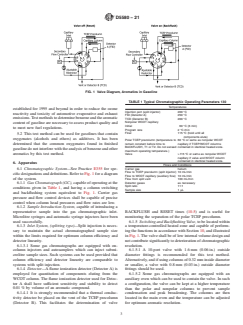
6.1 Chromatographic System—See Practice E355 for specific designations and definitions. Refer to Fig. 1 for a diagram of the
system.
D5580 − 21
FIG. 1 Valve Diagram, Aromatics in Gasoline
6.1.1 Gas Chromatograph (GC), capable of operating at the conditions given in Table 1, and having a column switching and
backflushing system equivalent to Fig. 1. Carrier gas pressure and flow control devices shall be capable of precise control when
column head pressures and flow rates are low.
6.1.2 Sample Introduction System, capable of introducing a representative sample into the gas chromatographic inlet. Microlitre
syringes and automatic syringe injectors have been used successfully.
6.1.3 Inlet System, (splitting type)—Split injection is necessary to maintain the actual chromatographed sample size within the
limits required for optimum column efficiency and detector linearity.
6.1.3.1 Some gas chromatographs are equipped with on-column injectors and autosamplers which can inject submicrolitre sample
sizes. Such systems can be used provided that column efficiency and detector linearity are comparable to systems with split
injection.
6.1.4 Detector—A flame ionization detector (Detector A) is employed for quantitation of components eluting from the WCOT
column. The flame ionization detector used for Detector A shall have sufficient sensitivity and stability to detect 0.01 % by volume
of an aromatic compound.
6.1.4.1 It is strongly recommended that a thermal conductivity detector be placed on the vent of the TCEP precolumn (Detector
B). This facilitates the determination of valve BACKFLUSH and RESET times (10.5) and is useful for monitoring the separation
of the polar TCEP precolumn.
6.1.5 Switching and Backflushing Valve, to be located within a temperature-controlled heated zone and capable of performing the
functions in accordance with Section 10, and illustrated in Fig. 1. The valve shall be of low internalvolume internal volume design
and not contribute significantly to deterioration of chromatographic resolution.
6.1.5.1 A 10-port valve with 1.6 mm (0.06 in.) outside diameter fittings is recommended for this test method. Alternatively, and
if using columns of 0.32 mm inside diameter or smaller, a valve with 0.8 mm (0.03 in.) outside diameter fittings should be used.
6.1.5.2 Some gas chromatographs are equipped with an auxiliary oven which can be used to contain the valve. In such a
configuration, the valve can be kept at a higher temperature than the polar and nonpolar columns to prevent sample condensation
and peak broadening. The columns are then located in the main oven and the temperature can be adjusted for optimum aromatic
resolution.
6.1.5.3 An automatic valve switching device is strongly recommended to ensure repeatable switching times.
6.2 Data Acquisition System:
6.2.1 Integrator or Computer, capable of providing real-time graphic and digital presentation of the chromatographic data are
recommended for use. Peak areas and retention times can be measured by computer or electronic integration.
D5580 − 21
TABLE 1 Typical Chromatographic Operating Parameters 130
Temperatures
Injection port (split injector) 200 °C
FID (Detector A) 250 °C
TCD (Detector B) 200 °C
Nonpolar WCOT capillary
Initial 60 °C (6 min)
Program rate 2 °C ⁄min
Final 115 °C (hold until all
components elute)
Polar TCEP precolumn (temperature to 60 °C or same as nonpolar WCOT
remain constant before time to capillary if TCEP/WCOT columns
BACKFLUSH, T1 or T2. Do not exceed contained in identical heated zone.
maximum operating temperature.)
Valve >115 °C or same as nonpolar WCOT
capillary if valve and WCOT column
contained in identical heated zone.
Flows and Conditions
Carrier gas helium
Flow to TCEP precolumn (split injector) 10 mL/min
Flow to WCOT capillary (auxiliary flow) 10 mL/min
Flow from split vent 100 mL/min
Detector gases as necessary
Split ratio 11:1
Sample size 1 μL
6.2.1.1 It is recommended that this device be capable of performing multilevel internal-standard-type calibrations and be able to
calculate the correlation coefficient (r ) and linear least square fit equation for each calibration data set in accordance with 11.4.
6.3 Chromatographic Columns (two columns are used):
6.3.1 Polar Precolumn, to perform a pre-separation of the aromatics from nonaromatic hydrocarbons in the same boiling point
range. Any column with equivalent or better chromatographic efficiency and selectivity in accordance with 6.3.1.1 can be used.
6.3.1.1 TCEP Micro-Packed Column, 560 mm (22 in.) by 1.6 mm ( ⁄16 in.) outside diameter by 0.76 mm (0.030 in.) inside
diameter stainless steel tube packed with 0.14 g to 0.15 g of 20 % (mass/mass) TCEP on 80/100 mesh Chromosorb P(AW). This
column was used in the cooperative study to provide the precision and bias data referred to in Section 15.
6.3.2 Nonpolar (Analytical) Column—Any column with equivalent or better chromatographic efficiency and selectivity in
accordance with 6.3.2.1 can be used.
6.3.2.1 WCOT Methyl Silicone Column, 30 m long by 0.53 mm inside diameter fused silica WCOT column with a 5.0 μm film
thickness of cross-linked methyl siloxane.
7. Reagents and Materials
7.1 Carrier Gas, appropriate to the type of detector used. Helium has been used successfully. The minimum purity of the carrier
gas used must be 99.95 mol %. Additional purification may be necessary to remove trace amounts of oxygen. (Warning—Helium
is usually supplied as a compressed gas under high pressure.)pressure.)
7.2 Methylene Chloride—Used for column preparation. Reagent grade, free of nonvolatile residue. (Warning—Harmful when
ingested or inhaled at high concentrations.)concentrations.)
7.3 2,2,4-Trimethylpentane (isooctane)—Used as a solvent in the preparation of the calibration mixture. Reagent grade.
(Warning—Isooctane is flammable and can be harmful or fatal when ingested or inhaled.)
7.4 Standards for Calibration and Identification, required for all components to be analyzed and the internal standard. Standards
are used for establishing identification by retention time as well as calibration for quantitative measurements. These materials shall
be of known purity and free of the other components to be analyzed. (Warning—These materials are flammable and may be
harmful or fatal when ingested or inhaled.)
D5580 − 21
8. Preparation of Columns
8.1 TCEP Column Packing:
8.1.1 Use any satisfactory method, that will produce a column capable of retaining aromatics from nonaromatic components of
the same boiling point range in a gasoline sample. The following procedure has been used successfully.
8.1.2 Completely dissolve 10 g of TCEP in 100 mL of methylene chloride. Next add 40 g of 80/100 mesh Chromosorb P(AW) to
the TCEP solution. Quickly transfer this mixture to a drying dish, in a fume hood, without scraping any of the residual packing
from the sides of the container. Constantly, but gently, stir the packing until all of the solvent has evaporated. This column packing
can be used immediately to prepare the TCEP column.
8.2 Micro-packed TCEP Column:
8.2.1 Wash a straight 560 mm (22 in.) length of 1.6 mm ( ⁄16 in.) outside diameter, 0.76 mm (0.030 in.) inside diameter stainless
steel tubing with methanol and dry with compressed nitrogen.
8.2.2 Insert 6 to 12 strands of silvered wire, a small mesh screen or stainless steel frit inside one end of the tube. Slowly add 0.14 g
to 0.15 g of packing material to the column and gently vibrate to settle the packing inside the column. Insert silvered wire, mesh
screen, or frit to the other end of the tube to prevent the packing material from falling. When strands of wire are used to retain
the packing material inside the column, leave 6.0 mm (0.25 in.) of space at the top of the column.
8.3 WCOT Methyl Silicone Column—It is suggested that this column be purchased directly from a suitable capillary column
manufacturer (see 6.3.2.1).
9. Sampling
9.1 Every effort should be made to ensure that the sample is representative of the fuel source from which it is taken. Follow the
recommendations of Practice D4057, or its equivalent, when obtaining samples from bulk storage or pipelines.
9.2 Appropriate steps should be taken to minimize the loss of light hydrocarbons from the gasoline sample to be analyzed. Upon
receipt in the laboratory, chill the sample in its original container from 0 °C to 5 °C (32 °F to 40 °F) before and after sub-sampling
is performed.
9.3 If necessary, transfer the chilled sample to a vaportight container and store at 0 °C to 5 °C (32 °F to 40 °F) until needed for
analysis.
10. Preparation of Apparatus and Establishment of Conditions
10.1 Assembly—Connect the TCEP and WCOT column to the valve system (Fig. 1) using low-volume connectors and narrow bore
tubing. It is important to minimize the volume of the chromatographic system that comes in contact with the sample, otherwise
peak broadening will occur.
10.2 Initial Operating Conditions—Adjust the operating conditions initially to approximately those listed in Table 1, but do not
turn on the detector circuits. Check the system for leaks before proceeding further.
10.2.1 If different polar and nonpolar columns are used, or WCOT capillary columns of smaller inner diameter or different film
thickness, or both, are used, it may be necessary to use different optimum flows and temperatures.
10.2.2 Conditions listed in Table 1 are applicable to the columns described in 6.3. If a WCOT column of a different film thickness
is used, the conditions chosen for the analysis must sufficiently separate toluene from the internal standard (first analysis) and
ethylbenzene from the xylenes (second analysis).
10.3 Flow Rate (Carrier Gas) Adjustments:
10.3.1 Attach a flow measuring device to the precolumn vent (or Detector B) with the valve in the RESET or forward flow position
D5580 − 21
and adjust the pressure of the capillary injection port (Fig. 1) to give approximately 10 mL ⁄min flow (17 psi to 20 psi). Soap bubble
flow meters are suitable. This represents the flow through the polar precolumn.
NOTE 1—The word “approximately” implies to get as close as possible to the stated column flows to initiate the further optimization of the system.
10.3.2 Attach a flow measuring device to the split injector vent and adjust the flow from the split vent using the flow controller
to provide a flow of approximately 100 mL ⁄min. Recheck the column vent flow set in 10.3.1 and adjust, if necessary. The split
ratio should be approximately 11:1. (See Note 1.)
10.3.3 Switch the valve to BACKFLUSH position and adjust the variable restrictor to give the same precolumn vent flow set in
10.3.1. This is necessary to minimize flow changes when the valve is switched.
10.3.4 Switch the valve to the RESET position and adjust the auxiliary flow controller to give a flow of approximately 10 mL ⁄min
at the Detector A (FID) exit. (See Note 1.)
10.4 Detector Setup—Depending on the particular type of instrumentation used, adjust the hydrogen, air, and makeup flows to the
flame ionization detector and ignite the flame. If a thermal conductivity detector (Detector B) is being used to monitor the vent
effluent in the valve RESET position, set the reference flow and turn on the detector circuit.
10.5 Valve Backflush and Reset Times:
10.5.1 The time to BACKFLUSH and RESET the valve will vary slightly for each column system and must be determined as
described in 10.5.1.1, 10.5.1.2, and 10.5.1.3. The start time of the integrator or computer system and valve timer must be
synchronized with the injection to accurately reproduce the backflush time. This procedure assumes that a thermal conductivity
detector is installed on the precolumn vent line as Detector B (see 6.1.4.1). If a detector is not available, the appropriate valve
BACKFLUSH times, T1 and T2, must be determined experimentally. If the BACKFLUSH times, T1 and T2, are not set correctly
(switched too late), it is possible that part of the benzene and ethylbenzene peaks will be vented.
10.5.1.1 Adjust the valve to RESET (forward flow) and inject 1.0 μL of a blend containing approximately 5 % each of benzene,
ethylbenzene, o-xylene, and 2-hexanone in isooctane. This mixture is used to set the valve timing, therefore, the exact
concentration need not be known. Alternatively, the calibration mixture can be used for this test. Determine retention time in
seconds at which benzene and ethylbenzene start to elute as measured by Detector B. Subtract 6 s from each of these and call these
times to BACKFLUSH, T1 and T2, respectively. The correct time for T1 and T2 is just prior to the elution of benzene and
ethylbenzene from the TCEP precolumn.
NOTE 2—Fig. 2 is an example chromatogram illustrating the elution of a calibration mixture from the polar precolumn using the procedure described in
10.5.1.1. Times to BACKFLUSH, T1 and T2, are indicated on the chromatogram. The times to BACKFLUSH, T1 and T2, should be optimized for each
chromatographic system.
10.5.1.2 Reinject the calibration blend and turn the valve to BACKFLUSH at time T1. When the internal standard peak
(2-hexanone) returns to baseline switch valve back to RESET (forward flow) position. Call this time T3.
10.5.1.3 Reinject the calibration blend and BACKFLUSH at time T2. When the o-xylene peak returns to baseline, switch the valve
back to RESET (forward flow). Call this time T4.
10.6 Polar Precolumn Selectivity Check:
10.6.1 The selectivity of the polar precolumn is critical to allow for accurate determination of the C and heavier aromatics without
non-aromatic interferences. The selectivity must be verified so that for the second analysis, when the time to BACKFLUSH T2
is properly adjusted, all of the C and lighter nonaromatic hydrocarbons are vented from the polar precolumn while the heavier
aromatics are retained. The following test can be used to verify the precolumn performance.
10.6.1.1 Prepare a blend containing approximately 1.7 % n-dodecane in 2,2,4-trimethylpentane (isooctane).(isooctane).
n-Dodecane is used to represent the high boiling nonaromatic hydrocarbons in gasoline. Inject 1.0 μL of the mixture under the
conditions specified in 10.2 to 10.5 and actuate the valve at time T2 (BACKFLUSH) and time T4 (RESET). Record the signals
from both the flame ionization (Detector A) and thermal conductivity (Detector B) detectors. Verify that n-dodecane fully elutes
from the polar precolumn before BACKFLUSH time T2. When monitoring the thermal conductivity detector (Detector B), the
D5580 − 21
FIG. 2 Determination of Precolumn Backflush Times, T1 and T2
n-dodecane peak should return to baseline before BACKFLUSH time T2. If not, part of the n-dodecane peak will be backflushed
to the non-polar WCOT column and be detected by the flame ionization detector after the valve RESET time T4. If a thermal
conductivity detector is not available on the precolumn vent line, the chromatogram obtained by the flame ionization detector can
be used to verify that all the n-dodecane is being vented. This chromatogram should not show any significant response f
...