

ASTM E1530-19
(Test Method)Standard Test Method for Evaluating the Resistance to Thermal Transmission by the Guarded Heat Flow Meter Technique
General Information
- Abstract
SIGNIFICANCE AND USE
5.1 This test method describes a procedure to measure and compare the thermal resistance properties of specimens (less than 25 mm in thickness) under controlled conditions.
SCOPE
1.1 This test method describes a steady-state technique for the determination of the resistance to thermal transmission (thermal resistance) of materials having a thickness of less than 25 mm. Thermal conductivity may be determined for homogeneous opaque solid specimens (see Note 1). This test method is particularly useful for homogeneous, multilayer, and composite specimens having a thermal resistance in the range from 10 (cm)2·K·W-1 to 400 (cm)2·K·W-1, which may be obtained from materials with an approximate thermal conductivity range 0.1 W·m-1·K-1 to 30 W·m-1·K-1 over the approximate temperature range from 150 K to 600 K. It can be used outside these ranges with reduced accuracy for thicker specimens and for thermal conductivity values up to 60 W·m-1·K-1.
Note 1: A body is considered homogeneous when the property to be measured is found to be independent of specimen dimensions.
1.2 This test method is similar in concept to Test Method C518, but is modified to accommodate smaller test specimens, having a higher thermal conductance. In addition, significant attention has been paid to ensure that the thermal resistance of contacting surfaces is minimized and reproducible.
1.3 The values stated in SI units are to be regarded as standard. No other units of measurement are included in this standard.
1.4 This standard does not purport to address all of the safety concerns, if any, associated with its use. It is the responsibility of the user of this standard to establish appropriate safety, health, and environmental practices and determine the applicability of regulatory limitations prior to use.
1.5 This international standard was developed in accordance with internationally recognized principles on standardization established in the Decision on Principles for the Development of International Standards, Guides and Recommendations issued by the World Trade Organization Technical Barriers to Trade (TBT) Committee.
- Status
- Published
- Publication Date
- 31-Jan-2019
- Technical Committee
- E37 - Thermal Measurements
- Drafting Committee
- E37.05 - Thermophysical Properties
Buy Documents
ASTM E1530-19 - Standard Test Method for Evaluating the Resistance to Thermal Transmission by the Guarded Heat Flow Meter Technique
REDLINE ASTM E1530-19 - Standard Test Method for Evaluating the Resistance to Thermal Transmission by the Guarded Heat Flow Meter Technique
Overview
ASTM E1530-19, issued by ASTM International, specifies the Standard Test Method for Evaluating the Resistance to Thermal Transmission by the Guarded Heat Flow Meter Technique. This method provides a steady-state procedure for determining the thermal resistance of materials less than 25 mm in thickness under controlled laboratory conditions. It is widely used to obtain quantitative data on how well materials resist heat flow, supporting quality control, product development, and thermal management across various industries.
The guarded heat flow meter technique offers accurate, reproducible measurement of thermal resistance and, for homogeneous, opaque solids, allows for the calculation of thermal conductivity, a key thermal property. The standard focuses on minimizing and standardizing the contact resistance between specimen and plates, thus enhancing measurement reliability for solid, multilayer, and composite specimens.
Key Topics
- Thermal Resistance Measurement: The test method determines the thermal resistance (R-value) of materials, primarily those with thicknesses below 25 mm.
- Guarded Heat Flow Meter Technique: Utilizes a heat flux transducer sandwiched between temperature-controlled plates, surrounded by a heated guard to minimize lateral heat loss.
- Thermal Conductivity Calculation: For homogeneous opaque solids, thermal conductivity (λ) can be calculated based on the measured resistance.
- Calibration: Involves reference specimens with known properties to ensure the system’s results are consistent and traceable.
- Precision and Reliability: The method ensures high precision within laboratories and good reproducibility across laboratories, critical attributes for standardized testing.
- Specimen and Apparatus Requirements: Detailed guidance is provided on specimen preparation, apparatus configuration, and measurement conditions to support reliable, repeatable results.
Applications
The ASTM E1530-19 standard is widely applied across multiple sectors where understanding and controlling heat flow through materials is essential. Notable application areas include:
- Building and Insulation Materials: Evaluating the thermal resistance of insulation boards, foams, and composites to comply with energy efficiency requirements.
- Automotive and Aerospace Components: Assessing thermal management materials, gaskets, and composites to enhance safety and performance.
- Industrial Manufacturing: Testing solid and composite materials for thermal barriers, protective linings, and process components.
- Electronics: Characterizing the thermal properties of circuit board materials, thermal interface materials (TIMs), and packaging solutions.
- Research and Development: Providing a baseline measurement for new materials and comparing performance during product improvement cycles.
The test method is particularly suited for:
- Homogeneous solids
- Multilayer and composite specimens with moderate to high thermal conductance
- Materials with thermal resistances from 10 to 400 (cm²·K·W⁻¹) and conductivities from 0.1 to 30 W·m⁻¹·K⁻¹ (with extended, but lower accuracy, usage outside this range)
Related Standards
Several ASTM standards are closely linked to ASTM E1530-19, supporting calibration, terminology, and alternative measurement techniques for evaluating thermal properties:
- ASTM C518 – Test Method for Steady-State Thermal Transmission Properties by Means of the Heat Flow Meter Apparatus (for larger or higher insulating specimens)
- ASTM C1045 – Practice for Calculating Thermal Transmission Properties Under Steady-State Conditions
- ASTM E220 – Test Method for Calibration of Thermocouples by Comparison Techniques
- ASTM E1142 – Terminology Relating to Thermophysical Properties
- ASTM E1225 – Test Method for Thermal Conductivity of Solids Using the Guarded-Comparative-Longitudinal Heat Flow Technique
- ASTM F104 – Classification System for Nonmetallic Gasket Materials
- ASTM F433 – Practice for Evaluating Thermal Conductivity of Gasket Materials
Adherence to ASTM E1530-19 and its related standards ensures comparability, reliability, and industry-accepted practices in measuring and specifying thermal resistance and conductivity for material selection, certification, and thermal system design.
Relations
- Effective Date
- 01-Feb-2019
- Effective Date
- 01-Sep-2015
- Effective Date
- 01-May-2010
- Effective Date
- 01-May-2004
- Effective Date
- 10-Sep-2002
- Effective Date
- 01-Feb-2019
- Referred By
ASTM D8104-17(2023) - Standard Guide for Determining Coating Qualification Test Data Applicability - Effective Date
- 01-Feb-2019
- Effective Date
- 01-Feb-2019
- Effective Date
- 01-Feb-2019
- Effective Date
- 01-Feb-2019
- Referred By
ASTM D5144-08(2021) - Standard Guide for Use of Protective Coating Standards in Nuclear Power Plants - Effective Date
- 01-Feb-2019
Buy Documents
ASTM E1530-19 - Standard Test Method for Evaluating the Resistance to Thermal Transmission by the Guarded Heat Flow Meter Technique
REDLINE ASTM E1530-19 - Standard Test Method for Evaluating the Resistance to Thermal Transmission by the Guarded Heat Flow Meter Technique
Get Certified
Connect with accredited certification bodies for this standard

BSMI (Bureau of Standards, Metrology and Inspection)
Taiwan's standards and inspection authority.
Sponsored listings
Frequently Asked Questions
ASTM E1530-19 is a standard published by ASTM International. Its full title is "Standard Test Method for Evaluating the Resistance to Thermal Transmission by the Guarded Heat Flow Meter Technique". This standard covers: SIGNIFICANCE AND USE 5.1 This test method describes a procedure to measure and compare the thermal resistance properties of specimens (less than 25 mm in thickness) under controlled conditions. SCOPE 1.1 This test method describes a steady-state technique for the determination of the resistance to thermal transmission (thermal resistance) of materials having a thickness of less than 25 mm. Thermal conductivity may be determined for homogeneous opaque solid specimens (see Note 1). This test method is particularly useful for homogeneous, multilayer, and composite specimens having a thermal resistance in the range from 10 (cm)2·K·W-1 to 400 (cm)2·K·W-1, which may be obtained from materials with an approximate thermal conductivity range 0.1 W·m-1·K-1 to 30 W·m-1·K-1 over the approximate temperature range from 150 K to 600 K. It can be used outside these ranges with reduced accuracy for thicker specimens and for thermal conductivity values up to 60 W·m-1·K-1. Note 1: A body is considered homogeneous when the property to be measured is found to be independent of specimen dimensions. 1.2 This test method is similar in concept to Test Method C518, but is modified to accommodate smaller test specimens, having a higher thermal conductance. In addition, significant attention has been paid to ensure that the thermal resistance of contacting surfaces is minimized and reproducible. 1.3 The values stated in SI units are to be regarded as standard. No other units of measurement are included in this standard. 1.4 This standard does not purport to address all of the safety concerns, if any, associated with its use. It is the responsibility of the user of this standard to establish appropriate safety, health, and environmental practices and determine the applicability of regulatory limitations prior to use. 1.5 This international standard was developed in accordance with internationally recognized principles on standardization established in the Decision on Principles for the Development of International Standards, Guides and Recommendations issued by the World Trade Organization Technical Barriers to Trade (TBT) Committee.
SIGNIFICANCE AND USE 5.1 This test method describes a procedure to measure and compare the thermal resistance properties of specimens (less than 25 mm in thickness) under controlled conditions. SCOPE 1.1 This test method describes a steady-state technique for the determination of the resistance to thermal transmission (thermal resistance) of materials having a thickness of less than 25 mm. Thermal conductivity may be determined for homogeneous opaque solid specimens (see Note 1). This test method is particularly useful for homogeneous, multilayer, and composite specimens having a thermal resistance in the range from 10 (cm)2·K·W-1 to 400 (cm)2·K·W-1, which may be obtained from materials with an approximate thermal conductivity range 0.1 W·m-1·K-1 to 30 W·m-1·K-1 over the approximate temperature range from 150 K to 600 K. It can be used outside these ranges with reduced accuracy for thicker specimens and for thermal conductivity values up to 60 W·m-1·K-1. Note 1: A body is considered homogeneous when the property to be measured is found to be independent of specimen dimensions. 1.2 This test method is similar in concept to Test Method C518, but is modified to accommodate smaller test specimens, having a higher thermal conductance. In addition, significant attention has been paid to ensure that the thermal resistance of contacting surfaces is minimized and reproducible. 1.3 The values stated in SI units are to be regarded as standard. No other units of measurement are included in this standard. 1.4 This standard does not purport to address all of the safety concerns, if any, associated with its use. It is the responsibility of the user of this standard to establish appropriate safety, health, and environmental practices and determine the applicability of regulatory limitations prior to use. 1.5 This international standard was developed in accordance with internationally recognized principles on standardization established in the Decision on Principles for the Development of International Standards, Guides and Recommendations issued by the World Trade Organization Technical Barriers to Trade (TBT) Committee.
ASTM E1530-19 is classified under the following ICS (International Classification for Standards) categories: 17.200.10 - Heat. Calorimetry. The ICS classification helps identify the subject area and facilitates finding related standards.
ASTM E1530-19 has the following relationships with other standards: It is inter standard links to ASTM E1530-11(2016), ASTM C518-15, ASTM C518-10, ASTM C518-04, ASTM C518-02e1, ASTM D6744-06(2017)e1, ASTM D8104-17(2023), ASTM C1470-20, ASTM D8157-19, ASTM F942-18(2023)e1, ASTM D5144-08(2021). Understanding these relationships helps ensure you are using the most current and applicable version of the standard.
ASTM E1530-19 is available in PDF format for immediate download after purchase. The document can be added to your cart and obtained through the secure checkout process. Digital delivery ensures instant access to the complete standard document.
Standards Content (Sample)
This international standard was developed in accordance with internationally recognized principles on standardization established in the Decision on Principles for the
Development of International Standards, Guides and Recommendations issued by the World Trade Organization Technical Barriers to Trade (TBT) Committee.
Designation: E1530 − 19
Standard Test Method for
Evaluating the Resistance to Thermal Transmission by the
Guarded Heat Flow Meter Technique
This standard is issued under the fixed designation E1530; the number immediately following the designation indicates the year of
original adoption or, in the case of revision, the year of last revision.Anumber in parentheses indicates the year of last reapproval.A
superscript epsilon (´) indicates an editorial change since the last revision or reapproval.
1. Scope* 2. Related Documents
1.1 This test method describes a steady-state technique for 2.1 ASTM Standards:
the determination of the resistance to thermal transmission C518Test Method for Steady-State Thermal Transmission
(thermalresistance)ofmaterialshavingathicknessoflessthan Properties by Means of the Heat Flow Meter Apparatus
25mm.Thermal conductivity may be determined for homoge-
3. Terminology
neousopaquesolidspecimens(seeNote1).Thistestmethodis
particularly useful for homogeneous, multilayer, and compos- 3.1 Definitions of Terms Specific to This Standard:
ite specimens having a thermal resistance in the range from 10
3.1.1 heat flux transducer (HFT), n—a device that produces
2 -1 2 -1
(cm) ·K·W to 400(cm) ·K·W , which may be obtained from an electrical output that is a function of the heat flux, in a
materials with an approximate thermal conductivity range 0.1
predefined and reproducible manner.
-1 -1 -1 -1
W·m ·K to 30W·m ·K over the approximate temperature
3.1.2 thermal conductance (C), n—thetimerateofheatflux
rangefrom150Kto600K.Itcanbeusedoutsidetheseranges
through a unit area of a body induced by unit temperature
with reduced accuracy for thicker specimens and for thermal
difference between the body surfaces.
-1 -1
conductivity values up to 60W·m ·K .
3.1.2.1 average temperature of a surface, n—the area-
NOTE 1—A body is considered homogeneous when the property to be
weighted mean temperature of that surface.
measured is found to be independent of specimen dimensions.
3.1.2.2 average (mean) temperature of a specimen (disc
1.2 This test method is similar in concept to Test Method
shaped), n—the mean value of the upper and lower face
C518, but is modified to accommodate smaller test specimens,
temperatures.
having a higher thermal conductance. In addition, significant
3.1.3 thermal conductivity (λ)—(of a solid material), n—the
attention has been paid to ensure that the thermal resistance of
time rate of heat flow, under steady conditions, through unit
contacting surfaces is minimized and reproducible.
area,perunittemperaturegradientinthedirectionperpendicu-
1.3 The values stated in SI units are to be regarded as
lar to the area:
standard. No other units of measurement are included in this
3.1.3.1 apparent thermal conductivity, n—when other
standard.
modes of heat transfer through a material are present in
1.4 This standard does not purport to address all of the
addition to conduction, the results of the measurements per-
safety concerns, if any, associated with its use. It is the
formed in accordance with this test method will represent the
responsibility of the user of this standard to establish appro-
apparent or effective thermal conductivity for the material
priate safety, health, and environmental practices and deter-
tested.
mine the applicability of regulatory limitations prior to use.
3.1.4 thermal resistance (R), n—the reciprocal of thermal
1.5 This international standard was developed in accor-
conductance.
dance with internationally recognized principles on standard-
3.2 Symbols:
ization established in the Decision on Principles for the
Development of International Standards, Guides and Recom-
-1 -1
λ = thermal conductivity, W·m ·K
mendations issued by the World Trade Organization Technical
-2 -1
C = thermal conductance, W·m ·K
Barriers to Trade (TBT) Committee. 2 -1
R = thermal resistance, m ·K·W
∆x = specimen thickness, mm
ThistestmethodisunderthejurisdictionofASTMCommitteeE37onThermal
Measurements and is the direct responsibility of Subcommittee E37.05 on Thermo-
physical Properties. For referenced ASTM standards, visit the ASTM website, www.astm.org, or
Current edition approved Feb. 1, 2019. Published February 2019. Originally contact ASTM Customer service at service@astm.org. For Annual Book of ASTM
approved in 1993. Last previous edition approved in 2016 as E1530–11 (2016). Standards volume information, refer to the standard’s Document Summary page on
DOI: 10.1520/E1530-19. the ASTM website.
*A Summary of Changes section appears at the end of this standard
Copyright © ASTM International, 100 Barr Harbor Drive, PO Box C700, West Conshohocken, PA 19428-2959. United States
E1530 − 19
proportionality is obtained through prior calibration of the
A = specimen cross-sectional area, m
system with specimens of known thermal resistance measured
Q = heat flow, W
under the same conditions, such that contact resistance at the
φ = heat flux transducer output, mV
-2 -1
N = heat flux transducer calibration constant, W·m ·mV surfaces can be made reproducible.
Nφ = heat flux, W·m
5. Significance and Use
∆T = temperature difference, °C
T = temperature of guard heater, °C
g 5.1 This test method describes a procedure to measure and
T = temperature of upper heater, °C
u
compare the thermal resistance properties of specimens (less
T = temperature of lower heater, °C
l
than 25 mm in thickness) under controlled conditions.
T = temperature of one surface of the specimen, °C
T = temperature of the other surface of the specimen, °C
2 6. Apparatus
T = mean temperature of the specimen, °C
m
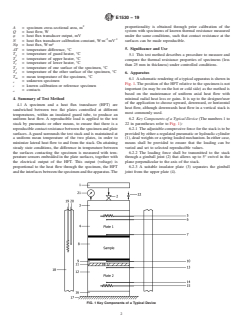
6.1 Aschematicrenderingofatypicalapparatusisshownin
= unknown specimen
s
Fig. 1. The position of the HFT relative to the specimen is not
= known calibration or reference specimen
r
important (in may be on the hot or cold side) as the method is
= contacts
o
based on the maintenance of uniform axial heat flow with
4. Summary of Test Method minimal radial heat loss or gains. It is up to the designer/user
of the application to choose upward, downward, or horizontal
4.1 A specimen and a heat flux transducer (HFT) are
heat flow, although downwards heat flow in a vertical stack is
sandwiched between two flat plates controlled at different
most commonly used.
temperatures, within an insulated guard tube, to produce an
uniform heat flow. A reproducible load is applied to the test 6.2 Key Components of a Typical Device (The numbers 1 to
stack by pneumatic or other means, to ensure that there is a 22 in parentheses refer to Fig. 1):
reproduciblecontactresistancebetweenthespecimenandplate 6.2.1 Theadjustablecompressiveforceforthestackistobe
surfaces.Aguard surrounds the test stack and is maintained at provided by either a regulated pneumatic or hydraulic cylinder
a uniform mean temperature of the two plates, in order to (1),deadweightsoraspringloadedmechanism.Ineithercase,
minimize lateral heat flow to and from the stack. On attaining means shall be provided to ensure that the loading can be
steady state conditions, the difference in temperature between varied and set to selected reproducible values.
the surfaces contacting the specimen is measured with tem- 6.2.2 The loading force shall be transmitted to the stack
perature sensors embedded in the plate surfaces, together with through a gimball joint (2) that allows up to 5° swivel in the
the electrical output of the HFT. This output (voltage) is plane perpendicular to the axis of the stack.
proportional to the heat flow through the specimen, the HFT 6.2.3 A suitable insulator plate (3) separates the gimball
andtheinterfacesbetweenthespecimenandtheapparatus.The joint from the upper plate (4).
FIG. 1 Key Components of a Typical Device
E1530 − 19
NOTE 3—Useful information on interfacial materials used for this test
6.2.4 The upper plate (assumed to be the hot plate for the
method is available from literature.
purposes of this description) is equipped with a heater (5) and
NOTE4—Thecross-sectionalareaandtheshapeofthespecimencanbe
control temperature sensor (6) adjacent to the heater, to
any, however, circular and rectangular cross sections are most commonly
maintain the desired temperature. (Other means of producing
used. Minimum size is dictated by the magnitude of the disturbance
and maintaining temperature may also be used providing the
caused by thermal sensors in relation to the overall flux distribution. The
most common sizes are 25 mm and 50 mm disks.
requirements in 6.3 are met.) The construction of the upper
plate is such as to ensure uniform heat distribution across the
6.2.11 Themeasurementsystemispreferablyequippedwith
faceincontactwiththespecimen(8).Atemperaturesensor(7)
suitable means (21) to measure the in situ thickness of the
that defines the temperature of the interface on the plate side is
specimen and provide a means (22) to limit compression when
attachedtothisface(orembeddedincloseproximitytoit)such
testing soft materials.
that it does not interfere with the specimen/plate interface.
NOTE 5—This requirement is also mandatory for testing materials that
6.2.5 The specimen (8) is in direct contact with the upper
soften while heated.
plate on one side and an intermediate plate (9) on the other
6.3 Requirements:
side.
6.3.1 Temperature control of upper and lower plate is to be
6.2.6 The intermediate plate (9) is an optional item. Its
60.1°C or better.
purpose is to provide a highly conductive environment to the
6.3.2 Reproducible load of 0.28MPa has been found to be
second temperature sensor (10), to obtain an average tempera-
satisfactory for solid specimens. The minimum load shall not
ture of the surface. If the temperature sensor (10) is embedded
be less than 0.07MPa.
into the face of the HFT, or other means are provided to define
6.3.3 Temperature sensors are usually fine gage or small-
the temperature of the surface facing the specimen, the use of
diameter sheath thermocouples, however, ultraminiature resis-
the intermediate plate is not mandatory.
tance thermometers and linear thermistors may also be used.
6.2.7 The heat flux transducer (HFT) is a device that will
6.3.4 Operating range of a device using a mean temperature
generate an electrical signal in proportion to the heat flux
guard shall be limited to from −100 °C to 300 °C, when using
acrossit.Thelevelofoutputrequired(sensitivity)significantly
thermocouples as temperature sensors, and from −180 °C to
depends on the rest of the instrumentation used for its
300 °C when platinum resistance thermometers are used.
evaluation.TheoverallperformanceoftheHFTanditsreadout
Thermistors are normally present on more restricted allowable
instrumentation shall be such as to meet the requirements in
temperature range of use.
Section 13.
6.2.8 The lower plate (12) is constructed similarly to the
7. Sampling and Conditioning
upper plate (4), except it is positioned as the mirror image.
7.1 Cut representative test specimens from larger pieces of
Both plates shall have a uniform thickness with the surfaces in
the sample material or body.
contact with the specimen being flat and parallel and having a
surface roughness of less than 10 µm maximum.
7.2 Condition the cut specimens in accordance with the
6.2.9 An insulator plate (16) separates the lower plate (12)
requirements of the appropriate material specifications, if any.
from the heat sink (17). In case of using circulating fluid in
place of a heater/temperature sensor arrangement in the upper 8. Test Specimen
or lower plates, or both, the heat sink may or may not be
8.1 The specimen to be tested should be representative for
present.
the sample material. The recommended specimen configura-
6.2.10 The entire stack is surrounded by a guard tube,
tions of 25 mm or 50 mm 60.25mm diameter disks or
insulated from heat losses to the outside, with a cross section
squares, shall have smooth flat and parallel surfaces, having a
that is not too different from that of the stacks (18) equipped
finish of 10 µm or less where possible, such that a uniform
with a heater or cooling coils (19), or both, and a similar
thickness within 60.025mm is attained in the range from 0.5
control temperature sensor (20) to maintain it at the mean
mm to 25.4mm For testing specimens having a thickness less
temperature between the upper and lower plates. A small,
than 0.5mm, an alternative technique, described in AnnexA1,
generally unfilled, gap separates the guard from the stack. For
is required.
instruments limited to operate in the ambient region, no guard
isnecessaryalthoughtheuseofadraftshieldisrecommended.
9. Calibration
NOTE 2—For materials in the higher thermal conductivity range, in 9.1 Calibrationofthesystemshallbeundertakenusingaset
particular, it is permissible to use a very thin layer of a suitable high
of reference specimens having a range of thermal resistance
conductivity contact medium on the contacting surfaces of the specimen
achieved using different materials of known thermal conduc-
to further reduce the thermal resistance of the interface and promote
tivity or using different thickness of the same materials.
uniform thermal contact across the interface area. Calibration shall be
performed under similar conditions of use or non-use of the contact
NOTE 6—At this writing (2017), there is a very limited number of
medium.
appropriate reference materials available. Comprehensive information,
Stacey, C., Sumpkin, A. J., and Jarrett, R. N., “Techniques for Reducing
Thermal Contact Resistance in Steady-State Thermal Conductivity Measurements
on Polymer Composites,” International Journal of Thermophysics,Vol 37, 2016, p.
107.
E1530 − 19
TABLE 1 Typical Thermal Resistance Values of Specimens of Different Materials
Approximate Thermal Conductivity, Thickness, Approximate Thermal Resistance,
Material
-1 -1 2 -1
W·m ·K at 30 °C mm (cm) ·K·W at 30 °C
A
Vespel Polyimide SP1 0.4 20 500
A
Vespel Polyimide SP1 0.4 10 250
A
Vespel Polyimide SP1 0.4 1 25
Polyethylene 0.2 1 50
Polyethylene 0.2 0.5 25
Polyethylene 0.2 0.1 5
B
Pyroceram 9606 420 50
B
Pyroceram 9606 410 25
B
Pyrex 7740 Glass 1 20 200
B
Pyrex 7740 Glass 1 10 100
B
Pyrex 7740 Glass 1 1 10
304 Stainless Steel 14 20 14
304 Stainless Steel 14 10 7
A
Vespel is a product and trademark of DuPont, Wilmington, DE.
B
Pyrex 7740 and Pyroceram 9606 are products and trademarks of Corning Glass Co.
TABLE 2 Thermal Conductivity Values of Selected Reference TABLE 3 Thermal Conductivity Values of Selected Reference
A,B
Materials Materials
-1 -1
-1 -1
Thermal Conductivity (W·m ·K )
Thermal Conductivity (W·m ·K )
Temperature (°C)
A B C
310 430
Vespel SP1 Pyrex 7740 Pyroceram 9696
Temperature (°C)
Inconel Nimonic
Stainless Stainless
–50 { 1.010 { 600 75
Steel Steel
0 { 1.104 {
50 13.2 20.9 13.3 12.8
25 0.377 1.177 4.06
100 14.1 21.6 14.2 13.7
100 0.391 1.236 3.71
200 15.9 22.8 15.9 15.4
200 0.413 1.330 3.42
D
300 17.7 23.8 17.8 17.2
300 0.436 1.447 3.23
400 19.5 24.5 19.7 19.1
400 {{ 3.10
500 21.2 24.9 21.7 21.1
500 {{ 3.00
600 23.0 25.1 23.7 23.1
600 {{ 2.92
700 24.8 25.9 25.8 25.2
700 {{ 2.86
750 25.7 26.4 26.9 26.2
800 {{ 2.81
900 {{ 2.77 A
Clark, J., and Tye, R., “Thermophysical Properties Reference Data for Some Key
1000 {{ 2.71
Engineering Alloys,” High Temperatures – High Pressures, Vol 35/36, 2003/2004,
A
pp. 1–14.
Jacobs-Fedore, R. A., and Stroe, D. E., “Thermophysical Properties of Vespel
B
Tye, R. P., and Salmon, D. R, “Development of New Thermal Conductivity
SP1,” in Thermal Conductivity 27: Thermal Expansion 15, DEStech Publications,
Reference Materials: A Summary of Recent Contributions by National Physical
Lancaster, PA, 2004, pp. 231–238.
B
Laboratory,” in Thermal Conductivity 27: Thermal Expansion 15, DEStech
Tye, R. P., Hume, D., “Reference Materials for Thermal Transport Property
Publications, Lancaster, PA, 2004, pp. 372–381.
Measurements,” Journal of Thermal Analysis and Calorimetry, 2017, pp. 1–11.
C
Salmon, D., Roebben, G., Lamberty, A., Brandt, R., “Certification of Thermal
Conductivity and Thermal Diffusivity Up to 1025 K of a Glass-Ceramic Reference
Material BCR-724,” EUR Report 21764 EN, European Commission, Geel,
Belgium, 2007.
5 5
D
calibration are Pyrex 7740 (a glass) and Pyroceram 96063 (a
Powell, R. W., Ho, C. Y., and Liley, P. E., Thermal Conductivity of Selected
Materials, Special Publication NSRDS, National Bureau of Standards,
ceramic), Vespel (a polyimide, a polymer), polymethylmeth-
Washington, DC 1966.
acrylate(PMMA,apolymer),andoneofseveralstainlesssteel
(a metal).
9.4 Table 2 and Table 3 list thermal conductivity values for
selected reference materials. Their temperature range of
including source, description, material type, range of application,
application, in some cases, exceeds the applicable temperature
availability, and properties is available.
range for this test method but the information is considered
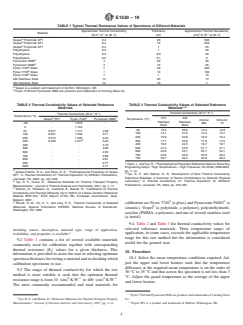
9.2 Table 1 contains a list of several available materials
useful for the general user.
commonly used for calibr
...
This document is not an ASTM standard and is intended only to provide the user of an ASTM standard an indication of what changes have been made to the previous version. Because
it may not be technically possible to adequately depict all changes accurately, ASTM recommends that users consult prior editions as appropriate. In all cases only the current version
of the standard as published by ASTM is to be considered the official document.
Designation: E1530 − 11 (Reapproved 2016) E1530 − 19
Standard Test Method for
Evaluating the Resistance to Thermal Transmission of
Materials by the Guarded Heat Flow Meter Technique
This standard is issued under the fixed designation E1530; the number immediately following the designation indicates the year of
original adoption or, in the case of revision, the year of last revision. A number in parentheses indicates the year of last reapproval. A
superscript epsilon (´) indicates an editorial change since the last revision or reapproval.
1. Scope Scope*
1.1 This test method coversdescribes a steady-state technique for the determination of the resistance to thermal transmission
(thermal resistance) of materials of thicknesses having a thickness of less than 25 mm. For homogeneous opaque solid specimens
of a representative thickness, thermal conductivity can be determined Thermal conductivity may be determined for homogeneous
opaque solid specimens (see Note 1). This test method is particularly useful for homogeneous, multilayer, and composite
2 -1 -4 2 -1
specimens having a thermal resistance in the range from 10 to(cm) ·K·W 400 × 10to m 400 (cm) ·K·W , which canmay be
-1 -1
obtained from materials of with an approximate thermal conductivity in the approximate range from 0.1 range 0.1 W·m ·K to
-1 -1
30 W·m ·K over the approximate temperature range from 150 K to 600 K. It can be used outside these ranges with reduced
-1 -1
accuracy for thicker specimens and for thermal conductivity values up to 60 W·m ·K .
NOTE 1—A body is considered homogeneous when the property to be measured is found to be independent of specimen dimensions.
1.2 This test method is similar in concept to Test Method C518, but is modified to accommodate smaller test specimens, having
a higher thermal conductance. In addition, significant attention has been paid to ensure that the thermal resistance of contacting
surfaces is minimized and reproducible.
1.3 The values stated in SI units are to be regarded as standard. The additional values are mathematical conversions to
inch-pound units that are provided for information only and are not considered No other units of measurement are included in this
standard.
1.4 This standard does not purport to address all of the safety concerns, if any, associated with its use. It is the responsibility
of the user of this standard to establish appropriate safety, health, and environmental practices and determine the applicability of
regulatory limitations prior to use.
1.5 This international standard was developed in accordance with internationally recognized principles on standardization
established in the Decision on Principles for the Development of International Standards, Guides and Recommendations issued
by the World Trade Organization Technical Barriers to Trade (TBT) Committee.
2. Related Documents
2.1 ASTM Standards:
C518 Test Method for Steady-State Thermal Transmission Properties by Means of the Heat Flow Meter Apparatus
C1045 Practice for Calculating Thermal Transmission Properties Under Steady-State Conditions
E220 Test Method for Calibration of Thermocouples By Comparison Techniques
E1142 Terminology Relating to Thermophysical Properties
E1225 Test Method for Thermal Conductivity of Solids Using the Guarded-Comparative-Longitudinal Heat Flow Technique
F104 Classification System for Nonmetallic Gasket Materials
F433 Practice for Evaluating Thermal Conductivity of Gasket Materials
3. Terminology
3.1 Definitions of Terms Specific to This Standard:
This test method is under the jurisdiction of ASTM Committee E37 on Thermal Measurements and is the direct responsibility of Subcommittee E37.05 on
Thermophysical Properties.
Current edition approved Sept. 1, 2016Feb. 1, 2019. Published September 2016February 2019. Originally approved in 1993. Last previous edition approved in 20112016
as E1530 – 11.E1530 – 11 (2016). DOI: 10.1520/E1530-11R16.10.1520/E1530-19.
For referenced ASTM standards, visit the ASTM website, www.astm.org, or contact ASTM Customer service at service@astm.org. For Annual Book of ASTM Standards
volume information, refer to the standard’s Document Summary page on the ASTM website.
*A Summary of Changes section appears at the end of this standard
Copyright © ASTM International, 100 Barr Harbor Drive, PO Box C700, West Conshohocken, PA 19428-2959. United States
E1530 − 19
3.1.1 heat flux transducer (HFT)—(HFT), n—a device that produces an electrical output that is a function of the heat flux, in
a predefined and reproducible manner.
3.1.2 thermal conductance (C)—(C), n—the time rate of heat flux through a unit area of a body induced by unit temperature
difference between the body surfaces.
3.1.2.1 average temperature of a surface—surface, n—the area-weighted mean temperature of that surface.
3.1.2.2 average (mean) temperature of a specimen (disc shaped)—shaped), n—the mean value of the upper and lower face
temperatures.
3.1.3 thermal conductivity (λ)—(of a solid material)—material), n—the time rate of heat flow, under steady conditions, through
unit area, per unit temperature gradient in the direction perpendicular to the area:
3.1.3.1 apparent thermal conductivity—conductivity, n—when other modes of heat transfer through a material are present in
addition to conduction, the results of the measurements performed in accordance with this test method will represent the apparent
or effective thermal conductivity for the material tested.
3.1.4 thermal resistance (R)—(R), n—the reciprocal of thermal conductance.
3.2 Symbols:
-1 -1
λ = thermal conductivity, W·m ·K
-1 -2 -1
or Btu·in.·h ·ft ·°F
-1 -1
λ = thermal conductivity, W·m ·K
-2 -1 -1 -2 -1
C = thermal conductance, W·m ·K or Btu·h ·ft ·°F
-2 -1
C = thermal conductance, W·m ·K
2 -1 2 -1
R = thermal resistance, m ·K·W or h·ft ·°F·Btu
2 -1
R = thermal resistance, m ·K·W
Δx = specimen thickness, mm or in
Δx = specimen thickness, mm
2 2
A = specimen cross-sectional area, m or ft
A = specimen cross-sectional area, m
-1
Q = heat flow, W or Btu·h
Q = heat flow, W
φ = heat flux transducer output, mV
- 2 -1 -1 -2 -1
N = heat flux transducer calibration constant, W·m ·mV or Btu·h ·ft ·mV
-2 -1
N = heat flux transducer calibration constant, W·m ·mV
2 -1 2
Nφ = heat flux, W·m or Btu·h ·ft
Nφ = heat flux, W·m
ΔT = temperature difference, °C or °F
ΔT = temperature difference, °C
T = temperature of guard heater, °C or °F
g
T = temperature of guard heater, °C
g
T = temperature of upper heater, °C or °F
u
T = temperature of upper heater, °C
u
T = temperature of lower heater, °C or °F
l
T = temperature of lower heater, °C
l
T = temperature of one surface of the specimen, °C or °F
T = temperature of one surface of the specimen, °C
T = temperature of the other surface of the specimen, °C or °F
T = temperature of the other surface of the specimen, °C
T = mean temperature of the specimen, °C or °F
m
T = mean temperature of the specimen, °C
m
= unknown specimen
s
= known calibration or reference specimen
r
= contacts
o
4. Summary of Test Method
4.1 A specimen and a heat flux transducer (HFT) are sandwiched between two flat plates controlled at different temperatures,
within an insulated guard tube, to produce a heat flow through the test stack. an uniform heat flow. A reproducible load is applied
to the test stack by pneumatic or other means, to ensure that there is a reproducible contact resistance between the specimen and
plate surfaces. A guard surrounds the test stack and is maintained at a uniform mean temperature of the two plates, in order to
minimize lateral heat flow to and from the stack. At steady state, On attaining steady state conditions, the difference in temperature
between the surfaces contacting the specimen is measured with temperature sensors embedded in the plate surfaces, together with
E1530 − 19
the electrical output of the HFT. This output (voltage) is proportional to the heat flow through the specimen, the HFT and the
interfaces between the specimen and the apparatus. The proportionality is obtained through prior calibration of the system with
specimens of known thermal resistance measured under the same conditions, such that contact resistance at the surfaces is can be
made reproducible.
5. Significance and Use
5.1 This test method is designed describes a procedure to measure and compare the thermal properties of materials under
controlled conditions and their ability to maintain required thermal conductance levels.resistance properties of specimens (less than
25 mm in thickness) under controlled conditions.
6. Apparatus
6.1 A schematic rendering of a typical apparatus is shown in Fig. 1. The relative position of the HFT relative to the specimen
is not important (it(in may be on the hot or cold side) as the test method is based on maintaining the maintenance of uniform axial
heat flow with minimal radial heat lossesloss or gains. It is also up to the designer whether designer/user of the application to
choose heat flow upward or downward or horizontally, although downwardupward, downward, or horizontal heat flow, although
downwards heat flow in a vertical stack is the most common one.commonly used.
6.2 Key Components of a Typical Device (The numbers 1 to 22 in parentheses refer to Fig. 1):
6.2.1 The adjustable compressive force for the stack is to be provided by either a regulated pneumatic or hydraulic cylinder (1),
dead weights or a spring loaded mechanism. In either case, means mustshall be provided to ensure that the loading can be varied
and set to certain values reproducibly.selected reproducible values.
6.2.2 The loading force mustshall be transmitted to the stack through a gimball joint (2) that allows up to 5° swivel in the plane
perpendicular to the axis of the stack.
6.2.3 Suitable A suitable insulator plate (3) separates the gimball joint from the topupper plate (4).
6.2.4 The topupper plate (assumed to be the hot plate for the purposes of this description) is equipped with a heater (5) and
control thermocouple temperature sensor (6) adjacent to the heater, to maintain a certain the desired temperature. (Other means
of producing and maintaining temperature may also be used as long as providing the requirements in 6.3 are met.) The construction
of the topupper plate is such as to ensure uniform heat distribution across its face contacting the face in contact with the specimen
(8). Attached A temperature sensor (7) that defines the temperature of the interface on the plate side is attached to this face (or
embedded in close proximity to it) in a fashion that such that it does not interfere with the specimen/plate interface, is a temperature
sensor (7) (typically a thermocouple, resistance thermometer, or a thermistor) that defines the temperature of the interface on the
plate side.interface.
FIG. 1 Key Components of a Typical Device
E1530 − 19
6.2.5 The specimen (8) is in direct contact with the topupper plate on one side and an intermediate plate (9) on the other side.
6.2.6 The intermediate plate (9) is an optional item. Its purpose is to provide a highly conductive environment to the second
temperature sensor (10), to obtain an average temperature of the surface. If the temperature sensor (10) is embedded into the face
of the HFT, or other means are provided to define the temperature of the surface facing the specimen, the use of the intermediate
plate is not mandatory.
6.2.7 The heat flux transducer (HFT) is a device that will generate an electrical signal in proportion to the heat flux across it.
The level of output required (sensitivity) greatlysignificantly depends on the rest of the instrumentation used to read it.for its
evaluation. The overall performance of the HFT and its readout instrumentation shall be such as to meet the requirements in
Section 13.
6.2.8 The lower plate (12) is constructed similarly to the upper plate (4), except it is positioned as a mirror image.the mirror
image. Both plates shall have a uniform thickness with the surfaces in contact with the specimen being flat and parallel and having
a surface roughness of less than 10 μm maximum.
6.2.9 An insulator plate (16) separates the lower plate (12) from the heat sink (17). In case of using circulating fluid in place
of a heater/thermocouple heater/temperature sensor arrangement in the upper or lower plates, or both, the heat sink may or may
not be present.
6.2.10 The entire stack is surrounded by a guard whose cross section tube, insulated from heat losses to the outside, with a cross
section that is not too much different from that of the stack’sstacks (18) equipped with a heater or cooling coils (19), or both, and
a control thermocouple, resistance thermometer or thermistor similar control temperature sensor (20) to maintain it at the mean
temperature between the upper and lower plates. A small, generally unfilled, gap separates the guard from the stack. For
instruments limited to operate in the ambient region, no guard is required but necessary although the use of a draft shield is
recommended in place of it.recommended.
NOTE 2—It For materials in the higher thermal conductivity range, in particular, it is permissible to use a very thin layers of high-conductivity grease
or elastomeric material on the twolayer of a suitable high conductivity contact medium on the contacting surfaces of the specimen to further reduce the
thermal resistance of the interface and promote uniform thermal contact across the interface area. Calibration shall be performed under similar conditions
of use or non-use of the contact medium.
E1530 − 19
NOTE 3—Useful information on interfacial materials used for this test method is available from literature.
NOTE 4—The cross-sectional area and the shape of the specimen maycan be any, however, most commonly circular and rectangular cross sections are
most commonly used. Minimum size is dictated by the magnitude of the disturbance caused by thermal sensors in relation to the overall flux distribution.
The most common sizes are 25 mm round or square to 25 mm and 50 mm round.disks.
6.2.11 The instrument measurement system is preferably equipped with suitable means (21) to measure the in situ thickness of
the specimen, in situ, in addition to provisions specimen and provide a means (22) to limit compression when testing elastomeric
or other compressible soft materials.
NOTE 5—This requirement is also mandatory for testing materials that soften while heated.
6.3 Requirements:
6.3.1 Temperature control of upper and lower plate is to be 60.1°C (0.18°F) or better.
6.3.2 Reproducible load of 0.28 MPa (40 psi) has been found to be satisfactory for solid specimens. Minimum The minimum
load shall not be below 0.07 MPa (10 psi).less than 0.07 MPa.
6.3.3 Temperature sensors are usually fine gage or small-diameter sheath thermocouples, however, ultraminiature resistance
thermometers and linear thermistors may also be used.
6.3.4 Operating range of a device using a mean temperature guard shall be limited to from −100 °C to 300°C, 300 °C, when
using thermocouples as temperature sensors, and from −180 °C to 300°C 300 °C when platinum resistance thermometers are used.
Thermistors are normally present on more restricted allowable temperature range of use.
7. Sampling and Conditioning
7.1 Cut representative test specimens from larger pieces of the sample material or body.
7.2 Condition the cut specimens in accordance with the requirements of the appropriate material specifications, if any.
8. Test Specimen
8.1 The specimen to be tested should be representative for the sample material. The recommended specimen configuration is
a 50.8 6 0.25 mm (2 6 0.010 in.) diameter disk, having configurations of 25 mm or 50 mm 6 0.25 mm diameter disks or squares,
shall have smooth flat and parallel faces, 60.025 mm (60.001 in.), surfaces, having a finish of 10 μm or less where possible, such
that a uniform thickness within 60.025 mm (60.001 in.) is attained in the range from 0.5 mm to 25.4 mm (0.020 to 1.0 in.) For
testing specimens with thicknesses below 0.5 mm, a specialhaving a thickness less than 0.5 mm, an alternative technique, described
in Annex A1, has to is required.beused. Other frequently favored sizes are 25.4 mm (1.00 in.) round or square cross section.
9. Calibration
9.1 Select the mean temperature and load conditions required. Adjust the upper heater temperature (T ) and lower heater
u
temperature (T ) such that the temperature difference at the required mean temperature is no less than 30 to 35°C and the specimen
l
ΔT is not less than 3°C. Adjust the guard heater temperature (T ) such that it is at approximately the average of T and T .
g u l
TABLE 1 Typical Thermal Resistance Values of Specimens of Different Materials
Approximate Approximate
Thermal Thermal
Thickness,
Material Conductivity, Resistance,
mm
-1 -1 -4 2 -1
W·m ·K 10(cm) m ·K·W
at 30°C30 °C at 30°C30 °C
A
Vespel Polyimide SP1 0.4 20 500
A
Vespel Polyimide SP1 0.4 10 250
A
Vespel Polyimide SP1 0.4 1 25
Polyethylene 0.2 1 50
Polyethylene 0.2 0.5 25
Polyethylene 0.2 0.1 5
B
Pyroceram 9606 4 20 50
B
Pyroceram 9606 4 10 25
B
Pyrex 7740 Glass 1 20 200
B
Pyrex 7740 Glass 1 10 100
B
Pyrex 7740 Glass 1 1 10
304 Stainless Steel 14 20 14
304 Stainless Steel 14 10 7
A
Vespel is a product and trademark of DuPont, Wilmington, DE.
B
Pyrex 7740 and Pyroceram 9606 are products and trademarks of Corning Glass Co.
Stacey, C., Sumpkin, A. J., and Jarrett, R. N., “Techniques for Reducing Thermal Contact Resistance in Steady-State Thermal Conductivity Measurements on Polymer
Composites,” International Journal of Thermophysics, Vol 37, 2016, p. 107.
E1530 − 19
9.1 Select at least three calibration specimens having thermal resistance values that bracket the range expected for the test
specimens at the temperature conditions required.Calibration of the system shall be undertaken using a set of reference specimens
having a range of thermal resistance achieved using different materials of known thermal conductivity or using different thickness
of the same materials.
NOTE 6—At this writing (2017), there is a very limited number of appropriate reference materials available. Comprehensive information, including
source, description, material type, range of application, availability, and properties is available.
9.2 Table 1 contains a list of several available materials commonly used for calibration together with corresponding thermal
resistance (R ) values for a given thickness. This information is provided to assist the user in selecting optimum specimen thickness
s
for testing a material and in deciding which calibration specimens to use.
9.3 The range of thermal conductivity for which thisthe test method is most suitable is such that the optimum thermal resistance
-4 2 -4-1 2 -1
range is from 10 × 1010 to (cm) 400 × 10·K·W mto 400 (cm) ·K·W . The most commonly recommended and used
5 5 6
calibration materials for calibration are the Pyrex 7740 and Pyroceram 9606, (a glass) and Pyroceram 96063 (a ceramic), Vespel
(polyimide) and stainless steel all having well-established thermal conductivity behaviors with temperature. (a polyimide, a
polymer), polymethylmethacrylate (PMMA, a polymer), and one of several stainless steel (a metal).
9.4 Table 2 and Table 3 are listing list thermal conductivity values for selected reference materials, with the appropriate
bibliographic references appearing in bold characters. The temperature range listed for each reference material corresponds to the
temperature range mentioned in each particular cited work, and in some casesmaterials. Their temperature range of application,
TABLE 2 Thermal Conductivity Values of Selected Reference
Materials
-1 -1
Thermal Conductivity (W·m ·K )
Temperature (°C)
A B C
Vespel SP1 Pyrex 7740 Pyroceram 9696
–50 { 1.010 {
0 { 1.104 {
25 0.377 1.177 4.03
25 0.377 1.177 4.06
100 0.391 1.236 3.65
100 0.391 1.236 3.71
200 0.413 1.330 3.40
200 0.413 1.330 3.42
D
300 0.436 1.447 3.24
D
300 0.436 1.447 3.23
400 { { 3.14
400 { { 3.10
500 { { 3.05
500 { { 3.00
600 { { 2.98
600 { { 2.92
700 { { 2.91
700 { { 2.86
800 { { 2.84
800 { { 2.81
900 { { 2.77
1000 { { 2.71
A
Jacobs-Fedore, R.A., R. A., and Stroe, D.E.,D. ThermophysicalE., “Thermo-
physical Properties of Vespel SP1,SP1,” in Thermal Conductivity 27 / 27: Thermal
Expansion 15, DEStech Publications, Inc., Lancaster, PA, 2004, pp. 231–238.
B
Tye, R.P., and Salmon, D.R, Tye, R. P., Hume, Thermal Conductivity Certified
Reference Materials:D., “Reference Materials for Thermal Pyrex 7740 andTrans-
port Property Measurements,” Polymethylmethacrylate, National Physical Labo-
ratory report, 2004,Journal of Thermal Analysis and Calorimetry, Teddington,
United Kingdom.2017, pp. 1–11.
C
Stroe, D.E., Thermitus, M.A., and Jacobs-Fedore, R.A., Salmon, D., Roebben,
G., Lamberty, A., Thermophysical Properties of Pyroceram 9606”,Brandt, R.,
“Certification of in Thermal Conductivity 27 / Thermal Expansion 15, DEStech
Publications, Inc., 2004, pp. 382–390. and Thermal Diffusivity Up to 1025 K of a
Glass-Ceramic Reference Material BCR-724,” EUR Report 21764 EN, European
Commis
...