

ASTM D3052-23
(Practice)Standard Practice for Rating Water-Emulsion Floor Polishes
General Information
- Abstract
SIGNIFICANCE AND USE
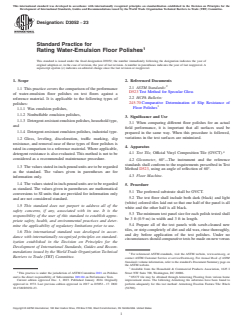
3.1 When comparing different floor polishes for an actual field performance, it is important that all surfaces used be prepared in the same way. When this procedure is followed, variations in the test surfaces are minimized.
SCOPE
1.1 This practice covers the comparison of the performance of water-emulsion floor polishes on test floors against a reference material. It is applicable to the following types of polishes:
1.1.1 Wax emulsion polishes,
1.1.2 Nonbuffable emulsion polishes,
1.1.3 Detergent-resistant emulsion polishes, household type, and
1.1.4 Detergent-resistant emulsion polishes, industrial type.
1.2 Gloss, leveling, discoloration, traffic marking, slip resistance, and removal ease of these types of floor polishes is rated in comparison to a reference material. Where applicable, detergent resistance is also evaluated. This method is not to be considered as a recommended maintenance procedure.
1.3 The values stated in inch-pound units are to be regarded as the standard. The values given in parentheses are for information only.
1.4 The values stated in inch-pound units are to be regarded as standard. The values given in parentheses are mathematical conversions to SI units that are provided for information only and are not considered standard.
1.5 This standard does not purport to address all of the safety concerns, if any, associated with its use. It is the responsibility of the user of this standard to establish appropriate safety, health, and environmental practices and determine the applicability of regulatory limitations prior to use.
1.6 This international standard was developed in accordance with internationally recognized principles on standardization established in the Decision on Principles for the Development of International Standards, Guides and Recommendations issued by the World Trade Organization Technical Barriers to Trade (TBT) Committee.
- Status
- Published
- Publication Date
- 30-Nov-2023
- Technical Committee
- D21 - Polishes
- Drafting Committee
- D21.04 - Performance Tests
Overview
ASTM D3052-23 is the Standard Practice for Rating Water-Emulsion Floor Polishes, developed by ASTM International. This standard provides a consistent method for evaluating and comparing the performance of various types of water-emulsion floor polishes on test floors against a reference material. It is applicable to wax emulsion polishes, nonbuffable emulsion polishes, and both household and industrial types of detergent-resistant floor polishes. The comprehensive approach outlined in this practice ensures that the test surfaces are prepared in a standardized manner, minimizing variations and enabling accurate, repeatable comparisons.
Key Topics
Types of Floor Polishes Evaluated:
- Wax emulsion polishes
- Nonbuffable emulsion polishes
- Detergent-resistant emulsion polishes (household and industrial types)
Performance Criteria:
- Gloss and leveling
- Discoloration resistance
- Traffic marking (heel marks, soil, scuffing, scratching)
- Slip resistance
- Ease of removal
- Detergent resistance (when applicable)
Standardized Testing Protocols:
- Uniform preparation of test tiles (Official Vinyl Composition Tile - OVCT)
- Use of a 60° glossmeter per ASTM D523
- Masking and control area setup to evaluate polish performance before and after traffic exposure
- Regular maintenance and evaluation schedules tailored to polish type
Rating System:
- Comparative ratings assigned based on visual and instrumented assessments against a reference material
Observer-based Evaluation:
- Ratings by at least three qualified observers
- Results to be averaged and reported, with range indicating agreement level
Applications
ASTM D3052-23 is highly valuable across multiple sectors involved in floor polish testing, manufacturing, and quality assurance:
- Product Development: Manufacturers can use this standard to evaluate new formulations of water-emulsion floor polishes and benchmark them against industry references.
- Quality Control: Laboratories engaged in product verification utilize these test methods to ensure consistent results and reliable product performance claims.
- Comparative Evaluation: Commercial and industrial buyers can request results based on this standard to compare different brands or types of floor polishes for facility maintenance.
- Regulatory Compliance: Facilities adhering to safety and performance standards for floor finishes can reference ASTM D3052-23 to meet internal or external requirements.
The standardized procedures ensure that results are comparable regardless of location or personnel, making this practice essential for global and local operations.
Related Standards
- ASTM D523 – Test Method for Specular Gloss: Details gloss measurement techniques, vital for evaluations in D3052-23.
- CSMA/HCPA Bulletin 245-70: Outlines methodologies for determining slip resistance of floor polishes, referenced for slip resistance evaluations.
- Other ASTM Floor Polish Standards: Additional related documents may include guidance on specific floor polish formulations, safety assessments, and application techniques.
Practical Value
Applying ASTM D3052-23 enables organizations to:
- Achieve reliable, repeatable, and objective comparisons of water-emulsion floor polishes
- Enhance product claims with data-driven performance ratings
- Reduce variability in test results by using consistent test surfaces and protocols
- Assess key attributes such as gloss, slip resistance, durability, and ease of removal
- Meet the expectations of facility managers, procurement professionals, and end users for safe and effective floor care products
By following this standard, professionals can ensure that comparisons of floor polishes are based on credible, standardized criteria-improving confidence in product selection and application outcomes.
Relations
- Effective Date
- 01-Dec-2023
- Effective Date
- 01-Dec-2023
- Referred By
ASTM D3440-13(2019) - Standard Guide for Preparing Specifications for Water-Emulsion Floor Polishes - Effective Date
- 01-Dec-2023
Get Certified
Connect with accredited certification bodies for this standard

ECOCERT
Organic and sustainability certification.

Eurofins Food Testing Global
Global leader in food, environment, and pharmaceutical product testing.

Intertek Bangladesh
Intertek certification and testing services in Bangladesh.
Sponsored listings
Frequently Asked Questions
ASTM D3052-23 is a standard published by ASTM International. Its full title is "Standard Practice for Rating Water-Emulsion Floor Polishes". This standard covers: SIGNIFICANCE AND USE 3.1 When comparing different floor polishes for an actual field performance, it is important that all surfaces used be prepared in the same way. When this procedure is followed, variations in the test surfaces are minimized. SCOPE 1.1 This practice covers the comparison of the performance of water-emulsion floor polishes on test floors against a reference material. It is applicable to the following types of polishes: 1.1.1 Wax emulsion polishes, 1.1.2 Nonbuffable emulsion polishes, 1.1.3 Detergent-resistant emulsion polishes, household type, and 1.1.4 Detergent-resistant emulsion polishes, industrial type. 1.2 Gloss, leveling, discoloration, traffic marking, slip resistance, and removal ease of these types of floor polishes is rated in comparison to a reference material. Where applicable, detergent resistance is also evaluated. This method is not to be considered as a recommended maintenance procedure. 1.3 The values stated in inch-pound units are to be regarded as the standard. The values given in parentheses are for information only. 1.4 The values stated in inch-pound units are to be regarded as standard. The values given in parentheses are mathematical conversions to SI units that are provided for information only and are not considered standard. 1.5 This standard does not purport to address all of the safety concerns, if any, associated with its use. It is the responsibility of the user of this standard to establish appropriate safety, health, and environmental practices and determine the applicability of regulatory limitations prior to use. 1.6 This international standard was developed in accordance with internationally recognized principles on standardization established in the Decision on Principles for the Development of International Standards, Guides and Recommendations issued by the World Trade Organization Technical Barriers to Trade (TBT) Committee.
SIGNIFICANCE AND USE 3.1 When comparing different floor polishes for an actual field performance, it is important that all surfaces used be prepared in the same way. When this procedure is followed, variations in the test surfaces are minimized. SCOPE 1.1 This practice covers the comparison of the performance of water-emulsion floor polishes on test floors against a reference material. It is applicable to the following types of polishes: 1.1.1 Wax emulsion polishes, 1.1.2 Nonbuffable emulsion polishes, 1.1.3 Detergent-resistant emulsion polishes, household type, and 1.1.4 Detergent-resistant emulsion polishes, industrial type. 1.2 Gloss, leveling, discoloration, traffic marking, slip resistance, and removal ease of these types of floor polishes is rated in comparison to a reference material. Where applicable, detergent resistance is also evaluated. This method is not to be considered as a recommended maintenance procedure. 1.3 The values stated in inch-pound units are to be regarded as the standard. The values given in parentheses are for information only. 1.4 The values stated in inch-pound units are to be regarded as standard. The values given in parentheses are mathematical conversions to SI units that are provided for information only and are not considered standard. 1.5 This standard does not purport to address all of the safety concerns, if any, associated with its use. It is the responsibility of the user of this standard to establish appropriate safety, health, and environmental practices and determine the applicability of regulatory limitations prior to use. 1.6 This international standard was developed in accordance with internationally recognized principles on standardization established in the Decision on Principles for the Development of International Standards, Guides and Recommendations issued by the World Trade Organization Technical Barriers to Trade (TBT) Committee.
ASTM D3052-23 is classified under the following ICS (International Classification for Standards) categories: 71.100.99 - Other products of the chemical industry. The ICS classification helps identify the subject area and facilitates finding related standards.
ASTM D3052-23 has the following relationships with other standards: It is inter standard links to ASTM D3052-17, ASTM D4078-02(2021), ASTM D3440-13(2019). Understanding these relationships helps ensure you are using the most current and applicable version of the standard.
ASTM D3052-23 is available in PDF format for immediate download after purchase. The document can be added to your cart and obtained through the secure checkout process. Digital delivery ensures instant access to the complete standard document.
Standards Content (Sample)
This international standard was developed in accordance with internationally recognized principles on standardization established in the Decision on Principles for the
Development of International Standards, Guides and Recommendations issued by the World Trade Organization Technical Barriers to Trade (TBT) Committee.
Designation: D3052 − 23
Standard Practice for
Rating Water-Emulsion Floor Polishes
This standard is issued under the fixed designation D3052; the number immediately following the designation indicates the year of
original adoption or, in the case of revision, the year of last revision. A number in parentheses indicates the year of last reapproval. A
superscript epsilon (´) indicates an editorial change since the last revision or reapproval.
1. Scope 2. Referenced Documents
2.1 ASTM Standards:
1.1 This practice covers the comparison of the performance
D523 Test Method for Specular Gloss
of water-emulsion floor polishes on test floors against a
2.2 HCPA Bulletin:
reference material. It is applicable to the following types of
245-70 Comparative Determination of Slip Resistance of
polishes:
Floor Polishes
1.1.1 Wax emulsion polishes,
1.1.2 Nonbuffable emulsion polishes,
3. Significance and Use
1.1.3 Detergent-resistant emulsion polishes, household type,
3.1 When comparing different floor polishes for an actual
and
field performance, it is important that all surfaces used be
1.1.4 Detergent-resistant emulsion polishes, industrial type.
prepared in the same way. When this procedure is followed,
variations in the test surfaces are minimized.
1.2 Gloss, leveling, discoloration, traffic marking, slip
resistance, and removal ease of these types of floor polishes is
4. Apparatus
rated in comparison to a reference material. Where applicable,
4.1 Test Tile, Official Vinyl Composition Tile (OVCT).
detergent resistance is also evaluated. This method is not to be
considered as a recommended maintenance procedure.
4.2 Glossmeter, 60°—The instrument and the reference
standards shall conform to the requirements prescribed in Test
1.3 The values stated in inch-pound units are to be regarded
Method D523, using an angle of reflection of 60°.
as the standard. The values given in parentheses are for
4.3 Floor Machine.
information only.
1.4 The values stated in inch-pound units are to be regarded
5. Procedure
as standard. The values given in parentheses are mathematical
5.1 The preferred substrate shall be OVCT.
conversions to SI units that are provided for information only
5.2 The test floor shall include both dark (black) and light
and are not considered standard.
(white) colored tiles laid out so that one half of the panel is all
1.5 This standard does not purport to address all of the
white and the other half is all black.
safety concerns, if any, associated with its use. It is the
5.3 The minimum test panel size for each polish tested shall
responsibility of the user of this standard to establish appro-
be 3 ft (0.9 m) in width and 3 ft in length.
priate safety, health, and environmental practices and deter-
5.4 Prepare all of the test panels with scrub-cleaned new
mine the applicability of regulatory limitations prior to use.
tiles, or strip completely of dirt and old wax, rinse thoroughly,
1.6 This international standard was developed in accor-
and dry before application of the test polishes. Under no
dance with internationally recognized principles on standard-
circumstances should comparative tests be made on new versus
ization established in the Decision on Principles for the
Development of International Standards, Guides and Recom-
mendations issued by the World Trade Organization Technical
For referenced ASTM standards, visit the ASTM website, www.astm.org, or
Barriers to Trade (TBT) Committee.
contact ASTM Customer Service at service@astm.org. For Annual Book of ASTM
Standards volume information, refer to the standard’s Document Summary page on
the ASTM website.
Available from the Household & Commercial Products Association, 1625 I
This practice is under the jurisdiction of ASTM Committee D21 on Polishes Street NW Suite 700, Washington, DC 20006.
and is the direct responsibility of Subcommittee D21.04 on Performance Tests. OVCT tile may be obtained through Armstrong Flooring from various home
Current edition approved Dec. 1, 2023. Published January 2024. Originally improvement stores. The following Armstrong tile substrates have been found to
approved in 1972. Last previous edition approved in 2017 as D3052 – 17. DOI: perform adequately for this test method: Armstrong Excelon Feature Tile: Black
10.1520/D3052-23. (56790).
Copyright © ASTM International, 100 Barr Harbor Drive, PO Box C700, West Conshohocken, PA 19428-2959. United States
D3052 − 23
old tiles. Similarly, where old tiles are employed, care should to 90 °F (21.1 °C to 32.2 °C) and above 70 % relative humidity
be taken to employ tiles or panels with approximately equiva- may necessitate longer periods of drying time.) Again take
lent traffic history. gloss readings on the four center tiles prior to exposure to
traffic. Comparatively rate the films visually for leveling, for
5.5 Mask a small portion of a black tile prior to polishing so
any discoloration tendencies, and for slip resistance following
as to provide an unpolished control area. The masking is to
HCPA Bulletin 245-70. In the instance of the wax emulsion
remain during the entire traffic period.
polishes, make the leveling and gloss ratings after buffing.
5.6 Take glossmeter readings on the clean and dry center
5.12 Daily maintenance should include dry brushing or
four tiles (two light tiles and two dark tiles) with a 60°
sweeping.
glossmeter prior to application of the polish.
5.7 Apply the test polish and the reference (standard) polish
6. Maintenance and Evaluation Schedule for Wax
equally to the same test panel in such a manner that each polish
Emulsion Polishes
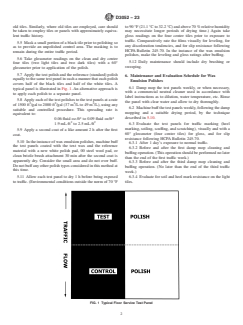
covers half of the black tiles and half of the white tiles. A
6.1 Damp mop the test panels weekly, or when necessary,
typical panel is illustrated in Fig. 1. An alternative approach is
with a commercial neutral cleaner used in accordance with
to apply each polish to a separate panel.
label instructions as to dilution, water temperature, etc. Rinse
5.8 Apply each of the test polishes to the test panels at a rate
the panel with clear water and allow to dry thoroughly.
2 2 2 2
of 1500 ft /gal to 2000 ft /gal (37 m /L to 49 m /L), using any
6.2 Machine buff the test panels weekly, following the damp
suitable and controlled procedure. This spreading rate is
mopping and a suitable drying period, by the technique
equivalent to:
2 2 described in 5.10.
0.06 fluid oz ⁄ft to 0.09 fluid oz/ft
2 2
1.9 mL ⁄ft to 2.5 mL ⁄ft
6.3 Evaluate the test panels for traffic marking (heel
marking, soiling, scuffing, and scratching), visually and with a
5.9 Apply a second coat of a like amount 2 h after the first
60° glossmeter (four center tiles) for gloss, and for slip
coat.
resistance following HCPA Bulletin 245-70.
5.10 In the instance of wax emulsion polishes, machine buff
6.3.1 After 1 day’s exposure to normal traffic.
the test panels coated with the text wax and the reference
6.3.2 Before and after the first damp mop cleaning and
material with a new white polish pad, 00 steel wool pad, or
buffing operation. (This operation should be performed no later
clean bristle brush attachment 30 min after the second coat is
than the end of the first traffic week.)
apparently dry. Consider the small area and do not over buff.
6.3.3 Before and after the third damp mop cleaning and
Do not buff any other polish types considered in this method at
buffing operation. (No later than the end of the third traffic
this time.
week.)
5.11 Allow each test panel to dry 1 h before being exposed 6.3.4 Evaluate for soil and heel mark resistance on the light
tiles.
to traffic. (Environmental conditions outside the norm of 70 °F
FIG. 1 Typical Floor Service Test Panel
D3052 − 23
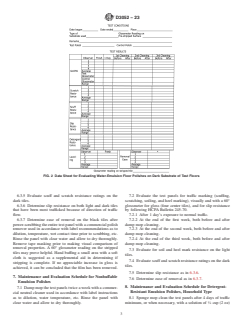
FIG. 2 Data Sheet for Evaluating Water-Emulsion Floor Polishes on Dark Substrate of Test Floors
6.3.5 Evaluate scuff and scratch resistance ratings on the 7.2 Evaluate the test panels for traffic marking (scuffing,
dark tiles. scratching, soiling, and heel marking), visually and with a 60°
6.3.6 Determine slip resistance on both light and dark tiles glossmeter for gloss (four center tiles), and for slip resistance
that have been most trafficked because of direction of traffic by following HCPA Bulletin 245-70.
flow. 7.2.1 After 1 day’s exposure to normal traffic.
6.3.7 Determine ease of removal on the black tiles after 7.2.2 At the end of the first week, both before and after
power-scrubbing the entire test panel with a commercial polish damp mop cleaning.
remover used in accordance with label recommendations as to 7.2.3 At the end of the second week, both before and after
dilution, temperature, wet contact time prior to scrubbing, etc. damp mop cleaning.
Rinse the panel with clear water and allow to dry thoroughly. 7.2.4 At the end of the third week, both before and after
Remove tape masking prior to making visual comparison of damp mop cleaning.
removal properties. A 60° glossmeter reading on the stripped
7.3 Evaluate for soil and heel mark resistance on the light
tiles may prove helpful. Hand buffing a small area with a soft
tiles.
cloth is suggested as a supplemental aid in determining if
7.4 Evaluate scuff and scratch resistance ratings on the dark
stripping is complete. If no appreciable increase in gloss is
tiles.
achieved, it can be concluded that the film has been removed.
7.5 Determin
...
This document is not an ASTM standard and is intended only to provide the user of an ASTM standard an indication of what changes have been made to the previous version. Because
it may not be technically possible to adequately depict all changes accurately, ASTM recommends that users consult prior editions as appropriate. In all cases only the current version
of the standard as published by ASTM is to be considered the official document.
Designation: D3052 − 17 D3052 − 23
Standard Practice for
Rating Water-Emulsion Floor Polishes
This standard is issued under the fixed designation D3052; the number immediately following the designation indicates the year of
original adoption or, in the case of revision, the year of last revision. A number in parentheses indicates the year of last reapproval. A
superscript epsilon (´) indicates an editorial change since the last revision or reapproval.
1. Scope
1.1 This practice covers the comparison of the performance of water-emulsion floor polishes on test floors against a reference
material. It is applicable to the following types of polishes:
1.1.1 Wax emulsion polishes,
1.1.2 Nonbuffable emulsion polishes,
1.1.3 Detergent-resistant emulsion polishes, household type, and
1.1.4 Detergent-resistant emulsion polishes, industrial type.
1.2 Gloss, leveling, discoloration, traffic marking, slip resistance, and removal ease of these types of floor polishes is rated in
comparison to a reference material. Where applicable, detergent resistance is also evaluated. This method is not to be considered
as a recommended maintenance procedure.
1.3 The values stated in inch-pound units are to be regarded as the standard. The values given in parentheses are for information
only.
1.4 The values stated in inch-pound units are to be regarded as standard. The values given in parentheses are mathematical
conversions to SI units that are provided for information only and are not considered standard.
1.5 This standard does not purport to address all of the safety concerns, if any, associated with its use. It is the responsibility
of the user of this standard to establish appropriate safety and healthsafety, health, and environmental practices and determine
the applicability of regulatory limitations prior to use.
1.6 This international standard was developed in accordance with internationally recognized principles on standardization
established in the Decision on Principles for the Development of International Standards, Guides and Recommendations issued
by the World Trade Organization Technical Barriers to Trade (TBT) Committee.
2. Referenced Documents
2.1 ASTM Standards:
D523 Test Method for Specular Gloss
This practice is under the jurisdiction of ASTM Committee D21 on Polishes and is the direct responsibility of Subcommittee D21.04 on Performance Tests.
Current edition approved March 1, 2017Dec. 1, 2023. Published April 2017January 2024. Originally approved in 1972. Last previous edition approved in 20102017 as
D3052 – 87 (2010).D3052 – 17. DOI: 10.1520/D3052-17.10.1520/D3052-23.
For referenced ASTM standards, visit the ASTM website, www.astm.org, or contact ASTM Customer Service at service@astm.org. For Annual Book of ASTM Standards
volume information, refer to the standard’s Document Summary page on the ASTM website.
Copyright © ASTM International, 100 Barr Harbor Drive, PO Box C700, West Conshohocken, PA 19428-2959. United States
D3052 − 23
2.2 CSMAHCPA Bulletin:
245-70 Comparative Determination of Slip Resistance of Floor Polishes
3. Significance and Use
3.1 When comparing different floor polishes for an actual field performance, it is important that all surfaces used be prepared in
the same way. When this procedure is followed, variations in the test surfaces are minimized.
4. Apparatus
4.1 Test Tile, OVCT.Official Vinyl Composition Tile (OVCT).
4.2 Glossmeter, 60°—The instrument and the reference standards shall conform to the requirements prescribed in Test Method
D523, using an angle of reflection of 60°.
4.3 Floor Machine.
5. Procedure
5.1 The preferred substrate shall be Official Vinyl Composition Tile.OVCT.
5.2 The test floor shall include both dark (black) and light (white) colored tiles laid out so that one half of the panel is all white
and the other half is all black.
5.3 The minimum test panel size for each polish tested shall be 3 ft (0.9 m) in width and 3 ft in length.
5.4 Prepare all of the test panels with scrub-cleaned new tiles, or strip completely of dirt and old wax, rinse thoroughly, and dry
before application of the test polishes. Under no circumstances should comparative tests be made on new versus old tiles. Similarly,
where old tiles are employed, care should be taken to employ tiles or panels with approximately equivalent traffic history.
5.5 Mask a small portion of a black tile prior to polishing so as to provide an unpolished control area. The masking is to remain
during the entire traffic period.
5.6 Take glossmeter readings on the clean and dry center four panelstiles (two light tiles and two dark tiles) with a 60° glossmeter
prior to application of the polish.
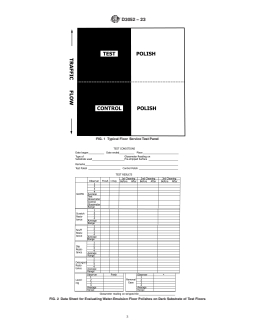
5.7 Apply the test polish and the reference (standard) polish equally to the same test panel in such a manner that each polish covers
half of the black tiles and half of the white tiles. A typical panel is illustrated in Fig. 1. An alternative approach is to apply each
polish to a separate panel.
2 2 2 2
5.8 Apply each of the test polishes to the test panels at a rate of 15001500 ft /gal to 2000 ft /gal (37(37 m to 49 m/L to 49 m /L),
using any suitable and controlled procedure. This spreading rate is equivalent to:
2 2
0.06 0.06 fluid oz ⁄ft to 0.08 fluid 0.09 fluid oz/ft
2 2
1.9 1.9 mL ⁄ft to 2.5 2.5 mL mL/ft⁄ft
5.9 Apply a second coat of a like amount 2 h after the first coat.
5.10 In the instance of wax emulsion polishes, machine buff the test panels coated with the text wax and the reference material
Available from the Chemical Specialties Manufacturers Association, 1001 Connecticut Avenue, NW, Washington, DC 20036.Household & Commercial Products
Association, 1625 I Street NW Suite 700, Washington, DC 20006.
OVCT tile may be obtained through Armstrong Flooring from various home improvement stores. The following Armstrong tile substrates have been found to perform
adequately for this test method: Armstrong Excelon Feature Tile: Black (56790), http://www.armstrong.com/commflooringna/product_details_toolbox_magnify.jsp?item_
id=47394.(56790).
D3052 − 23
FIG. 1 Typical Floor Service Test Panel
FIG. 2 Data Sheet for Evaluating Water-Emulsion Floor Polishes on Dark Substrate of Test Floors
D3052 − 23
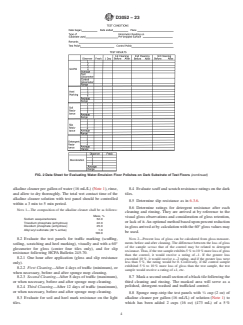
FIG. 2 Data Sheet for Evaluating Water-Emulsion Floor Polishes on Dark Substrate of Test Floors (continued)
with a new white polish pad, 00 steel wool pad, or clean bristle brush attachment 30 min after the second coat is apparently dry.
Consider the small area and do not over buff. Do not buff any other polish types considered in this method at this time.
5.11 Allow each test panel to dry 1 h before being exposed to traffic. (Environmental conditions outside the norm or 70 to 90°F
(21.1 to 32.2°C)of 70 °F to 90 °F (21.1 °C to 32.2 °C) and above 70 % relative humidity may necessitate longer periods of drying
time.) Again take gloss readings on the four center tiles prior to exposure to traffic. Comparatively rate the films visually for
leveling, for any discoloration tendencies, and for slip resistance following CSMA Bulletin HCPA Bulletin 245-70. In the instance
of the wax emulsion polishes, make the leveling and gloss ratings after buffing.
5.12 Daily maintenance should include dry brushing or sweeping.
6. Maintenance and Evaluation Schedule for Wax Emulsion Polishes
6.1 Damp mop the test panels weekly, or when necessary, with a commercial neutral cleaner used in accordance with label
instructions as to dilution, water temperature, etc. Rinse the panel with clear water and allow to dry thoroughly.
6.2 Machine buff the test panels weekly, following the damp mopping and a suitable drying period, by the technique described
in 5.10.
6.3 Evaluate the test panels for traffic marking (heel marking, soiling, scuffing, and scratching), visually and with a 60° glossmeter
(four center tiles) for gloss, and for slip resistance following CSMA Bulletin HCPA Bulletin 245-70.
6.3.1 After 1 day’s exposure to normal traffic.
D3052 − 23
6.3.2 Before and after the first damp mop cleaning and buffing operation. (This operation should be performed no later than the
end of the first traffic week.)
6.3.3 Before and after the third damp mop cleaning and buffing operation. (No later than the end of the third traffic week.)
6.3.4 Evaluate for soil and heel mark resistance on the light tiles.
6.3.5 Evaluate scuff and scratch resistance ratings on the dark tiles.
6.3.6 Determine slip resistance on both light and dark tiles that have been most trafficked because of direction of traffic flow.
6.3.7 Determine ease of removal on the black tiles after power-scrubbing the entire test panel with a commercial polish remover
used in accordance with label recommendations as to dilution, temperature, wet contact time prior to scrubbing, etc. Rinse the
panel with clear water and allow to dry thoroughly. Remove tape masking prior to making visual comparison of removal properties.
A 60° glossmeter reading on the stripped tiles may prove helpful. Hand buffing a small area with a soft cloth is suggested as a
supplemental aid in determining if stripping is complete. If no appreciable increase in gloss is achieved, it can be concluded that
the film has been removed.
7. Maintenance and Evaluation Schedule for Nonbuffable Emulsion Polishes
7.1 Damp mop the test panels twice a week with a commercial neutral cleaner used in accordance with label instructions as to
dilution, water temperature, etc. Rinse the panel with clear water
...