

ASTM D3181-15(2019)
(Guide)Standard Guide for Conducting Wear Tests on Textiles
General Information
- Abstract
SIGNIFICANCE AND USE
5.1 This guide may be used to evaluate textiles used in apparel.
5.2 This guide may be used for several purposes:
5.2.1 To determine the comparative performance of new or existing products,
5.2.2 To determine the suitability of current products in different end-uses, and
5.2.3 To evaluate and compare the effect of wear of construction details as well as specific fabrics, fibers, dyeings, finishing, fabrication techniques, etc.
5.3 This guide provides for flexibility in design and evaluation since the information sought from each wear test will vary (see Appendix X1).
5.4 This guide may be used to compare the wear performance of two or more textiles when these are included in the same test, or to compare a textile whose properties have not been evaluated with one having a known performance history.
5.5 The standard test methods and guides listed in 2.1 and 2.2 are not to be considered as limited to only those cited. It is recognized that textile innovations of chemistries on fibers and fabrics may require the use of other standards methods or modifications to existing standards. Further, product development efforts within companies may call for the use of internal procedures when investigation of worthiness of the innovation or prediction of consumer preference or satisfaction is questioned.
SCOPE
1.1 This guide is intended to provide guidance for the design of an experiment for the purpose of developing a prediction of expected wear performance of apparel and textile products when exposed to actual use conditions.
1.2 This guide recommends the use of a product for which a history of its performance is known from laboratory testing and consumer use as the basis for statistical significance of new product’s performance, however, other design or experimental approaches may be used.
1.3 The wide variety of textile products and the conditions under which consumers will use products prevents the inclusion of all types of wear trial experiments for research and development, product innovation studies, and special needs such as those for healthcare industry or military.
1.4 This standard does not purport to address all of the safety concerns, if any, associated with its use. It is the responsibility of the user of this standard to establish appropriate safety, health, and environmental practices and determine the applicability of regulatory limitations prior to use.
1.5 This international standard was developed in accordance with internationally recognized principles on standardization established in the Decision on Principles for the Development of International Standards, Guides and Recommendations issued by the World Trade Organization Technical Barriers to Trade (TBT) Committee.
- Status
- Published
- Publication Date
- 30-Jun-2019
- Technical Committee
- D13 - Textiles
- Drafting Committee
- D13.60 - Fabric Physical Test Methods B
Overview
ASTM D3181-15(2019), Standard Guide for Conducting Wear Tests on Textiles, is an international standard maintained by ASTM International. This guide provides a framework for designing and conducting wear tests to evaluate the durability, performance, and suitability of textile materials used in apparel under actual use conditions. The standard supports product development, quality assurance, and comparative testing of textile innovations or existing textile products by providing a flexible, statistically-sound approach to assess wear performance.
This guide is intended for manufacturers, quality assurance professionals, and researchers within the textile industry who aim to predict wear behavior, compare new and existing products, and improve textile product design and selection.
Key Topics
- Design of Wear Tests: Guidance on planning experiments to predict textile wear performance, including sample selection, participant assignment, and wear-refurbishing cycles.
- Performance Evaluation: Identification and assessment of key textile properties such as abrasion resistance, colorfastness, pilling, seam integrity, dimensional stability, and more.
- Comparative Analysis: Use of control textiles with established wear histories for benchmarking new products or untested materials.
- Statistical Approaches: Recommendations for statistical experimental designs (e.g., randomized block, paired comparison, incomplete block) to ensure reliable data analysis and meaningful conclusions.
- Flexibility and Innovation: Acknowledgment of the need for adaptability in wear test design to accommodate new fiber chemistries, finishing techniques, and emerging product categories.
Applications
ASTM D3181-15(2019) is highly valuable for diverse textile applications, including:
- Apparel Testing: Determining the suitability and comparative performance of garments, such as shirts, trousers, dresses, and specialty clothing, in real-world use scenarios.
- Research and Development: Supporting innovation by evaluating the impact of new fibers, treatments, and fabrication techniques on wear resistance and user acceptability.
- Quality Control: Establishing benchmarks for product consistency and consumer satisfaction by using standardized wear testing procedures.
- Specialized Sectors: Informing textile choices for sectors with stringent requirements, such as healthcare, military, or sportswear, where durability and functional performance are critical.
- Consumer Preference Studies: Collecting wear data and user feedback to predict consumer satisfaction and refine product offerings.
- Custom Test Designs: Accommodates the use of internal procedures or modified methods to investigate the performance of unique textile innovations not covered by other existing standards.
Examples of properties and garment areas commonly examined:
- Abrasion resistance (e.g., collars, cuffs, knees, seat)
- Colorfastness (to laundering, light, perspiration)
- Pilling resistance
- Seam appearance and durability
- Dimensional changes after washing
- Fabric hand and surface appearance
Related Standards
ASTM D3181 references several other essential standards used in textile wear testing and evaluation, including:
- ASTM D3884, D3885, D3886, D4157: Methods for testing abrasion resistance of textile fabrics.
- ASTM D2051, D2052, D2057, D2058: Durability and colorfastness of zippers to laundering and dry cleaning.
- ASTM D3511, D3512, D3514: Pilling resistance test methods.
- ASTM D4231, D3938: Guidelines for evaluating apparel and textile care instructions.
- AATCC Standards: Methods for colorfastness (AATCC 8, 15, 16), laundering (AATCC 61, 135, 150), seam smoothness (AATCC 88B), and other performance properties.
Terminology references:
- ASTM D123: Terminology Relating to Textiles
- ASTM D4850: Terminology Relating to Fabrics and Fabric Test Methods
- ASTM D7022: Terminology Relating to Apparel
By adhering to ASTM D3181-15(2019), organizations can ensure that textile wear testing is consistent, statistically valid, and relevant to both regulatory and market-driven performance criteria. This standard provides a sound foundation for ongoing textile product improvement and consumer satisfaction.
Relations
- Effective Date
- 01-Jul-2019
- Effective Date
- 01-Dec-2023
- Effective Date
- 01-Jan-2018
- Effective Date
- 15-Jul-2017
- Effective Date
- 01-Mar-2017
- Effective Date
- 15-Sep-2015
- Effective Date
- 01-Sep-2015
- Effective Date
- 01-Jul-2015
- Effective Date
- 01-Apr-2015
- Effective Date
- 01-Oct-2013
- Effective Date
- 01-Oct-2013
- Effective Date
- 01-Jul-2013
- Effective Date
- 01-Jul-2013
- Effective Date
- 01-Jul-2013
- Effective Date
- 01-Jul-2013
Frequently Asked Questions
ASTM D3181-15(2019) is a guide published by ASTM International. Its full title is "Standard Guide for Conducting Wear Tests on Textiles". This standard covers: SIGNIFICANCE AND USE 5.1 This guide may be used to evaluate textiles used in apparel. 5.2 This guide may be used for several purposes: 5.2.1 To determine the comparative performance of new or existing products, 5.2.2 To determine the suitability of current products in different end-uses, and 5.2.3 To evaluate and compare the effect of wear of construction details as well as specific fabrics, fibers, dyeings, finishing, fabrication techniques, etc. 5.3 This guide provides for flexibility in design and evaluation since the information sought from each wear test will vary (see Appendix X1). 5.4 This guide may be used to compare the wear performance of two or more textiles when these are included in the same test, or to compare a textile whose properties have not been evaluated with one having a known performance history. 5.5 The standard test methods and guides listed in 2.1 and 2.2 are not to be considered as limited to only those cited. It is recognized that textile innovations of chemistries on fibers and fabrics may require the use of other standards methods or modifications to existing standards. Further, product development efforts within companies may call for the use of internal procedures when investigation of worthiness of the innovation or prediction of consumer preference or satisfaction is questioned. SCOPE 1.1 This guide is intended to provide guidance for the design of an experiment for the purpose of developing a prediction of expected wear performance of apparel and textile products when exposed to actual use conditions. 1.2 This guide recommends the use of a product for which a history of its performance is known from laboratory testing and consumer use as the basis for statistical significance of new product’s performance, however, other design or experimental approaches may be used. 1.3 The wide variety of textile products and the conditions under which consumers will use products prevents the inclusion of all types of wear trial experiments for research and development, product innovation studies, and special needs such as those for healthcare industry or military. 1.4 This standard does not purport to address all of the safety concerns, if any, associated with its use. It is the responsibility of the user of this standard to establish appropriate safety, health, and environmental practices and determine the applicability of regulatory limitations prior to use. 1.5 This international standard was developed in accordance with internationally recognized principles on standardization established in the Decision on Principles for the Development of International Standards, Guides and Recommendations issued by the World Trade Organization Technical Barriers to Trade (TBT) Committee.
SIGNIFICANCE AND USE 5.1 This guide may be used to evaluate textiles used in apparel. 5.2 This guide may be used for several purposes: 5.2.1 To determine the comparative performance of new or existing products, 5.2.2 To determine the suitability of current products in different end-uses, and 5.2.3 To evaluate and compare the effect of wear of construction details as well as specific fabrics, fibers, dyeings, finishing, fabrication techniques, etc. 5.3 This guide provides for flexibility in design and evaluation since the information sought from each wear test will vary (see Appendix X1). 5.4 This guide may be used to compare the wear performance of two or more textiles when these are included in the same test, or to compare a textile whose properties have not been evaluated with one having a known performance history. 5.5 The standard test methods and guides listed in 2.1 and 2.2 are not to be considered as limited to only those cited. It is recognized that textile innovations of chemistries on fibers and fabrics may require the use of other standards methods or modifications to existing standards. Further, product development efforts within companies may call for the use of internal procedures when investigation of worthiness of the innovation or prediction of consumer preference or satisfaction is questioned. SCOPE 1.1 This guide is intended to provide guidance for the design of an experiment for the purpose of developing a prediction of expected wear performance of apparel and textile products when exposed to actual use conditions. 1.2 This guide recommends the use of a product for which a history of its performance is known from laboratory testing and consumer use as the basis for statistical significance of new product’s performance, however, other design or experimental approaches may be used. 1.3 The wide variety of textile products and the conditions under which consumers will use products prevents the inclusion of all types of wear trial experiments for research and development, product innovation studies, and special needs such as those for healthcare industry or military. 1.4 This standard does not purport to address all of the safety concerns, if any, associated with its use. It is the responsibility of the user of this standard to establish appropriate safety, health, and environmental practices and determine the applicability of regulatory limitations prior to use. 1.5 This international standard was developed in accordance with internationally recognized principles on standardization established in the Decision on Principles for the Development of International Standards, Guides and Recommendations issued by the World Trade Organization Technical Barriers to Trade (TBT) Committee.
ASTM D3181-15(2019) is classified under the following ICS (International Classification for Standards) categories: 61.020 - Clothes. The ICS classification helps identify the subject area and facilitates finding related standards.
ASTM D3181-15(2019) has the following relationships with other standards: It is inter standard links to ASTM D3181-15e1, ASTM D3938-18(2023), ASTM D3938-18, ASTM D4850-13(2017), ASTM D123-17, ASTM D123-15b, ASTM D123-15a, ASTM D3885-07a(2015), ASTM D123-15, ASTM D7022-13e1, ASTM D7022-13, ASTM D3884-09(2013), ASTM D3884-09(2013)e1, ASTM D4850-13, ASTM D4157-13. Understanding these relationships helps ensure you are using the most current and applicable version of the standard.
ASTM D3181-15(2019) is available in PDF format for immediate download after purchase. The document can be added to your cart and obtained through the secure checkout process. Digital delivery ensures instant access to the complete standard document.
Standards Content (Sample)
This international standard was developed in accordance with internationally recognized principles on standardization established in the Decision on Principles for the
Development of International Standards, Guides and Recommendations issued by the World Trade Organization Technical Barriers to Trade (TBT) Committee.
Designation: D3181 − 15 (Reapproved 2019)
Standard Guide for
Conducting Wear Tests on Textiles
This standard is issued under the fixed designation D3181; the number immediately following the designation indicates the year of
original adoption or, in the case of revision, the year of last revision. A number in parentheses indicates the year of last reapproval. A
superscript epsilon (´) indicates an editorial change since the last revision or reapproval.
1. Scope D2057 Test Method for Colorfastness of Zippers to Laun-
dering
1.1 This guide is intended to provide guidance for the
D2058 Test Method for Durability of Finish of Zippers to
design of an experiment for the purpose of developing a
Drycleaning
prediction of expected wear performance of apparel and textile
D3511 TestMethodforPillingResistanceandOtherRelated
products when exposed to actual use conditions.
Surface Changes of Textile Fabrics: Brush Pilling Tester
1.2 This guide recommends the use of a product for which
D3512 TestMethodforPillingResistanceandOtherRelated
a history of its performance is known from laboratory testing
Surface Changes of Textile Fabrics: Random Tumble
andconsumeruseasthebasisforstatisticalsignificanceofnew
Pilling Tester
product’s performance, however, other design or experimental
D3514 TestMethodforPillingResistanceandOtherRelated
approaches may be used.
Surface Changes of Textile Fabrics: Elastomeric Pad
D3884 Guide for Abrasion Resistance of Textile Fabrics
1.3 The wide variety of textile products and the conditions
under which consumers will use products prevents the inclu- (Rotary Platform, Double-Head Method)
D3885 Test Method for Abrasion Resistance of Textile
sion of all types of wear trial experiments for research and
development, product innovation studies, and special needs Fabrics (Flexing and Abrasion Method)
D3886 Test Method for Abrasion Resistance of Textile
such as those for healthcare industry or military.
Fabrics (Inflated Diaphragm Apparatus)
1.4 This standard does not purport to address all of the
D3938 Guide for Determining or Confirming Care Instruc-
safety concerns, if any, associated with its use. It is the
tions for Apparel and Other Textile Products
responsibility of the user of this standard to establish appro-
D4157 Test Method for Abrasion Resistance of Textile
priate safety, health, and environmental practices and deter-
Fabrics (Oscillatory Cylinder Method)
mine the applicability of regulatory limitations prior to use.
D4231 Practice for Evaluation of Launderable Woven Dress
1.5 This international standard was developed in accor-
Shirts and Sports Shirts
dance with internationally recognized principles on standard-
D4390 Practice for Evaluation of the Performance of Terry
ization established in the Decision on Principles for the
Bathroom Products for Household Use (Withdrawn
Development of International Standards, Guides and Recom-
1994)
mendations issued by the World Trade Organization Technical
2.1.2 Other ASTM Standards:
Barriers to Trade (TBT) Committee.
D123 Terminology Relating to Textiles
2. Referenced Documents
D4850 Terminology Relating to Fabrics and Fabric Test
Methods
2.1 ASTM Standards:
D7022 Terminology Relating to Apparel
2.1.1 Fabric and Apparel Tests:
2.2 AATCC Standards:
D2051 Test Method for Durability of Finish of Zippers to
2.2.1 Colorfastness and Physical Properties:
Laundering
8 Colorfastness to Crocking: AATCC Crockmeter Method
D2052 Test Method for Colorfastness of Zippers to Dry-
15 Colorfastness to Perspiration
cleaning
16 Colorfastness to Light
61 Colorfastness to Laundering: Accelerated
This guide is under the jurisdiction of ASTM Committee D13 on Textiles and
is the direct responsibility of Subcommittee D13.60 on Fabric Test Methods, 88B Smoothness of Seams in Fabrics After Repeated Home
Specific.
Laundering
Current edition approved July 1, 2019. Published July 2019. Originally approved
ɛ1
in 1973. Last previous edition approved in 2015 as D3181 – 15 . DOI: 10.1520/
D3181-15R19. The last approved version of this historical standard is referenced on
For referenced ASTM standards, visit the ASTM website, www.astm.org, or www.astm.org.
contact ASTM Customer Service at service@astm.org. For Annual Book of ASTM Annual AATCC Technical Manual, available from American Association of
Standards volume information, refer to the standard’s Document Summary page on TextileChemistsandColorists,P.O.Box12215,ResearchTrianglePark,NC 27709,
the ASTM website. www.aatcc.org.
Copyright © ASTM International, 100 Barr Harbor Drive, PO Box C700, West Conshohocken, PA 19428-2959. United States
D3181 − 15 (2019)
88C Appearance of Creases in Wash-and-Wear Items After 3. Terminology
Home Laundering
3.1 For all terms relating to D13.60 Fabric Test Methods,
96 Dimensional Changes in Commercial Laundering of
Specific, refer to Terminology D4850; for terms related to
Woven and Knitted Fabrics Except Wool)
D13.61 Apparel, refer to Terminology D7022.
116 Colorfastness to Crocking: Rotary Vertical Crockmeter
3.1.1 The following terms are relevant to this standard:
Method
control textile, end-use, evaluation period, grade, participant,
117 Colorfastness to Heat: Dry (Excluding Pressing)
performance property, rating, wear level, wear-refurbishing
124 Appearance of Fabrics After Repeated Home Launder-
cycle, wear-service condition, wear test.
ing
3.2 For all other terminology related to textiles, see Termi-
125 Colorfastness to Perspiration and Light
nology D123.
128 Wrinkle Recovery of Fabrics: Appearance Method
130 Soil Release: Oily Stain Release Method
4. Summary of Guide
135 Dimensional Changes of Fabric after Home Laundering
4.1 Textiles are subjected to actual wear under service
143 Appearance of Apparel and Other Textile End Products
conditions. This practice recommends a control textile having
after Repeated Home Laundering
a known wear performance history to be included with other
150 Dimensional Changes of Garments after Home Laun-
items being tested. Statistical methods for design of test and
dering
analysis of data are included that are applicable to all wear
179 Skewness Change in Fabric Resulting from Home
tests. Standard procedures for evaluation of textiles are pro-
Laundering
vided.
183 Transmittance or Blocking of Erythemally Weighted
Ultraviolet Radiation through Fabrics
5. Significance and Use
186 Weather Resistance: UV Light and Moisture Exposure
5.1 This guide may be used to evaluate textiles used in
192 Weather Resistance of Textiles: Sunshine-Arc Lamp
apparel.
Exposure With and Without Wetting
5.2 This guide may be used for several purposes:
202 Relative Hand Value of Textiles: Instrumental Method
5.2.1 To determine the comparative performance of new or
2.2.2 Vapor, Water and Moisture Management Tests:
existing products,
22 Water Repellency: Spray Test
5.2.2 To determine the suitability of current products in
35 Water Resistance: Rain Test
different end-uses, and
42 Water Resistance: Impact Penetration
5.2.3 To evaluate and compare the effect of wear of con-
70 Water Repellency: Tumble Jar Dynamic Absorption Test
struction details as well as specific fabrics, fibers, dyeings,
79 Absorbency of Textiles
finishing, fabrication techniques, etc.
127 Water Resistance: Hydrostatic Pressure Test
5.3 This guide provides for flexibility in design and evalu-
193 Aqueous Liquid Repellency: Water/Alcohol Solution
ation since the information sought from each wear test will
Resistance Test
vary (see Appendix X1).
195 Liquid Moisture Management Properties of Textiles
5.4 This guide may be used to compare the wear perfor-
Fabrics
mance of two or more textiles when these are included in the
197 Vertical Wicking of Textiles
same test, or to compare a textile whose properties have not
198 Horizontal Wicking Textiles
been evaluated with one having a known performance history.
199 Drying Time of Textiles: Moisture Analyzer Method
5.5 The standard test methods and guides listed in 2.1 and
200 Drying Rate of Textiles at theirAbsorbant Capacity:Air
2.2 are not to be considered as limited to only those cited. It is
Flow Method
recognized that textile innovations of chemistries on fibers and
201 Drying Rate of Fabrics: Heated Hot Plate Method
fabrics may require the use of other standards methods or
2.2.3 Evaluation Procedures:
modifications to existing standards. Further, product develop-
EP1 Gray Scale for Color Change
ment efforts within companies may call for the use of internal
EP2 Gray Scale for Staining
procedures when investigation of worthiness of the innovation
EP5 Fabric Hand: Guidelines for Subjective Evaluation
or prediction of consumer preference or satisfaction is ques-
EP6 Instrumental Color Measurement
tioned.
EP7 Instrumental Assessment of the Change in Color of a
Test Specimen
6. Apparatus and Facilities
EP8 AATCC 9–Step Chromatic Transference Scale
6.1 Laboratory Equipment, to perform designed tests.
EP9 Visual Assessment of Color Difference of Textiles
6.2 Facilities for Conditioning Textiles.
EP12 Instrumental Assessment of Degree of Staining
6.2.1 Environmental Chambers, if required.
2.2.4 AATCC Monographs:
6.2.2 Facilities, for participants to be interviewed, fill out
M5 Standardization of Hand Laundering for Fabrics and
worksheets, change clothes, etc.
Textiles
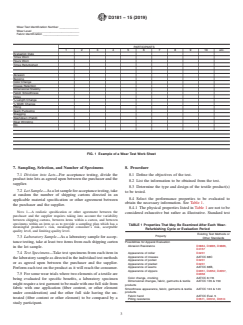
M6 Standardization of Home Laundering Test Conditions 6.3 Work Sheets, to record data (see Fig. 1).
D3181 − 15 (2019)
Wear Test Identification Number ____________
Wear Level _____________________________
Fabric Identification ______________________
PARTICIPANTS
12 34 56 78 9 10 etc.
Evaluation Date
Times Worn
Hours Worn
Times Refurbished
Abrasion
Bagging
Color Change
Crease Retention
Dimensional Stability
Fabric Smoothness
Holes
% Length Change
% Width Change
Pilling
Seam Puckering
Snagging
Washdown (Hand)
Wear Wrinkling
Etc.
FIG. 1 Example of a Wear Test Work Sheet
7. Sampling, Selection, and Number of Specimens 8. Procedure
7.1 Division into Lots—For acceptance testing, divide the 8.1 Define the objectives of the test.
product into lots as agreed upon between the purchaser and the
8.2 List the information to be obtained from the test.
supplier.
8.3 Determine the type and design of the textile product(s)
7.2 LotSample—Asalotsampleforacceptancetesting,take
to be tested.
at random the number of shipping cartons directed in an
8.4 Select the performance properties to be evaluated to
applicable material specification or other agreement between
obtain the necessary information. See Table 1.
the purchaser and the supplier.
8.4.1 The physical properties listed in Table 1 are not to be
NOTE 1—A realistic specification or other agreement between the
considered exhaustive but rather as illustrative. Standard test
purchaser and the supplier requires taking into account the variability
between shipping cartons, between items within a carton, and between
specimens within an item so as to provide a sampling plan which has a
TABLE 1 Properties That May Be Examined After Each Wear-
meaningful producer’s risk, meaningful consumer’s risk, acceptable
Refurbishing Cycle or Evaluation Period
quality level, and limiting quality level.
Existing Test Methods or
Property
7.3 Laboratory Sample—As a laboratory sample for accep- Other Standards
tance testing, take at least two items from each shipping carton
Possibilities for Apparel Evaluation
Abrasion Resistance D3884, D3885, D3886,
in the lot sample.
D4157
Appearance of
...