

ASTM E3286-21
(Practice)Standard Practice for Preparation Of Cell Monolayers on Glass Surfaces for Evaluation of Microbicidal Properties of Non-Chemical Based Antimicrobial Treatment Technologies
General Information
- Abstract
SIGNIFICANCE AND USE
5.1 There are no reproducible standardized protocols for preparing specimens used to evaluate the microbicidal efficacy of non-chemical treatments such as ultraviolet (UV), highenergy electron beam, or other forms of non-chemical antimicrobial technologies.
5.2 Conventional protocols for applying bioburdens to carriers (see Test Method E2197) cause cells to stack upon one another, thereby creating multiple cell layers in which cells in layers closer to the carrier are masked by cells in overlying layers, which makes relative comparison of different non-chemical antimicrobial treatments more difficult.
5.3 Steel and other metal carriers have asperities that can shield a percentage of the applied cells from direct exposure to electromagnetic irradiation.
5.4 The combined effects of 5.2 and 5.3 confound determination of the microbicidal effect of electromagnetic irradiation on test specimens.
5.5 The practice addresses these two confounding factors by:
5.5.1 Using glass microscope slides – the surfaces of which are asperity-free – as carriers.
5.5.2 Reliably depositing bacterial cells onto the carrier as a monolayer.
5.6 The resulting specimen ensures that all microbes deposited onto the carrier are exposed equally to the irradiation source thereby ensuring that the only variables are the controlled ones – starting inoculum concentration, wavelength (λ – in nm), exposure time(s), and resulting energy dose (J).
SCOPE
1.1 This practice provides a protocol for creating bacterial cell monolayers on a flat surface.
1.2 The cultures used and culture preparation steps in this Practice are similar to AOAC Method 961.02 and US EPA MB-06. However, test bacteria are applied to the carrier using an automated deposition device (6.2) rather than as a suspension droplet.
1.3 The carrier inspection protocol is similar to US EPA MB-03 except that carrier surfaces are inspected microscopically rather than visually, unaided.
1.4 A monolayer of cells eliminates the confounding effect caused by the shadowing effect of outer layers of bacteria stacked upon other bacteria on test specimens – thereby attenuating directed energy beams (that is, ultraviolet light, high-energy electron beams) before they can reach underlying cells.
1.5 An asperity-free surface eliminates the shadowing effect of specimen surface topology that can block direct exposure of target bacteria to non-chemical antimicrobial treatments.
1.6 This practice provides a reproducible target microbe and surface specimen to minimize specimen variability within and between testing facilities. This facilitates direct data comparisons among various non-chemical antimicrobial technologies.
1.6.1 Antimicrobial pesticides used in clinical and industrial applications are expected to overcome shadowing effects. However, this practice meets a need for a protocol that facilitates relative comparisons among non-chemical antimicrobial treatments.
1.6.2 This practice is not intended to satisfy or replace existing test requirements for liquid chemical antimicrobial treatments (for example Test Methods E1153 and E2197) or established regulatory agency performance standards such as US EPA MB-06.
1.7 This practice was validated using Staphylococcus aureus (ATCC 6538) and Pseudomonas aeruginosa (ATCC 15442) using a protocol based on AOAC Method 961.02. If other cultures are used, the suitability of this practice must be confirmed by inspecting prepared surfaces, by using scanning electron microscopy (SEM) or comparable high-resolution microscopy.
1.8 The specimens prepared in accordance with this practice are not meant to simulate end-use conditions.
1.8.1 Non-chemical technologies are only to be used on visibly clean, non-porous surfaces. Consequently, a soil load is not used.
1.9 Units—The values stated in SI units are to be regarded as standard. No other units of measurement are included in this standard.
1.10 Th...
- Status
- Published
- Publication Date
- 30-Sep-2021
- Technical Committee
- E35 - Pesticides, Antimicrobials, and Alternative Control Agents
- Drafting Committee
- E35.15 - Antimicrobial Agents
Overview
ASTM E3286-21 sets forth a standardized protocol for preparing bacterial cell monolayers on glass surfaces to support the evaluation of microbicidal properties of non-chemical-based antimicrobial treatment technologies. Developed by ASTM International, this standard addresses critical issues encountered in conventional specimen preparation-such as cell stacking and substrate surface irregularities-that can confound test results for ultraviolet (UV), high-energy electron beams, and other non-chemical disinfection modalities.
By utilizing asperity-free glass microscope slides and reliable monolayer cell deposition, ASTM E3286-21 ensures consistent and reproducible exposure of microbes to test conditions. This enables meaningful, direct comparisons among various non-chemical antimicrobial technologies and minimizes technical variability between laboratories.
Key Topics
- Reproducible specimen preparation: Provides a detailed, reproducible protocol for creating uniform bacterial monolayers on smooth glass slides, mitigating variability in test outcomes.
- Minimized confounding factors: Avoids surface shadowing or cell stacking, both of which can shield bacteria from directed energy treatments, by ensuring all cells are equally exposed.
- Applicability to non-chemical antimicrobials: Specifically designed for evaluating the microbicidal efficacy of treatments such as UV light, high-energy electron beams, and other forms of electromagnetic irradiation.
- Automated deposition: Specifies use of an automated inoculum deposition system over traditional manual droplet methods to achieve consistent monolayer formation.
- Microscopic inspection: Mandates microscopic (not visual) inspection of prepared carriers to confirm monolayer integrity, following protocols similar to US EPA MB-03.
- Validated with key organisms: Successfully validated using Staphylococcus aureus and Pseudomonas aeruginosa, with applicability to other cultures contingent on microscopic confirmation of monolayer quality.
Applications
ASTM E3286-21 is valuable in laboratory and industrial contexts where non-chemical antimicrobial technologies must be assessed reliably and compared across platforms. Principal applications include:
- Testing of UV and light-based disinfectants: Offers a robust means to evaluate how effectively such treatments inactivate microorganisms without the influence of substrate shadowing or cell clumping.
- Benchmarking new non-chemical disinfection technologies: Applies a uniform protocol that helps stakeholders compare efficacy data meaningfully.
- Research and regulatory support: Provides standardized data supporting regulatory filings and acceptance where direct comparison with legacy chemical-based methods is not practical.
- Quality assurance in healthcare, pharmaceutical, and cleanroom settings: Ensures replicable specimen preparation, critical for high-stakes antimicrobial testing and validation.
- Education and training: Establishes clear technical instructions for microbiology and materials science laboratories.
This practice is not intended for chemical disinfectant efficacy evaluation or to replace established performance standards, such as those for liquid antimicrobials or specific regulatory requirements (e.g., US EPA MB-06).
Related Standards
Users of ASTM E3286-21 may find the following related standards useful for comprehensive antimicrobial efficacy testing workflows:
- ASTM E2197: Quantitative Disk Carrier Test Method for Determining Bactericidal, Virucidal, Fungicidal, Mycobactericidal, and Sporicidal Activities of Chemicals
- ASTM E1153: Test Method for Efficacy of Sanitizers Recommended for Inanimate, Hard, Nonporous Non-Food Contact Surfaces
- AOAC Method 961.02: Germicidal spray products as disinfectants
- US EPA MB-03 & MB-06: Procedures for carrier preparation and germicidal spray testing
- ASTM E2756: Terminology Relating to Antimicrobial and Antiviral Agents
Keywords: ASTM E3286-21, cell monolayer, glass slides, antimicrobial efficacy testing, non-chemical disinfectant, UV disinfection standard, automated inoculum deposition, microbiology standard, laboratory protocol, healthcare disinfection testing
Relations
- Effective Date
- 01-Jul-2020
- Effective Date
- 01-Nov-2019
- Effective Date
- 01-Apr-2018
- Effective Date
- 01-Dec-2017
- Effective Date
- 01-Dec-2017
- Effective Date
- 01-Jun-2016
- Effective Date
- 01-Apr-2014
- Effective Date
- 01-Jun-2012
- Effective Date
- 01-Jan-2011
- Effective Date
- 01-May-2010
- Effective Date
- 01-Apr-2010
- Effective Date
- 01-Jun-2004
- Effective Date
- 10-Apr-2003
- Effective Date
- 10-Apr-2002
- Effective Date
- 10-Dec-1998
Frequently Asked Questions
ASTM E3286-21 is a standard published by ASTM International. Its full title is "Standard Practice for Preparation Of Cell Monolayers on Glass Surfaces for Evaluation of Microbicidal Properties of Non-Chemical Based Antimicrobial Treatment Technologies". This standard covers: SIGNIFICANCE AND USE 5.1 There are no reproducible standardized protocols for preparing specimens used to evaluate the microbicidal efficacy of non-chemical treatments such as ultraviolet (UV), highenergy electron beam, or other forms of non-chemical antimicrobial technologies. 5.2 Conventional protocols for applying bioburdens to carriers (see Test Method E2197) cause cells to stack upon one another, thereby creating multiple cell layers in which cells in layers closer to the carrier are masked by cells in overlying layers, which makes relative comparison of different non-chemical antimicrobial treatments more difficult. 5.3 Steel and other metal carriers have asperities that can shield a percentage of the applied cells from direct exposure to electromagnetic irradiation. 5.4 The combined effects of 5.2 and 5.3 confound determination of the microbicidal effect of electromagnetic irradiation on test specimens. 5.5 The practice addresses these two confounding factors by: 5.5.1 Using glass microscope slides – the surfaces of which are asperity-free – as carriers. 5.5.2 Reliably depositing bacterial cells onto the carrier as a monolayer. 5.6 The resulting specimen ensures that all microbes deposited onto the carrier are exposed equally to the irradiation source thereby ensuring that the only variables are the controlled ones – starting inoculum concentration, wavelength (λ – in nm), exposure time(s), and resulting energy dose (J). SCOPE 1.1 This practice provides a protocol for creating bacterial cell monolayers on a flat surface. 1.2 The cultures used and culture preparation steps in this Practice are similar to AOAC Method 961.02 and US EPA MB-06. However, test bacteria are applied to the carrier using an automated deposition device (6.2) rather than as a suspension droplet. 1.3 The carrier inspection protocol is similar to US EPA MB-03 except that carrier surfaces are inspected microscopically rather than visually, unaided. 1.4 A monolayer of cells eliminates the confounding effect caused by the shadowing effect of outer layers of bacteria stacked upon other bacteria on test specimens – thereby attenuating directed energy beams (that is, ultraviolet light, high-energy electron beams) before they can reach underlying cells. 1.5 An asperity-free surface eliminates the shadowing effect of specimen surface topology that can block direct exposure of target bacteria to non-chemical antimicrobial treatments. 1.6 This practice provides a reproducible target microbe and surface specimen to minimize specimen variability within and between testing facilities. This facilitates direct data comparisons among various non-chemical antimicrobial technologies. 1.6.1 Antimicrobial pesticides used in clinical and industrial applications are expected to overcome shadowing effects. However, this practice meets a need for a protocol that facilitates relative comparisons among non-chemical antimicrobial treatments. 1.6.2 This practice is not intended to satisfy or replace existing test requirements for liquid chemical antimicrobial treatments (for example Test Methods E1153 and E2197) or established regulatory agency performance standards such as US EPA MB-06. 1.7 This practice was validated using Staphylococcus aureus (ATCC 6538) and Pseudomonas aeruginosa (ATCC 15442) using a protocol based on AOAC Method 961.02. If other cultures are used, the suitability of this practice must be confirmed by inspecting prepared surfaces, by using scanning electron microscopy (SEM) or comparable high-resolution microscopy. 1.8 The specimens prepared in accordance with this practice are not meant to simulate end-use conditions. 1.8.1 Non-chemical technologies are only to be used on visibly clean, non-porous surfaces. Consequently, a soil load is not used. 1.9 Units—The values stated in SI units are to be regarded as standard. No other units of measurement are included in this standard. 1.10 Th...
SIGNIFICANCE AND USE 5.1 There are no reproducible standardized protocols for preparing specimens used to evaluate the microbicidal efficacy of non-chemical treatments such as ultraviolet (UV), highenergy electron beam, or other forms of non-chemical antimicrobial technologies. 5.2 Conventional protocols for applying bioburdens to carriers (see Test Method E2197) cause cells to stack upon one another, thereby creating multiple cell layers in which cells in layers closer to the carrier are masked by cells in overlying layers, which makes relative comparison of different non-chemical antimicrobial treatments more difficult. 5.3 Steel and other metal carriers have asperities that can shield a percentage of the applied cells from direct exposure to electromagnetic irradiation. 5.4 The combined effects of 5.2 and 5.3 confound determination of the microbicidal effect of electromagnetic irradiation on test specimens. 5.5 The practice addresses these two confounding factors by: 5.5.1 Using glass microscope slides – the surfaces of which are asperity-free – as carriers. 5.5.2 Reliably depositing bacterial cells onto the carrier as a monolayer. 5.6 The resulting specimen ensures that all microbes deposited onto the carrier are exposed equally to the irradiation source thereby ensuring that the only variables are the controlled ones – starting inoculum concentration, wavelength (λ – in nm), exposure time(s), and resulting energy dose (J). SCOPE 1.1 This practice provides a protocol for creating bacterial cell monolayers on a flat surface. 1.2 The cultures used and culture preparation steps in this Practice are similar to AOAC Method 961.02 and US EPA MB-06. However, test bacteria are applied to the carrier using an automated deposition device (6.2) rather than as a suspension droplet. 1.3 The carrier inspection protocol is similar to US EPA MB-03 except that carrier surfaces are inspected microscopically rather than visually, unaided. 1.4 A monolayer of cells eliminates the confounding effect caused by the shadowing effect of outer layers of bacteria stacked upon other bacteria on test specimens – thereby attenuating directed energy beams (that is, ultraviolet light, high-energy electron beams) before they can reach underlying cells. 1.5 An asperity-free surface eliminates the shadowing effect of specimen surface topology that can block direct exposure of target bacteria to non-chemical antimicrobial treatments. 1.6 This practice provides a reproducible target microbe and surface specimen to minimize specimen variability within and between testing facilities. This facilitates direct data comparisons among various non-chemical antimicrobial technologies. 1.6.1 Antimicrobial pesticides used in clinical and industrial applications are expected to overcome shadowing effects. However, this practice meets a need for a protocol that facilitates relative comparisons among non-chemical antimicrobial treatments. 1.6.2 This practice is not intended to satisfy or replace existing test requirements for liquid chemical antimicrobial treatments (for example Test Methods E1153 and E2197) or established regulatory agency performance standards such as US EPA MB-06. 1.7 This practice was validated using Staphylococcus aureus (ATCC 6538) and Pseudomonas aeruginosa (ATCC 15442) using a protocol based on AOAC Method 961.02. If other cultures are used, the suitability of this practice must be confirmed by inspecting prepared surfaces, by using scanning electron microscopy (SEM) or comparable high-resolution microscopy. 1.8 The specimens prepared in accordance with this practice are not meant to simulate end-use conditions. 1.8.1 Non-chemical technologies are only to be used on visibly clean, non-porous surfaces. Consequently, a soil load is not used. 1.9 Units—The values stated in SI units are to be regarded as standard. No other units of measurement are included in this standard. 1.10 Th...
ASTM E3286-21 is classified under the following ICS (International Classification for Standards) categories: 07.100.01 - Microbiology in general. The ICS classification helps identify the subject area and facilitates finding related standards.
ASTM E3286-21 has the following relationships with other standards: It is inter standard links to ASTM D5465-16(2020), ASTM E2756-19, ASTM E2756-18, ASTM E2197-17, ASTM E2197-17e1, ASTM D5465-16, ASTM E1153-14, ASTM D5465-93(2012), ASTM E2197-11, ASTM E2756-10, ASTM E1153-03(2010)e1, ASTM D5465-93(2004), ASTM E1153-03, ASTM E2197-02, ASTM D5465-93(1998). Understanding these relationships helps ensure you are using the most current and applicable version of the standard.
ASTM E3286-21 is available in PDF format for immediate download after purchase. The document can be added to your cart and obtained through the secure checkout process. Digital delivery ensures instant access to the complete standard document.
Standards Content (Sample)
This international standard was developed in accordance with internationally recognized principles on standardization established in the Decision on Principles for the
Development of International Standards, Guides and Recommendations issued by the World Trade Organization Technical Barriers to Trade (TBT) Committee.
Designation: E3286 − 21
Standard Practice for
Preparation Of Cell Monolayers on Glass Surfaces for
Evaluation of Microbicidal Properties of Non-Chemical
Based Antimicrobial Treatment Technologies
This standard is issued under the fixed designation E3286; the number immediately following the designation indicates the year of
original adoption or, in the case of revision, the year of last revision.Anumber in parentheses indicates the year of last reapproval.A
superscript epsilon (´) indicates an editorial change since the last revision or reapproval.
1. Scope 1.7 This practice was validated using Staphylococcus au-
reus (ATCC 6538) and Pseudomonas aeruginosa (ATCC
1.1 This practice provides a protocol for creating bacterial
15442) using a protocol based on AOAC Method 961.02. If
cell monolayers on a flat surface.
other cultures are used, the suitability of this practice must be
1.2 The cultures used and culture preparation steps in this
confirmed by inspecting prepared surfaces, by using scanning
Practice are similar to AOAC Method 961.02 and US EPA
electron microscopy (SEM) or comparable high-resolution
MB-06. However, test bacteria are applied to the carrier using
microscopy.
an automated deposition device (6.2) rather than as a suspen-
1.8 Thespecimenspreparedinaccordancewiththispractice
sion droplet.
are not meant to simulate end-use conditions.
1.3 The carrier inspection protocol is similar to US EPA
1.8.1 Non-chemical technologies are only to be used on
MB-03 except that carrier surfaces are inspected microscopi-
visiblyclean,non-poroussurfaces.Consequently,asoilloadis
cally rather than visually, unaided.
not used.
1.4 A monolayer of cells eliminates the confounding effect
1.9 Units—The values stated in SI units are to be regarded
caused by the shadowing effect of outer layers of bacteria
asstandard.Nootherunitsofmeasurementareincludedinthis
stacked upon other bacteria on test specimens – thereby
standard.
attenuating directed energy beams (that is, ultraviolet light,
1.10 This standard does not purport to address all of the
high-energy electron beams) before they can reach underlying
safety concerns, if any, associated with its use. It is the
cells.
responsibility of the user of this standard to establish appro-
1.5 Anasperity-freesurfaceeliminatestheshadowingeffect
priate safety, health, and environmental practices and deter-
ofspecimensurfacetopologythatcanblockdirectexposureof
mine the applicability of regulatory limitations prior to use.
target bacteria to non-chemical antimicrobial treatments.
1.11 This international standard was developed in accor-
dance with internationally recognized principles on standard-
1.6 Thispracticeprovidesareproducibletargetmicrobeand
ization established in the Decision on Principles for the
surface specimen to minimize specimen variability within and
Development of International Standards, Guides and Recom-
between testing facilities. This facilitates direct data compari-
mendations issued by the World Trade Organization Technical
sons among various non-chemical antimicrobial technologies.
Barriers to Trade (TBT) Committee.
1.6.1 Antimicrobialpesticidesusedinclinicalandindustrial
applications are expected to overcome shadowing effects.
2. Referenced Documents
However, this practice meets a need for a protocol that
2.1 ASTM Standards:
facilitates relative comparisons among non-chemical antimi-
D5465Practices for Determining Microbial Colony Counts
crobial treatments.
from Waters Analyzed by Plating Methods
1.6.2 This practice is not intended to satisfy or replace
E1153TestMethodforEfficacyofSanitizersRecommended
existing test requirements for liquid chemical antimicrobial
for Inanimate, Hard, Nonporous Non-Food Contact Sur-
treatments (for example Test Methods E1153 and E2197)or
faces
established regulatory agency performance standards such as
E2197Quantitative Disk Carrier Test Method for Determin-
US EPA MB-06.
ing Bactericidal, Virucidal, Fungicidal, Mycobactericidal,
This practice is under the jurisdiction ofASTM Committee E35 on Pesticides,
Antimicrobials, and Alternative Control Agents and is the direct responsibility of For referenced ASTM standards, visit the ASTM website, www.astm.org, or
Subcommittee E35.15 on Antimicrobial Agents. contact ASTM Customer Service at service@astm.org. For Annual Book of ASTM
Current edition approved Oct. 1, 2021. Published November 2021. DOI: Standards volume information, refer to the standard’s Document Summary page on
10.1520/E3286–21 the ASTM website.
Copyright © ASTM International, 100 Barr Harbor Drive, PO Box C700, West Conshohocken, PA 19428-2959. United States
E3286 − 21
and Sporicidal Activities of Chemicals 3.1.5 visible light, n—includes wavelengths from 400nm-
E2756Terminology Relating toAntimicrobial andAntiviral 740 nm.
Agents
4. Summary of Practice
2.2 AOAC Standard:
AOAC Method 961.02Germicidal spray products as disin-
4.1 Bacterialculturesaregrowninanappropriatetrypticase
fectants
soy broth (TSB) and harvested by centrifugation.
2.3 U.S. EPA Standards:
4.2 Cells in the resulting pellet are washed and resuspended
MB-03Standard Operating Procedure for Screening of Pol-
in deionized water and transferred to the deposition device’s
ished Stainless Steel Penicylinders, Porcelain
reservoir.
Penicylinders, and Glass Slide Carriers Used in Disinfec-
tant Efficacy Testing.
4.3 A glass microscope slide (carrier) is placed onto the
MB-06Standard Operating Procedure for Germicidal Spray
automated deposition device.
ProductsasDisinfectants(GSPT):Testingof Staphylococ-
4.4 The cell suspension is nebulized and sprayed onto the
cus aureus, Pseudomonas aeruginosa, and Salmonella
microscope slide’s surface. This process is repeated to prepare
enterica
twelvespecimenspertreatment(threeeach:controlandtreated
2.4 CDC Standard:
slides for bioburden testing and direct microscopic observa-
CDC 21-1112Biosafety in Microbiological and Biomedical
tion).
Laboratories, 5th Ed., 2009.
4.5 Once inoculated, carriers are air dried in a vacuum
3. Terminology
chamber for 2h before being used as test specimens.
3.1 Definitions: For definitions of terms used in this
5. Significance and Use
practice, refer to Terminology E2756.
3.1.1 asperity, n—a protuberance in the small-scale topo-
5.1 There are no reproducible standardized protocols for
graphical irregularities of a solid surface.
preparing specimens used to evaluate the microbicidal efficacy
3.1.1.1 Discussion—In materials science, smooth surfaces
of non-chemical treatments such as ultraviolet (UV), highen-
areroughonamicroscopicscale.Thesurfacetopologyofeven
ergy electron beam, or other forms of non-chemical antimicro-
highly polished surfaces is similar to that of mountain ranges.
bial technologies.
3.1.1.2 Discussion—Depending on the material and its sur-
5.2 Conventional protocols for applying bioburdens to car-
facefinish,thedistancebetweenasperitypeaksandvalleyscan
riers (see Test Method E2197) cause cells to stack upon one
range from <0.1 µm to >100 µm.When this distance is ≥1 µm,
another, thereby creating multiple cell layers in which cells in
thepeakcancreateashadowbetweenanirradiationsourceand
layers closer to the carrier are masked by cells in overlying
microbeslocatedonthepeak’sdistalside.Whenacavityis≥1
layers, which makes relative comparison of different non-
µmdeep,microbescanresideinsidethecavityandbepartlyor
chemical antimicrobial treatments more difficult.
fully protected from exposure.
3.1.2 carrier, n—inanimatesurfaceorobjectinoculatedwith
5.3 Steel and other metal carriers have asperities that can
the test organism.
shieldapercentageoftheappliedcellsfromdirectexposureto
electromagnetic irradiation.
3.1.3 electromagnetic spectrum, n—the ordered array of
known radiations, extending from the shortest wavelengths,
5.4 The combined effects of 5.2 and 5.3 confound determi-
gamma rays, through X rays, ultraviolet radiation, visible
nation of the microbicidal effect of electromagnetic irradiation
radiation, infrared and including microwave and all other
on test specimens.
wavelengths of radio energy.
5.5 The practice addresses these two confounding factors
3.1.4 ultraviolet, adj—invisible light radiation, adjacent to
by:
the violet end of the visible spectrum, with wavelengths from
5.5.1 Using glass microscope slides – the surfaces of which
about 200 nm to 400 nm (nanometers).
are asperity-free – as carriers.
3.1.4.1 Discussion—UV irradiation is commonly differenti-
ated into three wavelength ranges: UVA (320 nm-400 nm), 5.5.2 Reliablydepositingbacterialcellsontothecarrierasa
UVB (280 nm-320 nm) and UVC (200 nm-280 nm). monolayer.
5.6 Theresultingspecimenensuresthatallmicrobesdepos-
ited onto the carrier are exposed equally to the irradiation
Available from AOAC International, 2275 Research Blvd., Suite 300,
source thereby ensuring that the only variables are the con-
Rockville, MD 20850-3250, http://www.aoac.org.
trolledones–startinginoculumconcentration,wavelength(λ–
AvailablefromUnitedStatesEnvironmentalProtectionAgency(EPA),William
Jefferson Clinton Bldg., 1200 Pennsylvania Ave., NW, Washington, DC 20460,
in nm), exposure time(s), and resulting energy dose (J).
http://www.epa.gov.
https://www.epa.gov/sites/production/files/2018-01/documents/mb-03-07.pdf.
6. Apparatus
https://www.epa.gov/sites/production/files/2018-01/documents/mb-06-09.pdf.
Available from Centers for Disease Control and Prevention (CDC), 1600
6.1 Autoclave, standard laboratory model capable of main-
Clifton Rd., Atlanta, GA 30329-4027, http://www.cdc.gov.
https://www.cdc.gov/labs/BMBL.html taining 121 °C for ≥45 min.
E3286 − 21
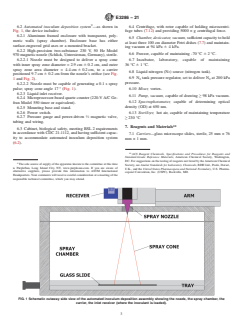
6.2 Automated inoculum deposition system —as shown in 6.4 Centrifuge, with rotor capable of holding microcentri-
Fig. 1, the device includes: fuge tubes (7.12) and providing 5000 × g centrifugal force.
6.2.1 Aluminum framed enclosure with transparent, poly-
6.5 Chamber, desiccator, vacuum,sufficientcapacitytohold
meric walls (spray chamber). Enclosure base has either
at least three 100 cm diameter Petri dishes (7.7) and maintain-
surface-engraved grid axes or a mounted bracket.
ing vacuum at 94 kPa 6 4 kPa.
6.2.2 High-precision two-substance 230 V, 50 Hz Model
6.6 Freezer, capable of maintaining -70°C 62°C.
970magneticnozzle(Schlick,Untersiemau,Germany),sterile.
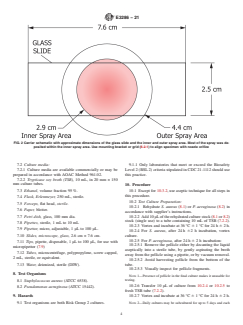
6.2.2.1 Nozzle must be designed to deliver a spray cone 6.7 Incubator, laboratory, capable of maintaining
with inner spray zone diameter = 2.9 cm 60.2 cm, and outer
36°C 61°C.
spray zone area diameter = 4.4cm 60.2cm, to a carrier
6.8 Liquid nitrogen (N ) source (nitrogen tank).
positioned 9.7cm 60.2cm from the nozzle’s orifice (see Fig.
6.9 N tank pressure regulator, set to deliver N at 200 kPa
2 2
1 and Fig. 2).
pressure.
6.2.2.2 Nozzle must be capable of generating a 0.1 s spray
pulse; spray cone angle 17° (Fig. 1).
6.10 Mixer, vortex.
6.2.3 Liquid inlet receiver.
6.11 Pump, vacuum, capable of drawing ≥ 98 kPa vacuum.
6.2.4 Microprocessor-based quartz counter (220-VA/C Ge-
6.12 Spectrophotometer, capable of determining optical
fran Model 550 timer or equivalent).
density (OD) at 650 nm.
6.2.5 Mounting base and stand.
6.2.6 Power switch.
6.13 Sterilizer, hot air, capable of maintaining temperature
6.2.7 Pressure gauge and power-driven ⁄2 magnetic valve,
≥230 °C
tubing and wiring.
7. Reagents and Materials
6.3 Cabinet, biological safety, meeting BSL 2 requirements
in accordance with CDC 21-1112, and having sufficient capac-
7.1 Carriers—glass microscope slides, sterile, 25 mm × 76
ity to accommodate automated inoculum deposition system
mm × 1 mm.
(6.2).
ACS Reagent Chemicals, Specifications and Procedures for Reagents and
Standard-Grade Reference Materials, American Chemical Society, Washington,
DC. For suggestions on the testing of reagents not listed by theAmerican Chemical
Thesolesourceofsupplyoftheapparatusknowntothecommitteeatthistime
Society, see Analar Standards for Laboratory Chemicals, BDH Ltd., Poole, Dorset,
is PurpleSun, Long Island City, NY, www.purplesun.com. If you are aware of
U.K., and the United States Pharmacopeia and National Formulary, U.S. Pharma-
alternative suppliers, please provide this information to ASTM International
copeial Convention, Inc. (USPC), Rockville, MD.
Headquarters.Your comments will receive careful consideration at a meeting of the
responsible technical committee, which you may attend.
FIG. 1 Schematic cutaway side view of the automated inoculum deposition assembly showing the nozzle, the spray chamber, the
carrier, the inlet receiver (where the inoculant is loaded).
E3286 − 21
FIG. 2 Carrier schematic with approximate dimensions of the glass slide and the inner and outer spray area. Most of the spray was de-
posited within the inner spray area. Use mounting bracket or grid (6.2.1) to align specimen with nozzle orifice
7.2 Culture media: 9.1.1 Only laboratories that meet or exceed the Biosafety
7.2.1 Culture media are available commercially or may be Level 2 (BSL2) criteria stipulated in CDC 21-1112 should use
prepared in accordance with AOAC Method 961.02. this practice.
7.2.2 Trypticase soy broth (TSB), 10 mL, in 20 mm × 150
mm culture tubes.
10. Procedure
7.3 Ethanol, volume fraction 95%. 10.1 Exceptfor10.3.2,useaseptictechniqueforallstepsin
this procedure.
7.4 Flask, Erlenmeyer, 250 mL, sterile.
10.2 Test Culture Preparation:
7.5 Forceps, flat head, sterile.
10.2.1 Rehydrate S. aureus (8.1)or P. aeruginosa (8.2)in
7.6 Paper, blotter.
accordance with supplier’s
...