

ASTM E2196-23
(Test Method)Standard Test Method for Quantification of Pseudomonas aeruginosa Biofilm Grown with Medium Shear and Continuous Flow Using Rotating Disk Reactor
General Information
- Abstract
SIGNIFICANCE AND USE
5.1 Bacteria that exist in a biofilm are phenotypically different from suspended cells of the same genotype. The study of biofilm in the laboratory requires protocols that account for this difference. Laboratory biofilms are engineered in growth reactors designed to produce a specific biofilm type. Altering system parameters will correspondingly result in a change in the biofilm. The purpose of this method is to direct a user in the laboratory study of biofilms by clearly defining each system parameter. This method will enable a person to grow, sample, and analyze a laboratory biofilm. The method was originally developed to study toilet bowl biofilms, but may also be utilized for research that requires a biofilm grown under moderate fluid shear.
SCOPE
1.1 This test method is used for growing a reproducible (1)2 Pseudomonas aeruginosa biofilm in a continuously stirred tank reactor (CSTR) under medium shear conditions. In addition, the test method describes how to sample and analyze biofilm for viable cells.
1.2 Although this test method was created to mimic conditions within a toilet bowl, it can be adapted for the growth and characterization of varying species of biofilm (rotating disk reactor—repeatability and relevance (2)).
1.3 This test method describes how to sample and analyze biofilm for viable cells. Biofilm population density is recorded as log10 colony forming units per surface area (rotating disk reactor—efficacy test method (3)).
1.4 Basic microbiology training is required to perform this test method.
1.5 The values stated in SI units are to be regarded as standard. No other units of measurement are included in this standard.
1.6 This standard does not purport to address all of the safety concerns, if any, associated with its use. It is the responsibility of the user of this standard to establish appropriate safety, health, and environmental practices and determine the applicability of regulatory limitations prior to use.
1.7 This international standard was developed in accordance with internationally recognized principles on standardization established in the Decision on Principles for the Development of International Standards, Guides and Recommendations issued by the World Trade Organization Technical Barriers to Trade (TBT) Committee.
- Status
- Published
- Publication Date
- 31-Mar-2023
- Technical Committee
- E35 - Pesticides, Antimicrobials, and Alternative Control Agents
- Drafting Committee
- E35.15 - Antimicrobial Agents
Buy Documents
ASTM E2196-23 - Standard Test Method for Quantification of <emph type="bdit">Pseudomonas aeruginosa</emph > Biofilm Grown with Medium Shear and Continuous Flow Using Rotating Disk Reactor
REDLINE ASTM E2196-23 - Standard Test Method for Quantification of <emph type="bdit">Pseudomonas aeruginosa</emph > Biofilm Grown with Medium Shear and Continuous Flow Using Rotating Disk Reactor
Overview
ASTM E2196-23 is the international standard test method issued by ASTM International for the quantification of Pseudomonas aeruginosa biofilm grown under medium shear and continuous flow conditions using a rotating disk reactor. This standard guides laboratories in cultivating reproducible biofilms, particularly for assessing population density, viability, and characteristics on solid surfaces under controlled, laboratory-simulated environments. Originally developed to mimic biofilm conditions found in toilet bowls, the method is adaptable to a range of biofilm species and growth conditions, making it highly relevant for research on microbial resistance, antimicrobial efficacy, and surface disinfection.
Key Topics
Biofilm Formation and Analysis
- Focuses on understanding bacterial phenotype changes in biofilms compared to suspended cells
- Outlines procedures to grow and analyze Pseudomonas aeruginosa biofilms using controlled shear and nutrient flow
Rotating Disk Reactor (RDR) Methodology
- Utilizes a continuously stirred tank reactor (CSTR) with rotating disk and coupons as the biofilm sampling surface
- Establishes steady-state biofilm conditions conducive to relevant laboratory studies
Quantification of Viable Cells
- Details sampling and enumeration techniques, including scraping, homogenization, serial dilution, and plating
- Population density is computed as log10 colony forming units (CFU) per surface area
Reproducibility and Laboratory Best Practices
- Recommends randomization to minimize bias in biofilm studies
- Emphasizes proper sterilization, culture preparation, and safety protocols
Applications
ASTM E2196-23 is valuable for laboratories, research institutions, and product development sectors focused on biofilm research, antimicrobial testing, and disinfectant efficacy. Its applications include:
Simulating Real-World Biofilm Environments
- Mimics conditions found in toilets and similar settings
- Enables realistic studies on detachment, growth rates, and microbial resistance in biofilms under medium fluid shear
Antimicrobial Agent Testing
- Helps evaluate the effectiveness of antibiotics and disinfectants by providing a reproducible method for biofilm formation and viability analysis
Material and Surface Studies
- Assesses how different materials (e.g., polycarbonate, stainless steel, glass) influence biofilm development and resilience
Water and Wastewater Research
- Suitable for bacteriological assessments in environmental and public health laboratories where biofilm control is essential
Fundamental Microbiology Training
- Serves as a hands-on protocol for training staff in microbiological sampling, laboratory best practices, and analytical accuracy
Related Standards
For comprehensive and consistent biofilm research, ASTM E2196-23 references several related standards, including:
ASTM E2756
- Terminology Relating to Antimicrobial and Antiviral Agents
ASTM D5465
- Practices for Determining Microbial Colony Counts from Waters Analyzed by Plating Methods
Standard Methods for the Examination of Water and Wastewater
- Reference for sample preparation and microbial dilution water (Method 9050 C.1.a)
Adopting ASTM E2196-23, in conjunction with related standards, ensures that laboratory research on biofilms is scientifically rigorous, industry-comparable, and aligned with international best practices for microbial testing and antimicrobial efficacy studies.
Keywords: Pseudomonas aeruginosa, biofilm quantification, rotating disk reactor, medium shear, continuous flow, ASTM E2196-23, antimicrobial effectiveness, laboratory biofilm testing, colony forming units, microbiological analysis.
Relations
- Effective Date
- 01-Jul-2020
- Effective Date
- 01-Nov-2019
- Effective Date
- 01-Apr-2018
- Effective Date
- 01-Jun-2016
- Effective Date
- 01-Jun-2012
- Effective Date
- 01-May-2010
- Effective Date
- 01-Jun-2004
- Effective Date
- 10-Dec-1998
Buy Documents
ASTM E2196-23 - Standard Test Method for Quantification of <emph type="bdit">Pseudomonas aeruginosa</emph > Biofilm Grown with Medium Shear and Continuous Flow Using Rotating Disk Reactor
REDLINE ASTM E2196-23 - Standard Test Method for Quantification of <emph type="bdit">Pseudomonas aeruginosa</emph > Biofilm Grown with Medium Shear and Continuous Flow Using Rotating Disk Reactor
Frequently Asked Questions
ASTM E2196-23 is a standard published by ASTM International. Its full title is "Standard Test Method for Quantification of <emph type="bdit">Pseudomonas aeruginosa</emph > Biofilm Grown with Medium Shear and Continuous Flow Using Rotating Disk Reactor". This standard covers: SIGNIFICANCE AND USE 5.1 Bacteria that exist in a biofilm are phenotypically different from suspended cells of the same genotype. The study of biofilm in the laboratory requires protocols that account for this difference. Laboratory biofilms are engineered in growth reactors designed to produce a specific biofilm type. Altering system parameters will correspondingly result in a change in the biofilm. The purpose of this method is to direct a user in the laboratory study of biofilms by clearly defining each system parameter. This method will enable a person to grow, sample, and analyze a laboratory biofilm. The method was originally developed to study toilet bowl biofilms, but may also be utilized for research that requires a biofilm grown under moderate fluid shear. SCOPE 1.1 This test method is used for growing a reproducible (1)2 Pseudomonas aeruginosa biofilm in a continuously stirred tank reactor (CSTR) under medium shear conditions. In addition, the test method describes how to sample and analyze biofilm for viable cells. 1.2 Although this test method was created to mimic conditions within a toilet bowl, it can be adapted for the growth and characterization of varying species of biofilm (rotating disk reactor—repeatability and relevance (2)). 1.3 This test method describes how to sample and analyze biofilm for viable cells. Biofilm population density is recorded as log10 colony forming units per surface area (rotating disk reactor—efficacy test method (3)). 1.4 Basic microbiology training is required to perform this test method. 1.5 The values stated in SI units are to be regarded as standard. No other units of measurement are included in this standard. 1.6 This standard does not purport to address all of the safety concerns, if any, associated with its use. It is the responsibility of the user of this standard to establish appropriate safety, health, and environmental practices and determine the applicability of regulatory limitations prior to use. 1.7 This international standard was developed in accordance with internationally recognized principles on standardization established in the Decision on Principles for the Development of International Standards, Guides and Recommendations issued by the World Trade Organization Technical Barriers to Trade (TBT) Committee.
SIGNIFICANCE AND USE 5.1 Bacteria that exist in a biofilm are phenotypically different from suspended cells of the same genotype. The study of biofilm in the laboratory requires protocols that account for this difference. Laboratory biofilms are engineered in growth reactors designed to produce a specific biofilm type. Altering system parameters will correspondingly result in a change in the biofilm. The purpose of this method is to direct a user in the laboratory study of biofilms by clearly defining each system parameter. This method will enable a person to grow, sample, and analyze a laboratory biofilm. The method was originally developed to study toilet bowl biofilms, but may also be utilized for research that requires a biofilm grown under moderate fluid shear. SCOPE 1.1 This test method is used for growing a reproducible (1)2 Pseudomonas aeruginosa biofilm in a continuously stirred tank reactor (CSTR) under medium shear conditions. In addition, the test method describes how to sample and analyze biofilm for viable cells. 1.2 Although this test method was created to mimic conditions within a toilet bowl, it can be adapted for the growth and characterization of varying species of biofilm (rotating disk reactor—repeatability and relevance (2)). 1.3 This test method describes how to sample and analyze biofilm for viable cells. Biofilm population density is recorded as log10 colony forming units per surface area (rotating disk reactor—efficacy test method (3)). 1.4 Basic microbiology training is required to perform this test method. 1.5 The values stated in SI units are to be regarded as standard. No other units of measurement are included in this standard. 1.6 This standard does not purport to address all of the safety concerns, if any, associated with its use. It is the responsibility of the user of this standard to establish appropriate safety, health, and environmental practices and determine the applicability of regulatory limitations prior to use. 1.7 This international standard was developed in accordance with internationally recognized principles on standardization established in the Decision on Principles for the Development of International Standards, Guides and Recommendations issued by the World Trade Organization Technical Barriers to Trade (TBT) Committee.
ASTM E2196-23 is classified under the following ICS (International Classification for Standards) categories: 07.100.01 - Microbiology in general. The ICS classification helps identify the subject area and facilitates finding related standards.
ASTM E2196-23 has the following relationships with other standards: It is inter standard links to ASTM D5465-16(2020), ASTM E2756-19, ASTM E2756-18, ASTM D5465-16, ASTM D5465-93(2012), ASTM E2756-10, ASTM D5465-93(2004), ASTM D5465-93(1998). Understanding these relationships helps ensure you are using the most current and applicable version of the standard.
ASTM E2196-23 is available in PDF format for immediate download after purchase. The document can be added to your cart and obtained through the secure checkout process. Digital delivery ensures instant access to the complete standard document.
Standards Content (Sample)
This international standard was developed in accordance with internationally recognized principles on standardization established in the Decision on Principles for the
Development of International Standards, Guides and Recommendations issued by the World Trade Organization Technical Barriers to Trade (TBT) Committee.
Designation: E2196 − 23
Standard Test Method for
Quantification of Pseudomonas aeruginosa Biofilm Grown
with Medium Shear and Continuous Flow Using Rotating
Disk Reactor
This standard is issued under the fixed designation E2196; the number immediately following the designation indicates the year of
original adoption or, in the case of revision, the year of last revision. A number in parentheses indicates the year of last reapproval. A
superscript epsilon (´) indicates an editorial change since the last revision or reapproval.
1. Scope* 2. Referenced Documents
2 3
1.1 This test method is used for growing a reproducible (1) 2.1 ASTM Standards:
Pseudomonas aeruginosa biofilm in a continuously stirred tank E2756 Terminology Relating to Antimicrobial and Antiviral
reactor (CSTR) under medium shear conditions. In addition, Agents
the test method describes how to sample and analyze biofilm D5465 Practices for Determining Microbial Colony Counts
for viable cells. from Waters Analyzed by Plating Methods
2.2 Other Standards:
1.2 Although this test method was created to mimic condi-
Method 9050 C.1.a Buffered Dilution Water Preparation (4)
tions within a toilet bowl, it can be adapted for the growth and
characterization of varying species of biofilm (rotating disk
3. Terminology
reactor—repeatability and relevance (2)).
3.1 For definitions of terms used in this test method refer to
1.3 This test method describes how to sample and analyze
Terminology E2756.
biofilm for viable cells. Biofilm population density is recorded
3.2 Definitions of Terms Specific to This Standard:
as log colony forming units per surface area (rotating disk
3.2.1 biofilm, n—microorganisms living in a self-organized
reactor—efficacy test method (3)).
community attached to surfaces, interfaces, or each other,
1.4 Basic microbiology training is required to perform this
embedded in a matrix of extracellular polymeric substances of
test method.
microbial origin, while exhibiting altered phenotypes with
respect to growth rate and gene transcription.
1.5 The values stated in SI units are to be regarded as
3.2.1.1 Discussion—Biofilms may be comprised of bacteria,
standard. No other units of measurement are included in this
fungi, algae, protozoa, viruses, or infinite combinations of
standard.
these microorganisms. The qualitative characteristics of a
1.6 This standard does not purport to address all of the
biofilm, including, but not limited to, population density,
safety concerns, if any, associated with its use. It is the
taxonomic diversity, thickness, chemical gradients, chemical
responsibility of the user of this standard to establish appro-
composition, consistency, and other materials in the matrix that
priate safety, health, and environmental practices and deter-
are not produced by the biofilm microorganisms, are controlled
mine the applicability of regulatory limitations prior to use.
by the physiochemical environment in which it exists.
1.7 This international standard was developed in accor-
3.2.2 coupon, n—biofilm sample surface.
dance with internationally recognized principles on standard-
ization established in the Decision on Principles for the
4. Summary of Test Method
Development of International Standards, Guides and Recom-
4.1 This test method is used for growing a reproducible
mendations issued by the World Trade Organization Technical
Pseudomonas aeruginosa biofilm in a rotating disk reactor.
Barriers to Trade (TBT) Committee.
The biofilm is established by operating the reactor in batch
mode (no flow) for 24 h. Steady state growth (attachment is
equal to detachment) is reached while the reactor operates for
This test method is under the jurisdiction of ASTM Committee E35 on
an additional 24 h with continuous flow of the nutrients. The
Pesticides, Antimicrobials, and Alternative Control Agents and is the direct
responsibility of Subcommittee E35.15 on Antimicrobial Agents.
Current edition approved April 1, 2023. Published April 2023. Originally
approved in 2002. Last previous edition approved in 2022 as E2196 – 22. DOI: For referenced ASTM standards, visit the ASTM website, www.astm.org, or
10.1520/E2196-23. contact ASTM Customer Service at service@astm.org. For Annual Book of ASTM
The boldface numbers in parentheses refer to a list of references at the end of Standards volume information, refer to the standard’s Document Summary page on
this standard. the ASTM website.
*A Summary of Changes section appears at the end of this standard
Copyright © ASTM International, 100 Barr Harbor Drive, PO Box C700, West Conshohocken, PA 19428-2959. United States
E2196 − 23
NOTE 1—Alternatively, a coupon manipulation tool may be used.
residence time of the nutrients in the reactor is set to select for
biofilm growth, and is species and reactor parameter specific.
6.13 Stainless Steel Hemostat Clamp, with curved tip.
During the entire 48 h, the biofilm is exposed to continuous
6.14 Environmental Shaker, capable of maintaining tem-
fluid shear from the rotation of the disk. At the end of the 48 h,
perature of 36 6 2 °C.
biofilm accumulation is quantified by removing coupons from
6.15 Analytical Balance, sensitive to 0.01 g.
the disk, harvesting the biofilm from the coupon surface,
disaggregating the clumps, then diluting and plating for viable 6.16 Sterilizer, any steam sterilizer capable of producing the
conditions of sterilization is acceptable.
cell enumeration.
6.17 Colony Counter, any one of several types may be used,
5. Significance and Use
such as the Quebec, Buck, and Wolfhuegel. A hand tally for the
recording of the bacterial count is recommended if manual
5.1 Bacteria that exist in a biofilm are phenotypically
counting is done.
different from suspended cells of the same genotype. The study
6.18 Peristaltic Pump, pump head capable of holding tubing
of biofilm in the laboratory requires protocols that account for
with inner diameter of 3.1 mm and outer diameter of 3.2 mm.
this difference. Laboratory biofilms are engineered in growth
reactors designed to produce a specific biofilm type. Altering
6.19 Digital Magnetic Stir Plate, top plate 10.16 by 10.16
system parameters will correspondingly result in a change in
cm, capable of rotating at 200 6 5 r/min.
the biofilm. The purpose of this method is to direct a user in the
6.20 Silicone Tubing, two sizes of tubing: one with inner
laboratory study of biofilms by clearly defining each system
diameter of 3.1 mm and outer diameter of 3.2 mm, and the
parameter. This method will enable a person to grow, sample,
other with inner diameter of 7.9 mm and outer diameter of 9.5
and analyze a laboratory biofilm. The method was originally
mm. Both sizes must withstand sterilization.
developed to study toilet bowl biofilms, but may also be
6.21 Norprene Tubing, inner diameter of 3.1 mm and outer
utilized for research that requires a biofilm grown under
diameter of 3.2 mm.
moderate fluid shear.
6.22 Glass Flow Break, any that will connect with tubing of
inner diameter 3.1 mm and withstands sterilization.
6. Apparatus
6.23 Clamp, used to hold flow break, extension clamp with
6.1 Wooden Applicator Sticks, sterile.
0.5 cm minimum grip size.
6.2 Inoculating Loop.
6.24 Clamp Stand, height no less than 76.2 cm, used with
clamp to suspend glass flow break vertically and stabilize
6.3 Petri Dish, 100 by 15 mm, plastic, sterile and empty to
tubing above reactor.
hold rotor while sampling.
6.25 Reactor Components :
6.4 Culture Tubes and Culture Tube Closures, any with a
6.25.1 Berzelius Borosilicate Glass Beaker, 1000 mL with-
volume capacity of 10 mL and minimum diameter of 16 mm.
out pour spout, 9.5 6 0.5 cm diameter. Borosilicate barbed
Recommended size is 16 by 125 mm borosilicate glass with
outlet spout added at 300 6 15 mL mark at 30 to 45° angle,
threaded opening.
spout should accommodate silicone tubing with an inner
diameter of 8 to 11 mm.
6.5 Pipette(s), continuously adjustable pipette(s) with vol-
ume capacity of 1 mL.
NOTE 2—The rotor, described in 6.25.3, will displace approximately 25
mL of liquid. Therefore, an outlet spout at the 300 mL mark will result in
6.6 Micropipette(s), continuously adjustable pipette(s) with
an operating volume of approximately 275 mL. Before use, the user
a volume capacity of 10 – 250 μL.
should confirm the actual liquid volume in the reactor, after the rotor is in
place and the stir plate is turned on. The measured operating volume is
6.7 Vortex, any vortex that will ensure proper agitation and
used to calculate an exact pump flow rate.
mixing of culture tubes.
6.25.2 Reactor Top, size 15 rubber or machined stopper,
with three holes bored through top to accommodate 6 cm
6.8 Homogenizer, any capable of mixing at 20 500 6 5000
r/min in a 5 to 10 mL volume.
6.9 Homogenizer Probe, any capable of mixing at 20 500 6
The sole source of supply of the apparatus (coupon manipulation tool) known
5000 r/min in a 5 to 10 mL volume that can withstand
to the committee at this time is BioSurface Technologies, Corp., www.biofilms.biz.
If you are aware of alternative suppliers, please provide this information to ASTM
autoclaving or other means of sterilization.
International Headquarters. Your comments will receive careful consideration at a
meeting of the responsible technical committee, which you may attend. The user
6.10 Sonicating Bath, any cavitating sonicating bath that
may also build the holder,
operates at 45 to 50 kHz for cleaning the coupons.
Trademarked by the Saint-Gobain Performance Plastics Corporation.
The sole source of supply of the apparatus (rotating disk reactor) known to the
6.11 Bunsen Burner, used to flame inoculating loop and
committee at this time is BioSurface Technologies, Corp., www.biofilms.biz. If you
other instruments.
are aware of alternative suppliers, please provide this information to ASTM
International Headquarter. Your comments will receive careful consideration at a
6.12 Stainless Steel Dissecting Tools, for removing the 1
meeting of the responsible technical committee, which you may attend. The user
coupons. may also build the reactor.
E2196 − 23
pieces of stainless steel tubing or other suitable rigid autocla- 6.26.2 Bacterial Air Vent, autoclavable 0.2 μm pore size, to
vable tubing with an outside diameter of 4 to 6 mm. One port be spliced into tubing on waste carboy, nutrient carboy, and
accommodates tubing for media, the second port is fitted with reactor top (37 mm and 25mm diameter recommended).
a short piece of silicone tubing that holds a bacterial air vent,
7. Reagents and Materials
and the third is an inoculum port as shown in Fig. 1.
6.25.3 Rotor or Disk, nominal 1.6 mm thick PTFE sheet cut
7.1 Purity of Water—All reference to water as diluent or
into a disk with a diameter of 7.0 6 0.2 cm containing six
reagent shall mean distilled water or water of equal purity.
evenly spaced holes with a diameter of 1.27 6 0.1 cm. The
7.2 Culture Media:
center of each hole is located 2.55 6 0.03 cm from the center
7.2.1 Bacterial Liquid Growth Broth—Tryptic Soy Broth
of the disk. 4.5 to 7.0 mm thick rubber sheet, or other suitable
(TSB) is recommended.
autoclavable material, cut into a disk with a diameter of 7.0 6
7.2.2 Bacterial Plating Medium—R2A agar is recom-
0.2 cm containing six evenly spaced holes with a diameter of
mended.
1.27 6 0.15 cm (the holes in the rubber are aligned with the
NOTE 5—Two different concentrations of TSB are used in the protocol,
holes in the PTFE) and a small hole in the center to house the
300 mg/L for the inoculum and batch reactor operation and 30 mg/L for
disk retrieving port. PTFE washer with disk retrieving port. the continuous flow reactor operation.
Four nylon screws. PTFE-coated 4.0 by 1.4 cm star-head
7.3 Buffered Water—0.0425 g/L KH PO distilled water,
2 4
magnetic stir bar, set flush against PTFE disk, with holes
filter sterilized, and 0.405 g/L MgCl · 6H O distilled water,
drilled for assembly using nylon screws. The PTFE ridges on
filter sterilized, prepared according to Method 9050 C.1.a(4).
one side of the magnet may be shaved to provide a flush
mounting surface. Assemble the pieces conforming to the 8. Culture Preparation
general details shown in Fig. 2.
8.1 Pseudomonas aeruginosa ATCC 700888 is the organism
used in this test. Aseptically remove an isolated colony from an
NOTE 3—Nominal implies that the manufacturer’s tolerance is accept-
able. R2A plate and place into 100 mL of sterile TSB (300 mg/L).
Incubate bacterial suspension in an environmental shaker at 36
6.25.4 Six Cylindrical Polycarbonate Coupons, with a di-
6 2 °C for 22 6 2 h. Viable bacterial density should be about
ameter of 1.27
...
This document is not an ASTM standard and is intended only to provide the user of an ASTM standard an indication of what changes have been made to the previous version. Because
it may not be technically possible to adequately depict all changes accurately, ASTM recommends that users consult prior editions as appropriate. In all cases only the current version
of the standard as published by ASTM is to be considered the official document.
Designation: E2196 − 22 E2196 − 23
Standard Test Method for
Quantification of Pseudomonas aeruginosa Biofilm Grown
with Medium Shear and Continuous Flow Using Rotating
Disk Reactor
This standard is issued under the fixed designation E2196; the number immediately following the designation indicates the year of
original adoption or, in the case of revision, the year of last revision. A number in parentheses indicates the year of last reapproval. A
superscript epsilon (´) indicates an editorial change since the last revision or reapproval.
1. Scope*
1.1 This test method is used for growing a reproducible (1) Pseudomonas aeruginosa biofilm in a continuously stirred tank
reactor (CSTR) under medium shear conditions. In addition, the test method describes how to sample and analyze biofilm for
viable cells.
1.2 Although this test method was created to mimic conditions within a toilet bowl, it can be adapted for the growth and
characterization of varying species of biofilm (rotating disk reactor—repeatability and relevance (2)).
1.3 This test method describes how to sample and analyze biofilm for viable cells. Biofilm population density is recorded as log
colony forming units per surface area (rotating disk reactor—efficacy test method (3)).
1.4 Basic microbiology training is required to perform this test method.
1.5 The values stated in SI units are to be regarded as standard. No other units of measurement are included in this standard.
1.6 This standard does not purport to address all of the safety concerns, if any, associated with its use. It is the responsibility
of the user of this standard to establish appropriate safety and healthsafety, health, and environmental practices and determine
the applicability of regulatory limitations prior to use.
1.7 This international standard was developed in accordance with internationally recognized principles on standardization
established in the Decision on Principles for the Development of International Standards, Guides and Recommendations issued
by the World Trade Organization Technical Barriers to Trade (TBT) Committee.
2. Referenced Documents
2.1 ASTM Standards:
E2756 Terminology Relating to Antimicrobial and Antiviral Agents
D5465 Practices for Determining Microbial Colony Counts from Waters Analyzed by Plating Methods
This test method is under the jurisdiction of ASTM Committee E35 on Pesticides, Antimicrobials, and Alternative Control Agents and is the direct responsibility of
Subcommittee E35.15 on Antimicrobial Agents.
Current edition approved May 1, 2022April 1, 2023. Published May 2022April 2023. Originally approved in 2002. Last previous edition approved in 20172022 as
E2196 – 17.E2196 – 22. DOI: 10.1520/E2196-22.10.1520/E2196-23.
The boldface numbers in parentheses refer to a list of references at the end of this standard.
For referenced ASTM standards, visit the ASTM website, www.astm.org, or contact ASTM Customer Service at service@astm.org. For Annual Book of ASTM Standards
volume information, refer to the standard’s Document Summary page on the ASTM website.
*A Summary of Changes section appears at the end of this standard
Copyright © ASTM International, 100 Barr Harbor Drive, PO Box C700, West Conshohocken, PA 19428-2959. United States
E2196 − 23
2.2 Other Standards:
Method 9050 C.1.a Buffered Dilution Water Preparation (4)
3. Terminology
3.1 For definitions of terms used in this test method refer to Terminology E2756.
3.2 Definitions of Terms Specific to This Standard:
3.2.1 biofilm, n—microorganisms living in a self-organized community attached to surfaces, interfaces, or each other, embedded
in a matrix of extracellular polymeric substances of microbial origin, while exhibiting altered phenotypes with respect to growth
rate and gene transcription.
3.2.1.1 Discussion—
Biofilms may be comprised of bacteria, fungi, algae, protozoa, viruses, or infinite combinations of these microorganisms. The
qualitative characteristics of a biofilm, including, but not limited to, population density, taxonomic diversity, thickness, chemical
gradients, chemical composition, consistency, and other materials in the matrix that are not produced by the biofilm
microorganisms, are controlled by the physiochemical environment in which it exists.
3.2.2 coupon, n—biofilm sample surface.
4. Summary of Test Method
4.1 This test method is used for growing a reproducible Pseudomonas aeruginosa biofilm in a rotating disk reactor. The biofilm
is established by operating the reactor in batch mode (no flow) for 24 h. Steady state growth (attachment is equal to detachment)
is reached while the reactor operates for an additional 24 h with continuous flow of the nutrients. The residence time of the nutrients
in the reactor is set to select for biofilm growth, and is species and reactor parameter specific. During the entire 48 h, the biofilm
is exposed to continuous fluid shear from the rotation of the disk. At the end of the 48 h, biofilm accumulation is quantified by
removing coupons from the disk, harvesting the biofilm from the coupon surface, disaggregating the clumps, then diluting and
plating for viable cell enumeration.
5. Significance and Use
5.1 Bacteria that exist in a biofilm are phenotypically different from suspended cells of the same genotype. The study of biofilm
in the laboratory requires protocols that account for this difference. Laboratory biofilms are engineered in growth reactors designed
to produce a specific biofilm type. Altering system parameters will correspondingly result in a change in the biofilm. The purpose
of this method is to direct a user in the laboratory study of biofilms by clearly defining each system parameter. This method will
enable a person to grow, sample, and analyze a laboratory biofilm. The method was originally developed to study toilet bowl
biofilms, but may also be utilized for research that requires a biofilm grown under moderate fluid shear.
6. Apparatus
6.1 Wooden Applicator Sticks, sterile.
6.2 Inoculating Loop.
6.3 Petri Dish, 100 by 15 mm, plastic, sterile and empty to hold rotor while sampling.
6.4 Culture Tubes and Culture Tube Closures, any with a volume capacity of 10 mL and minimum diameter of 16 mm.
Recommended size is 16 by 125 mm borosilicate glass with threaded opening.
6.5 Pipette(s), continuously adjustable pipette(s) with volume capacity of 1 mL.
6.6 Micropipette(s), continuously adjustable pipette(s) with a volume capacity of 10 – 250 μL.
6.7 Vortex, any vortex that will ensure proper agitation and mixing of culture tubes.
6.8 Homogenizer, any capable of mixing at 20 500 6 5000 r/min in a 5 to 10 mL volume.
E2196 − 23
6.9 Homogenizer Probe, any capable of mixing at 20 500 6 5000 r/min in a 5 to 10 mL volume that can withstand autoclaving
or other means of sterilization.
6.10 Sonicating Bath, any cavitating sonicating bath that operates at 45 to 6050 kHz for cleaning the coupons.
6.11 Bunsen Burner, used to flame inoculating loop and other instruments.
6.12 Stainless Steel Dissecting Tools, for removing the coupons.
NOTE 1—Alternatively, a coupon manipulation tool may be used.
6.13 Stainless Steel Hemostat Clamp, with curved tip.
6.14 Environmental Shaker, capable of maintaining temperature of 36 6 2°C.2 °C.
6.15 Analytical Balance, sensitive to 0.01 g.
6.16 Sterilizer, any steam sterilizer capable of producing the conditions of sterilization is acceptable.
6.17 Colony Counter, any one of several types may be used, such as the Quebec, Buck, and Wolfhuegel. A hand tally for the
recording of the bacterial count is recommended if manual counting is done.
6.18 Peristaltic Pump, pump head capable of holding tubing with inner diameter of 3.1 mm and outer diameter of 3.2 mm.
6.19 Digital Magnetic Stir Plate, top plate 10.16 by 10.16 cm, capable of rotating at 200 6 5 r/min.
6.20 Silicone Tubing, two sizes of tubing: one with inner diameter of 3.1 mm and outer diameter of 3.2 mm, and the other with
inner diameter of 7.9 mm and outer diameter of 9.5 mm. Both sizes must withstand sterilization.
6.21 Norprene Tubing, inner diameter of 3.1 mm and outer diameter of 3.2 mm.
6.22 Glass Flow Break, any that will connect with tubing of inner diameter 3.1 mm and withstands sterilization.
6.23 Clamp, used to hold flow break, extension clamp with 0.5 cm minimum grip size.
6.24 Clamp Stand, height no less than 76.2 cm, used with clamp to suspend glass flow break vertically and stabilize tubing above
reactor.
6.25 Reactor Components :
6.25.1 Berzelius Borosilicate Glass Beaker, 1000 mL without pour spout, 9.5 6 0.5 cm diameter. Borosilicate barbed outlet spout
added at 250300 6 15 mL mark at 30 to 45° angle, spout should accommodate silicone tubing with an inner diameter of 8 to 11
mm.
The sole source of supply of the apparatus (coupon manipulation tool) known to the committee at this time is BioSurface Technologies, Corp., www.biofilms.biz. If you
are aware of alternative suppliers, please provide this information to ASTM International Headquarters. Your comments will receive careful consideration at a meeting of
the responsible technical committee, which you may attend. The user may also build the holder,
Trademarked by the Saint-Gobain Performance Plastics Corporation.
The sole source of supply of the apparatus (rotating disk reactor) known to the committee at this time is BioSurface Technologies, Corp., www.biofilms.biz. If you are
aware of alternative suppliers, please provide this information to ASTM International Headquarter. Your comments will receive careful consideration at a meeting of the
responsible technical committee, which you may attend. The user may also build the reactor.
E2196 − 23
NOTE 2—The rotor, described in 6.25.3, will displace approximately 5025 mL of liquid. Therefore, an outlet spout at the 250300 mL mark will result in
an operating volume of approximately 200275 mL. Before use, the user should confirm the actual liquid volume in the reactor, after the rotor is in place
and the stir plate is turned on. The measured operating volume is used to calculate an exact pump flow rate.
6.25.2 Reactor Top, size 15 rubber or machined stopper, with three holes bored through top to accommodate 6 cm pieces of
stainless steel tubing or other suitable rigid autoclavable tubing with an outside diameter of 4 to 6 mm. One port accommodates
tubing for media, the second port is fitted with a short piece of silicone tubing that holds a bacterial air vent, and the third is an
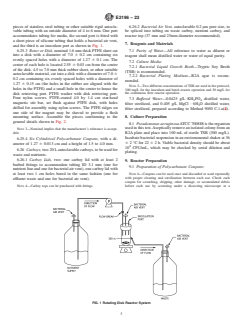
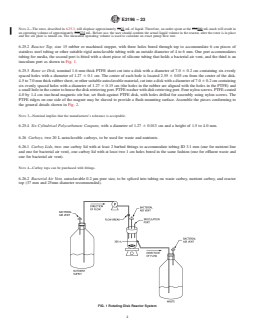
inoculum port as shown in Fig. 1.
6.25.3 Rotor or Disk, nominal 1.6 mm thick PTFE sheet cut into a disk with a diameter of 7.0 6 0.2 cm containing six evenly
spaced holes with a diameter of 1.27 6 0.1 cm. The center of each hole is located 2.55 6 0.03 cm from the center of the disk.
4.5 to 7.0 mm thick rubber sheet, or other suitable autoclavable material, cut into a disk with a diameter of 7.0 6 0.2 cm containing
six evenly spaced holes with a diameter of 1.27 6 0.15 cm (the holes in the rubber are aligned with the holes in the PTFE) and
a small hole in the center to house the disk retrieving port. PTFE washer with disk retrieving port. Four nylon screws. PTFE-coated
4.0 by 1.4 cm star-head magnetic stir bar, set flush against PTFE disk, with holes drilled for assembly using nylon screws. The
PTFE ridges on one side of the magnet may be shaved to provide a flush mounting surface. Assemble the pieces conforming to
the general details shown in Fig. 2.
NOTE 3—Nominal implies that the manufacturer’s tolerance is acceptable.
6.25.4 Six Cylindrical Polycarbonate Coupons, with a diameter of 1.27 6 0.013 cm and a height of 1.5 to 4.0 mm.
6.26 Carboys, two 20 L autoclavable carboys, to be used for waste and nutrients.
6.26.1 Carboy Lids, two: one carboy lid with at least 2 barbed fittings to accommodate tubing ID 3.1 mm (one for nutrient line
and one for bacterial air vent), one carboy lid with at least two 1 cm holes bored in the same fashion (one for effluent waste and
one for bacterial air vent).
NOTE 4—Carboy tops can be purchased with fittings.
6.26.2 Bacterial Air Vent, autoclavable 0.2 μm pore size, to be spliced into tubing on waste carboy, nutrient carboy, and reactor
top (37 mm and 25mm diameter recommended).
FIG. 1 Rotating Disk Reactor System
E2196 − 23
FIG. 2 Rotor Assembly
7. Reagents and Materials
7.1 Purity of Water—All reference to water as diluent or reagent shall mean distilled water or water of equal purity.
7.2 Culture Media:
7.2.1 Bacterial Liquid Growth Broth—Tryptic Soy Broth (TSB) is recommended.
7.2.2 Bacterial Plating Medium—R2A agar is recommended.
NOTE 5—Two different concentrations of TSB are used in
...