

ASTM F1687-22
(Guide)Standard Guide for Terminology and Indices to Describe Oiling Conditions on Shorelines and Other Terrain
General Information
- Abstract
SIGNIFICANCE AND USE
4.1 In order to ensure data consistency, it is important to use standardized terminology and definitions in describing oiling conditions (1)3. This guide provides a template for that purpose.
4.2 Data on oiling conditions at a shoreline are needed to provide an accurate perspective of the nature and scale of the oiling problem and to facilitate spill-response planning and decision making. Data on oiling conditions would be used in assessing the need for cleanup actions, selecting the most appropriate response technique(s), determining priorities for cleanup, and evaluating the endpoint of cleanup activities.(2-3)
4.3 Mechanisms by which data are collected can vary (see Guide F1686). They can include aerial video surveys or ground-level assessment surveys. The composition and responsibility of the survey team will depend on the response organization and objectives. The magnitude and type of data sets collected can likewise vary with the nature of the spill and operational needs.
4.4 Consistent data sets (observations and measurements) on shoreline oiling conditions are essential within any one spill in order to compare the data between different sites or observers, and to compare the data against existing benchmarks or criteria that have been developed to rate the nature or severity of the oiling. To the extent possible, consistency is also desirable between different spills, in order to benefit from previous experiences and cleanup decisions.
4.5 It is recognized that some modifications may be appropriate based on local or regional geographic conditions or upon the specific character of the stranded oil.
SCOPE
1.1 This guide covers the standardized terminology and types of observational data and indices appropriate to describe the quantity, nature, and distribution of oil and physical oiling conditions on shorelines that have been contaminated by an oil spill.
1.2 This guide does not address the mechanisms and field procedures by which the necessary data are gathered; nor does it address terminology used to describe the cultural resource or ecological character of oiled shorelines, spill monitoring, or cleanup techniques.
1.3 The values stated in SI units are to be regarded as standard. No other units of measurement are included in this standard.
1.4 This standard does not purport to address all of the safety concerns, if any, associated with its use. It is the responsibility of the user of this standard to establish appropriate safety, health, and environmental practices and determine the applicability of regulatory limitations prior to use.
1.5 This international standard was developed in accordance with internationally recognized principles on standardization established in the Decision on Principles for the Development of International Standards, Guides and Recommendations issued by the World Trade Organization Technical Barriers to Trade (TBT) Committee.
- Status
- Published
- Publication Date
- 31-Aug-2022
- Technical Committee
- F20 - Hazardous Substances and Oil Spill Response
- Drafting Committee
- F20.17 - Shoreline and Inland Countermeasures
Buy Documents
ASTM F1687-22 - Standard Guide for Terminology and Indices to Describe Oiling Conditions on Shorelines and Other Terrain
REDLINE ASTM F1687-22 - Standard Guide for Terminology and Indices to Describe Oiling Conditions on Shorelines and Other Terrain
Overview
ASTM F1687-22: Standard Guide for Terminology and Indices to Describe Oiling Conditions on Shorelines and Other Terrain provides a comprehensive framework for standardizing the terminology and indices used to describe the quantity, nature, and distribution of oil resulting from oil spills on shorelines and other types of terrain. Developed by ASTM International, this guide is critical for ensuring data consistency, supporting effective spill response planning, and enabling reliable comparisons across sites and incidents.
By defining a unified template for describing oiling conditions, ASTM F1687-22 facilitates accurate assessments, enhances spill-response strategies, and supports regulatory compliance. It is particularly relevant for environmental professionals, spill response teams, and regulatory bodies tasked with managing and mitigating the impacts of oil spills on diverse terrains.
Key Topics
Core Concepts Covered in ASTM F1687-22:
Standardized Terminology: Detailed definitions and standardized language for describing oiling conditions across different shoreline and terrain types, including marine, riverine, lacustrine (lake), and dry land environments.
Indices and Observational Data: Guidance on the types and classifications of observational data (e.g., length, width, thickness, distribution, and quantity of oil deposits) crucial for creating consistent, comparable reports.
Zonation and Habitat Types: Clear categorizations of shorelines, wetlands, intertidal zones, and terrains, including distinctions between surface and subsurface oiling.
Oiling Characterization: Descriptors for oil residue (e.g., pooled, coat, stain, tar balls, mousse), enabling field teams to accurately record visible pollution.
Degree of Oiling: Indices and matrices for rating the severity of oiling, supporting quick site assessment, response prioritization, and ongoing monitoring.
Comparability and Decision Support: Tools for comparing oiling conditions across different sites, observers, or events to facilitate data-driven spill response planning and evaluation.
Applications
Practical Uses of ASTM F1687-22:
Spill Response Planning: Provides critical data to assess the need for cleanup, choose appropriate techniques, prioritize actions, and evaluate cleanup endpoints.
Field Documentation: Offers a common reference for professionals conducting surveys, ensuring uniform observations and reporting in ground or aerial assessments.
Environmental Impact Assessment: Standardized descriptors help quantify the impact of oil spills for impact analysis and remediation planning.
Benchmarking and Consistency: Enables effective benchmarking by providing indices that allow comparisons across different spill events and geographic regions, improving learning and effectiveness over time.
Regulatory and Compliance Reporting: Supports regulatory requirements by facilitating clear, consistent, and defensible documentation of oiling conditions and response actions.
Training and Incident Command: Serves as an essential reference for training responders, ensuring that terminology and criteria are consistently applied in multi-agency or multi-jurisdictional operations.
Related Standards
For enhanced oil spill response and assessment processes, ASTM F1687-22 references and is complemented by several related standards:
- ASTM F1686 - Guide for Surveys to Document and Assess Oiling Conditions: Details survey techniques and field procedures for data collection.
- ASTM F2204/F2204M - Guide for Describing Shoreline and Inland Response Techniques: Outlines methods for shoreline and inland spill response.
These standards, when used with ASTM F1687-22, form a robust framework for comprehensive oil spill assessment, documentation, and management on shorelines and varied terrains.
Keywords: ASTM F1687-22, oil spill response, standard terminology, shoreline oiling, observational data, environmental impact, oil pollution assessment, field survey, cleanup decision-making, spill reporting, oil residue classification, standardized indices, habitat types, environmental standards.
Relations
- Refers
ASTM F1686-09e1 - Standard Guide for Surveys to Document and Assess Oiling Conditions on Shorelines - Effective Date
- 01-Oct-2009
- Refers
ASTM F1686-09 - Standard Guide for Surveys to Document and Assess Oiling Conditions on Shorelines - Effective Date
- 01-Oct-2009
- Effective Date
- 10-Feb-1997
- Refers
ASTM F1686-97 - Standard Guide for Surveys to Document and Assess Oiling Conditions on Shorelines - Effective Date
- 01-Jan-1997
Buy Documents
ASTM F1687-22 - Standard Guide for Terminology and Indices to Describe Oiling Conditions on Shorelines and Other Terrain
REDLINE ASTM F1687-22 - Standard Guide for Terminology and Indices to Describe Oiling Conditions on Shorelines and Other Terrain
Get Certified
Connect with accredited certification bodies for this standard

CIS Institut d.o.o.
Personal Protective Equipment (PPE) certification body. Notified Body NB-2890 for EU Regulation 2016/425 PPE.

Kiwa BDA Testing
Building and construction product certification.
Kmetijski inštitut Slovenije
Agricultural Institute of Slovenia. Soil testing, plant health, agricultural product analysis.
Sponsored listings
Frequently Asked Questions
ASTM F1687-22 is a guide published by ASTM International. Its full title is "Standard Guide for Terminology and Indices to Describe Oiling Conditions on Shorelines and Other Terrain". This standard covers: SIGNIFICANCE AND USE 4.1 In order to ensure data consistency, it is important to use standardized terminology and definitions in describing oiling conditions (1)3. This guide provides a template for that purpose. 4.2 Data on oiling conditions at a shoreline are needed to provide an accurate perspective of the nature and scale of the oiling problem and to facilitate spill-response planning and decision making. Data on oiling conditions would be used in assessing the need for cleanup actions, selecting the most appropriate response technique(s), determining priorities for cleanup, and evaluating the endpoint of cleanup activities.(2-3) 4.3 Mechanisms by which data are collected can vary (see Guide F1686). They can include aerial video surveys or ground-level assessment surveys. The composition and responsibility of the survey team will depend on the response organization and objectives. The magnitude and type of data sets collected can likewise vary with the nature of the spill and operational needs. 4.4 Consistent data sets (observations and measurements) on shoreline oiling conditions are essential within any one spill in order to compare the data between different sites or observers, and to compare the data against existing benchmarks or criteria that have been developed to rate the nature or severity of the oiling. To the extent possible, consistency is also desirable between different spills, in order to benefit from previous experiences and cleanup decisions. 4.5 It is recognized that some modifications may be appropriate based on local or regional geographic conditions or upon the specific character of the stranded oil. SCOPE 1.1 This guide covers the standardized terminology and types of observational data and indices appropriate to describe the quantity, nature, and distribution of oil and physical oiling conditions on shorelines that have been contaminated by an oil spill. 1.2 This guide does not address the mechanisms and field procedures by which the necessary data are gathered; nor does it address terminology used to describe the cultural resource or ecological character of oiled shorelines, spill monitoring, or cleanup techniques. 1.3 The values stated in SI units are to be regarded as standard. No other units of measurement are included in this standard. 1.4 This standard does not purport to address all of the safety concerns, if any, associated with its use. It is the responsibility of the user of this standard to establish appropriate safety, health, and environmental practices and determine the applicability of regulatory limitations prior to use. 1.5 This international standard was developed in accordance with internationally recognized principles on standardization established in the Decision on Principles for the Development of International Standards, Guides and Recommendations issued by the World Trade Organization Technical Barriers to Trade (TBT) Committee.
SIGNIFICANCE AND USE 4.1 In order to ensure data consistency, it is important to use standardized terminology and definitions in describing oiling conditions (1)3. This guide provides a template for that purpose. 4.2 Data on oiling conditions at a shoreline are needed to provide an accurate perspective of the nature and scale of the oiling problem and to facilitate spill-response planning and decision making. Data on oiling conditions would be used in assessing the need for cleanup actions, selecting the most appropriate response technique(s), determining priorities for cleanup, and evaluating the endpoint of cleanup activities.(2-3) 4.3 Mechanisms by which data are collected can vary (see Guide F1686). They can include aerial video surveys or ground-level assessment surveys. The composition and responsibility of the survey team will depend on the response organization and objectives. The magnitude and type of data sets collected can likewise vary with the nature of the spill and operational needs. 4.4 Consistent data sets (observations and measurements) on shoreline oiling conditions are essential within any one spill in order to compare the data between different sites or observers, and to compare the data against existing benchmarks or criteria that have been developed to rate the nature or severity of the oiling. To the extent possible, consistency is also desirable between different spills, in order to benefit from previous experiences and cleanup decisions. 4.5 It is recognized that some modifications may be appropriate based on local or regional geographic conditions or upon the specific character of the stranded oil. SCOPE 1.1 This guide covers the standardized terminology and types of observational data and indices appropriate to describe the quantity, nature, and distribution of oil and physical oiling conditions on shorelines that have been contaminated by an oil spill. 1.2 This guide does not address the mechanisms and field procedures by which the necessary data are gathered; nor does it address terminology used to describe the cultural resource or ecological character of oiled shorelines, spill monitoring, or cleanup techniques. 1.3 The values stated in SI units are to be regarded as standard. No other units of measurement are included in this standard. 1.4 This standard does not purport to address all of the safety concerns, if any, associated with its use. It is the responsibility of the user of this standard to establish appropriate safety, health, and environmental practices and determine the applicability of regulatory limitations prior to use. 1.5 This international standard was developed in accordance with internationally recognized principles on standardization established in the Decision on Principles for the Development of International Standards, Guides and Recommendations issued by the World Trade Organization Technical Barriers to Trade (TBT) Committee.
ASTM F1687-22 is classified under the following ICS (International Classification for Standards) categories: 13.300 - Protection against dangerous goods. The ICS classification helps identify the subject area and facilitates finding related standards.
ASTM F1687-22 has the following relationships with other standards: It is inter standard links to ASTM F1686-09e1, ASTM F1686-09, ASTM F1686-97(2003), ASTM F1686-97. Understanding these relationships helps ensure you are using the most current and applicable version of the standard.
ASTM F1687-22 is available in PDF format for immediate download after purchase. The document can be added to your cart and obtained through the secure checkout process. Digital delivery ensures instant access to the complete standard document.
Standards Content (Sample)
This international standard was developed in accordance with internationally recognized principles on standardization established in the Decision on Principles for the
Development of International Standards, Guides and Recommendations issued by the World Trade Organization Technical Barriers to Trade (TBT) Committee.
Designation: F1687 − 22
Standard Guide for
Terminology and Indices to Describe Oiling Conditions on
Shorelines and Other Terrain
This standard is issued under the fixed designation F1687; the number immediately following the designation indicates the year of
original adoption or, in the case of revision, the year of last revision.Anumber in parentheses indicates the year of last reapproval.A
superscript epsilon (´) indicates an editorial change since the last revision or reapproval.
1. Scope 3. Terminology
1.1 This guide covers the standardized terminology and 3.1 Definitions:
types of observational data and indices appropriate to describe
3.1.1 asphalt pavement—a naturally formed cohesive mix-
the quantity, nature, and distribution of oil and physical oiling
ture of weathered oil and sediments. Sediments in the mixture
conditionsonshorelinesthathavebeencontaminatedbyanoil
are usually in the sand/granule/pebble size range. In
spill.
appearance, natural asphalt pavement may resemble the mix-
ture artificially created to surface roads.
1.2 This guide does not address the mechanisms and field
procedures by which the necessary data are gathered; nor does
3.1.2 habitat types and zones—the land-water interface is
itaddressterminologyusedtodescribetheculturalresourceor typically subdivided into across-shore zones. Dry land terrain
ecological character of oiled shorelines, spill monitoring, or
is typically distinguished by climate, altitude, and species.
cleanup techniques. From Guide F2204/F2204M;
3.1.2.1 Discussion—Marine and estuarine shorelines, river
1.3 The values stated in SI units are to be regarded as
banks, and lake shores will be collectively referred to as
standard. No other units of measurement are included in this
shorelines, shores, or shore-zones.
standard.
3.1.2.2 Discussion—Shore types include a range of imper-
1.4 This standard does not purport to address all of the
meable (bedrock, ice, and manmade structures), permeable
safety concerns, if any, associated with its use. It is the
(flats, beaches, and manmade), and coastal wetland (marshes,
responsibility of the user of this standard to establish appro-
mangroves,) habitats.
priate safety, health, and environmental practices and deter-
3.1.2.3 Discussion—Othernon-shoreline,inlandhabitatsin-
mine the applicability of regulatory limitations prior to use.
cludewetlands(pond,fen,bog,swamp,tundra,andshrub)and
1.5 This international standard was developed in accor-
drier terrains (grassland, desert, forests), and will be collec-
dance with internationally recognized principles on standard-
tively referred to as either wetlands or terrains, respectively
ization established in the Decision on Principles for the
Tidal Environments
Development of International Standards, Guides and Recom-
Lower Intertidal Zone—the lower approximate one-third of the intertidal zone
mendations issued by the World Trade Organization Technical
Mid Intertidal Zone—the middle approximate one-third of the intertidal zone
Barriers to Trade (TBT) Committee. Upper Intertidal Zone—the upper approximate one-third of the intertidal zone
Supra-Tidal Zone—the area above the mean high tide that occasionally
experiences wave activity; also known as the splash zone
2. Referenced Documents
Non-Tidal Waters and Lake Environments
2.1 ASTM Standards:
Lower Swash Zone—the area between the mean annual water level and the
F1686Guide for Surveys to Document and Assess Oiling
lowest annual water level, the lower approximate one-half of the zone of
Conditions
wave activity
Upper Swash Zone—the area between the highest annual water level and the
F2204/F2204MGuide for Describing Shoreline and Inland
mean annual water level; the upper approximate one-half of the zone of
Response Techniques
wave activity
Supra-Swash Zone—the area above the highest annual water level that
occasionally experiences wave activity, for example, during a surge or
This guide is under the jurisdiction of ASTM Committee F20 on Hazardous
a storm event
Substances and Oil Spill Responseand is the direct responsibility of Subcommittee
F20.17 on Shoreline and Inland Countermeasures. River Environments
Current edition approved Sept. 1, 2022. Published October 2022. Originally Lower Bank—exposed only during low flow conditions
Midstream—areas exposed in a channel that are separated from the river bank
approved in 1996. Last previous edition approved in 2016 as F1687–16. DOI:
Upper Bank—under water only during bank-full river stage
10.1520/F1687-22
Overbank—flood plain-inundated only by over-bank flow during
For referenced ASTM standards, visit the ASTM website, www.astm.org, or
flood conditions
contact ASTM Customer Service at service@astm.org. For Annual Book of ASTM
Standards volume information, refer to the standard’s Document Summary page on
Dry Land Terrains
the ASTM website.
Copyright © ASTM International, 100 Barr Harbor Drive, PO Box C700, West Conshohocken, PA 19428-2959. United States
F1687 − 22
5.2 Descriptions of shoreline oiling conditions are typically
Desert—arid lands with little precipitation, of which there are four broad types:
hot and arid, semi-arid, coastal, and cold
referenced to the lateral (seaward to landward) shoreline
Forest—treed lands of which there are three broad types: tropical, temperate,
zonation. The location of the stranded oil within the intertidal
and boreal/taiga
Grassland—grass-dominated lands of which there are two broad types: tropical zone affects operational access time and oil persistence.
and temperate
5.2.1 Tidal zonation is described in terms of the supra-tidal,
Tundra—cold, treeless areas of far northern latitudes or alpine altitudes, of
upper/mid/lower intertidal, and sub-tidal zones.
which there are two broad types: arctic and alpine.
5.2.2 Non-tidal shoreline zonation is described in terms of
3.1.3 weathered oil—the oil that has had an alteration of
the supra/upper/lower swash zone for lacustrine (lake) envi-
physical or chemical properties, or both, through natural
ronments and the over/upper/lower bank or midstream for
processes such as evaporation, dissolution, oxidation,
riverine (river) environments.
emulsification, and biodegradation.
5.2.3 Dry land terrain zonation can be described in terms of
4. Significance and Use
discrete areas of similar slope, substrate, and vegetation.
Zonationcanalsobedescribedintermsofpolygonsthatrelate
4.1 Inordertoensuredataconsistency,itisimportanttouse
to areal changes in habitat type or oiling conditions, or both.
standardized terminology and definitions in describing oiling
conditions (1) . This guide provides a template for that
5.3 Oilpersistenceandthechoiceofcleanupoptionswillbe
purpose.
different for subsurface oil as opposed to surface oil. Descrip-
tions of shoreline oiling conditions should distinguish between
4.2 Data on oiling conditions at a shoreline are needed to
provide an accurate perspective of the nature and scale of the the oiling of surface sediments from that on the subsurface
sediments (vertical zonation). On coarse sediment beaches, it
oiling problem and to facilitate spill-response planning and
can be difficult to differentiate the vertical boundaries. Fig. 1
decision making. Data on oiling conditions would be used in
illustrates an approach for discriminating those boundaries.
assessing the need for cleanup actions, selecting the most
appropriate response technique(s), determining priorities for
5.4 For areas with fine sediments (that is, pebble, granule,
cleanup,andevaluatingtheendpointofcleanupactivities.(2-3)
sand,andmud),thesubsurfacelayersbeginsat5cmbelowthe
4.3 Mechanisms by which data are collected can vary (see
surface. If a pit were to reveal oiling in sand from the surface
Guide F1686). They can include aerial video surveys or down to 20 cm, the upper 5 cm would be classified as surface
ground-levelassessmentsurveys.Thecompositionandrespon-
oilandtheremainderassubsurface(Fig.1).However,theoiled
sibility of the survey team will depend on the response interval would still be shown as 0 to 20 cm.
organization and objectives. The magnitude and type of data
5.5 For areas with coarse sediments (that is, cobble and
sets collected can likewise vary with the nature of the spill and
boulder), the subsurface layers begin at the bottom of the
operational needs.
surface material (that is, where the top layer of cobbles or
4.4 Consistent data sets (observations and measurements)
boulders contact the underlying layer of sediments).
onshorelineoilingconditionsareessentialwithinanyonespill
5.6 Where asphalt pavement exists on the surface, the
in order to compare the data between different sites or
subsurface begins at the bottom of the pavement.
observers, and to compare the data against existing bench-
marks or criteria that have been developed to rate the nature or
5.7 Definitions of the inorganic sediments based on size
severityoftheoiling.Totheextentpossible,consistencyisalso
(diameter) are as follows:
desirable between different spills, in order to benefit from
Boulder >256-mm
previous experiences and cleanup decisions.
Cobble 64 to 256-mm
Pebble4 to 64-mm
4.5 It is recognized that some modifications may be appro-
Granule 2 to 4-mm
priatebasedonlocalorregionalgeographicconditionsorupon
Sand 0.06 to 2-mm
the specific character of the stranded oil.
Mud/silt/clay <0.06-mm
5. General Considerations
5.8 Terms and abbreviations used to describe ice and snow
5.1 Terrain conditions can be described in terms of the
conditions are as follows; (4-5)
length, width, depth, distribution, quantity, and character of
Snow (SNW)
stranded oil. Recognizing that a terrain segment can have
Frozen Swash (FSW)
distinct oiled zones, oiling conditions are documented on a
Frozen Spray (FSP)
zone-by-zone basis. The six different types of oiling data are
Ice Foot (IFT)
collected by direct measurement or direct visual estimates
Ice-push Ridge (IPR)
calibrated against existing scales or indices. Standard defini-
Grounded Ice Floes (GFL)
tions and descriptors of these data have been developed
Glacier Ice (GLC)
(Sections 6 and 7). Second-order applications of the basic data
Fresh Water Ice (FWI)
are further used to aid response planning (Sections 8 and 9).
6. Description of Terrain Surface-Oiling
6.1 Oil Length—This refers to the length of oil impacted
The boldface numbers in parentheses refer to a list of references at the end of
this standard. area.
F1687 − 22
FIG. 1 Subsurface Boundaries for Various Beach Types (1, 4)
6.1.1 The length should be described in numeric terms, as 6.2.3 Where a descriptive expression is required or for the
the actual measured or estimated value. purpose of aggregation of the actual data, use a simplified
6.1.2 The length value must clearly indicate a reference to classification scheme.
one of three different delineations:
6.2.3.1 Onslopingshorelines,thewidthoftheoiledbandor
6.1.2.1 The length of oil impacted area, which is the length
oiled area is affected by the tidal range. Oil width can be
of any single continuous oiling deposit and which is keyed to categorized based on tidal range or shoreline environment. (6)
a specific location;
Small tidal range Large tidal range
(< 2m), lake or (> 2m)
6.1.2.2 The total length of oiled-affected area, which is the
river shoreline
sum of the individual continuous oil zones; or
Wide > 2 m >6 m
6.1.2.3 The total length of affected area, which is the total
Medium 1–2 m 3 to 6 m
length of terrain in the spill path (the distance between the two Narrow 0.3–1 m 0.5 to 3 m
Very narrow <0.3 m 0.5 m
extreme strike points) and includes non-oiled sections of
terrain as well as oiled terrain. 6.2.3.2 The “small tidal range” would be applicable for
areas with micro-tidal environments (for example, the Great
6.2 Oil Width—This refers to the average width of the oil
Lakes or the Gulf of Mexico), whereas a “large tidal range”
band or oiled area
wouldbeapplicableinmacro-tidalenvironments(forexample,
6.2.1 If multiple bands or areas occur, the width represent
...
This document is not an ASTM standard and is intended only to provide the user of an ASTM standard an indication of what changes have been made to the previous version. Because
it may not be technically possible to adequately depict all changes accurately, ASTM recommends that users consult prior editions as appropriate. In all cases only the current version
of the standard as published by ASTM is to be considered the official document.
Designation: F1687 − 16 F1687 − 22
Standard Guide for
Terminology and Indices to Describe Oiling Conditions on
Shorelines and Other Terrain
This standard is issued under the fixed designation F1687; the number immediately following the designation indicates the year of
original adoption or, in the case of revision, the year of last revision. A number in parentheses indicates the year of last reapproval. A
superscript epsilon (´) indicates an editorial change since the last revision or reapproval.
1. Scope
1.1 This guide covers the standardized terminology and types of observational data and indices appropriate to describe the
quantity, nature, and distribution of oil and physical oiling conditions on shorelines that have been contaminated by an oil spill.
1.2 This guide does not address the mechanisms and field procedures by which the necessary data are gathered; nor does it address
terminology used to describe the cultural resource or ecological character of oiled shorelines, spill monitoring, or cleanup
techniques.
1.3 The values stated in SI units are to be regarded as standard. No other units of measurement are included in this standard.
1.4 This standard does not purport to address all of the safety concerns, if any, associated with its use. It is the responsibility
of the user of this standard to establish appropriate safety safety, health, and healthenvironmental practices and determine the
applicability of regulatory limitations prior to use.
1.5 This international standard was developed in accordance with internationally recognized principles on standardization
established in the Decision on Principles for the Development of International Standards, Guides and Recommendations issued
by the World Trade Organization Technical Barriers to Trade (TBT) Committee.
2. Referenced Documents
2.1 ASTM Standards:
F1686 Guide for Surveys to Document and Assess Oiling Conditions
F2202F2204/F2204M Guide for Describing Shoreline and Inland Response Techniques
3. Terminology
3.1 Definitions:
3.1.1 asphalt pavement—a naturally formed cohesive mixture of weathered oil and sediments. Sediments in the mixture are
usually in the sand/granule/pebble size range. In appearance, natural asphalt pavement may resemble the mixture artificially
created to surface roads.
3.1.2 habitat types and zones—the land-water interface is typically subdivided into across-shore zones. Dry land terrain is typically
distinguished by climate, altitude, and species. From Guide F2204F2204/F2204M;
This guide is under the jurisdiction of ASTM Committee F20 on Hazardous Substances and Oil Spill Responseand is the direct responsibility of Subcommittee F20.17
on Shoreline and Inland Countermeasures.
Current edition approved Jan. 1, 2016Sept. 1, 2022. Published February 2016October 2022. Originally approved in 1996. Last previous edition approved in 20092016 as
F1687 – 09.F1687 – 16. DOI: 10.1520/F1687-1610.1520/F1687-22
For referenced ASTM standards, visit the ASTM website, www.astm.org, or contact ASTM Customer Service at service@astm.org. For Annual Book of ASTM Standards
volume information, refer to the standard’s Document Summary page on the ASTM website.
Copyright © ASTM International, 100 Barr Harbor Drive, PO Box C700, West Conshohocken, PA 19428-2959. United States
F1687 − 22
3.1.2.1 Discussion—
Marine and estuarine shorelines, river banks, and lake shores will be collectively referred to as shorelines, shores, or shore-zones.
3.1.2.2 Discussion—
Shore types include a range of impermeable (bedrock, ice, and manmade structures), permeable (flats, beaches, and manmade), and
coastal wetland (marshes, mangroves,) habitats.
3.1.2.3 Discussion—
Other non-shoreline, inland habitats include wetlands (pond, fen, bog, swamp, tundra, and shrub) and drier terrains (grassland,
desert, forests), and will be collectively referred to as either wetlands or terrains, respectively
Tidal Environments
Lower Intertidal Zone—the lower approximate one-third of the intertidal zone
Mid Intertidal Zone—the middle approximate one-third of the intertidal zone
Upper Intertidal Zone—the upper approximate one-third of the intertidal zone
Supra-Tidal Zone—the area above the mean high tide that occasionally
experiences wave activity; also known as the splash zone
Non-Tidal Waters and Lake Environments
Lower Swash Zone—the area between the mean annual water level and the
lowest annual water level, the lower approximate one-half of the zone of
wave activity
Upper Swash Zone—the area between the highest annual water level and the
mean annual water level; the upper approximate one-half of the zone of
wave activity
Supra-Swash Zone—the area above the highest annual water level that
occasionally experiences wave activity, for example, during a surge or
a storm event
River Environments
Lower Bank—exposed only during low flow conditions
Midstream—areas exposed in a channel that are separated from the river bank
Upper Bank—under water only during bank-full river stage
Overbank—flood plain-inundated only by over-bank flow during
flood conditions
Dry Land Terrains
Desert—arid lands with little precipitation, of which there are four broad types: hot and arid, semi-arid, coastal, and cold
Forest—treed lands of which there are three broad types: tropical, temperate, and boreal/taiga
Grassland—grass-dominated lands of which there are two broad types: tropical and temperate
Tundra—cold, treeless areas of far northern latitudes or alpine altitudes, of which there are two broad types: arctic and
alpine.
3.1.3 weathered oil—the oil that has had an alteration of physical or chemical properties, or both, through natural processes such
as evaporation, dissolution, oxidation, emulsification, and biodegradation.
4. Significance and Use
4.1 In order to ensure data consistency, it is important to use standardized terminology and definitions in describing oiling
conditions (1) . This guide provides a template for that purpose.
4.2 Data on oiling conditions at a shoreline are needed to provide an accurate perspective of the nature and scale of the oiling
problem and to facilitate spill-response planning and decision making. Data on oiling conditions would be used in assessing the
need for cleanup actions, selecting the most appropriate response technique(s), determining priorities for cleanup, and evaluating
the endpoint of cleanup activities.(2-3)
4.3 Mechanisms by which data are collected can vary (see Guide F1686). They can include aerial video surveys or ground-level
assessment surveys. The composition and responsibility of the survey team will depend on the response organization and
objectives. The magnitude and type of data sets collected can likewise vary with the nature of the spill and operational needs.
4.4 Consistent data sets (observations and measurements) on shoreline oiling conditions are essential within any one spill in order
to compare the data between different sites or observers, and to compare the data against existing benchmarks or criteria that have
been developed to rate the nature or severity of the oiling. To the extent possible, consistency is also desirable between different
spills, in order to benefit from previous experiences and cleanup decisions.
The boldface numbers in parentheses refer to a list of references at the end of this standard.
F1687 − 22
4.5 It is recognized that some modifications may be appropriate based on local or regional geographic conditions or upon the
specific character of the stranded oil.
5. General Considerations
5.1 Terrain conditions can be described in terms of the length, width, depth, distribution, quantity, and character of stranded oil.
Recognizing that a terrain segment can have distinct oiled zones, oiling conditions are documented on a zone-by-zone basis. The
six different types of oiling data are collected by direct measurement or direct visual estimates calibrated against existing scales
or indices. Standard definitions and descriptors of these data have been developed (Sections 6 and 7). Second-order applications
of the basic data are further used to aid response planning (Sections 8 and 9).
5.2 Descriptions of shoreline oiling conditions are typically referenced to the lateral (seaward to landward) shoreline zonation. The
location of the stranded oil within the intertidal zone affects operational access time and oil persistence.
5.2.1 Tidal zonation is described in terms of the supra-tidal, upper/mid/lower intertidal, and sub-tidal zones.
5.2.2 Non-tidal shoreline zonation is described in terms of the supra/upper/lower swash zone for lacustrine (lake) environments
and the over/upper/lower bank or midstream for riverine (river) environments.
5.2.3 Dry land terrain zonation can be described in terms of discrete areas of similar slope, substrate, and vegetation. Zonation
can also be described in terms of polygons that relate to areal changes in habitat type or oiling conditions, or both.
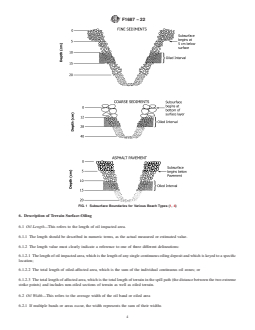
5.3 Oil persistence and the choice of cleanup options will be different for subsurface oil as opposed to surface oil. Descriptions
of shoreline oiling conditions should distinguish between the oiling of surface sediments from that on the subsurface sediments
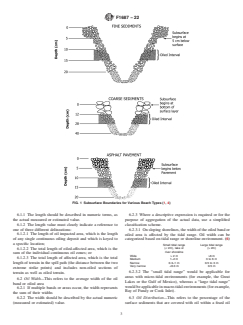
(vertical zonation). On coarse sediment beaches, it can be difficult to differentiate the vertical boundaries. Fig. 1 illustrates an
approach for discriminating those boundaries.
5.4 For areas with fine sediments (that is, pebble, granule, sand, and mud), the subsurface layers begins at 5 cm below the surface.
If a pit were to reveal oiling in sand from the surface down to 20 cm, the upper 5 cm would be classified as surface oil and the
remainder as subsurface (Fig. 1). However, the oiled interval would still be shown as 0 to 20 cm.
5.5 For areas with coarse sediments (that is, cobble and boulder), the subsurface layers begin at the bottom of the surface material
(that is, where the top layer of cobbles or boulders contact the underlying layer of sediments).
5.6 Where asphalt pavement exists on the surface, the subsurface begins at the bottom of the pavement.
5.7 Definitions of the inorganic sediments based on size (diameter) are as follows:
Boulder >256-mm
Cobble 64 to 256-mm
Pebble4 to 64-mm
Granule 2 to 4-mm
Sand 0.06 to 2-mm
Mud/silt/clay <0.06-mm
5.8 Terms and abbreviations used to describe ice and snow conditions are as follows; (4-5)
Snow (SNW)
Frozen Swash (FSW)
Frozen Spray (FSP)
Ice Foot (IFT)
Ice-push Ridge (IPR)
Grounded Ice Floes (GFL)
Glacier Ice (GLC)
Fresh Water Ice (FWI)
F1687 − 22
FIG. 1 Subsurface Boundaries for Various Beach Types (1, 4)
6. Description of Terrain Surface-Oiling
6.1 Oil Length—This refers to the length of oil impacted area.
6.1.1 The length should be described in numeric terms, as the actual measured or estimated value.
6.1.2 The length value must clearly indicate a reference to one of three different delineations:
6.1.2.1 The length of oil impacted area, which is the length of any single continuous oiling deposit and which is keyed to a specific
location;
6.1.2.2 The total length of oiled-affected area, which is the sum of the individual continuous oil zones; or
6.1.2.3 The total length of affected area, which is the total length of terrain in the spill path (the distance between the two extreme
strike points) and includes non-oiled sections of terrain as well as oiled terrain.
6.2 Oil Width—This refers to the average width of the oil band or oiled area
6.2.1 If multiple bands or areas occur, the width represents the sum of their widths
F1687 − 22
6.2.2 The width should be described by the actual numeric (measured or estimated) value.
6.2.3 Where a descriptive expression is required or for the purpose of aggregation of the actual data, use a simplified classification
scheme.
6.2.3.1 On sloping shorelines, the width of the oiled band or oiled area is affected by the tidal range. Oil width can be categorized
based on tidal range or shoreline environment. (6)
Small tidal range Small tidal range
(< 2m), lake or (> 2m)
river shoreline
Small tidal range Large tidal range
(< 2m), lake or (> 2m)
river shoreline
Wide > 2 m >6 m
Medium 1–2 m 3 to 6 m
Narrow 0.3–1 m 0.5 to 3 m
Very narrow <0.3
...