

ASTM D3703-18
(Test Method)Standard Test Method for Hydroperoxide Number of Aviation Turbine Fuels, Gasoline and Diesel Fuels
General Information
- Abstract
SIGNIFICANCE AND USE
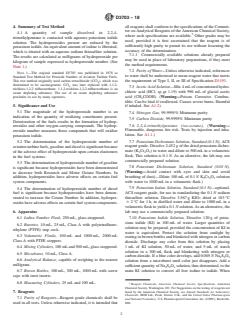
5.1 The magnitude of the hydroperoxide number is an indication of the quantity of oxidizing constituents present. Deterioration of the fuels results in the formation of hydroperoxides and other oxygen-carrying compounds. The hydroperoxide number measures those compounds that will oxidize potassium iodide.
5.2 The determination of the hydroperoxide number of aviation turbine fuels, gasoline and diesel is significant because of the adverse effect of hydroperoxide upon certain elastomers in the fuel systems.
5.3 The determination of hydroperoxide number of gasoline is significant because hydroperoxides have been demonstrated to decrease both Research and Motor Octane Numbers. In addition, hydroperoxides have adverse effects on certain fuel system components.
5.4 The determination of hydroperoxide number of diesel fuel is significant because hydroperoxides have been demonstrated to increase the Cetane Number. In addition, hydroperoxides have adverse effects on certain fuel system components.
SCOPE
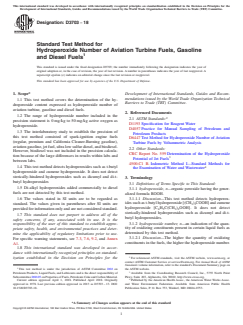
1.1 This test method covers the determination of the hydroperoxide content expressed as hydroperoxide number of aviation turbine, gasoline and diesel fuels.
1.2 The range of hydroperoxide number included in the precision statement is 0 mg/kg to 50 mg/kg active oxygen as hydroperoxide.
1.3 The interlaboratory study to establish the precision of this test method consisted of spark-ignition engine fuels (regular, premium and California Cleaner-Burning gasoline), aviation gasoline, jet fuel, ultra low sulfur diesel, and biodiesel. However, biodiesel was not included in the precision calculation because of the large differences in results within labs and between labs.
1.4 This test method detects hydroperoxides such as t-butyl hydroperoxide and cumene hydroperoxide. It does not detect sterically-hindered hydroperoxides such as dicumyl and di-t-butyl hydroperoxides
1.5 Di-alkyl hydroperoxides added commercially to diesel fuels are not detected by this test method.
1.6 The values stated in SI units are to be regarded as standard. The values given in parentheses after SI units are provided for information only and are not considered standard.
1.7 This standard does not purport to address all of the safety concerns, if any, associated with its use. It is the responsibility of the user of this standard to establish appropriate safety, health, and environmental practices and determine the applicability of regulatory limitations prior to use. For specific warning statements, see 7.3, 7.6, 9.2, and Annex A1.
1.8 This international standard was developed in accordance with internationally recognized principles on standardization established in the Decision on Principles for the Development of International Standards, Guides and Recommendations issued by the World Trade Organization Technical Barriers to Trade (TBT) Committee.
- Status
- Published
- Publication Date
- 31-Mar-2018
- Technical Committee
- D02 - Petroleum Products, Liquid Fuels, and Lubricants
- Drafting Committee
- D02.05 - Properties of Fuels, Petroleum Coke and Carbon Material
Buy Documents
ASTM D3703-18 - Standard Test Method for Hydroperoxide Number of Aviation Turbine Fuels, Gasoline and Diesel Fuels
REDLINE ASTM D3703-18 - Standard Test Method for Hydroperoxide Number of Aviation Turbine Fuels, Gasoline and Diesel Fuels
Overview
ASTM D3703-18 is the Standard Test Method for Hydroperoxide Number of Aviation Turbine Fuels, Gasoline, and Diesel Fuels. Published by ASTM International, this standard specifies procedures to determine the concentration of hydroperoxides in liquid hydrocarbon fuels. Hydroperoxides are critical indicators of fuel oxidation and degradation, which can negatively impact fuel stability, performance, and compatibility with elastomeric fuel system components.
The hydroperoxide number, measured in milligrams of active oxygen per kilogram of sample, provides an essential metric for monitoring fuel quality and preventing the adverse effects associated with fuel oxidation. This standard is recognized and utilized by regulatory bodies and the aviation, petroleum, and automotive industries.
Key Topics
- Hydroperoxide Measurement: This method detects hydroperoxides in aviation turbine fuel, gasoline, and diesel, excluding certain sterically-hindered and di-alkyl hydroperoxides.
- Significance: Hydroperoxides contribute to fuel system corrosion, reduce the octane rating in gasoline, affect cetane number in diesel, and can degrade elastomeric seals.
- Test Range: Applicable for samples within the hydroperoxide number range of 0 to 50 mg/kg.
- Sample Types: Tested fuels include regular and premium gasoline, California cleaner-burning gasoline, aviation gasoline, jet fuel, and ultra-low sulfur diesel. Biodiesel is excluded from the precision calculations due to variability.
- Oxidation Indicator: The magnitude of the hydroperoxide number indicates the level of oxidation and the presence of reactive oxygen-bearing compounds.
- Test Principle: The method involves reacting a dissolved fuel sample with potassium iodide; liberated iodine is titrated to quantify hydroperoxides.
Applications
Aviation Fuels
Monitoring the hydroperoxide content in aviation turbine fuels is essential for ensuring fuel stability and protecting elastomeric components in aircraft fuel systems. Elevated hydroperoxide levels can increase maintenance costs and compromise safety.
Automotive Fuels
- Gasoline: Hydroperoxides can lower Research and Motor Octane Numbers, leading to engine knocking and decreased efficiency. Ensuring low hydroperoxide numbers is vital for maintaining gasoline performance.
- Diesel Fuel: Hydroperoxides increase the cetane number, which may affect combustion characteristics. However, they also accelerate the degradation of elastomeric fuel system parts, highlighting the importance of regular monitoring.
Quality Management
Refineries, fuel depots, and regulatory agencies employ ASTM D3703-18 for quality control, certification, and compliance testing of fuels. The test supports decisions in production, storage, and transportation, safeguarding against potential failures caused by oxidative instability.
Related Standards
- ASTM D6447: Test Method for Hydroperoxide Number of Aviation Turbine Fuels by Voltammetric Analysis.
- ASTM D1193: Specification for Reagent Water.
- ASTM D4057: Practice for Manual Sampling of Petroleum and Petroleum Products.
- CRC Report No. 559: Determination of the Hydroperoxide Potential of Jet Fuels.
- Standard Methods 4500-Cl B.: Iodometric Method for water and wastewater examination.
Practical Value
Using ASTM D3703-18 ensures fuel quality, system reliability, and compliance with industry and regulatory requirements. Accurate hydroperoxide quantification helps:
- Prevent costly damage to engines and fuel systems.
- Maintain optimal engine performance and emissions.
- Meet contractual and regulatory fuel quality specifications.
- Optimize storage and transportation conditions to minimize fuel oxidation.
Keywords
hydroperoxide number, fuel oxidation, aviation fuel testing, gasoline quality, diesel fuel analysis, fuel system compatibility, ASTM D3703-18, fuel stability, oxidizing constituents, petroleum product testing
Relations
- Effective Date
- 01-Apr-2018
- Refers
ASTM D4057-06(2011) - Standard Practice for Manual Sampling of Petroleum and Petroleum Products - Effective Date
- 01-Jun-2011
- Effective Date
- 15-Apr-2009
- Effective Date
- 01-Mar-2006
- Effective Date
- 01-Nov-2003
- Refers
ASTM D4057-95(2000) - Standard Practice for Manual Sampling of Petroleum and Petroleum Products - Effective Date
- 10-Apr-2000
- Effective Date
- 10-Jul-1999
- Effective Date
- 10-Feb-1999
- Effective Date
- 10-Feb-1999
- Referred By
ASTM D4054-23 - Standard Practice for Evaluation of New Aviation Turbine Fuels and Fuel Additives - Effective Date
- 01-Apr-2018
- Effective Date
- 01-Apr-2018
- Referred By
ASTM D2700-23 - Standard Test Method for Motor Octane Number of Spark-Ignition Engine Fuel - Effective Date
- 01-Apr-2018
- Effective Date
- 01-Apr-2018
- Effective Date
- 01-Apr-2018
- Effective Date
- 01-Apr-2018
Buy Documents
ASTM D3703-18 - Standard Test Method for Hydroperoxide Number of Aviation Turbine Fuels, Gasoline and Diesel Fuels
REDLINE ASTM D3703-18 - Standard Test Method for Hydroperoxide Number of Aviation Turbine Fuels, Gasoline and Diesel Fuels
Get Certified
Connect with accredited certification bodies for this standard

Element Materials Technology
Materials testing and product certification.

ABS Group Brazil
ABS Group certification services in Brazil.

ABS Quality Evaluations Inc.
American Bureau of Shipping quality certification.
Sponsored listings
Frequently Asked Questions
ASTM D3703-18 is a standard published by ASTM International. Its full title is "Standard Test Method for Hydroperoxide Number of Aviation Turbine Fuels, Gasoline and Diesel Fuels". This standard covers: SIGNIFICANCE AND USE 5.1 The magnitude of the hydroperoxide number is an indication of the quantity of oxidizing constituents present. Deterioration of the fuels results in the formation of hydroperoxides and other oxygen-carrying compounds. The hydroperoxide number measures those compounds that will oxidize potassium iodide. 5.2 The determination of the hydroperoxide number of aviation turbine fuels, gasoline and diesel is significant because of the adverse effect of hydroperoxide upon certain elastomers in the fuel systems. 5.3 The determination of hydroperoxide number of gasoline is significant because hydroperoxides have been demonstrated to decrease both Research and Motor Octane Numbers. In addition, hydroperoxides have adverse effects on certain fuel system components. 5.4 The determination of hydroperoxide number of diesel fuel is significant because hydroperoxides have been demonstrated to increase the Cetane Number. In addition, hydroperoxides have adverse effects on certain fuel system components. SCOPE 1.1 This test method covers the determination of the hydroperoxide content expressed as hydroperoxide number of aviation turbine, gasoline and diesel fuels. 1.2 The range of hydroperoxide number included in the precision statement is 0 mg/kg to 50 mg/kg active oxygen as hydroperoxide. 1.3 The interlaboratory study to establish the precision of this test method consisted of spark-ignition engine fuels (regular, premium and California Cleaner-Burning gasoline), aviation gasoline, jet fuel, ultra low sulfur diesel, and biodiesel. However, biodiesel was not included in the precision calculation because of the large differences in results within labs and between labs. 1.4 This test method detects hydroperoxides such as t-butyl hydroperoxide and cumene hydroperoxide. It does not detect sterically-hindered hydroperoxides such as dicumyl and di-t-butyl hydroperoxides 1.5 Di-alkyl hydroperoxides added commercially to diesel fuels are not detected by this test method. 1.6 The values stated in SI units are to be regarded as standard. The values given in parentheses after SI units are provided for information only and are not considered standard. 1.7 This standard does not purport to address all of the safety concerns, if any, associated with its use. It is the responsibility of the user of this standard to establish appropriate safety, health, and environmental practices and determine the applicability of regulatory limitations prior to use. For specific warning statements, see 7.3, 7.6, 9.2, and Annex A1. 1.8 This international standard was developed in accordance with internationally recognized principles on standardization established in the Decision on Principles for the Development of International Standards, Guides and Recommendations issued by the World Trade Organization Technical Barriers to Trade (TBT) Committee.
SIGNIFICANCE AND USE 5.1 The magnitude of the hydroperoxide number is an indication of the quantity of oxidizing constituents present. Deterioration of the fuels results in the formation of hydroperoxides and other oxygen-carrying compounds. The hydroperoxide number measures those compounds that will oxidize potassium iodide. 5.2 The determination of the hydroperoxide number of aviation turbine fuels, gasoline and diesel is significant because of the adverse effect of hydroperoxide upon certain elastomers in the fuel systems. 5.3 The determination of hydroperoxide number of gasoline is significant because hydroperoxides have been demonstrated to decrease both Research and Motor Octane Numbers. In addition, hydroperoxides have adverse effects on certain fuel system components. 5.4 The determination of hydroperoxide number of diesel fuel is significant because hydroperoxides have been demonstrated to increase the Cetane Number. In addition, hydroperoxides have adverse effects on certain fuel system components. SCOPE 1.1 This test method covers the determination of the hydroperoxide content expressed as hydroperoxide number of aviation turbine, gasoline and diesel fuels. 1.2 The range of hydroperoxide number included in the precision statement is 0 mg/kg to 50 mg/kg active oxygen as hydroperoxide. 1.3 The interlaboratory study to establish the precision of this test method consisted of spark-ignition engine fuels (regular, premium and California Cleaner-Burning gasoline), aviation gasoline, jet fuel, ultra low sulfur diesel, and biodiesel. However, biodiesel was not included in the precision calculation because of the large differences in results within labs and between labs. 1.4 This test method detects hydroperoxides such as t-butyl hydroperoxide and cumene hydroperoxide. It does not detect sterically-hindered hydroperoxides such as dicumyl and di-t-butyl hydroperoxides 1.5 Di-alkyl hydroperoxides added commercially to diesel fuels are not detected by this test method. 1.6 The values stated in SI units are to be regarded as standard. The values given in parentheses after SI units are provided for information only and are not considered standard. 1.7 This standard does not purport to address all of the safety concerns, if any, associated with its use. It is the responsibility of the user of this standard to establish appropriate safety, health, and environmental practices and determine the applicability of regulatory limitations prior to use. For specific warning statements, see 7.3, 7.6, 9.2, and Annex A1. 1.8 This international standard was developed in accordance with internationally recognized principles on standardization established in the Decision on Principles for the Development of International Standards, Guides and Recommendations issued by the World Trade Organization Technical Barriers to Trade (TBT) Committee.
ASTM D3703-18 is classified under the following ICS (International Classification for Standards) categories: 75.160.20 - Liquid fuels. The ICS classification helps identify the subject area and facilitates finding related standards.
ASTM D3703-18 has the following relationships with other standards: It is inter standard links to ASTM D3703-13, ASTM D4057-06(2011), ASTM D6447-09, ASTM D1193-06, ASTM D6447-03, ASTM D4057-95(2000), ASTM D6447-99, ASTM D1193-99, ASTM D1193-99e1, ASTM D4054-23, ASTM C1572/C1572M-23, ASTM D2700-23, ASTM D613-23, ASTM D6447-09(2021), ASTM D8183-22. Understanding these relationships helps ensure you are using the most current and applicable version of the standard.
ASTM D3703-18 is available in PDF format for immediate download after purchase. The document can be added to your cart and obtained through the secure checkout process. Digital delivery ensures instant access to the complete standard document.
Standards Content (Sample)
This international standard was developed in accordance with internationally recognized principles on standardization established in the Decision on Principles for the
Development of International Standards, Guides and Recommendations issued by the World Trade Organization Technical Barriers to Trade (TBT) Committee.
Designation: D3703 − 18
Standard Test Method for
Hydroperoxide Number of Aviation Turbine Fuels, Gasoline
and Diesel Fuels
This standard is issued under the fixed designation D3703; the number immediately following the designation indicates the year of
original adoption or, in the case of revision, the year of last revision. A number in parentheses indicates the year of last reapproval. A
superscript epsilon (´) indicates an editorial change since the last revision or reapproval.
This standard has been approved for use by agencies of the U.S. Department of Defense.
1. Scope* Development of International Standards, Guides and Recom-
mendations issued by the World Trade Organization Technical
1.1 This test method covers the determination of the hy-
Barriers to Trade (TBT) Committee.
droperoxide content expressed as hydroperoxide number of
aviation turbine, gasoline and diesel fuels.
2. Referenced Documents
1.2 The range of hydroperoxide number included in the
2.1 ASTM Standards:
precision statement is 0 mg⁄kg to 50 mg⁄kg active oxygen as
D1193 Specification for Reagent Water
hydroperoxide.
D4057 Practice for Manual Sampling of Petroleum and
1.3 The interlaboratory study to establish the precision of
Petroleum Products
this test method consisted of spark-ignition engine fuels
D6447 Test Method for Hydroperoxide Number of Aviation
(regular, premium and California Cleaner-Burning gasoline),
Turbine Fuels by Voltammetric Analysis
aviationgasoline,jetfuel,ultralowsulfurdiesel,andbiodiesel.
2.2 Other Standards:
However, biodiesel was not included in the precision calcula-
CRC Report No. 559 Determination of the Hydroperoxide
tion because of the large differences in results within labs and
Potential of Jet Fuels
between labs.
4500-C1 B. Iodometric Method I—Standard Methods for
1.4 This test method detects hydroperoxides such as t-butyl
the Examination of Water and Wastewater
hydroperoxide and cumene hydroperoxide. It does not detect
sterically-hindered hydroperoxides such as dicumyl and di-t-
3. Terminology
butyl hydroperoxides
3.1 Definitions of Terms Specific to This Standard:
1.5 Di-alkyl hydroperoxides added commercially to diesel
3.1.1 hydroperoxide, n—organic peroxide having the gener-
fuels are not detected by this test method.
alized formula ROOH.
3.1.1.1 Discussion—This test method detects hydroperox-
1.6 The values stated in SI units are to be regarded as
idessuchast-butylhydroperoxide[(CH ) COOH]andcumene
standard. The values given in parentheses after SI units are 3 3
hydroperoxide [C H C(CH ) OOH]. It does not detect
provided for information only and are not considered standard.
6 5 3 2
sterically-hindered hydroperoxides such as dicumyl and di-t-
1.7 This standard does not purport to address all of the
butyl hydroperoxides.
safety concerns, if any, associated with its use. It is the
3.1.2 hydroperoxide number, n—an indication of the quan-
responsibility of the user of this standard to establish appro-
tity of oxidizing constituents present in certain liquid fuels as
priate safety, health, and environmental practices and deter-
determined by this test method.
mine the applicability of regulatory limitations prior to use.
3.1.2.1 Discussion—The higher the quantity of oxidizing
For specific warning statements, see 7.3, 7.6, 9.2, and Annex
constituents in the fuels, the higher the hydroperoxide number.
A1.
1.8 This international standard was developed in accor-
dance with internationally recognized principles on standard-
ization established in the Decision on Principles for the For referenced ASTM standards, visit the ASTM website, www.astm.org, or
contact ASTM Customer Service at service@astm.org. For Annual Book of ASTM
Standards volume information, refer to the standard’s Document Summary page on
This test method is under the jurisdiction of ASTM Committee D02 on the ASTM website.
Petroleum Products, Liquid Fuels, and Lubricants and is the direct responsibility of Available from the Coordinating Research Council, Inc., 5755 North Point
SubcommitteeD02.05onPropertiesofFuels,PetroleumCokeandCarbonMaterial. Pkwy, Suite 265, Alpharetta, GA 30022, http://www.crcao.org.
Current edition approved April 1, 2018. Published April 2018. Originally Published by the American Health Assoc., the American Water Works Assoc.
approved in 1978. Last previous edition approved in 2013 as D3703 – 13. DOI: and Water Environment Federation. Available from American Public Health
10.1520/D3703-18. Publication Sales, P. O. Box 753, Waldorf, MD 20604–0753.
*A Summary of Changes section appears at the end of this standard
Copyright © ASTM International, 100 Barr Harbor Drive, PO Box C700, West Conshohocken, PA 19428-2959. United States
D3703 − 18
4. Summary of Test Method all reagents shall conform to the specifications of the Commit-
tee onAnalytical Reagents of theAmerican Chemical Society,
4.1 A quantity of sample dissolved in 2,2,4-
where such specifications are available. Other grades may be
trimethylpentane is contacted with aqueous potassium iodide
used, provided it is first ascertained that the reagent is of
solution. The hydroperoxides present are reduced by the
sufficiently high purity to permit its use without lessening the
potassium iodide.An equivalent amount of iodine is liberated,
accuracy of the determination.
which is titrated with an aqueous sodium thiosulfate solution.
7.1.1 Commercially available solutions already prepared
The results are calculated as milligrams of hydroperoxide per
may be used in place of laboratory preparations, if they meet
kilogram of sample expressed as hydroperoxide number. (See
the method requirements.
Note 1.)
7.2 Purity of Water—Unless otherwise indicated, references
NOTE 1—The original standard D3703 was published in 1978 as
to water shall be understood to mean reagent water that meets
Standard Test Method for Peroxide Number of Aviation Turbine Fuels.
the requirement of Type I, II, or III of Specification D1193.
This test method originally used carbon tetrachloride (CCl ), which was
determined to be carcinogenetic. CCl was later replaced with 1,1,2-
7.3 Acetic Acid Solution—Mix 4 mLof concentrated hydro-
trichloro-1,2,2 trifluoroethane. 1,1,2-trichloro-1,2,2-trifluoroethane is an
chloric acid (HCl, sp gr 1.19) with 996 mL of glacial acetic
ozone depleting substance. The use of an ozone depleting substance
precludes its use by many operators. acid (CH COOH). (Warning—Poison. Corrosive. Combus-
tible. Can be fatal if swallowed. Causes severe burns. Harmful
5. Significance and Use
if inhaled. See A1.2).
5.1 The magnitude of the hydroperoxide number is an
7.4 Nitrogen Gas, 99.9995% Minimum purity
indication of the quantity of oxidizing constituents present.
7.5 Carbon Dioxide, 99.9995% Minimum purity
Deterioration of the fuels results in the formation of hydrop-
7.6 2,2,4-trimethylpentane (iso-octane), (Warning—
eroxides and other oxygen-carrying compounds. The hydrop-
Flammable, dangerous fire risk. Toxic by injection and inha-
eroxide number measures those compounds that will oxidize
lation. See A1.1.)
potassium iodide.
7.7 Potassium Dichromate Solution, Standard (0.1 N), ACS
5.2 The determination of the hydroperoxide number of
reagent grade. Dissolve 2.452 g of the dried potassium dichro-
aviationturbinefuels,gasolineanddieselissignificantbecause
mate (K Cr O ) in water and dilute to 500 mL in a volumetric
of the adverse effect of hydroperoxide upon certain elastomers
2 2 7
flask. This solution is 0.1 N. As an alterative, the lab may use
in the fuel systems.
commercially prepared solution.
5.3 The determination of hydroperoxide number of gasoline
7.8 Potassium Dichromate Solution, Standard (0.01 N),
is significant because hydroperoxides have been demonstrated
(Warning—Avoid contact with eyes and skin and avoid
to decrease both Research and Motor Octane Numbers. In
breathing of dust)—Dilute 100 mL of 0.1 N K Cr O solution
addition, hydroperoxides have adverse effects on certain fuel 2 2 7
with water to 1000 mL in a volumetric flask.)
system components.
7.9 Potassium Iodate Solution, Standard (0.1 N)—optional,
5.4 The determination of hydroperoxide number of diesel
ACS reagent grade, for use in standardizing the 0.1 N sodium
fuel is significant because hydroperoxides have been demon-
thiosulfate solution. Dissolve 3.567 g KIO dried at 103 °C
strated to increase the Cetane Number. In addition, hydroper- 3
6 2 °C for 1 h, in distilled water and dilute to 1000 mL in a
oxides have adverse effects on certain fuel system components.
volumetric flask to yield a 0.1 N solution.As an alternative, the
lab may use a commercially prepared solution.
6. Apparatus
6.1 Iodine Number Flask, 250 mL, glass-stoppered. 7.10 Potassium Iodide Solution, Dissolve 120 g of potas-
sium iodide (KI) in 100 mL of water. Larger quantities of
6.2 Burettes, 10 mL, 25 mL, Class A with polytetrafluoro-
solution may be prepared, provided the concentration of KI in
ethylene (PTFE) stop cock.
water is equivalent. Protect the solution from sunlight by
6.3 Volumetric Flasks, 100 mL and 1000 mL, 2000 mL
storing in brown bottles and blanketed with nitrogen or carbon
Class A with PTFE stoppers.
dioxide. Discharge any color from this solution by placing
1 mL of KI solution, 50 mL of water, and 5 mL of starch
6.4 MixingCylinders,100 mLand500 mL,glass-stoppered.
solution in a 300 mL flask and blanketing with nitrogen or
6.5 Microburet, 10 mL, Class A.
carbon dioxide. If a blue color develops, add 0.005 N Na S O
2 2 3
6.6 Analytical Balance, capable of weighing to the nearest
solution from a microburet until color just disappears. Add a
milligram.
sufficient quantity of Na S O solution, thus determined, to the
2 2 3
main KI solution to convert all free iodine to iodide. When
6.7 Brown Bottles, 100 mL, 300 mL, 1000 mL with screw
caps with inert inserts.
6.8 Measuring Cylinders, 25 mL and 100 mL.
Reagent Chemicals, American Chemical Society Specifications, American
Chemical Society, Washington, DC. For Suggestions on the testi
...
This document is not an ASTM standard and is intended only to provide the user of an ASTM standard an indication of what changes have been made to the previous version. Because
it may not be technically possible to adequately depict all changes accurately, ASTM recommends that users consult prior editions as appropriate. In all cases only the current version
of the standard as published by ASTM is to be considered the official document.
Designation: D3703 − 13 D3703 − 18
Standard Test Method for
Hydroperoxide Number of Aviation Turbine Fuels, Gasoline
and Diesel Fuels
This standard is issued under the fixed designation D3703; the number immediately following the designation indicates the year of
original adoption or, in the case of revision, the year of last revision. A number in parentheses indicates the year of last reapproval. A
superscript epsilon (´) indicates an editorial change since the last revision or reapproval.
This standard has been approved for use by agencies of the U.S. Department of Defense.
1. Scope*
1.1 This test method covers the determination of the hydroperoxide content expressed as hydroperoxide number of aviation
turbine, gasoline and diesel fuels.
1.2 The range of hydroperoxide number included in the precision statement is 00 mg ⁄kg to 5050 mg mg/kg ⁄kg active oxygen
as hydroperoxide.
1.3 The interlaboratory study to establish the precision of this test method consisted of spark-ignition engine fuels (regular,
premium and California Cleaner-Burning gasoline), aviation gasoline, jet fuel, ultra low sulfur diesel, and biodiesel. However,
biodiesel was not included in the precision calculation because of the large differences in results within labs and between labs.
1.4 This test method detects hydroperoxides such as t-butyl hydroperoxide and cumene hydroperoxide. It does not detect
sterically-hindered hydroperoxides such as dicumyl and di-t-butyl hydroperoxides
1.5 Di-alkyl hydroperoxides added commercially to diesel fuels are not detected by this test method.
1.6 The values stated in SI units are to be regarded as the standard. The values given in parentheses are for information only.after
SI units are provided for information only and are not considered standard.
1.7 This standard does not purport to address all of the safety concerns, if any, associated with its use. It is the responsibility
of the user of this standard to consult and establish appropriate safety safety, health, and healthenvironmental practices and
determine the applicability of regulatory limitations prior to use. For specific warning statements, see 7.3, 7.6, 9.2, and Annex A1.
1.8 This international standard was developed in accordance with internationally recognized principles on standardization
established in the Decision on Principles for the Development of International Standards, Guides and Recommendations issued
by the World Trade Organization Technical Barriers to Trade (TBT) Committee.
2. Referenced Documents
2.1 ASTM Standards:
D1193 Specification for Reagent Water
D4057 Practice for Manual Sampling of Petroleum and Petroleum Products
D6447 Test Method for Hydroperoxide Number of Aviation Turbine Fuels by Voltammetric Analysis
2.2 Other Standards:
CRC Report No. 559 Determination of the Hydroperoxide Potential of Jet Fuels
4500-C1 B. Iodometric Method I—Standard Methods for the Examination of Water and Wastewater
3. Terminology
3.1 Definitions of Terms Specific to This Standard:
3.1.1 hydroperoxide, n—organic peroxide having the generalized formula ROOH.
This test method is under the jurisdiction of ASTM Committee D02 on Petroleum Products, Liquid Fuels, and Lubricants and is the direct responsibility of Subcommittee
D02.05 on Properties of Fuels, Petroleum Coke and Carbon Material.
Current edition approved Oct. 1, 2013April 1, 2018. Published October 2013April 2018. Originally approved in 1978. Last previous edition approved in 20122013 as
D3703 – 07 (2012).D3703 – 13. DOI: 10.1520/D3703-13.10.1520/D3703-18.
For referenced ASTM standards, visit the ASTM website, www.astm.org, or contact ASTM Customer Service at service@astm.org. For Annual Book of ASTM Standards
volume information, refer to the standard’s Document Summary page on the ASTM website.
Available from the Coordinating Research Council, Inc., 219 Perimeter Center Parkway, Atlanta, GA 30346.5755 North Point Pkwy, Suite 265, Alpharetta, GA 30022,
http://www.crcao.org.
Published by the American Health Assoc., the American Water Works Assoc. and Water Environment Federation. Available from American Public Health Publication
Sales, P. O. Box 753, Waldorf, MD 20604–0753.
*A Summary of Changes section appears at the end of this standard
Copyright © ASTM International, 100 Barr Harbor Drive, PO Box C700, West Conshohocken, PA 19428-2959. United States
D3703 − 18
3.1.1.1 Discussion—
This test method detects hydroperoxides such as t-butyl hydroperoxide [(CH ) COOH] and cumene hydroperoxide
3 3
[C H C(CH ) OOH]. It does not detect sterically-hindered hydroperoxides such as dicumyl and di-t-butyl hydroperoxides.
6 5 3 2
3.1.2 hydroperoxide number, n—an indication of the quantity of oxidizing constituents present in certain liquid fuels as
determined by this test method.
3.1.2.1 Discussion—
The higher the quantity of oxidizing constituents in the fuels, the higher the hydroperoxide number.
4. Summary of Test Method
4.1 A quantity of sample dissolved in 2,2,4-trimethylpentane is contacted with aqueous potassium iodide solution. The
hydroperoxides present are reduced by the potassium iodide. An equivalent amount of iodine is liberated, which is titrated with
an aqueous sodium thiosulfate solution. The results are calculated as milligrams of hydroperoxide per kilogram of sample
expressed as hydroperoxide number. (See Note 1.)
NOTE 1—The original standard D3703 was published in 1978 as Standard Test Method for Peroxide Number of Aviation Turbine Fuels. This test
method originally used carbon tetrachloride (CCl ), which was determined to be carcinogenetic. CCl was later replaced with 1,1,2-trichloro-1,2,2
4 4
trifluoroethane. 1,1,2-trichloro-1,2,2-trifluoroethane is an ozone depleting substance. The use of an ozone depleting substance precludes its use by many
operators.
5. Significance and Use
5.1 The magnitude of the hydroperoxide number is an indication of the quantity of oxidizing constituents present. Deterioration
of the fuels results in the formation of hydroperoxides and other oxygen-carrying compounds. The hydroperoxide number
measures those compounds that will oxidize potassium iodide.
5.2 The determination of the hydroperoxide number of aviation turbine fuels, gasoline and diesel is significant because of the
adverse effect of hydroperoxide upon certain elastomers in the fuel systems.
5.3 The determination of hydroperoxide number of gasoline is significant because hydroperoxides have been demonstrated to
decrease both Research and Motor Octane Numbers. In addition, hydroperoxides have adverse effects on certain fuel system
components.
5.4 The determination of hydroperoxide number of diesel fuel is significant because hydroperoxides have been demonstrated
to increase the Cetane Number. In addition, hydroperoxides have adverse effects on certain fuel system components.
6. Apparatus
6.1 Iodine Number Flask, 250 mL, 250 mL, glass-stoppered.
6.2 Burettes, 10-mL, 25-mL,10 mL, 25 mL, Class A with polytetrafluoroethylene (PTFE) stop cock.
6.3 Volumetric Flasks, 100-mL and 1000-mL, 2000 mL 100 mL and 1000 mL, 2000 mL Class A with PTFE stoppers.
6.4 Mixing Cylinders, 100 mL 100 mL and 500-mL,500 mL, glass-stoppered.
6.5 Microburet, 10-mL,10 mL, Class A.
6.6 Analytical Balance, capable of weighing to the nearest milligram.
6.7 Brown Bottles, 100-mL, 300-mL, 1000-mL100 mL, 300 mL, 1000 mL with screw caps with inert inserts.
6.8 Measuring Cylinders, 25-mL25 mL and 100-mL.100 mL.
7. Reagents
7.1 Purity of Reagents—Reagent grade chemicals shall be used in all tests. Unless otherwise indicated, it is intended that all
reagents shall conform to the specifications of the Committee on Analytical Reagents of the American Chemical Society, where
such specifications are available. Other grades may be used, provided it is first ascertained that the reagent is of sufficiently high
purity to permit its use without lessening the accuracy of the determination.
7.1.1 Commercially available solutions already prepared may be used in place of laboratory preparations, if they meet the
method requirements.
Reagent Chemicals, American Chemical Society Specifications, American Chemical Society, Washington, DC. For Suggestions on the testing of reagents not listed by
the American Chemical Society, see Annual Standards for Laboratory Chemicals, BDH Ltd., Poole, Dorset, U.K., and the United States Pharmacopeia and National
Formulary, U.S. Pharmacopeial Convention, Inc. (USPC), Rockville, MD.
D3703 − 18
7.2 Purity of Water—Unless otherwise indicated, references to water shall be understood to mean reagent water that meets the
requirement of Type I, II, or III of Specification D1193.
7.3 Acetic Acid Solution—Mix 4 mL of concentrated hydrochloric acid (HCl, sp gr 1.19) with 996 mL of glacial acetic acid
(CH COOH). (Warning—WarningPoison.—Poison. Corrosive. Combustible. Can be fatal if swallowed. Causes severe burns.
Harmful if inhaled. See A1.2).
7.4 Nitrogen Gas, 99.9995% Minimum purity
7.5 Carbon Dioxide, 99.9995% Minimum purity
7.6 2,2,4-trimethylpentane (iso-octane), (Warning—Flammable, dangerous fire risk. Toxic by injection and inhalation. See
A1.1A1.1.)
7.7 Potassium Dichromate Solution, Standard (0.1 N), (0.1 N), ACS reagent grade. Dissolve 2.452 g 2.452 g of the dried
potassium dichromate (K Cr O ) in water and dilute to 500 mL 500 mL in a volumetric flask. This solution is 0.1 0.1 N. As an
2 2 7
alterative, the lab may use commercially prepared solution.
7.8 Potassium Dichromate Solution, Standard (0.01 N), (0.01 N), (Warning—Avoid contact with eyes and skin and avoid
breathing of dust)—Dilute 100 mL 100 mL of 0.1 0.1 N K Cr O solution with water to 1000 mL 1000 mL in a volumetric flask.)
2 2 7
7.9 Potassium Iodate Solution, Standard (0.1 N)—optional, ACS reagent grade, for use in standardizing the 0.1 0.1 N sodium
thiosulfate solution. Dissolve 3.567 g 3.567 g KIO dried at 103 °C 6 2 °C for 1 h, in distilled water and dilute to 1000 mL in
a volumetric flask to yield a 0.1 N solution. As an alternative, the lab may use a commercially prepared solution.
7.10 Potassium Iodide Solution, Dissolve 120 g 120 g of potassium iodide (KI) in 100 mL 100 mL of water. Larger quantities
of solution may be prepared, provided the concentration of KI in water is equivalent. Protect the solution from sunlight by storing
in brown bottles and blanketed with nitrogen or carbon dioxide. Discharge any color from this solution by pla
...