

ASTM F2085-19
(Specification)Standard Consumer Safety Specification for Portable Bed Rails
General Information
- Abstract
SCOPE
1.1 This consumer safety specification establishes requirements for the performance of portable bed rails. It also contains requirements for labeling and instructional literature. This consumer safety specification does not cover guardrails that fall under the scope of Consumer Safety Specification F1821 or guardrails that are designed for a specific model of bed and which attaches at the headboard or footboard.
1.2 This consumer safety specification is intended to minimize hazards to children resulting from normal use and reasonably foreseeable misuse of portable bed rails.
1.3 For the purpose of this consumer safety specification, a portable bed rail is a device intended to be installed on an adult bed to prevent children from falling out of bed. These bed rails are intended for children who can get in and out of an adult bed unassisted (typically from 2 to 5 years of age).
1.4 No bed rail as defined in 3.1.1 that is produced after the approval date of this consumer safety specification shall, either by label or other means, indicate compliance with this specification unless it conforms to all the requirements contained herein.
1.5 This consumer safety specification includes the following sections:
Title
Section
Scope
1
Referenced Documents
2
Terminology
3
Calibration and Standardization
4
General Requirements
5
Performance Requirements
6
Structural Integrity
6.1
Openings
6.2
Enclosed Openings
6.3
Openings Created by Bed Rail Displacement of Adjacent
Style Portable Bed Rails
6.4
Openings Created by Displacement of Mattress-Top Portable
Bed Rails
6.5
Openings Created by Displacement of Portable Bed Rails
Intended for Use on Specific Manufacturers' Beds
6.6
Protrusions
6.7
Openings Between Bedposts (Headboard, Footboards, Etc.)
and Ends of Portable Bed Rail
6.8
Bedrail components requiring consumer assembly
6.9
Test Equipment
7
Test Beds
7.1
Torso Probe
7.2
Wedge Probe
7.3
Ring Gauge
7.4
Weight Gauge
7.5
Force Gauge
7.6
Test Methods
8
Test Method for Structural Integrity
8.1
Test Method for Enclosed Openings Within Portable Bed Rail
8.2
Test Method for Displacement of Adjacent Style
Portable Bed Rails
8.3
Test Method for Displacement of "Mattress-Top" Style
Portable Bed Rails
8.4
Test Method for Portable Bed Rails Intended for Use on a
Specific Manufacturer’s Bed
8.5
Test Method for Entanglement on Protrusions
8.6
Marking and Labeling
9
Permanency of Labels and Warnings
10
Instructional Literature
11
Keywords
12
Rationale
Appendix X1
1.6 The values stated in inch-pound units are to be regarded as standard. The values given in parentheses are mathematical conversions to SI units that are provided for information only and are not considered standard.
1.7 The following precautionary caveat pertains only to the test methods portion in Section 8 of this specification. This standard does not purport to address all of the safety concerns, if any, associated with its use. It is the responsibility of the user of this standard to establish appropriate safety, health, and environmental practices and determine the applicability of regulatory requirements prior to use.
1.8 This international standard was developed in accordance with internationally recognized principles on standardization established in the Decision on Principles for the Development of International Standards, Guides and Recommendations issued by the World Trade Organization Technical Barriers to Trade (TBT) Committee.
- Status
- Published
- Publication Date
- 31-Oct-2019
- Technical Committee
- F15 - Consumer Products
- Drafting Committee
- F15.11 - Bed Rails and Expandable Gates
Overview
ASTM F2085-19 – Standard Consumer Safety Specification for Portable Bed Rails establishes critical safety and performance requirements for portable bed rails designed to prevent children from accidentally falling out of adult beds. This standard applies to bed rails intended for children who can enter and exit an adult bed unassisted, typically ages 2 to 5. It covers construction, labeling, warnings, and instructional literature to minimize the risk of entrapment, falls, and other hazards resulting from normal use or foreseeable misuse.
Portable bed rails, as defined by this standard, are separate consumer products-not integrated into a specific bed’s headboard or footboard. ASTM F2085-19 does not apply to guardrails for toddler beds (covered under ASTM F1821), nor to bed rails designed for a specific bed make or model that attach at the headboard or footboard.
Key Topics
- Safety Hazards Addressed: The standard aims to reduce risks such as child entrapment between the bed rail and mattress, as well as entanglement on protrusions, both of which have been identified in incident data.
- General Requirements: Specifies criteria such as the absence of hazardous sharp points, edges, and small parts, ensuring all exposed wooden parts are smooth and splinter-free.
- Performance Testing: Details structural integrity and opening size restrictions to prevent entrapment. Key performance requirements include:
- Openings must not allow passage of a torso probe, reducing head and neck entrapment hazards.
- Provisions for both “adjacent style” and “mattress-top” bed rails and for those designed for specific manufacturers’ beds.
- Labeling and Warnings: Requires permanent, highly visible labeling with precise warning language regarding suffocation, strangulation, and installation hazards. Labels must withstand attempts at removal without degrading.
- Instructional Literature: Mandates clear assembly, installation, and use instructions, including warnings.
- Assembly Safety: Portable bed rails must be designed to prevent misassembly. Critical parts like installation hardware must be captive and not easily lost or omitted.
- Testing Procedures: Describes standardized test beds, tools, and forces for evaluating structural strength, entrapment potential, and protrusion hazards.
Applications
ASTM F2085-19 is an essential safety compliance tool for manufacturers, importers, retailers, and testing laboratories involved with portable bed rails in consumer markets, especially those focused on child safety products.
- Manufacturers: Must design, label, and package bed rails to comply with the structural and marking requirements.
- Product Designers: Use this standard for incorporating features that prevent entrapment, safe assembly, and clear consumer warnings.
- Testing Laboratories: Reference ASTM F2085-19 for procedure and equipment requirements in structural integrity, opening measurements, and labeling permanency.
- Retailers and Distributors: Ensure supplied products conform to current safety standards and are properly labeled for consumer protection.
- Consumers and Caregivers: Can reference or look for products marked as compliant with ASTM F2085-19 to ensure higher standards of safety for children transitioning from cribs to adult beds.
Related Standards
Compliance with ASTM F2085-19 often requires familiarization with related regulations and industry standards:
- ASTM F1821: Consumer Safety Specification for Toddler Beds-regulates safety for toddler bed guardrails, a different product category.
- 16 CFR 1500/1501: U.S. federal requirements for sharp points/edges and small parts in toys and child use articles.
- 16 CFR 1303: Ban on lead-containing paint, applicable to surface coatings.
- ASTM F1487: Performance Specification for Playground Equipment for Public Use, referenced for protrusion testing.
- ASTM D3359/D3574: Adhesion and material testing methods referenced for label permanency and foam materials.
Practical Value
Adhering to ASTM F2085-19 is crucial for reducing accidents and improving the safety of portable bed rails used in home and institutional settings. Compliance also demonstrates due diligence in product design, manufacturing, and marketing, helping to meet regulatory requirements and consumer expectations for child safety. Following this standard ensures that portable bed rails are safer, clearly labeled, and reliably tested, promoting confidence among caregivers and reducing potential liability for manufacturers and sellers.
Relations
- Effective Date
- 01-Nov-2019
- Effective Date
- 01-Jun-2019
- Effective Date
- 01-Dec-2018
- Effective Date
- 01-Mar-2017
- Effective Date
- 01-Nov-2016
- Effective Date
- 01-Oct-2016
- Effective Date
- 01-Feb-2015
- Effective Date
- 01-Jun-2013
- Effective Date
- 15-Dec-2011
- Effective Date
- 01-Dec-2011
- Effective Date
- 15-Oct-2011
- Effective Date
- 01-Apr-2011
- Effective Date
- 01-Feb-2011
- Effective Date
- 01-Jun-2009
- Effective Date
- 01-Apr-2009
Frequently Asked Questions
ASTM F2085-19 is a technical specification published by ASTM International. Its full title is "Standard Consumer Safety Specification for Portable Bed Rails". This standard covers: SCOPE 1.1 This consumer safety specification establishes requirements for the performance of portable bed rails. It also contains requirements for labeling and instructional literature. This consumer safety specification does not cover guardrails that fall under the scope of Consumer Safety Specification F1821 or guardrails that are designed for a specific model of bed and which attaches at the headboard or footboard. 1.2 This consumer safety specification is intended to minimize hazards to children resulting from normal use and reasonably foreseeable misuse of portable bed rails. 1.3 For the purpose of this consumer safety specification, a portable bed rail is a device intended to be installed on an adult bed to prevent children from falling out of bed. These bed rails are intended for children who can get in and out of an adult bed unassisted (typically from 2 to 5 years of age). 1.4 No bed rail as defined in 3.1.1 that is produced after the approval date of this consumer safety specification shall, either by label or other means, indicate compliance with this specification unless it conforms to all the requirements contained herein. 1.5 This consumer safety specification includes the following sections: Title Section Scope 1 Referenced Documents 2 Terminology 3 Calibration and Standardization 4 General Requirements 5 Performance Requirements 6 Structural Integrity 6.1 Openings 6.2 Enclosed Openings 6.3 Openings Created by Bed Rail Displacement of Adjacent Style Portable Bed Rails 6.4 Openings Created by Displacement of Mattress-Top Portable Bed Rails 6.5 Openings Created by Displacement of Portable Bed Rails Intended for Use on Specific Manufacturers' Beds 6.6 Protrusions 6.7 Openings Between Bedposts (Headboard, Footboards, Etc.) and Ends of Portable Bed Rail 6.8 Bedrail components requiring consumer assembly 6.9 Test Equipment 7 Test Beds 7.1 Torso Probe 7.2 Wedge Probe 7.3 Ring Gauge 7.4 Weight Gauge 7.5 Force Gauge 7.6 Test Methods 8 Test Method for Structural Integrity 8.1 Test Method for Enclosed Openings Within Portable Bed Rail 8.2 Test Method for Displacement of Adjacent Style Portable Bed Rails 8.3 Test Method for Displacement of "Mattress-Top" Style Portable Bed Rails 8.4 Test Method for Portable Bed Rails Intended for Use on a Specific Manufacturer’s Bed 8.5 Test Method for Entanglement on Protrusions 8.6 Marking and Labeling 9 Permanency of Labels and Warnings 10 Instructional Literature 11 Keywords 12 Rationale Appendix X1 1.6 The values stated in inch-pound units are to be regarded as standard. The values given in parentheses are mathematical conversions to SI units that are provided for information only and are not considered standard. 1.7 The following precautionary caveat pertains only to the test methods portion in Section 8 of this specification. This standard does not purport to address all of the safety concerns, if any, associated with its use. It is the responsibility of the user of this standard to establish appropriate safety, health, and environmental practices and determine the applicability of regulatory requirements prior to use. 1.8 This international standard was developed in accordance with internationally recognized principles on standardization established in the Decision on Principles for the Development of International Standards, Guides and Recommendations issued by the World Trade Organization Technical Barriers to Trade (TBT) Committee.
SCOPE 1.1 This consumer safety specification establishes requirements for the performance of portable bed rails. It also contains requirements for labeling and instructional literature. This consumer safety specification does not cover guardrails that fall under the scope of Consumer Safety Specification F1821 or guardrails that are designed for a specific model of bed and which attaches at the headboard or footboard. 1.2 This consumer safety specification is intended to minimize hazards to children resulting from normal use and reasonably foreseeable misuse of portable bed rails. 1.3 For the purpose of this consumer safety specification, a portable bed rail is a device intended to be installed on an adult bed to prevent children from falling out of bed. These bed rails are intended for children who can get in and out of an adult bed unassisted (typically from 2 to 5 years of age). 1.4 No bed rail as defined in 3.1.1 that is produced after the approval date of this consumer safety specification shall, either by label or other means, indicate compliance with this specification unless it conforms to all the requirements contained herein. 1.5 This consumer safety specification includes the following sections: Title Section Scope 1 Referenced Documents 2 Terminology 3 Calibration and Standardization 4 General Requirements 5 Performance Requirements 6 Structural Integrity 6.1 Openings 6.2 Enclosed Openings 6.3 Openings Created by Bed Rail Displacement of Adjacent Style Portable Bed Rails 6.4 Openings Created by Displacement of Mattress-Top Portable Bed Rails 6.5 Openings Created by Displacement of Portable Bed Rails Intended for Use on Specific Manufacturers' Beds 6.6 Protrusions 6.7 Openings Between Bedposts (Headboard, Footboards, Etc.) and Ends of Portable Bed Rail 6.8 Bedrail components requiring consumer assembly 6.9 Test Equipment 7 Test Beds 7.1 Torso Probe 7.2 Wedge Probe 7.3 Ring Gauge 7.4 Weight Gauge 7.5 Force Gauge 7.6 Test Methods 8 Test Method for Structural Integrity 8.1 Test Method for Enclosed Openings Within Portable Bed Rail 8.2 Test Method for Displacement of Adjacent Style Portable Bed Rails 8.3 Test Method for Displacement of "Mattress-Top" Style Portable Bed Rails 8.4 Test Method for Portable Bed Rails Intended for Use on a Specific Manufacturer’s Bed 8.5 Test Method for Entanglement on Protrusions 8.6 Marking and Labeling 9 Permanency of Labels and Warnings 10 Instructional Literature 11 Keywords 12 Rationale Appendix X1 1.6 The values stated in inch-pound units are to be regarded as standard. The values given in parentheses are mathematical conversions to SI units that are provided for information only and are not considered standard. 1.7 The following precautionary caveat pertains only to the test methods portion in Section 8 of this specification. This standard does not purport to address all of the safety concerns, if any, associated with its use. It is the responsibility of the user of this standard to establish appropriate safety, health, and environmental practices and determine the applicability of regulatory requirements prior to use. 1.8 This international standard was developed in accordance with internationally recognized principles on standardization established in the Decision on Principles for the Development of International Standards, Guides and Recommendations issued by the World Trade Organization Technical Barriers to Trade (TBT) Committee.
ASTM F2085-19 is classified under the following ICS (International Classification for Standards) categories: 97.190 - Equipment for children. The ICS classification helps identify the subject area and facilitates finding related standards.
ASTM F2085-19 has the following relationships with other standards: It is inter standard links to ASTM F2085-12(2019), ASTM F1821-19, ASTM F1821-18, ASTM D3574-17, ASTM D3574-16, ASTM F1821-16, ASTM F1821-15, ASTM F1821-13, ASTM F1821-11b, ASTM D3574-11, ASTM F1487-11, ASTM F1821-11a, ASTM F1821-11, ASTM D3359-09e1, ASTM F1821-09. Understanding these relationships helps ensure you are using the most current and applicable version of the standard.
ASTM F2085-19 is available in PDF format for immediate download after purchase. The document can be added to your cart and obtained through the secure checkout process. Digital delivery ensures instant access to the complete standard document.
Standards Content (Sample)
This international standard was developed in accordance with internationally recognized principles on standardization established in the Decision on Principles for the
Development of International Standards, Guides and Recommendations issued by the World Trade Organization Technical Barriers to Trade (TBT) Committee.
Designation:F2085 −19
Standard Consumer Safety Specification for
Portable Bed Rails
This standard is issued under the fixed designation F2085; the number immediately following the designation indicates the year of
original adoption or, in the case of revision, the year of last revision. A number in parentheses indicates the year of last reapproval. A
superscript epsilon (´) indicates an editorial change since the last revision or reapproval.
INTRODUCTION
This consumer safety specification addresses portable bed rail incidents that were identified by the
U.S. Consumer Product Safety Commission (CPSC).
In response to incident data supplied by the CPSC, this consumer safety specification attempts to
minimize the following type of potential hazard through labeling and performance requirements:
entrapment between the portable bed rail and mattress in the bed rail structure and entanglement on
protrusions. Entrapment of a child by the head or neck can result in asphyxiation.
This consumer safety specification is written within the current state-of-the-art of portable bed rail
technology. It is intended that this specification will be updated whenever substantive information
becomes available that necessitates additional requirements or justifies the revision of existing
requirements.
This consumer safety specification is not intended to address all the hazards of bed rails that are
either blatantly misused or used in a careless manner that disregards the instructional literature and
warning statements provided with each bed rail.
1. Scope by label or other means, indicate compliance with this speci-
fication unless it conforms to all the requirements contained
1.1 This consumer safety specification establishes require-
herein.
mentsfortheperformanceofportablebedrails.Italsocontains
requirements for labeling and instructional literature. This
1.5 This consumer safety specification includes the follow-
consumer safety specification does not cover guardrails that
ing sections:
fallunderthescopeofConsumerSafetySpecificationF1821or
Title Section
guardrails that are designed for a specific model of bed and
Scope 1
Referenced Documents 2
which attaches at the headboard or footboard.
Terminology 3
Calibration and Standardization 4
1.2 This consumer safety specification is intended to mini-
General Requirements 5
mize hazards to children resulting from normal use and
Performance Requirements 6
reasonably foreseeable misuse of portable bed rails.
Structural Integrity 6.1
Openings 6.2
1.3 For the purpose of this consumer safety specification, a
Enclosed Openings 6.3
Openings Created by Bed Rail Displacement of Adjacent 6.4
portable bed rail is a device intended to be installed on an adult
Style Portable Bed Rails
bed to prevent children from falling out of bed.These bed rails
Openings Created by Displacement of Mattress-Top Portable 6.5
areintendedforchildrenwhocangetinandoutofanadultbed
Bed Rails
Openings Created by Displacement of Portable Bed Rails 6.6
unassisted (typically from 2 to 5 years of age).
Intended for Use on Specific Manufacturers’ Beds
Protrusions 6.7
1.4 No bed rail as defined in 3.1.1 that is produced after the
Openings Between Bedposts (Headboard, Footboards, Etc.) 6.8
approval date of this consumer safety specification shall, either
and Ends of Portable Bed Rail
Bedrail components requiring consumer assembly 6.9
Test Equipment 7
Test Beds 7.1
Torso Probe 7.2
This consumer safety specification is under the jurisdiction ofASTM Commit-
Wedge Probe 7.3
tee F15 on Consumer Products and is the direct responsibility of Subcommittee
Ring Gauge 7.4
F15.11 on Bed Rails.
Weight Gauge 7.5
Current edition approved Nov. 1, 2019. Published November 2019. Originally
Force Gauge 7.6
approved in 2001. Last previous edition approved in 2019 as F2085 – 12 (2019).
Test Methods 8
DOI: 10.1520/F2085-19.
Copyright © ASTM International, 100 Barr Harbor Drive, PO Box C700, West Conshohocken, PA 19428-2959. United States
F2085−19
FIG. 1Captive Hardware
F1487 ConsumerSafetyPerformanceSpecificationforPlay-
Test Method for Structural Integrity 8.1
Test Method for Enclosed Openings Within Portable Bed Rail 8.2
ground Equipment for Public Use
Test Method for Displacement of Adjacent Style 8.3
F1821 Consumer Safety Specification for Toddler Beds
Portable Bed Rails
Test Method for Displacement of 9Mattress-Top9 Style 8.4
2.2 Federal Standards:
Portable Bed Rails
16 CFR 1303 Ban of Lead-Containing Paint and Certain
Test Method for Portable Bed Rails Intended for Use on a 8.5
Consumer Products Bearing Lead-Containing Paint
Specific Manufacturer’s Bed
Test Method for Entanglement on Protrusions 8.6
16 CFR Part 1500 Federal Hazardous Substances Act
Marking and Labeling 9
Regulations, including Sections:
Permanency of Labels and Warnings 10
16 CFR 1500.48 Technical Requirements for Determining a
Instructional Literature 11
Keywords 12
Sharp Point in Toys and Other Articles Intended for Use
Rationale Appendix X1
by Children Under 8 Years of Age
1.6 The values stated in inch-pound units are to be regarded
16 CFR 1500.49 Technical Requirements for Determining a
as standard. The values given in parentheses are mathematical
Sharp Metal or Glass Edge in Toys and Other Articles
conversions to SI units that are provided for information only
Intended for Use by Children Under 8 Years of Age
and are not considered standard.
16 CFR 1501 Method for Identifying Toys and Other Ar-
ticles Intended for Use by Children Under 3 Years ofAge
1.7 The following precautionary caveat pertains only to the
which Present Choking, Aspiration, or Ingestion Hazards
test methods portion in Section 8 of this specification. This
Because of Small Parts
standard does not purport to address all of the safety concerns,
if any, associated with its use. It is the responsibility of the user
3. Terminology
of this standard to establish appropriate safety, health, and
environmental practices and determine the applicability of
3.1 Definitions of Terms Specific to This Standard:
regulatory requirements prior to use.
3.1.1 adjacent type bed rail, n—portable bed rail in which
1.8 This international standard was developed in accor-
the guard portion (portion that a child would contact when
dance with internationally recognized principles on standard-
rolling toward the mattress edge) of the unit is essentially a
ization established in the Decision on Principles for the
vertical plane that is pushed against the side of the mattress.
Development of International Standards, Guides and Recom-
The guard remains immediately next to the mattress and does
mendations issued by the World Trade Organization Technical
not extend over the mattress surface.
Barriers to Trade (TBT) Committee.
3.1.2 arm, n—for the purpose of this specification, a de-
vice(s) attached to a bed rail that extends between the mattress
2. Referenced Documents
and mattress foundation and is intended to secure the bed rail
2.1 ASTM Standards:
to the bed.
D3359 Test Methods for Rating Adhesion by Tape Test
3.1.3 bed manufacturer specific type portable bed rail,
D3574 Test Methods for Flexible Cellular Materials—Slab,
n—portable bed rail that is intended for use on a certain type or
Bonded, and Molded Urethane Foams
model(s) of bed as specified by the manufacturer of the bed or
bed rail, or both.
For referenced ASTM standards, visit the ASTM website, www.astm.org, or
contact ASTM Customer Service at service@astm.org. For Annual Book of ASTM
Standards volume information, refer to the standard’s Document Summary page on AvailablefromU.S.GovernmentPrintingOfficeSuperintendentofDocuments,
the ASTM website. 732 N. Capitol St., NW, Mail Stop: SDE, Washington, DC 20401.
F2085−19
3.1.4 captive hardware, n—fasteners that remain attached to 4.3 The product to be tested shall be in a room with an
their respective components before normal assembly and after ambient temperature of 73°F 6 9°F (23°C 6 5°C) for at least
normal disassembly (see Fig. 1). 1 h prior to testing. Testing shall then be conducted within this
temperature range.
3.1.5 conspicuous, adj—label that is visible, when the
4.4 All testing required by this specification shall be con-
portable bed rail is in the manufacturer’s recommended use
position, to a person standing near the unit at any one position ducted on the same unit.
around the unit but not necessarily visible from all positions.
5. General Requirements
3.1.6 consumer adjustment, n—those activities defined by
5.1 There shall be no hazardous sharp points or edges as
the instructions to be taken by the consumer in order to
defined by 16 CFR 1500.48 and 16 CFR 1500.49.
properly fit and secure the bedrail to the mattress.
5.2 There shall be no small parts as defined by 16 CFR
3.1.6.1 Discussion—Examples include sliding telescoping
1501.
poles for proper fit, or initial adjustment for use, tightening of
anchoring straps and positioning or changing of attachment
5.3 Any exposed wood parts shall be smooth and free from
components or locking pins.
splinters.
3.1.7 consumer assembly, v—the fitting together of compo- 5.4 The bed rail shall conform to 16 CFR 1303.
nents of the bedrail according to manufacturer instructions.
5.5 Non-rigid bed rails need only meet the general require-
3.1.8 installation component, n—component of the bedrail ments of Section 5, the performance requirement of 6.3, and
that is specifically designed to attach the bedrail to the bed and the warning requirements of 9.3.
typicallylocatedunderthemattresswheninthemanufacturer’s
5.6 Warning labels (whether paper or nonpaper) shall be
recommended use position.
permanent when tested per 10.1 – 10.3. Warning statements
applied directly onto the surface of the product by hot
3.1.9 mattress-topbedrail,n—portablebedrailinwhichthe
stamping, heat transfer, printing, wood burning. etc. shall be
guard portion (portion that a child would contact when rolling
permanent when tested per 10.4. Nonpaper labels shall not
toward the mattress edge) extends over the sleeping surface of
liberate small parts when tested in accordance with 10.5.
the mattress.
5.7 Installation components that are required to meet the
3.1.10 misassembled bed rail, n—a bed rail that has been
performance requirements of 6.4, 6.5, and 6.6 shall be fully
assembled incorrectly but appears to function as a bedrail.
assembled, inseparable, and permanently attached to a compo-
3.1.11 nonpaper label, adj—any label made of fabric or
nentrequiringconsumerassembly(thisexcludesanyconsumer
other material (such as plastic or metal) which either will not
adjustment).
tear without the aid of tools, or tears leaving a sharply defined
5.8 For products requiring consumer assembly, supplied
edge.
hardware used for assembly of the bedrail such as screws, nuts
3.1.12 non-rigid bed rail, n—portable bed rail constructed
or bolts shall be captive hardware to their respective compo-
of non-rigid materials, including but not limited to fabric or
nents.
foam, or that requires air be inflated into the product to achieve
structure.
6. Performance Requirements
3.1.13 paper label, adj—any label material (except fabric) 6.1 Structural Integrity—All tests of 8.1 shall be performed
which tears without the aid of tools and leaves a fibrous edge. sequentially.Aftertestinginaccordancewith8.1,thereshallbe
no hazardous condition created as defined in Section 5.
3.1.14 permanent, adj—marking or label shall be consid-
ered permanent if, during an attempt to manually remove it 6.2 Openings—Holes or slots that extend entirely through a
wallsectionofanyrigidmateriallessthan0.375-in.(9.53-mm)
without the aid of tools or solvents, it cannot be removed, or it
tears upon removal, or such action damages the surface to thick and admit a 0.210-in. (5.33-mm) diameter rod shall also
admit a 0.375-in. (9.53-mm) diameter rod. Holes or slots that
which it is attached.
are between 0.210 in. (5.33 mm) and 0.375 in. (9.53 mm) and
3.1.15 portable bed rail, n—portable railing installed on the
have a wall thickness less than 0.375 in. (9.53 mm) but are
side of an adult bed and/or on the mattress surface which is
limited in depth to 0.375 in. (9.53 mm) maximum by another
intended to keep a child from falling out of bed.
rigidsurfaceshallbepermissible(seeFig.2).Theproductshall
3.1.15.1 Discussion—Portable bed rails include those made
be evaluated in all manufacturer’s recommended use positions.
for a specific manufacturer’s bed.
6.3 Enclosed Openings—When tested in accordance with
8.2, there shall be no enclosed openings in the enclosed
4. Calibration and Standardization
structure of the portable bed rail that will permit passage of the
4.1 The product shall be completely assembled, unless
Torso Probe shown in Fig. 3.
otherwise noted, in accordance with the manufacturer’s in-
6.4 Openings Created by Bed Rail Displacement of Adja-
structions.
cent Style Portable Bed Rails—Whentestedinaccordancewith
4.2 No testing shall be conducted within 48 h of manufac- the procedure in 8.3, there shall be no opening between the
turing. mattress and the bed rail that will permit passage of the Torso
F2085−19
FIG. 2Opening Example
Probe shown in Fig. 3. Passage is defined as the entire Torso 6.5.1 Bed rails that are marketed as being usable on a bed
Probe passing the horizontal plane that extends from the top that has a mattress support that is solid rather than a box spring
surface of the mattress toward the guard portion of the bed rail. shall be tested on Platform 3, as defined in 7.1.3, in accordance
8.3.
with
6.4.1 Bed rails that are marketed as being usable on a bed
that has a mattress support that is solid rather than a box spring
6.6 Openings Created by Displacement of Portable Bed
shall be tested on Platform 3, as defined in 7.1.3, in accordance
Rails Intended for Use on Specific Manufacturers’ Beds—
with 8.3.
When tested in accordance with the procedure in 8.5, there
shall be no opening between the mattress and bed rail that will
6.5 Openings Created by Displacement of Mattress-Top
permit passage of the Torso Probe (Fig. 3). Passage is defined
Portable Bed Rails—When tested in accordance with the
as the entire Torso Probe passing the horizontal plane toward
procedure in 8.4, the Wedge Probe (Fig. 4) shall not penetrate
the guard position of the bed rail.
to a depth greater than 4.5 in. (114 mm) and the bed rail shall
notdisplacehorizontallysuchthattheinneredgeofthebedrail 6.7 Protrusions—Neither string on the weight gauge shall
moves off the top mattress surface. The inner edge of the bed stay attached to a protrusion when tested in accordance with
rail is the edge where the Wedge Probe is inserted. the procedure in 8.6.
F2085−19
FIG. 3Torso Probe
FIG. 4Wedge Probe
6.8 Openings Between Bedposts (Headboard, Footboards, forms 1 and 2, there shall be a minimum of 9 in. (230 mm)
etc.) and Ends of Portable Bed Rail—When installed in between the left and right ends of the portable bed rail and the
accordance with the manufacturer’s instructions on Test Plat- corresponding left and right ends of the test mattress.
F2085−19
6.9.1.3 Bedrails where the positions of the arms are in-
tended to be unidirectional are able to be assembled when the
arms are rotated 180° about the vertical axis (Fig. 9).
7. Test Equipment
7.1 Test Beds:
7.1.1 Test Platform 1:
7.1.1.1 Mattress Construction—The mattress shall be of
standard twin size, 38 in. by 74.5 in. 6 0.5 in. (0.97 m by 1.89
m 6 13 mm). The mattress shall be made from open cell
polyurethane foam padding and be 4 in. to 5 in. (102 mm to
3 3
FIG. 5Example of Fail Condition
127 mm) thick with a density of 1 lb/ft +0.2, –0 (16 kg/m
+3.2, –0). The mattress shall weigh between 6.0 lb and 9.5 lb
(2.7 kg to 4.3 kg). There shall be no surface texture features
(for example, quilting) on the test mattress. The mattress shall
6.8.1 Adjacent Style and Mattress Top Portable Bed Rails—
be covered with a standard twin-sized fitted sheet. The sheet
When installed in accordance with the manufacturer’s instruc-
shall be 60/40 cotton/polyester blend containing 100 to 300
tions on Test Platforms 1 and 2, there shall be a minimum of
threads per square inch.
9 in. (230 mm) between the left and right ends of the portable
7.1.1.2 Mattress Performance—The foam shall have an
bed rail and the corresponding left and right ends of the test
Indentation Load Deflection (ILD) (see Note 2) of between 28
mattress.
and 33 when tested in accordance with Test Methods D3574,
6.8.2 Bed Manufacturer Specific Type Portable Bed Rails—
Method B1.
When installed on the bed manufacturer’s bed with the
NOTE 2—Indentation Load (ILD) is defined as the weight in pounds
mattress from platforms 1 and 2, there shall be a minimum of
necessary to deflect a 15 in. square by 4 in. thick piece of foam 1 in.
9 in. (230 mm) between the left and right ends of the portable
7.1.1.3 Mattress Support—The support shall be a common
bed rail and the corresponding left and right ends of the test
twin sized foundation measuring approximately 6 in. thick by
mattress.
38 in. by 74.5 in. 6 0.5 in. (152 mm by 0.97 m by 1.89 m 6
6.9 Bedrail components requiring consumer assembly shall
13 mm). The foundation shall be of typical frame construction
not be able to be misassembled when evaluated to 6.9.1.
that is topped with a rigid board that has a layer of approxi-
6.9.1 Determining Misassembled Bed Rail—A bedrail shall
1 3
mately ⁄4 in. (6 mm) to ⁄8 in. (10 mm) of open cell foam and
be considered a misassembled bed rail if it appears to be a
covered with a fabric similar to that of the test mattress. The
functional bedrail under any one of the conditions listed in
foundation shall be placed in a common metal bed frame.
6.9.1.1, 6.9.1.2,or 6.9.1.3 and it does not meet the require-
7.1.2 Test Platform 2:
ments of 6.4, 6.5,or 6.6. 5
7.1.2.1 Mattress Construction—The mattress shall be of
6.9.1.1 The bedrail’s fabric cover or mesh can be placed
standard twin size, 38 in. by 74.5 in. 6 0.5 in. (0.97 m by 1.89
over the rigid frame structure without engaging all structural
m 6 13 mm). The mattress shall be of an innerspring design
components of the frame as intended in final assembly (Fig. 5
and be between 10.0 in. (0.25 m) and 11.0 in. (0.28 m) thick.
and Fig. 6). When the bedrail is evaluated, zippers and other
(See Note 3.) The mattress shall weigh 50 lb 6 10 lb (22.7 kg
means of attachment should be fully fastened. If possible to
6 4.5 kg). The mattress shall be covered with a standard
fasten the means of attachments without engaging said struc-
twin-sized fitted sheet. The sheet shall be 60/40 cotton/
tural components, evaluation for misassembly should account
polyester blend containing 100 to 300 threads per square inch.
for that (see Fig. 6).
NOTE 3—Thickness is measured when the mattress is located on a box
NOTE 1—Any means of attachment, including, but not limited to,
spring.Measurementisfromthetopsurfaceoftheboxspringtothecenter
zippers, hooks and loops, and snaps, should be fully fastened. Fig. 7
of the top-ticking seam.
represents a passing condition.
7.1.2.2 Mattress Support—The support shall be a common
6.9.1.2 The bedrail can be consumer assembled with any 4
twin sized foundation measuring approximately 6 in. thick by
horizontal structural components improperly positioned such
38 in. by 74.5 in. 6 0.5 in. (152 mm by 0.97 m by 1.89 m 6
as being inverted or interchanged, without permanent defor-
13 mm). The foundation shall be of typical frame construction
mation or breakage of the component or bedrail. This excludes
that is topped with a rigid board that has a layer of approxi-
consumer adjustment or universal components that are de-
1 3
mately ⁄4in.(6.4mm)to ⁄8in.(9.5mm)ofopencellfoamand
signed to be interchangeable (Fig. 8). For example:
covered with a fabric similar to that of the test mattress.
(1) Horizontal structural components shall be interchanged
7.1.3 Test Platform 3:
(Components 1, 2, 3).
(2) Horizontal structural components shall be inverted
(AB:BA); (CD:DC); (EF:FE).
Suggested foundation to use for this test is Chancellor II Twin Foundation
(3) Horizontal structural components shall be interchanged
model #1256332.
and inverted. (Example: combination of structural compo
...
This document is not an ASTM standard and is intended only to provide the user of an ASTM standard an indication of what changes have been made to the previous version. Because
it may not be technically possible to adequately depict all changes accurately, ASTM recommends that users consult prior editions as appropriate. In all cases only the current version
of the standard as published by ASTM is to be considered the official document.
Designation: F2085 − 12 (Reapproved 2019) F2085 − 19
Standard Consumer Safety Specification for
Portable Bed Rails
This standard is issued under the fixed designation F2085; the number immediately following the designation indicates the year of
original adoption or, in the case of revision, the year of last revision. A number in parentheses indicates the year of last reapproval. A
superscript epsilon (´) indicates an editorial change since the last revision or reapproval.
INTRODUCTION
This consumer safety specification addresses portable bed rail incidents that were identified by the
U.S. Consumer Product Safety Commission (CPSC).
In response to incident data supplied by the CPSC, this consumer safety specification attempts to
minimize the following type of potential hazard through labeling and performance requirements:
entrapment between the portable bed rail and mattress in the bed rail structure and entanglement on
protrusions. Entrapment of a child by the head or neck can result in asphyxiation.
This consumer safety specification is written within the current state-of-the-art of portable bed rail
technology. It is intended that this specification will be updated whenever substantive information
becomes available that necessitates additional requirements or justifies the revision of existing
requirements.
This consumer safety specification is not intended to address all the hazards of bed rails that are
either blatantly misused or used in a careless manner that disregards the instructional literature and
warning statements provided with each bed rail.
1. Scope
1.1 This consumer safety specification establishes requirements for the performance of portable bed rails. It also contains
requirements for labeling and instructional literature. This consumer safety specification does not cover guardrails that fall under
the scope of Consumer Safety Specification F1821 or guardrails that are designed for a specific model of bed and which attaches
at the headboard or footboard.
1.2 This consumer safety specification is intended to minimize hazards to children resulting from normal use and reasonably
foreseeable misuse of portable bed rails.
1.3 For the purpose of this consumer safety specification, a portable bed rail is a device intended to be installed on an adult bed
to prevent children from falling out of bed. These bed rails are intended for children who can get in and out of an adult bed
unassisted (typically from 2 to 5 years of age).
1.4 No bed rail as defined in 3.1.1 that is produced after the approval date of this consumer safety specification shall, either by
label or other means, indicate compliance with this specification unless it conforms to all the requirements contained herein.
1.5 This consumer safety specification includes the following sections:
Title Section
Scope 1
Referenced Documents 2
Terminology 3
Calibration and Standardization 4
General Requirements 5
Performance Requirements 6
Structural Integrity 6.1
Openings 6.2
Enclosed Openings 6.3
Openings Created by Bed Rail Displacement of Adjacent 6.4
Style Portable Bed Rails
This consumer safety specification is under the jurisdiction of ASTM Committee F15 on Consumer Products and is the direct responsibility of Subcommittee F15.11
on Bed Rails.
Current edition approved May 1, 2019Nov. 1, 2019. Published June 2019November 2019. Originally approved in 2001. Last previous edition approved in 20122019 as
F2085 – 12.F2085 – 12 (2019). DOI: 10.1520/F2085-12R19.10.1520/F2085-19.
Copyright © ASTM International, 100 Barr Harbor Drive, PO Box C700, West Conshohocken, PA 19428-2959. United States
F2085 − 19
Openings Created by Displacement of Mattress-Top Portable 6.5
Bed Rails
Openings Created by Displacement of Portable Bed Rails 6.6
Intended for Use on Specific Manufacturers’ Beds
Protrusions 6.7
Openings Between Bedposts (Headboard, Footboards, Etc.) 6.8
and Ends of Portable Bed Rail
Bedrail components requiring consumer assembly 6.9
Test Equipment 7
Test Beds 7.1
Torso Probe 7.2
Wedge Probe 7.3
Ring Gauge 7.4
Weight Gauge 7.5
Force Gauge 7.6
Test Methods 8
Test Method for Structural Integrity 8.1
Test Method for Enclosed Openings Within Portable Bed Rail 8.2
Test Method for Displacement of Adjacent Style 8.3
Portable Bed Rails
Test Method for Displacement of 9Mattress-Top9 Style 8.4
Portable Bed Rails
Test Method for Portable Bed Rails Intended for Use on a 8.5
Specific Manufacturer’s Bed
Test Method for Entanglement on Protrusions 8.6
Marking and Labeling 9
Permanency of Labels and Warnings 10
Instructional Literature 11
Keywords 12
Rationale Appendix X1
1.6 The values stated in inch-pound units are to be regarded as standard. The values given in parentheses are mathematical
conversions to SI units that are provided for information only and are not considered standard.
1.7 The following precautionary caveat pertains only to the test methods portion in Section 8 of this specification. This standard
does not purport to address all of the safety concerns, if any, associated with its use. It is the responsibility of the user of this
standard to establish appropriate safety, health, and environmental practices and determine the applicability of regulatory
requirements prior to use.
1.8 This international standard was developed in accordance with internationally recognized principles on standardization
established in the Decision on Principles for the Development of International Standards, Guides and Recommendations issued
by the World Trade Organization Technical Barriers to Trade (TBT) Committee.
2. Referenced Documents
2.1 ASTM Standards:
D3359 Test Methods for Rating Adhesion by Tape Test
D3574 Test Methods for Flexible Cellular Materials—Slab, Bonded, and Molded Urethane Foams
F1487 Consumer Safety Performance Specification for Playground Equipment for Public Use
F1821 Consumer Safety Specification for Toddler Beds
2.2 Federal Standards:
16 CFR 1303 Ban of Lead-Containing Paint and Certain Consumer Products Bearing Lead-Containing Paint
16 CFR Part 1500 Federal Hazardous Substances Act Regulations, including Sections:
16 CFR 1500.48 Technical Requirements for Determining a Sharp Point in Toys and Other Articles Intended for Use by Children
Under 8 Years of Age
16 CFR 1500.49 Technical Requirements for Determining a Sharp Metal or Glass Edge in Toys and Other Articles Intended for
Use by Children Under 8 Years of Age
16 CFR 1501 Method for Identifying Toys and Other Articles Intended for Use by Children Under 3 Years of Age which Present
Choking, Aspiration, or Ingestion Hazards Because of Small Parts
3. Terminology
3.1 Definitions of Terms Specific to This Standard:
3.1.1 adjacent type bed rail, n—portable bed rail in which the guard portion (portion that a child would contact when rolling
toward the mattress edge) of the unit is essentially a vertical plane that is pushed against the side of the mattress. The guard remains
immediately next to the mattress and does not extend over the mattress surface.
For referenced ASTM standards, visit the ASTM website, www.astm.org, or contact ASTM Customer Service at service@astm.org. For Annual Book of ASTM Standards
volume information, refer to the standard’s Document Summary page on the ASTM website.
Available from U.S. Government Printing Office Superintendent of Documents, 732 N. Capitol St., NW, Mail Stop: SDE, Washington, DC 20401.
F2085 − 19
FIG. 1 Captive Hardware
3.1.2 arm, n—for the purpose of this specification, a device(s) attached to a bed rail that extends between the mattress and
mattress foundation and is intended to secure the bed rail to the bed.
3.1.3 bed manufacturer specific type portable bed rail, n—portable bed rail that is intended for use on a certain type or model(s)
of bed as specified by the manufacturer of the bed or bed rail, or both.
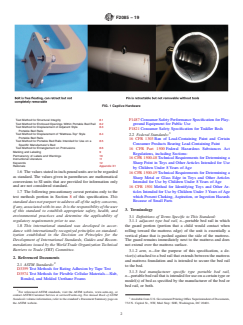
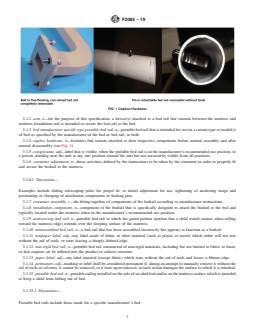
3.1.4 captive hardware, n—fasteners that remain attached to their respective components before normal assembly and after
normal disassembly (see Fig. 1).
3.1.5 conspicuous, adj—label that is visible, when the portable bed rail is in the manufacturer’s recommended use position, to
a person standing near the unit at any one position around the unit but not necessarily visible from all positions.
3.1.6 consumer adjustment, n—those activities defined by the instructions to be taken by the consumer in order to properly fit
and secure the bedrail to the mattress.
3.1.6.1 Discussion—
Examples include sliding telescoping poles for proper fit, or initial adjustment for use, tightening of anchoring straps and
positioning or changing of attachment components or locking pins.
3.1.7 consumer assembly, v—the fitting together of components of the bedrail according to manufacturer instructions.
3.1.8 installation component, n—component of the bedrail that is specifically designed to attach the bedrail to the bed and
typically located under the mattress when in the manufacturer’s recommended use position.
3.1.9 mattress-top bed rail, n—portable bed rail in which the guard portion (portion that a child would contact when rolling
toward the mattress edge) extends over the sleeping surface of the mattress.
3.1.10 misassembled bed rail, n—a bed rail that has been assembled incorrectly but appears to function as a bedrail.
3.1.11 nonpaper label, adj—any label made of fabric or other material (such as plastic or metal) which either will not tear
without the aid of tools, or tears leaving a sharply defined edge.
3.1.12 non-rigid bed rail, n—portable bed rail constructed of non-rigid materials, including but not limited to fabric or foam,
or that requires air be inflated into the product to achieve structure.
3.1.13 paper label, adj—any label material (except fabric) which tears without the aid of tools and leaves a fibrous edge.
3.1.14 permanent, adj—marking or label shall be considered permanent if, during an attempt to manually remove it without the
aid of tools or solvents, it cannot be removed, or it tears upon removal, or such action damages the surface to which it is attached.
3.1.15 portable bed rail, n—portable railing installed on the side of an adult bed and/or on the mattress surface which is intended
to keep a child from falling out of bed.
3.1.15.1 Discussion—
Portable bed rails include those made for a specific manufacturer’s bed.
F2085 − 19
4. Calibration and Standardization
4.1 The product shall be completely assembled, unless otherwise noted, in accordance with the manufacturer’s instructions.
4.2 No testing shall be conducted within 48 h of manufacturing.
4.3 The product to be tested shall be in a room with an ambient temperature of 7373°F 6 9°F (23(23°C 6 5°C) for at least 1
h prior to testing. Testing shall then be conducted within this temperature range.
4.4 All testing required by this specification shall be conducted on the same unit.
5. General Requirements
5.1 There shall be no hazardous sharp points or edges as defined by 16 CFR 1500.48 and 16 CFR 1500.49.
5.2 There shall be no small parts as defined by 16 CFR 1501.
5.3 Any exposed wood parts shall be smooth and free from splinters.
5.4 The bed rail shall conform to 16 CFR 1303.
5.5 Non-rigid bed rails need only meet the general requirements of Section 5, the performance requirement of 6.3, and the
warning requirements of 9.3.
5.6 Warning labels (whether paper or nonpaper) shall be permanent when tested per 10.1 – 10.3. Warning statements applied
directly onto the surface of the product by hot stamping, heat transfer, printing, wood burning. etc. shall be permanent when tested
per 10.4. Nonpaper labels shall not liberate small parts when tested in accordance with 10.5.
5.7 Installation components that are required to meet the performance requirements of 6.4, 6.5, and 6.6 shall be fully assembled,
inseparable, and permanently attached to a component requiring consumer assembly (this excludes any consumer adjustment).
5.8 For products requiring consumer assembly, supplied hardware used for assembly of the bedrail such as screws, nuts or bolts
shall be captive hardware to their respective components.
6. Performance Requirements
6.1 Structural Integrity—All tests of 8.1 shall be performed sequentially. After testing in accordance with 8.1, there shall be no
hazardous condition created as defined in Section 5.
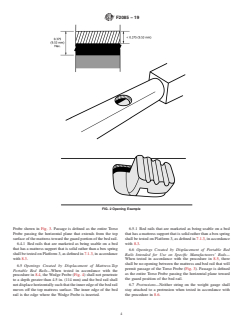
6.2 Openings—Holes or slots that extend entirely through a wall section of any rigid material less than 0.375-in. (9.53-mm)
thick and admit a 0.210-in. (5.33-mm) diameter rod shall also admit a 0.375-in. (9.53-mm) diameter rod. Holes or slots that are
between 0.210-in. (5.33-mm) and 0.375-in. (9.53-mm)0.210 in. (5.33 mm) and 0.375 in. (9.53 mm) and have a wall thickness less
than 0.375-in. (9.53-mm)0.375 in. (9.53 mm) but are limited in depth to 0.375-in. (9.53-mm)0.375 in. (9.53 mm) maximum by
another rigid surface shall be permissible (see Fig. 2). The product shall be evaluated in all manufacturer’s recommended use
positions.
6.3 Enclosed Openings—When tested in accordance with 8.2, there shall be no enclosed openings in the enclosed structure of
the portable bed rail that will permit passage of the Torso Probe shown in Fig. 3.
6.4 Openings Created by Bed Rail Displacement of Adjacent Style Portable Bed Rails—When tested in accordance with the
procedure in 8.3, there shall be no opening between the mattress and the bed rail that will permit passage of the Torso Probe shown
in Fig. 3. Passage is defined as the entire Torso Probe passing the horizontal plane that extends from the top surface of the mattress
toward the guard portion of the bed rail.
6.4.1 Bed rails that are marketed as being usable on a bed that has a mattress support that is solid rather than a box spring shall
be tested on Platform 3, as defined in 7.1.3, in accordance with 8.3.
6.5 Openings Created by Displacement of Mattress-Top Portable Bed Rails—When tested in accordance with the procedure in
8.4, the Wedge Probe (Fig. 4) shall not penetrate to a depth greater than 4.5 in. (114 mm) and the bed rail shall not displace
horizontally such that the inner edge of the bed rail moves off the top mattress surface. The inner edge of the bed rail is the edge
where the Wedge Probe is inserted.
6.5.1 Bed rails that are marketed as being usable on a bed that has a mattress support that is solid rather than a box spring shall
be tested on Platform 3, as defined in 7.1.3, in accordance with 8.3.
6.6 Openings Created by Displacement of Portable Bed Rails Intended for Use on Specific Manufacturers’ Beds—When tested
in accordance with the procedure in 8.5, there shall be no opening between the mattress and bed rail that will permit passage of
the Torso Probe (Fig. 3). Passage is defined as the entire Torso Probe passing the horizontal plane toward the guard position of
the bed rail.
6.7 Protrusions—Neither string on the weight gauge shall stay attached to a protrusion when tested in accordance with the
procedure in 8.6.
F2085 − 19
FIG. 2 Opening Example
6.8 Openings Between Bedposts (Headboard, Footboards, Etc.)etc.) and Ends of Portable Bed Rail—When installed in
accordance with the manufacturer’s instructions on Test Platforms 1 and 2, there shall be a minimum of 9 in. (230 mm) between
the left and right ends of the portable bed rail and the corresponding left and right ends of the test mattress.
6.8.1 Adjacent Style and Mattress Top Portable Bed Rails—When installed in accordance with the manufacturer’s instructions
on Test Platforms 1 and 2, there shall be a minimum of 9 in. (230 mm) between the left and right ends of the portable bed rail and
the corresponding left and right ends of the test mattress.
6.8.2 Bed Manufacturer Specific Type Portable Bed Rails—When installed on the bed manufacturer’s bed with the mattress
from platforms 1 and 2, there shall be a minimum of 9 in. (230 mm) between the left and right ends of the portable bed rail and
the corresponding left and right ends of the test mattress.
6.9 Bedrail components requiring consumer assembly shall not be able to be misassembled when evaluated to 6.9.1.
6.9.1 Determining Misassembled Bed Rail—A bedrail shall be considered a misassembled bed rail if it appears to be a functional
bedrail under any one of the conditions listed in 6.9.1.1, 6.9.1.2, or 6.9.1.3 and it does not meet the requirements of 6.4, 6.5, or
6.6.
6.9.1.1 The bedrail’s fabric cover or mesh can be placed over the rigid frame structure without engaging all structural
components of the frame as intended in final assembly (Fig. 5 and Fig. 6). When the bedrail is evaluated, zippers and other means
of attachment should be fully fastened. If possible to fasten the means of attachments without engaging said structural components,
evaluation for misassembly should account for that (see Fig. 6).
F2085 − 19
FIG. 3 Torso Probe
FIG. 4 Wedge Probe
NOTE 1—Any means of attachment, including, but not limited to, zippers, hooks and loops, and snaps, should be fully fastened. Fig. 7 represents a
passing condition.
6.9.1.2 The bedrail can be consumer assembled with any horizontal structural components improperly positioned such as being
inverted or interchanged, without permanent deformation or breakage of the component or bedrail. This excludes consumer
adjustment or universal components that are designed to be interchangeable (Fig. 8). For example:
F2085 − 19
FIG. 5 Example of Fail Condition
(1) Horizontal structural components shall be interchanged (Components 1, 2, 3).
(2) Horizontal structural components shall be inverted (AB:BA); (CD:DC); (EF:FE).
(3) Horizontal structural components shall be interchanged and inverted. (Example: combination of structural component 3 in
the top position and inverted (EF:FE).)
6.9.1.3 Bedrails where the positions of the arms are intended to be unidirectional are able to be assembled when the arms are
rotated 180° about the vertical axis (Fig. 9).
7. Test Equipment
7.1 Test Beds:
7.1.1 Test Platform 1:
7.1.1.1 Mattress Construction—The mattress shall be of standard twin size, 3838 in. by 74.5 in. 6 0.5 in. (0.97(0.97 m by 1.89
m 6 13 mm). The mattress shall be made from open cell polyurethane foam padding and be 44 in. to 5 in. (102(102 mm to 127
3 3
mm) thick with a density of 1 lb/ft +0.2, –0 (16 kg/m +3.2, –0). The mattress shall weigh between 6.06.0 lb and 9.5 lb (2.7(2.7 kg
to 4.3 kg). There shall be no surface texture features (for example, quilting) on the test mattress. The mattress shall be covered
with a standard twin sized twin-sized fitted sheet. The sheet shall be white, 50/50 cotton/polyester blend. It shall have 60/40
cotton/polyester blend containing 100 to 300 threads per square inch.
7.1.1.2 Mattress Performance—The foam shall have an Indentation Load Deflection (ILD) (see Note 2) of between 28 and 33
when tested in accordance with Test Methods D3574, Method B1.
NOTE 2—Indentation Load (ILD) is defined as the weight in pounds necessary to deflect a 15 in. square by 4 in. thick piece of foam 1 in.
7.1.1.3 Mattress Support—The support shall be a common twin sized foundation measuring approximately 6 in. thick by 38
in. by 74.574.5 in. 6 0.5 in. (152 mm by 0.97 m by 1.89 m 6 13 mm). The foundation shall be of typical frame construction that
1 3
is topped with a rigid board that has a layer of approximately ⁄4 in. (6 mm) to ⁄8 in. (10 mm) of open cell foam and covered with
a fabric similar to that of the test mattress. The foundation shall be placed in a common metal bed frame.
7.1.2 Test Platform 2:
7.1.2.1 Mattress Construction—The mattress shall be of standard twin size, 38 in. by 74.5 in. 6 0.5 in. (0.97 m by 1.89 m 6
13 mm). The mattress shall be of an innerspring design and be between 10.0 in. (0.25 m) and 11.0 in. (0.28 m) thick. (See Note
3.) The mattress shall weigh 5050 lb 6 10 lb (22.7(22.7 kg 6 4.5 kg). The mattress shall be covered with a standard twin sized
cotton twin-sized fitted sheet. The sheet shall be white, 50/50 cotton/polyester blend. It shall have 60/40 cotton/polyester blend
containing 100 to 300 threads per square inch.
NOTE 3—Thickness is measured when the mattress is located on a box spring. Measurement is from the top surface of the box spring to the center
of the top-ticking seam.
7.1.2.2 Mattress Support—The support shall be a common twin sized foundation measuring approximately 6 in. thick by 38
in. by 74.574.5 in. 6 0.5 in. (152 mm by 0.97 m by 1.89 m 6 13 mm). The foundation shall be of typical frame construction that
1 3
is topped with a rigid board that has a layer of approximately ⁄4 in. (6.4 mm) to ⁄8 in. (9.5 mm) of open cell foam and covered
with a fabric similar to that of the test mattress.
7.1.3 Test Platform 3:
7.1.3.1 Mattress Construction—The mattress shall be that specified in 7.1.1.1.
7.1.3.2 Mattress Supp
...