

ASTM F1326-02(2022)
(Test Method)Standard Test Method for Measuring Maximum Dry Volume of Utility Vacuum Cleaners
General Information
- Abstract
SIGNIFICANCE AND USE
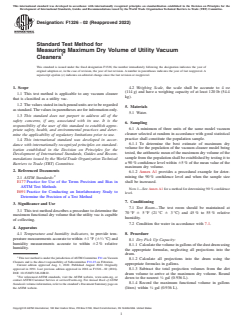
3.1 This test method describes a procedure to determine the maximum functional dry volume that the utility vac is capable of collecting.
SCOPE
1.1 This test method is applicable to any vacuum cleaner that is classified as a utility vac.
1.2 The values stated in inch-pound units are to be regarded as standard. The values in parentheses are for information only.
1.3 This standard does not purport to address all of the safety concerns, if any, associated with its use. It is the responsibility of the user of this standard to establish appropriate safety, health, and environmental practices and determine the applicability of regulatory limitations prior to use.
1.4 This international standard was developed in accordance with internationally recognized principles on standardization established in the Decision on Principles for the Development of International Standards, Guides and Recommendations issued by the World Trade Organization Technical Barriers to Trade (TBT) Committee.
- Status
- Published
- Publication Date
- 31-Jul-2022
- Technical Committee
- F11 - Vacuum Cleaners
- Drafting Committee
- F11.23 - Filtration
Overview
ASTM F1326-02(2022), Standard Test Method for Measuring Maximum Dry Volume of Utility Vacuum Cleaners, establishes a uniform procedure for determining the maximum functional dry volume that a utility vacuum cleaner, commonly called a "shop vac", can collect. Developed by ASTM International, this standard supports manufacturers, testing laboratories, and regulatory bodies in evaluating the collection capacity of utility vacuum cleaners. This method is applicable to any vacuum cleaner classified as a utility vac and promotes consistency, repeatability, and comparability of results across different products and laboratories.
Key Topics
- Test Method Applicability: Focuses on all types and models of utility vacuum cleaners, standardizing the approach to measuring maximum dry volume, regardless of configuration or brand.
- Measurement Units: The standard employs inch-pound units as default; metric equivalents are provided for informational purposes.
- Testing Process: Outlines environmental conditioning, apparatus requirements, and detailed step-by-step procedures to accurately establish the vacuum cleaner’s maximum dry capacity.
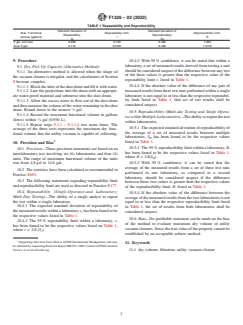
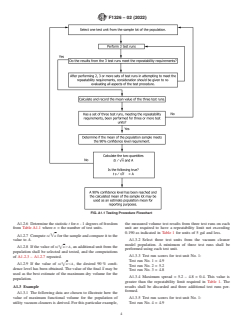
- Repeatability and Reproducibility: Describes how to validate test results through repeat tests and sets criteria for accepting or questioning results based on statistical limits.
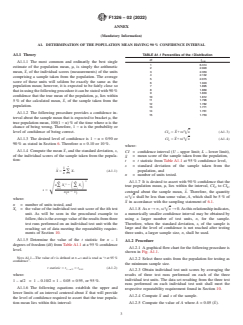
- Sample Size and Statistical Confidence: Specifies the minimum number of units to test, and the process for calculating the population mean with a defined confidence interval.
- Safety and Compliance: Notes that users are responsible for implementing appropriate safety, health, and environmental practices.
Applications
- Product Design and Manufacturing: Enables manufacturers to reliably specify and compare the maximum dry volume of their utility vacuums, facilitating product development and quality assurance.
- Quality Control and Performance Verification: Testing laboratories use this method to verify manufacturer claims and perform independent assessments for clients and regulatory agencies.
- Market Comparisons: Consumers and commercial purchasers benefit from standardized capacity ratings when comparing different models.
- Regulatory and Compliance Testing: Regulatory bodies and certification organizations employ this test method to ensure compliance with labeling requirements and performance standards.
- Research and Product Benchmarking: Researchers and engineers can benchmark different designs within controlled, repeatable parameters to drive innovation in filtration and dust collection.
Related Standards
- ASTM E177: Practice for Use of the Terms Precision and Bias in ASTM Test Methods - provides clarification on key statistical terms used in the context of test data.
- ASTM E691: Practice for Conducting an Interlaboratory Study to Determine the Precision of a Test Method - informs the procedures for evaluating consistency between different labs.
- ISO and IEC Standards on Vacuum Cleaners: For broader international alignment, reference related ISO and IEC standards for appliance testing and performance evaluation.
By adhering to ASTM F1326-02(2022), organizations can ensure accurate measurement of dry collection volume in utility vacuums, promoting transparency, product reliability, and consumer trust. This test method supports industry stakeholders in achieving consistency and high-quality standards for vacuum cleaner performance and capacity ratings.
Relations
- Effective Date
- 01-May-2014
- Effective Date
- 01-May-2013
- Effective Date
- 01-May-2013
- Effective Date
- 01-Nov-2011
- Effective Date
- 01-Oct-2010
- Effective Date
- 01-Oct-2008
- Effective Date
- 01-Oct-2008
- Refers
ASTM E177-06b - Standard Practice for Use of the Terms Precision and Bias in ASTM Test Methods - Effective Date
- 15-Nov-2006
- Refers
ASTM E177-06a - Standard Practice for Use of the Terms Precision and Bias in ASTM Test Methods - Effective Date
- 01-Nov-2006
- Effective Date
- 01-Nov-2005
- Refers
ASTM E177-04e1 - Standard Practice for Use of the Terms Precision and Bias in ASTM Test Methods - Effective Date
- 01-Nov-2004
- Effective Date
- 01-Nov-2004
- Effective Date
- 01-Nov-2004
- Refers
ASTM E177-90a(2002) - Standard Practice for Use of the Terms Precision and Bias in ASTM Test Methods - Effective Date
- 10-Jan-2002
- Effective Date
- 10-May-1999
Frequently Asked Questions
ASTM F1326-02(2022) is a standard published by ASTM International. Its full title is "Standard Test Method for Measuring Maximum Dry Volume of Utility Vacuum Cleaners". This standard covers: SIGNIFICANCE AND USE 3.1 This test method describes a procedure to determine the maximum functional dry volume that the utility vac is capable of collecting. SCOPE 1.1 This test method is applicable to any vacuum cleaner that is classified as a utility vac. 1.2 The values stated in inch-pound units are to be regarded as standard. The values in parentheses are for information only. 1.3 This standard does not purport to address all of the safety concerns, if any, associated with its use. It is the responsibility of the user of this standard to establish appropriate safety, health, and environmental practices and determine the applicability of regulatory limitations prior to use. 1.4 This international standard was developed in accordance with internationally recognized principles on standardization established in the Decision on Principles for the Development of International Standards, Guides and Recommendations issued by the World Trade Organization Technical Barriers to Trade (TBT) Committee.
SIGNIFICANCE AND USE 3.1 This test method describes a procedure to determine the maximum functional dry volume that the utility vac is capable of collecting. SCOPE 1.1 This test method is applicable to any vacuum cleaner that is classified as a utility vac. 1.2 The values stated in inch-pound units are to be regarded as standard. The values in parentheses are for information only. 1.3 This standard does not purport to address all of the safety concerns, if any, associated with its use. It is the responsibility of the user of this standard to establish appropriate safety, health, and environmental practices and determine the applicability of regulatory limitations prior to use. 1.4 This international standard was developed in accordance with internationally recognized principles on standardization established in the Decision on Principles for the Development of International Standards, Guides and Recommendations issued by the World Trade Organization Technical Barriers to Trade (TBT) Committee.
ASTM F1326-02(2022) is classified under the following ICS (International Classification for Standards) categories: 97.080 - Cleaning appliances. The ICS classification helps identify the subject area and facilitates finding related standards.
ASTM F1326-02(2022) has the following relationships with other standards: It is inter standard links to ASTM E177-14, ASTM E691-13, ASTM E177-13, ASTM E691-11, ASTM E177-10, ASTM E691-08, ASTM E177-08, ASTM E177-06b, ASTM E177-06a, ASTM E691-05, ASTM E177-04e1, ASTM E177-04, ASTM E177-06, ASTM E177-90a(2002), ASTM E691-99. Understanding these relationships helps ensure you are using the most current and applicable version of the standard.
ASTM F1326-02(2022) is available in PDF format for immediate download after purchase. The document can be added to your cart and obtained through the secure checkout process. Digital delivery ensures instant access to the complete standard document.
Standards Content (Sample)
This international standard was developed in accordance with internationally recognized principles on standardization established in the Decision on Principles for the
Development of International Standards, Guides and Recommendations issued by the World Trade Organization Technical Barriers to Trade (TBT) Committee.
Designation: F1326 − 02 (Reapproved 2022)
Standard Test Method for
Measuring Maximum Dry Volume of Utility Vacuum
Cleaners
This standard is issued under the fixed designation F1326; the number immediately following the designation indicates the year of
original adoption or, in the case of revision, the year of last revision.Anumber in parentheses indicates the year of last reapproval.A
superscript epsilon (´) indicates an editorial change since the last revision or reapproval.
1. Scope 4.2 Weighing Scale, the scale shall be accurate to 4 oz
(114g) and have a weighing capacity of at least 120 lb (54.4
1.1 This test method is applicable to any vacuum cleaner
kg).
that is classified as a utility vac.
1.2 The values stated in inch-pound units are to be regarded
5. Materials
asstandard.Thevaluesinparenthesesareforinformationonly.
5.1 Water.
1.3 This standard does not purport to address all of the
safety concerns, if any, associated with its use. It is the
6. Sampling
responsibility of the user of this standard to establish appro-
6.1 A minimum of three units of the same model vacuum
priate safety, health, and environmental practices and deter-
cleaner selected at random in accordance with good statistical
mine the applicability of regulatory limitations prior to use.
practice shall constitute the population sample.
1.4 This international standard was developed in accor-
6.1.1 To determine the best estimate of maximum dry
dance with internationally recognized principles on standard-
volume for the population of the vacuum cleaner model being
ization established in the Decision on Principles for the
tested, the arithmetic mean of the maximum dry volume of the
Development of International Standards, Guides and Recom-
sample from the population shall be established by testing it to
mendations issued by the World Trade Organization Technical
a 90% confidence level within 65% of the mean value of the
Barriers to Trade (TBT) Committee.
maximum dry volume.
2. Referenced Documents
6.1.2 Annex A1 provides a procedural example for deter-
mining the 90% confidence level and when the sample size
2.1 ASTM Standards:
shall be increased.
E177Practice for Use of the Terms Precision and Bias in
ASTM Test Methods
NOTE 1—See AnnexA1 for a method for determining 90% confidence
E691Practice for Conducting an Interlaboratory Study to
level.
Determine the Precision of a Test Method
7. Conditioning
3. Significance and Use
7.1 Test Room—The test room should be maintained at
3.1 This test method describes a procedure to determine the
70°F 6 5°F (21°C 6 3°C) and 45% to 55% relative
maximum functional dry volume that the utility vac is capable
humidity.
of collecting.
7.2 Condition the water in accordance with 7.1.
4. Apparatus
8. Procedure
4.1 Temperature and humidity indicators, to provide tem-
perature measurements accurate to within 61°F(6 ⁄2°C) and
8.1 Dry Pick Up Capacity:
humidity measurements accurate to within 62% relative
8.1.1 Calculatethevolumeingallonsofthedustdrumusing
humidity.
the appropriate formulas, neglecting all projections into the
drum.
ThistestmethodisunderthejurisdictionofASTMCommitteeF11onVacuum
8.1.2 Calculate all projections into the drum using the
Cleaners and is the direct responsibility of Subcommittee F11.23 on Filtration.
appropriate formulas in gallons.
Current edition approved Aug. 1, 2022. Published August 2022. Originally
8.1.3 Subtract the total projection volumes from the dirt
approved in 1991. Last previous edition approved in 2016 as F1326–02 (2016).
DOI: 10.1520/F1326-02R22.
drum volume to arrive at the maximum dry volume. Round
For referenced ASTM standards, visit the ASTM website, www.astm.org, or
down to the nearest ⁄4 gal (0.936 L).
contact ASTM Customer Service at service@astm.org. For Annual Book of ASTM
8.1.4 Record the maximum functional volume in gallons
Standards volume information, refer to the standard’s Document Summary page on
the ASTM website. (litres) within ⁄4 gal (0.936 L).
Copyright © ASTM International, 100 Barr Harbor Drive, PO Box C700, West Conshohocken, PA 19428-2959. United States
F1326 − 02 (2022)
TABLE 1 Repeatability and Reproducibility
Standard Deviation of Standard Deviation of
Max. Functional Repeatability Limit, Reproducibility Limit,
Repeatability, Reproducibility,
Volume (gallons) r R
S S
r R
5 gal. and less 0.068 0.190 0.380 1.063
Over 5 gal. 0.118 0.3297 0.468 1.3116
9. Procedure 10.4.3 With 95% confidence, it can be stated that within a
laboratory a set of measured results derived from testing a unit
9.1 Dry Pick Up Capacity (Alternative Method):
shouldbeconsideredsuspectifthedifferencebetweenanytwo
9.1.1 An alternative method is allowed when the shape of
of the three values is greater than the respective value of the
the vacuum cleaner is irregular, and the calculations of Section
repeatability limit r, listed in Table 1.
8 become complex.
10.4.4 If the absolute value of the difference of any pair of
9.1.1.1 Blocktheinletofthedustdrumandfillitwithwater.
measuredresultsfromthreetestrunsperformedwithinasingle
9.1.1.2 Line the projections into the drum with an appropri-
laboratory is not equal to or less than the respective repeatabil-
ate water-proof material and submerse into the dust drum.
ity limit listed in Table 1, that set of test results shall be
9.1.1.3 Allow the excess water to flow out of the dust drum
considered suspect.
andthenmeasurethevolumeofthewaterremaininginthedust
drum. Round down to the nearest ⁄4 gal.
10.5 Reproducibility (Multi-day Testing and Single Opera-
9.1.1.4 Record the maximum functional volume in gallons
torwithinMultipleLaboratories)—Theabilitytorepeatthetest
(litres) within ⁄4 gal (0.936 L).
within laboratories.
9.1.1.5 Repeat steps 9.1.1 – 9.1.1.4 two more times. The
10.5.1 Theexpectedstandarddeviationofreproducibilityof
average of the three tests represents the maximum dry func-
the average of a set of measured results between multiple
tional volume that the utility vacuum is capable of collecting.
laboratories, S has been found to be the respective values
R
listed in Table 1.
10. Precision and Bias
10.5.2 The95%reproducibilitylimitwithinalaboratory,R,
10.1 Precision—These precision statements are based on an
has been found to be the respective values listed in Table 1,
interlaboratory test involving six (6) laboratories and four (4)
where R = 2.8(S ).
units. The range of maximum functional volume of the units R
10.5.3 With 95% confidence, it can be stated that the
was from 4.8gal to 14.6 gal.
average of the measured results from a set of three test runs
10.2 The statistics have been calculated as recommended in
performed in one laboratory, as compared to a second
Practice E691.
laboratory, should be considered suspect if the difference
10.3 The following statements regarding repeatability limit
between those two values is greater than the respective values
and reproducibility limit are used as directed in Practice E177.
of the reproducibility limit, R, listed in Table 1.
10.4 Repeatability (Single-Operator-and Laboratory;
10.5.4 If the absolute value of the difference between the
Multi-Day Testing)—The ability of a single analyst to repeat
averageofthemeasuredresultsfromthetwolaboratoriesisnot
the test within a single laboratory.
equal to or less than the respective reproducibility limit listed
10.4.1 The expected standard deviation of repeatability of
in Table 1, the set of results from both laboratories shall be
themeasuredresultswithinalaboratorys hasbeenfoundtobe
r considered suspect.
the respective values listed in Table 1.
10.6 Bias—Nojustifiablestatementcanbemadeonthebias
10.4.2 The 95% repeatability limit within a laboratory, r,
of the method to evaluate maximum dry volume of utility
has been found to be the respective values listed on Table 1,
vacuumcleaners.Sincethetruevalueofthepropertycannotbe
where r = 2.8 (S ).
r
established by an acceptable referee method.
Supporting data have been filed atASTM International Headquarters and may
11. Keywords
beobtainedbyrequestingResearchReportRR:F11-1009.ContactASTMCustomer
Service at service@astm.org. 11.1 dry volume; filtration; utility vacuum cleaner
...