


ASTM F2303-03(2015)
(Practice)Standard Practice for Selection of Gravity Sewers Suitable for Installation of Optical Fiber Cable and Conduits
Standard Practice for Selection of Gravity Sewers Suitable for Installation of Optical Fiber Cable and Conduits
SIGNIFICANCE AND USE
5.1 This practice is intended to assist engineers and sewer owner/operators in determining the suitability of sewers for a secondary use as hosts for optical fiber cables and conduits. It must be kept in mind that the primary use of the sewers is to carry wastewater or storm water, or both. Any secondary use of the system shall not significantly impair the primary use. It is up to the engineer to decide upon any exceptions that may be involved in the selection process.
5.2 Before the selection procedure begins, the installer must have explicit authorization from the owner/operator allowing an evaluation to be conducted for the installation of optical fiber cables or conduits within their sewer system.
5.3 Engineers and owners should also be cognizant of how the installation of optical fiber cable or conduits will impact the future operational, maintenance, and rehabilitation needs of the sewers.
SCOPE
1.1 This practice specifically addresses the criteria for determining the suitability of gravity sewers for secondary uses such as the installation of optical fiber systems.
1.1.1 This practice applies to the process of selecting gravity sewers that are appropriate for accepting an optical fiber system as opposed to standards for the installation, operation and maintenance of such system within sewers.
1.2 This practice applies to both man accessible and man inaccessible sewer systems.
1.3 The values stated in inch-pound units are to be regarded as standard. No other units of measurement are included in this standard.
1.4 This standard does not purport to address all of the safety concerns, if any, associated with its use. It is the responsibility of the user of this standard to establish appropriate safety and health practices and determine the applicability of regulatory limitations prior to use.
General Information
Buy Standard
Standards Content (Sample)
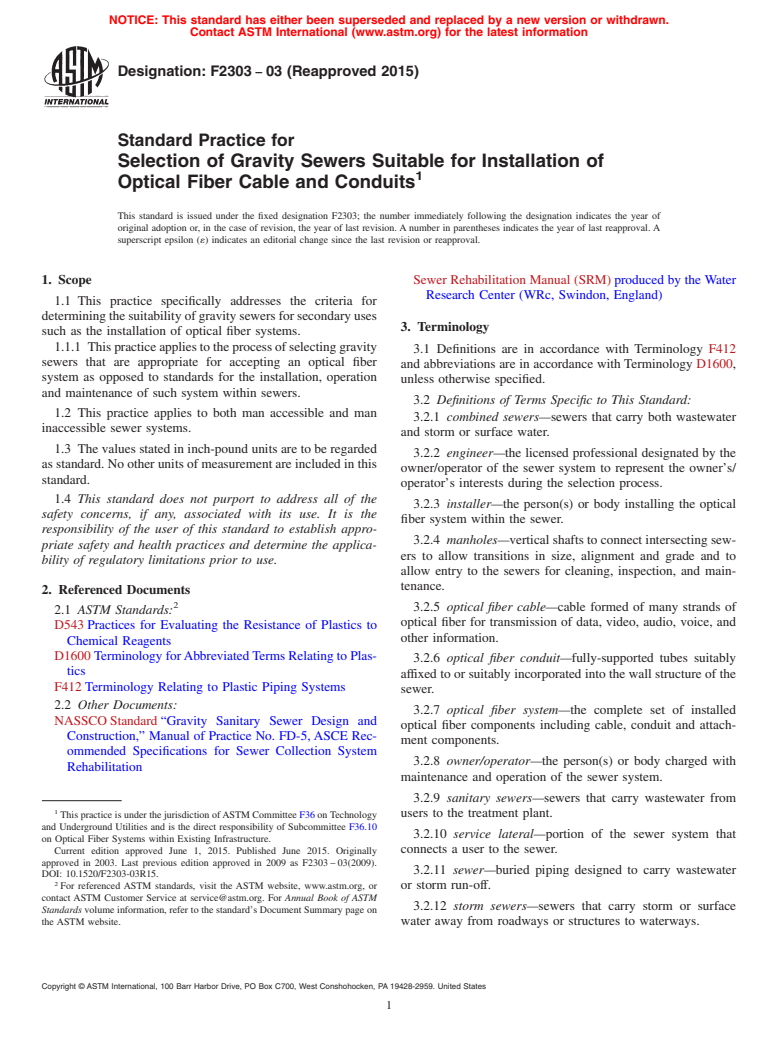
NOTICE: This standard has either been superseded and replaced by a new version or withdrawn.
Contact ASTM International (www.astm.org) for the latest information
Designation: F2303 − 03 (Reapproved 2015)
Standard Practice for
Selection of Gravity Sewers Suitable for Installation of
Optical Fiber Cable and Conduits
This standard is issued under the fixed designation F2303; the number immediately following the designation indicates the year of
original adoption or, in the case of revision, the year of last revision. A number in parentheses indicates the year of last reapproval. A
superscript epsilon (´) indicates an editorial change since the last revision or reapproval.
1. Scope Sewer Rehabilitation Manual (SRM) produced by the Water
Research Center (WRc, Swindon, England)
1.1 This practice specifically addresses the criteria for
determiningthesuitabilityofgravitysewersforsecondaryuses
3. Terminology
such as the installation of optical fiber systems.
1.1.1 Thispracticeappliestotheprocessofselectinggravity
3.1 Definitions are in accordance with Terminology F412
sewers that are appropriate for accepting an optical fiber
and abbreviations are in accordance with Terminology D1600,
system as opposed to standards for the installation, operation
unless otherwise specified.
and maintenance of such system within sewers.
3.2 Definitions of Terms Specific to This Standard:
1.2 This practice applies to both man accessible and man
3.2.1 combined sewers—sewers that carry both wastewater
inaccessible sewer systems.
and storm or surface water.
1.3 The values stated in inch-pound units are to be regarded
3.2.2 engineer—the licensed professional designated by the
as standard. No other units of measurement are included in this
owner/operator of the sewer system to represent the owner’s/
standard.
operator’s interests during the selection process.
1.4 This standard does not purport to address all of the
3.2.3 installer—the person(s) or body installing the optical
safety concerns, if any, associated with its use. It is the
fiber system within the sewer.
responsibility of the user of this standard to establish appro-
3.2.4 manholes—vertical shafts to connect intersecting sew-
priate safety and health practices and determine the applica-
ers to allow transitions in size, alignment and grade and to
bility of regulatory limitations prior to use.
allow entry to the sewers for cleaning, inspection, and main-
tenance.
2. Referenced Documents
3.2.5 optical fiber cable—cable formed of many strands of
2.1 ASTM Standards:
optical fiber for transmission of data, video, audio, voice, and
D543 Practices for Evaluating the Resistance of Plastics to
other information.
Chemical Reagents
D1600 Terminology forAbbreviatedTerms Relating to Plas-
3.2.6 optical fiber conduit—fully-supported tubes suitably
tics
affixed to or suitably incorporated into the wall structure of the
F412 Terminology Relating to Plastic Piping Systems
sewer.
2.2 Other Documents:
3.2.7 optical fiber system—the complete set of installed
NASSCO Standard “Gravity Sanitary Sewer Design and
optical fiber components including cable, conduit and attach-
Construction,” Manual of Practice No. FD-5, ASCE Rec-
ment components.
ommended Specifications for Sewer Collection System
3.2.8 owner/operator—the person(s) or body charged with
Rehabilitation
maintenance and operation of the sewer system.
3.2.9 sanitary sewers—sewers that carry wastewater from
This practice is under the jurisdiction ofASTM Committee F36 on Technology users to the treatment plant.
and Underground Utilities and is the direct responsibility of Subcommittee F36.10
3.2.10 service lateral—portion of the sewer system that
on Optical Fiber Systems within Existing Infrastructure.
Current edition approved June 1, 2015. Published June 2015. Originally connects a user to the sewer.
approved in 2003. Last previous edition approved in 2009 as F2303 – 03(2009).
3.2.11 sewer—buried piping designed to carry wastewater
DOI: 10.1520/F2303-03R15.
For referenced ASTM standards, visit the ASTM website, www.astm.org, or or storm run-off.
contact ASTM Customer Service at service@astm.org. For Annual Book of ASTM
3.2.12 storm sewers—sewers that carry storm or surface
Standards volume information, refer to the standard’s Document Summary page on
the ASTM website. water away from roadways or structures to waterways.
Copyright © ASTM International, 100 Barr Harbor Drive, PO Box C700, West Conshohocken, PA 19428-2959. United States
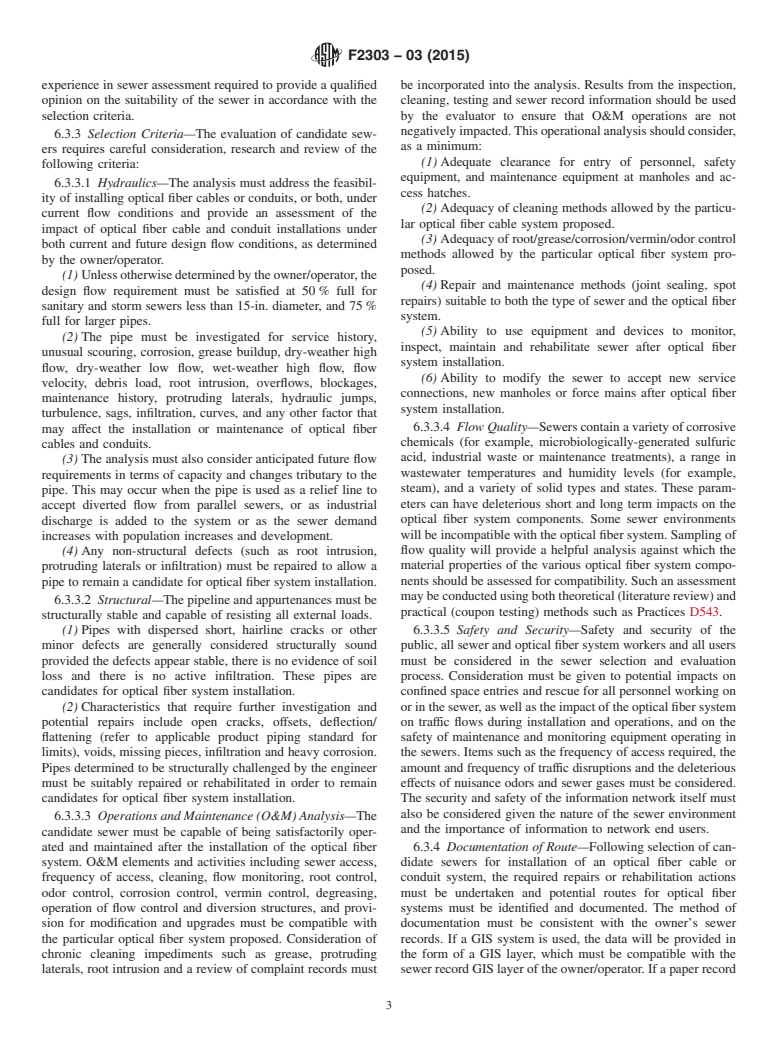
F2303 − 03 (2015)
4. Summary of Practice sewer. The installer shall provide written assurance of the
suitabilityforuseofthesemethodsthroughoutthetermthatthe
4.1 Optical fiber cable and conduit systems in existing
optical fiber system remains installed in the sewer.
sewers shall be designed and installed so that they have a
6.1.4 Requirement to Bypass—Unless otherwise agreed by
minimal effect on the sewer’s hydraulic performance and no
the owner/operator, the flow in the candidate sewer must be
effect on their structural integrity. Their design and installation
temporarily stopped or fully bypassed prior to inspection to
shall also allow for the safe and efficient operation and
allowforacompleteexaminationandevaluationoftheinternal
maintenance of the sewer, and provide for the safe and efficient
pipe circumference.
operation of the optical fiber system. The ultimate success of
theinstallationandoperationofopticalfiberandsewersystems 6.2 Inspection:
depends upon the proper evaluation and selection of appropri- 6.2.1 Televising—The inspection of the sewer system and
ate sewers. The steps in the process include the following appurtenances shall be accomplished by means of a closed
items: circuit television system (CCTV) or other equivalent technol-
4.1.1 Cleaning, ogy. Records of the inspection in analog or digital format will
4.1.2 Inspection and evaluation of the sewers which are be maintained and forwarded to the system owner/operator in
candidates for optical fiber cable or conduit installation, the selection report.
4.1.3 Selection of sewer route, and
6.2.1.1 Visual Quality—The visual quality will be such as to
4.1.4 Documentation of cable routing. allow determination of the presence of cracks, separated joints,
grease, deposits, sags, high water marks, infiltration, corrosion,
5. Significance and Use
and root intrusion.
5.1 This practice is intended to assist engineers and sewer
6.2.1.2 Distance Recording—The distance from the starting
owner/operators in determining the suitability of sewers for a
point of each inspection run must be designated by a specific
secondary use as hosts for optical fiber cables and conduits. It
reference (for example, middle of manhole) acceptable to the
must be kept in mind that the primary use of the sewers is to
owner/operator.
carry wastewater or storm water, or both.Any secondary use of
6.2.1.3 Acceptability of Digital Optical Scanning (New
the system shall not significantly impair the primary use. It is
Technology)—If acceptable to the owner, digital optical scan-
up to the engineer to decide upon any exceptions that may be
ning may be substituted for CCTV.The requirement for degree
involved in the selection process.
of resolution and recording of data remains the same as for
CCTV methods.
5.2 Before the selection procedure begins, the installer must
6.2.1.4 Replicable SystemAssessment Method—Themethod
have explicit authorization from the owner/operator allowing
used to document the presence and severity of sewer faults
an evaluation to be conducted for the installation of optical
shall be replicable. Unless otherwise specified by the owner/
fiber cables or conduits within their sewer system.
operator, a standard fault coding system such as the WRc
5.3 Engineers and owners should also be cognizant of how
Standard Fault Code (or equivalent) may be used to satisfy this
theinstallationofopticalfibercableorconduitswillimpactthe
criterion. The system selected should be capable of
future operational, maintenance, and rehabilitation needs of the
documenting, at a minimum, the presence and severity of the
sewers.
following types of faults: longitudinal cracks, radial cracks,
breaks, gapped joints, damaged seals, infiltration/inflow, sags,
6. Sewer Selection Procedure
levels of corrosion, out-of-round pipe, and uneven slopes.
6.1 Cleaning and Flow Bypass:
6.2.1.5 Requirement for Trained Professional—The inspec-
6.1.1 Requirement to Clean—Prior to selection of a candi-
tion operator shall be a trained individual with suitable
date sewer, the sewer must be thoroughly cleaned to allow for
professional qualifications (for example, NASSCO certifica-
proper inspection and evaluation according to the selection
tion) to provide a qualified inspection opinion as to fault
criteria outlined below. The National Association of Sewer
coding.
Services Companies (NASSCO) provides a helpful standard
6.3 Sewer Selection Criteria:
(NASSCO Standard).Thiscleaningprocessshallbeperformed
with the equipment recommended by the optical fiber installer 6.3.1 The data from the inspection and evaluation should be
as being compatible (see 6.1.3). The cleaning process then used to identify the sewer sections and manholes suitable for
serves as a test of the effectiveness of the cleaning equipment installation of optical fiber cables and conduits. The candidate
as well as allowing the inspection of the integrity of the sewer. sewer must meet minimum criteria based upon hydraulic,
6.1.2 Exceptions to Cleaning Requirement—In cases where structural, operations and maintenance, and flow chemistry
the pipe has recently been cleaned or has been recently analysis. Those sections not meeting the selection criteria shall
installed, the cleaning requirement may be waived by mutual be rejected, suitably repaired or rehabilitated, or otherwise
consent of the system owner and optical fiber system installer. modifiedandre-inspected.Otherwise,analternativerouteshall
be select
...
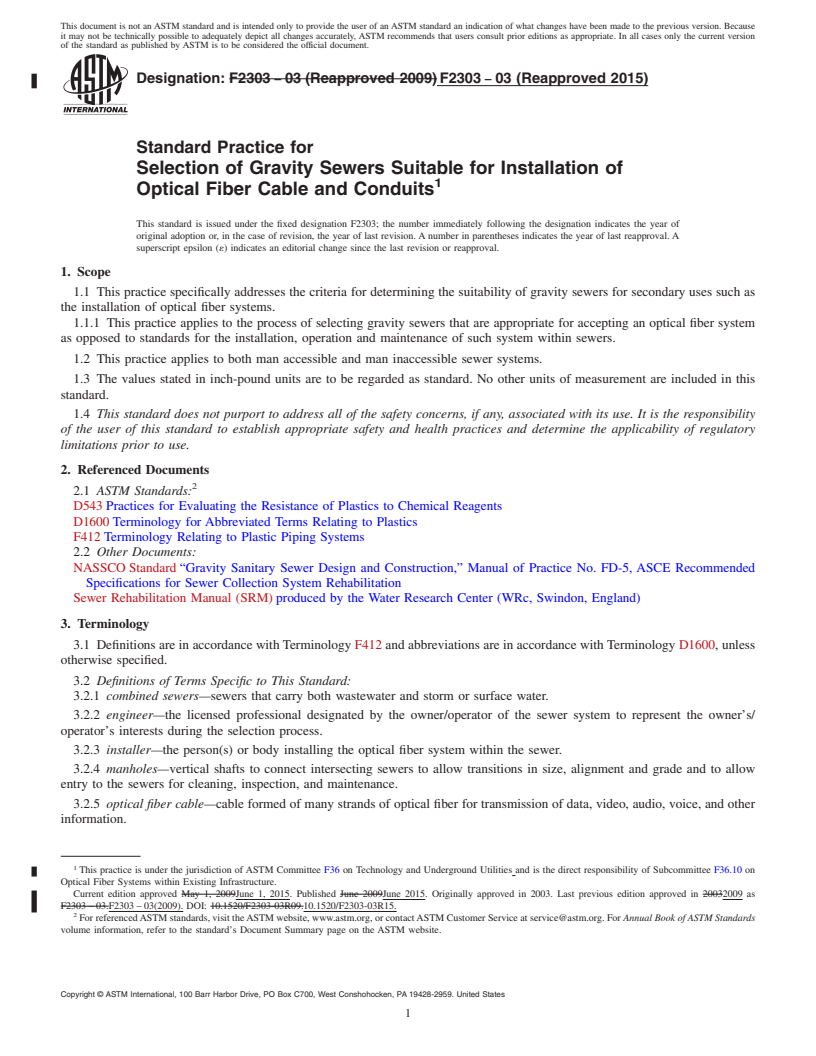
This document is not an ASTM standard and is intended only to provide the user of an ASTM standard an indication of what changes have been made to the previous version. Because
it may not be technically possible to adequately depict all changes accurately, ASTM recommends that users consult prior editions as appropriate. In all cases only the current version
of the standard as published by ASTM is to be considered the official document.
Designation: F2303 − 03 (Reapproved 2009) F2303 − 03 (Reapproved 2015)
Standard Practice for
Selection of Gravity Sewers Suitable for Installation of
Optical Fiber Cable and Conduits
This standard is issued under the fixed designation F2303; the number immediately following the designation indicates the year of
original adoption or, in the case of revision, the year of last revision. A number in parentheses indicates the year of last reapproval. A
superscript epsilon (´) indicates an editorial change since the last revision or reapproval.
1. Scope
1.1 This practice specifically addresses the criteria for determining the suitability of gravity sewers for secondary uses such as
the installation of optical fiber systems.
1.1.1 This practice applies to the process of selecting gravity sewers that are appropriate for accepting an optical fiber system
as opposed to standards for the installation, operation and maintenance of such system within sewers.
1.2 This practice applies to both man accessible and man inaccessible sewer systems.
1.3 The values stated in inch-pound units are to be regarded as standard. No other units of measurement are included in this
standard.
1.4 This standard does not purport to address all of the safety concerns, if any, associated with its use. It is the responsibility
of the user of this standard to establish appropriate safety and health practices and determine the applicability of regulatory
limitations prior to use.
2. Referenced Documents
2.1 ASTM Standards:
D543 Practices for Evaluating the Resistance of Plastics to Chemical Reagents
D1600 Terminology for Abbreviated Terms Relating to Plastics
F412 Terminology Relating to Plastic Piping Systems
2.2 Other Documents:
NASSCO Standard “Gravity Sanitary Sewer Design and Construction,” Manual of Practice No. FD-5, ASCE Recommended
Specifications for Sewer Collection System Rehabilitation
Sewer Rehabilitation Manual (SRM) produced by the Water Research Center (WRc, Swindon, England)
3. Terminology
3.1 Definitions are in accordance with Terminology F412 and abbreviations are in accordance with Terminology D1600, unless
otherwise specified.
3.2 Definitions of Terms Specific to This Standard:
3.2.1 combined sewers—sewers that carry both wastewater and storm or surface water.
3.2.2 engineer—the licensed professional designated by the owner/operator of the sewer system to represent the owner’s/
operator’s interests during the selection process.
3.2.3 installer—the person(s) or body installing the optical fiber system within the sewer.
3.2.4 manholes—vertical shafts to connect intersecting sewers to allow transitions in size, alignment and grade and to allow
entry to the sewers for cleaning, inspection, and maintenance.
3.2.5 optical fiber cable—cable formed of many strands of optical fiber for transmission of data, video, audio, voice, and other
information.
This practice is under the jurisdiction of ASTM Committee F36 on Technology and Underground Utilities and is the direct responsibility of Subcommittee F36.10 on
Optical Fiber Systems within Existing Infrastructure.
Current edition approved May 1, 2009June 1, 2015. Published June 2009June 2015. Originally approved in 2003. Last previous edition approved in 20032009 as
F2303 – 03.F2303 – 03(2009). DOI: 10.1520/F2303-03R09.10.1520/F2303-03R15.
For referenced ASTM standards, visit the ASTM website, www.astm.org, or contact ASTM Customer Service at service@astm.org. For Annual Book of ASTM Standards
volume information, refer to the standard’s Document Summary page on the ASTM website.
Copyright © ASTM International, 100 Barr Harbor Drive, PO Box C700, West Conshohocken, PA 19428-2959. United States
F2303 − 03 (2015)
3.2.6 optical fiber conduit—fully-supported tubes suitably affixed to or suitably incorporated into the wall structure of the sewer.
3.2.7 optical fiber system—the complete set of installed optical fiber components including cable, conduit and attachment
components.
3.2.8 owner/operator—the person(s) or body charged with maintenance and operation of the sewer system.
3.2.9 sanitary sewers—sewers that carry wastewater from users to the treatment plant.
3.2.10 service lateral—portion of the sewer system that connects a user to the sewer.
3.2.11 sewer—buried piping designed to carry wastewater or storm run-off.
3.2.12 storm sewers—sewers that carry storm or surface water away from roadways or structures to waterways.
4. Summary of Practice
4.1 Optical fiber cable and conduit systems in existing sewers shall be designed and installed so that they have a minimal effect
on the sewer’s hydraulic performance and no effect on their structural integrity. Their design and installation shall also allow for
the safe and efficient operation and maintenance of the sewer, and provide for the safe and efficient operation of the optical fiber
system. The ultimate success of the installation and operation of optical fiber and sewer systems depends upon the proper
evaluation and selection of appropriate sewers. The steps in the process include the following items:
4.1.1 Cleaning,
4.1.2 Inspection and evaluation of the sewers which are candidates for optical fiber cable or conduit installation,
4.1.3 Selection of sewer route, and
4.1.4 Documentation of cable routing.
5. Significance and Use
5.1 This practice is intended to assist engineers and sewer owner/operators in determining the suitability of sewers for a
secondary use as hosts for optical fiber cables and conduits. It must be kept in mind that the primary use of the sewers is to carry
wastewater or storm water, or both. Any secondary use of the system shall not significantly impair the primary use. It is up to the
engineer to decide upon any exceptions that may be involved in the selection process.
5.2 Before the selection procedure begins, the installer must have explicit authorization from the owner/operator allowing an
evaluation to be conducted for the installation of optical fiber cables or conduits within their sewer system.
5.3 Engineers and owners should also be cognizant of how the installation of optical fiber cable or conduits will impact the
future operational, maintenance, and rehabilitation needs of the sewers.
6. Sewer Selection Procedure
6.1 Cleaning and Flow Bypass:
6.1.1 Requirement to Clean—Prior to selection of a candidate sewer, the sewer must be thoroughly cleaned to allow for proper
inspection and evaluation according to the selection criteria outlined below. The National Association of Sewer Services
Companies (NASSCO) provides a helpful standard (NASSCO Standard). This cleaning process shall be performed with the
equipment recommended by the optical fiber installer as being compatible (see 6.1.3). The cleaning process then serves as a test
of the effectiveness of the cleaning equipment as well as allowing the inspection of the integrity of the sewer.
6.1.2 Exceptions to Cleaning Requirement—In cases where the pipe has recently been cleaned or has been recently installed,
the cleaning requirement may be waived by mutual consent of the system owner and optical fiber system installer.
6.1.3 Requirement for Compatibility—The installer shall recommend compatible sewer-cleaning methods to the owner/operator.
Such methods shall be compatible with both the existing pipeline (material and condition) and with the optical fiber system, and
shall be effective in maintaining the operation of the sewer without compromising the performance of the sewer. The installer shall
provide written assurance of the suitability for use of these methods throughout the term that the optical fiber system remains
installed in the sewer.
6.1.4 Requirement to Bypass—Unless otherwise agreed by the owner/operator, the flow in the candidate sewer must be
temporarily stopped or fully bypassed prior to inspection to allow for a complete examination and evaluation of the internal pipe
circumference.
6.2 Inspection:
6.2.1 Televising—The inspection of the sewer system and appurtenances shall be accomplished by means of a closed circuit
television system (CCTV) or other equivalent technology. Records of the inspection in analog or digital format will be maintained
and forwarded to the system owner/operator in the selection report.
6.2.1.1 Visual Quality—The visual quality will be such as to allow determination of the presence of cracks, separated joints,
grease, deposits, sags, high water marks, infiltration, corrosion, and root intrusion.
6.2.1.2 Distance Recording—The distance from the starting point of each inspection run must be designated by a specific
reference (for example, middle of manhole) acceptable to the owner/operator.
F2303 − 03 (2015)
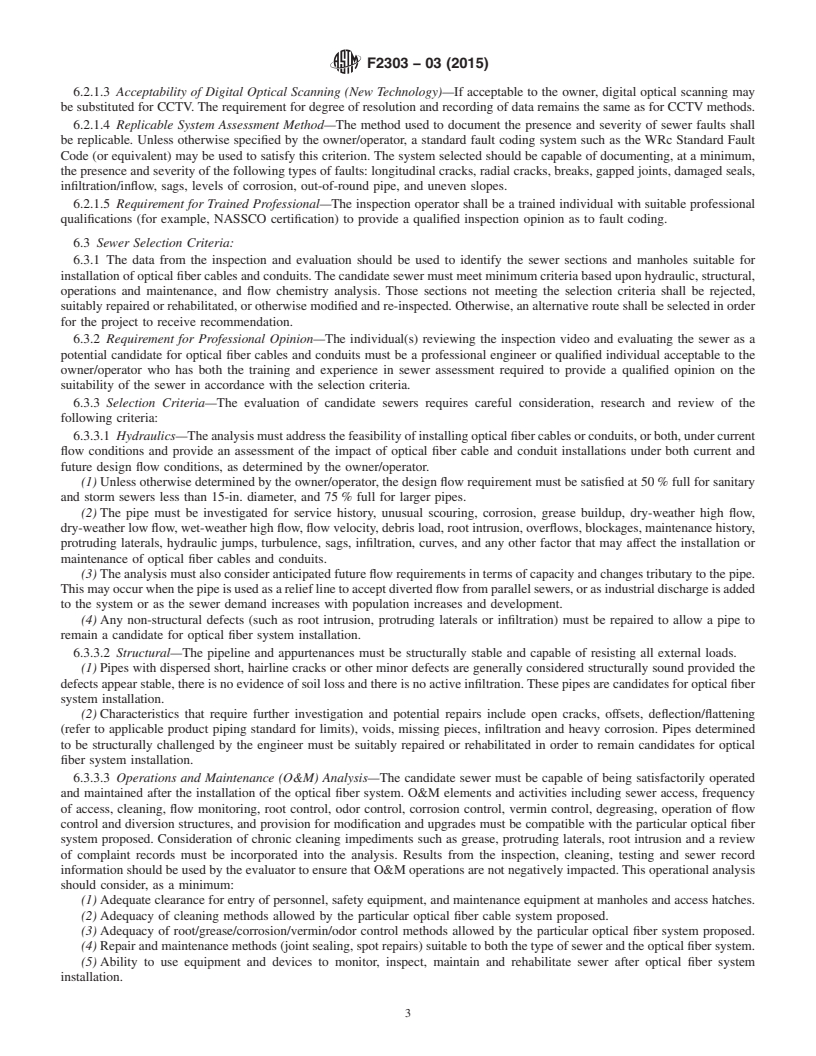
6.2.1.3 Acceptability of Digital Optical Scanning (New Technology)—If acceptable to the owner, digital optical scanning may
be substituted for CCTV. The requirement for degree of resolution and recording of data remains the same as for CCTV methods.
6.2.1.4 Replicable System Assessment Method—The method used to document the presence and severity of sewer faults shall
be replicable. Unless otherwise specified by the owner/operator, a standard fault coding system such as the WRc Standard Fault
Code (or equivalent) may be used to satisfy this criterion. The system selected should be capable of documenting, at a minimum,
the presence and severity of the following types of faults: longitudinal cracks, radial cracks, breaks, gapped joints, damaged seals,
infiltration/inflow, sags, levels of corrosion, out-of-round pipe, and uneven slopes.
6.2.1.5 Requirement for Trained Professional—The inspection operator shall be a trained individual with suitable professional
qualifications (for
...
Questions, Comments and Discussion
Ask us and Technical Secretary will try to provide an answer. You can facilitate discussion about the standard in here.