

ASTM B69-21
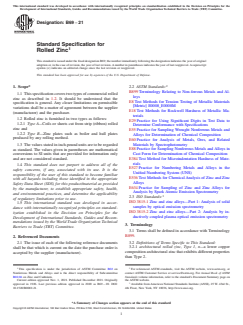
(Specification)Standard Specification for Rolled Zinc
General Information
- Abstract
ABSTRACT
This specification covers two types of commercial rolled zinc. Type I are coils or sheets cut from strip rolled zinc, and Type II are zinc plates such as boiler and hull plates produced by any rolling method. The products shall be produced by casting, rolling, and other processes found in mill product plant. The material shall be tested and conform to the required chemical composition. The testing of wrought zinc for determination of tensile properties shall be conducted. The testing of zinc for hardness shall be made on a Rockwell superficial hardness tester or on a microhardness tester. The determination of chemical composition shall be performed by either an appropriate chemical method or by optical emission spectrographic methods.
SCOPE
1.1 This specification covers two types of commercial rolled zinc as described in 1.2. It should be understood that the specification is general. Any closer limitations on permissible variations shall be a matter of agreement between the supplier (manufacturer) and the purchaser.
1.2 Rolled zinc is furnished in two types as follows:
1.2.1 Type A—Coils or sheets cut from strip (ribbon) rolled zinc and
1.2.2 Type B—Zinc plates such as boiler and hull plates produced by any rolling method.
1.3 The values stated in inch-pound units are to be regarded as standard. The values given in parentheses are mathematical conversions to SI units that are provided for information only and are not considered standard.
1.4 This standard does not purport to address all of the safety concerns, if any, associated with its use. It is the responsibility of the user of this standard to become familiar with all hazards including those identified in the appropriate Safety Data Sheet (SDS) for this product/material as provided by the manufacturer, to establish appropriate safety, health, and environmental practices, and determine the applicability of regulatory limitations prior to use.
1.5 This international standard was developed in accordance with internationally recognized principles on standardization established in the Decision on Principles for the Development of International Standards, Guides and Recommendations issued by the World Trade Organization Technical Barriers to Trade (TBT) Committee.
- Status
- Published
- Publication Date
- 31-Oct-2021
- Technical Committee
- B02 - Nonferrous Metals and Alloys
- Drafting Committee
- B02.04 - Zinc and Cadmium
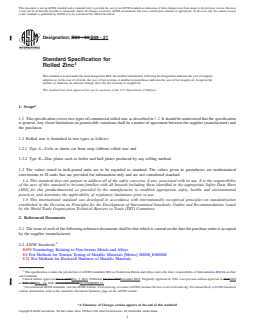
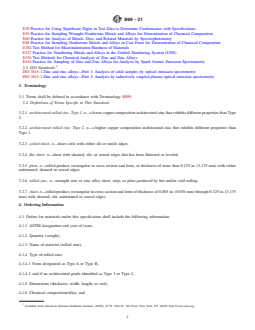
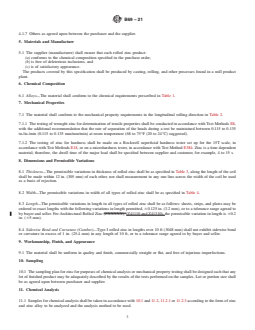
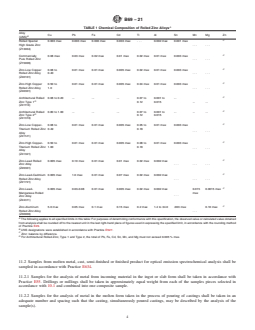
Overview
ASTM B69-21, Standard Specification for Rolled Zinc, is an important international standard published by ASTM International. It sets requirements for two primary types of commercial rolled zinc-Type A (coils or sheets cut from strip-rolled zinc) and Type B (zinc plates such as boiler and hull plates produced by any rolling method). This standard ensures that zinc products meet necessary chemical composition, mechanical properties, and dimensional tolerances, making them suitable for a wide variety of industrial, architectural, and manufacturing applications.
Key Topics
Product Types
- Type A: Coils or sheets cut from strip (ribbon) rolled zinc.
- Type B: Zinc plates, including boiler and hull plates, produced by any rolling method.
Manufacturing Processes
- Rolled zinc products are produced by casting, rolling, and other processes common to mill product plants.
Chemical Composition
- The standard outlines acceptable chemical compositions for various zinc alloys and architectural grades, requiring conformance through appropriate testing methods (chemical, spectrographic).
Mechanical Properties
- Tensile properties and hardness must be determined for wrought zinc. Test methods such as ASTM E8 (tension testing) and ASTM E18 or E384 (hardness testing) are referenced for compliance.
Dimensional Tolerances
- The specification includes permissible variations in thickness, width, and length for both types of rolled zinc, ensuring consistency and reliability in finished products.
Quality and Appearance
- Products must be free from injurious imperfections, uniform in quality and finish, and commercially straight or flat.
Inspection and Certification
- Guidelines for sampling, inspection, and certification are established, with specific details negotiated between supplier and purchaser as required.
Applications
Rolled zinc products covered under ASTM B69-21 are widely used in numerous industries. Key areas include:
Architectural Applications
- Rolled zinc sheets and plates are employed for cladding, roofing, facades, gutters, and downspouts in building construction, thanks to zinc’s corrosion resistance and malleability.
Industrial Manufacturing
- Boiler plates, hull plates, and other fabricated parts benefit from the mechanical strength and dimensional accuracy specified in this standard.
Electrical and Chemical Industries
- Rolled zinc is often used in battery casings, chemical processing equipment, and as sacrificial anodes in cathodic protection systems.
Custom Fabrication
- The ability to specify precise thickness, width, and length, as well as custom chemical compositions, enables engineers and manufacturers to meet unique design requirements.
Related Standards
Several ASTM and ISO standards are referenced in ASTM B69-21 to guide testing, terminology, and analysis methods:
- ASTM B899: Terminology Relating to Non-ferrous Metals and Alloys
- ASTM E8/E8M: Test Methods for Tension Testing of Metallic Materials
- ASTM E18: Test Methods for Rockwell Hardness of Metallic Materials
- ASTM E384: Test Method for Microindentation Hardness of Materials
- ASTM E536: Test Methods for Chemical Analysis of Zinc and Zinc Alloys
- ASTM E55, E60, E88: Practices for sampling and analysis
- ISO 3815-1/2: Analysis of zinc and zinc alloys by optical emission and inductively coupled plasma spectrometry
By adhering to ASTM B69-21, manufacturers, suppliers, and purchasers can ensure consistent product quality, traceability, and compliance with internationally recognized requirements for rolled zinc and zinc alloys.
Keywords: rolled zinc, ASTM B69, zinc sheet, zinc plate, architectural zinc, zinc alloys, mechanical properties, zinc manufacturing, quality standards, zinc specification
Relations
- Effective Date
- 01-Jul-2018
- Effective Date
- 01-Sep-2017
- Effective Date
- 01-Jul-2017
- Effective Date
- 01-Oct-2016
- Effective Date
- 01-Oct-2015
- Effective Date
- 01-Jun-2015
- Effective Date
- 01-Oct-2014
- Effective Date
- 01-Feb-2013
- Effective Date
- 01-Dec-2012
- Effective Date
- 01-Apr-2012
- Effective Date
- 01-Nov-2011
- Effective Date
- 01-May-2011
- Effective Date
- 01-Feb-2010
- Effective Date
- 01-Feb-2010
- Effective Date
- 01-Oct-2009
Get Certified
Connect with accredited certification bodies for this standard

Element Materials Technology
Materials testing and product certification.

Inštitut za kovinske materiale in tehnologije
Institute of Metals and Technology. Materials testing, metallurgical analysis, NDT.
Sponsored listings
Frequently Asked Questions
ASTM B69-21 is a technical specification published by ASTM International. Its full title is "Standard Specification for Rolled Zinc". This standard covers: ABSTRACT This specification covers two types of commercial rolled zinc. Type I are coils or sheets cut from strip rolled zinc, and Type II are zinc plates such as boiler and hull plates produced by any rolling method. The products shall be produced by casting, rolling, and other processes found in mill product plant. The material shall be tested and conform to the required chemical composition. The testing of wrought zinc for determination of tensile properties shall be conducted. The testing of zinc for hardness shall be made on a Rockwell superficial hardness tester or on a microhardness tester. The determination of chemical composition shall be performed by either an appropriate chemical method or by optical emission spectrographic methods. SCOPE 1.1 This specification covers two types of commercial rolled zinc as described in 1.2. It should be understood that the specification is general. Any closer limitations on permissible variations shall be a matter of agreement between the supplier (manufacturer) and the purchaser. 1.2 Rolled zinc is furnished in two types as follows: 1.2.1 Type A—Coils or sheets cut from strip (ribbon) rolled zinc and 1.2.2 Type B—Zinc plates such as boiler and hull plates produced by any rolling method. 1.3 The values stated in inch-pound units are to be regarded as standard. The values given in parentheses are mathematical conversions to SI units that are provided for information only and are not considered standard. 1.4 This standard does not purport to address all of the safety concerns, if any, associated with its use. It is the responsibility of the user of this standard to become familiar with all hazards including those identified in the appropriate Safety Data Sheet (SDS) for this product/material as provided by the manufacturer, to establish appropriate safety, health, and environmental practices, and determine the applicability of regulatory limitations prior to use. 1.5 This international standard was developed in accordance with internationally recognized principles on standardization established in the Decision on Principles for the Development of International Standards, Guides and Recommendations issued by the World Trade Organization Technical Barriers to Trade (TBT) Committee.
ABSTRACT This specification covers two types of commercial rolled zinc. Type I are coils or sheets cut from strip rolled zinc, and Type II are zinc plates such as boiler and hull plates produced by any rolling method. The products shall be produced by casting, rolling, and other processes found in mill product plant. The material shall be tested and conform to the required chemical composition. The testing of wrought zinc for determination of tensile properties shall be conducted. The testing of zinc for hardness shall be made on a Rockwell superficial hardness tester or on a microhardness tester. The determination of chemical composition shall be performed by either an appropriate chemical method or by optical emission spectrographic methods. SCOPE 1.1 This specification covers two types of commercial rolled zinc as described in 1.2. It should be understood that the specification is general. Any closer limitations on permissible variations shall be a matter of agreement between the supplier (manufacturer) and the purchaser. 1.2 Rolled zinc is furnished in two types as follows: 1.2.1 Type A—Coils or sheets cut from strip (ribbon) rolled zinc and 1.2.2 Type B—Zinc plates such as boiler and hull plates produced by any rolling method. 1.3 The values stated in inch-pound units are to be regarded as standard. The values given in parentheses are mathematical conversions to SI units that are provided for information only and are not considered standard. 1.4 This standard does not purport to address all of the safety concerns, if any, associated with its use. It is the responsibility of the user of this standard to become familiar with all hazards including those identified in the appropriate Safety Data Sheet (SDS) for this product/material as provided by the manufacturer, to establish appropriate safety, health, and environmental practices, and determine the applicability of regulatory limitations prior to use. 1.5 This international standard was developed in accordance with internationally recognized principles on standardization established in the Decision on Principles for the Development of International Standards, Guides and Recommendations issued by the World Trade Organization Technical Barriers to Trade (TBT) Committee.
ASTM B69-21 is classified under the following ICS (International Classification for Standards) categories: 77.120.60 - Lead, zinc, tin and their alloys. The ICS classification helps identify the subject area and facilitates finding related standards.
ASTM B69-21 has the following relationships with other standards: It is inter standard links to ASTM E18-18, ASTM E88-11(2017), ASTM E18-17, ASTM B899-16, ASTM B899-15, ASTM E536-15, ASTM B899-14, ASTM B899-13, ASTM E18-12, ASTM E634-12, ASTM E18-11, ASTM E88-11, ASTM E384-10, ASTM E384-10e1, ASTM B899-09. Understanding these relationships helps ensure you are using the most current and applicable version of the standard.
ASTM B69-21 is available in PDF format for immediate download after purchase. The document can be added to your cart and obtained through the secure checkout process. Digital delivery ensures instant access to the complete standard document.
Standards Content (Sample)
This international standard was developed in accordance with internationally recognized principles on standardization established in the Decision on Principles for the
Development of International Standards, Guides and Recommendations issued by the World Trade Organization Technical Barriers to Trade (TBT) Committee.
Designation:B69 −21
Standard Specification for
Rolled Zinc
This standard is issued under the fixed designation B69; the number immediately following the designation indicates the year of original
adoption or, in the case of revision, the year of last revision.Anumber in parentheses indicates the year of last reapproval.Asuperscript
epsilon (´) indicates an editorial change since the last revision or reapproval.
This standard has been approved for use by agencies of the U.S. Department of Defense.
1. Scope* 2.2 ASTM Standards:
B899 Terminology Relating to Non-ferrous Metals and Al-
1.1 Thisspecificationcoverstwotypesofcommercialrolled
loys
zinc as described in 1.2. It should be understood that the
E8 Test Methods for Tension Testing of Metallic Materials
specification is general. Any closer limitations on permissible
[Metric] E0008_E0008M
variations shall be a matter of agreement between the supplier
E18 Test Methods for Rockwell Hardness of Metallic Ma-
(manufacturer) and the purchaser.
terials
1.2 Rolled zinc is furnished in two types as follows:
E29 Practice for Using Significant Digits in Test Data to
1.2.1 Type A—Coils or sheets cut from strip (ribbon) rolled
Determine Conformance with Specifications
zinc and
E55 Practice for Sampling Wrought Nonferrous Metals and
1.2.2 Type B—Zinc plates such as boiler and hull plates
Alloys for Determination of Chemical Composition
produced by any rolling method.
E60 Practice for Analysis of Metals, Ores, and Related
1.3 The values stated in inch-pound units are to be regarded Materials by Spectrophotometry
E88 Practice for Sampling Nonferrous Metals and Alloys in
as standard. The values given in parentheses are mathematical
conversions to SI units that are provided for information only Cast Form for Determination of Chemical Composition
E384 Test Method for Microindentation Hardness of Mate-
and are not considered standard.
rials
1.4 This standard does not purport to address all of the
E527 Practice for Numbering Metals and Alloys in the
safety concerns, if any, associated with its use. It is the
Unified Numbering System (UNS)
responsibility of the user of this standard to become familiar
E536 Test Methods for Chemical Analysis of Zinc and Zinc
with all hazards including those identified in the appropriate
Alloys
Safety Data Sheet (SDS) for this product/material as provided
E634 Practice for Sampling of Zinc and Zinc Alloys for
by the manufacturer, to establish appropriate safety, health,
Analysis by Spark Atomic Emission Spectrometry
and environmental practices, and determine the applicability
2.3 ISO Standards:
of regulatory limitations prior to use.
ISO 3815-1 Zinc and zinc alloys—Part 1: Analysis of solid
1.5 This international standard was developed in accor-
samples by optical emission spectrometry
dance with internationally recognized principles on standard-
ISO 3815-2 Zinc and zinc alloys—Part 2: Analysis by in-
ization established in the Decision on Principles for the
ductively coupled plasma optical emission spectrometry
Development of International Standards, Guides and Recom-
mendations issued by the World Trade Organization Technical
3. Terminology
Barriers to Trade (TBT) Committee.
3.1 Terms shall be defined in accordance with Terminology
B899.
2. Referenced Documents
3.2 Definitions of Terms Specific to This Standard:
2.1 The issue of each of the following reference documents
3.2.1 architectural rolled zinc, Type 1, n—a lower copper
shall be that which is current on the date the purchase order is
composition architectural zinc that exhibits different properties
accepted by the supplier (manufacturer).
than Type 2.
1 2
This specification is under the jurisdiction of ASTM Committee B02 on For referenced ASTM standards, visit the ASTM website, www.astm.org, or
Nonferrous Metals and Alloys and is the direct responsibility of Subcommittee contact ASTM Customer Service at service@astm.org. For Annual Book of ASTM
B02.04 on Zinc and Cadmium. Standards volume information, refer to the standard’s Document Summary page on
Current edition approved Nov. 1, 2021. Published December 2021. Originally the ASTM website.
approved in 1926. Last previous edition approved in 2020 as B69 – 20. DOI: Available from American National Standards Institute (ANSI), 25 W. 43rd St.,
10.1520/B0069-21. 4th Floor, New York, NY 10036, http://www.ansi.org.
*A Summary of Changes section appears at the end of this standard
Copyright © ASTM International, 100 Barr Harbor Drive, PO Box C700, West Conshohocken, PA 19428-2959. United States
B69−21
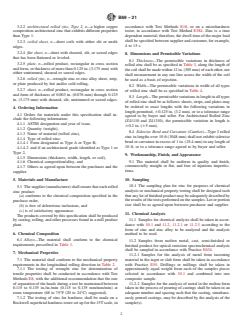
3.2.2 architectural rolled zinc, Type 2, n—a higher copper accordance with Test Methods E18, or on a microhardness
composition architectural zinc that exhibits different properties tester, in accordance with Test Method E384. Zinc is a time
than Type 1. dependent material; therefore, the dwell time of the major load
shall be specified between supplier and customer, for example,
3.2.3 coiled sheet, n—sheet coils with either slit or unslit
4to15s.
edges.
3.2.4 flat sheet, n—sheet with sheared, slit, or sawed edges
8. Dimensions and Permissible Variations
that has been flattened or leveled.
8.1 Thickness—The permissible variations in thickness of
3.2.5 plate, n—rolled product, rectangular in cross section
rolled zinc shall be as specified in Table 3, along the length of
and form, or thickness of more than 0.125 in. (3.175 mm) with
thecoilshallbemadewithin12in.(305mm)ofeachother,nor
either untrimmed, sheared or sawed edges.
shall measurement in any one line across the width of the coil
3.2.6 rolled zinc, n—wrought zinc or zinc alloy sheet, strip,
be used as a basis of rejection.
or plate produced by hot and/or cold rolling.
8.2 Width—The permissible variations in width of all types
3.2.7 sheet, n—rolled product, rectangular in cross section
of rolled zinc shall be as specified in Table 4.
and form of thickness of 0.003 in. (0.076 mm) through 0.125
8.3 Length—Thepermissiblevariationsinlengthinalltypes
in. (3.175 mm) with sheared, slit, untrimmed or sawed edges.
of rolled zinc shall be as follows: sheets, strips, and plates may
be ordered to exact lengths with the following variations in
4. Ordering Information
length permitted, 60.125 in. (3.2 mm), or to a tolerance range
4.1 Orders for materials under this specification shall in-
agreed to by buyer and seller. For Architectural Rolled Zinc
clude the following information:
(Z41110 and Z41310), the permissible variation in length is
4.1.1 ASTM designation and year of issue,
60.2 in. (65 mm).
4.1.2 Quantity (weight),
8.4 Sidewise Bend and Curvature (Camber)—Type I rolled
4.1.3 Name of material (rolled zinc),
zinc in lengths over 10 ft (3048 mm) shall not exhibit sidewise
4.1.4 Type of rolled zinc:
bend or curvature in excess of 1 in. (25.4 mm) in any length of
4.1.4.1 Form designated as Type A or Type B,
10 ft, or to a tolerance range agreed to by buyer and seller.
4.1.4.2 and if an architectural grade identified as Type 1 or
Type 2,
9. Workmanship, Finish, and Appearance
4.1.5 Dimensions (thickness, width, length, or coil),
9.1 The material shall be uniform in quality and finish,
4.1.6 Chemical composition/alloy, and
commercially straight or flat, and free of injurious imperfec-
4.1.7 Others as agreed upon between the purchaser and the
tions.
supplier.
10. Sampling
5. Materials and Manufacture
10.1 The sampling plan for zinc for purposes of chemical
5.1 Thesupplier(manufacturer)shallensurethateachrolled
analysis or mechanical property testing shall be designed such
zinc product:
thatanylotoffinishedproductmaybeadequatelydescribedby
(a) conforms to the chemical composition specified in the
theresultsofthetestsperformedonthesamples.Lotorportion
purchase order,
size shall be as agreed upon between purchaser and supplier.
(b) is free of deleterious inclusions, and
(c) is of satisfactory appearance.
11. Chemical Analysis
The products covered by this specification shall be produced
11.1 Samples for chemical analysis shall be taken in accor-
by casting, rolling, and other processes found in a mill product
dance with 10.1 and 11.2, 11.2.1 or 11.2.3 according to the
plant.
form of zinc and zinc alloy to be analyzed and the analysis
6. Chemical Composition
method to be used.
6.1 Alloys—The material shall conform to the chemical
11.2 Samples from molten metal, cast, semi-finished or
requirements prescribed in Table 1.
finished product for optical emission spectrochemical analysis
shall be sampled in accordance with Practice E634.
7. Mechanical Properties
11.2.1 Samples for the analysis of metal from incoming
7.1 The material shall conform to the mechanical property material in the ingot or slab form shall be taken in accordance
requirements in the longitudinal rolling direction in Table 2. with Practice E55. Drillings or millings shall be
...
This document is not an ASTM standard and is intended only to provide the user of an ASTM standard an indication of what changes have been made to the previous version. Because
it may not be technically possible to adequately depict all changes accurately, ASTM recommends that users consult prior editions as appropriate. In all cases only the current version
of the standard as published by ASTM is to be considered the official document.
Designation: B69 − 20 B69 − 21
Standard Specification for
Rolled Zinc
This standard is issued under the fixed designation B69; the number immediately following the designation indicates the year of original
adoption or, in the case of revision, the year of last revision. A number in parentheses indicates the year of last reapproval. A superscript
epsilon (´) indicates an editorial change since the last revision or reapproval.
This standard has been approved for use by agencies of the U.S. Department of Defense.
1. Scope*
1.1 This specification covers two types of commercial rolled zinc as described in 1.2. It should be understood that the specification
is general. Any closer limitations on permissible variations shall be a matter of agreement between the supplier (manufacturer) and
the purchaser.
1.2 Rolled zinc is furnished in two types as follows:
1.2.1 Type A—Coils or sheets cut from strip (ribbon) rolled zinc and
1.2.2 Type B—Zinc plates such as boiler and hull plates produced by any rolling method.
1.3 The values stated in inch-pound units are to be regarded as standard. The values given in parentheses are mathematical
conversions to SI units that are provided for information only and are not considered standard.
1.4 This standard does not purport to address all of the safety concerns, if any, associated with its use. It is the responsibility
of the user of this standard to become familiar with all hazards including those identified in the appropriate Safety Data Sheet
(SDS) for this product/material as provided by the manufacturer, to establish appropriate safety, health, and environmental
practices, and determine the applicability of regulatory limitations prior to use.
1.5 This international standard was developed in accordance with internationally recognized principles on standardization
established in the Decision on Principles for the Development of International Standards, Guides and Recommendations issued
by the World Trade Organization Technical Barriers to Trade (TBT) Committee.
2. Referenced Documents
2.1 The issue of each of the following reference documents shall be that which is current on the date the purchase order is accepted
by the supplier (manufacturer).
2.2 ASTM Standards:
B899 Terminology Relating to Non-ferrous Metals and Alloys
E8 Test Methods for Tension Testing of Metallic Materials [Metric] E0008_E0008M
E18 Test Methods for Rockwell Hardness of Metallic Materials
This specification is under the jurisdiction of ASTM Committee B02 on Nonferrous Metals and Alloys and is the direct responsibility of Subcommittee B02.04 on Zinc
and Cadmium.
Current edition approved Oct. 1, 2020Nov. 1, 2021. Published October 2020December 2021. Originally approved in 1926. Last previous edition approved in 20162020
as B69 – 16.B69 – 20. DOI: 10.1520/B0069-20.10.1520/B0069-21.
For referenced ASTM standards, visit the ASTM website, www.astm.org, or contact ASTM Customer Service at service@astm.org. For Annual Book of ASTM Standards
volume information, refer to the standard’s Document Summary page on the ASTM website.
*A Summary of Changes section appears at the end of this standard
Copyright © ASTM International, 100 Barr Harbor Drive, PO Box C700, West Conshohocken, PA 19428-2959. United States
B69 − 21
E29 Practice for Using Significant Digits in Test Data to Determine Conformance with Specifications
E55 Practice for Sampling Wrought Nonferrous Metals and Alloys for Determination of Chemical Composition
E60 Practice for Analysis of Metals, Ores, and Related Materials by Spectrophotometry
E88 Practice for Sampling Nonferrous Metals and Alloys in Cast Form for Determination of Chemical Composition
E384 Test Method for Microindentation Hardness of Materials
E527 Practice for Numbering Metals and Alloys in the Unified Numbering System (UNS)
E536 Test Methods for Chemical Analysis of Zinc and Zinc Alloys
E634 Practice for Sampling of Zinc and Zinc Alloys for Analysis by Spark Atomic Emission Spectrometry
2.3 ISO Standards:
ISO 3815-1 Zinc and zinc alloys—Part 1: Analysis of solid samples by optical emission spectrometry
ISO 3815-2 Zinc and zinc alloys—Part 2: Analysis by inductively coupled plasma optical emission spectrometry
3. Terminology
3.1 Terms shall be defined in accordance with Terminology B899.
3.2 Definitions of Terms Specific to This Standard:
3.2.1 architectural rolled zinc, Type 1, n—a lower copper composition architectural zinc that exhibits different properties than Type
2.
3.2.2 architectural rolled zinc, Type 2, n—a higher copper composition architectural zinc that exhibits different properties than
Type 1.
3.2.3 coiled sheet, n—sheet coils with either slit or unslit edges.
3.2.4 flat sheet, n—sheet with sheared, slit, or sawed edges that has been flattened or leveled.
3.2.5 plate, n—rolled product, rectangular in cross section and form, or thickness of more than 0.125 in. (3.175 mm) with either
untrimmed, sheared or sawed edges.
3.2.6 rolled zinc, n—wrought zinc or zinc alloy sheet, strip, or plate produced by hot and/or cold rolling.
3.2.7 sheet, n—rolled product, rectangular in cross section and form of thickness of 0.003 in. (0.076 mm) through 0.125 in. (3.175
mm) with sheared, slit, untrimmed or sawed edges.
4. Ordering Information
4.1 Orders for materials under this specification shall include the following information:
4.1.1 ASTM designation and year of issue,
4.1.2 Quantity (weight),
4.1.3 Name of material (rolled zinc),
4.1.4 Type of rolled zinc:
4.1.4.1 Form designated as Type A or Type B,
4.1.4.2 and if an architectural grade identified as Type 1 or Type 2,
4.1.5 Dimensions (thickness, width, length, or coil),
4.1.6 Chemical composition/alloy, and
Available from American National Standards Institute (ANSI), 25 W. 43rd St., 4th Floor, New York, NY 10036, http://www.ansi.org.
B69 − 21
4.1.7 Others as agreed upon between the purchaser and the supplier.
5. Materials and Manufacture
5.1 The supplier (manufacturer) shall ensure that each rolled zinc product:
(a) conforms to the chemical composition specified in the purchase order,
(b) is free of deleterious inclusions, and
(c) is of satisfactory appearance.
The products covered by this specification shall be produced by casting, rolling, and other processes found in a mill product
plant.
6. Chemical Composition
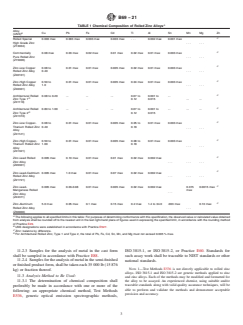
6.1 Alloys—The material shall conform to the chemical requirements prescribed in Table 1.
7. Mechanical Properties
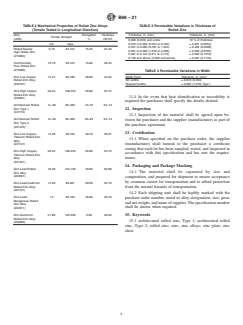
7.1 The material shall conform to the mechanical property requirements in the longitudinal rolling direction in Table 2.
7.1.1 The testing of wrought zinc for determination of tensile properties shall be conducted in accordance with Test Methods E8,
with the additional recommendation that the rate of separation of the heads during a test be maintained between 0.115 to 0.135
in./in./min (0.115 to 0.135 mm/mm/min) at room temperature (68 to 75°F (20 to 24°C) suggested).
7.1.2 The testing of zinc for hardness shall be made on a Rockwell superficial hardness tester set up for the 15T scale, in
accordance with Test Methods E18, or on a microhardness tester, in accordance with Test Method E384. Zinc is a time dependent
material; therefore, the dwell time of the major load shall be specified between supplier and customer, for example, 4 to 15 s.
8. Dimensions and Permissible Variations
8.1 Thickness—The permissible variations in thickness of rolled zinc shall be as specified in Table 3, along the length of the coil
shall be made within 12 in. (305 mm) of each other, nor shall measurement in any one line across the width of the coil be used
as a basis of rejection.
8.2 Width—The permissible variations in width of all types of rolled zinc shall be as specified in Table 4.
8.3 Length—The permissible variations in length in all types of rolled zinc shall be as follows: sheets, strips, and plates may be
ordered to exact lengths with the following variations in length permitted, 60.125 in. (3.2 mm), or to a tolerance range agreed to
by buyer and seller. For Architectural Rolled Zinc (ZXXXXX), (Z41110 and Z41310), the permissible variation in length is 60.2
in. (65 mm).
8.4 Sidewise Bend and Curvature (Camber)—Type I rolled zinc in lengths over 10 ft (3048 mm) shall not exhibit sidewise bend
or curvature in excess of 1 in. (25.4 mm) in any length of 10 ft, or to a tolerance range agreed to by buyer and seller.
9. Workmanship, Finish, and Appearance
9.1 The material shall be uniform in quality and finish, commercially straight or flat, and free of injurious imperfections.
10. Sampling
10.1 The sampling plan for zinc for purposes of chemical analysis or mechanical property testing shall be designed such that any
lot of finished product may be adequately described by the results of the tests performed on the samples. Lot or portion size shall
be as agreed upon between purchaser and supplier.
11. Chemical Analysis
11.1 Samples for chemical analysis shall be taken in accordance with 10.1 and 11.2, 11.2.1 or 11.2.3 according to the form of zinc
and zinc alloy to be analyzed and the analys
...