


ASTM A1017/A1017M-17
(Specification)Standard Specification for Pressure Vessel Plates, Alloy Steel, Chromium-Molybdenum-Tungsten
Standard Specification for Pressure Vessel Plates, Alloy Steel, Chromium-Molybdenum-Tungsten
ABSTRACT
This specification covers chromium-molybdenum-tungsten alloy steel plates intended primarily for welded boilers and pressure vessels designed for elevated temperature service. The plates shall be available in three grades, namely Grades 23, 911, and 122, having different alloy contents. The maximum thickness of plates is limited only by the capacity of the composition to meet the specified mechanical requirements. The steel shall be killed and the plates shall undergo heat treatment. In order to determine mechanical properties such as yield strength and elongation, the plates shall be subjected to tension and hardness tests.
SCOPE
1.1 This specification covers Chromium-Molybdenum-Tungsten alloy steel plates intended primarily for welded boilers and pressure vessels designed for elevated temperature service.
1.2 Plates are available under this specification in grades having different alloy contents as follows:
Grade
Nominal
Chromium
Content, %
Nominal
Molybdenum
Content, %
Nominal
Tungsten
Content, %
23
2.25
0.20
1.60
911
9.00
1.00
1.00
92
9.00
0.45
1.75
122
12.00
0.40
2.00
1.3 The maximum thickness of plates is limited only by the capacity of the composition to meet the specified mechanical property requirements.
1.4 The specification is expressed in both inch-pound units and in SI units. However, unless the order specifies the applicable “M” specification designation (SI units), the material shall be furnished to inch-pound units.
1.5 The values stated in either SI units or inch-pound units are to be regarded separately as standard. The values stated in each system may not be exact equivalents; therefore, each system shall be used independently of the other. Combining values from the two systems may result in non-conformance with the standard.
1.6 This international standard was developed in accordance with internationally recognized principles on standardization established in the Decision on Principles for the Development of International Standards, Guides and Recommendations issued by the World Trade Organization Technical Barriers to Trade (TBT) Committee.
General Information
- Status
- Published
- Publication Date
- 31-Oct-2017
- Technical Committee
- A01 - Steel, Stainless Steel and Related Alloys
- Drafting Committee
- A01.11 - Steel Plates for Boilers and Pressure Vessels
Relations
- Effective Date
- 01-Nov-2017
- Effective Date
- 01-Nov-2023
- Effective Date
- 01-Nov-2023
- Effective Date
- 01-Nov-2023
- Effective Date
- 01-Mar-2018
- Effective Date
- 15-Nov-2017
- Effective Date
- 01-Nov-2017
- Effective Date
- 01-Nov-2015
- Effective Date
- 01-Oct-2014
- Effective Date
- 01-Oct-2013
- Effective Date
- 01-Mar-2012
- Effective Date
- 01-Mar-2012
- Effective Date
- 01-Mar-2012
- Effective Date
- 01-Nov-2011
- Effective Date
- 01-Oct-2010
Overview
ASTM A1017/A1017M-17 is a standard specification developed by ASTM International for chromium-molybdenum-tungsten alloy steel plates. These steel plates are primarily intended for use in the fabrication of welded boilers and pressure vessels that are designed for elevated temperature service. The specification offers a range of alloy grades, specifically Grades 23, 911, 92, and 122, each with distinct chemical compositions to meet varying mechanical and thermal performance requirements. The standard ensures that pressure vessel plates made to these requirements are suitable for demanding industrial applications where high strength, toughness, and reliable performance at elevated temperatures are critical.
Key Topics
- Material Grades:
- Grade 23, Grade 911, Grade 92, and Grade 122, each defined by varying nominal levels of chromium, molybdenum, and tungsten.
- Intended Use:
- Plates are designed mainly for welded construction in pressure vessels and boilers operating at high temperatures.
- Thickness and Sizing:
- Plate thickness is not strictly limited except by the need to meet specified mechanical properties.
- Heat Treatment:
- Plates must be killed steel and receive appropriate heat treatment, such as normalizing, tempering, or in some cases, accelerated cooling or annealing.
- Testing Requirements:
- Tension and hardness tests are performed to confirm yield strength, tensile strength, elongation, and hardness meet minimum specification.
- Dual Unit Standards:
- Specifies both inch-pound and SI units; the standard requires units not be mixed on a single order to maintain conformity.
- Marking:
- Plates are labeled according to their heat treatment state (Normalized, Quenched, Stress Relieved, or Annealed).
- Supplementary Requirements:
- Optional tests and controls, such as ultrasonic testing, Charpy impact testing, high-temperature tests, and vacuum carbon deoxidation, may be specified by purchasing requirements.
Applications
ASTM A1017/A1017M-17 is widely used across industries where superior creep resistance, strength, and durability at elevated temperatures are necessary. Common applications include:
- Pressure Vessel Fabrication:
- Used in the construction of power plant boilers, petrochemical reactors, and process pressure vessels requiring high-temperature operation and resistance to internal pressure.
- Industrial Boilers:
- Suitable for boiler shells and heads in fossil-fuel and nuclear power plants.
- Petrochemical Equipment:
- Essential for equipment where components are exposed to process heat and elevated pressures, such as heat exchangers and high-pressure reactors.
- Chemical Processing:
- Utilized in high-temperature process vessels and storage tanks.
The use of specific alloy grades allows engineers to match material performance to particular service conditions, optimizing both reliability and efficiency.
Related Standards
To ensure comprehensive compliance and accurate application, ASTM A1017/A1017M-17 references and should be used in conjunction with several related ASTM standards:
- ASTM A20/A20M: General requirements for steel plates used in pressure vessels.
- ASTM A435/A435M: Straight-beam ultrasonic examination of steel plates.
- ASTM A577/A577M: Ultrasonic angle-beam examination of steel plates.
- ASTM A578/A578M: Ultrasonic examination of rolled steel plates for special applications.
These documents provide additional guidelines on material properties, non-destructive testing, quality controls, and supplementary requirements crucial for ensuring the safety and performance of chromium-molybdenum-tungsten alloy steel plates.
By adhering to ASTM A1017/A1017M-17, manufacturers, engineers, and end-users can ensure their pressure vessel and boiler components meet the robust requirements for high-temperature service, supporting operational safety, durability, and regulatory compliance in critical industrial applications.
Buy Documents
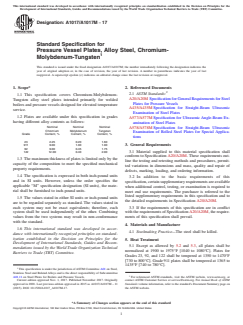
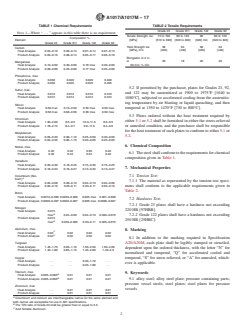


ASTM A1017/A1017M-17 - Standard Specification for Pressure Vessel Plates, Alloy Steel, Chromium-Molybdenum-Tungsten
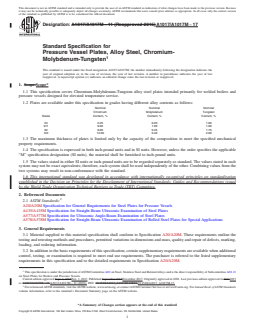
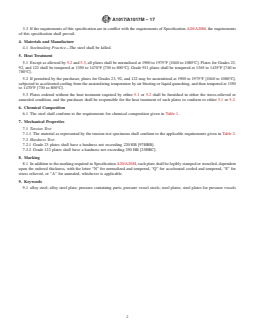
REDLINE ASTM A1017/A1017M-17 - Standard Specification for Pressure Vessel Plates, Alloy Steel, Chromium-Molybdenum-Tungsten
Get Certified
Connect with accredited certification bodies for this standard

Element Materials Technology
Materials testing and product certification.

Inštitut za kovinske materiale in tehnologije
Institute of Metals and Technology. Materials testing, metallurgical analysis, NDT.
Sponsored listings
Frequently Asked Questions
ASTM A1017/A1017M-17 is a technical specification published by ASTM International. Its full title is "Standard Specification for Pressure Vessel Plates, Alloy Steel, Chromium-Molybdenum-Tungsten". This standard covers: ABSTRACT This specification covers chromium-molybdenum-tungsten alloy steel plates intended primarily for welded boilers and pressure vessels designed for elevated temperature service. The plates shall be available in three grades, namely Grades 23, 911, and 122, having different alloy contents. The maximum thickness of plates is limited only by the capacity of the composition to meet the specified mechanical requirements. The steel shall be killed and the plates shall undergo heat treatment. In order to determine mechanical properties such as yield strength and elongation, the plates shall be subjected to tension and hardness tests. SCOPE 1.1 This specification covers Chromium-Molybdenum-Tungsten alloy steel plates intended primarily for welded boilers and pressure vessels designed for elevated temperature service. 1.2 Plates are available under this specification in grades having different alloy contents as follows: Grade Nominal Chromium Content, % Nominal Molybdenum Content, % Nominal Tungsten Content, % 23 2.25 0.20 1.60 911 9.00 1.00 1.00 92 9.00 0.45 1.75 122 12.00 0.40 2.00 1.3 The maximum thickness of plates is limited only by the capacity of the composition to meet the specified mechanical property requirements. 1.4 The specification is expressed in both inch-pound units and in SI units. However, unless the order specifies the applicable “M” specification designation (SI units), the material shall be furnished to inch-pound units. 1.5 The values stated in either SI units or inch-pound units are to be regarded separately as standard. The values stated in each system may not be exact equivalents; therefore, each system shall be used independently of the other. Combining values from the two systems may result in non-conformance with the standard. 1.6 This international standard was developed in accordance with internationally recognized principles on standardization established in the Decision on Principles for the Development of International Standards, Guides and Recommendations issued by the World Trade Organization Technical Barriers to Trade (TBT) Committee.
ABSTRACT This specification covers chromium-molybdenum-tungsten alloy steel plates intended primarily for welded boilers and pressure vessels designed for elevated temperature service. The plates shall be available in three grades, namely Grades 23, 911, and 122, having different alloy contents. The maximum thickness of plates is limited only by the capacity of the composition to meet the specified mechanical requirements. The steel shall be killed and the plates shall undergo heat treatment. In order to determine mechanical properties such as yield strength and elongation, the plates shall be subjected to tension and hardness tests. SCOPE 1.1 This specification covers Chromium-Molybdenum-Tungsten alloy steel plates intended primarily for welded boilers and pressure vessels designed for elevated temperature service. 1.2 Plates are available under this specification in grades having different alloy contents as follows: Grade Nominal Chromium Content, % Nominal Molybdenum Content, % Nominal Tungsten Content, % 23 2.25 0.20 1.60 911 9.00 1.00 1.00 92 9.00 0.45 1.75 122 12.00 0.40 2.00 1.3 The maximum thickness of plates is limited only by the capacity of the composition to meet the specified mechanical property requirements. 1.4 The specification is expressed in both inch-pound units and in SI units. However, unless the order specifies the applicable “M” specification designation (SI units), the material shall be furnished to inch-pound units. 1.5 The values stated in either SI units or inch-pound units are to be regarded separately as standard. The values stated in each system may not be exact equivalents; therefore, each system shall be used independently of the other. Combining values from the two systems may result in non-conformance with the standard. 1.6 This international standard was developed in accordance with internationally recognized principles on standardization established in the Decision on Principles for the Development of International Standards, Guides and Recommendations issued by the World Trade Organization Technical Barriers to Trade (TBT) Committee.
ASTM A1017/A1017M-17 is classified under the following ICS (International Classification for Standards) categories: 77.140.30 - Steels for pressure purposes. The ICS classification helps identify the subject area and facilitates finding related standards.
ASTM A1017/A1017M-17 has the following relationships with other standards: It is inter standard links to ASTM A1017/A1017M-11(2015), ASTM A435/A435M-17(2023), ASTM A578/A578M-17(2023), ASTM A577/A577M-17(2023), ASTM A20/A20M-18, ASTM A20/A20M-17, ASTM A578/A578M-17, ASTM A20/A20M-15, ASTM A20/A20M-14, ASTM A20/A20M-13, ASTM A578/A578M-07(2012), ASTM A435/A435M-90(2012), ASTM A577/A577M-90(2012), ASTM A20/A20M-11, ASTM A20/A20M-10. Understanding these relationships helps ensure you are using the most current and applicable version of the standard.
ASTM A1017/A1017M-17 is available in PDF format for immediate download after purchase. The document can be added to your cart and obtained through the secure checkout process. Digital delivery ensures instant access to the complete standard document.
Standards Content (Sample)
This international standard was developed in accordance with internationally recognized principles on standardization established in the Decision on Principles for the
Development of International Standards, Guides and Recommendations issued by the World Trade Organization Technical Barriers to Trade (TBT) Committee.
Designation:A1017/A1017M −17
Standard Specification for
Pressure Vessel Plates, Alloy Steel, Chromium-
Molybdenum-Tungsten
This standard is issued under the fixed designation A1017/A1017M; the number immediately following the designation indicates the
year of original adoption or, in the case of revision, the year of last revision. A number in parentheses indicates the year of last
reapproval. A superscript epsilon (´) indicates an editorial change since the last revision or reapproval.
1. Scope* 2. Referenced Documents
2.1 ASTM Standards:
1.1 This specification covers Chromium-Molybdenum-
A20/A20M SpecificationforGeneralRequirementsforSteel
Tungsten alloy steel plates intended primarily for welded
Plates for Pressure Vessels
boilers and pressure vessels designed for elevated temperature
A435/A435M Specification for Straight-Beam Ultrasonic
service.
Examination of Steel Plates
1.2 Plates are available under this specification in grades
A577/A577M Specification for Ultrasonic Angle-Beam Ex-
having different alloy contents as follows:
amination of Steel Plates
Nominal Nominal Nominal
A578/A578M Specification for Straight-Beam Ultrasonic
Chromium Molybdenum Tungsten
Examination of Rolled Steel Plates for Special Applica-
Grade Content, % Content, % Content, %
tions
23 2.25 0.20 1.60
911 9.00 1.00 1.00 3. General Requirements
92 9.00 0.45 1.75
3.1 Material supplied to this material specification shall
122 12.00 0.40 2.00
conform to Specification A20/A20M. These requirements out-
1.3 The maximum thickness of plates is limited only by the
line the testing and retesting methods and procedures, permit-
capacity of the composition to meet the specified mechanical
ted variations in dimensions and mass, quality and repair of
property requirements.
defects, marking, loading, and ordering information.
1.4 The specification is expressed in both inch-pound units
3.2 In addition to the basic requirements of this
and in SI units. However, unless the order specifies the
specification, certain supplementary requirements are available
applicable “M” specification designation (SI units), the mate-
when additional control, testing, or examination is required to
rial shall be furnished to inch-pound units.
meet end use requirements. The purchaser is referred to the
listed supplementary requirements in this specification and to
1.5 The values stated in either SI units or inch-pound units
the detailed requirements in Specification A20/A20M.
are to be regarded separately as standard. The values stated in
each system may not be exact equivalents; therefore, each 3.3 If the requirements of this specification are in conflict
with the requirements of Specification A20/A20M, the require-
system shall be used independently of the other. Combining
values from the two systems may result in non-conformance ments of this specification shall prevail.
with the standard.
4. Materials and Manufacture
1.6 This international standard was developed in accor-
4.1 Steelmaking Practice—The steel shall be killed.
dance with internationally recognized principles on standard-
ization established in the Decision on Principles for the
5. Heat Treatment
Development of International Standards, Guides and Recom-
5.1 Except as allowed by 5.2 and 5.3, all plates shall be
mendations issued by the World Trade Organization Technical
normalized at 1900 to 1975°F [1040 to 1080°C]. Plates for
Barriers to Trade (TBT) Committee.
Grades 23, 92, and 122 shall be tempered at 1350 to 1470°F
[730 to 800°C]. Grade 911 plates shall be tempered at 1365 to
1435°F [740 to 780°C].
This specification is under the jurisdiction of ASTM Committee A01 on Steel,
Stainless Steel and Related Alloys and is the direct responsibility of Subcommittee
A01.11 on Steel Plates for Boilers and Pressure Vessels. For referenced ASTM standards, visit the ASTM website, www.astm.org, or
Current edition approved Nov. 1, 2017. Published November 2017. Originally contact ASTM Customer Service at service@astm.org. For Annual Book of ASTM
approved in 2001. Last previous edition approved in 2015 as A1017/A1017M – 11 Standards volume information, refer to the standard’s Document Summary page on
(2015). DOI: 10.1520/A1017_A1017M-17. the ASTM website.
*A Summary of Changes section appears at the end of this standard
Copyright © ASTM International, 100 Barr Harbor Drive, PO Box C700, West Conshohocken, PA 19428-2959. United States
A1017/A1017M−17
TABLE 1 Chemical Requirements TABLE 2 Tensile Requirements
Grade 23 Grade 911 Grade 122 Grade 92
NOTE 1—Where“.” appears in this table there is no requirement.
Tensile Strength, ksi 74 to 100 90 to 120 90 90 to 120
Composition %
[MPa] [510 to 690] [620 to 840] [620] min [620 to 840]
Element
Grade 23 Grade 911 Grade 122 Grade 92
Yield Strength ksi 58 64 58 64
Carbon
[MPa], min [400] [440] [400] [440]
Heat Analysis 0.04–0.10 0.09–0.13 0.07–0.14 0.07–0.13
Product Analysis 0.03–0.10 0.08–0.14 0.05–0.17 0.05–0.16
Elongation in 2 in.
or 20 18 20 20
Manganese
50 mm, % min
Heat Analysis 0.10–0.60 0.30–0.60 0.70 max 0.30–0.60
Product Analysis 0.09–0.66 0.25–0.66 0.77 max 0.25–0.66
Phosphorus, max.
Heat Analysis 0.030 0.020 0.020 0.020
Product Analysis 0.030 0.025 0.025 0.025
5.2 If permitted by the purchaser, plates for Grades 23, 92,
Sulfur, max.
and 122 may be austenitized at 1900 to 1975°F [1040 to
Heat Analysis 0.010 0.010 0.010 0.010
Product Analysis 0.012 0.012 0.012 0.012
1080°C], subjected to accelerated cooling from the au
...
This document is not an ASTM standard and is intended only to provide the user of an ASTM standard an indication of what changes have been made to the previous version. Because
it may not be technically possible to adequately depict all changes accurately, ASTM recommends that users consult prior editions as appropriate. In all cases only the current version
of the standard as published by ASTM is to be considered the official document.
Designation: A1017/A1017M − 11 (Reapproved 2015) A1017/A1017M − 17
Standard Specification for
Pressure Vessel Plates, Alloy Steel, Chromium-
Molybdenum-Tungsten
This standard is issued under the fixed designation A1017/A1017M; the number immediately following the designation indicates the
year of original adoption or, in the case of revision, the year of last revision. A number in parentheses indicates the year of last
reapproval. A superscript epsilon (´) indicates an editorial change since the last revision or reapproval.
1. Scope Scope*
1.1 This specification covers Chromium-Molybdenum-Tungsten alloy steel plates intended primarily for welded boilers and
pressure vessels designed for elevated temperature service.
1.2 Plates are available under this specification in grades having different alloy contents as follows:
Nominal Nominal Nominal
Chromium Molybdenum Tungsten
Grade Content, % Content, % Content, %
23 2.25 0.20 1.60
911 9.00 1.00 1.00
92 9.00 0.45 1.75
122 12.00 0.40 2.00
1.3 The maximum thickness of plates is limited only by the capacity of the composition to meet the specified mechanical
property requirements.
1.4 The specification is expressed in both inch-pound units and in SI units. However, unless the order specifies the applicable
“M” specification designation (SI units), the material shall be furnished to inch-pound units.
1.5 The values stated in either SI units or inch-pound units are to be regarded separately as standard. The values stated in each
system may not be exact equivalents; therefore, each system shall be used independently of the other. Combining values from the
two systems may result in non-conformance with the standard.
1.6 This international standard was developed in accordance with internationally recognized principles on standardization
established in the Decision on Principles for the Development of International Standards, Guides and Recommendations issued
by the World Trade Organization Technical Barriers to Trade (TBT) Committee.
2. Referenced Documents
2.1 ASTM Standards:
A20/A20M Specification for General Requirements for Steel Plates for Pressure Vessels
A435/A435M Specification for Straight-Beam Ultrasonic Examination of Steel Plates
A577/A577M Specification for Ultrasonic Angle-Beam Examination of Steel Plates
A578/A578M Specification for Straight-Beam Ultrasonic Examination of Rolled Steel Plates for Special Applications
3. General Requirements
3.1 Material supplied to this material specification shall conform to Specification A20/A20M. These requirements outline the
testing and retesting methods and procedures, permitted variations in dimensions and mass, quality and repair of defects, marking,
loading, and ordering information.
3.2 In addition to the basic requirements of this specification, certain supplementary requirements are available when additional
control, testing, or examination is required to meet end use requirements. The purchaser is referred to the listed supplementary
requirements in this specification and to the detailed requirements in Specification A20/A20M.
This specification is under the jurisdiction of ASTM Committee A01 on Steel, Stainless Steel and Related Alloys and is the direct responsibility of Subcommittee A01.11
on Steel Plates for Boilers and Pressure Vessels.
Current edition approved Sept. 1, 2015Nov. 1, 2017. Published September 2015November 2017. Originally approved in 2001. Last previous edition approved in 20112015
as A1017/A1017M – 11.A1017/A1017M – 11 (2015). DOI: 10.1520/A1017_A1017M-11R15.10.1520/A1017_A1017M-17.
For referenced ASTM standards, visit the ASTM website, www.astm.org, or contact ASTM Customer Service at service@astm.org. For Annual Book of ASTM Standards
volume information, refer to the standard’s Document Summary page on the ASTM website.
*A Summary of Changes section appears at the end of this standard
Copyright © ASTM International, 100 Barr Harbor Drive, PO Box C700, West Conshohocken, PA 19428-2959. United States
A1017/A1017M − 17
3.3 If the requirements of this specification are in conflict with the requirements of Specification A20/A20M, the requirements
of this specification shall prevail.
4. Materials and Manufacture
4.1 Steelmaking Practice—The steel shall be killed.
5. Heat Treatment
5.1 Except as allowed by 5.2 and 5.3, all plates shall be normalized at 1900 to 1975°F [1040 to 1080°C]. Plates for Grades 23,
92, and 122 shall be tempered at 1350 to 1470°F [730 to 800°C]. Grade 911 plates shall be tempered at 1365 to 1435°F [740 to
780°C].
5.2 If permitted by the purchaser, plates for Grades 23, 92, and 122 may be austenitized at 1900 to 1975°F [1040 to 1080°C],
subjected to accelerated cooling from the austenitizing temperature by air blasting or liquid quenching, and then tempered at 1350
to 1470°F [730 to 800°C].
5.3 Plates ordered without the heat treatment required by either 5.1 or 5.2 shall be furnished in either the stress-relieved or
annealed condition, and the purchaser shall be responsible for the heat treatment of such plates to conform to either 5.1 or 5.2.
6. Chemical Composition
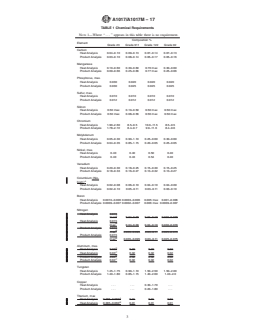
6.1 The steel shall conform to the requirements for chemical composition given in Table 1.
7. Mechanical Properties
7.1 Tension Test:
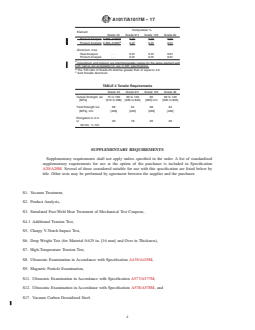
7.1.1 The material as represented by the tension test specimens shall conform to the applicable requirements given in Table 2.
7.2 Hardness Test:
7.2.1 Grade 23 plates shall have a hardness not exceeding 220 HB [97HRB].
7.2.2 Grade 122 plates shall have a hardness not exceeding 250 HB [25HRC].
8. Marking
8.1 In addition to the marking required in Specification A20/A20M, each plate shall be legibly stamped or stenciled, dependent
upon the ordered thickness, with the letter “N” for normali
...
Questions, Comments and Discussion
Ask us and Technical Secretary will try to provide an answer. You can facilitate discussion about the standard in here.
Loading comments...