

ASTM D1336-07(2019)
(Test Method)Standard Test Method for Distortion of Yarn in Woven Fabrics
General Information
- Abstract
SIGNIFICANCE AND USE
5.1 This test method is considered satisfactory for acceptance testing of commercial shipments because current estimates of between-laboratory precision are acceptable and the method has been used extensively in the trade for acceptance testing.
5.2 In cases of dispute, the statistical bias, if any, between the laboratory of the purchaser and the laboratory of the seller should be determined, with each comparison being based on testing randomized specimens from one sample of fabric.
5.3 This test method is used as an indication of the propensity of yarns to shift or distort in a fabric. Such distortions are objectionable due to the resulting changes in appearance. These appearance changes are sometimes referred to as “finger marks” or “shift marks.”
5.4 It is recommended that fabrics be tested in their original condition and also after laundering or drycleaning, or both, depending upon the intended use of the material.
SCOPE
1.1 This test method covers the measurement of yarn distortion of one set of yarns over the other in woven cloth following the application of surface friction. This test method especially is applicable to open-weave fabrics, such as nettings, marquisettes, gauzes, chiffons, and heavier fabrics made from slippery surface yarns.
Note 1: For the determination of yarn slippage in woven fabrics, refer to Test Method D434.
1.2 The values stated in SI units are to be regarded as the standard. The inch-pound units given in parentheses are provided for information only.
1.3 This standard does not purport to address all of the safety concerns, if any, associated with its use. It is the responsibility of the user of this standard to establish appropriate safety, health, and environmental practices and determine the applicability of regulatory limitations prior to use.
1.4 This international standard was developed in accordance with internationally recognized principles on standardization established in the Decision on Principles for the Development of International Standards, Guides and Recommendations issued by the World Trade Organization Technical Barriers to Trade (TBT) Committee.
- Status
- Published
- Publication Date
- 30-Jun-2019
- Technical Committee
- D13 - Textiles
- Drafting Committee
- D13.59 - Fabric Physical Test Methods A
Overview
ASTM D1336-07(2019): Standard Test Method for Distortion of Yarn in Woven Fabrics establishes a method for measuring yarn distortion in woven fabrics after surface friction is applied. Developed by ASTM International, this standard is widely recognized and used in the textile industry to assess the propensity of yarns in woven cloth to shift and create visible distortions, such as “finger marks” or “shift marks.” The procedure is particularly relevant for open-weave fabrics-including nettings, gauzes, marquisettes, chiffons, and heavier fabrics made with slippery yarns-but is applicable to a variety of woven textiles.
The test method is suitable for acceptance testing in commercial textile shipments due to its demonstrated, reliable inter-laboratory precision and extensive trade usage. It follows practices developed under internationally recognized principles and conforms to guidelines from the World Trade Organization Technical Barriers to Trade (TBT) Committee.
Key Topics
- Yarn Distortion Measurement: The core focus is on quantifying the amount of yarn distortion caused by friction in one set of yarns relative to the other within woven fabrics.
- Applicability: Especially useful for fabrics with characteristics prone to yarn shifting, such as those made with slick or loosely woven yarns.
- Test Procedures: Details procedures for specimen selection, conditioning, mounting, and the application of controlled friction using specialized test apparatus.
- Assessment Criteria: Describes how to report the degree of distortion in terms of the widest opening produced, measured precisely to ensure test accuracy.
- Acceptance Testing: Emphasizes its role in commercial shipment acceptance, providing guidance for resolving disputes through statistically rigorous, randomized specimen comparisons.
- Post-Treatment Evaluation: Recommends testing fabrics both in their original condition and following laundering or drycleaning to simulate end-use performance.
- Safety and Compliance: Highlights user responsibility for meeting safety and environmental requirements.
Applications
ASTM D1336-07(2019) is widely used in:
- Textile Manufacturing: Ensures quality and consistency of woven fabrics by measuring resistance to yarn shift and maintaining desired fabric appearance.
- Quality Control and Assurance: Used for acceptance testing in commercial transactions, enabling objective comparison between supplier and purchaser laboratories.
- Product Development: Informs design and selection of fabric constructions for products needing minimized appearance defects, especially in apparel, home textiles, and decorative fabrics.
- Performance Testing after Refurbishment: Verifies the durability of fabrics post-laundering or drycleaning, ensuring sustained performance throughout the product lifecycle.
- Regulatory Compliance: Supports conformance to industry and international trade standards, facilitating smooth cross-border transactions in the textile sector.
Related Standards
- ASTM D434: Test Method for Resistance to Slippage of Yarns in Woven Fabrics Using a Standard Seam (now withdrawn, reference for related evaluation).
- ASTM D123: Terminology relating to textiles, providing definitions relevant to yarn distortion testing.
- ASTM D1776: Practice for Conditioning and Testing Textiles, referenced for preparation and conditioning protocols.
- Federal Standard 191, Method 5410: Another methodology for assessing yarn slippage and distortion in cloth.
- ISO and WTO TBT Principles: This standard aligns with broader principles for developing and implementing international standards in the textile industry.
By using the ASTM D1336-07(2019) Standard Test Method for Distortion of Yarn in Woven Fabrics, manufacturers and quality assurance laboratories can reliably assess fabric integrity and resist yarn distortion, supporting superior fabric performance and appearance across a wide range of woven textile products.
Relations
- Effective Date
- 01-Jul-2019
- Effective Date
- 15-Jul-2017
- Effective Date
- 01-Mar-2017
- Effective Date
- 15-Sep-2015
- Effective Date
- 01-Sep-2015
- Effective Date
- 01-Apr-2015
- Effective Date
- 01-Jul-2013
- Effective Date
- 01-Jul-2013
- Effective Date
- 15-Jun-2013
- Effective Date
- 15-Jun-2013
- Effective Date
- 15-May-2013
- Effective Date
- 01-Jul-2012
- Effective Date
- 01-Feb-2012
- Effective Date
- 01-Feb-2012
- Effective Date
- 15-Jan-2009
Get Certified
Connect with accredited certification bodies for this standard

Control Union Certifications
Global certification for agriculture and sustainability.

Hohenstein Institut
Textile testing and certification.

Bureau Veritas Bangladesh
Bureau Veritas certification services in Bangladesh.
Sponsored listings
Frequently Asked Questions
ASTM D1336-07(2019) is a standard published by ASTM International. Its full title is "Standard Test Method for Distortion of Yarn in Woven Fabrics". This standard covers: SIGNIFICANCE AND USE 5.1 This test method is considered satisfactory for acceptance testing of commercial shipments because current estimates of between-laboratory precision are acceptable and the method has been used extensively in the trade for acceptance testing. 5.2 In cases of dispute, the statistical bias, if any, between the laboratory of the purchaser and the laboratory of the seller should be determined, with each comparison being based on testing randomized specimens from one sample of fabric. 5.3 This test method is used as an indication of the propensity of yarns to shift or distort in a fabric. Such distortions are objectionable due to the resulting changes in appearance. These appearance changes are sometimes referred to as “finger marks” or “shift marks.” 5.4 It is recommended that fabrics be tested in their original condition and also after laundering or drycleaning, or both, depending upon the intended use of the material. SCOPE 1.1 This test method covers the measurement of yarn distortion of one set of yarns over the other in woven cloth following the application of surface friction. This test method especially is applicable to open-weave fabrics, such as nettings, marquisettes, gauzes, chiffons, and heavier fabrics made from slippery surface yarns. Note 1: For the determination of yarn slippage in woven fabrics, refer to Test Method D434. 1.2 The values stated in SI units are to be regarded as the standard. The inch-pound units given in parentheses are provided for information only. 1.3 This standard does not purport to address all of the safety concerns, if any, associated with its use. It is the responsibility of the user of this standard to establish appropriate safety, health, and environmental practices and determine the applicability of regulatory limitations prior to use. 1.4 This international standard was developed in accordance with internationally recognized principles on standardization established in the Decision on Principles for the Development of International Standards, Guides and Recommendations issued by the World Trade Organization Technical Barriers to Trade (TBT) Committee.
SIGNIFICANCE AND USE 5.1 This test method is considered satisfactory for acceptance testing of commercial shipments because current estimates of between-laboratory precision are acceptable and the method has been used extensively in the trade for acceptance testing. 5.2 In cases of dispute, the statistical bias, if any, between the laboratory of the purchaser and the laboratory of the seller should be determined, with each comparison being based on testing randomized specimens from one sample of fabric. 5.3 This test method is used as an indication of the propensity of yarns to shift or distort in a fabric. Such distortions are objectionable due to the resulting changes in appearance. These appearance changes are sometimes referred to as “finger marks” or “shift marks.” 5.4 It is recommended that fabrics be tested in their original condition and also after laundering or drycleaning, or both, depending upon the intended use of the material. SCOPE 1.1 This test method covers the measurement of yarn distortion of one set of yarns over the other in woven cloth following the application of surface friction. This test method especially is applicable to open-weave fabrics, such as nettings, marquisettes, gauzes, chiffons, and heavier fabrics made from slippery surface yarns. Note 1: For the determination of yarn slippage in woven fabrics, refer to Test Method D434. 1.2 The values stated in SI units are to be regarded as the standard. The inch-pound units given in parentheses are provided for information only. 1.3 This standard does not purport to address all of the safety concerns, if any, associated with its use. It is the responsibility of the user of this standard to establish appropriate safety, health, and environmental practices and determine the applicability of regulatory limitations prior to use. 1.4 This international standard was developed in accordance with internationally recognized principles on standardization established in the Decision on Principles for the Development of International Standards, Guides and Recommendations issued by the World Trade Organization Technical Barriers to Trade (TBT) Committee.
ASTM D1336-07(2019) is classified under the following ICS (International Classification for Standards) categories: 59.080.30 - Textile fabrics. The ICS classification helps identify the subject area and facilitates finding related standards.
ASTM D1336-07(2019) has the following relationships with other standards: It is inter standard links to ASTM D1336-07(2015), ASTM D4850-13(2017), ASTM D123-17, ASTM D123-15b, ASTM D123-15a, ASTM D123-15, ASTM D4850-13e1, ASTM D4850-13, ASTM D123-13ae1, ASTM D123-13a, ASTM D123-13, ASTM D4850-12, ASTM D123-12, ASTM D123-12e1, ASTM D123-09. Understanding these relationships helps ensure you are using the most current and applicable version of the standard.
ASTM D1336-07(2019) is available in PDF format for immediate download after purchase. The document can be added to your cart and obtained through the secure checkout process. Digital delivery ensures instant access to the complete standard document.
Standards Content (Sample)
This international standard was developed in accordance with internationally recognized principles on standardization established in the Decision on Principles for the
Development of International Standards, Guides and Recommendations issued by the World Trade Organization Technical Barriers to Trade (TBT) Committee.
Designation: D1336 − 07 (Reapproved 2019)
Standard Test Method for
Distortion of Yarn in Woven Fabrics
This standard is issued under the fixed designation D1336; the number immediately following the designation indicates the year of
original adoption or, in the case of revision, the year of last revision.Anumber in parentheses indicates the year of last reapproval.A
superscript epsilon (´) indicates an editorial change since the last revision or reapproval.
1. Scope D4850Terminology Relating to Fabrics and Fabric Test
Methods
1.1 This test method covers the measurement of yarn
distortion of one set of yarns over the other in woven cloth 2.2 Federal Standard:
following the application of surface friction. This test method Federal Test Method Standard191–Method 5410Slippage
especiallyisapplicabletoopen-weavefabrics,suchasnettings, Resistance of Yarns in Cloth, Yarn Distortion Method
marquisettes, gauzes, chiffons, and heavier fabrics made from
slippery surface yarns. 3. Terminology
3.1 For all terminology relating to D13.59, Fabric Test
NOTE1—Forthedeterminationofyarnslippageinwovenfabrics,refer
to Test Method D434.
Methods, General, refer to Terminology D4850.
3.1.1 Thefollowingtermsarerelevanttothisstandard:yarn
1.2 The values stated in SI units are to be regarded as the
distortion.
standard. The inch-pound units given in parentheses are
provided for information only.
3.2 For all other terminology related to textiles, refer to
Terminology D123.
1.3 This standard does not purport to address all of the
safety concerns, if any, associated with its use. It is the
4. Summary of Test Method
responsibility of the user of this standard to establish appro-
priate safety, health, and environmental practices and deter-
4.1 A specimen is subjected to a specified shearing force
mine the applicability of regulatory limitations prior to use.
acting in the plane of the fabric.The degree to which the force
1.4 This international standard was developed in accor-
causes yarns to shift distorting the original symmetry of the
dance with internationally recognized principles on standard-
weave is taken as a measure of ease of yarn distortion in the
ization established in the Decision on Principles for the
fabric. The degree of distortion is reported in terms of the
Development of International Standards, Guides and Recom-
widest opening, measured in hundredths of an inch.
mendations issued by the World Trade Organization Technical
Barriers to Trade (TBT) Committee.
5. Significance and Use
5.1 This test method is considered satisfactory for accep-
2. Referenced Documents
tance testing of commercial shipments because current esti-
2.1 ASTM Standards:
mates of between-laboratory precision are acceptable and the
D123Terminology Relating to Textiles
method has been used extensively in the trade for acceptance
D434Test Method for Resistance to Slippage of Yarns in
testing.
Woven Fabrics Using a Standard Seam (Withdrawn
3 5.2 In cases of dispute, the statistical bias, if any, between
2003)
the laboratory of the purchaser and the laboratory of the seller
D1776Practice for Conditioning and Testing Textiles
should be determined, with each comparison being based on
testing randomized specimens from one sample of fabric.
5.3 This test method is used as an indication of the propen-
ThistestmethodisunderthejurisdictionofASTMCommitteeD13onTextiles
and is the direct responsibility of Subcommittee D13.59 on Fabric Test Methods, sity of yarns to shift or distort in a fabric. Such distortions are
General.
objectionable due to the resulting changes in appearance.
CurrenteditionapprovedJuly1,2019.PublishedJuly2019.Originallyapproved
Theseappearancechangesaresometimesreferredtoas“finger
in 1954. Last previous edition approved in 2015 as D1337–07(2015). DOI:
marks” or “shift marks.”
10.1520/D1336-07R19.
For referenced ASTM standards, visit the ASTM website, www.astm.org, or
contact ASTM Customer Service at service@astm.org. For Annual Book of ASTM
Standards volume information, refer to the standard’s Document Summary page on
the ASTM website. Available from General ServicesAdministrations, Specification and Consumer
The last approved version of this historical standard is referenced on Information and Distribution Section (WFSIS), Washington, Navy Yard, Building
www.astm.org. 197, Washington, DC 20407.
Copyright © ASTM International, 100 Barr Harbor Drive, PO Box C700, West Conshohocken, PA 19428-2959. United States
D1336 − 07 (2019)
because of established trade usage.The word weight is used to mean both
5.4 Itisrecommendedthatfabricsbetestedintheiroriginal
“force” and “mass,” and care must be taken to determine which is meant
condition and also after laundering or drycleaning, or both,
in each case (SI unit for force=newton and for mass=kilogram).
depending upon the intended use of the material.
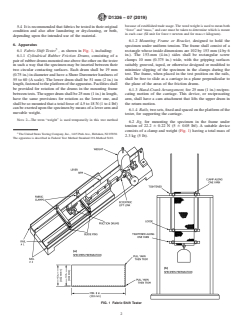
6.1.2 Mounting Frame or Bracket, designed to hold the
6. Apparatus
specimen under uniform tension. The frame shall consist of a
rectangle whose inside dimensions are 102 by 153 mm (4 by 6
6.1 Fabric Shift Tester , as shown in Fig. 1, including:
in.). The 153-mm (4-in.) sides shall be rectangular screw
6.1.1 Cylindrical Rubber Friction Drums, consisting of a
clamps 10 mm (0.375 in.) wide, with the gripping surfaces
pairofrubberdrumsmountedoneabovetheotheronthetester
suitably grooved, taped, or otherwise designed or modified to
in such a way that the specimen may be inserted between their
minimize slipping of the specimen in the clamps during the
two circular contacting surfaces. Each drum shall be 19 mm
test. The frame, when placed in the test position on the rails,
(0.75 in.) in diameter and have a Shore Durometer hardness of
shall be free to slide as a carriage in a plane perpendicular to
55 to 60 (A scale). The lower drum shall be 51 mm (2 in.) in
the plane of the areas of the friction drums.
length,fastenedtotheplatformoftheapparatus.Facilitiesshall
be provided for rotation of the drums in the mounting frame
6.1.3 Hand-Crank Arrangement, for 25 mm (1 in.) recipro-
betweentests.Theupperdrumshallbe25mm(1in.)inlength,
cating motion of the carriage. This device, or reciprocating
have the same provisions for rotation as the lower one, and
arm, shall have a cam attachment that lifts the upper drum in
shallbesomountedthatatotalforceof4.5to18N(1to4lbf)
the return motion.
canbeexerteduponthespecimenbymeansofaleverarmand
6.1.4 Rails,twosets,fixedandspacedontheplatformofthe
movable weight.
tester, for supporting the carriage.
NOTE 2—The term “weight” is used temporarily in this test method
6.2 Jig, for mounting the specimen in the frame under
tension of 22.2 6 0.22 N (5 6 0.05 lbf). A suitable device
consists of a clamp and weight (Fig. 1) having a total mass of
TheUnitedStatesTestingCompany,Inc.,1415ParkAve.,Hoboken,NJ07030.
2.3 kg (5 lb).
The apparatus is described in Federal Test Method Standard191-Method5410.
FIG. 1 Fabric Shift Tester
D1336 − 07 (2019)
6.3 Steel Scale, graduated in a 0.2 mm (0.01 in.). 10. Procedure
6.4 Dividers. 10.1 Verifyandestablishtheweightlocationonthemoment
arm of the tester using a calibrated spring scale, or equivalent,
6.5 Magnifying Device, 5× power.
and adjust the weight position as needed to provide the
required force.
7. Sampling, Selection and Number of Specimens
NOTE4—Someinstrumentsmaynotprovidethedesignatedforceatthe
7.1 Takealotsampleandalaboratorysampleasdirectedin
manufacturer’s marked location.
the applicable material specification or as agreed upon by the
10.2 Test the specimens in the standard atmosphere for
purchaser and the supplier. In the absence of such a specifica-
testing textiles.
tionoragreement,takeonerepresentativesamplefromeachlot
of rolls, pieces, or consumer items.
10.3 Place the specimen vertically in the frame with the
warp or filling yarns parallel to the sides of the frame. Clamp
NOTE 3—A realistic specification or other agreement between the
purchaser and the supplier requires taking into account the variability
one 102-mm (4-in.) end of the specimen to one end of the
between primary sampling units and within primary sampling units so as
frame. Apply the 2.3-kg (5-lb) weight across the opposite
to provide a sampling plan, which has a meaningful producer’s risk,
102-mm (4-in.) width of the specimen and fasten the second
consumer’s risk, acceptable quality level, and limiting quality level.Alot
clamp securely. Remove the weight and clamp.
sample normally consists of a very small fraction of the total primary
sampling units.
10.4 Raisetheupperfrictiondrumonitsweightedleverand
7.2 Takefivespecimensfromeachlaboratorysamplingunit place the frame between the drums, positioning it at the
extreme end of its travel on the rails.
(roll,piece,orconsumeritem)withthelongdimensionparallel
totheyarnsthathave
...