

ASTM F3448-20
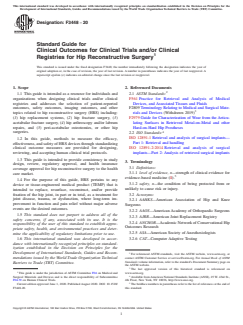
(Guide)Standard Guide for Clinical Outcomes for Clinical Trials and/or Clinical Registries for Hip Reconstructive Surgery
General Information
- Abstract
SIGNIFICANCE AND USE
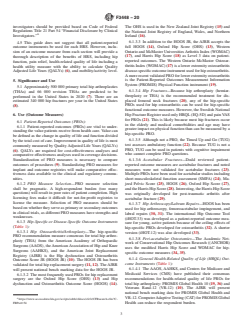
5.1 Approximately 500 000 primary total hip arthroplasties (THAs) and 66 000 revision THAs are predicted to be performed in the United States in 2020 (7). There are an estimated 340 000 hip fractures per year in the United States (8).
SCOPE
1.1 This guide is intended as a resource for individuals and organizations when designing clinical trials and/or clinical registries and addresses the selection of patient-reported outcomes, safety outcomes, imaging outcomes, and other topics related to hip reconstructive surgery (HRS) including: (1) hip replacement systems, (2) hip fracture surgery, (3) acetabular fracture surgery, (4) hip arthroscopy and/or labrum repairs, and (5) peri-acetabular osteotomies, or other hip surgeries.
1.2 In this guide, methods to measure the efficacy, effectiveness, and safety of HRS devices through standardizing clinical outcome measures are provided for designing, reviewing, and accepting human clinical trial protocols.
1.3 This guide is intended to provide consistency in study design, review, regulatory approval, and health insurance coverage approval for hip reconstructive surgery to the health care market.
1.4 For the purpose of this guide, HRS pertains to any device or tissue-engineered medical product (TEMP) that is intended to replace, resurface, reconstruct, and/or provide fixation of the hip joint, in part or in total, as a treatment for joint disease, trauma, or dysfunction, where long-term improvement in function and pain relief without major adverse events are the desired outcomes.
1.5 This standard does not purport to address all of the safety concerns, if any, associated with its use. It is the responsibility of the user of this standard to establish appropriate safety, health, and environmental practices and determine the applicability of regulatory limitations prior to use.
1.6 This international standard was developed in accordance with internationally recognized principles on standardization established in the Decision on Principles for the Development of International Standards, Guides and Recommendations issued by the World Trade Organization Technical Barriers to Trade (TBT) Committee.
- Status
- Published
- Publication Date
- 31-May-2020
- Technical Committee
- F04 - Medical and Surgical Materials and Devices
- Drafting Committee
- F04.39 - Human Clinical Trials
Overview
ASTM F3448-20: Standard Guide for Clinical Outcomes for Clinical Trials and/or Clinical Registries for Hip Reconstructive Surgery is an international standard developed by ASTM International. This guide provides a comprehensive framework for the design, implementation, and evaluation of clinical trials and registries focusing on hip reconstructive surgery (HRS). It addresses the selection and standardization of clinical outcome measures-particularly patient-reported outcomes (PROs), safety outcomes, and imaging assessments-to enhance consistency and reliability in data collection, review, and regulatory submissions.
The standard applies to procedures such as total hip arthroplasty (THA), hip fracture surgery, acetabular fracture surgery, hip arthroscopy, labrum repairs, peri-acetabular osteotomies, and the use of devices or tissue-engineered medical products intended to repair or replace the hip joint.
Key Topics
Clinical Outcome Measures: The guide emphasizes the importance of standardized patient-reported outcomes, activity level assessments, pain scales (e.g., NPRS, VAS), health-related quality of life metrics (e.g., EQ-5D, SF-12, PROMIS Global Health), and imaging results in evaluating hip reconstructive surgery interventions.
Study Design Consistency: By recommending the use of validated outcome instruments and clearly defined protocols, ASTM F3448-20 ensures comparability across clinical studies and registries. This consistency supports regulatory approval processes and health insurance coverage decisions.
Safety and Adverse Events Reporting: The standard outlines protocols for comprehensive adverse event capture, including definitions and grading of adverse events, timeframes for reporting, and requirements for independent review when appropriate.
Data Collection and Analysis: Specified timelines for data collection (preoperative to long-term follow-up) and guidance on subgroup analyses for patient demographics, diagnoses, and surgeon experience help ensure that studies reflect real-world patient populations and clinical practices.
Imaging and Device Assessment: The guide includes recommendations for radiographic and MRI evaluation protocols, wear and migration analysis (e.g., radiostereometric analysis), and retrieval procedures in line with referenced ASTM and ISO standards.
Applications
ASTM F3448-20 is valuable for:
- Clinical Trial Designers and Registry Managers: Provides a clear structure for selecting and implementing outcome measures, improving the quality and comparability of clinical data in hip reconstructive surgery.
- Medical Device Manufacturers: Assists in preparing clinical evidence to meet regulatory and reimbursement requirements for new hip implants, fixation devices, or tissue-engineered products.
- Regulatory Agencies and Health Insurers: Supports evidence-based review processes by standardizing clinical endpoints and safety reporting, helping determine the net health benefit and generalizability of study findings.
- Healthcare Providers and Academic Researchers: Enables meaningful benchmarking of outcomes, facilitating quality improvement and translational research in hip surgery.
Related Standards
ASTM F3448-20 references several key standards to ensure methodological rigor:
- ASTM F561: Practice for Retrieval and Analysis of Medical Devices, and Associated Tissues and Fluids
- ASTM F2979: Guide for Characterization of Wear from the Articulating Surfaces in Retrieved Metal-on-Metal and other Hard-on-Hard Hip Prostheses
- ISO 12891-1 & ISO 12891-2: Retrieval and analysis of surgical implants-Parts 1 & 2
Other important terminology and guidance are provided by regulatory documents, such as those developed by the US FDA and international health agencies.
Keywords: clinical trial design, hip reconstructive surgery, patient-reported outcomes, hip arthroplasty, hip fracture, acetabular fracture, hip replacement, outcome measurement, safety reporting, health-related quality of life, registry data, medical devices, ASTM F3448-20.
Relations
- Effective Date
- 01-Jan-2019
- Effective Date
- 01-Sep-2013
- Effective Date
- 01-Sep-2010
- Effective Date
- 15-Aug-2010
- Effective Date
- 01-Oct-2005
- Effective Date
- 01-Jun-2005
- Effective Date
- 01-Dec-2004
- Effective Date
- 10-Apr-2003
- Effective Date
- 01-Jan-1997
Get Certified
Connect with accredited certification bodies for this standard

BSI Group
BSI (British Standards Institution) is the business standards company that helps organizations make excellence a habit.

TÜV Rheinland
TÜV Rheinland is a leading international provider of technical services.

TÜV SÜD
TÜV SÜD is a trusted partner of choice for safety, security and sustainability solutions.
Sponsored listings
Frequently Asked Questions
ASTM F3448-20 is a guide published by ASTM International. Its full title is "Standard Guide for Clinical Outcomes for Clinical Trials and/or Clinical Registries for Hip Reconstructive Surgery". This standard covers: SIGNIFICANCE AND USE 5.1 Approximately 500 000 primary total hip arthroplasties (THAs) and 66 000 revision THAs are predicted to be performed in the United States in 2020 (7). There are an estimated 340 000 hip fractures per year in the United States (8). SCOPE 1.1 This guide is intended as a resource for individuals and organizations when designing clinical trials and/or clinical registries and addresses the selection of patient-reported outcomes, safety outcomes, imaging outcomes, and other topics related to hip reconstructive surgery (HRS) including: (1) hip replacement systems, (2) hip fracture surgery, (3) acetabular fracture surgery, (4) hip arthroscopy and/or labrum repairs, and (5) peri-acetabular osteotomies, or other hip surgeries. 1.2 In this guide, methods to measure the efficacy, effectiveness, and safety of HRS devices through standardizing clinical outcome measures are provided for designing, reviewing, and accepting human clinical trial protocols. 1.3 This guide is intended to provide consistency in study design, review, regulatory approval, and health insurance coverage approval for hip reconstructive surgery to the health care market. 1.4 For the purpose of this guide, HRS pertains to any device or tissue-engineered medical product (TEMP) that is intended to replace, resurface, reconstruct, and/or provide fixation of the hip joint, in part or in total, as a treatment for joint disease, trauma, or dysfunction, where long-term improvement in function and pain relief without major adverse events are the desired outcomes. 1.5 This standard does not purport to address all of the safety concerns, if any, associated with its use. It is the responsibility of the user of this standard to establish appropriate safety, health, and environmental practices and determine the applicability of regulatory limitations prior to use. 1.6 This international standard was developed in accordance with internationally recognized principles on standardization established in the Decision on Principles for the Development of International Standards, Guides and Recommendations issued by the World Trade Organization Technical Barriers to Trade (TBT) Committee.
SIGNIFICANCE AND USE 5.1 Approximately 500 000 primary total hip arthroplasties (THAs) and 66 000 revision THAs are predicted to be performed in the United States in 2020 (7). There are an estimated 340 000 hip fractures per year in the United States (8). SCOPE 1.1 This guide is intended as a resource for individuals and organizations when designing clinical trials and/or clinical registries and addresses the selection of patient-reported outcomes, safety outcomes, imaging outcomes, and other topics related to hip reconstructive surgery (HRS) including: (1) hip replacement systems, (2) hip fracture surgery, (3) acetabular fracture surgery, (4) hip arthroscopy and/or labrum repairs, and (5) peri-acetabular osteotomies, or other hip surgeries. 1.2 In this guide, methods to measure the efficacy, effectiveness, and safety of HRS devices through standardizing clinical outcome measures are provided for designing, reviewing, and accepting human clinical trial protocols. 1.3 This guide is intended to provide consistency in study design, review, regulatory approval, and health insurance coverage approval for hip reconstructive surgery to the health care market. 1.4 For the purpose of this guide, HRS pertains to any device or tissue-engineered medical product (TEMP) that is intended to replace, resurface, reconstruct, and/or provide fixation of the hip joint, in part or in total, as a treatment for joint disease, trauma, or dysfunction, where long-term improvement in function and pain relief without major adverse events are the desired outcomes. 1.5 This standard does not purport to address all of the safety concerns, if any, associated with its use. It is the responsibility of the user of this standard to establish appropriate safety, health, and environmental practices and determine the applicability of regulatory limitations prior to use. 1.6 This international standard was developed in accordance with internationally recognized principles on standardization established in the Decision on Principles for the Development of International Standards, Guides and Recommendations issued by the World Trade Organization Technical Barriers to Trade (TBT) Committee.
ASTM F3448-20 is classified under the following ICS (International Classification for Standards) categories: 11.040.40 - Implants for surgery, prosthetics and orthotics. The ICS classification helps identify the subject area and facilitates finding related standards.
ASTM F3448-20 has the following relationships with other standards: It is inter standard links to ASTM F561-19, ASTM F561-13, ASTM F561-05a(2010), ASTM F2809-10, ASTM F561-05a, ASTM F561-05, ASTM F561-04, ASTM F561-97(2003), ASTM F561-97. Understanding these relationships helps ensure you are using the most current and applicable version of the standard.
ASTM F3448-20 is available in PDF format for immediate download after purchase. The document can be added to your cart and obtained through the secure checkout process. Digital delivery ensures instant access to the complete standard document.
Standards Content (Sample)
This international standard was developed in accordance with internationally recognized principles on standardization established in the Decision on Principles for the
Development of International Standards, Guides and Recommendations issued by the World Trade Organization Technical Barriers to Trade (TBT) Committee.
Designation: F3448 − 20
Standard Guide for
Clinical Outcomes for Clinical Trials and/or Clinical
Registries for Hip Reconstructive Surgery
This standard is issued under the fixed designation F3448; the number immediately following the designation indicates the year of
original adoption or, in the case of revision, the year of last revision. A number in parentheses indicates the year of last reapproval. A
superscript epsilon (´) indicates an editorial change since the last revision or reapproval.
1. Scope 2. Referenced Documents
1.1 This guide is intended as a resource for individuals and 2.1 ASTM Standards:
organizations when designing clinical trials and/or clinical F561 Practice for Retrieval and Analysis of Medical
registries and addresses the selection of patient-reported Devices, and Associated Tissues and Fluids
outcomes, safety outcomes, imaging outcomes, and other F2809 Terminology Relating to Medical and Surgical Mate-
topics related to hip reconstructive surgery (HRS) including: rials and Devices (Withdrawn 2019)
(1) hip replacement systems, (2) hip fracture surgery, (3) F2979 Guide for Characterization of Wear from the Articu-
acetabular fracture surgery, (4) hip arthroscopy and/or labrum lating Surfaces in Retrieved Metal-on-Metal and other
repairs, and (5) peri-acetabular osteotomies, or other hip Hard-on-Hard Hip Prostheses
surgeries.
2.2 ISO Standards:
ISO 12891-1 Retrieval and analysis of surgical implants—
1.2 In this guide, methods to measure the efficacy,
Part 1: Retrieval and handling
effectiveness, and safety of HRS devices through standardizing
ISO 12891-2:2014 Retrieval and analysis of surgical
clinical outcome measures are provided for designing,
implants—Part 2: Analysis of retrieved surgical implants
reviewing, and accepting human clinical trial protocols.
1.3 This guide is intended to provide consistency in study
3. Terminology
design, review, regulatory approval, and health insurance
3.1 Definitions:
coverage approval for hip reconstructive surgery to the health
3.1.1 level of evidence, n—strength of clinical evidence for
care market.
evidence-based medicine (1).
1.4 For the purpose of this guide, HRS pertains to any
3.1.2 safety, n—the condition of being protected from or
device or tissue-engineered medical product (TEMP) that is
unlikely to cause risk or injury.
intended to replace, resurface, reconstruct, and/or provide
fixation of the hip joint, in part or in total, as a treatment for
3.2 Acronyms:
joint disease, trauma, or dysfunction, where long-term im-
3.2.1 AAHKS—American Association of Hip and Knee
provement in function and pain relief without major adverse
Surgeons
events are the desired outcomes.
3.2.2 AAOS—American Academy of Orthopaedic Surgeons
1.5 This standard does not purport to address all of the
3.2.3 AJRR—American Joint Replacement Registry
safety concerns, if any, associated with its use. It is the
3.2.4 ANCHOR—AcademicNetworkofConservationalHip
responsibility of the user of this standard to establish appro-
Outcomes Research
priate safety, health, and environmental practices and deter-
3.2.5 ASA—American Society of Anesthesiologists
mine the applicability of regulatory limitations prior to use.
1.6 This international standard was developed in accor-
3.2.6 CAT—Computer Adaptive Testing
dance with internationally recognized principles on standard-
ization established in the Decision on Principles for the
Development of International Standards, Guides and Recom- 2
For referenced ASTM standards, visit the ASTM website, www.astm.org, or
mendations issued by the World Trade Organization Technical contact ASTM Customer Service at service@astm.org. For Annual Book of ASTM
Standards volume information, refer to the standard’s Document Summary page on
Barriers to Trade (TBT) Committee.
the ASTM website.
The last approved version of this historical standard is referenced on
This guide is under the jurisdiction of ASTM Committee F04 on Medical and www.astm.org.
Surgical Materials and Devices and is the direct responsibility of Subcommittee Available fromAmerican National Standards Institute (ANSI), 25 W. 43rd St.,
F04.39 on Human Clinical Trials. 4th Floor, New York, NY 10036, http://www.ansi.org.
Current edition approved June 1, 2020. Published August 2020. DOI: 10.1520/ The boldface numbers in parentheses refer to the list of references at the end of
F3448-20. this standard.
Copyright © ASTM International, 100 Barr Harbor Drive, PO Box C700, West Conshohocken, PA 19428-2959. United States
F3448 − 20
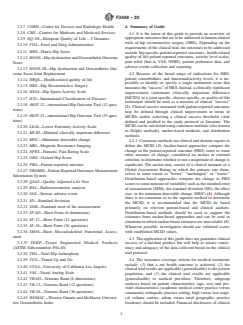
3.2.7 CDRH—Center for Devices and Radiologic Health 4. Summary of Guide
3.2.8 CMS—Centers for Medicare and Medicaid Services
4.1 It is the intent of this guide to provide an overview of
appropriateoutcomesthataretobeaddressedinhumanclinical
3.2.9 EQ-5D—European Quality of Life – 5 Domains
trials of hip reconstructive surgery (HRS). Depending on the
3.2.10 FDA—Food and Drug Administration
requirements of the clinical trial, the outcomes to be addressed
3.2.11 HHS—Harris Hip Score
include hip-specific patient-reported outcomes, health-related
quality-of-life patient-reported outcomes, activity level scales,
3.2.12 HOOS—HipdysfunctionandOsteoarthritisOutcome
pain relief (that is, VAS, NPRS), patient preference data, and
Score
adverse events collection and reporting.
3.2.13 HOOS JR—Hip dysfunction and Osteoarthritis Out-
come Score Joint Replacement
4.2 Because of the broad range of indications for HRS,
patient comorbidities, and functional/activity levels, it is im-
3.2.14 HRQL—Health-related quality of life
possible to identify or specify a single instrument score that
3.2.15 HRS—Hip Reconstructive Surgery
measuresthe“success”ofHRS.Instead,aclinicallysignificant
3.2.16 HSAS—Hip Sports Activity Scale
improvement (minimum clinically important difference
[MCID]) in a joint-specific, disease-specific, or quality-of-life
3.2.17 ICD—International Classification of Diseases
instrument should be used as a measure of clinical “success”
3.2.18 iHOT-12—international Hip Outcome Tool (12 ques-
(2). Clinical success measured with patient-reported outcomes
tions)
may be defined through clinical improvement in terms of
3.2.19 iHOT-33—international Hip Outcome Tool (33 ques-
MCIDs and/or achieving a clinical success threshold value
tions)
defined and justified in the study protocol or literature. The
MCID can be calculated using consensus methods (also known
3.2.20 LEAS—Lower Extremity Activity Scale
as Delphi methods), anchor-based methods, and distribution
3.2.21 MCID—Minimal clinically important difference
methods.
3.2.22 MDC—Minimum detectable change
4.2.1 Consensus methods use clinical and domain experts to
3.2.23 MRI—Magnetic Resonance Imaging define the MCID (3). Anchor-based approaches compare the
change in the patient-reported outcome (PRO) score to some
3.2.24 NPRS—Numeric Pain Rating Scale
other measure of change, considered an anchor or external
3.2.25 OHS—Oxford Hip Score
criterion, to determine whether or not a magnitude of change is
3.2.26 PRO—Patient-reported outcome
significant. The anchor may consist of a clinical measure or a
Global Assessment Rating in which the patients rate them-
3.2.27 PROMIS—Patient-ReportedOutcomesMeasurement
selves to some extent as “better,” “unchanged,” or “worse.”
Information System
Distribution-based approaches compare the change in PRO
3.2.28 QALY—Quality Adjusted Life Year
scorestosomemeasureofvariabilitysuchasthestandarderror
3.2.29 RSA—Radiostereometric analysis
of measurement (SEM), the standard deviation (SD), the effect
size, or the minimum detectable change (MDC) (4). Although
3.2.30 SAE—Serious adverse event
there is no consensus as to the superior method to determine
3.2.31 SD—Standard deviation
the MCID, it is recommended that the MCID be based
3.2.32 SEM—Standard error of the measurement
primarily on relevant patient-based and clinical anchors.
Distribution-based methods should be used to support the
3.2.33 SF-6D—Short Form (6 dimensions)
estimates from anchor-based approaches and can be used in
3.2.34 SF-12—Short Form (12 questions)
situations in which anchor-based estimates are unavailable (5).
3.2.35 SF-36—Short Form (36 questions)
Whenever possible, investigators should use validated scores
with established MCID values.
3.2.36 SMFA—Short Musculoskeletal Functional Assess-
ment
4.3 The application of this guide does not guarantee clinical
3.2.37 TEMP—Tissue Engineered Medical Products success of a finished product but will help to ensure consis-
(ASTM Subcommittee F04.40)
tency and adequacy of the data collected based on the clinical
trial protocol.
3.2.38 THA—Total Hip Arthroplasty
4.4 The insurance coverage criteria for medical treatments
3.2.39 TUG—Timed Up and Go
include: (1) that a net health outcome is achieved, (2) the
3.2.40 UCLA—University of California Los Angeles
clinical trial results are applicable (generalizable) to the patient
3.2.41 VAS—Visual Analog Scale
population, and (3) the clinical trial results are applicable
3.2.42 VR-6D—Veterans Rand (6 dimensions) (generalizable) to medical providers. Therefore, subgroup
analyses based on patient characteristics (age, sex) and pro-
3.2.43 VR-12—Veterans Rand (12 questions)
vider characteristics (academic medical center practice versus
3.2.44 VR-36—Veterans Rand (36 questions)
community orthopedic practice setting, high versus low surgi-
3.2.45 WOMAC—Western Ontario and McMaster Universi- cal volume centers, urban versus rural geographic practice
ties Osteoarthritis Index locations) should be included. Financial disclosures of clinical
F3448 − 20
investigators should be provided based on Code of Federal The OHS is used in the New Zealand Joint Registry (15) and
Regulations Title 21 Part 54 “Financial Disclosure by Clinical the National Joint Registry of England, Wales, and Northern
Investigators.” Ireland (16).
6.1.3.3 In addition to the HOOS JR, the AJRR accepts the
4.5 This guide does not suggest that all patient-reported
full HOOS (14), Oxford Hip Score (OHS) (13), Western
outcome instruments be used for each HRS. However, inclu-
Ontario and McMaster UniversitiesArthritis Index (WOMAC)
sion of an outcome measure from each section will provide a
(17), and Harris Hip Score (18) as Level 3 data on patient-
thorough description of the benefits of HRS, including hip
reported outcomes. The Western Ontario McMaster Osteoar-
function, pain relief, health-related quality of life including a
thritisIndex(WOMAC) (17)isalowerextremityosteoarthritis
health utility measure with the ability to calculate Quality
disease-specific outcome instrument used for hip osteoarthritis.
Adjusted Life Years (QALYs) (6), and mobility/activity level.
Amore recent validated PRO for lower extremity osteoarthritis
5. Significance and Use is the Patient-Reported Outcomes Measurement Information
System (PROMIS) Physical Function instrument (19).
5.1 Approximately 500 000 primary total hip arthroplasties
6.1.3.4 Hip Fractures—Because hip arthroplasty (hemiar-
(THAs) and 66 000 revision THAs are predicted to be
throplasty or THA) is the recommended treatment for dis-
performed in the United States in 2020 (7). There are an
placed femoral neck fractures (20), any of the hip-specific
estimated 340 000 hip fractures per year in the United States
PROs used for hip osteoarthritis can be used for hip-specific
(8).
functional outcome measures. However, the Swedish National
HipFractureRegisterusedonlyHRQL(EQ-5D)andpainVAS
6. Use (Outcome Measures)
for PROs (21). This is likely because most hip fractures occur
6.1 Patient-Reported Outcomes (PROs):
in the elderly and medical comorbidities and age may have
6.1.1 Patient-reported outcomes (PROs) are vital to under-
greater impact on physical function than can be measured by a
standing the value patients receive from health care. Value can
hip-specific PRO.
be defined as the change in quality of life and function divided
6.1.3.5 Although not a PRO, the Timed Up and Go (TUG)
by the total cost of care. Improvement in quality of life is most
test assesses ambulatory function (22). Because TUG is not a
commonly measured by QualityAdjusted LifeYears (QALYs)
PRO, TUG can be used in patients with cognitive impairment
(6). QALYs are required for cost-effectiveness analyses and
who cannot complete PRO questions.
comparative effectiveness analyses used in coverage decisions.
Standardization of PRO measures is necessary to compare 6.1.3.6 Acetabular Fractures—Dodd reviewed patient-
outcomes of procedures (9). Standardizing PRO measures for reported outcome measures are acetabular fractures and noted
implant and outcome registries will make comparative effec- measures were not validated for acetabular fractures (23).
tiveness data available to the clinical and regulatory commu- Multiple PROs have been used for acetabular studies including
nities. short musculoskeletal function assessment (SMFA) (24),Ma-
6.1.2 PRO Measure Selection—PRO measure selection
jeed Pelvic Score (25), HOOS (26), Oxford Hip Score (27),
shall be pragmatic. A high-respondent burden (too many andtheHarrisHipScore (28).Interesting,theHarrisHipScore
questions) will result in poor rates of patient completion. High
was originally developed for post-traumatic arthritis after
licensing fees make it difficult for not-for-profit registries to acetabular fracture (29).
license the measure. Selection of PRO measures should be
6.1.3.7 Hip Arthroscopy/Labrum Repairs—HOOS has been
basedonwhethertheyserveasprimaryorsecondaryoutcomes
used for hip arthroscopy, femoroacetabular impingement, and
in clinical trials, as different PRO measures have strengths and
labral repairs (30, 31). The international Hip Outcome Tool
weaknesses.
(iHOT-33) was developed as a patient-reported outcome mea-
6.1.3 Hip-Specific or Disease-Specific Outcome Instruments
sure for young, active patients because of the ceiling effects of
(Table 1):
hip-specific PROs developed for osteoarthritis (32). A shorter
6.1.3.1 Hip Osteoarthritis/Arthroplasty—The hip-specific
version (iHOT-12) was also developed (33).
PRO recommendation measure consensus for total hip arthro-
6.1.3.8 Peri-acetabular Osteotomies—The Academic Net-
plasty (THA) from the American Academy of Orthopaedic
work of Conservational Hip Outcomes Research ((ANCHOR)
Surgeons (AAOS), theAmericanAssociation of Hip and Knee
uses the modified Harris Hip Score and WOMAC for hip-
Surgeons (AAHKS), and the American Joint Replacement
specific outcome measures (34, 35).
Registry (AJRR) is the Hip dysfunction and Osteoarthritis
6.1.4 General Health-Related Quality of Life (HRQL) Out-
Outcome Score JR (HOOS JR) (10). The HOOS JR has been
come Instruments (Table 1):
validated for total hip replacement surgery (11, 12). TheAJRR
6.1.4.1 TheAAOS,AAHKS, and Centers for Medicare and
will present national bench marking data for the HOOS JR.
Medicaid Services (CMS) have published their consensus
6.1.3.2 The most frequently used PROs for hip replacement
recommendations for health-related quality of life PROs for
surgery are the Oxford Hip Score (OHS) (13) and Hip
total hip arthroplasty: PROMIS Global Health 10 (19, 36) and
dysfunction and Osteoarthritis Outcome Score (HOOS) (14).
Veterans Rand-12 (VR-12) (10). The AJRR will present
national bench marking data for PROMIS Global Health and
VR-12.ComputerAdaptiveTesting(CAT)forPROMISGlobal
https://www.accessdata.fda.gov/scripts/cdrh/cfdocs/cfcfr/CFRsearch.cfm?C-
FRPart=54 Health can reduce the respondent burden.
F3448 − 20
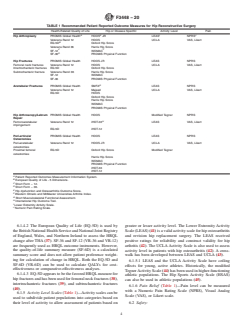
TABLE 1 Recommended Patient Reported Outcome Measures for Hip Reconstructive Surgery
Health-Related Quality of Life Hip or Disease Specific Activity Level Pain
A E I J
Hip Arthroplasty PROMIS Global Health HOOS JR LEAS NPRS
Veterans Rand 12 HOOS UCLA VAS, Likert
B
EQ-5D Oxford Hip Score
Veterans Rand 36 Harris Hip Score
C F
SF-12 WOMAC
D
SF-36 PROMIS Physical Function
Hip Fractures PROMIS Global Health HOOS JR LEAS NPRS
Femoral neck fractures Veterans Rand 12 HOOS UCLA VAS, Likert
Intertrochanteric fractures EQ-5D Oxford Hip Score
Subtrochanteric fracture Veterans Rand 36 Harris Hip Score
SF-12 WOMAC
SF-36 PROMIS Physical Function
G
Acetabular Fractures PROMIS Global Health SMFA LEAS NPRS
Veterans Rand 12 Majeed UCLA VAS, Likert
EQ-5D HOOS
Oxford Hip Score
Harris Hip Score
WOMAC
PROMIS Physical Function
Hip Arthroscopy/Labrum PROMIS Global Health HOOS Modified Tegner NPRS
Repair
H
Femoroacetabular Veterans Rand 12 iHOT-33 LEAS VAS, Likert
impingement
EQ-5D iHOT-12
Peri-articular PROMIS Global Health HOOS LEAS NPRS
Osteotomies
Peri-acetabular Veterans Rand 12 HOOS JR UCLA VAS, Likert
osteotomies
Proximal femoral EQ-5D Oxford Hip Score Modified Tegner
osteotomies
Harris Hip Score
WOMAC
PROMIS Physical Function
iHOT-33
iHOT-12
A
Patient Reported Outcomes Measurement Information System.
B
European Quality of Life - 5 Dimensions.
C
Short Form – 12.
D
Short Form – 36.
E
Hip dysfunction and Osteoarthritis Outcome Score.
F
Western Ontario and McMaster Universities Arthritis Index.
G
Short Musculoskeletal Functional Assessment.
H
International Hip Outcome Tool.
I
Lower Extremity Activity Scale.
J
Numeric Pain Rating Scale.
6.1.4.2 The European Quality of Life (EQ-5D) is used by greater or lesser activity level. The Lower Extremity Activity
theBritishNationalHealthServiceandNationalJointRegistry Scale (LEAS) (41) is a valid activity scale for hip osteoarthritis
of England, Wales, and Northern Ireland to assess the HRQL
and revision hip replacement surgery. The LEAS received
change after THA (37). SF-36 and SF-12 (VR-36 and VR-12) positive ratings for reliability and construct validity for hip
are frequently used as HRQL outcome instruments. However,
arthritis (42). The UCLAActivity Scale is also used to assess
the quality-of-life summary measure (SF-6D) is a calculated activity level in patients with hip osteoarthritis (42). A cross-
summary score and does not allow patient preference weight-
walk has been developed between LEAS and UCLA (43).
ing for calculation of change in HRQL. Both the EQ-5D and
6.1.5.1 LEAS and the UCLA Activity Scale have ceiling
SF-6D (VR-6D) can be used to calculate QALYs for cost-
effects for young, active athletes. Historically, the modified
effectiveness or comparative-effectiveness analyses.
TegnerActivity Scale (44) has been used in higher-functioning
6.1.4.3 EQ-5DappearstobethefavoredHRQLmeasurefor
athletic populations. The Hip Sports Activity Scale (HSAS)
hipfracturesandhasbeenusedforfemoralneckfractures (38),
can also be used in athletic populations (45).
intertrochanteric fractures (39), and subtrochanteric fractures
6.1.6 Pain Relief (Table 1)—Pain level can be measured
(40).
with a Numeric Pain Rating Scale (NPRS), Visual Analog
6.1.5 Activity Level Scales (Table 1)—Activity scales can be
Scale (VAS), or Likert scale.
used to subdivide patient populations into categories based on
their level of activity to allow assessment of patients based on 6.2 Safety:
F3448 − 20
6.2.1 Adverseeventratesareameasureofsafetyandshould osteoarthritis after HRS should be evaluated and graded using
be defined by the study protocol. All adverse events shall be a classification system such as the Kellgren-Lawrence grading
recorded. Adverse events directly related to the HRS or scale (49) or other appropriate classification system. Some hip
otherwise required by regulatory guidance shall be reported. surgeries may not conform to standard radiographic measure-
Time windows for adverse event reporting should be based on ment techniques. In such situations, alternative measurement/
regulatory guidance. Adverse event reporting may be reported assessment techniques should be proposed. In either case,
and analyzed according to both: (1) regulatory requirements “radiographic failure” should be defined and the number of
and (2) time windows included in this guide in order to capture failures should be reported.
all adverse events and determine if different time windows
6.3.1.1 Radiographs and other imaging data should be
affect adverse event rates.
independently reviewed according to a
...