

ASTM D1364-22
(Test Method)Standard Test Method for Water in Volatile Solvents (Karl Fischer Reagent Titration Method)
General Information
- Abstract
SIGNIFICANCE AND USE
5.1 Volatile solvents are used in a variety of chemical processes which may be affected by water. Therefore, this test method provides a test procedure for assessing compliance with a specification.
SCOPE
1.1 This test method covers the determination of water in volatile solvents and chemical intermediates used in paint, varnish, lacquer, and related products.
1.2 This test method is not applicable in the presence of mercaptans, peroxides, or appreciable quantities of aldehydes or amines.
1.3 For purposes of determining conformance of an observed or a calculated value using this test method to relevant specifications, test result(s) shall be rounded off “to the nearest unit” in the last right-hand digit used in expressing the specification limit, in accordance with the rounding-off method of Practice E29.
1.4 The values stated in SI units are to be regarded as standard. No other units of measurement are included in this standard.
1.5 For hazard information and guidance, see the supplier’s Material Safety Data sheet.
1.6 This standard does not purport to address all of the safety concerns, if any, associated with its use. It is the responsibility of the user of this standard to establish appropriate safety, health, and environmental practices and determine the applicability of regulatory limitations prior to use.
1.7 This international standard was developed in accordance with internationally recognized principles on standardization established in the Decision on Principles for the Development of International Standards, Guides and Recommendations issued by the World Trade Organization Technical Barriers to Trade (TBT) Committee.
- Status
- Published
- Publication Date
- 31-Dec-2021
- Technical Committee
- D01 - Paint and Related Coatings, Materials, and Applications
- Drafting Committee
- D01.35 - Solvents, Plasticizers, and Chemical Intermediates

Overview
ASTM D1364-22 is the internationally recognized standard test method for determining water content in volatile solvents using the Karl Fischer reagent titration method. Developed by ASTM International, this standard is specifically designed for solvents and chemical intermediates commonly used in paints, varnishes, lacquers, and similar products. Accurate water analysis is critical in chemical processes, as excess moisture can affect product performance, quality, and compliance with industry specifications.
This standard is not suitable for substances containing mercaptans, peroxides, significant amounts of aldehydes, or amines, as these components can interfere with the Karl Fischer titration chemistry. All values are stated in SI units to ensure global applicability.
Key Topics
- Purpose and Significance: Ensures that volatile solvents used in coatings and chemical manufacturing meet required limits for water content, preventing possible process issues and ensuring regulatory compliance.
- Scope: Applies to a broad range of volatile solvents and intermediates, excluding those with interfering substances.
- Methodology: Utilizes the renowned Karl Fischer titration technique, which detects water by the quantitative reaction involving iodine, sulfur dioxide, pyridine, and an alcohol.
- Results Handling: Specifies that results must be rounded in accordance with ASTM E29, ensuring consistency in data reporting.
- Precision and Repeatability: Establishes benchmarks for test repeatability and interlaboratory reproducibility, ensuring reliability across laboratories.
- Safety and Best Practices: Emphasizes the importance of reviewing hazard information from suppliers and adopting appropriate safety, health, and environmental policies prior to use.
Applications
ASTM D1364-22 is widely implemented in quality control and compliance testing for:
- Paints and Coatings Manufacturing: Ensures that solvents and intermediates used in paints, varnishes, and lacquers contain moisture levels within acceptable limits, preserving product stability and appearance.
- Chemical Production: Offers reliable water content determination for intermediates and solvents critical in organic synthesis and industrial formulations.
- Laboratory Analysis: Standardizes water determination procedures for research and testing laboratories handling volatile organics.
- Regulatory Compliance: Supports conformance with industry standards and customer specifications, reducing risk of product rejection due to excess water.
Related Standards
- ASTM E29: Guides on the usage of significant digits in test data for specification compliance, referenced for rounding off reported water content results.
- ASTM D1500: Provides specifications for color determination, useful for interpreting titration endpoint color changes in the Karl Fischer method.
- Other Karl Fischer Methods: Various ISO and ASTM standards address water content in differing matrices (e.g., oils, plastics), complementing ASTM D1364-22 in broader quality assurance programs.
Practical Value
Implementing ASTM D1364-22 ensures accurate and reproducible water content analysis in volatile solvents, minimizing the risk of moisture-related defects in end products. By following this standard, chemical manufacturers, laboratories, and quality assurance professionals can streamline compliance, standardize procedures, and maintain the consistency needed for reliable production and regulatory approval.
For further information and access to referenced documents, ASTM International provides extensive resources at www.astm.org.
Keywords: ASTM D1364-22, Karl Fischer titration, water in volatile solvents, solvent analysis, chemical quality control, paint and coating standards, moisture determination, ASTM standards.
Relations
- Effective Date
- 01-Mar-2024
- Effective Date
- 01-Dec-2012
- Effective Date
- 01-Oct-2008
- Effective Date
- 01-Dec-2007
- Effective Date
- 15-Nov-2006
- Effective Date
- 15-Sep-2006
- Effective Date
- 01-May-2006
- Effective Date
- 01-Dec-2004
- Effective Date
- 01-Nov-2004
- Effective Date
- 01-Jun-2004
- Effective Date
- 01-Nov-2003
- Effective Date
- 10-Nov-2002
- Effective Date
- 10-May-2002
- Effective Date
- 10-May-1999
Frequently Asked Questions
ASTM D1364-22 is a standard published by ASTM International. Its full title is "Standard Test Method for Water in Volatile Solvents (Karl Fischer Reagent Titration Method)". This standard covers: SIGNIFICANCE AND USE 5.1 Volatile solvents are used in a variety of chemical processes which may be affected by water. Therefore, this test method provides a test procedure for assessing compliance with a specification. SCOPE 1.1 This test method covers the determination of water in volatile solvents and chemical intermediates used in paint, varnish, lacquer, and related products. 1.2 This test method is not applicable in the presence of mercaptans, peroxides, or appreciable quantities of aldehydes or amines. 1.3 For purposes of determining conformance of an observed or a calculated value using this test method to relevant specifications, test result(s) shall be rounded off “to the nearest unit” in the last right-hand digit used in expressing the specification limit, in accordance with the rounding-off method of Practice E29. 1.4 The values stated in SI units are to be regarded as standard. No other units of measurement are included in this standard. 1.5 For hazard information and guidance, see the supplier’s Material Safety Data sheet. 1.6 This standard does not purport to address all of the safety concerns, if any, associated with its use. It is the responsibility of the user of this standard to establish appropriate safety, health, and environmental practices and determine the applicability of regulatory limitations prior to use. 1.7 This international standard was developed in accordance with internationally recognized principles on standardization established in the Decision on Principles for the Development of International Standards, Guides and Recommendations issued by the World Trade Organization Technical Barriers to Trade (TBT) Committee.
SIGNIFICANCE AND USE 5.1 Volatile solvents are used in a variety of chemical processes which may be affected by water. Therefore, this test method provides a test procedure for assessing compliance with a specification. SCOPE 1.1 This test method covers the determination of water in volatile solvents and chemical intermediates used in paint, varnish, lacquer, and related products. 1.2 This test method is not applicable in the presence of mercaptans, peroxides, or appreciable quantities of aldehydes or amines. 1.3 For purposes of determining conformance of an observed or a calculated value using this test method to relevant specifications, test result(s) shall be rounded off “to the nearest unit” in the last right-hand digit used in expressing the specification limit, in accordance with the rounding-off method of Practice E29. 1.4 The values stated in SI units are to be regarded as standard. No other units of measurement are included in this standard. 1.5 For hazard information and guidance, see the supplier’s Material Safety Data sheet. 1.6 This standard does not purport to address all of the safety concerns, if any, associated with its use. It is the responsibility of the user of this standard to establish appropriate safety, health, and environmental practices and determine the applicability of regulatory limitations prior to use. 1.7 This international standard was developed in accordance with internationally recognized principles on standardization established in the Decision on Principles for the Development of International Standards, Guides and Recommendations issued by the World Trade Organization Technical Barriers to Trade (TBT) Committee.
ASTM D1364-22 is classified under the following ICS (International Classification for Standards) categories: 87.060.30 - Solvents. The ICS classification helps identify the subject area and facilitates finding related standards.
ASTM D1364-22 has the following relationships with other standards: It is inter standard links to ASTM D1500-24, ASTM D1500-12, ASTM E29-08, ASTM D1500-07, ASTM E29-06b, ASTM E29-06a, ASTM E29-06, ASTM E29-04, ASTM D1500-04a, ASTM D1500-04, ASTM D1500-03, ASTM D1500-02, ASTM E29-02e1, ASTM E29-93a(1999). Understanding these relationships helps ensure you are using the most current and applicable version of the standard.
ASTM D1364-22 is available in PDF format for immediate download after purchase. The document can be added to your cart and obtained through the secure checkout process. Digital delivery ensures instant access to the complete standard document.
Standards Content (Sample)
This international standard was developed in accordance with internationally recognized principles on standardization established in the Decision on Principles for the
Development of International Standards, Guides and Recommendations issued by the World Trade Organization Technical Barriers to Trade (TBT) Committee.
Designation: D1364 − 22
Standard Test Method for
Water in Volatile Solvents (Karl Fischer Reagent Titration
Method)
This standard is issued under the fixed designation D1364; the number immediately following the designation indicates the year of
original adoption or, in the case of revision, the year of last revision.Anumber in parentheses indicates the year of last reapproval.A
superscript epsilon (´) indicates an editorial change since the last revision or reapproval.
This standard has been approved for use by agencies of the U.S. Department of Defense.
1. Scope 2. Referenced Documents
2.1 ASTM Standards:
1.1 This test method covers the determination of water in
D1500Test Method forASTM Color of Petroleum Products
volatile solvents and chemical intermediates used in paint,
(ASTM Color Scale)
varnish, lacquer, and related products.
E29Practice for Using Significant Digits in Test Data to
1.2 This test method is not applicable in the presence of
Determine Conformance with Specifications
mercaptans, peroxides, or appreciable quantities of aldehydes
3. Terminology
or amines.
3.1 Definitions of Terms Specific to This Standard:
1.3 For purposes of determining conformance of an ob-
3.1.1 instrumental end point, n—that point in the titration
served or a calculated value using this test method to relevant
whentwosmallplatinumelectrodes,uponwhichapotentialof
specifications, test result(s) shall be rounded off “to the nearest
20 to 50 mV has been impressed, are depolarized by the
unit” in the last right-hand digit used in expressing the
addition of 0.05 mLof Karl Fischer reagent (6 mg of H O per
specificationlimit,inaccordancewiththerounding-offmethod
mL), causing a change of current flow of 10 to 20 µA that
of Practice E29.
persists for at least 30 s.
1.4 The values stated in SI units are to be regarded as
NOTE1—Thisendpointissometimesincorrectlycalledthe“deadstop”
which is the reverse of the above.
standard. No other units of measurement are included in this
standard. 3.1.2 color end point, n—during the titration, the solution
first turns yellow, then later deepens towards the end of the
1.5 For hazard information and guidance, see the supplier’s
titration; the end point is indicated by the change from yellow
Material Safety Data sheet.
to orange-red which is quite sharp and easily repeated; the
orange-red color must persist for at least 30 s in order to
1.6 This standard does not purport to address all of the
indicate an end point.
safety concerns, if any, associated with its use. It is the
responsibility of the user of this standard to establish appro-
NOTE 2—View the color by transmitted daylight or by transmitted light
priate safety, health, and environmental practices and deter- from an artificial daylight lamp, such as the one that complies with the
specifications given in Test Method D1500.
mine the applicability of regulatory limitations prior to use.
1.7 This international standard was developed in accor-
4. Summary of Test Method
dance with internationally recognized principles on standard-
4.1 This test method is based essentially upon the reduction
ization established in the Decision on Principles for the
of iodine by sulfur dioxide in the presence of water. This
Development of International Standards, Guides and Recom-
reaction can be used quantitatively only when pyridine and an
mendations issued by the World Trade Organization Technical
alcohol are present to react with the sulfur trioxide and
Barriers to Trade (TBT) Committee.
hydriodic acid produced according to the following reactions:
H O1I 1SO 13C H N→2C H N·HI1C H N·SO (1)
2 2 2 5 5 5 5 5 5 3
This test method is under the jurisdiction of ASTM Committee D01 on Paint C H N·SO 1ROH→C H N·HSO R
5 5 3 5 5 4
and Related Coatings, Materials, andApplications and is the direct responsibility of
Subcommittee D01.35 on Solvents, Plasticizers, and Chemical Intermediates.
Current edition approved Jan. 1, 2022. Published January 2022. Originally For referenced ASTM standards, visit the ASTM website, www.astm.org, or
approved in 1955. Last previous edition approved in 2012 as D1364–02 (2012) contact ASTM Customer Service at service@astm.org. For Annual Book of ASTM
which was withdrawn January 2021 and reinstated in January 2022. DOI: 10.1520/ Standards volume information, refer to the standard’s Document Summary page on
D1364-22. the ASTM website.
Copyright © ASTM International, 100 Barr Harbor Drive, PO Box C700, West Conshohocken, PA 19428-2959. United States
D1364 − 22
mixture.Itisdesirabletohaveameansforcoolingthetitration
vessel to ice temperature.
6.2 Instrument Electrodes—Platinum with a surface equiva-
lent to two No. 26 wires 5 mm long. The wires should be 3 to
8 mm apart and so inserted in the vessel that 25 mL of liquid
will cover them.
6.3 Instrument Depolarization Indicator, having an internal
resistance of less than 5000Ω and consisting of a means of
impressing and showing a voltage of 20 to 50 mV across the
electrodes and capable of indicating a current flow of 10 to
20µAby means of a galvanometer or radiotuning eye circuit.
6.4 Buret Assembly for Karl Fischer reagent, consisting of a
25 or 50-mL buret connected by means of glass (not rubber)
connectors to a source of reagent; several types of automatic
dispensing burets may be used. Since the reagent loses
strengthwhenexposedtomoistair,allventsmustbeprotected
against atmospheric moisture by adequate drying tubes con-
taining indicating calcium sulfate drying agent. All stopcocks
andjointsshouldbelubricatedwithalubricantnotparticularly
reactive with the reagent.
NOTE 1—All dimensions in millimetres.
6.5 Weighing Bottle, of the Lunge or Grethen Type, or
FIG. 1 Titration Flask Assembly
equivalent.
7. Reagents
4.2 To determine water, Karl Fischer reagent (a solution of
iodine, pyridine, and sulfur dioxide, in the molar ratio of
7.1 Purity of Reagents—Reagent grade chemicals shall be
1+10+3) dissolved in anhydrous 2-methoxyethanol is added
used in all tests. Unless otherwise indicated, it is intended that
to a solution of the sample in anhydrous pyridine-ethylene
all reagents shall conform to the specifications of the Commit-
glycol (1+4) until all water present has been consumed. This
tee onAnalytical Reagents of theAmerican Chemical Society,
is evidenced by the persistence of the orange-red end-point
where such specifications are available. Other grades may be
color; or alternatively by an indication on a galvanometer or
used, provided it is first ascertained that the reagent is of
similarcurrent-indicatingdevicewhichrecordsthedepolariza-
sufficiently high purity to permit its use without decreasing the
tion of a pair of noble-metal electrodes. The reagent is
accuracy of the determination.
standardized by titration of water.
7.1.1 Karl Fischer Reagent (equivalent to 6 mg of H O per
mL) —For each liter of solution, dissolve 133 61gofI in
5. Significance and Use
425 6 2 mLof anhydrous (less than 0.1% H O) pyridine in a
dryglass-stopperedbottle.Add425 62mLofanhydrous(less
5.1 Volatile solvents are used in a variety of chemical
than 0.1% H O) 2-methoxyethanol. Cool to below 4°C in an
processes which may be affected by water. Therefore, this test
method provides a test procedure for assessing compliance
with a specification.
The sole source of supply of instrument depolarization indicator known to the
committee at this time is Fisher Scientific Co., www.fishersci.com. If you are aware
6. Apparatus
of alternative suppliers, please provide this information to ASTM International
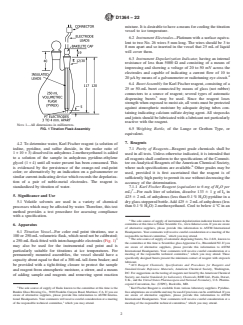
6.1 Titration Vessel—For color end point titrations, use a Headquarters.Your comments will receive careful consideration at a meeting of the
responsible technical committee, which you may attend.
100 or 250-mLvolumetric flask, which need not be calibrated;
The sole source of supply of automatic dispensing burets, No. J-821, known to
a 250-mLflask fitted with interchangeable electrodes (Fig. 1)
the committee at this time is Scientifice glassApparatus Co., Bloomfield NJ. If you
may also be used for the instrumental end point and is
are aware of alternative suppliers, please provide this information to ASTM
International Headquarters. Your comments will receive careful consideration at a
particularly suitable for titrations at ice temperatures. For
meeting of the responsible technical committee, which you may attend. These
permanently mounted assemblies, the vessel should have a
specifically designed burets present the minimum contact of reagent with stopcock
capacity about equal to that of a 300-mLtall-form beaker; and
lubricant.
be provided with a tight-fitting closure to protect the sample
ACS Reagent Chemicals, Specifications and Procedures for Reagents and
Standard-Grade Reference Materials, American Chemical Society, Washington,
and reagent from atmospheric moisture, a stirrer, and a means
DC. For suggestions on the testing of reagents not listed by theAmerican Chemical
of adding sample and reagents and removing spent reaction
Society, see Analar Standards for Laboratory Chemicals, BDH Ltd., Poole, Dorset,
U.K., and the United States Pharmacopeia and National Formulary, U.S. Pharma-
copeial Convention, Inc. (USPC), Rockville, MD.
3 7
The sole source of supply of flasks known to the committee at this time is the Karl Fischer Reagent is available from various laboratory suppliers. Pyridine-
Rankin Glass Blowing Co., 3920 Franklin Canyon Road, Martinez, CA. If you are freeadaptationsareavailableandmaybeusedifprecisioncanbeestablished.Ifyou
aware of alternative suppliers, please provide this information to ASTM Interna- are aware of alter
...