


ASTM D6076-18(2023)
(Test Method)Standard Test Method for Shrinkage Temperature of Leather
Standard Test Method for Shrinkage Temperature of Leather
SIGNIFICANCE AND USE
5.1 This test method is designed to determine the temperature at which a thoroughly wetted leather specimen experiences shrinkage. In this test method, shrinkage occurs as a result of hydrothermal denaturation of the collagen protein molecules which make up the fiber structure of the leather. The shrinkage temperature of leather is influenced by many different factors, most of which appear to affect the number and nature of crosslinking interactions between adjacent polypeptide chains of the collagen protein molecules. The value of the shrinkage temperature of leather is commonly used as an indicator of the type of tannage or the degree of tannage, or both, of that particular leather (especially for the more hydrothermally stable tannages such as chrome tannage).
SCOPE
1.1 This test method covers the determination of the shrinkage temperature of all types of leather. The heating medium is water when the shrinkage temperature is at or below 98 °C. The heating medium is a glycerine-water solution when the shrinkage temperature is above 98 °C.
1.2 The values stated in SI units are to be regarded as the standard. The values given in parentheses are for information only.
1.3 This standard does not purport to address all of the safety concerns, if any, associated with its use. It is the responsibility of the user of this standard to establish appropriate safety, health, and environmental practices and determine the applicability of regulatory limitations prior to use.
1.4 This international standard was developed in accordance with internationally recognized principles on standardization established in the Decision on Principles for the Development of International Standards, Guides and Recommendations issued by the World Trade Organization Technical Barriers to Trade (TBT) Committee.
General Information
- Status
- Published
- Publication Date
- 31-Dec-2022
- Technical Committee
- D31 - Leather
- Drafting Committee
- D31.07 - Physical Properties
Relations
- Effective Date
- 01-Dec-2015
- Effective Date
- 01-Oct-2010
- Effective Date
- 01-Oct-2006
- Effective Date
- 01-Sep-2004
- Effective Date
- 01-Sep-2004
- Effective Date
- 01-Apr-2004
- Effective Date
- 10-May-1999
Overview
ASTM D6076-18(2023): Standard Test Method for Shrinkage Temperature of Leather is a globally recognized method published by ASTM International. This standard outlines the procedure for determining the shrinkage temperature of all types of leather by controlled heating in an aqueous medium. The test identifies the temperature at which a wetted leather specimen undergoes noticeable shrinkage due to hydrothermal denaturation of collagen protein molecules, which make up the structure of leather.
The shrinkage temperature is an essential quality indicator for leather, providing valuable information on the type and degree of tannage used in its processing. The method applies to chrome-tanned and other hydrothermally stable leathers.
Key Topics
- Test Purpose: Measures the temperature where leather exhibits shrinkage, indicating collagen denaturation under heat.
- Sample Preparation: Specifies dimensions and soaking techniques for leather test specimens.
- Heating Media: Uses water when the anticipated shrinkage temperature is at or below 98°C; utilizes a glycerine-water solution for temperatures above 98°C.
- Apparatus: Detailed requirements for clamps, immersion heaters, variable transformers, precise thermometers, and indicating devices.
- Test Procedure:
- Soaking the leather specimen in the appropriate medium.
- Mounting in a shrinkage meter between clamps.
- Gradual heating at a controlled rate.
- Observing and recording temperature at the first sign of shrinkage.
- Reporting: Results are documented to the nearest 1°C or, when required, as the elapsed time for shrinkage at standardized temperatures.
Applications
ASTM D6076-18(2023) serves multiple sectors within the leather industry:
- Quality Control: Manufacturers use shrinkage temperature tests to verify the tanning process, ensuring leather meets specified stability and durability requirements.
- Material Comparison: Assists in distinguishing between types of leather tannage (such as chrome versus vegetable) by comparing their hydrothermal stability.
- Research and Development: Facilitates the development of new tanning agents and processes by quantifying their effect on leather’s shrinkage temperature.
- Compliance and Procurement: Meets requirements set by regulators, institutions, and military agencies for uniformity in leather quality assessment.
- Performance Assessment: Ensures that finished leather products will withstand conditions involving moisture and elevated temperatures without compromising structural integrity.
Related Standards
- ASTM D1517: Terminology Relating to Leather - Provides essential definitions referenced in this and related test methods.
- ISO Leather Testing Standards: Various ISO standards address additional physical and chemical testing procedures for finished leather.
- Federal Test Method Standard No. 311: Origin of test procedures included in ASTM D6076.
- Other ASTM Leather Standards: Related methods for assessing physical, chemical, and performance characteristics of leather.
Practical Value
Implementing ASTM D6076-18(2023) ensures consistent and reliable determination of the shrinkage temperature across all leather products, benefiting manufacturers, suppliers, and end-users committed to quality assurance in the leather supply chain. Whether for footwear, upholstery, fashion, automotive, or industrial uses, adherence to this standard maximizes product reliability and customer confidence, fully aligning with international best practices for materials testing.
Keywords: shrinkage temperature, leather testing, tannage, ASTM D6076, leather quality, hydrothermal stability, chrome-tanned leather, test method, material compliance.

Get Certified
Connect with accredited certification bodies for this standard

Control Union Certifications
Global certification for agriculture and sustainability.

Bureau Veritas Bangladesh
Bureau Veritas certification services in Bangladesh.

ECOCERT France
Leader in organic and sustainability certification worldwide.
Sponsored listings
Frequently Asked Questions
ASTM D6076-18(2023) is a standard published by ASTM International. Its full title is "Standard Test Method for Shrinkage Temperature of Leather". This standard covers: SIGNIFICANCE AND USE 5.1 This test method is designed to determine the temperature at which a thoroughly wetted leather specimen experiences shrinkage. In this test method, shrinkage occurs as a result of hydrothermal denaturation of the collagen protein molecules which make up the fiber structure of the leather. The shrinkage temperature of leather is influenced by many different factors, most of which appear to affect the number and nature of crosslinking interactions between adjacent polypeptide chains of the collagen protein molecules. The value of the shrinkage temperature of leather is commonly used as an indicator of the type of tannage or the degree of tannage, or both, of that particular leather (especially for the more hydrothermally stable tannages such as chrome tannage). SCOPE 1.1 This test method covers the determination of the shrinkage temperature of all types of leather. The heating medium is water when the shrinkage temperature is at or below 98 °C. The heating medium is a glycerine-water solution when the shrinkage temperature is above 98 °C. 1.2 The values stated in SI units are to be regarded as the standard. The values given in parentheses are for information only. 1.3 This standard does not purport to address all of the safety concerns, if any, associated with its use. It is the responsibility of the user of this standard to establish appropriate safety, health, and environmental practices and determine the applicability of regulatory limitations prior to use. 1.4 This international standard was developed in accordance with internationally recognized principles on standardization established in the Decision on Principles for the Development of International Standards, Guides and Recommendations issued by the World Trade Organization Technical Barriers to Trade (TBT) Committee.
SIGNIFICANCE AND USE 5.1 This test method is designed to determine the temperature at which a thoroughly wetted leather specimen experiences shrinkage. In this test method, shrinkage occurs as a result of hydrothermal denaturation of the collagen protein molecules which make up the fiber structure of the leather. The shrinkage temperature of leather is influenced by many different factors, most of which appear to affect the number and nature of crosslinking interactions between adjacent polypeptide chains of the collagen protein molecules. The value of the shrinkage temperature of leather is commonly used as an indicator of the type of tannage or the degree of tannage, or both, of that particular leather (especially for the more hydrothermally stable tannages such as chrome tannage). SCOPE 1.1 This test method covers the determination of the shrinkage temperature of all types of leather. The heating medium is water when the shrinkage temperature is at or below 98 °C. The heating medium is a glycerine-water solution when the shrinkage temperature is above 98 °C. 1.2 The values stated in SI units are to be regarded as the standard. The values given in parentheses are for information only. 1.3 This standard does not purport to address all of the safety concerns, if any, associated with its use. It is the responsibility of the user of this standard to establish appropriate safety, health, and environmental practices and determine the applicability of regulatory limitations prior to use. 1.4 This international standard was developed in accordance with internationally recognized principles on standardization established in the Decision on Principles for the Development of International Standards, Guides and Recommendations issued by the World Trade Organization Technical Barriers to Trade (TBT) Committee.
ASTM D6076-18(2023) is classified under the following ICS (International Classification for Standards) categories: 59.140.30 - Leather and furs. The ICS classification helps identify the subject area and facilitates finding related standards.
ASTM D6076-18(2023) has the following relationships with other standards: It is inter standard links to ASTM D1517-15, ASTM D1517-10, ASTM D1517-06, ASTM D1517-04, ASTM D1517-04e1, ASTM D1517-99(2004), ASTM D1517-99. Understanding these relationships helps ensure you are using the most current and applicable version of the standard.
ASTM D6076-18(2023) is available in PDF format for immediate download after purchase. The document can be added to your cart and obtained through the secure checkout process. Digital delivery ensures instant access to the complete standard document.
Standards Content (Sample)
This international standard was developed in accordance with internationally recognized principles on standardization established in the Decision on Principles for the
Development of International Standards, Guides and Recommendations issued by the World Trade Organization Technical Barriers to Trade (TBT) Committee.
Designation: D6076 − 18 (Reapproved 2023)
Standard Test Method for
Shrinkage Temperature of Leather
This standard is issued under the fixed designation D6076; the number immediately following the designation indicates the year of
original adoption or, in the case of revision, the year of last revision. A number in parentheses indicates the year of last reapproval. A
superscript epsilon (´) indicates an editorial change since the last revision or reapproval.
This standard has been approved for use by agencies of the U.S. Department of Defense.
1. Scope 3. Terminology
1.1 This test method covers the determination of the shrink- 3.1 Definitions—For definitions of general leather terms
age temperature of all types of leather. The heating medium is used in this test method, refer to Terminology D1517.
water when the shrinkage temperature is at or below 98 °C.
3.2 Definitions of Terms Specific to This Standard:
The heating medium is a glycerine-water solution when the
3.2.1 shrink—to contract or become smaller.
shrinkage temperature is above 98 °C.
3.2.2 shrinkage—the temperature at which noticeable
1.2 The values stated in SI units are to be regarded as the
shrinkage occurs when a leather specimen is gradually heated
standard. The values given in parentheses are for information
in an aqueous medium.
only.
4. Summary of Test Method
1.3 This standard does not purport to address all of the
safety concerns, if any, associated with its use. It is the 4.1 Aleather specimen is thoroughly soaked in the aqueous
responsibility of the user of this standard to establish appro-
medium that will be used to heat the specimen for this test
priate safety, health, and environmental practices and deter- method. This specimen is then fastened between two clamps
mine the applicability of regulatory limitations prior to use.
(one fixed and one movable) and immersed in the aqueous
1.4 This international standard was developed in accor- medium (see Fig. 1). The aqueous medium is gradually heated
dance with internationally recognized principles on standard-
until the specified temperature is reached without shrinkage or
ization established in the Decision on Principles for the until shrinkage is indicated by a deflection of the dial needle
Development of International Standards, Guides and Recom-
which is attached to the movable clamp.
mendations issued by the World Trade Organization Technical
5. Significance and Use
Barriers to Trade (TBT) Committee.
5.1 This test method is designed to determine the tempera-
2. Referenced Documents
tureatwhichathoroughlywettedleatherspecimenexperiences
shrinkage. In this test method, shrinkage occurs as a result of
2.1 ASTM Standards:
D1517 Terminology Relating to Leather hydrothermal denaturation of the collagen protein molecules
which make up the fiber structure of the leather. The shrinkage
temperature of leather is influenced by many different factors,
This test method is under the jurisdiction ofASTM Committee D31 on Leather
most of which appear to affect the number and nature of
andisthedirectresponsibilityofSubcommitteeD31.07onPhysicalProperties.This
crosslinking interactions between adjacent polypeptide chains
test method was developed from Federal Test Method Standard No. 311, Method
7011.1, in cooperation with the U.S. Defense Personnel Support Center, Directorate of the collagen protein molecules. The value of the shrinkage
of Clothing and Textiles, Philadelphia, PA and the U.S. Army Natick Research,
temperature of leather is commonly used as an indicator of the
Development and Engineering Center, Natick, MA.
type of tannage or the degree of tannage, or both, of that
Current edition approved Jan. 1, 2023. Published January 2023. Originally
particular leather (especially for the more hydrothermally
approved in 1997. Last previous edition approved in 2018 as D6076-18. DOI:
10.1520/D6076-18R23.
stable tannages such as chrome tannage).
For referenced ASTM standards, visit the ASTM website, www.astm.org, or
contact ASTM Customer Service at service@astm.org. For Annual Book of ASTM
6. Apparatus
Standards volume information, refer to the standard’s Document Summary page on
the ASTM website. 6.1 Stand, for supporting the testing equipment.
Copyright © ASTM International, 100 Barr Harbor Drive, PO Box C700, West Conshohocken, PA 19428-2959. United States
D6076 − 18 (2023)
The indicator shall have a spindle capable of attachment to the
specimen and to the adjustable weight assembly.
6.3 Immersion Heater, 250 W to 500 W, with a heating
element not longer than 140 mm (5 ⁄2 in.) and a depth of
immersion not in excess of 152 mm (6 in.).
6.4 Variable Speed Stirrer, with small blades.
6.5 Spring-loaded Clamps—(alligator type), two, mounted
vertically one above the other and sufficiently far apart for
gripping the full width of the specimen at the ends.The bottom
clamp shall be fastened to the end of a U-shaped rod that can
be turned sideways. The upper clamp shall be movable
sideways as well as up and down.
6.6 Metal Supporting Plate, with apertures for the stirrer,
thermometer, immersion heater, and the rod fastened to the
upper specimen clamp.
6.7 Variable Transformer, capable of controlling the rate of
heating (3 °C⁄min to 5 °C⁄min) of the aqueous medium and
capable of maintaining a temperature of 98 °C 6 0.5 °C.
6.8 Thermometer, with a white background, a scale from
–1 °C or –10 °C to +101 °C or +110 °C or +150 °C, graduated
in 1 °C, and with 60.5 °C tolerance.
6.9 Tall-form 1 L Beaker, for holding the aqueous heating
medium.
6.10 Lead Shot.
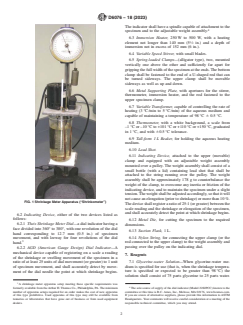
6.11 Indicating Device, attached to the upper (movable)
clamp and equipped with an adjustable weight assembly
mounted over a pulley. The weight assembly shall consist of a
small bottle (with a lid) containing lead shot that shall be
attached to the string running over the pulley. The weight
assembly shall be approximately 178 g to counterbalance the
weight of the clamp, to overcome any inertia or friction of the
indicating device, and to maintain the specimen under a slight
tension.Theweightshallbeadjustedaccordingly,sothatitwill
notcauseanelongation(priortoshrinkage)ormorethan10%.
FIG. 1 Shrinkage Meter Apparatus (“Shrinkometer”)
Thedeviceshallregisteraratioof25:1(orgreater)betweenthe
scale reading and the shrinkage or elongation of the specimen,
and shall accurately detect the point at which shrinkage begins.
6.2 Indicating Device, either of the two devices listed as
follows:
6.12 Metal Die, for cutting the specimen to the required
6.2.1 Theis Shrinkage Meter Dial—a dial indicator having a
dimensions.
face divided into 360° to 380°, with one revolution of the dial
6.13 Suction Flask,1L.
hand corresponding to 12.7 mm (0.5 in.) of specimen
6.14 Nylon String, for connecting the upper clamp (or the
movement, and with leeway for four revolutions of the dial
rod connected to the upper clamp) to the weight assembly and
hand.
passing over the pulley on the indicating dial.
6.2.2 AGD (American Gauge Design) Dial Indicator—A
mechanical device capable of registering on a scale a reading
7. Reagents
of the shrinkage or swelling movement of the specimen in a
7.1 Glycerine-water Solution—When glycerine-water me-
ratio of at least 25 units of
...
Questions, Comments and Discussion
Ask us and Technical Secretary will try to provide an answer. You can facilitate discussion about the standard in here.
Loading comments...