

ASTM E2082-12(2020)
(Guide)Standard Guide for Descriptive Analysis of Shampoo Performance
General Information
- Abstract
SIGNIFICANCE AND USE
6.1 The methods outlined in this guide can be used to qualitatively and quantitatively describe the performance and sensory characteristics of shampoos.
6.2 The methods described in this guide may be used for product formulation and research guidance as well as for quality control.
6.3 These methods may be used by individuals who familiarize themselves with these procedures and who have previous experience with sensory evaluation.
6.4 Variables that may affect results include, but are not limited to, water conditions (for example, hardness), hair type, and hair condition. These variables should be controlled or accounted for in the experimental design.
6.5 These are suggested procedures and are not intended to exclude alternate methods, which may effectively provide the same or similar results.
SCOPE
1.1 The objective of this guide is to provide procedures which may be used in the design, execution, and analysis of studies to quantitatively assess the objective sensory attributes of shampoos. This is one of many appropriate techniques used in the hair-care industry. These attributes can then be used to define performance of shampoos and to provide direction in product formulation, research guidance testing, and claim substantiation. This guide includes the sensory properties involved in dispensing a product, as well as the attributes pertinent to shampooing swatches, half and whole heads. Although this guide is specific to shampoos, the procedures should be applicable to most hair-care products.
1.2 Guidelines are provided for the definition of terminology, procedures for manipulation of products, identification/selection of hair type, and assessor training. References for rating scales are not provided in this guide. The user should be aware that some sensory practices may require the use of attribute references (anchors) when training the assessors.
1.3 This international standard was developed in accordance with internationally recognized principles on standardization established in the Decision on Principles for the Development of International Standards, Guides and Recommendations issued by the World Trade Organization Technical Barriers to Trade (TBT) Committee.
- Status
- Published
- Publication Date
- 30-Sep-2020
- Technical Committee
- E18 - Sensory Evaluation
- Drafting Committee
- E18.07 - Personal Care and Household Evaluation
Overview
ASTM E2082-12(2020): Standard Guide for Descriptive Analysis of Shampoo Performance provides comprehensive procedures for the sensory evaluation of shampoos. Developed by ASTM International, this standard recommends qualitative and quantitative methods for assessing shampoo performance, covering both laboratory and real-user (in-use) conditions. The guide supports the hair-care industry in evaluating the effectiveness of shampoo products, ensuring consistency in product formulation, quality control, research, and claim substantiation. The methodologies discussed can also be extended to other hair-care products.
Key Topics
- Sensory Evaluation Procedures: Outlines steps to assess the visual, tactile, and performance characteristics of shampoos using both hair swatches and live test subjects.
- Panel Selection and Training: Details the recruitment and training of assessors, including the use of licensed cosmetologists and guidelines for descriptive sensory analysis.
- Controlled Testing Variables: Stresses the importance of controlling variables such as water quality, hair type, and hair condition to achieve reliable results.
- Testing Equipment and Environment: Recommends standardized equipment (e.g., light sources, combs, hair swatches) and environmental controls (lighting, humidity) for repeatable measurements.
- Evaluation Attributes: Defines measurable attributes such as foam quality, wet and dry combing ease, residue, luster, slip, detangling, and static, among others.
- Method Flexibility: Recognizes that alternate sensory evaluation methodologies may be equally effective when appropriately controlled.
Applications
Product Development & Formulation
- Guiding Product Development: Enables formulators to objectively assess and compare sensory properties of new and existing shampoo formulas for enhanced consumer appeal.
- Optimizing Performance: Allows researchers to fine-tune shampoo performance, such as improving foaming characteristics, rinsability, and conditioning effects.
Quality Control
- Batch-to-Batch Consistency: Ensures that sensory properties remain consistent across production runs by using trained assessors and standardized protocols.
- Claim Substantiation: Provides robust support for marketing claims (such as "improves shine" or "easier detangling"), backed by scientifically controlled sensory research.
Consumer Testing & Market Research
- Panel Testing: Informs the selection and operation of sensory panels, whether consisting of company employees, local community members, or professional cosmetologists.
- Real-Use Assessment: Incorporates evaluations on half or whole heads of hair to simulate consumer use and capture real-world performance data.
Related Standards
- ASTM E253: Terminology Relating to Sensory Evaluation of Materials and Products – provides definitions for terms used in sensory analysis.
- ASTM MNL13, MNL26, MNL30: Manuals offering further details on descriptive analysis testing, sensory methods, and connecting consumer responses to laboratory data.
- ASTM STP758: Guidelines for the Selection and Training of Sensory Panel Members.
- 21 CFR 50.25: US FDA regulation governing the protection of human subjects and requirements for informed consent in consumer testing.
Practical Value
The ASTM E2082-12(2020) Standard Guide is a critical resource for cosmetic companies, contract testing labs, and regulatory bodies seeking to implement best practices in shampoo product evaluation. Its guidance facilitates:
- Objective comparison of shampoo sensory attributes.
- Reliable training and validation of sensory panels.
- Standardized communication of results to stakeholders.
- Greater efficiency and credibility in product development and quality assurance.
Adopting these procedures increases confidence in product claims and ensures that products deliver on consumer expectations for performance and sensory experience. This, in turn, enhances brand reputation and trust in the highly competitive personal care market.
Relations
- Effective Date
- 15-Oct-2019
- Effective Date
- 01-Oct-2018
- Effective Date
- 15-Jun-2018
- Effective Date
- 01-May-2017
- Effective Date
- 01-Jun-2016
- Effective Date
- 01-Dec-2015
- Effective Date
- 01-Jun-2015
- Effective Date
- 15-Jan-2015
- Effective Date
- 01-Nov-2013
- Effective Date
- 01-May-2013
- Effective Date
- 01-Nov-2012
- Effective Date
- 01-May-2012
- Effective Date
- 01-Dec-2011
- Effective Date
- 15-Apr-2011
- Effective Date
- 01-Dec-2010
Get Certified
Connect with accredited certification bodies for this standard

ECOCERT
Organic and sustainability certification.

Eurofins Food Testing Global
Global leader in food, environment, and pharmaceutical product testing.

Intertek Bangladesh
Intertek certification and testing services in Bangladesh.
Sponsored listings
Frequently Asked Questions
ASTM E2082-12(2020) is a guide published by ASTM International. Its full title is "Standard Guide for Descriptive Analysis of Shampoo Performance". This standard covers: SIGNIFICANCE AND USE 6.1 The methods outlined in this guide can be used to qualitatively and quantitatively describe the performance and sensory characteristics of shampoos. 6.2 The methods described in this guide may be used for product formulation and research guidance as well as for quality control. 6.3 These methods may be used by individuals who familiarize themselves with these procedures and who have previous experience with sensory evaluation. 6.4 Variables that may affect results include, but are not limited to, water conditions (for example, hardness), hair type, and hair condition. These variables should be controlled or accounted for in the experimental design. 6.5 These are suggested procedures and are not intended to exclude alternate methods, which may effectively provide the same or similar results. SCOPE 1.1 The objective of this guide is to provide procedures which may be used in the design, execution, and analysis of studies to quantitatively assess the objective sensory attributes of shampoos. This is one of many appropriate techniques used in the hair-care industry. These attributes can then be used to define performance of shampoos and to provide direction in product formulation, research guidance testing, and claim substantiation. This guide includes the sensory properties involved in dispensing a product, as well as the attributes pertinent to shampooing swatches, half and whole heads. Although this guide is specific to shampoos, the procedures should be applicable to most hair-care products. 1.2 Guidelines are provided for the definition of terminology, procedures for manipulation of products, identification/selection of hair type, and assessor training. References for rating scales are not provided in this guide. The user should be aware that some sensory practices may require the use of attribute references (anchors) when training the assessors. 1.3 This international standard was developed in accordance with internationally recognized principles on standardization established in the Decision on Principles for the Development of International Standards, Guides and Recommendations issued by the World Trade Organization Technical Barriers to Trade (TBT) Committee.
SIGNIFICANCE AND USE 6.1 The methods outlined in this guide can be used to qualitatively and quantitatively describe the performance and sensory characteristics of shampoos. 6.2 The methods described in this guide may be used for product formulation and research guidance as well as for quality control. 6.3 These methods may be used by individuals who familiarize themselves with these procedures and who have previous experience with sensory evaluation. 6.4 Variables that may affect results include, but are not limited to, water conditions (for example, hardness), hair type, and hair condition. These variables should be controlled or accounted for in the experimental design. 6.5 These are suggested procedures and are not intended to exclude alternate methods, which may effectively provide the same or similar results. SCOPE 1.1 The objective of this guide is to provide procedures which may be used in the design, execution, and analysis of studies to quantitatively assess the objective sensory attributes of shampoos. This is one of many appropriate techniques used in the hair-care industry. These attributes can then be used to define performance of shampoos and to provide direction in product formulation, research guidance testing, and claim substantiation. This guide includes the sensory properties involved in dispensing a product, as well as the attributes pertinent to shampooing swatches, half and whole heads. Although this guide is specific to shampoos, the procedures should be applicable to most hair-care products. 1.2 Guidelines are provided for the definition of terminology, procedures for manipulation of products, identification/selection of hair type, and assessor training. References for rating scales are not provided in this guide. The user should be aware that some sensory practices may require the use of attribute references (anchors) when training the assessors. 1.3 This international standard was developed in accordance with internationally recognized principles on standardization established in the Decision on Principles for the Development of International Standards, Guides and Recommendations issued by the World Trade Organization Technical Barriers to Trade (TBT) Committee.
ASTM E2082-12(2020) is classified under the following ICS (International Classification for Standards) categories: 71.100.70 - Cosmetics. Toiletries. The ICS classification helps identify the subject area and facilitates finding related standards.
ASTM E2082-12(2020) has the following relationships with other standards: It is inter standard links to ASTM E253-19, ASTM E253-18a, ASTM E253-18, ASTM E253-17, ASTM E253-16, ASTM E253-15b, ASTM E253-15a, ASTM E253-15, ASTM E253-13a, ASTM E253-13, ASTM E253-12a, ASTM E253-12, ASTM E253-11a, ASTM E253-11, ASTM E253-10a. Understanding these relationships helps ensure you are using the most current and applicable version of the standard.
ASTM E2082-12(2020) is available in PDF format for immediate download after purchase. The document can be added to your cart and obtained through the secure checkout process. Digital delivery ensures instant access to the complete standard document.
Standards Content (Sample)
This international standard was developed in accordance with internationally recognized principles on standardization established in the Decision on Principles for the
Development of International Standards, Guides and Recommendations issued by the World Trade Organization Technical Barriers to Trade (TBT) Committee.
Designation: E2082 − 12 (Reapproved 2020)
Standard Guide for
Descriptive Analysis of Shampoo Performance
This standard is issued under the fixed designation E2082; the number immediately following the designation indicates the year of
original adoption or, in the case of revision, the year of last revision. A number in parentheses indicates the year of last reapproval. A
superscript epsilon (´) indicates an editorial change since the last revision or reapproval.
1. Scope 2.2 ASTM Publications:
MNL13 Descriptive Analysis Testing for Sensory Evalua-
1.1 The objective of this guide is to provide procedures
tion
which may be used in the design, execution, and analysis of
MNL26 Sensory Testing Methods, 2nd Edition
studies to quantitatively assess the objective sensory attributes
MNL30 Relating Consumer, Descriptive, and Laboratory
of shampoos. This is one of many appropriate techniques used
Data to Better Understand Consumer Responses
in the hair-care industry. These attributes can then be used to
STP758 Guidelines for the Selection and Training of Sen-
define performance of shampoos and to provide direction in
sory Panel Members
product formulation, research guidance testing, and claim
2.3 Code of Federal Regulations:
substantiation. This guide includes the sensory properties
21 CFR 50.25 Protection of Human Subjects—Elements of
involved in dispensing a product, as well as the attributes
Informed Consent
pertinent to shampooing swatches, half and whole heads.
3. Terminology
Although this guide is specific to shampoos, the procedures
should be applicable to most hair-care products.
3.1 Definitions:
3.1.1 Definitions of terms other than those given as follows
1.2 Guidelines are provided for the definition of
appear in Terminology E253.
terminology, procedures for manipulation of products,
3.2 Definitions:
identification/selection of hair type, and assessor training.
3.2.1 cosmetologist—a licensed, trained professional who
References for rating scales are not provided in this guide. The
has been certified by state or government agencies to apply
user should be aware that some sensory practices may require
hair-care products to human heads; these individuals may be
the use of attribute references (anchors) when training the
alternately described as beauticians, stylists, hairdressers, or
assessors.
cosmetologists.
1.3 This international standard was developed in accor-
3.2.2 subjects—those individuals recruited to participate in
dance with internationally recognized principles on standard-
a study for the quality or condition of their hair, to serve as
ization established in the Decision on Principles for the
sample carriers.
Development of International Standards, Guides and Recom-
3.2.3 trained panel—a group of assessors who have been
mendations issued by the World Trade Organization Technical
formally trained to evaluate the visual and tactile properties of
Barriers to Trade (TBT) Committee.
shampoo or hair, using a standard descriptive analysis method
which quantifies attributes on a rating scale over a set time
2. Referenced Documents
period; the number may vary depending on the complexity of
the test and the skill of the assessor.
2.1 ASTM Standards:
E253 Terminology Relating to Sensory Evaluation of Mate-
4. Equipment
rials and Products
4.1 The following equipment may be used during the
evaluation process:
4.1.1 General:
This guide is under the jurisdiction of ASTM Committee E18 on Sensory
4.1.1.1 Light Source—A consistent light source is recom-
Evaluation and is the direct responsibility of Subcommittee E18.07 on Personal
mended for use during evaluation of shine or luster. It is
Care and Household Evaluation.
Current edition approved Oct. 1, 2020. Published October 2020. Originally
approved in 2000. Last previous edition approved in 2012 as E2082 – 12. DOI:
10.1520/E2082-12R20. Available from ASTM International Headquarters, 100 Barr Harbor Drive, PO
For referenced ASTM standards, visit the ASTM website, www.astm.org, or Box C700, West Conshohocken, PA 19428-2959
contact ASTM Customer Service at service@astm.org. For Annual Book of ASTM Available from U.S. Government Printing Office, Superintendent of
Standards volume information, refer to the standard’s Document Summary page on Documents, 732 N. Capitol St., NW, Washington, DC 20401-0001, http://
the ASTM website. www.access.gpo.gov.
Copyright © ASTM International, 100 Barr Harbor Drive, PO Box C700, West Conshohocken, PA 19428-2959. United States
E2082 − 12 (2020)
TABLE 1 Comparative Overview of Shampoo Testing Using
important to control the amount of light as well as the angle
Trained Evaluators
and distance from the hair.
Swatches Versus Subjects
4.1.1.2 Water Source—Temperature and hardness should be
Swatch Subject: Half or Whole Head
consistent. If controlled temperature sinks are used, they
should all have the same, consistent flow rate.
Highly Controlled Testing: Less Controlled:
Controlled procedure, limited Controlled procedure but highly
4.1.1.3 Blow Dryer—Specifications should be documented
variability variable hair/scalp types and
(that is, wattage, voltage, power level, air velocity, and
Uniform hair samples (typically conditions (length, diameter,
temperature).
commercially blended 9virgin9 hair) oiliness, dirtiness, damage, etc.)
Often may purchase/create In special cases, may screen/
4.1.1.4 Syringes/Pipettes, Petri Dishes.
desired/target hair types target specific hair types
4.1.1.5 Towels (cloth or paper, or both).
Artificial: Less Artificial:
4.1.1.6 Combs—It is recommended that all combs be iden-
Lack scalp/sebum involvement, Scalp ⁄sebum involvement,
tical in material and construction (that is, tooth length,
packing/scalp orientation effects, packing/whole-head effects,
thickness, and distance between teeth). They should be appro-
single hair type represented usually incorporates a range of
hair types/conditions
priately cleaned before each use. For evaluations on subject
heads, combs must be sanitized properly prior to use with each
Initial Investment: Initial Investment:
test subject.
Lower capital requirements per Higher capital requirements per
station station
4.1.1.7 Thermometer.
Controlled environment should Requires suitable salon-style
4.1.1.8 Hygrometer.
include controlled lighting, water facilities/stations with controlled
4.1.2 Additional Equipment for Evaluation on Swatches: flow, and individual assessor lighting, water flow, etc.
stations May require fewer total stations
4.1.2.1 Hair Swatches (see Section 8 for preparation proce-
Several approaches available,
dure).
varying in sophistication and
expense
4.1.3 Additional Equipment for Evaluation on Subjects
Depending on testing volume
(Salon Setting):
and scheduling, may require a
4.1.3.1 All-purpose Styling Chair. greater total number of stations
4.1.3.2 Capes.
Initial Training and Maintenance: Initial Training and Maintenance:
4.1.3.3 Wet/Dry Sanitizers.
Variable, but probably grossly Variable, but probably grossly
similar for swatch and subject similar for swatch and subject
testing testing
5. Summary of Guide
Lower Cost for Testing: Higher Cost for Testing:
5.1 This guide provides guidelines for the identification,
Assessor fees, consumables In addition to assessors’ fees
selection, and training of assessors, using a common
(syringes, etc.) and consumables; there are
Hair reusable over extended subject fees, recruiting costs
procedure, so they may effectively evaluate the sensory attri-
periods May require services of a
butes of shampoos and the effects of their use on hair. This
licensed cosmetologist for some
guidedescribestheevaluationusinghairswatchesandsubjects
types of testing
(half and whole heads).
Sample Turn Around: Sample Turn Around:
5.2 During swatch evaluation, a panel of trained assessors Rapid testing, high throughput, Less rapid testing, assessors
assessors available as needed — available, but may require
treats hair swatches with the shampoo products, and evaluate
little to no lead time additional lead time for subject
the appearance, product pick-up, application, foaming, and wet
recruiting
hair and dry hair attributes of the shampoo.
Evaluations/Evaluators : Evaluations/Evaluators:
5.3 Evaluations using live subjects are typically performed
Typically requires fewer total Requires more total evaluations
evaluations but more (minimum of (subjects), but may require fewer
inasalon-typesetting.Insomecases,theservicesofalicensed
7 to 10) evaluators, usually 2 or trained assessors (see 10.1)
cosmetologist may be required by state or local law. Licensed
more reps/product Simultaneous descriptive and
cosmetologists may bring an expanded frame of reference and subject self-assessment possible
may be trained as descriptive assessors. Many of the attributes
evaluated on subject heads are similar to those evaluated on
swatches.
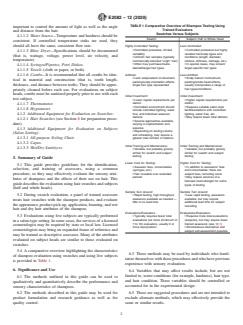
5.4 Acomparative overview highlighting the characteristics
6.3 These methods may be used by individuals who famil-
of shampoo evaluation using swatches and using live subjects
iarizethemselveswiththeseproceduresandwhohaveprevious
is provided in Table 1.
experience with sensory evaluation.
6. Significance and Use
6.4 Variables that may affect results include, but are not
limited to, water conditions (for example, hardness), hair type,
6.1 The methods outlined in this guide can be used to
and hair condition. These variables should be controlled or
qualitatively and quantitatively describe the performance and
accounted for in the experimental design.
sensory characteristics of shampoos.
6.2 The methods described in this guide may be used for 6.5 These are suggested procedures and are not intended to
product formulation and research guidance as well as for exclude alternate methods, which may effectively provide the
quality control. same or similar results.
E2082 − 12 (2020)
7. Trained Panel Selection and Descriptive Training 7.3.2 Priortocompletingascreeningquestionnaire,thetime
commitment for training (orientation and practice sessions),
7.1 The objective is to select and train assessors to evaluate
potential duration of the panel, panel objectives, and assessor
the visual and tactile properties of shampoos on hair swatches
commitment should be discussed with each candidate. In
using a descriptive analysis method. The selection process
addition,inthecaseofacosmetologistassessor,thedifferences
should include the principles embodied inASTM STP758.The
between conduct and responsibilities as a trained evaluator and
task of the assessor is to describe product and hair attributes by
those of a cosmetologist should be emphasized.
ratingtheperceivedquantityandqualityofspecifiedattributes.
7.3.3 A screening questionnaire is recommended (refer to
7.2 Trained Panel Selection:
7.2.3.1).
7.2.1 Assessors may be recruited from within the company,
7.3.4 Select 15 to 20 assessors. This number may vary
or from the local community. The use of licensed cosmetolo-
depending on the complexity of the test and the skill of the
gists as trained assessors adds an additional qualification to the
assessors. The following criteria may be used as a guideline.
community recruit.
Other approaches are described in ASTM MNL13 and ASTM
7.2.2 The choice to use internal employees allows a com-
STP758.
pany to have assessors on site and control proprietary infor-
7.3.4.1 Screening Questionnaire:
mation. It may, however, create potential resource and sched-
(1) Availability for the complete orientation and 80–100 %
uling conflicts, since panel evaluation will not be the
of the training practice sessions.
employees’ primary job focus.
(2) No health-related problems, such as, skin irritations,
7.2.3 The use of local community residents allows the
central nervous system disorders, or medications which might
company to schedule more panel time per week and may lower
interfere with the central nervous system or reduce skin and
the risk of losing assessors.Alarge pool of potential assessors
muscle activity.
is usually available.
(3) Correct and comprehensive descriptive answers to
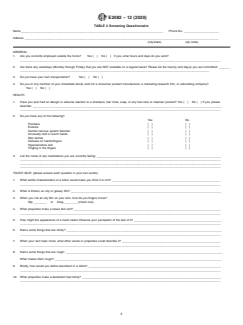
7.2.3.1 Ascreening questionnaire is recommended to deter-
75 % or more of the open-ended tactile questions in the
mine availability, interest, general knowledge of tactile
screening questionnaire.
properties, ability to use descriptive words, and ability to use
(4) Correct rating of 80 % or more of the scaling exercises
rating scales.This questionnaire is used to eliminate unsuitable
in the screening questionnaire (see Figs. 1 and 2).
candidates. Some questions on the screening questionnaire
7.3.4.2 Interview—Eachcandidateshouldbeinterviewedby
relate to previous and current employment. Assess if any of
thepaneladministratorortrainertodetermineattitude,interest,
these questions conflicts with individual company policy (see
and ability to learn and work in a group situation. The
Table 2) It is recommended that the form be approved by the
candidateshoulddemonstrategoodverbalskills,ahighinterest
company’s human resources department.
in descriptive dynamics, and a cooperative yet confident
7.2.4 With specific training, licensed cosmetologists may
personality (see Table 3).
represent a special type of descriptively trained assessor. In
7.4 Trained Panel Orientation/Training:
some states, licensing is required to apply certain hair-care
7.4.1 The panel trainer needs to orient assessors first to the
products to live models (subjects). Information concerning the
general concepts, such as, the definition, components, and
legal requirements for licensing professional cosmetologists
application of descriptive analysis testing. This will take
may be obtained through the states’ Board of Beauty Culture.
approximately two hours.
7.2.5 Licensed cosmetologists typically will require higher
7.4.2 Assessors are introduced to the need for strictly
compensation than non-licensed candidates. Since licensed
controlled sample application procedures and for the careful
cosmetologists are experienced, they may require a shorter
definition of each sensory attribute. This will take approxi-
trainingperiod.Theymayalsohavesomepreconceivedbiases.
mately two hours.
7.2.6 When cosmetologists are trained as descriptive
7.4.3 A discussion and demonstration of each attribute is
evaluators, the difference between their traditional role and
conducted at each stage of the evaluation. This establishes the
their role as a trained descriptive evaluator should be carefully
overall structure of the descriptive analysis of hair-care prop-
explained.
erties. Assessors are encouraged to discuss each term, its
7.3 Recruitment and Screening:
definition, the evaluation procedure(s), and the corresponding
7.3.1 Alarge group of candidates may be recruited from the rating scale after they are demonstrated by the panel trainer.
local community or from within the company (50 to 70 The time involved completing this step depends on the number
recommended, with necessarily fewer if licensed cosmetolo- of attributes selected and the length of discussions. See Section
gists are to be used). If candidates are recruited from the local 9 for suggested procedures and attributes.
community, recommendations include contacting community 7.4.4 For each attribute, the procedure, definition, and scale
groups, placing newspaper ads, and an announcement on the are discussed again in greater depth. Each is demonstrated
recruiting company’s website. If candidates are recruited again with three references when possible. References should
within the company, interoffice memos or emails, or notices represent the full intensity range from none to high. The time
posted on the company’s website or bulletin boards are involved completing this step will again depend on the number
effective. of attributes selected.
E2082 − 12 (2020)
TABLE 2 Screening Questionnaire
Name________________________________________________________________________________________ Phone No. ______________________
Address ________________________________________________________________________________________________________________________
(city/state) (zip code)
GENERAL:
1. Are you currently employed outside the home? Yes ( ) No ( ) If yes, what hours and days do you work?
____________________________________________________________________________________________________________________________
2. Are there any weekdays (Monday through Friday) that you are NOT available on a regular basis? Please list the hour(s) and day(s) you are committed: _______
_____________________________________________________________________________________________________________________
3. Do you have your own transportation? Yes ( ) No ( )
4. Do you or any member of your immediate family work for a consumer product manufacturer, a marketing research firm, or advertising company?
Yes( ) No( )
HEALTH:
1. Have you ever had an allergic or adverse reaction to a shampoo, hair rinse, soap, or any hair-care or cleanser product? Yes ( ) No ( ) If yes, please
describe: _____________________________________________________________________________________________________________________
____________________________________________________________________________________________________________________________
2. Do you have any of the following?
Yes No
Psoriasis () ()
Eczema () ()
Central nervous system disorder ( ) ( )
Unusually cold or warm hands ( ) ( )
Skin rashes () ()
Calluses on hands/fingers ( ) ( )
Hypersensitive skin () ()
Tingling in the fingers ( ) ( )
3. List the name of any medications you are currently taking: _____________________________________________________________________________
____________________________________________________________________________________________________________________________
____________________________________________________________________________________________________________________________
____________________________________________________________________________________________________________________________
TOUCH QUIZ: (please answer each question in your own words)
1. What tactile characteristics of a lotion would make you think it is rich? ___________________________________________________________________
____________________________________________________________________________________________________________________________
2. What is thicker, an oily or greasy film? _____________________________________________________________________________________________
3. When you rub an oily film on your skin, how do you fingers move?
Slip ________ or Drag ________ (check one)
4. What properties make a tissue feel soft? ___________________________________________________________________________________________
____________________________________________________________________________________________________________________________
5. How might the appearance of a hand cream influence your perception of the feel of it? ______________________________________________________
____________________________________________________________________________________________________________________________
6. Name some things that are sticky? ________________________________________________________________________________________________
____________________________________________________________________________________________________________________________
7. When your skin feels moist, what other words or properties could describe it? _____________________________________________________________
____________________________________________________________________________________________________________________________
8. Name some things that are rough: _________________________________________________________________________________________________
What makes them rough? _______________________________________________________________________________________________________
9. Briefly, how would you define absorbent in a lotion? __________________________________________________________________________________
____________________________________________________________________________________________________________________________
10. What properties make a deodorant feel sticky? ______________________________________________________________________________________
____________________________________________________________________________________________________________________________
E2082 − 12 (2020)
FIG. 2 Key for Scaling Exercise
FIG. 1 Scaling Exercise
7.5.1 Several practice sessions totaling at least 20 to 24 h
7.4.5 The attributes (characteristics) and procedures identi-
should be conducted to review the orientation material. These
fied in this guide are suggested (see Section 9). Additional
sessionsshouldincludereviewingtheprocedure,definitionand
attributes may be observed, identified, and evaluated by
rating scale for each attribute, and the evaluation of one or two
different panels. Individual panels may choose to rename the
products using the scale references.
attributes.
7.5.2 During the practice sessions, five to six pairs of
7.5 Trained Panel Practice: samples should be evaluated on all attributes for each stage.
E2082 − 12 (2020)
TABLE 3 Interview Questionnaire
Name ___________________________________________________________________________________ Date ______________________
1. Are you comfortable working in a group situation?
______________________________________________________________________________________________________________________
2. How do you feel about voicing your opinion?
______________________________________________________________________________________________________________________
3. How do you feel about opinionated people?
______________________________________________________________________________________________________________________
4. How do you feel about committing your time to a training program?
______________________________________________________________________________________________________________________
5. Are you interested in being an assessor?
______________________________________________________________________________________________________________________
6. Do you have any questions for me?
______________________________________________________________________________________________________________________
__________________________________________________________________________________________________________________________
Comments ________________________________________________________________________________________________________________
__________________________________________________________________________________________________________________________
Accepted: YES NO
The initial pairs of samples should be very different from each 8.2 Swatchesshouldbefromthesamebundleorlotnumber,
other. This will take from ten to twelve hours. and should be checked for uniformity and quality.
7.6 Trained Panel Validation: 8.3 Hair swatches should be mounted to a tab or other
7.6.1 If possible, correlate results from a recently trained fastening device. The hair should be cut to the same length,
panel to results from an established panel. Otherwise, panel approximately 15 to 25 cm. Depending on the test, the hair
performance can be validated by comparing the results of should be washed with either a standard non-conditioning
replicate evaluations. For this purpose, each test material shampoo or detergent solution (for example, 5 % TEA lauryl
should be presented a minimum of three times. sulfate or 15 % sodium lauryl sulfate). The swatches should be
7.6.2 Alternatemethodsofvalidationmaybesuitable.Refer dried at room temperature. Preparation of the swatches should
toASTM MNL30,ASTM MNL26,ASTM MNL13, orASTM includeorientationofthehairinthesamedirection(roottotip)
STP758,orcombinationthereof,foramoredetaileddiscussion to avoid swatch to swatch differences from frictional effects
on panel validation. created by the cuticle scales during combing.
7.7 Trained Panel Monitoring—Several different aspects 8.4 Theh
...