

ASTM B359/B359M-23
(Specification)Standard Specification for Copper and Copper-Alloy Seamless Condenser and Heat Exchanger Tubes With Integral Fins
General Information
- Abstract
ABSTRACT
This specification establishes the requirements for seamless copper and copper alloy tubing on which the external or internal surface, or both, has been modified by a coldforming process to produce an integral enhanced surface for improved heat transfer. The tubes are typically used in surface condensers, evaporators, and heat exchangers. The seamless copper and copper alloy tubing shall have the internal or external surface, or both, modified by a cold forming process to produce an integral enhanced surface for improved heat transfer. The tube, after enhancing, shall be supplied in the annealed (O61) or as-fabricated temper. The enhanced sections of tubes in the as-fabricated temper are in the cold-worked condition produced by the fabricating operation. The unenhanced sections of tubes in the asfabricated temper are in the temper of the tube prior to enhancing, annealed (O61), or light drawn (H55), and suitable for rolling-in operations. Samples of annealed-temper (O61) tubes selected for test shall be subjected to microscopical examination and shall show uniform and complete recrystallation. Grain size and mechanical properties such as tensile strength and yield strength of the alloys shall be determined. Expansion and flattening tests shall be done to the alloys for performance evaluation. Non-destructive tests such as eddy-current test, hydrostatic test, and pneumatic test shall be done as well.
SCOPE
1.1 This specification2 covers the requirements for seamless copper and copper alloy tubing on which the external or internal surface, or both, has been modified by a cold-forming process to produce an integral enhanced surface for improved heat transfer.
1.2 The tubes are typically used in surface condensers, evaporators, and heat exchangers.
1.3 The product shall be produced of the following coppers or copper alloys, as specified in the ordering information.
Copper or
Copper Alloy
UNS No.
Type of Metal
C10100
Oxygen-free electronic
C10200
Oxygen-free without residual deoxidants
C10300
Oxygen-free, extra low phosphorus
C10800
Oxygen-free, low phosphorus
C12000
DLP Phosphorized, low residual phosphorus
(See Note 1)
C12200
DHP, Phosphorized, high residual phosphorus
(See Note 1)
C14200
DPA Phosphorized arsenical (See Note 1)
C15630
Nickel Phosphorus
C19200
Phosphorized, 1 % iron
C23000
Red Brass
C44300
Admiralty Metal Types B,
C44400
C, and
C44550
D
C60800
Aluminum Bronze
C68700
Aluminum Brass Type B
C70400
95-5 Copper-Nickel
C70600
90-10 Copper-Nickel
C70620
90-10 Copper-Nickel (Modified for Welding)
Copper or
Copper Alloy
UNS No.
Type of Metal
C71000
80-20 Copper-Nickel Type A
C71500
70-30 Copper-Nickel
C71520
70-30 Copper-Nickel (Modified for Welding)
C72200
Copper-Nickel
Note 1: Designations listed in Classification B224.
1.4 Units—The values stated in either in-pound units or SI units are to be regarded separately as the standard. Within the text, the SI units are shown in brackets. The values stated in each system are not exact equivalents; therefore, each system shall be used independently of the other. Combining values from the two systems could result in nonconformance with the specification.
1.5 Product produced in accordance with the Supplementary Requirements section for military applications shall be produced only to the inch-pound system of this specification.
1.6 The following safety hazard caveat pertains only to the test methods described in this specification. This standard does not purport to address all of the safety concerns, if any, associated with its use. It is the responsibility of the user of this standard to establish appropriate safety, health, and environmental practices and determine the applicability of regulatory limitations prior to use. Some specific h...
- Status
- Published
- Publication Date
- 30-Sep-2023
- Technical Committee
- B05 - Copper and Copper Alloys
- Drafting Committee
- B05.04 - Pipe and Tube
Buy Documents
ASTM B359/B359M-23 - Standard Specification for Copper and Copper-Alloy Seamless Condenser and Heat Exchanger Tubes With Integral Fins
REDLINE ASTM B359/B359M-23 - Standard Specification for Copper and Copper-Alloy Seamless Condenser and Heat Exchanger Tubes With Integral Fins
Overview
ASTM B359/B359M-23 is the internationally recognized standard specification developed by ASTM for copper and copper-alloy seamless condenser and heat exchanger tubes with integral fins. This standard establishes the requirements for seamless tubing that is enhanced by a cold-forming process, producing integral finned surfaces-internally, externally, or both-to significantly improve heat transfer performance. Key applications include use in surface condensers, evaporators, and heat exchangers where efficient thermal transfer and durability are required.
The tubes covered under this specification are manufactured from a variety of copper and copper alloy grades, tailored for different operational requirements and end uses in various industries, including HVAC, power generation, and industrial process systems.
Key Topics
- Materials Covered: The standard specifies a comprehensive range of copper and copper alloys, such as C10100, C10200, C12000, C12200, C44300, C70600, C71500, and others. These materials are chosen for their proven thermal conductivity, corrosion resistance, and mechanical properties, making them ideal for heat transfer applications.
- Integral Enhanced Surfaces: Tubes must have enhanced surfaces created through a cold forming process, which may be external, internal, or both. The enhancement is integral to the tube, ensuring durability and maximized surface area for improved heat exchange.
- Product Temper: After enhancement, tubes are furnished in either annealed (O61) or as-fabricated temper. Enhanced sections retain the cold-worked condition, while unenhanced sections can be supplied in the required temper for ease of installation, such as rolling into tube sheets.
- Mechanical and Physical Testing: To guarantee performance, tubes must meet specific requirements for grain size, tensile and yield strength, and undergo various tests including expansion, flattening, and non-destructive tests (eddy-current, hydrostatic, and pneumatic tests).
- Ordering Requirements: Critical details such as alloy designation, dimensions, temper, and enhanced configuration must be specified when ordering to assure compliance with design and performance criteria.
Applications
ASTM B359/B359M-23 tubes are engineered specifically for demanding heat exchange environments. They are widely used in:
- Surface Condensers: Enhanced tubes optimize heat transfer from steam or gas to coolant, improving efficiency in power plants and refineries.
- Evaporators: The integral fin structure increases the surface area, promoting rapid phase change and improved energy efficiency in refrigeration and HVAC units.
- Heat Exchangers: Seamless, enhanced tubes are utilized in shell-and-tube configurations for industrial processing, petrochemical, and marine systems, where resistance to corrosion and optimal thermal performance are crucial.
- Chillers and Cooling Towers: High-conductivity copper alloys with integral fins help maintain consistent temperature control in commercial and industrial facilities.
By meeting ASTM B359/B359M-23 requirements, manufacturers and end-users ensure that their systems operate reliably under varying pressures and temperatures, with a structure that supports easy maintenance and long service life.
Related Standards
The following standards support and supplement ASTM B359/B359M-23:
- ASTM B153: Expansion (Pin Test) of Copper and Copper-Alloy Pipe and Tubing
- ASTM B154: Mercurous Nitrate Test for Copper Alloys
- ASTM B224: Classification of Coppers
- ASTM B601: Classification for Temper Designations for Copper and Copper Alloys
- ASTM B846: Terminology for Copper and Copper Alloys
- ASTM E8/E8M: Tension Testing of Metallic Materials
For applications involving the ASME Boiler and Pressure Vessel Code, refer to ASME SB-359. These referenced standards ensure comprehensive quality, testing, and compatibility throughout the copper tube industry.
Keywords: ASTM B359, copper condenser tubes, copper-alloy heat exchanger, integral finned tubes, seamless tubing, enhanced heat transfer, HVAC standards, industrial heat exchangers, copper nickel tube, thermal conductivity tubing, B359/B359M-23 compliance.
Relations
- Effective Date
- 01-Oct-2023
- Effective Date
- 01-Jan-2024
- Effective Date
- 01-May-2022
- Effective Date
- 01-Oct-2023
Buy Documents
ASTM B359/B359M-23 - Standard Specification for Copper and Copper-Alloy Seamless Condenser and Heat Exchanger Tubes With Integral Fins
REDLINE ASTM B359/B359M-23 - Standard Specification for Copper and Copper-Alloy Seamless Condenser and Heat Exchanger Tubes With Integral Fins
Get Certified
Connect with accredited certification bodies for this standard

Institut za varilstvo d.o.o. (Welding Institute)
Slovenia's leading welding institute since 1952. ISO 3834, EN 1090, pressure equipment certification, NDT personnel, welder qualification. Only IIW Au
Sponsored listings
Frequently Asked Questions
ASTM B359/B359M-23 is a technical specification published by ASTM International. Its full title is "Standard Specification for Copper and Copper-Alloy Seamless Condenser and Heat Exchanger Tubes With Integral Fins". This standard covers: ABSTRACT This specification establishes the requirements for seamless copper and copper alloy tubing on which the external or internal surface, or both, has been modified by a coldforming process to produce an integral enhanced surface for improved heat transfer. The tubes are typically used in surface condensers, evaporators, and heat exchangers. The seamless copper and copper alloy tubing shall have the internal or external surface, or both, modified by a cold forming process to produce an integral enhanced surface for improved heat transfer. The tube, after enhancing, shall be supplied in the annealed (O61) or as-fabricated temper. The enhanced sections of tubes in the as-fabricated temper are in the cold-worked condition produced by the fabricating operation. The unenhanced sections of tubes in the asfabricated temper are in the temper of the tube prior to enhancing, annealed (O61), or light drawn (H55), and suitable for rolling-in operations. Samples of annealed-temper (O61) tubes selected for test shall be subjected to microscopical examination and shall show uniform and complete recrystallation. Grain size and mechanical properties such as tensile strength and yield strength of the alloys shall be determined. Expansion and flattening tests shall be done to the alloys for performance evaluation. Non-destructive tests such as eddy-current test, hydrostatic test, and pneumatic test shall be done as well. SCOPE 1.1 This specification2 covers the requirements for seamless copper and copper alloy tubing on which the external or internal surface, or both, has been modified by a cold-forming process to produce an integral enhanced surface for improved heat transfer. 1.2 The tubes are typically used in surface condensers, evaporators, and heat exchangers. 1.3 The product shall be produced of the following coppers or copper alloys, as specified in the ordering information. Copper or Copper Alloy UNS No. Type of Metal C10100 Oxygen-free electronic C10200 Oxygen-free without residual deoxidants C10300 Oxygen-free, extra low phosphorus C10800 Oxygen-free, low phosphorus C12000 DLP Phosphorized, low residual phosphorus (See Note 1) C12200 DHP, Phosphorized, high residual phosphorus (See Note 1) C14200 DPA Phosphorized arsenical (See Note 1) C15630 Nickel Phosphorus C19200 Phosphorized, 1 % iron C23000 Red Brass C44300 Admiralty Metal Types B, C44400 C, and C44550 D C60800 Aluminum Bronze C68700 Aluminum Brass Type B C70400 95-5 Copper-Nickel C70600 90-10 Copper-Nickel C70620 90-10 Copper-Nickel (Modified for Welding) Copper or Copper Alloy UNS No. Type of Metal C71000 80-20 Copper-Nickel Type A C71500 70-30 Copper-Nickel C71520 70-30 Copper-Nickel (Modified for Welding) C72200 Copper-Nickel Note 1: Designations listed in Classification B224. 1.4 Units—The values stated in either in-pound units or SI units are to be regarded separately as the standard. Within the text, the SI units are shown in brackets. The values stated in each system are not exact equivalents; therefore, each system shall be used independently of the other. Combining values from the two systems could result in nonconformance with the specification. 1.5 Product produced in accordance with the Supplementary Requirements section for military applications shall be produced only to the inch-pound system of this specification. 1.6 The following safety hazard caveat pertains only to the test methods described in this specification. This standard does not purport to address all of the safety concerns, if any, associated with its use. It is the responsibility of the user of this standard to establish appropriate safety, health, and environmental practices and determine the applicability of regulatory limitations prior to use. Some specific h...
ABSTRACT This specification establishes the requirements for seamless copper and copper alloy tubing on which the external or internal surface, or both, has been modified by a coldforming process to produce an integral enhanced surface for improved heat transfer. The tubes are typically used in surface condensers, evaporators, and heat exchangers. The seamless copper and copper alloy tubing shall have the internal or external surface, or both, modified by a cold forming process to produce an integral enhanced surface for improved heat transfer. The tube, after enhancing, shall be supplied in the annealed (O61) or as-fabricated temper. The enhanced sections of tubes in the as-fabricated temper are in the cold-worked condition produced by the fabricating operation. The unenhanced sections of tubes in the asfabricated temper are in the temper of the tube prior to enhancing, annealed (O61), or light drawn (H55), and suitable for rolling-in operations. Samples of annealed-temper (O61) tubes selected for test shall be subjected to microscopical examination and shall show uniform and complete recrystallation. Grain size and mechanical properties such as tensile strength and yield strength of the alloys shall be determined. Expansion and flattening tests shall be done to the alloys for performance evaluation. Non-destructive tests such as eddy-current test, hydrostatic test, and pneumatic test shall be done as well. SCOPE 1.1 This specification2 covers the requirements for seamless copper and copper alloy tubing on which the external or internal surface, or both, has been modified by a cold-forming process to produce an integral enhanced surface for improved heat transfer. 1.2 The tubes are typically used in surface condensers, evaporators, and heat exchangers. 1.3 The product shall be produced of the following coppers or copper alloys, as specified in the ordering information. Copper or Copper Alloy UNS No. Type of Metal C10100 Oxygen-free electronic C10200 Oxygen-free without residual deoxidants C10300 Oxygen-free, extra low phosphorus C10800 Oxygen-free, low phosphorus C12000 DLP Phosphorized, low residual phosphorus (See Note 1) C12200 DHP, Phosphorized, high residual phosphorus (See Note 1) C14200 DPA Phosphorized arsenical (See Note 1) C15630 Nickel Phosphorus C19200 Phosphorized, 1 % iron C23000 Red Brass C44300 Admiralty Metal Types B, C44400 C, and C44550 D C60800 Aluminum Bronze C68700 Aluminum Brass Type B C70400 95-5 Copper-Nickel C70600 90-10 Copper-Nickel C70620 90-10 Copper-Nickel (Modified for Welding) Copper or Copper Alloy UNS No. Type of Metal C71000 80-20 Copper-Nickel Type A C71500 70-30 Copper-Nickel C71520 70-30 Copper-Nickel (Modified for Welding) C72200 Copper-Nickel Note 1: Designations listed in Classification B224. 1.4 Units—The values stated in either in-pound units or SI units are to be regarded separately as the standard. Within the text, the SI units are shown in brackets. The values stated in each system are not exact equivalents; therefore, each system shall be used independently of the other. Combining values from the two systems could result in nonconformance with the specification. 1.5 Product produced in accordance with the Supplementary Requirements section for military applications shall be produced only to the inch-pound system of this specification. 1.6 The following safety hazard caveat pertains only to the test methods described in this specification. This standard does not purport to address all of the safety concerns, if any, associated with its use. It is the responsibility of the user of this standard to establish appropriate safety, health, and environmental practices and determine the applicability of regulatory limitations prior to use. Some specific h...
ASTM B359/B359M-23 is classified under the following ICS (International Classification for Standards) categories: 23.040.15 - Non-ferrous metal pipes. The ICS classification helps identify the subject area and facilitates finding related standards.
ASTM B359/B359M-23 has the following relationships with other standards: It is inter standard links to ASTM B359/B359M-18, ASTM E8/E8M-24, ASTM E8/E8M-22, ASTM B956-19e1. Understanding these relationships helps ensure you are using the most current and applicable version of the standard.
ASTM B359/B359M-23 is available in PDF format for immediate download after purchase. The document can be added to your cart and obtained through the secure checkout process. Digital delivery ensures instant access to the complete standard document.
Standards Content (Sample)
This international standard was developed in accordance with internationally recognized principles on standardization established in the Decision on Principles for the
Development of International Standards, Guides and Recommendations issued by the World Trade Organization Technical Barriers to Trade (TBT) Committee.
Designation: B359/B359M − 23
Standard Specification for
Copper and Copper-Alloy Seamless Condenser and Heat
Exchanger Tubes With Integral Fins
This standard is issued under the fixed designation B359/B359M; the number immediately following the designation indicates the year
of original adoption or, in the case of revision, the year of last revision. A number in parentheses indicates the year of last reapproval.
A superscript epsilon (´) indicates an editorial change since the last revision or reapproval.
1. Scope*
Copper or
Copper Alloy Type of Metal
1.1 This specification covers the requirements for seamless
UNS No.
copper and copper alloy tubing on which the external or
C71000 80-20 Copper-Nickel Type A
internal surface, or both, has been modified by a cold-forming
C71500 70-30 Copper-Nickel
process to produce an integral enhanced surface for improved
C71520 70-30 Copper-Nickel (Modified for Welding)
heat transfer. C72200 Copper-Nickel
1.2 The tubes are typically used in surface condensers, NOTE 1—Designations listed in Classification B224.
evaporators, and heat exchangers.
1.4 Units—The values stated in either in-pound units or SI
1.3 The product shall be produced of the following coppers units are to be regarded separately as the standard. Within the
or copper alloys, as specified in the ordering information. text, the SI units are shown in brackets. The values stated in
each system are not exact equivalents; therefore, each system
Copper or
Copper Alloy Type of Metal
shall be used independently of the other. Combining values
UNS No.
from the two systems could result in nonconformance with the
specification.
C10100 Oxygen-free electronic
C10200 Oxygen-free without residual deoxidants
1.5 Product produced in accordance with the Supplementary
C10300 Oxygen-free, extra low phosphorus
C10800 Oxygen-free, low phosphorus
Requirements section for military applications shall be pro-
C12000 DLP Phosphorized, low residual phosphorus
duced only to the inch-pound system of this specification.
(See Note 1)
C12200 DHP, Phosphorized, high residual phosphorus
1.6 The following safety hazard caveat pertains only to the
(See Note 1)
test methods described in this specification. This standard does
C14200 DPA Phosphorized arsenical (See Note 1)
C15630 Nickel Phosphorus
not purport to address all of the safety concerns, if any,
C19200 Phosphorized, 1 % iron
associated with its use. It is the responsibility of the user of this
C23000 Red Brass
standard to establish appropriate safety, health, and environ-
C44300 Admiralty Metal Types B,
C44400 C, and
mental practices and determine the applicability of regulatory
C44550 D
limitations prior to use. Some specific hazards statements are
C60800 Aluminum Bronze
given in Sections 1, 12 and 18.
C68700 Aluminum Brass Type B
C70400 95-5 Copper-Nickel
1.7 (Warning—Mercury has been designated by many
C70600 90-10 Copper-Nickel
C70620 90-10 Copper-Nickel (Modified for Welding)
regulatory agencies as a hazardous substance that can cause
serious medical issues. Mercury, or its vapor, has been dem-
onstrated to be hazardous to health and corrosive to materials.
This specification is under the jurisdiction of ASTM Committee B05 on Copper
Use caution when handling mercury and mercury-containing
and Copper Alloys and is the direct responsibility of Subcommittee B05.04 on Pipe
products. See the applicable product Safety Data Sheet (SDS)
and Tube.
Current edition approved Oct. 1, 2023. Published October 2023. Originally
for additional information. The potential exists that selling
approved in 1960. Last previous edition approved in 2018 as B359/B359M – 18.
mercury or mercury-containing products, or both, is prohibited
DOI: 10.1520/B0359_B0359M-23.
by local or national law. Users must determine legality of sales
For ASME Boiler and Pressure Vessel Code applications, see related Specifi-
cation SB-359 in Section II of that Code. in their location.)
*A Summary of Changes section appears at the end of this standard
Copyright © ASTM International, 100 Barr Harbor Drive, PO Box C700, West Conshohocken, PA 19428-2959. United States
B359/B359M − 23
1.8 This international standard was developed in accor- 3. General Requirements
dance with internationally recognized principles on standard-
3.1 Product described by this specification shall typically be
ization established in the Decision on Principles for the
furnished with unenhanced ends, but may be furnished with
Development of International Standards, Guides and Recom-
enhanced ends or stripped ends from which the O.D. enhance-
mendations issued by the World Trade Organization Technical
ment has been removed by machining.
Barriers to Trade (TBT) Committee.
3.1.1 The enhanced sections of the tube in the as-fabricated
temper are in the cold-worked condition produced by the
2. Referenced Documents
enhancing operation.
2.1 ASTM Standards:
3.1.2 The unenhanced sections of the tube shall be in the
B153 Test Method for Expansion (Pin Test) of Copper and
annealed or light drawn temper, and shall be suitable for
Copper-Alloy Pipe and Tubing
rolling-in operations.
B154 Test Method for Mercurous Nitrate Test for Copper
Alloys
4. Terminology
B170 Specification for Oxygen-Free Electrolytic Copper—
4.1 For the definitions of terms related to copper and copper
Refinery Shapes
alloys, refer to Terminology B846.
B224 Classification of Coppers
4.2 Definitions of Terms Specific to This Standard:
B601 Classification for Temper Designations for Copper and
4.2.1 tube condenser, n—see tube, heat exchanger in Ter-
Copper Alloys—Wrought and Cast
minology B846.
B846 Terminology for Copper and Copper Alloys
B858 Test Method for Ammonia Vapor Test for Determining
5. Ordering Information
Susceptibility to Stress Corrosion Cracking in Copper
5.1 Include the following information when placing orders
Alloys
under this specification:
B900 Practice for Packaging of Copper and Copper Alloy
5.1.1 ASTM designation and year of issue,
Mill Products for U.S. Government Agencies
5.1.2 Copper or Copper Alloy UNS No. designation (see 1.3
B968/B968M Test Method for Flattening of Copper and
and Section 7),
Copper-Alloy Pipe and Tube
5.1.3 Temper (see Section 8),
D4727/D4727M Specification for Corrugated and Solid Fi-
5.1.4 Dimensions: diameter, wall thickness, length and lo-
berboard Sheet Stock (Container Grade) and Cut Shapes
cation of unenhanced surfaces and total tube length. Configu-
E3 Guide for Preparation of Metallographic Specimens
ration of enhanced surfaces shall be as agreed upon between
E8/E8M Test Methods for Tension Testing of Metallic Ma-
the manufacturer and the purchaser. (See Figs. 1 and 2).
terials
5.1.5 Whether the product is to be subsequently welded for
E29 Practice for Using Significant Digits in Test Data to
UNS Alloy C72200, UNS Alloys C70620 and C71520 are
Determine Conformance with Specifications
welding grades of C70600 and C71500,
E53 Test Method for Determination of Copper in Unalloyed
5.1.6 Quantity, and
Copper by Gravimetry (Withdrawn 2022)
5.1.7 If product is for the U.S. government.
E62 Test Methods for Chemical Analysis of Copper and
Copper Alloys (Photometric Methods) (Withdrawn 2010)
5.2 The following options are available and shall be speci-
E112 Test Methods for Determining Average Grain Size
fied at the time of placing the order, when required:
E118 Test Methods for Chemical Analysis of Copper-
5.2.1 When heat identification or traceability is required,
Chromium Alloys (Withdrawn 2010)
5.2.2 When tubes are for Boiler and Pressure Vessel code
E243 Practice for Electromagnetic (Eddy Current) Examina-
application, which should then be ordered according to ASME
tion of Copper and Copper-Alloy Tubes
SB 359,
E255 Practice for Sampling Copper and Copper Alloys for
5.2.3 Flattening test (see 11.2),
the Determination of Chemical Composition
5.2.4 Certification (see Section 22), when required,
E478 Test Methods for Chemical Analysis of Copper Alloys
5.2.5 Mill test report (see Section 23), when required, and
E2575 Test Method for Determination of Oxygen in Copper
5.2.6 Stress relief annealing (see 9.4), when required.
and Copper Alloys by Inert Gas Fusion
5.3 In addition, when material is purchased for agencies of
2.2 ASME Standard:
the U.S. government, it shall conform to the requirements
ASME Boiler and Pressure Vessel Code
specified in the Supplementary Requirements section, when
specified in the contract or purchase order.
For referenced ASTM standards, visit the ASTM website, www.astm.org, or
contact ASTM Customer Service at service@astm.org. For Annual Book of ASTM
6. Materials and Manufacture
Standards volume information, refer to the standard’s Document Summary page on
6.1 Materials:
the ASTM website.
The last approved version of this historical standard is referenced on
6.1.1 The material of manufacture shall be of such quality
www.astm.org.
and purity that the finished product shall have the properties
Available from American Society of Mechanical Engineers (ASME), ASME
and characteristics prescribed in this specification for the
International Headquarters, Two Park Ave., New York, NY 10016-5990, http://
www.asme.org. applicable alloy and temper.
B359/B359M − 23
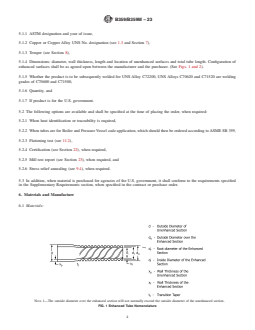
NOTE 1—The outside diameter over the enhanced section will not normally exceed the outside diameter of the unenhanced section.
FIG. 1 Enhanced Tube Nomenclature
FIG. 2 Inside Enhanced Tube Nomenclature
(Internal Groove Tube)
6.2 Manufacture: 7.2.2 For alloys in which zinc is specified as the remainder,
either copper or zinc may be taken as the difference between
6.2.1 The seamless copper and copper alloy tubing shall
the sum of the results of specified elements analyzed and
have the internal or external surface, or both, modified by a
100 %.
cold forming process to produce an integral enhanced surface
for improved heat transfer.
8. Temper
6.2.2 The cut ends of the tubes shall be deburred.
6.2.3 Due to the discontinuous nature of the processing of
8.1 Tempers, as defined in Classification B601 and this
castings into wrought products, it is not practical to identify
document, are as follows:
specific casting analysis with a specific quantity of finished
8.1.1 The tube, after enhancing, shall be supplied, as
material.
specified, in the annealed (O61), heavy anneal (O62), or
6.2.4 When heat identification is required, the purchaser
as-fabricated temper.
shall specify the details desired in the purchase order or
8.1.1.1 The enhanced sections of tubes in the as-fabricated
contract.
temper are in the cold-worked condition produced by the
fabricating operation.
7. Chemical Composition
8.1.1.2 The unenhanced sections of tubes in the as-
7.1 The tubes shall conform to the chemical requirements
fabricated temper are either in the temper of the tube prior to
specified in Table 1 for copper or copper alloy specified in the
enhancing (annealed (O61), heavy anneal (O62), light drawn
ordering information.
(H55), or hard drawn (H80)) or when cold working of the
unenhanced portions is performed as a part of the enhancing
7.2 These specification limits do not preclude the presence
operations they shall be in the light drawn (H55) temper. In
of unnamed elements. By agreement between the
either case, the unenhanced surfaces shall be suitable for
manufacturer, or supplier and purchaser, analysis may be
rolling-in operations.
required and limits established for elements not specified.
8.1.1.3 Copper Alloy UNS Nos. C23000, C44300, C44400,
7.2.1 For alloys in which copper is specified as the
remainder, copper may be taken as the difference between the C44500, C60800, and C68700, furnished in the as-fabricated
temper, shall be stress-relief annealed after enhancing and be
sum of the results for all specified elements and 100 % for the
particular alloy. capable of meeting the requirements of the stress-corrosion
B359/B359M − 23
TABLE 1 Chemical Composition
Composition, %
Copper
or
Other
Copper
Alumi- Nickel, incl Lead, Named
Copper Tin Iron Zinc Manganese Arsenic Antimony Phosphorus Chromium
Alloy
num Cobalt max Ele-
UNS No.
ments
A,B
C10100 99.99 min 0.0002 . . . 0.0010 0.0005 0.0010 0.0001 0.00005 0.0005 0.0004 max 0.0003 max . . . Te 0.0002
max max max max max max
C,D,E
C10200 99.95 min . . . . . . . . . . . . . . . . . . . . . . . . . . . . . . . . . . . .
C,F,G
C10300 99.95 min . . . . . . . . . . . . . . . . . . . . . . . . . . . 0.001–0.005 . . . . . .
C,F,G
C10800 99.95 min . . . . . . . . . . . . . . . . . . . . . . . . . . . 0.005–0.012 . . . . . .
C
C12000 99.90 min . . . . . . . . . . . . . . . . . . . . . . . . . . . 0.004–0.012 . . . . . .
C
C12200 99.9 min . . . . . . . . . . . . . . . . . . . . . . . . 0.015–0.040 . . .
C
C14200 99.4 min . . . . . . . . . . . . . . . . . . . . . 0.15–0.50 . . . 0.015–0.040 . . . . . .
C, H I
C15630 remainder . . . . . . 0.60–0.90 . . . . . . . . . . . . . . . . . . 0.015–0.040 . . . . . .
J
C19200 98.5 min . . . . . . . . . . . . 0.8–1.2 0.20 max . . . . . . . . . 0.01–0.04 . . . . . .
J
C23000 84.0–86.0 . . . . . . . . . 0.05 0.05 max remainder . . . . . . . . . . . . . . . . . .
K
C44300 70.0–73.0 0.9–1.2 . . . . . . 0.07 0.06 max remainder . . . 0.02–0.06 . . . . . . . . . . . .
K
C44400 70.0–73.0 0.9–1.2 . . . . . . 0.07 0.06 max remainder . . . . . . 0.02–0.10 . . . . . . . . .
K
C44500 70.0–73.0 0.9–1.2 . . . . . . 0.07 0.06 max remainder . . . . . . . . . 0.02–0.10 . . . . . .
C,H
C60800 remainder . . . 5.0–6.5 . . . 0.10 0.10 max . . . . . . 0.02–0.35 . . . . . . . . . . . .
C,H
C68700 76.0–79.0 . . . 1.8–2.5 . . . 0.07 0.06 max remainder . . . 0.02–0.06 . . . . . . . . . . . .
C,H
C70400 remainder . . . . . . 4.8–6.2 0.05 1.3–1.7 1.0 max 0.30–0.8 . . . . . . . . . . . . . . .
C,H
C70600 remainder . . . . . . 9.0–11.0 0.05 1.0–1.8 1.0 max 1.0 max . . . . . . . . . . . . . . .
C,H
C70620 86.5 min . . . . . . 9.0–11.0 0.02 1.0–1.8 0.5 max 1.0 max . . . . . . 0.02 max . . . 0.05 C max
0.02 S max
C,H,L
C71000 remainder . . . . . . 19.0–23.0 0.05 1.0 max 1.0 max 1.0 max . . . . . . . . . . . .
C,H
C71500 remainder . . . . . . 29.0–33.0 0.05 0.40–1.0 1.0 max 1.0 max . . . . . . . . . . . . . . .
G,H
C71520 65.0 min . . . . . . 29.0–33.0 0.02 0.40–1.0 0.50 max 1.0 max . . . . . . 0.02 max . . . 0.05 C max
0.02 S max
C,J,L
C72200 remainder . . . . . . 15.0–18.0 0.05 0.50–1.0 1.0 max 1.0 max . . . . . . . . . 0.30–0.70 0.03 Si
0.03 Ti
A
This value is exclusive of silver and shall be determined by difference of “impurity total” from 100 %. “Impurity total” is defined as the sum of sulfur, silver, lead, tin, bismuth,
arsenic, antimony, iron, nickel, zinc, phosphorus, selenium, tellurium, manganese, cadmium, and oxygen present in the sample.
B
Other impurity maximums for C10100 shall be: bismuth and cadmium 0.0001 each, oxygen 0.0005, selenium 0.0003, silver 0.0025, and sulfur 0.0015.
C
Copper (including silver).
D
Oxygen in C10200 shall be 0.0010 max.
E
Cu is determined by the difference in the impurity total and 100 %.
F
Copper plus sum of named elements shall be 99.95 % min.
G
Includes P.
H
Cu + Sum of Named Elements, 99.5 % min.
I
Not including Co.
J
Cu + Sum of Named Elements, 99.8 % min.
K
Cu + Sum of Named Elements, 99.6 % min.
L
When the product is for subsequent welding applications, and so specified in the contract or purchase order, zinc shall be 0.50 % max, lead 0.02 % max, phosphorus
0.02 % max, sulfur 0.02 % max, and carbon 0.05 % max.
susceptibility requirement in Section 12. Stress-relief anneal- tubes of Copper Alloy UNS Nos. C23000, C44300, C44400,
ing of alloys not listed in this paragraph is not required unless C44500, C60800, and C68700 be subjected to a stress relieving
specified by customer. thermal treatment subsequent to straightening. When required,
this must be specified on the purchase order or contract.
9. Grain Size of Annealed Temper
Tolerance for roundness and length, and the condition for
9.1 Samples of annealed-temper (O61, O62) tubes selected straightness, for tube so ordered, shall be to the requirements
agreed upon between the manufacturer and purchaser.
for test shall be subjected to microscopical examination at a
magnification of 75 diameters and shall show uniform and
10. Mechanical Property Requirements
complete recrystallization.
10.1 Tensile Property Requirements:
9.2 Average grain size shall be within limits agreed upon
10.1.1 Prior to the enhancing operation, the tube shall
between the manufacturer and purchaser.
conform to the requirements for tensile properties prescribed in
9.3 The requirements of this section do not apply to product
Table 2.
shipped in the as-fabricated temper.
10.1.2 Alternatively, for those enhancing operations that
9.4 Some annealed tubes, when subjected to aggressive include cold working of the unenhanced portions of the tube
environments, may be subject to stress-corrosion cracking integral to the process, the unenhanced portions shall conform
failure because of the residual tensile stresses developed in to the H55 as prescribed in Table 2 for the UNS alloys
straightening. For such applications, it is recommended that identified.
B359/B359M − 23
TABLE 2 Tensile Requirements
Tensile
Yield
A
Temper Designation Strength,
Strength,
Copper or Copper Alloy UNS No.
min
min
B B
Standard Former ksi [MPa] ksi [MPa]
C
C10100, C10200, C10300, C10800, C12000, C12200, C14200 O61 annealed 30 [205] 9 [62]
C
C10100, C10200, C10300, C10800, C12000, C12200, C14200 O62 heavy anneal 30 [205] 6.5 [45]
C10100, C10200, C10300, C10800, C12000, C12200, C14200 H55 light-drawn 36 [250] 30 [205]
C10100, C10200, C10300, C10800, C12000, C12200, C14200 H80 hard-drawn 45 [310] 40 [275]
C15630 O61 annealed 30 [205] 8 [55]
C19200 O61 annealed 38 [260] 12 [85]
C23000 O61 annealed 40 [275] 12 [85]
C44300, C44400, C44500 O61 annealed 45 [310] 15 [105]
C60800 O61 annealed 50 [345] 19 [130]
C68700 O61 annealed 50 [345] 18 [125]
C70400 O61 annealed 38 [260] 12 [85]
C70600 O61 annealed 40 [275] 15 [105]
C70620 O61 annealed 40 [275] 15 [105]
C71000 O61 annealed 45 [310] 16 [110]
C71500 O61 annealed 52 [360] 18 [125]
C71520 O61 annealed 52 [360] 18 [125]
C72200 O61 annealed 45 [310] 16 [110]
A
At 0.5 % extension under load.
B
ksi = 1000 psi.
C
Light straightening operation is permitted.
11. Performance Requirements 12. Other Requirements
11.1 Expansion Test—The unenhanced sections of all tubes
12.1 Mercurous Nitrate Test or Ammonia Vapor Test:
selected for test shall conform to the requirements prescribed in
12.1.1 The mercurous nitrate or ammonia vapor test is
Table 3 when tested in accordance with Test Method B153. The
required only for Copper Alloys UNS Nos. C23000, C44300,
expanded tube shall show no cracking or rupture visible to the
C44400, C44500, C60800, and C68700. (Warning—Mercury
unaided eye.
is a definite health hazard and therefore equipment for the
11.2 Flattening Test:
detection and removal of mercury vapor produced in volitiza-
11.2.1 When specified in the contract or purchase order, the
tion is recommended. The use of rubber gloves in testing is
flattening test described in the Test Method B968/B968M shall
advisable.)
be performed.
12.1.2 The test specimens, cut 6 in. [150 mm] in length from
11.2.1.1 During inspection, the flattened areas of the test-
the enhanced section shall withstand, without cracking, an
specimen shall be free of defects, but blemishes of a nature that
immersion in the standard mercurous nitrate solution in Test
do not interfere with the intended application are acceptable.
TABLE 3 Expansion Requirements
Expansion of Tube
Temper Designation
Outside Diameter in
Copper or Copper Alloy UNS No.
Percent of Original
Standard Former
Outside Diameter
O61 annealed C10100, C10200, C10300, C10800, C12000, C12200, C14200 30
O62 heavy anneal C10100, C10200, C10300, C10800, C12000, C12200, C14200 30
H55 light-drawn C10100, C10200, C10300, C10800, C12000, C12200, C14200 20
H80 hard-drawn C10100, C10200, C10300, C10800, C12000, C12200, C14200 20
O61 annealed C15630 40
O61 annealed C19200 30
O61 annealed C23000 20
O61 annealed C44300, C44400, C44500 20
O61 annealed C60800 20
O61 annealed C68700 20
O61 annealed C70400 30
O61 annealed C70600, C70620 30
O61 annealed C71000 30
O61 annealed C71500, C71520 30
O61 annealed C72200 30
B359/B359M − 23
Method B154 or immersion in the ammonia vapor solution as 13. Dimensions, Mass, and Permissible Variations
defined in Test Method B858.
13.1 Tube Diameter:
12.1.3 Unless otherwise agreed upon between the
13.1.1 The outside diameter of the unenhanced sections
manufacturer, or supplier, and the purchaser, the manufacturer
shall not vary by more than the amount shown in Table 4 for
shall have the option of using either the mercurous nitrate test
the appropriate dimensional system, as measured by “go” and
or the ammonia vapor test. If agreement cannot be reached, the
“no go” ring gages. The diameter over the enhanced sections
mercurous nitrate test standard shall be utilized.
shall not exceed the diameter of the plain sections involved, as
12.1.4 If the ammonia vapor test is selected, the appropriate determined by a “go” ring gage, unless otherwise specified.
risk level pH value for the test solution shall be agreed upon by
13.2 Wall Thickness—No tube shall be less than the mini-
the manufacturer and purchaser, or alternately, if the purchaser
mum thickness specified in the plain sections or in the
defers to the manufacturer’s expertise for the selection of the
enhanced sections.
test pH value, the minimum value selected shall be 9.8.
13.3 Length:
12.2 Non-Destructive Testing:
13.3.1 The length of the tubes shall not be less than that
specified when measured at a temperature of 68 °F [20 °C], but
12.2.1 Each tube shall be subjected to a non-destructive test.
Tubes shall normally be tested in the as-fabricated temper but, may exceed the specified value by the amounts shown in Table
5, for the appropriate dimensional system.
at the option of the manufacturer, may be tested in the annealed
temper. Unless otherwise specified, the manufacturer shall 13.3.2 The length of the unenhanced end(s), as measured
from the tube end to the first fin disk impression, shall not be
have the option of testing the tubes by one of the following test
methods: less than that specified, but may exceed the specified value by
⁄2 in. [13 mm].
12.2.1.1 Non-Destructive Examination for Defects:
(1) The tubes shall be passed through an eddy-current
13.4 Squareness of Cut—The departure from squareness of
testing unit adjusted in accordance with the requirements of
the end of any tube shall not exceed the tolerance stated in
18.3.3 to provide information on the suitability of the tube for
Table 6, for the appropriate dimensional system.
the intended application.
14. Workmanship, Finish, and Appearance
(2) Tubes causing irrelevant signals because of moisture,
soil, and like effects may be reconditioned and retested. Such
14.1 Roundness, straightness, uniformity of wall thickness,
tubes shall be considered to conform, should they not cause
and condition of inner and outer surfaces of the tube shall be
output signals beyond the acceptable limits.
such as to make it suitable for the intended application. Unless
(3) Tubes causing irrelevant signals because of visible and
otherwise specified on the purchase order, the cut ends of the
identifiable handli
...
This document is not an ASTM standard and is intended only to provide the user of an ASTM standard an indication of what changes have been made to the previous version. Because
it may not be technically possible to adequately depict all changes accurately, ASTM recommends that users consult prior editions as appropriate. In all cases only the current version
of the standard as published by ASTM is to be considered the official document.
Designation: B359/B359M − 18 B359/B359M − 23
Standard Specification for
Copper and Copper-Alloy Seamless Condenser and Heat
Exchanger Tubes With Integral Fins
This standard is issued under the fixed designation B359/B359M; the number immediately following the designation indicates the year
of original adoption or, in the case of revision, the year of last revision. A number in parentheses indicates the year of last reapproval.
A superscript epsilon (´) indicates an editorial change since the last revision or reapproval.
1. Scope*
1.1 This specification establishescovers the requirements for seamless copper and copper alloy tubing on which the external or
internal surface, or both, has been modified by a cold-forming process to produce an integral enhanced surface for improved heat
transfer.
1.2 The tubes are typically used in surface condensers, evaporators, and heat exchangers.
1.3 The product shall be produced of the following coppers or copper alloys, as specified in the ordering information.
Copper or
Copper Alloy Type of Metal
UNS No.
C10100 Oxygen-free electronic
C10200 Oxygen-free without residual deoxidants
C10300 Oxygen-free, extra low phosphorus
C10800 Oxygen-free, low phosphorus
C12000 DLP Phosphorized, low residual phosphorus
(See Note 1)
C12200 DHP, Phosphorized, high residual phosphorus
(See Note 1)
C14200 DPA Phosphorized arsenical (See Note 1)
C15630 Nickel Phosphorus
C19200 Phosphorized, 1 % iron
C23000 Red Brass
C44300 Admiralty Metal Types B,
C44400 C, and
C44550 D
C60800 Aluminum Bronze
C68700 Aluminum Brass Type B
C70400 95-5 Copper-Nickel
C70600 90-10 Copper-Nickel
C70620 90-10 Copper-Nickel (Modified for Welding)
Copper or
Copper Alloy Type of Metal
UNS No.
C71000 80-20 Copper-Nickel Type A
This specification is under the jurisdiction of ASTM Committee B05 on Copper and Copper Alloys and is the direct responsibility of Subcommittee B05.04 on Pipe and
Tube.
Current edition approved Oct. 1, 2018Oct. 1, 2023. Published November 2018October 2023. Originally approved in 1960. Last previous edition approved in 20152018
as B359/B359MB359/B359M – 18.–15. DOI: 10.1520/B0359_B0359M–18.10.1520/B0359_B0359M-23.
For ASME Boiler and Pressure Vessel Code applications, see related Specification SB-359 in Section II of that Code.
*A Summary of Changes section appears at the end of this standard
Copyright © ASTM International, 100 Barr Harbor Drive, PO Box C700, West Conshohocken, PA 19428-2959. United States
B359/B359M − 23
C71500 70-30 Copper-Nickel
C71520 70-30 Copper-Nickel (Modified for Welding)
C72200 Copper-Nickel
NOTE 1—Designations listed in Classification B224.
1.4 Units—The values stated in either in-pound units or SI units are to be regarded separately as the standard. Within the text, the
SI units are shown in brackets. The values stated in each system are not exact equivalents; therefore, each system shall be used
independently of the other. Combining values from the two systems could result in nonconformance with the specification.
1.5 Product produced in accordance with the Supplementary Requirements section for military applications shall be produced only
to the inch-pound system of this specification.
1.6 The following safety hazard caveat pertains only to the test methods described in this specification. This standard does not
purport to address all of the safety concerns, if any, associated with its use. It is the responsibility of the user of this standard to
establish appropriate safety, health, and environmental practices and determine the applicability of regulatory limitations prior
to use. Some specific hazards statements are given in Sections 1, 12 and 18.
1.7 (Warning—Mercury has been designated by many regulatory agencies as a hazardous substance that can cause serious
medical issues. Mercury, or its vapor, has been demonstrated to be hazardous to health and corrosive to materials. Use caution
when handling mercury and mercury-containing products. See the applicable product Safety Data Sheet (SDS) for additional
information. The potential exists that selling mercury or mercury-containing products, or both, is prohibited by local or national
law. Users must determine legality of sales in their location.)
B359/B359M − 23
1.8 This international standard was developed in accordance with internationally recognized principles on standardization
established in the Decision on Principles for the Development of International Standards, Guides and Recommendations issued
by the World Trade Organization Technical Barriers to Trade (TBT) Committee.
2. Referenced Documents
2.1 ASTM Standards:
B153 Test Method for Expansion (Pin Test) of Copper and Copper-Alloy Pipe and Tubing
B154 Test Method for Mercurous Nitrate Test for Copper Alloys
B170 Specification for Oxygen-Free Electrolytic Copper—Refinery Shapes
B224 Classification of Coppers
B601 Classification for Temper Designations for Copper and Copper Alloys—Wrought and Cast
B846 Terminology for Copper and Copper Alloys
B858 Test Method for Ammonia Vapor Test for Determining Susceptibility to Stress Corrosion Cracking in Copper Alloys
B900 Practice for Packaging of Copper and Copper Alloy Mill Products for U.S. Government Agencies
B968/B968M Test Method for Flattening of Copper and Copper-Alloy Pipe and Tube
D4727/D4727M Specification for Corrugated and Solid Fiberboard Sheet Stock (Container Grade) and Cut Shapes
E3 Guide for Preparation of Metallographic Specimens
E8/E8M Test Methods for Tension Testing of Metallic Materials
E29 Practice for Using Significant Digits in Test Data to Determine Conformance with Specifications
E53 Test Method for Determination of Copper in Unalloyed Copper by Gravimetry (Withdrawn 2022)
E62 Test Methods for Chemical Analysis of Copper and Copper Alloys (Photometric Methods) (Withdrawn 2010)
E112 Test Methods for Determining Average Grain Size
E118 Test Methods for Chemical Analysis of Copper-Chromium Alloys (Withdrawn 2010)
E243 Practice for Electromagnetic (Eddy Current) Examination of Copper and Copper-Alloy Tubes
E255 Practice for Sampling Copper and Copper Alloys for the Determination of Chemical Composition
E478 Test Methods for Chemical Analysis of Copper Alloys
E2575 Test Method for Determination of Oxygen in Copper and Copper Alloys by Inert Gas Fusion
2.2 ASME Standard:
ASME Boiler and Pressure Vessel Code
3. General Requirements
3.1 Product described by this specification shall typically be furnished with unenhanced ends, but may be furnished with enhanced
ends or stripped ends from which the O.D. enhancement has been removed by machining.
3.1.1 The enhanced sections of the tube in the as-fabricated temper are in the cold-worked condition produced by the enhancing
operation.
3.1.2 The unenhanced sections of the tube shall be in the annealed or light drawn temper, and shall be suitable for rolling-in
operations.
4. Terminology
4.1 For the definitions of terms related to copper and copper alloys, refer to Terminology B846.
4.2 Definitions of Terms Specific to This Standard:
4.2.1 tube condenser, n—see tube, heat exchanger in Terminology B846.
5. Ordering Information
5.1 Include the following information when placing orders under this specification:
For referenced ASTM standards, visit the ASTM website, www.astm.org, or contact ASTM Customer Service at service@astm.org. For Annual Book of ASTM Standards
volume information, refer to the standard’s Document Summary page on the ASTM website.
The last approved version of this historical standard is referenced on www.astm.org.
Available from American Society of Mechanical Engineers (ASME), ASME International Headquarters, Two Park Ave., New York, NY 10016-5990, http://
www.asme.org.
B359/B359M − 23
5.1.1 ASTM designation and year of issue,
5.1.2 Copper or Copper Alloy UNS No. designation (see 1.3 and Section 7),
5.1.3 Temper (see Section 8),
5.1.4 Dimensions: diameter, wall thickness, length and location of unenhanced surfaces and total tube length. Configuration of
enhanced surfaces shall be as agreed upon between the manufacturer and the purchaser. (See Figs. 1 and 2).
5.1.5 Whether the product is to be subsequently welded for UNS Alloy C72200, UNS Alloys C70620 and C71520 are welding
grades of C70600 and C71500,
5.1.6 Quantity, and
5.1.7 If product is for the U.S. government.
5.2 The following options are available and shall be specified at the time of placing the order, when required:
5.2.1 When heat identification or traceability is required,
5.2.2 When tubes are for Boiler and Pressure Vessel code application, which should then be ordered according to ASME SB 359,
5.2.3 Flattening test (see 11.2),
5.2.4 Certification (see Section 22), when required,
5.2.5 Mill test report (see Section 23), when required, and
5.2.6 Stress relief annealing (see 9.4), when required.
5.3 In addition, when material is purchased for agencies of the U.S. government, it shall conform to the requirements specified
in the Supplementary Requirements section, when specified in the contract or purchase order.
6. Materials and Manufacture
6.1 Materials:
NOTE 1—The outside diameter over the enhanced section will not normally exceed the outside diameter of the unenhanced section.
FIG. 1 Enhanced Tube Nomenclature
B359/B359M − 23
FIG. 2 Inside Enhanced Tube Nomenclature
(Internal Groove Tube)
6.1.1 The material of manufacture shall be of such quality and purity that the finished product shall have the properties and
characteristics prescribed in this specification for the applicable alloy and temper.
B359/B359M − 23
6.2 Manufacture:
6.2.1 The seamless copper and copper alloy tubing shall have the internal or external surface, or both, modified by a cold forming
process to produce an integral enhanced surface for improved heat transfer.
6.2.2 The cut ends of the tubes shall be deburred.
6.2.3 Due to the discontinuous nature of the processing of castings into wrought products, it is not practical to identify specific
casting analysis with a specific quantity of finished material.
6.2.4 When heat identification is required, the purchaser shall specify the details desired in the purchase order or contract.
7. Chemical Composition
7.1 The tubes shall conform to the chemical requirements specified in Table 1 for copper or copper alloy specified in the ordering
information.
7.2 These specification limits do not preclude the presence of unnamed elements. By agreement between the manufacturer, or
supplier and purchaser, analysis may be required and limits established for elements not specified.
TABLE 1 Chemical Composition
Composition, %
Copper
or
Other
Copper
Alumi- Nickel, incl Lead, Named
Copper Tin Iron Zinc Manganese Arsenic Antimony Phosphorus Chromium
Alloy
num Cobalt max Ele-
UNS No.
ments
A,B
C10100 99.99 min 0.0002 . . . 0.0010 0.0005 0.0010 0.0001 0.00005 0.0005 0.0004 max 0.0003 max . . . Te 0.0002
max max max max max max
C,D,E
C10200 99.95 min . . . . . . . . . . . . . . . . . . . . . . . . . . . . . . . . . . . .
C,F,G
C10300 99.95 min . . . . . . . . . . . . . . . . . . . . . . . . . . . 0.001–0.005 . . . . . .
C,F,G
C10800 99.95 min . . . . . . . . . . . . . . . . . . . . . . . . . . . 0.005–0.012 . . . . . .
C
C12000 99.90 min . . . . . . . . . . . . . . . . . . . . . . . . . . . 0.004–0.012 . . . . . .
C
C12200 99.9 min . . . . . . . . . . . . . . . . . . . . . . . . 0.015–0.040 . . .
C
C14200 99.4 min . . . . . . . . . . . . . . . . . . . . . 0.15–0.50 . . . 0.015–0.040 . . . . . .
C, H I
C15630 remainder . . . . . . 0.60–0.90 . . . . . . . . . . . . . . . . . . 0.015–0.040 . . . . . .
J
C19200 98.5 min . . . . . . . . . . . . 0.8–1.2 0.20 max . . . . . . . . . 0.01–0.04 . . . . . .
J
C23000 84.0–86.0 . . . . . . . . . 0.05 0.05 max remainder . . . . . . . . . . . . . . . . . .
K
C44300 70.0–73.0 0.9–1.2 . . . . . . 0.07 0.06 max remainder . . . 0.02–0.06 . . . . . . . . . . . .
K
C44400 70.0–73.0 0.9–1.2 . . . . . . 0.07 0.06 max remainder . . . . . . 0.02–0.10 . . . . . . . . .
K
C44500 70.0–73.0 0.9–1.2 . . . . . . 0.07 0.06 max remainder . . . . . . . . . 0.02–0.10 . . . . . .
C,H
C60800 remainder . . . 5.0–6.5 . . . 0.10 0.10 max . . . . . . 0.02–0.35 . . . . . . . . . . . .
C,H
C68700 76.0–79.0 . . . 1.8–2.5 . . . 0.07 0.06 max remainder . . . 0.02–0.06 . . . . . . . . . . . .
C,H
C70400 remainder . . . . . . 4.8–6.2 0.05 1.3–1.7 1.0 max 0.30–0.8 . . . . . . . . . . . . . . .
C,H
C70600 remainder . . . . . . 9.0–11.0 0.05 1.0–1.8 1.0 max 1.0 max . . . . . . . . . . . . . . .
C,H
C70620 86.5 min . . . . . . 9.0–11.0 0.02 1.0–1.8 0.5 max 1.0 max . . . . . . 0.02 max . . . 0.05 C max
0.02 S max
C,H,L
C71000 remainder . . . . . . 19.0–23.0 0.05 1.0 max 1.0 max 1.0 max . . . . . . . . . . . .
C,H
C71500 remainder . . . . . . 29.0–33.0 0.05 0.40–1.0 1.0 max 1.0 max . . . . . . . . . . . . . . .
G,H
C71520 65.0 min . . . . . . 29.0–33.0 0.02 0.40–1.0 0.50 max 1.0 max . . . . . . 0.02 max . . . 0.05 C max
0.02 S max
C,J,L
C72200 remainder . . . . . . 15.0–18.0 0.05 0.50–1.0 1.0 max 1.0 max . . . . . . . . . 0.30–0.70 0.03 Si
0.03 Ti
A
This value is exclusive of silver and shall be determined by difference of “impurity total” from 100 %. “Impurity total” is defined as the sum of sulfur, silver, lead, tin, bismuth,
arsenic, antimony, iron, nickel, zinc, phosphorus, selenium, tellurium, manganese, cadmium, and oxygen present in the sample.
B
Other impurity maximums for C10100 shall be: bismuth and cadmium 0.0001 each, oxygen 0.0005, selenium 0.0003, silver 0.0025, and sulfur 0.0015.
C
Copper (including silver).
D
Oxygen in C10200 shall be 0.0010 max.
E
Cu is determined by the difference in the impurity total and 100 %.
F
Copper plus sum of named elements shall be 99.95 % min.
G
Includes P.
H
Cu + Sum of Named Elements, 99.5 % min.
I
Not including Co.
J
Cu + Sum of Named Elements, 99.8 % min.
K
Cu + Sum of Named Elements, 99.6 % min.
L
When the product is for subsequent welding applications, and so specified in the contract or purchase order, zinc shall be 0.50 % max, lead 0.02 % max, phosphorus
0.02 % max, sulfur 0.02 % max, and carbon 0.05 % max.
B359/B359M − 23
7.2.1 For alloys in which copper is specified as the remainder, copper may be taken as the difference between the sum of the results
for all specified elements and 100 % for the particular alloy.
7.2.2 For alloys in which zinc is specified as the remainder, either copper or zinc may be taken as the difference between the sum
of the results of specified elements analyzed and 100 %.
8. Temper
8.1 Tempers, as defined in Classification B601 and this document, are as follows:
8.1.1 The tube, after enhancing, shall be supplied, as specified, in the annealed (O61), heavy anneal (O62), or as-fabricated temper.
8.1.1.1 The enhanced sections of tubes in the as-fabricated temper are in the cold-worked condition produced by the fabricating
operation.
8.1.1.2 The unenhanced sections of tubes in the as-fabricated temper are either in the temper of the tube prior to enhancing
(annealed (O61), heavy anneal (O62), or light drawn (H55))(H55), or hard drawn (H80)) or when cold working of the unenhanced
portions is performed as a part of the enhancing operations they shall be in the light drawn (H55) temper. In either case, the
unenhanced surfaces shall be suitable for rolling-in operations.
8.1.1.3 Copper Alloy UNS Nos. C23000, C44300, C44400, C44500, C60800, and C68700, furnished in the as-fabricated temper,
shall be stress-relief annealed after enhancing and be capable of meeting the requirements of the stress-corrosion susceptibility
requirement in Section 12. Stress-relief annealing of alloys not listed in this paragraph is not required unless specified by customer.
9. Grain Size of Annealed Temper
9.1 Samples of annealed-temper (O61, O62) tubes selected for test shall be subjected to microscopical examination at a
magnification of 75 diameters and shall show uniform and complete recrystallization.
9.2 Average grain size shall be within limits agreed upon between the manufacturer and purchaser.
9.3 The requirements of this section do not apply to product shipped in the as-fabricated temper.
9.4 Some annealed tubes, when subjected to aggressive environments, may be subject to stress-corrosion cracking failure because
of the residual tensile stresses developed in straightening. For such applications, it is recommended that tubes of Copper Alloy
UNS Nos. C23000, C44300, C44400, C44500, C60800, and C68700 be subjected to a stress relieving thermal treatment
subsequent to straightening. When required, this must be specified on the purchase order or contract. Tolerance for roundness and
length, and the condition for straightness, for tube so ordered, shall be to the requirements agreed upon between the manufacturer
and purchaser.
10. Mechanical Property Requirements
10.1 Tensile Property Requirements:
10.1.1 Prior to the enhancing operation, the tube shall conform to the requirements for tensile properties prescribed in Table 2.
10.1.2 Alternatively, for those enhancing operations that include cold working of the unenhanced portions of the tube integral to
the process, the unenhanced portions shall conform to the H55 as prescribed in Table 2 for the UNS alloys identified.
11. Performance Requirements
11.1 Expansion Test—The unenhanced sections of all tubes selected for test shall conform to the requirements prescribed in Table
3 when tested in accordance with Test Method B153. The expanded tube shall show no cracking or rupture visible to the unaided
eye.
11.2 Flattening Test:
B359/B359M − 23
TABLE 2 Tensile Requirements
Tensile
Yield
A
Temper Designation Strength,
Strength,
Copper or Copper Alloy UNS No.
min
min
B B
Standard Former ksi [MPa] ksi [MPa]
C
C10100, C10200, C10300, C10800, C12000, C12200, C14200 O61 annealed 30 [205] 9 [62]
C
C10100, C10200, C10300, C10800, C12000, C12200, C14200 O62 heavy anneal 30 [205] 6.5 [45]
C10100, C10200, C10300, C10800, C12000, C12200, C14200 H55 light-drawn 36 [250] 30 [205]
C10100, C10200, C10300, C10800, C12000, C12200, C14200 H80 hard-drawn 45 [310] 40 [275]
C15630 O61 annealed 30 [205] 8 [55]
C19200 O61 annealed 38 [260] 12 [85]
C23000 O61 annealed 40 [275] 12 [85]
C44300, C44400, C44500 O61 annealed 45 [310] 15 [105]
C60800 O61 annealed 50 [345] 19 [130]
C68700 O61 annealed 50 [345] 18 [125]
C70400 O61 annealed 38 [260] 12 [85]
C70600 O61 annealed 40 [275] 15 [105]
C70620 O61 annealed 40 [275] 15 [105]
C71000 O61 annealed 45 [310] 16 [110]
C71500 O61 annealed 52 [360] 18 [125]
C71520 O61 annealed 52 [360] 18 [125]
C72200 O61 annealed 45 [310] 16 [110]
A
At 0.5 % extension under load.
B
ksi = 1000 psi.
C
Light straightening operation is permitted.
TABLE 3 Expansion Requirements
Expansion of Tube
Temper Designation
Outside Diameter in
Copper or Copper Alloy UNS No.
Percent of Original
Standard Former
Outside Diameter
O61 annealed C10100, C10200, C10300, C10800, C12000, C12200, C14200 30
O62 heavy anneal C10100, C10200, C10300, C10800, C12000, C12200, C14200 30
H55 light-drawn C10100, C10200, C10300, C10800, C12000, C12200, C14200 20
H80 hard-drawn C10100, C10200, C10300, C10800, C12000, C12200, C14200 20
O61 annealed C15630 40
O61 annealed C19200 30
O61 annealed C23000 20
O61 annealed C44300, C44400, C44500 20
O61 annealed C60800 20
O61 annealed C68700 20
O61 annealed C70400 30
O61 annealed C70600, C70620 30
O61 annealed C71000 30
O61 annealed C71500, C71520 30
O61 annealed C72200 30
11.2.1 When specified in the contract or purchase order, the flattening test described in the Test Method B968/B968M shall be
performed.
11.2.1.1 During inspection, the flattened areas of the test-specimen shall be free of defects, but blemishes of a nature that do not
interfere with the intended application are acceptable.
12. Other Requirements
12.1 Mercurous Nitrate Test or Ammonia Vapor Test:
12.1.1 The mercurous nitrate or ammonia vapor test is required only for Copper Alloys UNS Nos. C23000, C44300, C44400,
C44500, C60800, and C68700. (Warning—Mercury is a definite health hazard and therefore equipment for the detection and
removal of mercury vapor produced in volitization is recommended. The use of rubber gloves in testing is advisable.)
12.1.2 The test specimens, cut 6 in. [150 mm] in length from the enhanced section shall withstand, without cracking, an immersion
in the standard mercurous nitrate solution in Test Method B154 or immersion in the ammonia vapor solution as defined in Test
Method B858.
B359/B359M − 23
12.1.3 Unless otherwise agreed upon between the manufacturer, or supplier, and the purchaser, the manufacturer shall have the
option of using either the mercurous nitrate test or the ammonia vapor test. If agreement cannot be reached, the mercurous nitrate
test standard shall be utilized.
12.1.4 If the ammonia vapor test is selected, the appropriate risk level pH value for the test solution shall be agreed upon by the
manufacturer and purchaser, or alternately, if the purchaser defers to the manufacturer’s expertise for the selection of the test pH
value, the minimum value selected shall be 9.8.
B359/B359M − 23
12.2 Non-Destructive Testing:
12.2.1 Each tube shall be subjected to a non-destructive test. Tubes shall normally be tested in the as-fabricated temper but, at the
option of the manufacturer, may be tested in the annealed temper. Unless otherwise specified, the manufacturer shall have the
option of testing the tubes by one of the following test methods:
12.2.1.1 Non-Destructive Examination for Defects:
(1) The tubes shall be passed through an eddy-current testing unit adjusted per in accordance with the requirements of 18.3.3
to provide information on the suitability of the tube for the intended application.
(2) Tubes causing irrelevant signals because of moisture, soil, and like effects may be reconditioned and retested. Such tubes
shall be considered to conform, should they not cause output signals beyond the acceptable limits.
(3) Tubes causing irrelevant signals because of visible and identifiable handling marks may be retested by the hydrostatic test
prescribed in 12.2.1.2 or the pneumatic test prescribed in 12.2.1.3.
(4) Unless otherwise agreed, tubes meeting the requirements of either test shall be considered to conform if the tube dimensions
are within the prescribed limits.
12.2.1.2 Hydrostatic Test—Each tube, without showing evidence of leakage, shall withstand an internal hydrostatic pressure
sufficient to subject the material in the unenhanced region of the tube to a fiber stress of 7000 psi [48 MPa], as determined by the
following equation for thin hollow cylinders under tension:
2St
P 5 (1)
D 20.8t
~ !
where:
P = hydrostatic pressure, psig, [MPa],
t = thickness of tube wall, in., [mm],
D = outside diameter of tube, in., [mm], and
S = allowable fiber stress of the material, psi [MPa].
The tube need not be tested at a hydrostatic pressure over 1000 psi [6.9 MPa] unless so specified.
12.2.1.3 Pneumatic Test—Each tube, after enhancing, shall withstand a minimum internal air pressure of 250 psig [1.7 MPa]
[1.7 MPa] for 5 s and any evidence of leakage shall be cause for rejection. The test method used shall permit easy visual detection
of any leakage, such as having the tube under water, or by the pressure differential method.
13. Dimensions, Mass, and Permissible Variations
13.1 Tube Diameter:
13.1.1 The outside diameter of the unenhanced sections shall not vary by more than the amount shown in
...