


ASTM E1297-08
(Test Method)Standard Test Method for Measuring Fast-Neutron Reaction Rates by Radioactivation of Niobium
Standard Test Method for Measuring Fast-Neutron Reaction Rates by Radioactivation of Niobium
SIGNIFICANCE AND USE
p>Refer to Practice E 261 for a general discussion of the determination of decay rates, reaction rates, and neutron fluence rates with threshold detectors (1-29). Refer to Practice E 1006, Practice E 185 and Guide E 1018 for the use and application of results obtained by this test method.(34-36)
The half-life of 93mNb is 5730 ± 220 days (30) and has a K X-ray emission probability of 0.1099 ± 0.0025 per decay (30). The Kα and Kβ X-rays of niobium are at 16.5213–16.152 and 18.618–18.953 keV, respectively. The recommended 93Nb (n,n′)93mNb cross section comes from the IRDF-90 cross section compendium (31), was drawn from the RRDF-98 cross section evaluations (37) and is shown in Fig. 1.
Chemical dissolution of the irradiated niobium to produce very low mass-per-unit area sources is an effective way to obtain consistent results. The direct counting of foils or wires can produce satisfactory results provided appropriate methods and interpretations are employed. It is possible to use liquid scintillation methods to measure the niobium activity provided the radioactive material can be kept uniformly in solution and appropriate corrections can be made for interfering activities.
The measured reaction rates can be used to correlate neutron exposures, provide comparison with calculated reaction rates, and determine neutron fluences. Reaction rates can be determined with greater accuracy than fluence rates because of the current uncertainty in the cross section versus energy shape.
The 93Nb(n,n′)93mNb reaction has the desirable properties of monitoring neutron exposures related to neutron damage of nuclear facility structural components. It has an energy response range corresponding to the damage function of steel and has a half-life sufficiently long to allow its use in very long exposures (up to about 40 years). Monitoring long exposures is useful in determining the long-term integrity of nuclear facility components.
SCOPE
1.1 This test method describes procedures for measuring reaction rates by the activation reaction 93Nb(n,n′)93mNb.
1.2 This activation reaction is useful for monitoring neutrons with energies above approximately 0.5 MeV and for irradiation times up to about 30 years.
1.3 With suitable techniques, fast-neutron reaction rates for neutrons with energy distribution similar to fission neutrons can be determined in fast-neutron fluences above about 1016cm−2. In the presence of high thermal-neutron fluence rates (>1012cm−2·s−1), the transmutation of 93mNb due to neutron capture should be investigated. In the presence of high-energy neutron spectra such as are associated with fusion and spallation sources, the transmutation of 93mNb by reactions such as (n,2n) may occur and should be investigated.
1.4 Procedures for other fast-neutron monitors are referenced in Practice E 261.
1.5 Fast-neutron fluence rates can be determined from the reaction rates provided that the appropriate cross section information is available to meet the accuracy requirements.
1.6 The values stated in SI units are to be regarded as standard. No other units of measurement are included in this standard.
1.7 This standard does not purport to address all of the safety concerns, if any, associated with its use. It is the responsibility of the user of this standard to establish appropriate safety and health practices and determine the applicability of regulatory limitations prior to use.
General Information
Relations
Buy Standard
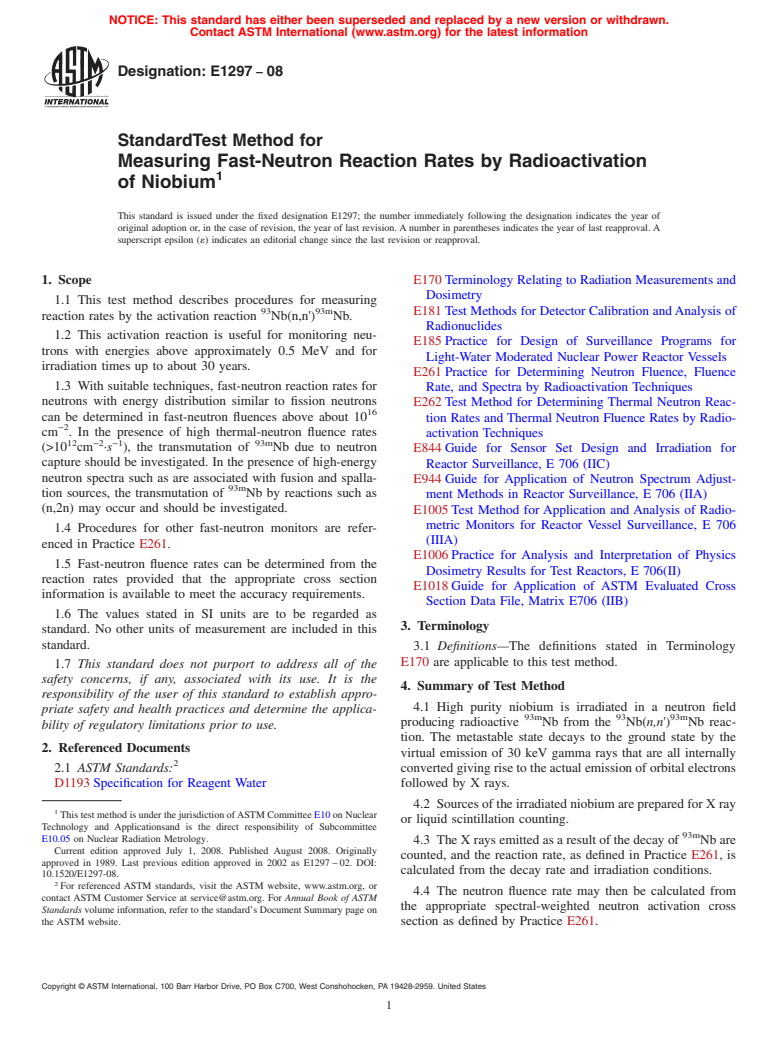


Standards Content (Sample)
NOTICE: This standard has either been superseded and replaced by a new version or withdrawn.
Contact ASTM International (www.astm.org) for the latest information
Designation: E1297 − 08
StandardTest Method for
Measuring Fast-Neutron Reaction Rates by Radioactivation
1
of Niobium
This standard is issued under the fixed designation E1297; the number immediately following the designation indicates the year of
original adoption or, in the case of revision, the year of last revision.Anumber in parentheses indicates the year of last reapproval.A
superscript epsilon (´) indicates an editorial change since the last revision or reapproval.
1. Scope E170Terminology Relating to Radiation Measurements and
Dosimetry
1.1 This test method describes procedures for measuring
93 93m
E181Test Methods for Detector Calibration andAnalysis of
reaction rates by the activation reaction Nb(n,n') Nb.
Radionuclides
1.2 This activation reaction is useful for monitoring neu-
E185Practice for Design of Surveillance Programs for
trons with energies above approximately 0.5 MeV and for
Light-Water Moderated Nuclear Power Reactor Vessels
irradiation times up to about 30 years.
E261Practice for Determining Neutron Fluence, Fluence
1.3 With suitable techniques, fast-neutron reaction rates for
Rate, and Spectra by Radioactivation Techniques
neutrons with energy distribution similar to fission neutrons
E262Test Method for Determining Thermal Neutron Reac-
16
can be determined in fast-neutron fluences above about 10
tion Rates and Thermal Neutron Fluence Rates by Radio-
−2
cm . In the presence of high thermal-neutron fluence rates
activation Techniques
12 −2 −1 93m
(>10 cm ·s ), the transmutation of Nb due to neutron
E844Guide for Sensor Set Design and Irradiation for
capture should be investigated. In the presence of high-energy
Reactor Surveillance, E 706 (IIC)
neutron spectra such as are associated with fusion and spalla-
E944Guide for Application of Neutron Spectrum Adjust-
93m
tion sources, the transmutation of Nb by reactions such as
ment Methods in Reactor Surveillance, E 706 (IIA)
(n,2n) may occur and should be investigated.
E1005Test Method for Application and Analysis of Radio-
metric Monitors for Reactor Vessel Surveillance, E 706
1.4 Procedures for other fast-neutron monitors are refer-
(IIIA)
enced in Practice E261.
E1006Practice for Analysis and Interpretation of Physics
1.5 Fast-neutron fluence rates can be determined from the
Dosimetry Results for Test Reactors, E 706(II)
reaction rates provided that the appropriate cross section
E1018Guide for Application of ASTM Evaluated Cross
information is available to meet the accuracy requirements.
Section Data File, Matrix E706 (IIB)
1.6 The values stated in SI units are to be regarded as
3. Terminology
standard. No other units of measurement are included in this
standard.
3.1 Definitions—The definitions stated in Terminology
E170 are applicable to this test method.
1.7 This standard does not purport to address all of the
safety concerns, if any, associated with its use. It is the
4. Summary of Test Method
responsibility of the user of this standard to establish appro-
4.1 High purity niobium is irradiated in a neutron field
priate safety and health practices and determine the applica-
93m 93 93m
producing radioactive Nb from the Nb(n,n') Nb reac-
bility of regulatory limitations prior to use.
tion. The metastable state decays to the ground state by the
2. Referenced Documents
virtual emission of 30 keV gamma rays that are all internally
2
2.1 ASTM Standards: convertedgivingrisetotheactualemissionoforbitalelectrons
D1193Specification for Reagent Water followed by X rays.
4.2 SourcesoftheirradiatedniobiumarepreparedforXray
1
ThistestmethodisunderthejurisdictionofASTMCommitteeE10onNuclear
or liquid scintillation counting.
Technology and Applicationsand is the direct responsibility of Subcommittee
93m
E10.05 on Nuclear Radiation Metrology.
4.3 TheXraysemittedasaresultofthedecayof Nbare
Current edition approved July 1, 2008. Published August 2008. Originally
counted, and the reaction rate, as defined in Practice E261,is
approved in 1989. Last previous edition approved in 2002 as E1297–02. DOI:
calculated from the decay rate and irradiation conditions.
10.1520/E1297-08.
2
For referenced ASTM standards, visit the ASTM website, www.astm.org, or
4.4 The neutron fluence rate may then be calculated from
contact ASTM Customer Service at service@astm.org. For Annual Book of ASTM
the appropriate spectral-weighted neutron activation cross
Standards volume information, refer to the standard’s Document Summary page on
the ASTM website. section as defined by Practice E261.
Copyright © ASTM International, 100 Barr Harbor Drive, PO Box C700, West Conshohocken, PA 19428-2959. United States
1
---------------------- Page: 1 ----------------------
E1297 − 08
5. Significance and Use andhasahalf-lifesufficientlylongtoallowitsuseinverylong
exposures(uptoabout40years).Monitoringlongexposuresis
5.1 Refer to Practice E261 fo
...
This document is not anASTM standard and is intended only to provide the user of anASTM standard an indication of what changes have been made to the previous version. Because
it may not be technically possible to adequately depict all changes accurately, ASTM recommends that users consult prior editions as appropriate. In all cases only the current version
of the standard as published by ASTM is to be considered the official document.
Designation:E1297–02 Designation: E 1297 – 08
Standard Test Method for
Measuring Fast-Neutron Reaction Rates by Radioactivation
1
of Niobium
This standard is issued under the fixed designation E1297; the number immediately following the designation indicates the year of
original adoption or, in the case of revision, the year of last revision.Anumber in parentheses indicates the year of last reapproval.A
superscript epsilon (´) indicates an editorial change since the last revision or reapproval.
1. Scope
93 93m
1.1 This test method describes procedures for measuring reaction rates by the activation reaction Nb(n,n8) Nb.
1.2 This activation reaction is useful for monitoring neutrons with energies above approximately 0.5 MeV and for irradiation
times up to about 30 years.
1.3 With suitable techniques, fast-neutron reaction rates for neutrons with energy distribution similar to fission neutrons can be
16 −2 12 −2 −1
determined in fast-neutron fluences above about 10 cm . In the presence of high thermal-neutron fluence rates (>10 cm ·s
93m
), the transmutation of Nb due to neutron capture should be investigated. In the presence of high-energy neutron spectra such
93m
as are associated with fusion and spallation sources, the transmutation of Nb by reactions such as (n,2n) may occur and should
be investigated.
1.4 Procedures for other fast-neutron monitors are referenced in Practice E261.
1.5 Fast-neutronfluenceratescanbedeterminedfromthereactionratesprovidedthattheappropriatecrosssectioninformation
is available to meet the accuracy requirements.
1.6The values stated in SI units are to be regarded as the standard.
1.6 The values stated in SI units are to be regarded as standard. No other units of measurement are included in this standard.
1.7 This standard does not purport to address all of the safety concerns, if any, associated with its use. It is the responsibility
of the user of this standard to establish appropriate safety and health practices and determine the applicability of regulatory
limitations prior to use.
2. Referenced Documents
2
2.1 ASTM Standards:
D1193 Specification for Reagent Water
E170 Terminology Relating to Radiation Measurements and Dosimetry
E181 Test Methods for Detector Calibration and Analysis of Radionuclides
E185 PracticeforConductingDesignofSurveillanceTestsProgramsforLight-WaterCooledModeratedNuclearPowerReactor
3
Vessels, E706 (IF) Vessels
E261 Practice for Determining Neutron Fluence, Fluence Rate, Fluence, and Spectra by Radioactivation Techniques
E262 Test Method for Determining Thermal Neutron Reaction and Fluence Rates by Radioactivation Techniques
E844 Guide for Sensor Set Design and Irradiation for Reactor Surveillance, E 706(IIC)
3
E944Practice for Application of Neutron Spectrum Adjustment Methods in Reactor Surveillance Guide for Application of
Neutron Spectrum Adjustment Methods in Reactor Surveillance, E 706 (IIA)
E1005 Test Method for Application and Analysis of Radiometric Monitors for Reactor Vessel Surveillance, E 706(IIIA)
3
E1006 Practice for Analysis and Interpretation of Physics Dosimetry Results for Test Reactors, E706 (II) E 706(II)
E1018Guide for Application of ASTM Evaluated Cross Section Data File (ENDF/A)—Cross Section and Uncertainty File,
3
E706 (IIB) Guide for Application of ASTM Evaluated Cross Section Data File, Matrix E 706 (IIB)
3. Terminology
3.1 Definitions— The definitions stated in Terminology E170 are applicable to this test method.
1
This test method is under the jurisdiction of ASTM Committee E10 on Nuclear Technology and Applications and is the direct responsibility of Subcommittee E10.05
on Nuclear Radiation Metrology.
Current edition approved June 10, 2002. Published September 2002. Originally published as E1297–89. Last previous edition E1297–96.
Current edition approved July 1, 2008. Published August 2008. Originally approved in 1989. Last previous edition approved in 2002 as E1297–02.
2
ForreferencedASTMstandards,visittheASTMwebsite,www.astm.org,orcontactASTMCustomerServiceatservice@astm.org.For Annual Book of ASTM Standards
, Vol 11.01.volume information, refer to the standard’s Document Summary page on the ASTM website.
Copyright © ASTM International, 100 Barr Harbor Drive, PO Box C700, West Conshohocken, PA 19428-2959, United States.
1
---------------------- Page: 1 ----------------------
E1297–08
4. Summary of Test Method
93m 93 93m
4.1 High purity niobium is irradiated in a neutron field producing radioactive Nb from the Nb(n,n8) Nb reaction. The
metastable state decays to the ground state by the virtual
...
Questions, Comments and Discussion
Ask us and Technical Secretary will try to provide an answer. You can facilitate discussion about the standard in here.