

ASTM E3205-20
(Test Method)Standard Test Method for Small Punch Testing of Metallic Materials
General Information
- Abstract
SIGNIFICANCE AND USE
4.1 The safety margins provided in the design for a component or structure can be reduced throughout its service life by aging. Aging is the process by which the physical and mechanical characteristics of component or structure materials change with time or use; this process may proceed by a single aging mechanism or a combination of several aging mechanisms.
4.2 The term “safety margin” is used in a broad sense, meaning the safety state (that is, integrity and functional capability) of components in excess of their normal operational requirements (1).3
4.3 The determination of mechanical properties such as yield strength, tensile strength, and ductile-to-brittle transition temperature of structural components is, hence, desirable for optimization of operating procedures and inspection intervals, as well as repair strategies and residual lifetime assessment. Current standardized mechanical tests require relatively large volumes of test material that cannot be extracted from in-service equipment without post-sampling removal repair (2).
4.4 The need to obtain estimates of the mechanical properties of components without post-sampling removal repair has led to the development of small punch (SP) test techniques based on penetration/bulge tests of miniaturized test specimens (often disk-shaped, or square) (3, 4, 5). It can be considered as a quasi-nondestructive technique because of the very limited amount of material to be sampled. It is an efficient and cost-effective technique and has the potential to provide estimates of the material properties of the specific component, identifying the present state of damage and focusing on the most critical (most stressed, most damaged) locations in the component. Examples of empirical correlations that have been established between small punch test results and mechanical properties for specific classes of materials are provided in Appendix X1.
4.5 This test method can be also used for identifying the most suitable ma...
SCOPE
1.1 This test method covers procedures for conducting the small punch deformation test for metallic materials. The results can be used to derive estimates of yield and tensile strength up to 450 °C, and estimates of the ductile-to-brittle transition temperature from the results of small punch bulge tests in the temperature range from -193 °C to 350 °C for iron based materials or 0.4 Tm for other metallic materials, where Tm is their melting temperature in K.
1.2 The values stated in SI units are to be regarded as standard. No other units of measurement are included in this standard.
1.3 This standard does not purport to address all of the safety concerns, if any, associated with its use. It is the responsibility of the user of this standard to establish appropriate safety, health, and environmental practices and determine the applicability of regulatory limitations prior to use.
1.4 This international standard was developed in accordance with internationally recognized principles on standardization established in the Decision on Principles for the Development of International Standards, Guides and Recommendations issued by the World Trade Organization Technical Barriers to Trade (TBT) Committee.
- Status
- Published
- Publication Date
- 30-Jun-2020
- Technical Committee
- E10 - Nuclear Technology and Applications
- Drafting Committee
- E10.02 - Behavior and Use of Nuclear Structural Materials
Overview
The ASTM E3205-20 – Standard Test Method for Small Punch Testing of Metallic Materials defines a procedure for assessing the mechanical properties of metallic materials using the small punch (SP) deformation test. Developed by ASTM International, this method is particularly useful for estimating yield and tensile strength, as well as ductile-to-brittle transition temperature, using miniaturized disk-shaped specimens. Small punch testing offers a quasi-nondestructive and cost-effective approach, especially where only limited quantities of material are available, such as in-service components or irradiated samples.
Key Topics
Small Punch Testing Purpose:
- Used to estimate yield strength, tensile strength, and ductile-to-brittle transition temperature.
- Provides critical data for structural integrity assessments, repair planning, and residual lifetime estimation.
Test Method Scope:
- Suitable for metallic materials, with application temperatures ranging from -193°C to 450°C, depending on material type.
- Results are derived from analyzing force-specimen deflection (F-u) and force-punch displacement (F-v) curves.
Sample Requirements:
- Utilizes small, disk-shaped test specimens, minimizing the impact on the original component.
- Especially valuable for components subject to aging, irradiation, or those with geometric constraints.
Quasi-Nondestructive Nature:
- Samples can be extracted with minimal damage to the parent material, reducing the need for post-sampling repair.
Applications
Structural Integrity and Lifetime Assessment:
- Enables ongoing monitoring of safety margins as metallic components age in service, supporting proactive maintenance and replacement decisions.
- Valuable for identifying critical, highly-stressed, or damaged regions within a component.
Optimization of Components and Materials:
- Supports the selection and design of materials resistant to operational damage, such as neutron irradiation or thermal aging.
- Useful for optimizing welds and heat treatments, and for investigating the effects of coating techniques.
Suitability for Non-Uniform or Irradiated Materials:
- Effective for testing welds, coatings, or irradiated metals where conventional sample sizes are impractical.
- Often applied in the nuclear, aerospace, power generation, and chemical processing sectors.
Empirical and Analytical Data Correlation:
- Established empirical correlations relate small punch test results to standardized tensile and fracture properties, enhancing confidence in predictive models.
Related Standards
- ASTM E8/E8M – Standard Test Methods for Tension Testing of Metallic Materials: Provides reference methods for full-size tensile testing.
- ASTM E21 – Test Methods for Elevated Temperature Tension Tests of Metallic Materials: Supports high-temperature testing standards.
- ASTM E691 – Practice for Conducting an Interlaboratory Study: Ensures repeatability and reproducibility of test methods.
- CEN CWA 15627 – Small Punch Test Method for Metallic Materials: A European code of practice complementing ASTM E3205-20.
Practical Value
The small punch testing method outlined in ASTM E3205-20 enhances the toolkit for materials engineers and asset managers by providing a standardized, reliable way to extract crucial performance data from metallic components with minimal intrusion. Its high applicability to in-service equipment, particularly where large samples are unavailable, makes this method an essential part of any comprehensive materials assessment or lifetime management strategy, ensuring safer, more efficient, and cost-effective industrial operations.
Keywords: small punch test, ASTM E3205-20, metallic materials, yield strength, tensile strength, ductile-to-brittle transition temperature, in-service inspection, quasi-nondestructive testing, mechanical properties, residual life assessment.
Relations
- Effective Date
- 01-Jan-2024
- Effective Date
- 15-Jul-2016
- Effective Date
- 01-Feb-2015
- Effective Date
- 01-May-2014
- Effective Date
- 01-Nov-2013
- Effective Date
- 01-Jun-2013
- Effective Date
- 01-May-2013
- Effective Date
- 01-May-2013
- Effective Date
- 01-May-2013
- Effective Date
- 01-Mar-2013
- Effective Date
- 01-Dec-2012
- Effective Date
- 01-Dec-2011
- Effective Date
- 01-Nov-2011
- Effective Date
- 01-Oct-2010
- Refers
ASTM E21-09 - Standard Test Methods for Elevated Temperature Tension Tests of Metallic Materials - Effective Date
- 01-Apr-2009
Get Certified
Connect with accredited certification bodies for this standard

BUREAU VERITAS Certification Germany
Bureau Veritas certification in Germany.

Element Materials Technology
Materials testing and product certification.

AQMS Ltd.
AQMS provides ISO certification to SMEs across the UK.
Sponsored listings
Frequently Asked Questions
ASTM E3205-20 is a standard published by ASTM International. Its full title is "Standard Test Method for Small Punch Testing of Metallic Materials". This standard covers: SIGNIFICANCE AND USE 4.1 The safety margins provided in the design for a component or structure can be reduced throughout its service life by aging. Aging is the process by which the physical and mechanical characteristics of component or structure materials change with time or use; this process may proceed by a single aging mechanism or a combination of several aging mechanisms. 4.2 The term “safety margin” is used in a broad sense, meaning the safety state (that is, integrity and functional capability) of components in excess of their normal operational requirements (1).3 4.3 The determination of mechanical properties such as yield strength, tensile strength, and ductile-to-brittle transition temperature of structural components is, hence, desirable for optimization of operating procedures and inspection intervals, as well as repair strategies and residual lifetime assessment. Current standardized mechanical tests require relatively large volumes of test material that cannot be extracted from in-service equipment without post-sampling removal repair (2). 4.4 The need to obtain estimates of the mechanical properties of components without post-sampling removal repair has led to the development of small punch (SP) test techniques based on penetration/bulge tests of miniaturized test specimens (often disk-shaped, or square) (3, 4, 5). It can be considered as a quasi-nondestructive technique because of the very limited amount of material to be sampled. It is an efficient and cost-effective technique and has the potential to provide estimates of the material properties of the specific component, identifying the present state of damage and focusing on the most critical (most stressed, most damaged) locations in the component. Examples of empirical correlations that have been established between small punch test results and mechanical properties for specific classes of materials are provided in Appendix X1. 4.5 This test method can be also used for identifying the most suitable ma... SCOPE 1.1 This test method covers procedures for conducting the small punch deformation test for metallic materials. The results can be used to derive estimates of yield and tensile strength up to 450 °C, and estimates of the ductile-to-brittle transition temperature from the results of small punch bulge tests in the temperature range from -193 °C to 350 °C for iron based materials or 0.4 Tm for other metallic materials, where Tm is their melting temperature in K. 1.2 The values stated in SI units are to be regarded as standard. No other units of measurement are included in this standard. 1.3 This standard does not purport to address all of the safety concerns, if any, associated with its use. It is the responsibility of the user of this standard to establish appropriate safety, health, and environmental practices and determine the applicability of regulatory limitations prior to use. 1.4 This international standard was developed in accordance with internationally recognized principles on standardization established in the Decision on Principles for the Development of International Standards, Guides and Recommendations issued by the World Trade Organization Technical Barriers to Trade (TBT) Committee.
SIGNIFICANCE AND USE 4.1 The safety margins provided in the design for a component or structure can be reduced throughout its service life by aging. Aging is the process by which the physical and mechanical characteristics of component or structure materials change with time or use; this process may proceed by a single aging mechanism or a combination of several aging mechanisms. 4.2 The term “safety margin” is used in a broad sense, meaning the safety state (that is, integrity and functional capability) of components in excess of their normal operational requirements (1).3 4.3 The determination of mechanical properties such as yield strength, tensile strength, and ductile-to-brittle transition temperature of structural components is, hence, desirable for optimization of operating procedures and inspection intervals, as well as repair strategies and residual lifetime assessment. Current standardized mechanical tests require relatively large volumes of test material that cannot be extracted from in-service equipment without post-sampling removal repair (2). 4.4 The need to obtain estimates of the mechanical properties of components without post-sampling removal repair has led to the development of small punch (SP) test techniques based on penetration/bulge tests of miniaturized test specimens (often disk-shaped, or square) (3, 4, 5). It can be considered as a quasi-nondestructive technique because of the very limited amount of material to be sampled. It is an efficient and cost-effective technique and has the potential to provide estimates of the material properties of the specific component, identifying the present state of damage and focusing on the most critical (most stressed, most damaged) locations in the component. Examples of empirical correlations that have been established between small punch test results and mechanical properties for specific classes of materials are provided in Appendix X1. 4.5 This test method can be also used for identifying the most suitable ma... SCOPE 1.1 This test method covers procedures for conducting the small punch deformation test for metallic materials. The results can be used to derive estimates of yield and tensile strength up to 450 °C, and estimates of the ductile-to-brittle transition temperature from the results of small punch bulge tests in the temperature range from -193 °C to 350 °C for iron based materials or 0.4 Tm for other metallic materials, where Tm is their melting temperature in K. 1.2 The values stated in SI units are to be regarded as standard. No other units of measurement are included in this standard. 1.3 This standard does not purport to address all of the safety concerns, if any, associated with its use. It is the responsibility of the user of this standard to establish appropriate safety, health, and environmental practices and determine the applicability of regulatory limitations prior to use. 1.4 This international standard was developed in accordance with internationally recognized principles on standardization established in the Decision on Principles for the Development of International Standards, Guides and Recommendations issued by the World Trade Organization Technical Barriers to Trade (TBT) Committee.
ASTM E3205-20 is classified under the following ICS (International Classification for Standards) categories: 49.035 - Components for aerospace construction. The ICS classification helps identify the subject area and facilitates finding related standards.
ASTM E3205-20 has the following relationships with other standards: It is inter standard links to ASTM E8/E8M-24, ASTM E8/E8M-16, ASTM E8/E8M-15, ASTM E177-14, ASTM E220-13, ASTM E8/E8M-13, ASTM E74-13a, ASTM E177-13, ASTM E691-13, ASTM E74-13, ASTM E74-12, ASTM E8/E8M-11, ASTM E691-11, ASTM E177-10, ASTM E21-09. Understanding these relationships helps ensure you are using the most current and applicable version of the standard.
ASTM E3205-20 is available in PDF format for immediate download after purchase. The document can be added to your cart and obtained through the secure checkout process. Digital delivery ensures instant access to the complete standard document.
Standards Content (Sample)
This international standard was developed in accordance with internationally recognized principles on standardization established in the Decision on Principles for the
Development of International Standards, Guides and Recommendations issued by the World Trade Organization Technical Barriers to Trade (TBT) Committee.
Designation: E3205 − 20
Standard Test Method for
Small Punch Testing of Metallic Materials
This standard is issued under the fixed designation E3205; the number immediately following the designation indicates the year of
original adoption or, in the case of revision, the year of last revision.Anumber in parentheses indicates the year of last reapproval.A
superscript epsilon (´) indicates an editorial change since the last revision or reapproval.
1. Scope E691Practice for Conducting an Interlaboratory Study to
Determine the Precision of a Test Method
1.1 This test method covers procedures for conducting the
E220Test Method for Calibration of Thermocouples By
smallpunchdeformationtestformetallicmaterials.Theresults
Comparison Techniques
can be used to derive estimates of yield and tensile strength up
to 450 °C, and estimates of the ductile-to-brittle transition
3. Terminology
temperature from the results of small punch bulge tests in the
temperature range from -193 °C to 350 °C for iron based 3.1 Definitions:
materials or 0.4 T for other metallic materials, where T is
3.1.1 force, F [F], n—force applied to the test specimen by
m m
their melting temperature in K.
the punch.
3.1.1.1 Discussion—This includes the weights of the equip-
1.2 The values stated in SI units are to be regarded as
ment acting on the punch.
standard. No other units of measurement are included in this
standard. 3.1.2 force-punch displacement (F-v) curve, n—relationship
between force and punch displacement, which is continuously
1.3 This standard does not purport to address all of the
recorded during the small punch (SP) bulge test.
safety concerns, if any, associated with its use. It is the
responsibility of the user of this standard to establish appro- 3.1.3 force-specimen deflection (F-u) curve, n—relationship
priate safety, health, and environmental practices and deter-
between force and deflection, which is continuously recorded
mine the applicability of regulatory limitations prior to use. during the SP bulge test.
1.4 This international standard was developed in accor-
3.1.4 punch displacement, v [L], n—displacement of the
dance with internationally recognized principles on standard-
center of the top of the punch in contact with the specimen.
ization established in the Decision on Principles for the
3.1.4.1 Discussion—Determination of the punch displace-
Development of International Standards, Guides and Recom-
ment from the measurement of machine crosshead displace-
mendations issued by the World Trade Organization Technical
ment requires correcting for machine compliance.
Barriers to Trade (TBT) Committee.
3.1.4.2 Discussion—In this test method, specimen
deflection, u, is used as the reference displacement signal.
2. Referenced Documents
However, if specimen deflection is unavailable or not
2.1 ASTM Standards:
measured, punch displacement, v, may be used instead.
E8/E8MTest Methods for Tension Testing of Metallic Ma-
3.1.5 small punch (SP) bulge test, n—mechanical test con-
terials
sisting of loading a small disk-shaped specimen clamped
E21TestMethodsforElevatedTemperatureTensionTestsof
between two dies by means of a hemispherical-shaped punch,
Metallic Materials
deforming it to failure, and analyzing the resulting F-u curve.
E74Practices for Calibration and Verification for Force-
3.1.6 specimen deflection, u [L], n—displacement of a point
Measuring Instruments
at the center of the specimen opposite to the punch during the
E177Practice for Use of the Terms Precision and Bias in
small punch (SP) bulge test.
ASTM Test Methods
4. Significance and Use
ThistestmethodisunderthejurisdictionofASTMCommitteeE10onNuclear
4.1 The safety margins provided in the design for a compo-
Technology and Applications and is the direct responsibility of Subcommittee
nent or structure can be reduced throughout its service life by
E10.02 on Behavior and Use of Nuclear Structural Materials.
aging. Aging is the process by which the physical and
Current edition approved July 1, 2020. Published August 2020. DOI: 10.1520/
E3205-20.
mechanical characteristics of component or structure materials
For referenced ASTM standards, visit the ASTM website, www.astm.org, or
change with time or use; this process may proceed by a single
contact ASTM Customer Service at service@astm.org. For Annual Book of ASTM
aging mechanism or a combination of several aging mecha-
Standards volume information, refer to the standard’s Document Summary page on
the ASTM website. nisms.
Copyright © ASTM International, 100 Barr Harbor Drive, PO Box C700, West Conshohocken, PA 19428-2959. United States
E3205 − 20
4.2 The term “safety margin” is used in a broad sense, Roughness of the die bore and punch tip radius shall not be
meaning the safety state (that is, integrity and functional greater than Ra = 2 µm.
capability)ofcomponentsinexcessoftheirnormaloperational 5.1.2 Thetestrigshallhaveahemisphericaltippedpunchor
requirements (1). ball capable of forcing the central portion of the specimen
through the hole in the receiving die until the end of the test
4.3 The determination of mechanical properties such as
occurs. The hemispherical portion of the punch or the whole
yield strength, tensile strength, and ductile-to-brittle transition
ballvolumeshallbehardenoughnottobeplasticallydeformed
temperature of structural components is, hence, desirable for
during the test (55 HRC is sufficient for testing most steels).
optimization of operating procedures and inspection intervals,
5.1.3 The clamping surfaces of the specimen holder in
as well as repair strategies and residual lifetime assessment.
contact with the test specimen shall be plane and parallel to
Current standardized mechanical tests require relatively large
each other within 6 0.5°. Both surfaces shall be clean, free
volumes of test material that cannot be extracted from in-
from oxide buildup, corrosion and dirt, and sufficiently rigid
service equipment without post-sampling removal repair (2).
not to be deformed during the test (hardness of 55 HRC or
4.4 The need to obtain estimates of the mechanical proper-
higher) with roughness not greater than Ra = 0.8 µm. The
ties of components without post-sampling removal repair has
clamping torque shall be between5Nmand15Nmand shall
led to the development of small punch (SP) test techniques
be recorded. The recommended torque value is 10 N m.
basedonpenetration/bulgetestsofminiaturizedtestspecimens
5.1.4 Thesurfacefinishofthepunchanddieincontactwith
(often disk-shaped, or square) (3, 4, 5). It can be considered as
the specimen shall not exceed 0.004 mm based on maximum
a quasi-nondestructive technique because of the very limited
peak-to-peak distance.
amount of material to be sampled. It is an efficient and
5.2 Loading System—A screw-driven or servo-hydraulic
cost-effective technique and has the potential to provide
testing machine is generally used for SP tests. It shall be
estimates of the material properties of the specific component,
equipped with a fixture for holding and loading the test
identifying the present state of damage and focusing on the
specimen, a load cell, and a measuring system for specimen
most critical (most stressed, most damaged) locations in the
deflectionorpunchdisplacement,orboth.Thepercenterrorfor
component. Examples of empirical correlations that have been
the force measurement system within the capacity of the load
established between small punch test results and mechanical
cell shall not exceed 61 % of the actual measured force, in
properties for specific classes of materials are provided in
accordance with Practices E74. The loading system should be
Appendix X1.
calibrated for accuracy using a proving ring or similar certified
4.5 This test method can be also used for identifying the
device and the results shall be recorded at least once a year.
most suitable materials with respect to their resistance against
5.3 Punch Displacement, v, or Specimen Deflection, u,
operational damage, like neutron irradiation, thermal aging
Measurement System—Any method of measuring specimen
etc., as well as for optimization of their chemical composition,
deflection or punch displacement may be used. The displace-
thermalheattreatment,etc.Thistestmethodisbeneficialinthe
ment indicator shall monitor specimen deflection with an
study of the effect of radiation damage when test specimen
accuracy of at least 61 % of the original specimen thickness,
dimensions are limited by small irradiation volume or high
h .
activity.
NOTE 1—It may be convenient to measure the deflection by monitoring
the displacement of a measuring rod as indicated in Fig. 1.
4.6 Due to the small sample size, this test method also
allows estimating mechanical properties of non-uniform mate-
5.4 Heating or Cooling System—Testing temperature sig-
rials such as welds (6). Examples of weld techniques that
nificantly affects the nature of the F-u curve. For this reason,
produce narrow geometric gradients include electron beam or
temperature shall be maintained constant within 63°C
laserbeamwelds,andmetalcoatings (7, 8).Thistesttechnique
throughout the test.Any method of cooling or heating may be
provides a more direct means of estimating material properties
used. The method of temperature measurement shall be suffi-
than indirect methods based on laboratory simulations of the
ciently sensitive and reliable to ensure that the temperature of
localizedregionsoranalyticalpredictionsbasedongeneralized
the test specimen is within the limits specified below. A
methods.
temperature measuring system shall include thermometers,
usually thermocouples, appropriately located to determine that
5. Apparatus
the full test section remains within the temperature limits
prescribed for the test. The thermocouples shall be of a type
5.1 Test Rig:
and composition suitable for the test temperature regime
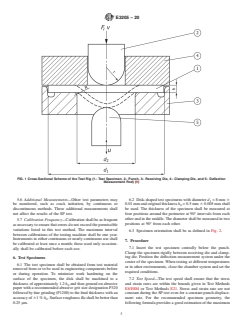
5.1.1 In Fig. 1, a cross-sectional view of the specimen
selected for the test and calibrated in accordance with Test
holder with a hemispherical tipped punch and a test specimen
Method E220. The temperature of the test specimen shall be
is illustrated schematically. The receiving die bore diameter
maintained within 63 °C of the designated test temperature
shall be d = 4.00 mm 6 0.01 mm and the punch tip radius
throughout the test in accordance with Test Methods E8/E8M
shall be r =1.25 mm 6 0.01 mm. The corner radius of the
and Test Methods E21.
receiving die (Fig. 1) shall be R = 0.20 mm 6 0.05 mm.
5.5 Test Environment—Usually the SP test is performed in
air. For studies in which the effect of the environment is of
specificinterest,otherenvironmentsmaybeused,butthisshall
Theboldfacenumbersinparenthesesrefertothelistofreferencesattheendof
this standard. be clearly stated in the test report.
E3205 − 20
FIG. 1 Cross-Sectional Scheme of the Test Rig (1– Test Specimen, 2– Punch, 3– Receiving Die, 4– Clamping Die, and 5– Deflection
Measurement Rod) (9)
5.6 Additional Measurements—Other test parameters may 6.2 Disk-shaped test specimens with diameter d =8mm 6
be monitored, such as crack initiation, by continuous or 0.01mmandoriginalthickness h =0.5mm 60.005mmshall
discontinuous methods. These additional measurements shall be used. The thickness of the specimen shall be measured at
not affect the results of the SP test.
four positions around the perimeter at 90° intervals from each
otherandinthemiddle.Thediametershallbemeasuredintwo
5.7 Calibration Frequency—Calibrationshallbeasfrequent
positions at 90° from each other.
asnecessarytoensurethaterrorsdonotexceedthepermissible
variations listed in this test method. The maximum interval
6.3 Specimen orientation shall be as defined in Fig. 2.
between calibrations of the testing machine shall be one year.
Instruments in either continuous or nearly continuous use shall
7. Procedure
be calibrated at least once a month; those used only occasion-
7.1 Insert the test specimen centrally below the punch.
ally shall be calibrated before each use.
Clamp the specimen rigidly between receiving die and clamp-
ing die. Position the deflection measurement system under the
6. Test Specimens
center of the specimen. When testing at different temperatures
6.1 The test specimen shall be obtained from test material
or in other environments, close the chamber system and set the
removed from or to be used in engineering components before
required conditions.
or during operation. To minimize work hardening on the
surface of the specimen, the disk shall be machined to a 7.2 Test Speed—The test speed shall ensure that the stress
thickness of approximately 1.2·h and then ground on abrasive and strain rates are within the bounds given in Test Methods
paper with a recommended abrasive grit size designation P320 E8/E8M or Test Methods E21. Stress and strain rate are not
followedbyfinegrinding(P1200)tothefinalthicknesswithan constant during the SPtest even for a constant punch displace-
accuracyof 61%·h .SurfaceroughnessRashallbebetterthan ment rate. For the recommended specimen geometry, the
0.25 µm. followingformulaprovidesagoodestimationofthemaximum
E3205 − 20
and strength properties of the material. The following charac-
teristicparametersfroma F-ucurveareusedfortheestimation
of strength and fracture characteristics (see Fig. 3):
8.1.1 F [N]—force characterizing the transition from lin-
e
earity to the stage associated with the spread of the yield zone
through the specimen thickness (plastic bending stage).
8.1.2 F [N]—maximum force recorded during the SP test.
m
8.1.3 u [mm]—specimen deflection corresponding to the
m
maximum force F .
m
8.1.4 u [mm]—specimen deflection corresponding to a 20
f
% force drop with respect to F , i.e., F = 0.8 F .
m f m
8.1.5 E [J]—SP fracture energy calculated under the area
SP
under the F-u curve up to u.
f
8.1.6 E [J]—SP total energy (elastic + plastic) calculated
m
under the area under the F-u curve up to u .
m
8.1.7 E [J]—SP plastic energy calculated from the area
PL
under the F-u curve up to u .
m
8.2 Determination of the Elastic-Plastic Transition Force,
F —The elastic-plastic transition force, F , can be correlated
e e
with the yield strength obtained from tensile tests and is,
therefore, of specific interest. The following procedure de-
scribes how to obtain F (Fig. 4) from the F-u curve.
e
8.2.1 A bilinear function f(u) from the origin through the
points A and B is defined as:
f
A
u for 0# u# u
A
u
A
f u 5 % (2)
~ !
f 2 f
B A
where:
u 2 u 1f for u # u# u
~ !
A A A B
u 2 u
B A
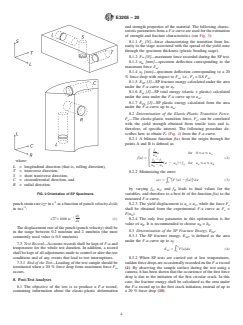
L = longitudinal direction (that is, rolling direction),
T = transverse direction,
8.2.2 Minimizing the error:
S = short transverse direction,
u
B
C = circumferential direction, and err 5 F u 2 f u du (3)
* @ ~ ! ~ !#
R = radial direction.
by varying f , u , and f leads to final values for the
A A B
FIG. 2 Orientation of SP Specimens
variables, and therefore to a best fit of the function f(u) to the
measured F-u curve.
-1
max
punchstrainrate ε˙ ins asafunctionofpunchvelocitydv/ds
8.2.3 The yield displacement is u = u , while the force F
SP
e A e
-1
in m.s :
shall be obtained from the experimental F-u curve as F =
e
F(u ).
A
dv
max 21
ε˙ '1000 m · (1)
8.2.4 The only free parameter in this optimization is the
SP
ds
value of u . It is recommended to choose u = h .
B B 0
Thedisplacementrateofthepunch(punchvelocity)shallbe
8.3 Determination of the SP Fracture Energy, E :
SP
in the range between 0.2 mm/min and 2 mm/min (the most
8.3.1 The SP fracture energy, E , is defined as the area
commonly used value is 0.5 mm/min).
SP
under the F-u curve up to u:
f
7.3 Test Record—Accurate records shall be kept of F-u and
u
f
temperature for the whole test duration. In addition, a record
E 5 * F~u!du (4)
SP
shallbekeptofalladjustmentsmadetocontroloralterthetest
conditions and of any events that lead to test interruptions. 8.3.2 When SP tests are carried out at low temperatures,
7.3.1 End of the Test—Loading of the test sample should be suddenforcedropsareoccasionallyrecordedonthe F-urecord
terminated when a 20 % force drop from maximum force F (4). By observing the sample surface during the test using a
m
occurs. camera, it has been shown that the occurrence of the first force
drop is due to the initiation of the first circular crack. In this
8. Post-Test Analyses
case, the fracture energy shall be calculated as the area under
8.1 The objective of the test is to produce a F-u record, the F-u record up to the first crack initiation, instead of up to
containing information about the elastic-plastic deformation a 20 % force drop (10).
E3205 − 20
FIG. 3 Force-Specimen Deflection Curve Recorded during a SP Test of a Ductile Material
FIG. 4 Experimental Force versus Specimen Deflection Curve, F(u), and Least Square Fit, f(u)
8.4 Determination of the SP Energy E : 8.5 Energy Calculation in case of Pop-ins:
m
8.4.1 The SP total energy E , is defined as the area under
8.5.1 In case of brittle materials, the F-u record can exhibit
m
the F-u curve up to u : discontinuous force drops (pop-ins) caused by crack initiation
m
u followed by crack arrest (11). In this case, the procedure for
m
E 5 * F~u!du (5)
m
0 energy calculation shall be modified as follows (Fig. 5):
E3205 − 20
FIG. 5 Force-deflection Curve for a 13Cr-ODS-steel, Showing Not Significant and Significant Pop-ins
8.5.1.1 In Eq 6, replace u with u . u is the value of 8.7.1 The effective fracture strain, ε, is defined as:
m 1p 1p f
specimen deflection corresponding to the first significant force
h
drop. ε 5 ln (7)
S D
f
h
f
8.5.1.2 A pop-in shall be considered significant if force
where:
drops by at least 10 % of F .
m
h = final thickness adjacent to the area of failure.
f
8.6 Determination of the SP Plastic Energy E :
PL
8.6.1 The SP plastic energy, E , is defined as the plastic
PL
8.7.2 In order to measure h, the specimen should be
f
area under the F-u curve up to u :
m
sectionedthroughthelocationoffractureafterthetest(Fig.6).
F ·u
Use of other methods for measurement of h (for example,
m A
f
E 5 E 2 0.5 (6)
PL m
f
tomography or scanning electron microscopy), shall be re-
...