

ASTM D5598-20
(Test Method)Standard Test Method for Evaluating Unleaded Automotive Spark-Ignition Engine Fuel for Electronic Port Fuel Injector Fouling
General Information
- Abstract
SIGNIFICANCE AND USE
5.1 Test Method—Deposits are prone to form on the metering surfaces of pintle-type electronic fuel injectors. These deposits reduce fuel flow through the metering orifices. Reductions in metered fuel flow result in an upset in the air-fuel ratio, which can affect emissions and driveability. When heavy enough, these deposits can lead to driveability symptoms such as hesitation, hard starting, loss of power, or a combination thereof, that are easily noticed by the average driver and lead to customer complaints. The mechanism of the formation of deposits is not completely understood. It is believed to be influenced by many factors, including driving cycle, engine design, port fuel injector design, and composition of fuel used. The procedure in this test method has been found to build deposits in injectors on a consistent basis. The deposits formed by this procedure are similar to the deposits experienced in the field in terms of composition and in amount of deposition. This procedure can be used to evaluate differences in unleaded base fuels and fuel additives.
5.1.1 State and Federal Legislative and Regulatory Action—Legislative and regulatory activity, primarily by the state of California6 and the Federal Government7 necessitate the acceptance of a standard test method to evaluate the port fuel injector deposit-forming tendency of an automotive spark-ignition engine fuel.
5.1.2 Relevance of Results—The operating conditions and design of the engine and vehicle used in this test method are not representative of all modern automobiles. These factors must be considered when interpreting test results.
5.2 Test Validity:
5.2.1 Procedural Compliance—The test results are not considered valid unless the test is completed in compliance with all requirements of this test method. Deviations from the parameter limits presented in Section 10 will result in a void test. Engineering judgment must be applied during conduct of the test method when assessing any anomalies ...
SCOPE
1.1 This test method covers a vehicle test procedure to evaluate the tendency of an unleaded spark-ignition engine fuel to foul electronic port fuel injectors (PFI).
1.2 The test method is applicable to unleaded spark-ignition engine fuels which may contain antioxidants, corrosion inhibitors, metal deactivators, dyes, deposit control additives, and oxygenates.
1.3 The values stated in SI units are to be regarded as the standard. The values in parentheses are provided for information only.
1.4 This standard does not purport to address all of the safety concerns, if any, associated with its use. It is the responsibility of the user of this standard to establish appropriate safety, health, and environmental practices and determine the applicability of regulatory limitations prior to use. Specific precautionary statements are given throughout this test method.
Note 1: If there is any doubt as to the latest edition of Test Method D5598, contact ASTM Headquarters. Other properties of significance to spark-ignition engine fuel are described in Specification D4814.
1.5 This international standard was developed in accordance with internationally recognized principles on standardization established in the Decision on Principles for the Development of International Standards, Guides and Recommendations issued by the World Trade Organization Technical Barriers to Trade (TBT) Committee.
- Status
- Published
- Publication Date
- 31-Mar-2020
- Technical Committee
- D02 - Petroleum Products, Liquid Fuels, and Lubricants
- Drafting Committee
- D02.A0.01 - Gasoline and Gasoline-Oxygenate Blends
Buy Documents
ASTM D5598-20 - Standard Test Method for Evaluating Unleaded Automotive Spark-Ignition Engine Fuel for Electronic Port Fuel Injector Fouling
REDLINE ASTM D5598-20 - Standard Test Method for Evaluating Unleaded Automotive Spark-Ignition Engine Fuel for Electronic Port Fuel Injector Fouling
Overview
ASTM D5598-20 is the internationally recognized standard test method for evaluating unleaded automotive spark-ignition engine fuel with regard to fouling of electronic port fuel injectors (PFI). Developed and published by ASTM International, this test procedure is designed to assess the deposit-forming tendency of unleaded gasoline-both with and without various fuel additives-under controlled vehicle operation. Spark-ignition engines with electronic port fuel injection are subject to deposit formation, particularly on the metering surfaces of pintle-type injectors, which can negatively impact fuel flow, emissions, and driveability. By providing a reproducible protocol, ASTM D5598-20 supports fuel manufacturers, regulatory agencies, and automotive engineers in ensuring fuel quality, optimizing additive performance, and complying with emissions and driveability requirements.
Keywords: ASTM D5598-20, port fuel injector fouling, spark-ignition engine, unleaded gasoline, automotive fuel testing, fuel injector deposits, driveability, fuel additives, emissions.
Key Topics
- Electronic Port Fuel Injector Deposit Evaluation: The standard outlines a comprehensive test cycle simulating real-world operation to build deposits on injectors in a controlled and reproducible manner.
- Vehicle and Engine Criteria: Test vehicles must meet specific requirements to ensure consistent, valid results, using Chrysler Corp. models (1985-1987) equipped with 2.2 L turbocharged engines and Bosch pintle-style injectors.
- Fuel Considerations: The method can evaluate neat unleaded base fuels or fuels containing common additives such as antioxidants, corrosion inhibitors, metal deactivators, dyes, deposit control additives, and oxygenates.
- Driveability and Emissions Impact: Fuel injector deposits can reduce fuel flow and upset air-fuel ratios, causing hesitation, hard starting, loss of power, and increased emissions-issues this standard helps identify and quantify.
- Regulatory Relevance: The method addresses requirements from both federal and state regulatory bodies (notably California and U.S. EPA), making it highly relevant for demonstrating compliance with fuel regulations.
- Test Validity and Procedural Compliance: Strict adherence to procedural parameters is essential. Any deviation from requirements results in void tests, ensuring only comparable and reliable data.
Applications
ASTM D5598-20 is widely used in several key areas:
- Automotive Fuel Quality Testing: Petroleum companies and fuel additive manufacturers employ this standard to compare the deposit-forming tendencies of unleaded gasolines and additive packages, optimizing formulations for modern vehicles.
- Regulatory Compliance: The procedure is used to demonstrate compliance with state and federal standards aimed at reducing harmful emissions and maintaining vehicle driveability over time.
- Engine and Vehicle R&D: Automotive OEMs and engineering teams apply D5598-20 in fuel system design and validation, ensuring compatibility between approved fuels and port fuel injectors, and assessing the benefits of new fuel detergency and deposit control technologies.
- Additive Performance Evaluation: Laboratories utilize the test method to quantitatively measure the effectiveness of deposit control additives in preventing injector fouling under standardized conditions.
Related Standards
Several supporting and related standards enhance and supplement ASTM D5598-20:
- ASTM D4814 - Specification for Automotive Spark-Ignition Engine Fuel: Defines properties for gasoline used in spark-ignition engines.
- ASTM D5500 - Test Method for Vehicle Evaluation of Unleaded Automotive Spark-Ignition Engine Fuel for Intake Valve Deposit Formation.
- ASTM D235 - Specification for Mineral Spirits (Hydrocarbon Dry Cleaning Solvent): Used as a test solvent.
- California Air Resources Board (CARB) PFI Deposit Test Method: The state-level reference for evaluating PFI deposits.
- ANSI MC 96.1 - Temperature Measurement Thermocouples: Guidance on thermocouple calibration for instrumentation.
By implementing ASTM D5598-20, stakeholders ensure the reliability of unleaded gasolines in electronic port fuel injector applications, helping to maintain engine performance and meet increasingly stringent regulatory and consumer expectations for automotive fuels.
Relations
- Effective Date
- 01-Apr-2020
- Effective Date
- 01-Jan-2024
- Refers
ASTM D4175-23a - Standard Terminology Relating to Petroleum Products, Liquid Fuels, and Lubricants - Effective Date
- 15-Dec-2023
- Effective Date
- 01-Dec-2023
- Refers
ASTM D4175-23e1 - Standard Terminology Relating to Petroleum Products, Liquid Fuels, and Lubricants - Effective Date
- 01-Jul-2023
- Effective Date
- 01-Jun-2020
- Effective Date
- 01-Feb-2020
- Effective Date
- 01-Dec-2019
- Effective Date
- 01-Nov-2019
- Effective Date
- 01-Dec-2018
- Effective Date
- 01-Oct-2018
- Effective Date
- 01-Apr-2018
- Effective Date
- 01-Jan-2018
- Effective Date
- 15-Nov-2016
- Effective Date
- 15-Nov-2016
Buy Documents
ASTM D5598-20 - Standard Test Method for Evaluating Unleaded Automotive Spark-Ignition Engine Fuel for Electronic Port Fuel Injector Fouling
REDLINE ASTM D5598-20 - Standard Test Method for Evaluating Unleaded Automotive Spark-Ignition Engine Fuel for Electronic Port Fuel Injector Fouling
Get Certified
Connect with accredited certification bodies for this standard

Element Materials Technology
Materials testing and product certification.

ABS Group Brazil
ABS Group certification services in Brazil.

ABS Quality Evaluations Inc.
American Bureau of Shipping quality certification.
Sponsored listings
Frequently Asked Questions
ASTM D5598-20 is a standard published by ASTM International. Its full title is "Standard Test Method for Evaluating Unleaded Automotive Spark-Ignition Engine Fuel for Electronic Port Fuel Injector Fouling". This standard covers: SIGNIFICANCE AND USE 5.1 Test Method—Deposits are prone to form on the metering surfaces of pintle-type electronic fuel injectors. These deposits reduce fuel flow through the metering orifices. Reductions in metered fuel flow result in an upset in the air-fuel ratio, which can affect emissions and driveability. When heavy enough, these deposits can lead to driveability symptoms such as hesitation, hard starting, loss of power, or a combination thereof, that are easily noticed by the average driver and lead to customer complaints. The mechanism of the formation of deposits is not completely understood. It is believed to be influenced by many factors, including driving cycle, engine design, port fuel injector design, and composition of fuel used. The procedure in this test method has been found to build deposits in injectors on a consistent basis. The deposits formed by this procedure are similar to the deposits experienced in the field in terms of composition and in amount of deposition. This procedure can be used to evaluate differences in unleaded base fuels and fuel additives. 5.1.1 State and Federal Legislative and Regulatory Action—Legislative and regulatory activity, primarily by the state of California6 and the Federal Government7 necessitate the acceptance of a standard test method to evaluate the port fuel injector deposit-forming tendency of an automotive spark-ignition engine fuel. 5.1.2 Relevance of Results—The operating conditions and design of the engine and vehicle used in this test method are not representative of all modern automobiles. These factors must be considered when interpreting test results. 5.2 Test Validity: 5.2.1 Procedural Compliance—The test results are not considered valid unless the test is completed in compliance with all requirements of this test method. Deviations from the parameter limits presented in Section 10 will result in a void test. Engineering judgment must be applied during conduct of the test method when assessing any anomalies ... SCOPE 1.1 This test method covers a vehicle test procedure to evaluate the tendency of an unleaded spark-ignition engine fuel to foul electronic port fuel injectors (PFI). 1.2 The test method is applicable to unleaded spark-ignition engine fuels which may contain antioxidants, corrosion inhibitors, metal deactivators, dyes, deposit control additives, and oxygenates. 1.3 The values stated in SI units are to be regarded as the standard. The values in parentheses are provided for information only. 1.4 This standard does not purport to address all of the safety concerns, if any, associated with its use. It is the responsibility of the user of this standard to establish appropriate safety, health, and environmental practices and determine the applicability of regulatory limitations prior to use. Specific precautionary statements are given throughout this test method. Note 1: If there is any doubt as to the latest edition of Test Method D5598, contact ASTM Headquarters. Other properties of significance to spark-ignition engine fuel are described in Specification D4814. 1.5 This international standard was developed in accordance with internationally recognized principles on standardization established in the Decision on Principles for the Development of International Standards, Guides and Recommendations issued by the World Trade Organization Technical Barriers to Trade (TBT) Committee.
SIGNIFICANCE AND USE 5.1 Test Method—Deposits are prone to form on the metering surfaces of pintle-type electronic fuel injectors. These deposits reduce fuel flow through the metering orifices. Reductions in metered fuel flow result in an upset in the air-fuel ratio, which can affect emissions and driveability. When heavy enough, these deposits can lead to driveability symptoms such as hesitation, hard starting, loss of power, or a combination thereof, that are easily noticed by the average driver and lead to customer complaints. The mechanism of the formation of deposits is not completely understood. It is believed to be influenced by many factors, including driving cycle, engine design, port fuel injector design, and composition of fuel used. The procedure in this test method has been found to build deposits in injectors on a consistent basis. The deposits formed by this procedure are similar to the deposits experienced in the field in terms of composition and in amount of deposition. This procedure can be used to evaluate differences in unleaded base fuels and fuel additives. 5.1.1 State and Federal Legislative and Regulatory Action—Legislative and regulatory activity, primarily by the state of California6 and the Federal Government7 necessitate the acceptance of a standard test method to evaluate the port fuel injector deposit-forming tendency of an automotive spark-ignition engine fuel. 5.1.2 Relevance of Results—The operating conditions and design of the engine and vehicle used in this test method are not representative of all modern automobiles. These factors must be considered when interpreting test results. 5.2 Test Validity: 5.2.1 Procedural Compliance—The test results are not considered valid unless the test is completed in compliance with all requirements of this test method. Deviations from the parameter limits presented in Section 10 will result in a void test. Engineering judgment must be applied during conduct of the test method when assessing any anomalies ... SCOPE 1.1 This test method covers a vehicle test procedure to evaluate the tendency of an unleaded spark-ignition engine fuel to foul electronic port fuel injectors (PFI). 1.2 The test method is applicable to unleaded spark-ignition engine fuels which may contain antioxidants, corrosion inhibitors, metal deactivators, dyes, deposit control additives, and oxygenates. 1.3 The values stated in SI units are to be regarded as the standard. The values in parentheses are provided for information only. 1.4 This standard does not purport to address all of the safety concerns, if any, associated with its use. It is the responsibility of the user of this standard to establish appropriate safety, health, and environmental practices and determine the applicability of regulatory limitations prior to use. Specific precautionary statements are given throughout this test method. Note 1: If there is any doubt as to the latest edition of Test Method D5598, contact ASTM Headquarters. Other properties of significance to spark-ignition engine fuel are described in Specification D4814. 1.5 This international standard was developed in accordance with internationally recognized principles on standardization established in the Decision on Principles for the Development of International Standards, Guides and Recommendations issued by the World Trade Organization Technical Barriers to Trade (TBT) Committee.
ASTM D5598-20 is classified under the following ICS (International Classification for Standards) categories: 75.160.20 - Liquid fuels. The ICS classification helps identify the subject area and facilitates finding related standards.
ASTM D5598-20 has the following relationships with other standards: It is inter standard links to ASTM D5598-19, ASTM D4814-24, ASTM D4175-23a, ASTM D4814-23a, ASTM D4175-23e1, ASTM D5500-20a, ASTM D4814-20, ASTM D4814-19a, ASTM D5500-19, ASTM D5500-18, ASTM D4814-18c, ASTM D4814-18a, ASTM D4814-18, ASTM D4814-16e, ASTM D4814-16ee1. Understanding these relationships helps ensure you are using the most current and applicable version of the standard.
ASTM D5598-20 is available in PDF format for immediate download after purchase. The document can be added to your cart and obtained through the secure checkout process. Digital delivery ensures instant access to the complete standard document.
Standards Content (Sample)
This international standard was developed in accordance with internationally recognized principles on standardization established in the Decision on Principles for the
Development of International Standards, Guides and Recommendations issued by the World Trade Organization Technical Barriers to Trade (TBT) Committee.
Designation: D5598 − 20
Standard Test Method for
Evaluating Unleaded Automotive Spark-Ignition Engine Fuel
for Electronic Port Fuel Injector Fouling
This standard is issued under the fixed designation D5598; the number immediately following the designation indicates the year of
original adoption or, in the case of revision, the year of last revision. A number in parentheses indicates the year of last reapproval. A
superscript epsilon (´) indicates an editorial change since the last revision or reapproval.
INTRODUCTION
This test method is based on a test procedure developed by the Coordinating Research Council
(CRC) and maintains as much commonality as possible with the original test. A similar test method
is described in the California Air Resource Board (CARB) report, “Test Method for Evaluating Port
Fuel Injector Deposits in Vehicle Engines.”
Driveability problems in PFI automobiles were first reported in 1984. These driveability problems
were caused by deposits in the tips of pintle-type fuel injectors. In response to this problem, the CRC
developed a program to evaluate a method of testing PFI deposit-forming tendencies in gasolines.
D235-h test cycle consisting of 15 min of operation at 88 kph (55 mph) followed by a 45 min soak
period was used for the program. This test cycle showed statistically significant differences in
deposit-forming tendencies of the test fuels on the vehicles’ fuel injectors. The results of the CRC
2 3
program are discussed in CRC Report No. 565, and SAE Paper 890213.
1. Scope* priate safety, health, and environmental practices and deter-
mine the applicability of regulatory limitations prior to use.
1.1 This test method covers a vehicle test procedure to
Specificprecautionarystatementsaregiventhroughoutthistest
evaluatethetendencyofanunleadedspark-ignitionenginefuel
method.
to foul electronic port fuel injectors (PFI).
NOTE 1—If there is any doubt as to the latest edition of Test Method
1.2 The test method is applicable to unleaded spark-ignition
D5598, contact ASTM Headquarters. Other properties of significance to
engine fuels which may contain antioxidants, corrosion
spark-ignition engine fuel are described in Specification D4814.
inhibitors, metal deactivators, dyes, deposit control additives,
1.5 This international standard was developed in accor-
and oxygenates.
dance with internationally recognized principles on standard-
1.3 The values stated in SI units are to be regarded as the
ization established in the Decision on Principles for the
standard. The values in parentheses are provided for informa-
Development of International Standards, Guides and Recom-
tion only.
mendations issued by the World Trade Organization Technical
1.4 This standard does not purport to address all of the Barriers to Trade (TBT) Committee.
safety concerns, if any, associated with its use. It is the
2. Referenced Documents
responsibility of the user of this standard to establish appro-
2.1 ASTM Standards:
D235 Specification for Mineral Spirits (Petroleum Spirits)
This test method is under the jurisdiction of ASTM Committee D02 on
(Hydrocarbon Dry Cleaning Solvent)
Petroleum Products, Liquid Fuels, and Lubricants and is the direct responsibility of
Subcommittee D02.A0.01 on Gasoline and Gasoline-Oxygenate Blends. D4175 Terminology Relating to Petroleum Products, Liquid
Current edition approved April 1, 2020. Published April 2020. Originally
Fuels, and Lubricants
approved in 1994. Last previous edition approved in 2019 as D5598 – 19. DOI:
D4814 Specification for Automotive Spark-Ignition Engine
10.1520/D5598-20.
2 Fuel
CRC Report No. 565 “A Program to Evaluate a Vehicle Test Method for Port
Fuel Injector Deposit-Forming Tendencies of Unleaded Base Gasolines,” February
D5500 Test Method for Vehicle Evaluation of Unleaded
1989. Available from Coordinating Research Council, Inc., 5755 North Point
Parkway Suite 265 Alpharetta, GA 30022, www.crcao.org.
Tupa, Taniguchi, Benson, “A Vehicle Test Technique for Studying Port Fuel
Injector Deposits—A Coordinating Research Council Program,” Society of Auto- For referenced ASTM standards, visit the ASTM website, www.astm.org, or
motiveEngineers(SAE)TechnicalPaperSeries:PaperNo.890213,1989,Available contact ASTM Customer Service at service@astm.org. For Annual Book of ASTM
from Society of Automotive Engineers International, 400 Commonwealth Dr., Standards volume information, refer to the standard’s Document Summary page on
Warrendale, PA 15096. the ASTM website.
*A Summary of Changes section appears at the end of this standard
Copyright © ASTM International, 100 Barr Harbor Drive, PO Box C700, West Conshohocken, PA 19428-2959. United States
D5598 − 20
Automotive Spark-Ignition Engine Fuel for Intake Valve 3.3.4 test fuel, n—base fuel with or without the addition of
Deposit Formation a deposit control additive which is used to accumulate mileage
5 as described in this test method.
2.2 ANSI Standard:
MC 96.1 Temperature Measurement Thermocouples
4. Summary of Test Method
2.3 Other Standards:
4.1 This test method describes a procedure for evaluating
“Test Method for Evaluating Port Fuel Injector (PFI)
the formation of deposits in port fuel injectors of a modern
Deposits In Vehicle Engines,” State of California—Air
spark-ignition engine. This test method described herein uti-
Resources Board (CARB), Stationary Source Div., March
lizes a 2.2 L Chrysler turbocharged engine equipped with an
1, 1991 (incorporated by reference in California Code of
overheadcamshaft,twovalvespercylinder,andelectronicport
Regulations, Title 13, Section 2257).
fuel injection. This test method includes a procedure for
Title 1— Provisions for Attainment and Maintenance of
running a vehicle on a prescribed test cycle to form deposits in
National Air Quality Standards, Clean Air Act Amend-
7 the port fuel injectors and a procedure for determining the
ments of 1990 Public Law 101-549, Nov. 15, 1990.
resultant flow loss of a set of standardized injectors of known
flow rate.
3. Terminology
4.2 Each test begins with a new set of standardized fuel
3.1 For general terminology, refer to Terminology D4175.
injectors which have previously been flow rated. All routine
3.2 Definitions:
maintenance is performed in accordance with the Chrysler
3.2.1 base fuel, n—in automotive spark-ignition engine
service manual. The entire fuel system is flushed and filled
fuels, a material composed primarily of hydrocarbons that may
with the new test fuel. To ensure compliance with the estab-
also contain oxygenates, anti-oxidants, corrosion inhibitors,
lished test procedure, a data logger is active at all times after
metal deactivators, and dyes but does not contain deposit
the test has begun, during all mileage accumulation and soak
control or lead additives. D5500
times.
4.3 The vehicle is operated on a cycle consisting of 15 min
3.2.1.1 Discussion—A jurisdiction may set limits on lead
content from all sources. at a speed of 88 kph (55 mph) and an engine soak time of
45 min. This cycle is repeated for a total of 16 100 km
3.2.2 deposit control additive, n—material added to the fuel
(10 000 miles).
topreventorremovedepositsinoneormoreoftheenginefuel,
intake, and combustion systems. D5500
4.4 After the required mileage has been accumulated, the
3.2.2.1 Discussion—For the purpose of this test method, the
port fuel injectors are removed from the engine and the
performance evaluation of a deposit control additive is limited
end-of-test flow rate is measured. The resultant flow loss is
to the electronic port fuel injector tip areas.
then calculated by comparing both end and start of test flow
rates. Operational and mechanical criteria are then reviewed to
3.2.3 driveability, n—in vehicles equipped with internal
combustion engines, the quality of a vehicle’s performance determine if the test shall be considered valid.
characteristics under a range of conditions as perceived by the
operator. D4814 5. Significance and Use
3.2.3.1 Discussion—The operating conditions may include
5.1 Test Method—Deposits are prone to form on the meter-
cold starting and warm-up, acceleration, idling, and hot start.
ing surfaces of pintle-type electronic fuel injectors. These
Theperformancecharacteristicsmayincludeenginehesitation,
deposits reduce fuel flow through the metering orifices. Reduc-
stumble, and stall. D4814
tionsinmeteredfuelflowresultinanupsetintheair-fuelratio,
which can affect emissions and driveability. When heavy
3.3 Definitions of Terms Specific to This Standard:
enough, these deposits can lead to driveability symptoms such
3.3.1 electronic port fuel injector (PFI), n—an electrome-
as hesitation, hard starting, loss of power, or a combination
chanical device used to control fuel flow in an internal
thereof, that are easily noticed by the average driver and lead
combustion engine.
to customer complaints. The mechanism of the formation of
3.3.2 fouling, v—formation of carbonaceous deposits on the
deposits is not completely understood. It is believed to be
pintle or metering surfaces of an electronic fuel injector, which
influenced by many factors, including driving cycle, engine
reduces fuel flow rate.
design, port fuel injector design, and composition of fuel used.
3.3.3 pintle, n—needle-like metering device, that is part of
The procedure in this test method has been found to build
an electronic fuel injector, which controls flow rate and spray
deposits in injectors on a consistent basis.The deposits formed
pattern.
by this procedure are similar to the deposits experienced in the
field in terms of composition and in amount of deposition.This
procedure can be used to evaluate differences in unleaded base
fuels and fuel additives.
Available fromAmerican National Standards Institute (ANSI), 25 W. 43rd St.,
4th Floor, New York, NY 10036, http://www.ansi.org.
Available from California Air Resources Board, P.O. Box 2815, Sacramento,
CA 95812, http://www.arb.ca.gov.
7 8
Clean Air Act Amendments of 1990, Available from Superintendent of Available from Chrysler Corp. Service Publications, 25999 Lawrence Ave.,
Documents, U.S. Government Printing Office, Washington, DC 20402. Center Line, MI 48015.
D5598 − 20
TABLE 1 Allowable Vehicle List TABLE 2 Frequently Replaced Parts List
Chrysler Dodge Plymouth Part Part No.
Laser Daytona Caravelle Air conditioning belt 4343523
LeBaron 600 Lancer Air filter 4342801
LeBaron GTS Charger Sundance Distributor cap (1987) 5226546
New Yorker Shadow Omni GLH Distributor rotor (1987) 5226535
Exhaust pipe hanger 4150798
Fan relay package 4419169
Fuel injector 4306024
Fuel injector O-ring 5277919
5.1.1 State and Federal Legislative and Regulatory
Oil filter (1986) 4419970
Action—Legislative and regulatory activity, primarily by the Oil filter (1987) 4105409
6 7
Oxygen Sensor 5227368
state of California and the Federal Government necessitate
Positive crankcase ventilation (PCV) hose 4387387
the acceptance of a standard test method to evaluate the port
Positive crankcase ventilation (PCV) valve (1987) 3671076
fuel injector deposit-forming tendency of an automotive spark- Power steering belt 4343490
Radiator cap 3781830
ignition engine fuel.
A
Spark plug RN12YC
5.1.2 Relevance of Results—The operating conditions and
Spark plug wires 4419359
design of the engine and vehicle used in this test method are Temperature sensor 5226374
Timing chain cover 4105714
not representative of all modern automobiles. These factors
Voltage regulator 4275313
must be considered when interpreting test results.
Water pump 4293898
Water pump with O-ring 5203542
5.2 Test Validity:
Fuel pressure regulator 4275313
5.2.1 Procedural Compliance—The test results are not con-
A
Champion, or equivalent.
sideredvalidunlessthetestiscompletedincompliancewithall
requirements of this test method. Deviations from the param-
eter limits presented in Section 10 will result in a void test.
Engineering judgment must be applied during conduct of the
testmethodwhenassessinganyanomaliestoensurevalidityof
6.1.4 New Engine/Vehicle Parts List—Table 2 contains
the test results.
those frequently replaced parts with the corresponding
5.2.2 Vehicle Compliance—A test is not considered valid
Chrysler/Mopar part number to be used for the buildup of the
unless the vehicle has met the quality control inspection
vehicleasrequiredbythistestmethod.Partnumberssuggested
requirements in accordance with 8.2.
in Table 2 or listed by the manufacturer may vary from
model-to-model.
6. Apparatus
6.2 Laboratory Facilities:
6.1 Automobile—The vehicle to be used for this test method
6.2.1 Fuel Injector Testing Area—The ambient atmosphere
is a Chrysler Corp. vehicle equipped with a 2.2 L, 4-cylinder
of the fuel injector testing area shall be reasonably free of
turbocharged engine.An intercooled turbocharged engine may
contaminants. The temperature shall be maintained at a uni-
also be used. Vehicles equipped with either manual or auto-
form temperature between 21 °C and 27 °C (70 °F and 80 °F).
matic transmissions are acceptable. Hood vents shall be
Uniform temperature is necessary to ensure repeatable injector
plugged on vehicles so equipped. Only vehicles from model
flow measurements. (Warning—Provide adequate ventilation
years 1985 through 1987, inclusive, shall be used. Allowable
andfireprotectioninareaswhereflammableorvolatileliquids,
vehicle models are shown in Table 1.
or both, and solvents are used. Suitable protective clothing is
6.1.1 Electronic Port Fuel Injectors—Only Bosch EV1.1A
recommended.)
pintle-style injectors with plastic caps shall be used. These
9 6.2.2 Garage/Maintenance Area—The ambient atmosphere
injectors are Bosch part number 0280150360. The corre-
of the garage/maintenance area shall be reasonably free of
sponding Chrysler Corp. part number is 4306024 and is clearly
contaminants. The temperature and humidity shall be main-
marked on the injector. All tests shall begin with new,
tained at a uniform, comfortable level. Because of the delicate
flow-tested injectors. Each new injector shall be qualified for
nature of the deposits, do not subject the deposits to extreme
leak rate prior to testing using the procedure in Annex A1.
changes in temperature or humidity. (Warning—Adequate
6.1.2 Tires—All tires shall be of the same size and as
ventilation and fire protection are necessary in areas where
specified by the vehicle manfacturer. Tires shall be inflated to
automotive spark-ignition engine fuel and deposit control
themanufacturer’srecommendedpressureoruptoamaximum
detergent additives are handled. Suitable protective clothing is
pressure of 310 kPa 6 10 kPa (45 psi 6 0.5 psi) for chassis
recommended.) (Warning—Adequate ventilation and fire pro-
dynamometer use.
tection are necessary concerning the venting of the vehicle
6.1.3 Miscellaneous Parts—All powertrain components,
exhaust and when working on vehicle fuel systems. Suitable
front-end accessory drive, air intake system, and exhaust
protective clothing is recommended.)
system, except as specified, shall be original equipment,
6.2.3 Chassis Dynamometer—A chassis dynamometer may
original equipment manufacturer replacement parts, or equiva-
be used for mileage accumulation. The dynamometer shall be
lent.
calibrated before the beginning of each series of tests and
monitored throughout each test. Both single- and dual-roll
Available from Robert Bosch Corp., 2800 S. 25th Ave., Broadview, IL 60153. dynamometers are acceptable for use.
D5598 − 20
6.2.4 Deposit Control Additive Blending Facilities Report” and “Instrumentation Task Force Report to ASTM
—Insteadofsupplyingafinishedtestfuel,thetestsponsormay Technical Guidance Committee.”
6.3.2.1 If thermocouples are used, all thermocouples shall
supply concentrated additive in bulk to the test laboratory. The
be premium, sheathed types. Thermocouples, wires, and ex-
test requestor shall obtain concurrence from the test laboratory
tensionwiresshouldbematchedtoperforminaccordancewith
regarding the supply of base fuels and additives and their
the limits of error as defined by ANSI MC96.1. Either Type J
packaging. For those laboratories offering the capability of
(Iron-Constantan), Type T (Copper-Constantan), or Type K
blending additive and base fuel, the laboratories must have the
(Chromel-Alumel) thermocouples are acceptable.
ability to handle and blend the additive into fuel supplied in
6.3.3 Vehicle Speed—A suitable sensor shall be utilized to
either bulk, 210 L(55 gal) drums, or both.The laboratory shall
measure vehicle speed 62 kph (61 mph).
have an appropriate balance or graduated cylinder to blend the
6.3.4 EngineOn-Time—Asuitablemeansshallbeutilizedto
additive at the recommended concentrations expressed as a
record ignition power on and off time during each 1 h cycle,
mass or volumetric ratio. The base fuel and additive shall be
accurate to the nearest second.
placed, at the appropriate ratio, into 210 L drums or bulk
storage tanks and clearly labeled. Provisions to stir or recircu-
6.4 Special Measurement and Assembly Equipment:
late the fuel/additive blend to ensure a homogeneous mixture 6.4.1 Graduated Cylinder—Blendingoftheadditivemaybe
required and the concentration may be given as a volumetric
are necessary. Safe, clean storage shall be provided for base
fuel, additive, and test fuel. The ambient atmosphere of the ratio (see Note 2). A 1000 mL graduate is recommended.
additive blending facility area shall be reasonably free of
NOTE 2—Volumetric measurement of the deposit control additive is not
contaminants. The testing laboratory shall retain a 1 L sample
recommended. Mass-based measurement is preferred.
of the fuel blend. The sample shall be held for one month after
6.4.2 Analytical Balance—Blending of the additive may be
test completion date or released to test requestor. (Warning—
required and the concentration may be given as a mass ratio.
Adequate ventilation and fire protection are necessary in areas
An analytical balance capable of a 0.01 g resolution with a
where automotive spark-ignition engine fuel and deposit con-
maximum capacity of at least 2000 g is recommended. The
trol detergent additives are handled. Suitable protective cloth-
balance shall be calibrated following the manufacturer’s pro-
ing is recommended.)
cedure and frequency recommendations.
6.2.5 Fuel Storage and Refueling Facilities—Sufficient fin-
6.4.3 Fuel Injector Flow Apparatus—A suitable fuel injec-
ished test fuel shall be stored at the refueling station in clearly
tor flow measurement device shall be capable of accurate,
labeled drums or dispensers. In laboratories that may run
repeatable flow measurements. The injector flow apparatus
several different test methods concurrently, dispensers or hand
shall maintain a constant flow fluid temperature between 21 °C
pumps for the drums shall not be switched between dissimilar
to 27 °C (70 °F to 80 °F) and shall be recorded for each set of
test fuels. To ensure the test fuels are not contaminated either
injector flow measurements. The maximum deviation in tem-
byothertestfuelsorforeignmatter,asuitablestructureshallbe
perature between injector flow measurements throughout an
provided to contain the test fuels safely. The laboratory shall
entire test shall be less than 5 °C (9 °F). Be aware that
have a protocol to ensure the test vehicle receives the proper temperature affects a fluid’s volume and density and use
test fuel. (Warning—Adequate ventilation and fire protection engineering judgment along with good laboratory practices to
are necessary in areas where automotive spark-ignition engine enableahighleveloftestprecisionandaccuracy.Thetestfluid
pressure supplied to the injector(s) shall be 310 kPa 6 3.4 kPa
fuel and deposit control detergent additives are handled.
Suitable protective clothing is recommended.) (Warning— (45 psi 6 0.5 psi) during the entire test. Maintaining this
pressureisverycriticalbecauseasmallchangeinpressurewill
Adequateventilationandfireprotectionarenecessaryconcern-
haveadramaticeffectontheflowrateandspraypattern.Either
ing the venting of the vehicle exhaust and when working on
a direct weight or volumetric measurement technique is ac-
vehicle fuel systems. Suitable protective clothing is recom-
ceptable for quantifying fuel injector flow rates.An illustration
mended.)
of a fuel injector flow apparatus is shown in Fig. 1. Necessary
6.3 Laboratory Equipment:
requirements of any type of flow bench design include the
6.3.1 Data Acquisition—A data acquisition device, capable
following:
of collecting the raw data in accordance with 10.5, shall be
6.4.3.1 Fluid Flow Measurement Device—The device shall
required.
have 60.5 mL accuracy.
6.3.2 Temperature Measurement Equipment—Temperature 6.4.3.2 Timer Mechanism—The device shall be capable of
60.01 s accuracy.
measurement equipment and locations for the required tem-
perature measurements are specified as follows. Alternative
temperaturemeasurementequipmentmaybeusedifequivalent 10
Supporting data have been filed atASTM International Headquarters and may
beobtainedbyrequestingResearchReportRR:D02-1210.ContactASTMCustomer
performancecanbedemonstrated.Theaccuracyandresolution
Service at service@astm.org.
of the temperature measurement sensors and the complete
Supporting data have been filed atASTM International Headquarters and may
temperature measurement system must follow guidelines de-
beobtainedbyrequestingResearchReportRR:D02-1218.ContactASTMCustomer
tailed in the Research Reports “Data Acquisition Task Force Service at service@astm.org.
D5598 − 20
FIG. 1 Fuel Injector Flow Apparatus (example)
6.4.3.3 Analytical Balance—If a direct weigh method is syringebyalengthoftubing.Ifmorethan2 mLofairleakinto
utilized, an analytical balance shall be used with a 600 g the syringe in a 1 min period, the injector shall be rejected for
capacity or higher, and 60.001 g resolution.
PFI testing. See Annex A1 for the injector leak test procedure
6.4.3.4 System Fuel Pump—The fuel pump shall be capable
and an example of a leak test apparatus.
of supplying a fuel pressure of 375 kPa (55 psi). Pump shall be
compatible with fuel pressure regulator (see also 6.4.3.8 for
7. Reagents and Materials
requirements).
7.1 Additive/Base Fuel—Some test requestors may require
6.4.3.5 System Fuel Filter—Chrysler part number 4279987,
thatthetestfuelbeblendedatthetestlaboratoryand,therefore,
or equivalent, shall be used.
willsupplythedepositcontroladditiveandmay,attheiroption
6.4.3.6 Power Supply—An electronically controlled 12 V
or if a suitable base fuel is not available at the test laboratory,
d-c device shall be used to energize injectors. Batteries shall
not be utilized to energize fuel injectors. supply untreated base fuel. The test requestor shall supply the
6.4.3.7 Fuel Injector Manifold—A suitable device shall be deposit control additive and, if supplied by him, the base fuel
utilized which is capable of holding one to four fuel injectors.
in appropriate volumes and packaging to ensure safe and
6.4.3.8 Fluid Pressure Regulator—A suitable device ca-
efficient handling. Blending instructions detailing the concen-
pable of maintaining 310 kPa 6 3.4 kPa (45 psi 6 0.5 psi)
tration ratio either volumetric-based or mass-based shall ac-
solvent pressure to injectors during injector flow testing shall
company all deposit control additives. Mass-based measure-
be used.
ment is preferred. However, it is most desirable to have the
6.4.3.9 Fluid Temperature Measurement Device—Asuitable
additive supplied in premeasured, individual containers. The
device capable of 60.5 °C (0.9 °F) accuracy shall be used to
blended fuel shall be clearly identified.
measure solvent temperature.
7.1.1 Additive/Base Fuel Shipment and Storage—The addi-
6.4.3.10 Fluid Pressure Measurement Device—A suitable
tive shall be shipped in a container as dictated by safety and
device capable of 63.4 kPa (0.5 psi) accuracy shall be used to
environmental regulations. The additive shall be stored in
measure solvent pressure.
accordance with all applicable safety and environmental regu-
6.4.4 Fuel Injector Leak TestApparatus—Asuitablemethod
lations.
to measure fuel injector leakage shall be used prior to the test
7.1.2 Base Fuel—The base fuel used for this test procedure
to evaluate new injectors for leakage. The injector leak test
should be typical of commercial, unleaded automotive spark-
stand should consist of a supply of compressed air, a fuel rail,
fuel injectors, release valves, a fluid reservoir, syringes, and a ignition engine fuel. The base fuel may contain oxygenates
pressure gage. The air shall be delivered to the fuel injectors at typical of those being used commercially.The base fuel should
a minimum of 310 kPa (45 psi) to the nonenergized (closed)
allow the vehicle to operate satisfactorily.
injector(s). Each injector tip is connected to an immersed 5 mL
D5598 − 20
7.2 Engine Coolant—The coolant is a mixture of equal
volumes of a commercial ethylene glycol-based antifreeze and
distilled or demineralized water.
7.3 Engine Oil/Assembly Lubricant—The standard engine
oil and assembly lubricant used for all tests shall be at least of
a minimum commercial quality (API SG, EC II) SAE multi-
grade that meets the manufacturer’s recommendations.
7.3.1 Petroleum Jelly—A light petroleum jelly should be
used as a lubricant for fuel injector installation. The petroleum
jelly should be placed on the fuel injector O-ring.
7.4 Solvents:
7.4.1 Flow Test Solvent—Solvent should be isooctane of a
minimum purity of 99.75 % or a mineral sp
...
This document is not an ASTM standard and is intended only to provide the user of an ASTM standard an indication of what changes have been made to the previous version. Because
it may not be technically possible to adequately depict all changes accurately, ASTM recommends that users consult prior editions as appropriate. In all cases only the current version
of the standard as published by ASTM is to be considered the official document.
Designation: D5598 − 19 D5598 − 20
Standard Test Method for
Evaluating Unleaded Automotive Spark-Ignition Engine Fuel
for Electronic Port Fuel Injector Fouling
This standard is issued under the fixed designation D5598; the number immediately following the designation indicates the year of
original adoption or, in the case of revision, the year of last revision. A number in parentheses indicates the year of last reapproval. A
superscript epsilon (´) indicates an editorial change since the last revision or reapproval.
INTRODUCTION
This test method is based on a test procedure developed by the Coordinating Research Council
(CRC) and maintains as much commonality as possible with the original test. A similar test method
is described in the California Air Resource Board (CARB) report, “Test Method for Evaluating Port
Fuel Injector Deposits in Vehicle Engines.”
Driveability problems in PFI automobiles were first reported in 1984. These driveability problems
were caused by deposits in the tips of pintle-type fuel injectors. In response to this problem, the CRC
developed a program to evaluate a method of testing PFI deposit-forming tendencies in gasolines.
D235-h test cycle consisting of 15 min of operation at 88 kph (55 mph) followed by a 45 min soak
period was used for the program. This test cycle showed statistically significant differences in
deposit-forming tendencies of the test fuels on the vehicles’ fuel injectors. The results of the CRC
2 3
program are discussed in CRC Report No. 565, and SAE Paper 890213.
1. Scope*
1.1 This test method covers a vehicle test procedure to evaluate the tendency of an unleaded spark-ignition engine fuel to foul
electronic port fuel injectors (PFI).
1.2 The test method is applicable to unleaded spark-ignition engine fuels which may contain antioxidants, corrosion inhibitors,
metal deactivators, dyes, deposit control additives, and oxygenates.
1.3 The values stated in SI units are to be regarded as the standard. The values in parentheses are provided for information only.
1.4 This standard does not purport to address all of the safety concerns, if any, associated with its use. It is the responsibility
of the user of this standard to establish appropriate safety, health, and environmental practices and determine the applicability of
regulatory limitations prior to use. Specific precautionary statements are given throughout this test method.
NOTE 1—If there is any doubt as to the latest edition of Test Method D5598, contact ASTM Headquarters. Other properties of significance to
spark-ignition engine fuel are described in Specification D4814.
1.5 This international standard was developed in accordance with internationally recognized principles on standardization
established in the Decision on Principles for the Development of International Standards, Guides and Recommendations issued
by the World Trade Organization Technical Barriers to Trade (TBT) Committee.
2. Referenced Documents
2.1 ASTM Standards:
D235 Specification for Mineral Spirits (Petroleum Spirits) (Hydrocarbon Dry Cleaning Solvent)
This test method is under the jurisdiction of ASTM Committee D02 on Petroleum Products, Liquid Fuels, and Lubricants and is the direct responsibility of Subcommittee
D02.A0.01 on Gasoline and Gasoline-Oxygenate Blends.
Current edition approved Nov. 1, 2019April 1, 2020. Published November 2019April 2020. Originally approved in 1994. Last previous edition approved in 20182019 as
D5598 – 18.D5598 – 19. DOI: 10.1520/D5598-19.10.1520/D5598-20.
CRC Report No. 565 “A Program to Evaluate a Vehicle Test Method for Port Fuel Injector Deposit-Forming Tendencies of Unleaded Base Gasolines,” February 1989.
Available from Coordinating Research Council, Inc., 5755 North Point Parkway Suite 265 Alpharetta, GA 30022, www.crcao.org.
Tupa, Taniguchi, Benson, “A Vehicle Test Technique for Studying Port Fuel Injector Deposits—A Coordinating Research Council Program,” Society of Automotive
Engineers (SAE) Technical Paper Series: Paper No. 890213, 1989, Available from Society of Automotive Engineers International, 400 Commonwealth Dr., Warrendale, PA
15096.
For referenced ASTM standards, visit the ASTM website, www.astm.org, or contact ASTM Customer Service at service@astm.org. For Annual Book of ASTM Standards
volume information, refer to the standard’s Document Summary page on the ASTM website.
*A Summary of Changes section appears at the end of this standard
Copyright © ASTM International, 100 Barr Harbor Drive, PO Box C700, West Conshohocken, PA 19428-2959. United States
D5598 − 20
D4175 Terminology Relating to Petroleum Products, Liquid Fuels, and Lubricants
D4814 Specification for Automotive Spark-Ignition Engine Fuel
D5500 Test Method for Vehicle Evaluation of Unleaded Automotive Spark-Ignition Engine Fuel for Intake Valve Deposit
Formation
2.2 ANSI Standard:
MC 96.1 Temperature Measurement Thermocouples
2.3 Other Standards:
“Test Method for Evaluating Port Fuel Injector (PFI) Deposits In Vehicle Engines,” State of California—Air Resources Board
(CARB), Stationary Source Div., March 1, 1991 (incorporated by reference in California Code of Regulations, Title 13,
Section 2257).
Title 1—Provisions1— Provisions for Attainment and Maintenance of National Air Quality Standards, Clean Air Act
Amendments of 1990 Public Law 101-549, Nov. 15, 1990Nov. 15, 1990.
3. Terminology
3.1 For general terminology, refer to Terminology D4175.
3.2 Definitions:
3.2.1 base fuel, n—in automotive spark-ignition engine fuels, a material composed primarily of hydrocarbons that may also
contain oxygenates, anti-oxidants, corrosion inhibitors, metal deactivators, and dyes but does not contain deposit control or lead
additives. D5500
Available from American National Standards Institute (ANSI), 25 W. 43rd St., 4th Floor, New York, NY 10036, http://www.ansi.org.
Available from California Air Resources Board, P.O. Box 2815, Sacramento, CA 95812, http://www.arb.ca.gov.
Clean Air Act Amendments of 1990, Available from Superintendent of Documents, U.S. Government Printing Office, Washington, DC 20402.
3.2.1.1 Discussion—
A jurisdiction may set limits on lead content from all sources.
3.2.2 deposit control additive, n—material added to the fuel to prevent or remove deposits in one or more of the engine fuel,
intake, and combustion systems. D5500
3.2.2.1 Discussion—
For the purpose of this test method, the performance evaluation of a deposit control additive is limited to the electronic port fuel
injector tip areas.
3.2.3 driveability, n—in vehicles equipped with internal combustion engines, the quality of a vehicle’s performance
characteristics under a range of conditions as perceived by the operator. D4814
3.2.3.1 Discussion—
The performance characteristicsoperating conditions may include cold starting and warm-up, acceleration, idling, and hot
startingstart. The performance characteristics may include engine hesitation, stumble, and stall. D4814
3.3 Definitions of Terms Specific to This Standard:
3.3.1 electronic port fuel injector (PFI), n—an electromechanical device used to control fuel flow in an internal combustion
engine.
3.3.2 fouling, v—formation of carbonaceous deposits on the pintle or metering surfaces of an electronic fuel injector, which
reduces fuel flow rate.
3.3.3 pintle, n—needle-like metering device, that is part of an electronic fuel injector, which controls flow rate and spray pattern.
3.3.4 test fuel, n—base fuel with or without the addition of a deposit control additive which is used to accumulate mileage as
described in this test method.
4. Summary of Test Method
4.1 This test method describes a procedure for evaluating the formation of deposits in port fuel injectors of a modern
spark-ignition engine. This test method described herein utilizes a 2.2 L Chrysler turbocharged engine equipped with an overhead
camshaft, two valves per cylinder, and electronic port fuel injection. This test method includes a procedure for running a vehicle
on a prescribed test cycle to form deposits in the port fuel injectors and a procedure for determining the resultant flow loss of a
set of standardized injectors of known flow rate.
D5598 − 20
TABLE 1 Allowable Vehicle List
Chrysler Dodge Plymouth
Laser Daytona Caravelle
LeBaron 600 Lancer
LeBaron GTS Charger Sundance
New Yorker Shadow Omni GLH
4.2 Each test begins with a new set of standardized fuel injectors which have previously been flow rated. All routine
maintenance is performed in accordance with the Chrysler service manual. The entire fuel system is flushed and filled with the
new test fuel. To ensure compliance with the established test procedure, a data logger is active at all times after the test has begun,
during all mileage accumulation and soak times.
4.3 The vehicle is operated on a cycle consisting of 15 min at a speed of 88 kph (55 mph) and an engine soak time of 45 min.
This cycle is repeated for a total of 16 100 km (10 000 miles).
4.4 After the required mileage has been accumulated, the port fuel injectors are removed from the engine and the end-of-test
flow rate is measured. The resultant flow loss is then calculated by comparing both end and start of test flow rates. Operational
and mechanical criteria are then reviewed to determine if the test shall be considered valid.
5. Significance and Use
5.1 Test Method—Deposits are prone to form on the metering surfaces of pintle-type electronic fuel injectors. These deposits
reduce fuel flow through the metering orifices. Reductions in metered fuel flow result in an upset in the air-fuel ratio, which can
affect emissions and driveability. When heavy enough, these deposits can lead to driveability symptoms such as hesitation, hard
starting, loss of power, or a combination thereof, that are easily noticed by the average driver and lead to customer complaints.
The mechanism of the formation of deposits is not completely understood. It is believed to be influenced by many factors,
including driving cycle, engine design, port fuel injector design, and composition of fuel used. The procedure in this test method
has been found to build deposits in injectors on a consistent basis. The deposits formed by this procedure are similar to the deposits
experienced in the field in terms of composition and in amount of deposition. This procedure can be used to evaluate differences
in unleaded base fuels and fuel additives.
5.1.1 State and Federal Legislative and Regulatory Action—Legislative and regulatory activity, primarily by the state of
6 7
California and the Federal Government necessitate the acceptance of a standard test method to evaluate the port fuel injector
deposit-forming tendency of an automotive spark-ignition engine fuel.
5.1.2 Relevance of Results—The operating conditions and design of the engine and vehicle used in this test method are not
representative of all modern automobiles. These factors must be considered when interpreting test results.
5.2 Test Validity:
5.2.1 Procedural Compliance—The test results are not considered valid unless the test is completed in compliance with all
requirements of this test method. Deviations from the parameter limits presented in Section 10 will result in a void test.
Engineering judgment must be applied during conduct of the test method when assessing any anomalies to ensure validity of the
test results.
5.2.2 Vehicle Compliance—A test is not considered valid unless the vehicle has met the quality control inspection requirements
in accordance with 8.2.
6. Apparatus
6.1 Automobile—The vehicle to be used for this test method is a Chrysler Corp. vehicle equipped with a 2.2 L, 4-cylinder
turbocharged engine. An intercooled turbocharged engine may also be used. Vehicles equipped with either manual or automatic
transmissions are acceptable. Hood vents shall be plugged on vehicles so equipped. Only vehicles from model years 1985 through
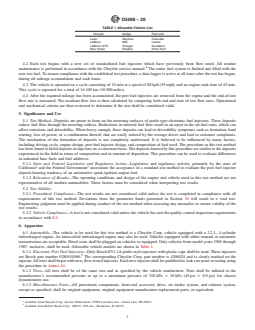
1987, inclusive, shall be used. Allowable vehicle models are shown in Table 1.
6.1.1 Electronic Port Fuel Injectors—Only Bosch EV1.1A pintle-style injectors with plastic caps shall be used. These injectors
are Bosch part number 0280150360. The corresponding Chrysler Corp. part number is 4306024 and is clearly marked on the
injector. All tests shall begin with new, flow-tested injectors. Each new injector shall be qualified for leak rate prior to testing using
the procedure in Annex A1.
6.1.2 Tires—All tires shall be of the same size and as specified by the vehicle manfacturer. Tires shall be inflated to the
manufacturer’s recommended pressure or up to a maximum pressure of 310 kPa 6 10 kPa (45 psi 6 0.5 psi) for chassis
dynamometer use.
6.1.3 Miscellaneous Parts—All powertrain components, front-end accessory drive, air intake system, and exhaust system,
except as specified, shall be original equipment, original equipment manufacturer replacement parts, or equivalent.
Available from Chrysler Corp. Service Publications, 25999 Lawrence Ave., Center Line, MI 48015.
Available from Robert Bosch Corp., 2800 S. 25th Ave., Broadview, IL 60153.
D5598 − 20
TABLE 2 Frequently Replaced Parts List
Part Part No.
Air conditioning belt 4343523
Air filter 4342801
Distributor cap (1987) 5226546
Distributor rotor (1987) 5226535
Exhaust pipe hanger 4150798
Fan relay package 4419169
Fuel injector 4306024
Fuel injector O-ring 5277919
Oil filter (1986) 4419970
Oil filter (1987) 4105409
Oxygen Sensor 5227368
Positive crankcase ventilation (PCV) hose 4387387
Positive crankcase ventilation (PCV) valve (1987) 3671076
Power steering belt 4343490
Radiator cap 3781830
A
Spark plug RN12YC
Spark plug wires 4419359
Temperature sensor 5226374
Timing chain cover 4105714
Voltage regulator 4275313
Water pump 4293898
Water pump with O-ring 5203542
Fuel pressure regulator 4275313
A
Champion, or equivalent.
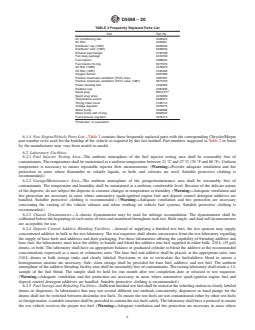
6.1.4 New Engine/Vehicle Parts List—Table 2 contains those frequently replaced parts with the corresponding Chrysler/Mopar
part number to be used for the buildup of the vehicle as required by this test method. Part numbers suggested in Table 2 or listed
by the manufacturer may vary from model-to-model.
6.2 Laboratory Facilities:
6.2.1 Fuel Injector Testing Area—The ambient atmosphere of the fuel injector testing area shall be reasonably free of
contaminants. The temperature shall be maintained at a uniform temperature between 21 °C and 27 °C (70 °F and 80 °F). Uniform
temperature is necessary to ensure repeatable injector flow measurements. (Warning—Provide adequate ventilation and fire
protection in areas where flammable or volatile liquids, or both, and solvents are used. Suitable protective clothing is
recommended.)
6.2.2 Garage/Maintenance Area—The ambient atmosphere of the garage/maintenance area shall be reasonably free of
contaminants. The temperature and humidity shall be maintained at a uniform, comfortable level. Because of the delicate nature
of the deposits, do not subject the deposits to extreme changes in temperature or humidity. (Warning—Adequate ventilation and
fire protection are necessary in areas where automotive spark-ignition engine fuel and deposit control detergent additives are
handled. Suitable protective clothing is recommended.) (Warning—Adequate ventilation and fire protection are necessary
concerning the venting of the vehicle exhaust and when working on vehicle fuel systems. Suitable protective clothing is
recommended.)
6.2.3 Chassis Dynamometer—A chassis dynamometer may be used for mileage accumulation. The dynamometer shall be
calibrated before the beginning of each series of tests and monitored throughout each test. Both single- and dual-roll dynamometers
are acceptable for use.
6.2.4 Deposit Control Additive Blending Facilities —Instead of supplying a finished test fuel, the test sponsor may supply
concentrated additive in bulk to the test laboratory. The test requestor shall obtain concurrence from the test laboratory regarding
the supply of base fuels and additives and their packaging. For those laboratories offering the capability of blending additive and
base fuel, the laboratories must have the ability to handle and blend the additive into fuel supplied in either bulk, 210 L (55 gal)
drums, or both. The laboratory shall have an appropriate balance or graduated cylinder to blend the additive at the recommended
concentrations expressed as a mass or volumetric ratio. The base fuel and additive shall be placed, at the appropriate ratio, into
210 L drums or bulk storage tanks and clearly labeled. Provisions to stir or recirculate the fuel/additive blend to ensure a
homogeneous mixture are necessary. Safe, clean storage shall be provided for base fuel, additive, and test fuel. The ambient
atmosphere of the additive blending facility area shall be reasonably free of contaminants. The testing laboratory shall retain a 1 L
sample of the fuel blend. The sample shall be held for one month after test completion date or released to test requestor.
(Warning—Adequate ventilation and fire protection are necessary in areas where automotive spark-ignition engine fuel and
deposit control detergent additives are handled. Suitable protective clothing is recommended.)
6.2.5 Fuel Storage and Refueling Facilities—Sufficient finished test fuel shall be stored at the refueling station in clearly labeled
drums or dispensers. In laboratories that may run several different test methods concurrently, dispensers or hand pumps for the
drums shall not be switched between dissimilar test fuels. To ensure the test fuels are not contaminated either by other test fuels
or foreign matter, a suitable structure shall be provided to contain the test fuels safely. The laboratory shall have a protocol to ensure
the test vehicle receives the proper test fuel. (Warning—Adequate ventilation and fire protection are necessary in areas where
D5598 − 20
automotive spark-ignition engine fuel and deposit control detergent additives are handled. Suitable protective clothing is
recommended.) (Warning—Adequate ventilation and fire protection are necessary concerning the venting of the vehicle exhaust
and when working on vehicle fuel systems. Suitable protective clothing is recommended.)
6.3 Laboratory Equipment:
6.3.1 Data Acquisition—A data acquisition device, capable of collecting the raw data in accordance with 10.5, shall be required.
6.3.2 Temperature Measurement Equipment—Temperature measurement equipment and locations for the required temperature
measurements are specified as follows. Alternative temperature measurement equipment may be used if equivalent performance
can be demonstrated. The accuracy and resolution of the temperature measurement sensors and the complete temperature
measurement system must follow guidelines detailed in the Research Reports “Data Acquisition Task Force Report” and
“Instrumentation Task Force Report to ASTM Technical Guidance Committee.”
6.3.2.1 If thermocouples are used, all thermocouples shall be premium, sheathed types. Thermocouples, wires, and extension
wires should be matched to perform in accordance with the limits of error as defined by ANSI MC96.1. Either Type J
(Iron-Constantan), Type T (Copper-Constantan), or Type K (Chromel-Alumel) thermocouples are acceptable.
6.3.3 Vehicle Speed—A suitable sensor shall be utilized to measure vehicle speed 62 kph (61 mph).
6.3.4 Engine On-Time—A suitable means shall be utilized to record ignition power on and off time during each 1 h cycle,
accurate to the nearest second.
6.4 Special Measurement and Assembly Equipment:
6.4.1 Graduated Cylinder—Blending of the additive may be required and the concentration may be given as a volumetric ratio
(see Note 2). A 1000 mL graduate is recommended.
NOTE 2—Volumetric measurement of the deposit control additive is not recommended. Mass-based measurement is preferred.
6.4.2 Analytical Balance—Blending of the additive may be required and the concentration may be given as a mass ratio. An
analytical balance capable of a 0.01 g resolution with a maximum capacity of at least 2000 g is recommended. The balance shall
be calibrated following the manufacturer’s procedure and frequency recommendations.
6.4.3 Fuel Injector Flow Apparatus—A suitable fuel injector flow measurement device shall be capable of accurate, repeatable
flow measurements. The injector flow apparatus shall maintain a constant flow fluid temperature between 21 °C to 27 °C (70 °F
to 80 °F) and shall be recorded for each set of injector flow measurements. The maximum deviation in temperature between
injector flow measurements throughout an entire test shall be less than 5 °C (9 °F). Be aware that temperature affects a fluid’s
volume and density and use engineering judgment along with good laboratory practices to enable a high level of test precision and
accuracy. The test fluid pressure supplied to the injector(s) shall be 310 kPa 6 3.4 kPa (45 psi 6 0.5 psi) during the entire test.
Maintaining this pressure is very critical because a small change in pressure will have a dramatic effect on the flow rate and spray
pattern. Either a direct weight or volumetric measurement technique is acceptable for quantifying fuel injector flow rates. An
illustration of a fuel injector flow apparatus is shown in Fig. 1. Necessary requirements of any type of flow bench design include
the following:
6.4.3.1 Fluid Flow Measurement Device—The device shall have 60.5 mL accuracy.
6.4.3.2 Timer Mechanism—The device shall be capable of 60.01 s accuracy.
6.4.3.3 Analytical Balance—If a direct weigh method is utilized, an analytical balance shall be used with a 600 g capacity or
higher, and 60.001 g resolution.
6.4.3.4 System Fuel Pump—The fuel pump shall be capable of supplying a fuel pressure of 375 kPa (55 psi). Pump shall be
compatible with fuel pressure regulator (see also 6.4.3.8 for requirements).
6.4.3.5 System Fuel Filter—Chrysler part number 4279987, or equivalent, shall be used.
6.4.3.6 Power Supply—An electronically controlled 12 V d-c device shall be used to energize injectors. Batteries shall not be
utilized to energize fuel injectors.
6.4.3.7 Fuel Injector Manifold—A suitable device shall be utilized which is capable of holding one to four fuel injectors.
6.4.3.8 Fluid Pressure Regulator—A suitable device capable of maintaining 310 kPa 6 3.4 kPa (45 psi 6 0.5 psi) solvent
pressure to injectors during injector flow testing shall be used.
6.4.3.9 Fluid Temperature Measurement Device—A suitable device capable of 60.5 °C (0.9 °F) accuracy shall be used to
measure solvent temperature.
6.4.3.10 Fluid Pressure Measurement Device—A suitable device capable of 63.4 kPa (0.5 psi) accuracy shall be used to
measure solvent pressure.
6.4.4 Fuel Injector Leak Test Apparatus—A suitable method to measure fuel injector leakage shall be used prior to the test to
evaluate new injectors for leakage. The injector leak test stand should consist of a supply of compressed air, a fuel rail, fuel
injectors, release valves, a fluid reservoir, syringes, and a pressure gage. The air shall be delivered to the fuel injectors at a
Supporting data have been filed at ASTM International Headquarters and may be obtained by requesting Research Report RR:D02-1210. Contact ASTM Customer
Service at service@astm.org.
Supporting data have been filed at ASTM International Headquarters and may be obtained by requesting Research Report RR:D02-1218. Contact ASTM Customer
Service at service@astm.org.
D5598 − 20
FIG. 1 Fuel Injector Flow Apparatus (example)
minimum of 310 kPa (45 psi) to the nonenergized (closed) injector(s). Each injector tip is connected to an immersed 5 mL syringe
by a length of tubing. If more than 2 mL of air leak into the syringe in a 1 min period, the injector shall be rejected for PFI testing.
See Annex A1 for the injector leak test procedure and an example of a leak test apparatus.
7. Reagents and Materials
7.1 Additive/Base Fuel—Some test requestors may require that the test fuel be blended at the test laboratory and, therefore, will
supply the deposit control additive and may, at their option or if a suitable base fuel is not available at the test laboratory, supply
untreated base fuel. The test requestor shall supply the deposit control additive and, if supplied by him, the base fuel in appropriate
volumes and packaging to ensure safe and efficient handling. Blending instructions detailing the concentration ratio either
volumetric-based or mass-based shall accompany all deposit control additives. Mass-based measurement is preferred. However,
it is most desirable to have the additive supplied in premeasured, individual containers. The blended fuel shall be clearly identified.
7.1.1 Additive/Base Fuel Shipment and Storage—The additive shall be shipped in a container as dictated by safety and
environmental regulations. The additive shall be stored in accordance with all applicable safety and environmental regulations.
7.1.2 Base Fuel—The base fuel used for this test procedure should be typical of commercial, unleaded automotive spark-ignition
engine fuel. The base fuel may contain oxygenates typical of those being used commercially. The base fuel should allow the vehicle
to operate satisfactorily.
7.2 Engine Coolant—The coolant is a mixture of equal volumes of a commercial ethylene glycol-based antifreeze and distilled
or demineralized water.
7.3 Engine Oil/Assembly Lubricant—The standard engine oil and assembly lubricant used for all tests shall be at least of a
minimum commercial quality (API SG, EC II) SAE multigrade that meets the manufacturer’s recommendations.
7.3.1 Petroleum Jelly—A light petroleum jelly should be used as a lubricant for fuel injector installation. The petroleum jelly
should be placed on the fuel injector O-ring.
7.4 Solvents:
7.4.1 Flow Test Solvent—Solvent should be isooctaneisooctane of a minimum purity of 9
...