

ASTM F3437-23
(Test Method)Standard Test Methods for Metallic Bone Plates Used in Small Bone Fracture Fixation
General Information
- Abstract
SIGNIFICANCE AND USE
4.1 Due to the variety of small bone fractures, plates used for the fixation of these fractures come in a variety of shapes and configurations. Table 1 categorizes the plate types for each anatomical area. Flat plates are the simplest; see Fig. 2 for an example of a basic flat plate. Many other plates have features to accommodate specific anatomies, such as condylar, complex (such as cuneiform), pre-contoured (such as metatarsophalangeal joint (MPJ)), step, orbital, orthognathic step, and wedge plates. Other plates, such as mesh-based and burr hole plates, are generally flat but are designed to be used in specific anatomical regions, so their designs are not the same as conventional straight plates. If test data is used from one type of plate for justification of the mechanical properties of another type of plate, this justification shall be described in the final report.
4.2 Most of the testing described herein is focused on a “functional unit,” which can be described as a single-line fracture being spanned by a plate with one screw hole on each side of the fracture. This configuration allows for the simplest determination of worst-case size if the strut geometry is the determining factor for the worst case. If a worst-case size cannot be isolated to a functional unit/strut geometry, perhaps due to irregular screw hole patterns or the shape of the plate, it is understandable that some tests would need to be modified, or possibly removed from test consideration, to accommodate the shape of the plate or the screw hole. Any test modifications or omissions shall be described in the final report with a rationale related to the plate’s anatomical use, indications, and functional requirements.
SCOPE
1.1 This standard is intended to provide guidance for the static testing of small bone metallic plates used for fracture fixation. Small bone plates referred to in this standard would be used in minimally load-bearing anatomical areas of the far extremities, such as the fingers and toes, and in the cranium and upper face. Lower face/mandible, wrist, and ankle fixation plates would generally be larger and carry a substantial amount of load and should not be evaluated under this standard.
1.2 ASTM Specification F382 and ISO 9585 are currently available for the testing of metallic bone plates as well, so the user can choose to use any of the tests in these standards for small bone plates. However, due to plate size, Specification F382 and ISO 9585 test setup and execution difficulty can be increased for small bone plates. Thus, this standard offers alternative test methods that are more appropriate for metallic bone plates used in small bone fracture fixation.
1.3 This standard is not intended to address the mechanical performance of the plating construct or accessory components (for example, screws and wires).
1.4 This standard is intended to provide a basis for the mechanical comparison of small bone plates. Due to the complex and varying biomechanics found in the areas of the body where these plates are used, this standard should only be used to compare the in vitro mechanical performance of small bone plates and not used to infer in vivo performance characteristics.
1.5 This standard describes static tests by specifying load types and specific methods of applying these loads. Tests for evaluating and characterizing these loads include the following: static torsion, static cantilever beam bending, static lateral bending, and static three-point bending.
1.6 The values stated in SI units are to be regarded as standard. No other units of measurement are included in this standard.
1.7 Multiple tests are cited in this standard. However, it must be noted that the user is not obligated to test using all of the described methods. Instead, the user should only select test methods that are appropriate for a particular device design.
1.8 This standard does not purport to address all of th...
- Status
- Published
- Publication Date
- 31-Mar-2023
- Technical Committee
- F04 - Medical and Surgical Materials and Devices
- Drafting Committee
- F04.21 - Osteosynthesis
Overview
ASTM F3437-23: Standard Test Methods for Metallic Bone Plates Used in Small Bone Fracture Fixation provides guidance on static mechanical testing for metallic bone plates intended for fracture fixation in minimally load-bearing anatomical areas. These plates are commonly used in the fingers, toes, cranium, and upper face. The standard specifically addresses the need for appropriately scaled test methods for small bone plates, as existing standards may not be well-suited for these smaller devices due to challenges in setup and execution.
This standard supports manufacturers, testing laboratories, and regulatory bodies by defining procedures for evaluating in vitro mechanical properties of bone plates, facilitating consistent comparison and selection of devices designed for small bone fracture fixation.
Key Topics
- Scope of Application: ASTM F3437-23 is designed for static testing of metallic bone plates used in the fixation of small bone fractures. This includes plates for the digits (fingers and toes), cranium, and upper face. Larger plates for mandible, wrist, or ankle are excluded.
- Plate Varieties: Small bone plates come in diverse configurations. Types include:
- Flat
- Condylar
- Complex (e.g., cuneiform)
- Pre-contoured (e.g., MPJ)
- Step, wedge, mesh-based, and burr hole plates
- Test Methods: The standard details static testing methods, specifying load types and how loads should be applied. Main methods include:
- Static torsion
- Static cantilever beam bending
- Static lateral bending
- Static three-point bending
- Selection of Tests: Users are not obligated to perform all listed tests. Test method selection should be based on plate design, anatomical application, and device indications.
- Functional Unit Focus: Testing often focuses on a “functional unit”-a basic bone plate spanning a single-line fracture with one screw hole on each side, ensuring worst-case mechanical conditions are assessed.
- Reporting Requirements: The standard requires thorough documentation of test selection, modifications, and mechanical property results. Deviations from prescribed methods or apparatus should be justified and clearly presented in the test report.
Applications
- Design Verification: Ensures metallic bone plates for small bone fracture fixation meet mechanical requirements for intended use areas, supporting device safety and efficacy claims.
- Quality Assurance: Provides reference performance benchmarks for comparison of different plate designs and production lots.
- Regulatory Submissions: Used in pre-market submissions to demonstrate compliance with recognized testing protocols for small bone fixation devices.
- Research & Development: Offers clear methodologies for R&D teams to evaluate and optimize new designs for small bone plates, especially in minimally load-bearing anatomical regions.
- Test Laboratory Standardization: Facilitates harmonized test procedures among labs, contributing to reproducibility and comparability of results.
Note: ASTM F3437-23 is not intended to evaluate the mechanical performance of the complete fixation construct, such as accessory components (screws, wires), nor to predict in vivo behavior. The mechanical data obtained are for in vitro comparative purposes only.
Related Standards
Users of ASTM F3437-23 may also reference the following standards for metallic bone plate testing:
- ASTM F382: Specification and Test Method for Metallic Bone Plates - provides guidance for larger plate sizes.
- ISO 9585: Implants for surgery - Determination of bending strength and stiffness of bone plates.
- ASTM E4: Practices for Force Calibration and Verification of Testing Machines.
- ASTM F983: Practice for Permanent Marking of Orthopaedic Implant Components.
- ASTM F2503: Practice for Marking Medical Devices and Other Items for Safety in the Magnetic Resonance Environment.
These standards, together, support comprehensive evaluation and consistent quality control for bone plate systems used in orthopedic and craniofacial surgery.
Keywords: metallic bone plates, small bone fracture fixation, static mechanical testing, ASTM F3437-23, orthopedic implants, device comparison, quality assurance, in vitro performance, cranium, upper face, finger fracture, toe fracture.
Relations
- Effective Date
- 01-Apr-2023
- Effective Date
- 01-Feb-2020
- Refers
ASTM F983-86(2018) - Standard Practice for Permanent Marking of Orthopaedic Implant Components - Effective Date
- 01-Feb-2018
- Effective Date
- 01-Sep-2017
- Effective Date
- 01-Dec-2015
- Effective Date
- 01-Nov-2014
- Effective Date
- 01-Jun-2014
- Refers
ASTM F983-86(2013) - Standard Practice for Permanent Marking of Orthopaedic Implant Components - Effective Date
- 01-Oct-2013
- Effective Date
- 01-Jun-2013
- Effective Date
- 15-Jan-2011
- Effective Date
- 01-Jun-2010
- Effective Date
- 01-Nov-2009
- Refers
ASTM F983-86(2009) - Standard Practice for Permanent Marking of Orthopaedic Implant Components - Effective Date
- 01-Aug-2009
- Effective Date
- 01-Apr-2009
- Effective Date
- 01-Apr-2009
Get Certified
Connect with accredited certification bodies for this standard

BSI Group
BSI (British Standards Institution) is the business standards company that helps organizations make excellence a habit.

TÜV Rheinland
TÜV Rheinland is a leading international provider of technical services.

TÜV SÜD
TÜV SÜD is a trusted partner of choice for safety, security and sustainability solutions.
Sponsored listings
Frequently Asked Questions
ASTM F3437-23 is a standard published by ASTM International. Its full title is "Standard Test Methods for Metallic Bone Plates Used in Small Bone Fracture Fixation". This standard covers: SIGNIFICANCE AND USE 4.1 Due to the variety of small bone fractures, plates used for the fixation of these fractures come in a variety of shapes and configurations. Table 1 categorizes the plate types for each anatomical area. Flat plates are the simplest; see Fig. 2 for an example of a basic flat plate. Many other plates have features to accommodate specific anatomies, such as condylar, complex (such as cuneiform), pre-contoured (such as metatarsophalangeal joint (MPJ)), step, orbital, orthognathic step, and wedge plates. Other plates, such as mesh-based and burr hole plates, are generally flat but are designed to be used in specific anatomical regions, so their designs are not the same as conventional straight plates. If test data is used from one type of plate for justification of the mechanical properties of another type of plate, this justification shall be described in the final report. 4.2 Most of the testing described herein is focused on a “functional unit,” which can be described as a single-line fracture being spanned by a plate with one screw hole on each side of the fracture. This configuration allows for the simplest determination of worst-case size if the strut geometry is the determining factor for the worst case. If a worst-case size cannot be isolated to a functional unit/strut geometry, perhaps due to irregular screw hole patterns or the shape of the plate, it is understandable that some tests would need to be modified, or possibly removed from test consideration, to accommodate the shape of the plate or the screw hole. Any test modifications or omissions shall be described in the final report with a rationale related to the plate’s anatomical use, indications, and functional requirements. SCOPE 1.1 This standard is intended to provide guidance for the static testing of small bone metallic plates used for fracture fixation. Small bone plates referred to in this standard would be used in minimally load-bearing anatomical areas of the far extremities, such as the fingers and toes, and in the cranium and upper face. Lower face/mandible, wrist, and ankle fixation plates would generally be larger and carry a substantial amount of load and should not be evaluated under this standard. 1.2 ASTM Specification F382 and ISO 9585 are currently available for the testing of metallic bone plates as well, so the user can choose to use any of the tests in these standards for small bone plates. However, due to plate size, Specification F382 and ISO 9585 test setup and execution difficulty can be increased for small bone plates. Thus, this standard offers alternative test methods that are more appropriate for metallic bone plates used in small bone fracture fixation. 1.3 This standard is not intended to address the mechanical performance of the plating construct or accessory components (for example, screws and wires). 1.4 This standard is intended to provide a basis for the mechanical comparison of small bone plates. Due to the complex and varying biomechanics found in the areas of the body where these plates are used, this standard should only be used to compare the in vitro mechanical performance of small bone plates and not used to infer in vivo performance characteristics. 1.5 This standard describes static tests by specifying load types and specific methods of applying these loads. Tests for evaluating and characterizing these loads include the following: static torsion, static cantilever beam bending, static lateral bending, and static three-point bending. 1.6 The values stated in SI units are to be regarded as standard. No other units of measurement are included in this standard. 1.7 Multiple tests are cited in this standard. However, it must be noted that the user is not obligated to test using all of the described methods. Instead, the user should only select test methods that are appropriate for a particular device design. 1.8 This standard does not purport to address all of th...
SIGNIFICANCE AND USE 4.1 Due to the variety of small bone fractures, plates used for the fixation of these fractures come in a variety of shapes and configurations. Table 1 categorizes the plate types for each anatomical area. Flat plates are the simplest; see Fig. 2 for an example of a basic flat plate. Many other plates have features to accommodate specific anatomies, such as condylar, complex (such as cuneiform), pre-contoured (such as metatarsophalangeal joint (MPJ)), step, orbital, orthognathic step, and wedge plates. Other plates, such as mesh-based and burr hole plates, are generally flat but are designed to be used in specific anatomical regions, so their designs are not the same as conventional straight plates. If test data is used from one type of plate for justification of the mechanical properties of another type of plate, this justification shall be described in the final report. 4.2 Most of the testing described herein is focused on a “functional unit,” which can be described as a single-line fracture being spanned by a plate with one screw hole on each side of the fracture. This configuration allows for the simplest determination of worst-case size if the strut geometry is the determining factor for the worst case. If a worst-case size cannot be isolated to a functional unit/strut geometry, perhaps due to irregular screw hole patterns or the shape of the plate, it is understandable that some tests would need to be modified, or possibly removed from test consideration, to accommodate the shape of the plate or the screw hole. Any test modifications or omissions shall be described in the final report with a rationale related to the plate’s anatomical use, indications, and functional requirements. SCOPE 1.1 This standard is intended to provide guidance for the static testing of small bone metallic plates used for fracture fixation. Small bone plates referred to in this standard would be used in minimally load-bearing anatomical areas of the far extremities, such as the fingers and toes, and in the cranium and upper face. Lower face/mandible, wrist, and ankle fixation plates would generally be larger and carry a substantial amount of load and should not be evaluated under this standard. 1.2 ASTM Specification F382 and ISO 9585 are currently available for the testing of metallic bone plates as well, so the user can choose to use any of the tests in these standards for small bone plates. However, due to plate size, Specification F382 and ISO 9585 test setup and execution difficulty can be increased for small bone plates. Thus, this standard offers alternative test methods that are more appropriate for metallic bone plates used in small bone fracture fixation. 1.3 This standard is not intended to address the mechanical performance of the plating construct or accessory components (for example, screws and wires). 1.4 This standard is intended to provide a basis for the mechanical comparison of small bone plates. Due to the complex and varying biomechanics found in the areas of the body where these plates are used, this standard should only be used to compare the in vitro mechanical performance of small bone plates and not used to infer in vivo performance characteristics. 1.5 This standard describes static tests by specifying load types and specific methods of applying these loads. Tests for evaluating and characterizing these loads include the following: static torsion, static cantilever beam bending, static lateral bending, and static three-point bending. 1.6 The values stated in SI units are to be regarded as standard. No other units of measurement are included in this standard. 1.7 Multiple tests are cited in this standard. However, it must be noted that the user is not obligated to test using all of the described methods. Instead, the user should only select test methods that are appropriate for a particular device design. 1.8 This standard does not purport to address all of th...
ASTM F3437-23 is classified under the following ICS (International Classification for Standards) categories: 11.040.40 - Implants for surgery, prosthetics and orthotics. The ICS classification helps identify the subject area and facilitates finding related standards.
ASTM F3437-23 has the following relationships with other standards: It is inter standard links to ASTM F2503-23e1, ASTM E2309/E2309M-20, ASTM F983-86(2018), ASTM E2624-17, ASTM E2624-15, ASTM F382-14, ASTM E4-14, ASTM F983-86(2013), ASTM F2503-13, ASTM E2309/E2309M-05(2011)e1, ASTM E4-10, ASTM E4-09a, ASTM F983-86(2009), ASTM E2624-09, ASTM E4-09. Understanding these relationships helps ensure you are using the most current and applicable version of the standard.
ASTM F3437-23 is available in PDF format for immediate download after purchase. The document can be added to your cart and obtained through the secure checkout process. Digital delivery ensures instant access to the complete standard document.
Standards Content (Sample)
This international standard was developed in accordance with internationally recognized principles on standardization established in the Decision on Principles for the
Development of International Standards, Guides and Recommendations issued by the World Trade Organization Technical Barriers to Trade (TBT) Committee.
Designation: F3437 − 23
Standard Test Methods for
Metallic Bone Plates Used in Small Bone Fracture Fixation
This standard is issued under the fixed designation F3437; the number immediately following the designation indicates the year of
original adoption or, in the case of revision, the year of last revision. A number in parentheses indicates the year of last reapproval. A
superscript epsilon (´) indicates an editorial change since the last revision or reapproval.
1. Scope 1.7 Multiple tests are cited in this standard. However, it
must be noted that the user is not obligated to test using all of
1.1 This standard is intended to provide guidance for the
the described methods. Instead, the user should only select test
static testing of small bone metallic plates used for fracture
methods that are appropriate for a particular device design.
fixation. Small bone plates referred to in this standard would be
1.8 This standard does not purport to address all of the
used in minimally load-bearing anatomical areas of the far
safety concerns, if any, associated with its use. It is the
extremities, such as the fingers and toes, and in the cranium and
responsibility of the user of this standard to establish appro-
upper face. Lower face/mandible, wrist, and ankle fixation
priate safety, health, and environmental practices and deter-
plates would generally be larger and carry a substantial amount
mine the applicability of regulatory limitations prior to use.
of load and should not be evaluated under this standard.
1.9 This international standard was developed in accor-
1.2 ASTM Specification F382 and ISO 9585 are currently
dance with internationally recognized principles on standard-
available for the testing of metallic bone plates as well, so the
ization established in the Decision on Principles for the
user can choose to use any of the tests in these standards for
Development of International Standards, Guides and Recom-
small bone plates. However, due to plate size, Specification
mendations issued by the World Trade Organization Technical
F382 and ISO 9585 test setup and execution difficulty can be
Barriers to Trade (TBT) Committee.
increased for small bone plates. Thus, this standard offers
alternative test methods that are more appropriate for metallic
2. Referenced Documents
bone plates used in small bone fracture fixation.
2.1 ASTM Standards:
1.3 This standard is not intended to address the mechanical
E4 Practices for Force Calibration and Verification of Test-
performance of the plating construct or accessory components
ing Machines
(for example, screws and wires).
E2309/E2309M Practices for Verification of Displacement
Measuring Systems and Devices Used in Material Testing
1.4 This standard is intended to provide a basis for the
Machines
mechanical comparison of small bone plates. Due to the
E2624 Practice for Torque Calibration of Testing Machines
complex and varying biomechanics found in the areas of the
F382 Specification and Test Method for Metallic Bone Plates
body where these plates are used, this standard should only be
F983 Practice for Permanent Marking of Orthopaedic Im-
used to compare the in vitro mechanical performance of small
plant Components
bone plates and not used to infer in vivo performance charac-
F2503 Practice for Marking Medical Devices and Other
teristics.
Items for Safety in the Magnetic Resonance Environment
1.5 This standard describes static tests by specifying load
2.2 ISO Standards:
types and specific methods of applying these loads. Tests for
ISO 9585 Implants for surgery—Determination of bending
evaluating and characterizing these loads include the follow-
strength and stiffness of bone plates
ing: static torsion, static cantilever beam bending, static lateral
ISO 14602 Non-active surgical implants—Implants for
bending, and static three-point bending.
osteosynthesis—Particular requirements
1.6 The values stated in SI units are to be regarded as
3. Terminology
standard. No other units of measurement are included in this
3.1 Definitions – Geometric:
standard.
For referenced ASTM standards, visit the ASTM website, www.astm.org, or
These test methods are under the jurisdiction of ASTM Committee F04 on contact ASTM Customer Service at service@astm.org. For Annual Book of ASTM
Medical and Surgical Materials and Devices and are the direct responsibility of Standards volume information, refer to the standard’s Document Summary page on
Subcommittee F04.21 on Osteosynthesis. the ASTM website.
Current edition approved April 1, 2023. Published April 2023. DOI: 10.1520/ Available from American National Standards Institute (ANSI), 25 W. 43rd St.,
F3437-23. 4th Floor, New York, NY 10036, http://www.ansi.org.
Copyright © ASTM International, 100 Barr Harbor Drive, PO Box C700, West Conshohocken, PA 19428-2959. United States
F3437 − 23
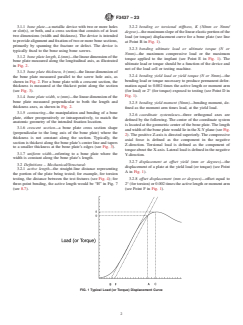
3.1.1 bone plate—a metallic device with two or more holes 3.2.2 bending or torsional stiffness, K (N/mm or Nmm/
or slot(s), or both, and a cross section that consists of at least degree)—the maximum slope of the linear elastic portion of the
two dimensions (width and thickness). The device is intended
load (or torque) displacement curve for a bone plate (see line
to provide alignment and fixation of two or more bone sections,
at Point B in Fig. 1).
primarily by spanning the fracture or defect. The device is
3.2.3 bending ultimate load or ultimate torque (N or
typically fixed to the bone using bone screws.
Nmm)—the maximum compressive load or the maximum
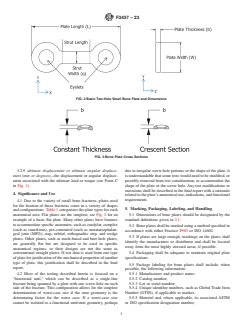
3.1.2 bone plate length, L (mm)—the linear dimension of the
torque applied to the implant (see Point E in Fig. 1). The
bone plate measured along the longitudinal axis, as illustrated
ultimate load or torque should be a function of the device and
in Fig. 2.
not of the load cell or testing machine.
3.1.3 bone plate thickness, b (mm)—the linear dimension of
3.2.4 bending yield load or yield torque (N or Nmm)—the
the bone plate measured parallel to the screw hole axis, as
bending load or torque necessary to produce permanent defor-
shown in Fig. 2. For a bone plate with a crescent section, the
mation equal to 0.002 times the active length or moment arm
thickness is measured at the thickest point along the section
(for load) or 2° (for torque) exposed to testing (see Point D in
(see Fig. 3).
Fig. 1).
3.1.4 bone plate width, w (mm)—the linear dimension of the
bone plate measured perpendicular to both the length and
3.2.5 bending yield moment (Nmm)—bending moment, de-
thickness axes, as shown in Fig. 2.
fined as the moment arm times load, at the yield load.
3.1.5 contouring—the manipulation and bending of a bone
3.2.6 coordinate system/axes—three orthogonal axes are
plate, either preoperatively or intraoperatively, to match the
defined by the following. The center of the coordinate system
anatomic geometry of the intended fixation location.
is located at the geometric center of the bone plate. The length
3.1.6 crescent section—a bone plate cross section shape
and width of the bone plate would lie in the X-Y plane (see Fig.
(perpendicular to the long axis of the bone plate) where the
2). The positive Z-axis is directed superiorly. The compressive
thickness is not constant along the section. Typically, the
axial force is defined as the component in the negative
section is thickest along the bone plate’s center line and tapers
Z-direction. Torsional load is defined as the component of
to a smaller thickness at the bone plate’s edges (see Fig. 3).
torque about the X-axis. Lateral load is defined in the negative
3.1.7 uniform width—referring to a bone plate where the
Y-direction.
width is constant along the bone plate’s length.
3.2.7 displacement at offset yield (mm or degrees)—the
3.2 Definitions – Mechanical/Structural:
displacement of a plate at the yield load (or torque) (see Point
3.2.1 active length—the straight-line distance representing
A in Fig. 1).
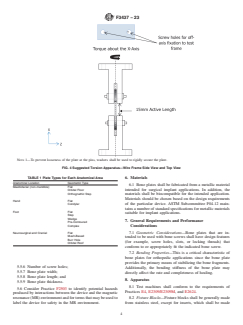
the portion of the plate being tested; for example, for torsion
3.2.8 offset displacement (mm or degrees)—offset equal to
testing, the distance between the test fixtures (see Fig. 4); for
2° (for torsion) or 0.002 times the active length or moment arm
three-point bending, the active length would be “H” in Fig. 7
(see 8.7). (see Point F in Fig. 1).
FIG. 1 Typical Load (or Torque) Displacement Curve
F3437 − 23
FIG. 2 Basic Two-Hole Small Bone Plate and Dimensions
FIG. 3 Bone Plate Cross Sections
3.2.9 ultimate displacement or ultimate angular displace- due to irregular screw hole patterns or the shape of the plate, it
ment (mm or degrees)—the displacement or angular displace- is understandable that some tests would need to be modified, or
ment associated with the ultimate load or torque (see Point C possibly removed from test consideration, to accommodate the
in Fig. 1). shape of the plate or the screw hole. Any test modifications or
omissions shall be described in the final report with a rationale
4. Significance and Use
related to the plate’s anatomical use, indications, and functional
requirements.
4.1 Due to the variety of small bone fractures, plates used
for the fixation of these fractures come in a variety of shapes
5. Marking, Packaging, Labeling, and Handling
and configurations. Table 1 categorizes the plate types for each
5.1 Dimensions of bone plates should be designated by the
anatomical area. Flat plates are the simplest; see Fig. 2 for an
standard definitions given in
example of a basic flat plate. Many other plates have features 3.1.
to accommodate specific anatomies, such as condylar, complex
5.2 Bone plates shall be marked using a method specified in
(such as cuneiform), pre-contoured (such as metatarsophalan-
accordance with either Practice F983 or ISO 14602.
geal joint (MPJ)), step, orbital, orthognathic step, and wedge
5.3 If plates are large enough, markings on the plates shall
plates. Other plates, such as mesh-based and burr hole plates,
identify the manufacturer or distributor and shall be located
are generally flat but are designed to be used in specific
away from the most highly stressed areas, if possible.
anatomical regions, so their designs are not the same as
conventional straight plates. If test data is used from one type 5.4 Packaging shall be adequate to maintain original plate
of plate for justification of the mechanical properties of another specifications.
type of plate, this justification shall be described in the final
5.5 Package labeling for bone plates shall include, when
report.
possible, the following information:
4.2 Most of the testing described herein is focused on a 5.5.1 Manufacturer and product name;
“functional unit,” which can be described as a single-line 5.5.2 Catalog number;
fracture being spanned by a plate with one screw hole on each 5.5.3 Lot or serial number;
side of the fracture. This configuration allows for the simplest 5.5.4 Unique identifier numbers, such as Global Trade Item
determination of worst-case size if the strut geometry is the Number (GTIN), if applicable to market;
determining factor for the worst case. If a worst-case size 5.5.5 Material and, where applicable, its associated ASTM
cannot be isolated to a functional unit/strut geometry, perhaps or ISO specification designation number;
F3437 − 23
NOTE 1—To prevent looseness of the plate at the pins, washers shall be used to rigidly secure the plate.
FIG. 4 Suggested Torsion Apparatus—Wire Frame Side View and Top View
TABLE 1 Plate Types for Each Anatomical Area
6. Materials
Anatomical Location Geometric Type
6.1 Bone plates shall be fabricated from a metallic material
Maxillofacial (non-mandible) Flat
intended for surgical implant applications. In addition, the
Orbital Floor
Orthognathic Step
materials shall be biocompatible for the intended application.
Materials should be chosen based on the design requirements
Hand Flat
of the particular device. ASTM Subcommittee F04.12 main-
Condylar
tains a number of standard specifications for metallic materials
Fo
...