

ASTM D8514/D8514M-23
(Specification)Standard Specification for Flexible, Retroreflective Sheeting for Use in High Visibility Vehicle Markings
General Information
- Abstract
SCOPE
1.1 This specification covers flexible, retroreflective sheeting for use in high visibility markings to provide enhanced daytime and/or nighttime visibility for use on emergency response vehicles, utility vehicles, and similar vehicles.
1.2 Units—The values stated in either SI units or inch-pound units are to be regarded separately as standard. The values stated in each system may not be exact equivalents; therefore, each system shall be used independently of the other. Combining values from the two systems may result in nonconformance with the standard.
1.3 This standard does not purport to address all of the safety concerns, if any, associated with its use. It is the responsibility of the user of this standard to establish appropriate safety, health, and environmental practices and determine the applicability of regulatory limitations prior to use.
1.4 This international standard was developed in accordance with internationally recognized principles on standardization established in the Decision on Principles for the Development of International Standards, Guides and Recommendations issued by the World Trade Organization Technical Barriers to Trade (TBT) Committee.
- Status
- Published
- Publication Date
- 31-May-2023
- Technical Committee
- D04 - Road and Paving Materials
- Drafting Committee
- D04.38 - Highway Traffic Control Materials
Overview
ASTM D8514/D8514M-23 is the international standard specification developed by ASTM International for flexible, retroreflective sheeting used in high visibility vehicle markings. This standard addresses the requirements for materials that provide enhanced daytime and nighttime visibility, ensuring safety for emergency response vehicles, utility vehicles, and other vehicles operating alongside active roadways. The standard outlines performance criteria, test methods, terminology, and guidance for the application of retroreflective sheeting.
Key Topics
- High Visibility Markings: The standard focuses on increasing visibility for vehicles through retroreflective sheeting, especially during low-light or night conditions.
- Material Specifications: Retroreflective sheeting must have a pressure-sensitive adhesive and provide consistent retroreflection across its surface.
- Color and Chromaticity: It defines acceptable colors (white, yellow, orange, red, blue, green, fluorescent variants) and provides limits for chromaticity and luminance factors, both for daytime and nighttime.
- Performance Requirements: The sheeting must meet minimum coefficients of retroreflection, withstand weathering, remain colorfast, and be resistant to impacts, cleaning solvents, corrosion, and pressure washing.
- Test Methods: Several ASTM and ISO test methods are referenced, including accelerated weathering (outdoor and artificial), color measurement, and adhesion and durability tests.
- Safety and Compliance: Users are responsible for ensuring the safe use and regulatory conformance of materials within their intended environments.
- Terminology: Key terms, such as Battenburg markings (alternating color blocks), chevron markings (V-shaped patterns), and perimeter markings (outline striping), are defined.
Applications
ASTM D8514/D8514M-23 provides practical value across multiple industries and sectors, such as:
- Emergency Services: Fire trucks, police cars, ambulances, and other first responder vehicles require conspicuous markings to alert motorists and enhance roadside safety.
- Utility and Service Fleets: Utility companies and municipal departments use high-visibility markings to reduce accident risk when vehicles stop for roadside work.
- Special Purpose Vehicles: Road maintenance, tow trucks, and hazardous material transporters benefit from increased visibility and compliance using specified retroreflective materials.
- Regulatory Compliance: Adoption of this standard helps fleets meet national and international road safety regulations and best practices, supporting requirements under NFPA 1901/1917, 49 CFR 571.108, and other guidelines.
Related Standards
ASTM D8514/D8514M-23 references a robust set of related standards and best practices, including:
- ASTM D4956 - Retroreflective Sheeting for Traffic Control
- ASTM E808, E810, E811, E991, E1349, E2301, E3165 - Retroreflection and colorimetric test methods
- ASTM G7/G7M, G147, G151, G155 - Weathering, conditioning, and exposure protocols
- B117, B209/B209M, B449 - Substrate and corrosion testing
- NFPA 1901 & 1917 - Standards for emergency vehicle apparatus and ambulances
- 49 CFR 571.108 - U.S. regulation for vehicle lamps and reflective devices
- ISO 4892-2 - Artificial accelerated weathering
- EN12899 - Traffic signs and retroreflective material requirements
Practical Value
Implementing ASTM D8514/D8514M-23:
- Increases visibility and reduces roadside accident risks.
- Supports compliance with global safety regulations for high-visibility vehicle markings.
- Ensures selection of durable, reliable retroreflective materials proven by rigorous ASTM and ISO test methods.
- Provides flexibility for manufacturers and purchasers in specifying colors, sizes, and application patterns suitable for varying operational requirements.
Keywords: ASTM D8514/D8514M-23, retroreflective sheeting, high visibility vehicle markings, emergency vehicles, safety, reflective material, vehicle conspicuity, durability, weathering, regulatory compliance.
Relations
- Effective Date
- 15-Jan-2024
- Effective Date
- 01-Dec-2023
- Effective Date
- 01-Nov-2023
- Effective Date
- 15-Jun-2020
- Effective Date
- 01-Jul-2019
- Effective Date
- 01-Jul-2018
- Effective Date
- 01-Nov-2017
- Effective Date
- 01-Oct-2017
- Effective Date
- 01-Jun-2017
- Effective Date
- 01-May-2017
- Effective Date
- 01-Jul-2016
- Effective Date
- 01-May-2016
- Effective Date
- 01-Mar-2016
- Effective Date
- 01-Jan-2016
- Effective Date
- 01-Jul-2015
Get Certified
Connect with accredited certification bodies for this standard

Zavod za gradbeništvo Slovenije (ZAG) - Inšpekcija
ZAG inspection body for construction products, structures, and materials.
Sponsored listings
Frequently Asked Questions
ASTM D8514/D8514M-23 is a technical specification published by ASTM International. Its full title is "Standard Specification for Flexible, Retroreflective Sheeting for Use in High Visibility Vehicle Markings". This standard covers: SCOPE 1.1 This specification covers flexible, retroreflective sheeting for use in high visibility markings to provide enhanced daytime and/or nighttime visibility for use on emergency response vehicles, utility vehicles, and similar vehicles. 1.2 Units—The values stated in either SI units or inch-pound units are to be regarded separately as standard. The values stated in each system may not be exact equivalents; therefore, each system shall be used independently of the other. Combining values from the two systems may result in nonconformance with the standard. 1.3 This standard does not purport to address all of the safety concerns, if any, associated with its use. It is the responsibility of the user of this standard to establish appropriate safety, health, and environmental practices and determine the applicability of regulatory limitations prior to use. 1.4 This international standard was developed in accordance with internationally recognized principles on standardization established in the Decision on Principles for the Development of International Standards, Guides and Recommendations issued by the World Trade Organization Technical Barriers to Trade (TBT) Committee.
SCOPE 1.1 This specification covers flexible, retroreflective sheeting for use in high visibility markings to provide enhanced daytime and/or nighttime visibility for use on emergency response vehicles, utility vehicles, and similar vehicles. 1.2 Units—The values stated in either SI units or inch-pound units are to be regarded separately as standard. The values stated in each system may not be exact equivalents; therefore, each system shall be used independently of the other. Combining values from the two systems may result in nonconformance with the standard. 1.3 This standard does not purport to address all of the safety concerns, if any, associated with its use. It is the responsibility of the user of this standard to establish appropriate safety, health, and environmental practices and determine the applicability of regulatory limitations prior to use. 1.4 This international standard was developed in accordance with internationally recognized principles on standardization established in the Decision on Principles for the Development of International Standards, Guides and Recommendations issued by the World Trade Organization Technical Barriers to Trade (TBT) Committee.
ASTM D8514/D8514M-23 is classified under the following ICS (International Classification for Standards) categories: 93.080.30 - Road equipment and installations. The ICS classification helps identify the subject area and facilitates finding related standards.
ASTM D8514/D8514M-23 has the following relationships with other standards: It is inter standard links to ASTM D2794-93(2024), ASTM E808-23, ASTM E1247-12(2023), ASTM E811-09(2020)e1, ASTM D4956-19, ASTM E3165-18, ASTM E1247-12(2017), ASTM D4956-17, ASTM G147-17, ASTM E308-17, ASTM D4956-16b, ASTM D4956-16a, ASTM D4956-16, ASTM E808-01(2016), ASTM E811-09(2015). Understanding these relationships helps ensure you are using the most current and applicable version of the standard.
ASTM D8514/D8514M-23 is available in PDF format for immediate download after purchase. The document can be added to your cart and obtained through the secure checkout process. Digital delivery ensures instant access to the complete standard document.
Standards Content (Sample)
This international standard was developed in accordance with internationally recognized principles on standardization established in the Decision on Principles for the
Development of International Standards, Guides and Recommendations issued by the World Trade Organization Technical Barriers to Trade (TBT) Committee.
Designation: D8514/D8514M − 23
Standard Specification for
Flexible, Retroreflective Sheeting for Use in High Visibility
Vehicle Markings
This standard is issued under the fixed designation D8514/D8514M; the number immediately following the designation indicates the
year of original adoption or, in the case of revision, the year of last revision. A number in parentheses indicates the year of last
reapproval. A superscript epsilon (´) indicates an editorial change since the last revision or reapproval.
1. Scope E284 Terminology of Appearance
E308 Practice for Computing the Colors of Objects by Using
1.1 This specification covers flexible, retroreflective sheet-
the CIE System
ing for use in high visibility markings to provide enhanced
E808 Practice for Describing Retroreflection
daytime and/or nighttime visibility for use on emergency
E810 Test Method for Coefficient of Retroreflection of
response vehicles, utility vehicles, and similar vehicles.
Retroreflective Sheeting Utilizing the Coplanar Geometry
1.2 Units—The values stated in either SI units or inch-
E811 Practice for Measuring Colorimetric Characteristics of
pound units are to be regarded separately as standard. The
Retroreflectors Under Nighttime Conditions
values stated in each system may not be exact equivalents;
E991 Practice for Color Measurement of Fluorescent Speci-
therefore, each system shall be used independently of the other.
mens Using the One-Monochromator Method
Combining values from the two systems may result in noncon-
E1247 Practice for Detecting Fluorescence in Object-Color
formance with the standard.
Specimens by Spectrophotometry
1.3 This standard does not purport to address all of the
E1349 Test Method for Reflectance Factor and Color by
safety concerns, if any, associated with its use. It is the
Spectrophotometry Using Bidirectional (45°:0° or 0°:45°)
responsibility of the user of this standard to establish appro-
Geometry
priate safety, health, and environmental practices and deter-
E2301 Test Method for Daytime Colorimetric Properties of
mine the applicability of regulatory limitations prior to use.
Fluorescent Retroreflective Sheeting and Marking Mate-
1.4 This international standard was developed in accor-
rials for High Visibility Traffic Control and Personal
dance with internationally recognized principles on standard-
Safety Applications Using 45°:Normal Geometry
ization established in the Decision on Principles for the
E3165 Test Method for Nighttime Retroreflected Chromatic-
Development of International Standards, Guides and Recom-
ity of Retroreflective Sheeting
mendations issued by the World Trade Organization Technical
G7/G7M Practice for Natural Weathering of Materials
Barriers to Trade (TBT) Committee.
G147 Practice for Conditioning and Handling of Nonmetal-
2. Referenced Documents
lic Materials for Natural and Artificial Weathering Tests
G151 Practice for Exposing Nonmetallic Materials in Accel-
2.1 ASTM Standards:
B117 Practice for Operating Salt Spray (Fog) Apparatus erated Test Devices that Use Laboratory Light Sources
B209/B209M Specification for Aluminum and Aluminum- G155 Practice for Operating Xenon Arc Lamp Apparatus for
Alloy Sheet and Plate
Exposure of Materials
B449 Specification for Chromates on Aluminum
2.2 Other Standards and References:
D2794 Test Method for Resistance of Organic Coatings to
Publication No. 14/04 High Conspicuity Livery for Police
the Effects of Rapid Deformation (Impact)
Vehicles, by Paul Harrison, Published by Police Scientific
D4956 Specification for Retroreflective Sheeting for Traffic
Development Branch, UK Home Office, 2004
Control
NFPA 1901 Standard for Automotive Fire Apparatus, 2016
49 CFR 571.108, Standard No. 108 Lamps, Reflective
This specification is under the jurisdiction of ASTM Committee D04 on Road
Devices, and Associated Equipment
and Paving Materials and is the direct responsibility of Subcommittee D04.38 on
Report FA-336 / December 2013 Emergency Vehicle Safety
Highway Traffic Control Materials.
Initiative, U.S. Fire Administration, Federal Emergency
Current edition approved June 1, 2023. Published June 2023. DOI: 10.1520/
D8514_D8514M-23.
Management Administration, 2013
For referenced ASTM standards, visit the ASTM website, www.astm.org, or
Report FA-323 / August 2009 Emergency Vehicle Visibility
contact ASTM Customer Service at service@astm.org. For Annual Book of ASTM
and Conspiciuity Study, Federal Emergency Management
Standards volume information, refer to the standard’s Document Summary page on
the ASTM website. Administration, 2009
Copyright © ASTM International, 100 Barr Harbor Drive, PO Box C700, West Conshohocken, PA 19428-2959. United States
D8514/D8514M − 23
Study of Protecting Emergency Responders on the High- retroreflection than that provided by engineer grade sheeting,
ways and Operation of Emergency Vehicles: A Review of which is commonly defined by Specification D4956, Type I.
Responder Agencies Who Have Adopted Emergency
4.3 This specification only defines the minimum properties
Lighting and Vehicle Conspicuity Technology, Cumber-
for a flexible, retroreflective sheeting for use in high visibility
land Valley Volunteer Fireman’s Association – Emergency
vehicle markings. The application guidelines provided in the
Responder Safety Institute, June 2018
appendixes are for reference purposes only. It is the responsi-
NFPA 1917 Standard for Automotive Ambulances, 2019
bility of the user of this document to determine the appropriate
Olson, Paul L. et al., Performance Requirements for Large
choice of materials, coverage areas, colors, and application
Truck Conspicuity Enhancements, University of Michigan
patterns to meet their specific needs.
Traffic Research Institute, Report UMTRI-92-8, February
4.4 This specification does not cover conspicuity tape as
commonly applied to the contours of heavy trucks, trailers,
3. Terminology
buses, or similar large vehicles. Such conspicuity tape is
covered by other industry standards and regulations, such as 49
3.1 Definitions:
CFR 571.108. Similarly, this specification does not cover
3.1.1 Definitions of terms are as described in Terminology
retroreflective tape utilized to outline the edges of slow-moving
E284 (Appearance), and Practice E808 (Practice for Describ-
vehicle warning triangles.
ing Retroreflection).
3.1.2 Battenburg markings, n—an alternating pattern of
4.5 This specification does not address inks, overlays, or
large, contrasting color blocks. See X1.15.1 and Fig. X1.2 for
other imaging methods that may be applied to the retroreflec-
additional details.
tive sheeting.
3.1.3 chevron markings, n—an inverted V-shaped mark of
4.6 This specification provides minimum requirements for
an alternating pattern positioned at a 45° angle of two
photometric and colorimetric properties for the retroreflective
contrasting colors. See X1.15.2 and Fig. X1.3 for additional
sheeting prior to its installation and in-service use on vehicles.
details.
Retroreflective sheeting, once installed as vehicle markings,
3.1.4 fluorescent material, n—a material that absorbs light
are outside the scope of this document.
energy of visible and/or ultraviolet wavelengths, and which, in
turn, reradiates some portion of that light energy, typically at
5. Description of Materials
longer wavelengths.
5.1 Retroreflective sheeting shall consist of a white or
3.1.4.1 Discussion—This reradiation allows fluorescent col-
colored sheeting having a smooth outer surface and essentially
ors to be brighter during the daytime than non-fluorescent
have the property of a retroreflector over its entire surface. The
colors having a similar chromaticity.
sheeting is supplied with a pressure-sensitive adhesive to allow
3.1.5 perimeter markings, n—retroreflective striping, typi-
application to a vehicle surface.
cally 25 mm wide, used to outline the contours of a vehicle.
6. Ordering Information
4. Significance and Use
6.1 The purchaser using this specification shall include the
4.1 High visibility markings are utilized on emergency
following information:
response vehicles, utility vehicles, and similar vehicles that
6.1.1 Reference to required conformance of this standard
may be required to stop alongside an active roadway. Such
specification,
high visibility markings are utilized in order to capture the
6.1.2 Color, and
attention of motorists to warn of potentially hazardous roadside
6.1.3 Roll size.
activity or to alert of the possible presence of individuals
working outside their vehicle. Chevron markings and Batten-
7. Required Properties
burg markings are two examples of such high visibility
markings.
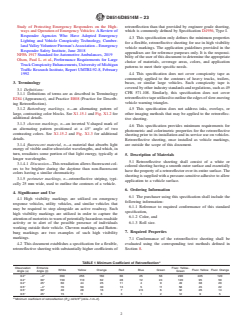
7.1 Conformance of the retroreflective sheeting shall be
4.2 This document establishes a specification for a flexible, evaluated using the corresponding test methods defined in
retroreflective sheeting with substantially higher coefficients of Section 8.
A
TABLE 1 Minimum Coefficient of Retroreflection
Observation Entrance Fluor. Yellow-
White Yellow Orange Red Blue Green Fluor. Yellow Fluor. Orange
Angle (α) Angle (β) Green
0.2° –4° 350 255 150 66 25 56 290 225 120
0.2° 30° 150 110 62 28 12 24 120 95 50
0.2° 45° 60 44 25 11 4 9 49 38 20
0.5° –4° 70 50 30 13 5 11 58 45 22
0.5° 30° 40 28 16 7 2.5 6 32 26 14
0.5° 45° 15 11 6 3 1 2 12 9 5
A 2
Minimum coefficient of retroreflection (R ) cd/fc/ft [cd·lx−1·m−2].
A
D8514/D8514M − 23
TABLE 3 Daytime Luminance Factor Requirements
7.2 Minimum Coeffıcient of Retroreflection—When tested in
accordance with 8.3, the coefficient of retroreflection shall Y%
Color
meet the requirements as provided in Table 1. Minimum Maximum
White 27 . . .
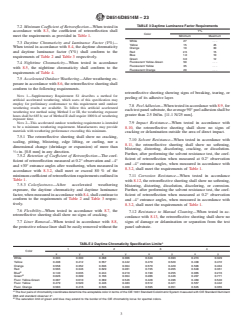
7.3 Daytime Chromaticity and Luminance Factor (Y%)—
Yellow 15 45
When tested in accordance with 8.4, the daytime chromaticity
Orange 10 30
Red 2.5 15
and daytime luminance factor (Y%) shall conform to the
Blue 1.0 10
requirements of Table 2 and Table 3 respectively.
Green 3.0 12
Fluorescent Yellow-Green 50 . . .
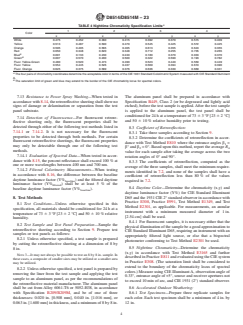
7.4 Nighttime Chromaticity—When tested in accordance
Fluorescent Yellow 35 . . .
with 8.5, the nighttime chromaticity shall conform to the
Fluorescent Orange 20 . . .
requirements of Table 4.
7.5 Accelerated Outdoor Weathering—After weathering ex-
posure in accordance with 8.6, the retroreflective sheeting shall
conform to the following requirements.
retroreflective sheeting showing signs of breaking, tearing, or
NOTE 1—Supplementary Requirement S1 describes a method for
peeling of its adhesive layer.
artificial accelerated weathering, which users of this specification may
employ for preliminary conformance to this requirement until outdoor
7.8 Peel Adhesion—When tested in accordance with 8.9, for
weathering results are available. To follow this artificial accelerated
each test panel substrate, the average 90° peel adhesion shall be
weathering test method using Method I or III, the weathering exposure
greater than 2.5 lbf/in. [11.1 N/25 mm].
hours shall be 685 h; use of Method II shall require 1000 h of weathering
exposure time.
7.9 Impact Resistance—When tested in accordance with
NOTE 2—This accelerated outdoor weathering requirement is intended
to be a minimum weathering requirement. Manufacturers may provide
8.10, the retroreflective sheeting shall show no signs of
materials with weathering performance exceeding this minimum.
cracking or delamination outside the area of direct impact.
7.5.1 The retroreflective sheeting shall show no cracking,
7.10 Solvent Resistance—When tested in accordance with
scaling, pitting, blistering, edge lifting, or curling, nor a
8.11, the retroreflective sheeting shall show no softening,
dimensional change (shrinkage or expansion) of more than
blistering, distorting, discoloring, cracking, or dissolution.
⁄32 in. [0.8 mm] in any direction.
Further, after performing the solvent resistance test, the coef-
7.5.2 Retention of Coeffıcient of Retroreflection—The coef-
ficient of retroreflection when measured at 0.2° observation
ficient of retroreflection measured at 0.2° observation and –4°
and –4° entrance angles, when measured in accordance with
and +30° entrance angles after weathering, when measured in
8.3.2, shall meet the requirements of Table 1.
accordance with 8.3.2, shall meet or exceed 80 % of the
minimum coefficient of retroreflection requirements outlined in
7.11 Corrosion Resistance—When tested in accordance
Table 1.
with 8.12, the retroreflective sheeting shall show no softening,
7.5.3 Colorfastness—After accelerated weathering
blistering, distorting, dissolution, discoloring, or corrosion.
exposure, the daytime chromaticity and daytime luminance
Further, after performing the solvent resistance test, the coef-
factor, when measured in accordance with 8.4, shall continue to
ficient of retroreflection when measured at 0.2° observation
conform to the requirements of Table 2 and Table 3 respec-
and –4° entrance angles, when measured in accordance with
tively.
8.3.2, shall meet the requirements of Table 1.
7.6 Flexibility—When tested in accordance with 8.7, the
7.12 Resistance to Manual Cleaning—When tested in ac-
retroreflective sheeting shall show no signs of cracking.
cordance with 8.13, the retroreflective sheeting shall show no
7.7 Liner Removal—When tested in accordance with 8.8, signs of damage or delamination or separation from the test
the protective release liner shall be easily removed without the panel substrate.
A
TABLE 2 Daytime Chromaticity Specification Limits
1 2 3 4
Color
x y x y x y x y
White 0.303 0.300 0.368 0.366 0.340 0.393 0.274 0.329
Yellow 0.498 0.412 0.557 0.442 0.479 0.520 0.438 0.472
Orange 0.558 0.352 0.636 0.364 0.570 0.429 0.506 0.404
Red 0.565 0.346 0.629 0.281 0.735 0.265 0.648 0.351
B
Blue 0.140 0.035 0.244 0.210 0.190 0.255 0.065 0.216
B
Green 0.026 0.399 0.166 0.364 0.286 0.446 0.207 0.771
Fluor. Yellow-Green 0.387 0.610 0.369 0.546 0.428 0.496 0.460 0.540
Fluor. Yellow 0.479 0.520 0.446 0.483 0.512 0.421 0.557 0.442
Fluor. Orange 0.583 0.416 0.535 0.400 0.595 0.351 0.645 0.355
A
The four pairs of chromaticity coordinates determine the acceptable color in terms of the CIE 1931 Standard Colorimetric System measured with CIE Standard Illuminant
D65 and standard observer 2°.
B
The saturation limit of green and blue may extend to the border of the CIE chromaticity locus for spectral colors.
D8514/D8514M − 23
A
TABLE 4 Nighttime Chromaticity Specification Limits
1 2 3 4
Color
x y x y x y x y
White 0.475 0.452 0.360 0.415 0.392 0.370 0.515 0.409
Yellow 0.513 0.487 0.500 0.470 0.545 0.425 0.572 0.425
Orange 0.595 0.405 0.565 0.405 0.613 0.355 0.643 0.355
Red 0.650 0.348 0.620 0.348 0.712 0.255 0.735 0.265
B
Blue 0.091 0.133 0.230 0.240 0.180 0.370 0.033 0.370
B
Green 0.007 0.570 0.200 0.500 0.322 0.590 0.193 0.782
Fluor. Yellow-Green 0.480 0.520 0.473 0.490 0.523 0.440 0.550 0.449
Fluor. Yellow 0.554 0.445 0.526 0.437 0.569 0.394 0.610 0.390
Fluor. Orange 0.625 0.375 0.589 0.376 0.636 0.330 0.669 0.331
A
The four pairs of chromaticity coordinates determine the acceptable color in terms of the CIE 1931 Standard Colorimetric System measured with CIE Standard Illuminant
A.
B
The saturation limit of green and blue may extend to the border of the CIE chromaticity locus for spectral colors.
7.13 Resistance to Power Spray Washing—When tested in The aluminum panel shall be prepared in accordance with
accordance with 8.14, the retroreflective sheeting shall show no Specification B449, Class 2 (or be degreased and lightly acid
signs of damage or delamination or separation from the test etched), before the test sample is applied. After the test sample
panel substrate. is applied to the aluminum panel, the test panel shall be
conditioned for 24 h at a temperature of 73 6 3 °F [23 6 2 °C]
7.14 Detection of Fluorescence—For fluorescent retrore-
and 50 6 10 % relative humidity prior to testing.
flective sheeting only, the fluorescent properties shall be
detected through either of the following test methods listed in
8.3 Coeffıcient of Retroreflection:
7.14.1 or 7.14.2. It is not necessary for the fluorescent
8.3.1 Take three samples according to Section 9.
properties to be detected through both methods. For certain
8.3.2 Determine the coefficients of retroreflection in accor-
fluorescent retroreflective sheetings, the fluorescent properties
dance with Test Method E810 where the entrance angles β =
may only be detectable through one of the following test
β° and β = 0°. Based upon this method, report the average R
2 A
methods.
value for each sample after taking the average across the two
7.14.1 Evaluation of Spectral Data—When tested in accor-
rotation angles of 0° and 90°.
dance with 8.15, the percent reflectance shall exceed 100 % at
8.3.3 The coefficients of retroreflection, computed as the
one or more wavelengths between 400 nm and 700 nm.
average of the three samples, shall meet the minimum require-
7.14.2 Filtered Colorimetry Measurements—When testing
ments identified in 7.2, and none of the samples shall have a
in accordance with 8.16, the difference between the baseline
coefficient of retroreflection less than 80 % of the values
daytime luminance factor (Y% ) and the filtered daytime
baseline
required in 7.2.
luminance factor (Y% ) shall be at least 5 % of the
filtered
8.4 Daytime Color—Determine the chromaticity (x,y) and
baseline daytime luminance factor (Y% ).
baseline
daytime luminance factor (Y%) for CIE Standard Illuminant
8. Test Methods D65 and the 1931 CIE 2° standard observer in accordance with
Practice E308, Practice E991, Test Method E1349, and Test
8.1 Test Conditions—Unless otherwise specified in this
Method E2301, as applicable. For measurements, an annular
specification, all materials should be conditioned for 24 h at a
instrument with a minimum measured diameter of 1 in.
temperature of 73 6 3 °F [23 6 2 °C] and 50 6 10 % relative
[2.54 cm] shall be used.
humidity.
8.4.1 For fluorescent samples, it is necessary either that the
8.2 Test Sample and Test Panel Preparation—Sample the
physical illumination of the sample be a good approximation to
retroreflective sheeting according to Section 9. Prepare test
CIE Standard Illuminant D65, requiring an instrument with an
samples or test panels as follows:
appropriately filtered light source, or else that a bispectral
8.2.1 Unless otherwise specified, a test sample is prepared
photometer conforming to Test Method E2301 be used.
by cutting the retroreflective sheeting at a dimension of 8 by
8.5 Nighttime Chromaticity—Determine the chromaticity
8 in.
(x,y) in accordance with Test Method E3165 and further
NOTE 3—It may not always be possible to test an 8 by 8 in. sample. In
described in Practice E811 and evaluated using the CIE system
these cases, a composite of smaller sizes may be utilized or a smaller area
in Practice E308. (The saturation limit shall be considered to
may be utilized.
extend to the boundary of the chromaticity locus of spectral
8.2.2 Unless otherwise specified, a test panel is prepared by
colors.) Measure using CIE Illuminant A, observation angle of
removing the liner from the test sample and applying the test
0.33°, entrance angle of +5°, source and receiver apertures not
sample to an aluminum panel, as per the recommendations of
to exceed 10 min of arc, and CIE 1931 (2°) standard observer.
the retroreflective material manufacturer. The aluminum panel
8.6 Accelerated Outdoor Weathering:
shall be cut from Alloy 6061-T6 or 5052-H38, in accordance
with Specification B209/B209M, and be of one of three 8.6.1 Test Specimens—Prepare three replicate samples for
thicknesses: 0.020 in. [0.508 mm], 0.040 in. [1.016 mm], or each color. Each test specimen shall be a minimum of 4 in. by
0.063 in. [1.600 mm] in thickness, and a minimum of 8 by 8 in. 12 in.
D8514/D8514M − 23
8.6.2 Outdoor Weathering Conditions—Conduct outdoor Further, during application of the test strip, care should be
exposures in accordance with Practice G7/G7M. During taken not to exert any additional force or pressure during the
exposure, test panels shall be open backed and oriented at an application process other than what the steel roller applicator
angle of 45° from the horizontal and facing the equator in provides through its own weight.
accordance with Practice G7/G7M. Exposure location shall be
8.9.3 Condition each panel for 24 h at a temperature of 73 6
South Florida. Panel labeling, and conditioning and handling of
3 °F [23 6 2 °C] and 50 6 5 % relative humidity prior to
panels prior to exposure and during evaluation periods shall be
testing. Using a 90° peel fixture on a tensile strength testing
in accordance with Practice G147.
machine, measure the peel force required to remove each
8.6.3 Exposure Time Frame—The exposure time shall be
sample from each test panel substrate. Utilize a constant peel
twelve months.
speed of 300 mm [11.8 in.] per minute and measure the peel
8.6.4 Washing and Drying of Panels After Weathering—
force along a test distance of at least 50 mm [3.94 in.]. For each
Gently wash the panels using a soft cloth or sponge and clean
sample, record the average peel force across the test distance.
water or a dilute solution of a mild detergent (1 % by weight in
For each test panel substrate, report the average of the three
water, maximum concentration). Then, rinse thoroughly with
measurements.
clean water and blot dry with a soft, clean cloth. Finally,
8.10 Impact Resistance—Apply a test sample to an alumi-
condition the panels at 73 6 3 °F for at least 2 h prior to
num panel of 0.063 in. [1.600 mm] thickness according to
conducting any property measurements.
8.2.2. Utilizing the test instrument and procedures described in
8.6.5 Report of Test Results—For each test conducted after
Test Method D2794, with the reflective sheeting side facing up,
accelerated outdoor weathering, report the average measure-
subject this test panel to the impact of a 2 lb [0.91 kg] weight
ment of the three replicate test samples for each color tested.
dropped from a height necessary to generate an impact of 10
8.7 Flexibility—Bend the material, in 1 s, around a ⁄8 in.
in.-lb [1.13 N-m] when striking with a ⁄8 in. [15.8 mm]
[3.2 mm] mandrel with adhesive contacting the mandrel. The
diameter rounded tip indentor. The indentation formed during
test specimen shall be 2.75 by 11 in. [70 by 229 mm]. The test
this test shall be an intrusion, in which the panel is struck on
specimen shall be conditioned for 24 h at 73 6 3 °F prior to
the sheeting side and the panel is supported by a steel fixture
conducting the test.
having a cylindrical hole as described in subsection 6.3 of Test
Method D2794.
NOTE 4—For ease of testing, spread talcum powder on the adhesive to
prevent sticking to the mandrel.
8.11 Solvent Resistance—A test panel not less than 2 in. by
8.8 Liner Removal—Condition the test sample for 4 h at
6 in. shall be immersed in a mixture of 70 % n-heptane and
160 °F [71 °C] and under a weight of 2.5 psi [17.2 kPa].
30 % toluene (also known as toluol), by volume, for 1 min.
Immediately after removal from this conditioning, attempt to
After removal, the surface shall be wiped dry with a clean and
remove the protective release liner.
soft cloth.
8.9 Peel Adhesion:
8.12 Corrosion Resistance—Following Practice B117, a test
8.9.1 Test Panel Substrates—Peel adhesion testing shall be
panel shall be exposed to a saline mist for two periods of
conducted on two different test panel substrates as listed below.
exposure of 24 h each, separated by a 2 h interval during which
Each panel shall be cut to the proper size to fit within a 90° peel
the specimen dries. The saline mist shall be produced by
testing fixture.
atomizing a saline solution obtained by dissolving five parts by
8.9.1.1 Aluminum Test Panel Substrate #1—Prepare an
weight of sodium chloride in 95 parts of water. At the end of
aluminum panel as outlined in 8.2.2.
the test, the surface of the sample unit shall be cleaned with a
8.9.1.2 Automotive Paint Test Panel Substrate #2—Utilize a
clean and soft cloth to remove salt deposits from the saline
steel test panel prepared and coated to be representative of an
mist.
OEM automotive white basecoat / clear coat paint surface. The
8.13 Resistance to Manual Cleaning—A test sample
test panel shall be made from cold roll steel of 0.032 in.
smeared with a mixture of detergent lubricating oil and
thickness and consist of a white basecoat and a clear coat of
graphite shall be easily cleaned without damage to the retrore-
polysiloxane chemistry.
flective surface when wiped with a mild aliphatic solvent such
NOTE 5—Formulation differences between available polysiloxane clear
as n-heptane, followed by washing with a neutral detergent.
coat products may result in different peel adhesion results. When
performing the peel adhesion testing, the identity of the polysiloxane clear
8.14 Resistance to Pressure Washing—Subject the test panel
coat should be recorded for future reference purposes.
to a continuous spraying action for 60 s on the test sample in its
8.9.2 Preparation of Test Panels—Cut a set of six different normal mounting conditions under the following setup param-
test strips from the center of the test samples. Each test strip eters: (1) Water/wash solution pressure 8 6 0.2 MPa; (2)
shall be 1 in. by 12 in. [25 mm by 305 mm]. Using a Water/wash solution temperature 140 6 9 °F [60 6 5 °C]; (3)
rubber-coated steel roller applicator having a weight of 4.5 6 Water/wash solution flow rate 7 6 1 l/min; (4) The tip of the
0.1 lb, a diameter of 3.25 in., and approximately a ⁄4 in. rubber cleaning wand to be positioned at distance of 24 6 0.079 in.
coating with a Shore A durometer between 75 and 85, apply [600 6 20 mm] away from the retroreflective surface; (5)
three test strips to each of the two different test panel Cleaning wand to be held at no greater angle than 45° from
substrates. Only a single pass with the roller applicator shall be perpendicular to the retroreflective surface; and (6) 40° nozzle
utilized to laminate the test strips to each panel substrate. creating wide fan pattern.
D8514/D8514M − 23
8.15 Detection of Fluorescence Through Evaluation of the filter, the coated side of the filter shall be positioned towards
Spectral Data—Using an instrument capable of providing the the light source of the colorimeter.
spectral data, measure the daytime color in accordance with 8.4
8.16.2 Determination of Baseline Daytime Luminance Fac-
to obtain the spectral data providing the percent reflectance as
tor (Y% )—Determine the baseline daytime luminance
baseline
a function of wavelength. Review the spectral data to identify
factor (Y% ) by placing a 325 nm long-wavelength
baseline
any wavelengths where the percent reflectance is greater than
bandpass filter between the sample and the illuminating source
100 %.
of the colorimeter and then measure the total daytime lumi-
nance factor (Y%) per 8.4. Take eight measurements at random
8.16 Detection of Fluorescence Through Filtered Colorim-
positions and rotations across each sample and report the
etry Measurements—Follow the sequence of steps provided
average. The baseline daytime luminance factor (Y% )
baseline
below to determine the baseline daytime luminance factor
shall be the average of these measurements.
(Y% ) and the filtered daytime luminance factor
baseline
8.16.3 Determine the Cut-On Wavelength for the Second
(Y% ) for CIE Standard Illuminant D65 and the 1931 CIE
filtered
Long-W
...