

ASTM D2221-01(2021)
(Test Method)Standard Test Method for Creep Properties of Package Cushioning Materials
General Information
- Abstract
SIGNIFICANCE AND USE
5.1 This test method determines the extent and nature of cushion thickness change under static load. Creep data obtained by this test method are applicable to the cushion under the conditions of the particular test and are not necessarily the same as obtained in a complete pack in actual packaging environments. Data may be affected by magnitude of static load, specimen area, shape, and thickness, by varying ambient conditions of temperature, humidity, by friction in the movable platen guide system, and by actual cushion thickness. Vibration in the vicinity of the test fixtures may also influence data results.
SCOPE
1.1 This test method covers the determination of creep properties of package cushioning materials. It is applicable to materials available in bulk, sheet, or molded form used for the cushioning of articles during storage, handling, and shipment.
1.2 The values stated in inch-pound units are to be regarded as standard. The values given in parentheses are mathematical conversions to SI units that are provided for information only and are not considered standard.
1.3 This standard does not purport to address all of the safety concerns, if any, associated with its use. It is the responsibility of the user of this standard to establish appropriate safety, health, and environmental practices and determine the applicability of regulatory limitations prior to use.
1.4 This international standard was developed in accordance with internationally recognized principles on standardization established in the Decision on Principles for the Development of International Standards, Guides and Recommendations issued by the World Trade Organization Technical Barriers to Trade (TBT) Committee.
- Status
- Published
- Publication Date
- 30-Sep-2021
- Technical Committee
- D10 - Packaging
- Drafting Committee
- D10.13 - Interior Packaging
Overview
ASTM D2221-01(2021), Standard Test Method for Creep Properties of Package Cushioning Materials, is an internationally recognized standard developed by ASTM International. This test method provides a consistent procedure to determine the extent and characteristics of thickness change, also known as creep, in cushioning materials subjected to static compressive loads over time. Creep testing is essential for quality assurance and performance evaluation of packaging cushions designed to protect items during storage, handling, and shipment.
The standard applies to cushioning materials that are available in bulk, sheet, or molded forms, commonly used in industrial, commercial, and shipping sectors. The data generated helps manufacturers and users assess how cushioning materials will behave under prolonged loading, which is crucial for reducing the risk of product damage during transit.
Key Topics
- Creep Properties Measurement: The standard outlines procedures to evaluate the deformation (creep) of packaging cushioning materials when subjected to a constant static load, simulating real packaging environments.
- Applicability: Covers various forms of cushioning such as bulk, sheet, or molded materials, making it widely relevant in packaging and shipping applications.
- Test Apparatus: Specifies the use of guided movable platen and static load box fixtures, as well as measurement techniques including two-position and four-position micrometer methods.
- Sample Preparation and Conditioning: Details requirements for sample size, preconditioning in controlled temperature and humidity, and optional preworking for highly compressible cushions.
- Calculation Methods: Provides guidance on computing density, static stress, initial strain, interval strain, creep, and permanent set based on measured specimen deformation.
- Reporting Requirements: Defines necessary data and observations to be included in the test report for reliability, consistency, and traceability.
- Influencing Factors: Describes environmental and procedural variables such as ambient conditions, specimen geometry, and vibration effects that may impact results.
Applications
- Packaging Material Development: Enables manufacturers to design and select cushioning materials with documented creep performance to enhance product protection.
- Quality Control: Supports material suppliers and packaging engineers in verifying the long-term performance and reliability of cushioning products under static loads.
- Compliance and Specification: Assists companies in meeting regulatory and client-specific packaging requirements related to stability and shock absorption.
- Risk Management: Provides valuable data for predicting the performance of cushioning materials over time, reducing the likelihood of product damage during extended storage or transit.
- Research and Product Comparison: Facilitates comparison between different cushioning materials or configurations by using standardized test results.
Related Standards
- ASTM D4332 – Practice for Conditioning Containers, Packages, or Packaging Components for Testing: Details procedures for conditioning packaging materials prior to testing for more consistent results.
- ASTM E105 – Guide for Probability Sampling of Materials: Describes procedures for selecting test samples randomly to ensure representative and unbiased testing.
- ASTM E122 – Practice for Calculating Sample Size to Estimate with Specified Precision the Average for a Characteristic of a Lot or Process: Provides methods for determining adequate sample size in material testing.
By following ASTM D2221-01(2021), stakeholders in the packaging supply chain can ensure reliable evaluation of cushioning materials' creep properties, supporting informed selection, performance validation, and compliance in packaging systems. Using this method strengthens packaging reliability, protects product integrity, and enhances customer satisfaction throughout distribution and storage processes.
Relations
- Effective Date
- 15-Mar-2013
- Effective Date
- 01-Aug-2011
- Effective Date
- 01-Oct-2010
- Effective Date
- 01-Aug-2009
- Effective Date
- 01-Oct-2007
- Effective Date
- 01-Nov-2006
- Effective Date
- 01-Jun-2004
- Effective Date
- 10-Apr-2001
- Effective Date
- 10-Apr-2001
- Effective Date
- 10-Apr-2001
- Effective Date
- 10-Apr-2001
- Effective Date
- 10-Apr-2001
- Effective Date
- 10-Oct-2000
- Effective Date
- 10-Oct-2000
- Effective Date
- 01-Jan-1996
Get Certified
Connect with accredited certification bodies for this standard

BRCGS (Brand Reputation Compliance Global Standards)
Global food safety and quality standards owner.
Sponsored listings
Frequently Asked Questions
ASTM D2221-01(2021) is a standard published by ASTM International. Its full title is "Standard Test Method for Creep Properties of Package Cushioning Materials". This standard covers: SIGNIFICANCE AND USE 5.1 This test method determines the extent and nature of cushion thickness change under static load. Creep data obtained by this test method are applicable to the cushion under the conditions of the particular test and are not necessarily the same as obtained in a complete pack in actual packaging environments. Data may be affected by magnitude of static load, specimen area, shape, and thickness, by varying ambient conditions of temperature, humidity, by friction in the movable platen guide system, and by actual cushion thickness. Vibration in the vicinity of the test fixtures may also influence data results. SCOPE 1.1 This test method covers the determination of creep properties of package cushioning materials. It is applicable to materials available in bulk, sheet, or molded form used for the cushioning of articles during storage, handling, and shipment. 1.2 The values stated in inch-pound units are to be regarded as standard. The values given in parentheses are mathematical conversions to SI units that are provided for information only and are not considered standard. 1.3 This standard does not purport to address all of the safety concerns, if any, associated with its use. It is the responsibility of the user of this standard to establish appropriate safety, health, and environmental practices and determine the applicability of regulatory limitations prior to use. 1.4 This international standard was developed in accordance with internationally recognized principles on standardization established in the Decision on Principles for the Development of International Standards, Guides and Recommendations issued by the World Trade Organization Technical Barriers to Trade (TBT) Committee.
SIGNIFICANCE AND USE 5.1 This test method determines the extent and nature of cushion thickness change under static load. Creep data obtained by this test method are applicable to the cushion under the conditions of the particular test and are not necessarily the same as obtained in a complete pack in actual packaging environments. Data may be affected by magnitude of static load, specimen area, shape, and thickness, by varying ambient conditions of temperature, humidity, by friction in the movable platen guide system, and by actual cushion thickness. Vibration in the vicinity of the test fixtures may also influence data results. SCOPE 1.1 This test method covers the determination of creep properties of package cushioning materials. It is applicable to materials available in bulk, sheet, or molded form used for the cushioning of articles during storage, handling, and shipment. 1.2 The values stated in inch-pound units are to be regarded as standard. The values given in parentheses are mathematical conversions to SI units that are provided for information only and are not considered standard. 1.3 This standard does not purport to address all of the safety concerns, if any, associated with its use. It is the responsibility of the user of this standard to establish appropriate safety, health, and environmental practices and determine the applicability of regulatory limitations prior to use. 1.4 This international standard was developed in accordance with internationally recognized principles on standardization established in the Decision on Principles for the Development of International Standards, Guides and Recommendations issued by the World Trade Organization Technical Barriers to Trade (TBT) Committee.
ASTM D2221-01(2021) is classified under the following ICS (International Classification for Standards) categories: 55.040 - Packaging materials and accessories. The ICS classification helps identify the subject area and facilitates finding related standards.
ASTM D2221-01(2021) has the following relationships with other standards: It is inter standard links to ASTM D4332-13, ASTM E122-09e1, ASTM E105-10, ASTM E122-09, ASTM E122-07, ASTM D4332-01(2006), ASTM E105-04, ASTM D4332-01e1, ASTM D4332-99, ASTM D4332-01e2, ASTM D4332-00, ASTM D4332-01, ASTM E122-00, ASTM E122-99, ASTM E105-58(1996). Understanding these relationships helps ensure you are using the most current and applicable version of the standard.
ASTM D2221-01(2021) is available in PDF format for immediate download after purchase. The document can be added to your cart and obtained through the secure checkout process. Digital delivery ensures instant access to the complete standard document.
Standards Content (Sample)
This international standard was developed in accordance with internationally recognized principles on standardization established in the Decision on Principles for the
Development of International Standards, Guides and Recommendations issued by the World Trade Organization Technical Barriers to Trade (TBT) Committee.
Designation: D2221 − 01 (Reapproved 2021)
Standard Test Method for
Creep Properties of Package Cushioning Materials
This standard is issued under the fixed designation D2221; the number immediately following the designation indicates the year of
original adoption or, in the case of revision, the year of last revision.Anumber in parentheses indicates the year of last reapproval.A
superscript epsilon (´) indicates an editorial change since the last revision or reapproval.
This standard has been approved for use by agencies of the U.S. Department of Defense.
1. Scope 3.1.1 creep, n—thedeformationofamaterialoccurringwith
time and due to an externally applied constant stress. For
1.1 This test method covers the determination of creep
cushioning materials specifically, it may be defined as the
properties of package cushioning materials. It is applicable to
change in thickness of a cushion under static compressive load
materials available in bulk, sheet, or molded form used for the
over a period of time.
cushioning of articles during storage, handling, and shipment.
3.1.2 permanent set, n—the permanent change in thickness
1.2 The values stated in inch-pound units are to be regarded
of an unloaded cushion as a result of an applied compressive
as standard. The values given in parentheses are mathematical
load for any given time interval and any given unloaded
conversions to SI units that are provided for information only
recovery time period.
and are not considered standard.
1.3 This standard does not purport to address all of the
4. Summary of Test Method
safety concerns, if any, associated with its use. It is the
4.1 The test apparatus consists of a suitable testing device
responsibility of the user of this standard to establish appro-
having a base plate and a guided movable platen which can be
priate safety, health, and environmental practices and deter-
loaded with weights.The loaded movable platen is placed on a
mine the applicability of regulatory limitations prior to use.
cushion to simulate static compressive loading of cushioning
1.4 This international standard was developed in accor-
material in actual packaging. By measuring the change in
dance with internationally recognized principles on standard-
thickness of the loaded cushion with time, creep properties of
ization established in the Decision on Principles for the
the cushioning material can be obtained.
Development of International Standards, Guides and Recom-
mendations issued by the World Trade Organization Technical
5. Significance and Use
Barriers to Trade (TBT) Committee.
5.1 This test method determines the extent and nature of
cushion thickness change under static load. Creep data ob-
2. Referenced Documents
tained by this test method are applicable to the cushion under
2.1 ASTM Standards:
the conditions of the particular test and are not necessarily the
D4332Practice for Conditioning Containers, Packages, or
same as obtained in a complete pack in actual packaging
Packaging Components for Testing
environments. Data may be affected by magnitude of static
E105Guide for Probability Sampling of Materials
load, specimen area, shape, and thickness, by varying ambient
E122PracticeforCalculatingSampleSizetoEstimate,With
conditionsoftemperature,humidity,byfrictioninthemovable
Specified Precision, the Average for a Characteristic of a
platenguidesystem,andbyactualcushionthickness.Vibration
Lot or Process
in the vicinity of the test fixtures may also influence data
results.
3. Terminology
3.1 Definitions of Terms Specific to This Standard:
6. Apparatus
6.1 Movable, Guided Platen, capable of being weighted to
achieve the desired loading along with a base to support the
This test method is under the jurisdiction of ASTM Committee D10 on
sample throughout the duration of the test. Two such assem-
Packaging and is the direct responsibility of Subcommittee D10.13 on Interior
Packaging.
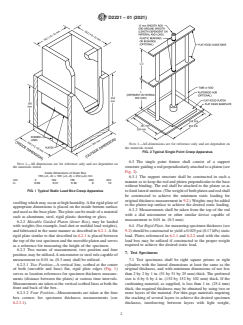
blies are shown in Fig. 1 and Fig. 2.
Current edition approved Oct. 1, 2021. Published November 2021. Originally
6.2 Static Load Box Fixture (Fig. 1), consisting of a mov-
approved in 1963. Last previous edition approved in 2015 as D2221–01 (2015).
DOI: 10.1520/D2221-01R21.
able guided platen and an outer box that shall act as the guide
For referenced ASTM standards, visit the ASTM website, www.astm.org, or
and the base plate for supporting the sample.
contact ASTM Customer Service at service@astm.org. For Annual Book of ASTM
6.2.1 Base Plate (Outer Box), may be constructed of ⁄4 in.
Standards volume information, refer to the standard’s Document Summary page on
the ASTM website. (19.0 mm) minimum white pine and fabricated to reduce
Copyright © ASTM International, 100 Barr Harbor Drive, PO Box C700, West Conshohocken, PA 19428-2959. United States
D2221 − 01 (2021)
NOTE 1—All dimensions are for reference only and are dependent on
the materials tested.
FIG. 2 Typical Single Point Creep Apparatus
6.3 The single point fixture shall consist of a support
NOTE 1—All dimensions are for reference only and are dependent on
structureguidingarodperpendicularlyattachedtoaplaten(see
the materials tested.
Fig. 2).
Inside Dimensions of Outer Box
165 (+2,−0) × 165 (+2,−0) × 254 (±3) mm
6.3.1 The support structure shall be constructed in such a
mm 2 162 165 203 254
manner as to keep the rod and platen perpendicular to the base
in. 0.08 6.37 6.50 8 10
without binding. The rod shall be attached to the platen so as
FIG. 1 Typical Static Load Box Creep Apparatus
tolimitlateralmotion.(Theweightofbothplatenandrodshall
be constructed to achieve the minimum static loading for
original thickness measurement in 9.2.)Weights may be added
swellingwhichmayoccurathighhumidity.Aflatrigidplateof
to the platen top surface to achieve the desired static loading.
appropriate dimensions is placed on the inside bottom surface
6.3.2 Measurements shall be taken from the top of the rod
and used as the base plate.The plate can be made of a material
with a dial micrometer or other similar device capable of
such as aluminum, steel, rigid plastic sheeting or glass.
measurement to 0.01 in. (0.3 mm).
6.2.2 Movable Guided Platen (Inner Box), may be loaded
with weights (for example, lead shot or molded lead weights), 6.4 Flat Rigid Plate, for measuring specimen thickness (see
9.2)shouldbeconstructedtoyielda0.025psi(0.17kPa)static
and fabricated in the same manner as described in 6.2.1.Aflat
rigid plate similar to that described in 6.2.1 is placed between load. Plates referenced in 6.2.1 and 6.2.2 used with the static
load box may be utilized if constructed to the proper weight
the top of the test specimen and the movable platen and serves
as a reference for measuring the height of the specimen. required to achieve the desired static load.
6.2.3 Two means of measurement, two position and four
7. Test Specimens
position,maybeutilized.Amicrometerorsteelrulecapableof
measurement to 0.01 in. (0.3 mm) shall be utilized. 7.1 Test specimens shall be right square prisms or right
6.2.3.1 Two Position—A vertical line, scribed at the center cylinders with the lateral dimensions at least the same as the
of both (movable and base) flat, rigid plate edges (Fig. 1) original thickness, and with minimum dimensions of not less
serves as location references for specimen thickness measure- than 2 by 2 by 1 in. (51 by 51 by 25 mm) thick. The preferred
ments (distance between the plates) at various time intervals. size is 6 by 6 by 4 in. (152 by 152 by 102 mm) thick. If the
Measurementsaretakenattheverticalscribedlinesatboththe cushioning material, as supplied, is less than 1 in. (25.4 mm)
front and back of the box. thick, the required thickness may be obtained by using two or
6.2.3.2 Four Position—Measurements are taken at the four more layers of the material. For thin gage materials requiring
box corners for specimen thickness measurements (see the stacking of several layers to achieve the desired specimen
6.2.3.1). thickness, interleaving between layers with light weight,
D2221 − 01 (2021)
noncompressible,flat,rigidplatescanhelpstabilizethestacked cushion is required, a preworking of the creep test specimen
specimen.However,thecumulativethicknessesandweightsof prior to loading is recommended. A suggested preworking
these plates must be accounted for in all thickness measure- proceduremayconsistofcompressingthespecimento65%of
ments before calculating any values described in Section 10. its thickness twice at a rate not to exceed 1 cps. Rest the
Specimens with larger areas are recommended whenever specimen for a minimum period of 16 h. Following the rest
possible and may be dictated by the apparatus used to measure period, record as the preworked thickness, T , the thickness of
p
creep. Fiber length, pore size, or the nature of a material may the specimen, as determined in 9.2.
also be determining factors regarding specimen size.
9.4 Loading of Specimen—Using either of the fixtures
7.2 The number of specimens tested as a sample may vary described in Section 6, center the rigid plate on the specimen
and apply the desired static load (weight of the rigid plate plus
widely, depending on the intended use of the data. It is
recommended that at least four specimens be used for the that of the movable platen plus the lead shot or molded
weights) evenly and gently to the entire upper surface of each
initial sample of a material. Then, depending on the accuracy
and degree of certainty required, this sample size may be specimen. Start to measure or determine the thickness of the
specimen while under load, 60 6 5 s after the load has been
increased or decreased. To ensure better representation of the
sample, individual specimens should be selected by systematic applied. Determine the thickness by averaging the vertical
randomization. This can be done by assigning a consecutive perpendicular distance between
...