

ASTM F3432-20a
(Practice)Standard Practice for Powerplant Instruments
General Information
- Abstract
SIGNIFICANCE AND USE
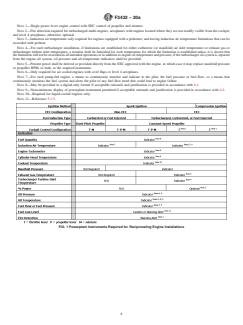
4.1 This practice provides designers of general aviation aeroplanes with a list of previously accepted required powerplant instruments, and a method for the powerplant information to be provided to the crew based on the type of powerplant installation. Criteria for mitigating the need for rate of change, direction of change, and proximity to limits information for some required powerplant instruments is also provided. This practice applies to reciprocating and turbine engine powerplant requirements. This practice provides a method of compliance to Section 6 of Specification F3064/F3064M.
SCOPE
1.1 This standard practice provides the minimum required powerplant instruments, along with information on how that information is provided to the flight crew or pilot of Normal Category Level 1, 2, 3, or 4 aeroplanes. The material was developed through open consensus of international experts in general aviation. This practice does not consider remotely piloted aeroplanes, nor does it consider electric, hydrogen, or hybrid aeroplanes. The content may be more broadly applicable; it is the responsibility of the applicant to substantiate broader applicability as a specific means of compliance.
1.2 An applicant intending to propose this information as Means of Compliance for a design approval must seek guidance from their respective oversight authority (for example, published guidance from applicable CAAs) concerning the acceptable use and application thereof. For information on which oversight authorities have accepted this standard (in whole or in part) as an acceptable Means of Compliance to their regulatory requirements (hereinafter “the Rules”), refer to the ASTM Committee F44 web page (www.astm.org/COMMITTEE/F44.htm).
1.3 This standard does not purport to address all of the safety concerns, if any, associated with its use. It is the responsibility of the user of this standard to establish appropriate safety, health, and environmental practices and determine the applicability of regulatory limitations prior to use.
1.4 This international standard was developed in accordance with internationally recognized principles on standardization established in the Decision on Principles for the Development of International Standards, Guides and Recommendations issued by the World Trade Organization Technical Barriers to Trade (TBT) Committee.
- Status
- Published
- Publication Date
- 31-Oct-2020
- Technical Committee
- F44 - General Aviation Aircraft
- Drafting Committee
- F44.40 - Powerplant
Overview
ASTM F3432-20a - Standard Practice for Powerplant Instruments provides comprehensive guidance for the selection, application, and presentation of powerplant instruments required on general aviation aeroplanes equipped with reciprocating or turbine engines. Developed through international consensus, this standard establishes baseline requirements for analog and digital cockpit indications, covering what information must be available to the flight crew, how it should be provided, and under what conditions digital-only or intermittent displays are acceptable. Compliance with ASTM F3432-20a supports industry stakeholders in meeting regulatory requirements and best practices for powerplant instrument configuration under Section 6 of ASTM F3064/F3064M.
Key Topics
Minimum Required Instruments
Specifies the essential cockpit instruments for reciprocating and turbine engine airplanes, including indicators for fuel quantity, oil pressure and temperature, fire warnings, and others as appropriate to engine type and aircraft mission.Analog and Digital Presentations
Details requirements for both traditional analog (round dial, "steam gauge") instruments and nontraditional digital displays, including digital-only and hybrid formats. It addresses presentation criteria needed for clear crew awareness: state, rate and direction of change, and proximity to operational limits.Alerting and Indication Criteria
Outlines criteria for the use of alerts-such as low fuel, low oil pressure, or fire warnings-and specifies color coding and prominence in cockpit displays in accordance with interface standards.Mitigating Rate/Direction/Limit Information
Provides rationale and compliance guidance for cases where certain real-time dynamic information (e.g., rate of change) may not be needed due to engine control design, operational procedures, or digital enhancements.Compliance and Oversight Guidance
Notes steps for applicants wishing to propose this approach as a Means of Compliance (MoC) for regulatory approval, encouraging early engagement with relevant civil aviation authorities (CAA), EASA, or the FAA.
Applications
ASTM F3432-20a is widely applicable to:
Design and Certification of Aircraft
Used by aircraft designers and OEMs developing or modifying general aviation airplanes in Normal Category Levels 1-4, ensuring compliant and consistent powerplant indication systems aligned with international safety expectations.System Integration
Beneficial for avionics manufacturers and integrators outfitting new or retrofit aircraft cockpits, who must meet both regulatory and ergonomic requirements for instrument layout and information delivery.Regulatory and Compliance Auditing
Provides a recognized method of compliance for certification teams, regulatory authorities, and independent assessors reviewing conformity with ASTM F3064/F3064M, FAA 14 CFR Part 23.1305, or EASA CS-23.1305.Digital Cockpit Retrofits
Informs retrofitting programs transitioning aircraft from analog to digital instrument suites, clarifying where digital-only or non-continuous displays may be justified, minimizing pilot workload while maintaining safety.
Related Standards
- ASTM F3062/F3062M: Specification for Aircraft Powerplant Installation
- ASTM F3063/F3063M: Specification for Aircraft Fuel Storage and Delivery
- ASTM F3064/F3064M: Specification for Aircraft Powerplant Control, Operation, and Indication
- ASTM F3066/F3066M: Specification for Powerplant Installation Hazard Mitigation
- ASTM F3117/F3117M: Specification for Crew Interface in Aircraft
- FAA 14 CFR 23.1305: Airworthiness Standards - Powerplant Instrumentation
- EASA CS-23.1305: Certification Specifications - Powerplant Instruments for Aeroplanes
For more information regarding regulatory acceptance or applicability as an official Means of Compliance, consult the ASTM Committee F44 on General Aviation Aircraft website.
Keywords: powerplant instruments, aircraft cockpit instrumentation, general aviation, ASTM F3432-20a, powerplant indication systems, flight crew alerts, digital cockpit displays, regulatory compliance, aviation standards
Relations
- Effective Date
- 01-Mar-2024
- Effective Date
- 01-Jun-2020
- Effective Date
- 01-Feb-2019
- Effective Date
- 01-Nov-2018
- Refers
ASTM F3063/F3063M-18a - Standard Specification for Aircraft Fuel and Energy Storage and Delivery - Effective Date
- 01-Jul-2018
- Refers
ASTM F3063/F3063M-18 - Standard Specification for Aircraft Fuel and Energy Storage and Delivery - Effective Date
- 01-Jan-2018
- Effective Date
- 01-Jan-2018
- Refers
ASTM F3066/F3066M-17 - Standard Specification for Aircraft Powerplant Installation Hazard Mitigation - Effective Date
- 01-Dec-2017
- Effective Date
- 15-Dec-2016
- Effective Date
- 01-Sep-2016
- Effective Date
- 01-Feb-2016
- Effective Date
- 01-Jun-2015
- Effective Date
- 01-Jun-2015
- Refers
ASTM F3066/F3066M-15 - Standard Specification for Powerplant Systems Specific Hazard Mitigation - Effective Date
- 01-May-2015
Get Certified
Connect with accredited certification bodies for this standard

BUREAU VERITAS Certification Germany
Bureau Veritas certification in Germany.

Element Materials Technology
Materials testing and product certification.

AQMS Ltd.
AQMS provides ISO certification to SMEs across the UK.
Sponsored listings
Frequently Asked Questions
ASTM F3432-20a is a standard published by ASTM International. Its full title is "Standard Practice for Powerplant Instruments". This standard covers: SIGNIFICANCE AND USE 4.1 This practice provides designers of general aviation aeroplanes with a list of previously accepted required powerplant instruments, and a method for the powerplant information to be provided to the crew based on the type of powerplant installation. Criteria for mitigating the need for rate of change, direction of change, and proximity to limits information for some required powerplant instruments is also provided. This practice applies to reciprocating and turbine engine powerplant requirements. This practice provides a method of compliance to Section 6 of Specification F3064/F3064M. SCOPE 1.1 This standard practice provides the minimum required powerplant instruments, along with information on how that information is provided to the flight crew or pilot of Normal Category Level 1, 2, 3, or 4 aeroplanes. The material was developed through open consensus of international experts in general aviation. This practice does not consider remotely piloted aeroplanes, nor does it consider electric, hydrogen, or hybrid aeroplanes. The content may be more broadly applicable; it is the responsibility of the applicant to substantiate broader applicability as a specific means of compliance. 1.2 An applicant intending to propose this information as Means of Compliance for a design approval must seek guidance from their respective oversight authority (for example, published guidance from applicable CAAs) concerning the acceptable use and application thereof. For information on which oversight authorities have accepted this standard (in whole or in part) as an acceptable Means of Compliance to their regulatory requirements (hereinafter “the Rules”), refer to the ASTM Committee F44 web page (www.astm.org/COMMITTEE/F44.htm). 1.3 This standard does not purport to address all of the safety concerns, if any, associated with its use. It is the responsibility of the user of this standard to establish appropriate safety, health, and environmental practices and determine the applicability of regulatory limitations prior to use. 1.4 This international standard was developed in accordance with internationally recognized principles on standardization established in the Decision on Principles for the Development of International Standards, Guides and Recommendations issued by the World Trade Organization Technical Barriers to Trade (TBT) Committee.
SIGNIFICANCE AND USE 4.1 This practice provides designers of general aviation aeroplanes with a list of previously accepted required powerplant instruments, and a method for the powerplant information to be provided to the crew based on the type of powerplant installation. Criteria for mitigating the need for rate of change, direction of change, and proximity to limits information for some required powerplant instruments is also provided. This practice applies to reciprocating and turbine engine powerplant requirements. This practice provides a method of compliance to Section 6 of Specification F3064/F3064M. SCOPE 1.1 This standard practice provides the minimum required powerplant instruments, along with information on how that information is provided to the flight crew or pilot of Normal Category Level 1, 2, 3, or 4 aeroplanes. The material was developed through open consensus of international experts in general aviation. This practice does not consider remotely piloted aeroplanes, nor does it consider electric, hydrogen, or hybrid aeroplanes. The content may be more broadly applicable; it is the responsibility of the applicant to substantiate broader applicability as a specific means of compliance. 1.2 An applicant intending to propose this information as Means of Compliance for a design approval must seek guidance from their respective oversight authority (for example, published guidance from applicable CAAs) concerning the acceptable use and application thereof. For information on which oversight authorities have accepted this standard (in whole or in part) as an acceptable Means of Compliance to their regulatory requirements (hereinafter “the Rules”), refer to the ASTM Committee F44 web page (www.astm.org/COMMITTEE/F44.htm). 1.3 This standard does not purport to address all of the safety concerns, if any, associated with its use. It is the responsibility of the user of this standard to establish appropriate safety, health, and environmental practices and determine the applicability of regulatory limitations prior to use. 1.4 This international standard was developed in accordance with internationally recognized principles on standardization established in the Decision on Principles for the Development of International Standards, Guides and Recommendations issued by the World Trade Organization Technical Barriers to Trade (TBT) Committee.
ASTM F3432-20a is classified under the following ICS (International Classification for Standards) categories: 49.050 - Aerospace engines and propulsion systems. The ICS classification helps identify the subject area and facilitates finding related standards.
ASTM F3432-20a has the following relationships with other standards: It is inter standard links to ASTM F3064/F3064M-24, ASTM F3062/F3062M-20, ASTM F3062/F3062M-19, ASTM F3117/F3117M-18c, ASTM F3063/F3063M-18a, ASTM F3063/F3063M-18, ASTM F3062/F3062M-18, ASTM F3066/F3066M-17, ASTM F3063/F3063M-16a, ASTM F3062/F3062M-16, ASTM F3063/F3063M-16, ASTM F3063/F3063M-15, ASTM F3062/F3062M-15, ASTM F3066/F3066M-15. Understanding these relationships helps ensure you are using the most current and applicable version of the standard.
ASTM F3432-20a is available in PDF format for immediate download after purchase. The document can be added to your cart and obtained through the secure checkout process. Digital delivery ensures instant access to the complete standard document.
Standards Content (Sample)
This international standard was developed in accordance with internationally recognized principles on standardization established in the Decision on Principles for the
Development of International Standards, Guides and Recommendations issued by the World Trade Organization Technical Barriers to Trade (TBT) Committee.
Designation: F3432 − 20a
Standard Practice for
Powerplant Instruments
This standard is issued under the fixed designation F3432; the number immediately following the designation indicates the year of
original adoption or, in the case of revision, the year of last revision. A number in parentheses indicates the year of last reapproval. A
superscript epsilon (´) indicates an editorial change since the last revision or reapproval.
1. Scope 2. Referenced Documents
2.1 ASTM Standards:
1.1 This standard practice provides the minimum required
F3062/F3062M Specification forAircraft Powerplant Instal-
powerplant instruments, along with information on how that
lation
information is provided to the flight crew or pilot of Normal
F3063/F3063M Specification for Aircraft Fuel Storage and
Category Level 1, 2, 3, or 4 aeroplanes. The material was
Delivery
developed through open consensus of international experts in
F3064/F3064M Specification for Aircraft Powerplant
general aviation. This practice does not consider remotely
Control, Operation, and Indication
piloted aeroplanes, nor does it consider electric, hydrogen, or
F3066/F3066M Specification forAircraft Powerplant Instal-
hybrid aeroplanes. The content may be more broadly appli-
lation Hazard Mitigation
cable; it is the responsibility of the applicant to substantiate
F3117/F3117M Specification for Crew Interface in Aircraft
broader applicability as a specific means of compliance.
2.2 EASA Standard:
1.2 An applicant intending to propose this information as
CS-23.1305 Normal, Utility, Acrobatic, and Commuter
Means of Compliance for a design approval must seek guid-
Aeroplanes, Amendment 4
ance from their respective oversight authority (for example,
2.3 FAA Documents:
published guidance from applicable CAAs) concerning the
14 CFR 23.1305 Airworthiness Standards: Normal
acceptable use and application thereof. For information on
Category, Utility, Acrobatic, and Commuter Category
which oversight authorities have accepted this standard (in
Aeroplanes, Amendment 23-62
whole or in part) as an acceptable Means of Compliance to
FAA Advisory Circular 20-88A Guidelines on the Marking
their regulatory requirements (hereinafter “the Rules”), refer to
of Aircraft Powerplant Instruments (Displays)
the ASTM Committee F44 web page (www.astm.org/
COMMITTEE/F44.htm).
3. Terminology
1.3 This standard does not purport to address all of the
3.1 Definitions:
safety concerns, if any, associated with its use. It is the
3.1.1 altitude engine, n—a reciprocating aircraft engine
responsibility of the user of this standard to establish appro-
having a rated takeoff power that is producible from sea level
priate safety, health, and environmental practices and deter-
to an established higher altitude.
mine the applicability of regulatory limitations prior to use.
3.1.2 crew, n—for the purposes of this practice, the pilot and
1.4 This international standard was developed in accor-
any personnel required onboard for the safe operation of the
dance with internationally recognized principles on standard-
aeroplane.
ization established in the Decision on Principles for the
3.1.3 electronic engine control, EEC, n—a digital computer
Development of International Standards, Guides and Recom-
that controls aspects of engine performance.
mendations issued by the World Trade Organization Technical
Barriers to Trade (TBT) Committee.
For referenced ASTM standards, visit the ASTM website, www.astm.org, or
contact ASTM Customer Service at service@astm.org. For Annual Book of ASTM
This practice is under the jurisdiction of ASTM Committee F44 on General Standards volume information, refer to the standard’s Document Summary page on
Aviation Aircraft and is the direct responsibility of Subcommittee F44.40 on the ASTM website.
Powerplant. Available from the European UnionAviation SafetyAgency (EASA), Konrad-
Current edition approved Nov. 1, 2020. Published November 2020. Originally Adenauer-Ufer 3, D-50668 Cologne, Germany, https://www.easa.europa.eu/.
approved in 2020. Last previous edition approved in 2020 as F3432–20. DOI: Available from Federal Aviation Administration (FAA), 800 Independence
10.1520/F3432-20A. Ave., SW, Washington, DC 20591, http://www.faa.gov.
Copyright © ASTM International, 100 Barr Harbor Drive, PO Box C700, West Conshohocken, PA 19428-2959. United States
F3432 − 20a
3.1.4 indicator, n—a means to provide parameter informa- 5.2.6.1 If limitations are established for either carburetor (or
tion to the flight crew or pilot such that it includes current state manifold) air inlet temperature, or exhaust gas, or turbocharger
of operation, rate of change information, direction of change turbine inlet temperature, indicators shall be furnished for each
information, and relative proximity to any limits. temperature for which the limitation is established, unless it is
shown that the limitation will not be exceeded in all intended
4. Significance and Use
operations.
5.2.6.2 If its oil system is separate from the engine oil
4.1 This practice provides designers of general aviation
system, oil pressure and oil temperature indicators shall be
aeroplanes with a list of previously accepted required power-
provided.
plantinstruments,andamethodforthepowerplantinformation
5.2.7 Coolant temperature indicator for each liquid-cooled
to be provided to the crew based on the type of powerplant
engine.
installation. Criteria for mitigating the need for rate of change,
direction of change, and proximity to limits information for
5.3 For Turbine Engine-powered Aeroplanes—In addition
some required powerplant instruments is also provided. This
to the powerplant instruments required by 5.1, the following
practice applies to reciprocating and turbine engine powerplant
powerplant instruments shall be provided:
requirements. This practice provides a method of compliance
5.3.1 Gas temperature indicator for each engine.
to Section 6 of Specification F3064/F3064M.
5.3.2 Fuel flowmeter indicator for each engine.
5.3.3 Fuel low pressure warning means for each engine.
5. Required Powerplant Instruments for Reciprocating
5.3.4 A tachometer indicator (to indicate the speed of the
and Turbine Engine Powered Aeroplanes
rotors with established limiting speeds) for each engine.
5.1 The following are required powerplant instruments for 5.3.5 An oil low pressure warning means for each engine.
all aeroplanes using internal combustion based engines and
5.3.6 An indicating means to indicate the functioning of the
nondigital displays: powerplant ice protection system for each engine.
5.1.1 With the exception of auxiliary transfer tanks defined
5.3.7 For each engine, an indicating means for the fuel
in Specification F3064/F3064M, a fuel quantity indicator for strainer or filter required by Specification F3063/F3063M to
each fuel tank shall be installed in accordance with Specifica-
indicatetheoccurrenceofcontaminationofthestrainerorfilter
tion F3064/F3064M. before it reaches the capacity established in accordance with
5.1.2 Oil pressure indicator for each engine.
Specification F3063/F3063M.
5.1.3 Oil temperature indicator for each engine.
5.3.8 For each engine, a warning means for the oil strainer
5.1.4 Afire warning means for those aeroplanes required to
or filter required by Specification F3062/F3062M,ifithasno
comply with Specification F3066/F3066M. bypass, to warn the pilot of the occurrence of contamination of
5.1.5 Fuel low level alert means for any tank that should not
the strainer or filter screen before it reaches the capacity
bedepletedoffuelinnormaloperations.Thealertshallprovide established in accordance with Specification F3062/F3062M.
indication to the flight crew or pilot that awareness (caution) or
5.3.9 An indicating means to indicate the functioning of any
immediate action (warning) is required based upon the level of
heater used to prevent ice clogging of fuel system components.
fuel within the tank. The level of the alert (caution or warning)
5.4 For Turbojet/Turbofan Engine-powered Aeroplanes—In
is dependent upon factors inherent to each aeroplane and its
addition to the powerplant instruments required by 5.1 and 5.3,
intended use. Historically, for traditional general aviation
the following powerplant instruments are required:
aeroplanes and their missions, a caution alert at approximately
5.4.1 For each engine, an indicator to indicate thrust or a
30 min of usable fuel remaining has been accepted. Fuel low
parameter that can be related to thrust, including a free air
level alerts greater than 45 min require careful consideration to
temperature indicator, if needed for this purpose.
avoid unnecessary alerts to the flight crew during typical
5.4.2 For each engine, a position indicating means to
operations.
indicate to the flight crew when the thrust reverser, if installed,
5.2 For Reciprocating Engine-powered Aeroplanes—In ad-
is in the reverse thrust position.
dition to the powerplant instruments required by 5.1, the
5.5 For Turbopropeller-poweredAeroplanes—Inadditionto
following powerplant instruments shall be provided:
the powerplant instruments required by 5.1 and 5.3, the
5.2.1 Aninductionsystemairtemperatureindicatorforeach
following powerplant instruments are required:
engine equipped with a preheater, and having induction air
5.5.1 A torque indicator for each engine.
temperature limitations that can be exceeded with preheat.
5.5.2 A position indicating means to indicate to the flight
5.2.2 A tachometer indicator for each engine.
crew when the propeller blade angle is below the flight low
5.2.3 Cylinder head temperature indicator for each air-
pitch position, for each propeller, unless it can be shown that
cooled engine with cowl flaps or level 4 aeroplanes.
such occurrence is highly improbable.
5.2.4 For each pump-fed engine, a means to indicate con-
tinuously to the pilot the fuel pressure or fuel flow; or a means
6. Methods for Providing Required Powerplant
that continuously monitors the fuel system, and warns the pilot
Instrument Information to the Crew
of any fuel flow trend that could lead to engine failure.
5.2.5 Manifold pressure indicator for each altitude engine, 6.1 A digital-only display may be used for powerplant
and for each engine with a controllable propeller. instruments that traditionally require rate and direction of
5.2.6 For each turbocharger installation: change, and proximity to limits information if it is shown that
F3432 − 20a
information is not needed. To support this showing, a rational 6.2 Noncontinuous display of powerplant instruments may
argument shall be provided for each digital-only powerplant be permitted for those instruments that are only needed during
certain phases of flight. If it is desired to inhibit some
instrument that identifies all compensating features along with
powerplantinstrumentsfromfull-timedisplay,ahumanfactors
justification of how those features mitigate the pilot need to
evaluation that shows the system is functionally equivalent to
directly monitor rate of change, direction of change, and
afull-timedisplayshouldbedemonstrated.Thefollowingshall
proximity to limit information to prevent a limit exceedance or
be provided and evaluated for any powerplant instrument that
unsafe operating conditions. The following are several ex-
is not continuously displayed:
amples of digital-only powerplant instrument arguments that
6.2.1 A determination that continuous display of the pow-
justify digital-only presentation. Digital-only displayed power-
erplant instrument is not required for safety of flight in all
plant instruments, at a minimum, shall provide a numerical
normal flight phases.
readout of each parameter, including colored digits or colored
6.2.2 Automatic display of the powerplant instrument in
background identifying normal, caution, and warning operat-
phases of flight where it is required.
ing ranges in accordance with Specification F3117/F3117M to
6.2.3 Automatic monitoring of the instrument when
indicate current operating state and limit exceedance informa-
inhibited, that before reaching any operating limit, returns
tion.
continuous display of the required powerplant instrument
6.1.1 For gas generator speed, if the instrument is not
without pilot action. The monitoring function should automati-
required to set power, the primary concern is preventing
cally provide the same level of monitoring that would exist if
overspeed and potential engine failure. If a redundant auto-
there were continuous display of the individual powerplant
matic overspeed protection system is provided, and the likeli-
instruments. The display of the powerplant instruments or
hood of an overspeed is addressed for both normal and latent
alerts shall allow the flight crew or pilot to identify and carry
failure operating conditions, the design mitigates the need for
out the necessary and appropriate actions. The required pow-
reliance on the indicating system for immediate flight crew or
erplantindicationsshouldbepresentedcontinuouslyduringthe
pilot action to prevent an overspeed.
critical takeoff and landing phases of flight to minimize flight
6.1.2 For propeller speed, even though it is part of the
crew or pilot distraction until an established rate of climb or
primary power setting procedure, a speed governor prevents
minimum altitude is achieved.
the need for the flight crew to constantly monitor or adjust
6.2.4 Capability for the flight crew or pilot to manually
propeller speed to adjust power. If in addition to a speed
display any inhibited powerplant instrument at any time
governor, an overspeed protection means is provided that
without interfering with the display of other required informa-
protects against limit exceedance and potential engine failure, tion.
the design mitigates the need for rate and direction of change,
6.2.5 Displays that provide multiple powerplant instruments
or proximity to limit information being provided to the pilot. shallbedesignedsuchthatanyinstrument,display,oralertwill
notsuppressorinhibitanotherdisplayoralertthatalsorequires
6.1.3 For engine oil temperature, the rate of change is
immediate flight crew awarenes
...
This document is not an ASTM standard and is intended only to provide the user of an ASTM standard an indication of what changes have been made to the previous version. Because
it may not be technically possible to adequately depict all changes accurately, ASTM recommends that users consult prior editions as appropriate. In all cases only the current version
of the standard as published by ASTM is to be considered the official document.
Designation: F3432 − 20 F3432 − 20a
Standard Practice for
Powerplant Instruments
This standard is issued under the fixed designation F3432; the number immediately following the designation indicates the year of
original adoption or, in the case of revision, the year of last revision. A number in parentheses indicates the year of last reapproval. A
superscript epsilon (´) indicates an editorial change since the last revision or reapproval.
1. Scope
1.1 This standard practice provides the minimum required powerplant instruments, along with information on how that
information is provided to the flight crew or pilot of Normal Category Level 1, 2, 3, or 4 aeroplanes. The material was developed
through open consensus of international experts in general aviation. This practice does not consider remotely piloted aeroplanes,
nor does it consider electric electric, hydrogen, or hybrid-electrichybrid aeroplanes. The content may be more broadly applicable;
it is the responsibility of the applicant to substantiate broader applicability as a specific means of compliance.
1.2 An applicant intending to propose this information as Means of Compliance for a design approval must seek guidance from
their respective oversight authority (for example, published guidance from applicable CAAs) concerning the acceptable use and
application thereof. For information on which oversight authorities have accepted this standard (in whole or in part) as an
acceptable Means of Compliance to their regulatory requirements (hereinafter “the Rules”), refer to the ASTM Committee F44 web
page (www.astm.org/COMMITTEE/F44.htm).
1.3 This standard does not purport to address all of the safety concerns, if any, associated with its use. It is the responsibility
of the user of this standard to establish appropriate safety, health, and environmental practices and determine the applicability of
regulatory limitations prior to use.
1.4 This international standard was developed in accordance with internationally recognized principles on standardization
established in the Decision on Principles for the Development of International Standards, Guides and Recommendations issued
by the World Trade Organization Technical Barriers to Trade (TBT) Committee.
2. Referenced Documents
2.1 ASTM Standards:
F3062/F3062M Specification for Aircraft Powerplant Installation
F3063/F3063M Specification for Aircraft Fuel Storage and Delivery
F3064/F3064M Specification for Aircraft Powerplant Control, Operation, and Indication
F3066/F3066M Specification for Aircraft Powerplant Installation Hazard Mitigation
F3117/F3117M Specification for Crew Interface in Aircraft
2.2 EASA Standard:
CS-23.1305 Normal, Utility, Acrobatic, and Commuter Aeroplanes, Amendment 4
2.3 FAA Standard:Documents:
14 CFR 23.1305 Airworthiness Standards: Normal Category, Utility, Acrobatic, and Commuter Category Aeroplanes,
Amendment 23-62
This practice is under the jurisdiction of ASTM Committee F44 on General Aviation Aircraft and is the direct responsibility of Subcommittee F44.40 on Powerplant.
Current edition approved March 1, 2020Nov. 1, 2020. Published April 2020November 2020. Originally approved in 2020. Last previous edition approved in 2020 as
F3432–20. DOI: 10.1520/F3432–20.10.1520/F3432-20A.
For referenced ASTM standards, visit the ASTM website, www.astm.org, or contact ASTM Customer Service at service@astm.org. For Annual Book of ASTM Standards
volume information, refer to the standard’s Document Summary page on the ASTM website.
Available from the European Union Aviation Safety Agency (EASA), Konrad-Adenauer-Ufer 3, D-50668 Cologne, Germany, https://www.easa.europa.eu/.
Available from Federal Aviation Administration (FAA), 800 Independence Ave., SW, Washington, DC 20591, http://www.faa.gov.
Copyright © ASTM International, 100 Barr Harbor Drive, PO Box C700, West Conshohocken, PA 19428-2959. United States
F3432 − 20a
FAA Advisory Circular 20-88A Guidelines on the Marking of Aircraft Powerplant Instruments (Displays)
3. Terminology
3.1 Definitions:
3.1.1 altitude engine, n—a reciprocating aircraft engine having a rated takeoff power that is producible from sea level to an
established higher altitude.
3.1.2 crew, n—for the purposes of this practice, the pilot and any personnel required onboard for the safe operation of the
aeroplane.
3.1.3 electronic engine control, EEC, n—a digital computer that controls aspects of engine performance.
3.1.4 indicator, n—a means to provide parameter information to the flight crew or pilot such that it includes current state of
operation, rate of change information, direction of change information, and relative proximity to any limits.
4. Significance and Use
4.1 This practice provides designers of general aviation aeroplanes with a list of previously accepted required powerplant
instruments, and a method for the powerplant information to be provided to the crew based on the type of powerplant installation.
Criteria for mitigating the need for rate of change, direction of change, and proximity to limits information for some required
powerplant instruments is also provided. This practice applies to reciprocating and turbine engine powerplant requirements. This
practice provides a method of compliance to Section 6 of Specification F3064/F3064M.
5. Traditional Powerplant Instrument RequirementsRequired Powerplant Instruments for Reciprocating and Turbine
Engine Powered Aeroplanes
5.1 The following are required powerplant instruments for all aeroplanes using internal combustion based engines and nondigital
displays:
5.1.1 With the exception of auxiliary transfer tanks defined in Specification F3064/F3064M, a fuel quantity indicator for each fuel
tank shall be installed in accordance with Specification F3064/F3064M.
5.1.2 Oil pressure indicator for each engine.
5.1.3 Oil temperature indicator for each engine.
5.1.4 A fire warning means for those aeroplanes required to comply with Specification F3066/F3066M.
5.1.5 Fuel low level alert means for any tank that should not be depleted of fuel in normal operations. The alert shall provide
indication to the flight crew or pilot that awareness (caution) or immediate action (warning) is required based upon the level of
fuel within the tank. The level of the alert (caution or warning) is dependent upon factors inherent to each aeroplane and its
intended use. Historically, for traditional general aviation aeroplanes and their missions, a caution alert at approximately 30 min
of usable fuel remaining has been accepted. Fuel low level alerts greater than 45 min require careful consideration to avoid
unnecessary alerts to the flight crew during typical operations.
5.2 For Reciprocating Engine-powered Aeroplanes—In addition to the powerplant instruments required by 5.1, the following
powerplant instruments shall be provided:
5.2.1 An induction system air temperature indicator for each engine equipped with a preheater, and having induction air
temperature limitations that can be exceeded with preheat.
5.2.2 A tachometer indicator for each engine.
5.2.3 Cylinder head temperature indicator for each air-cooled engine with cowl flaps or level 4 aeroplanes.
5.2.4 For each pump-fed engine, a means to indicate continuously to the pilot the fuel pressure or fuel flow; or a means that
continuously monitors the fuel system, and warns the pilot of any fuel flow trend that could lead to engine failure.
F3432 − 20a
5.2.5 Manifold pressure indicator for each altitude engine, and for each engine with a controllable propeller.
5.2.6 For each turbocharger installation:
5.2.6.1 If limitations are established for either carburetor (or manifold) air inlet temperature, or exhaust gas, or turbocharger
turbine inlet temperature, indicators shall be furnished for each temperature for which the limitation is established, unless it is
shown that the limitation will not be exceeded in all intended operations.
5.2.6.2 If its oil system is separate from the engine oil system, oil pressure and oil temperature indicators shall be provided.
5.2.7 Coolant temperature indicator for each liquid-cooled engine.
5.3 For Turbine Engine-powered Aeroplanes—In addition to the powerplant instruments required by 5.1, the following powerplant
instruments shall be provided:
5.3.1 Gas temperature indicator for each engine.
5.3.2 Fuel flowmeter indicator for each engine.
5.3.3 Fuel low pressure warning means for each engine.
5.3.4 A tachometer indicator (to indicate the speed of the rotors with established limiting speeds) for each engine.
5.3.5 An oil low pressure warning means for each engine.
5.3.6 An indicating means to indicate the functioning of the powerplant ice protection system for each engine.
5.3.7 For each engine, an indicating means for the fuel strainer or filter required by Specification F3063/F3063M to indicate the
occurrence of contamination of the strainer or filter before it reaches the capacity established in accordance with Specification
F3063/F3063M.
5.3.8 For each engine, a warning means for the oil strainer or filter required by Specification F3062/F3062M, if it has no bypass,
to warn the pilot of the occurrence of contamination of the strainer or filter screen before it reaches the capacity established in
accordance with Specification F3062/F3062M.
5.3.9 An indicating means to indicate the functioning of any heater used to prevent ice clogging of fuel system components.
5.4 For Turbojet/Turbofan Engine-powered Aeroplanes—In addition to the powerplant instruments required by 5.1 and 5.3, the
following powerplant instruments are required:
5.4.1 For each engine, an indicator to indicate thrust or a parameter that can be related to thrust, including a free air temperature
indicator, if needed for this purpose.
5.4.2 For each engine, a position indicating means to indicate to the flight crew when the thrust reverser, if installed, is in the
reverse thrust position.
5.5 For Turbopropeller-powered Aeroplanes—In addition to the powerplant instruments required by 5.1 and 5.3, the following
powerplant instruments are required:
5.5.1 A torque indicator for each engine.
5.5.2 A position indicating means to indicate to the flight crew when the propeller blade angle is below the flight low pitch
position, for each propeller, unless it can be shown that such occurrence is highly improbable.
F3432 − 20a
6. Nontraditional Powerplant Instrument RationaleMethods for Providing Required Powerplant Instrument
Information to the Crew
6.1 A digital-only display may be used for powerplant instruments that traditionally require rate and direction of change, and
proximity to limits information if it is shown that information is not needed. To support this showing, a rational argument shall
be provided for each digital-only powerplant instrument that identifies all compensating features along with justification of how
those features mitigate the pilot need to directly monitor rate of change, direction of change, and proximity to limit information
to prevent a limit exceedance or unsafe operating conditions. The following are several examples of digital-only powerplant
instrument arguments that justify digital-only presentation. Digital-only displayed powerplant instruments, at a minimum, shall
provide a numerical readout of each parameter, including colored digits or colored background identifying normal, caution, and
warning operating ranges in accordance with Specification F3117/F3117M to indicate current operating state and limit exceedance
information.
6.1.1 For gas generator speed, if the instrument is not required to set power, the primary concern is preventing overspeed and
potential engine failure. If a redundant automatic overspeed protection system is provided, and the likelihood of an overspeed is
addressed for both normal and latent failure operating conditions, the design mitigates the need for reliance on the indicating
system for immediate flight crew or pilot action to prevent an overspeed.
6.1.2 For propeller speed, even though it is part of the primary power setting procedure, a speed governor prevents the need for
the flight crew to constantly monitor or adjust propeller speed to adjust power. If in addition to a speed governor, an overspeed
protection means is provided that protects against limit exceedance and potential engine failure, the design mitigates the need for
rate and direction of change, or proximity to limit information being provided to the pilot.
6.1.3 For engine oil temperature, the rate of change is relatively slow, not directly controlled by flight crew or pilot (except by
airspeed or power changes), and is generally controlled by a thermostat such that immediate pilot action is not necessary to prevent
an exceedance. Additionally, short term oil temperature exceedances do not typically present an immediate hazard. This design
configuration typically mitigates the need for rate and direction of change, or proximity to limit information needed for immediate
flight crew or pilot action to prevent a hazardous condition. Flight crew or pilot action based on indication of a limit exceedance
at or shortly after its occurrence is typically sufficient.
6.1.4 Fuel flow typically does not include any limitations, and only requires verification of positive flow during some engine start
procedures. This mitigates the need for rate and direction of change, or proximity to limits information needed for immediate flight
crew or pilot action to prevent a hazardous condition.
6.2 Noncontinuous display of powerplant instruments may be permitted for those instruments that are only needed during certain
phases of flight. If it is desired to inhibit some powerplant instruments from full-time display, a human factors evaluation that
shows the system is functionally equivalent to a full-time display should be demonstrated. The following shall be provided and
evaluated for any powerplant instrument that is not continuously displayed:
6.2.1 A determination that continuous display of the powerplant instrument is not required for safety of flight in all normal flight
phases.
6.2.2 Automatic display of the powerplant instrument in phases of flight where it is required.
6.2.3 Automatic monitoring of the instrument when inhibited, that before reaching any operating limit, returns continuous display
of the required powerplant instrument without pilot action. The monitoring function should automatically provide the same level
of monitoring that would exist if there were continuous display of the individual powerplant instruments. The display of the
powerplant instruments or alerts shall allow the flight crew or pilot to identify and carry o
...