

SIST ETS 300 256 E2:2005
(Main)Private Integrated Services Network (PISN); Specification, functional models and information flows; Diversion supplementary services
- Abstract
This European Telecommunication Standard (ETS) specifies the supplementary services Calling Forwarding Unconditional (SS-CFU), Call Forwarding Busy (SS-CFB), Call Forwarding No Reply (SS-CFNR) and Call Deflection (SS-CD), which are applicable to various basic services supported by Private Integrated Services Networks (PISN).
- Status
- Published
- Publication Date
- 30-Apr-2005
- Technical Committee
- SPN - Services and Protocols for Networks
- Current Stage
- 6060 - National Implementation/Publication (Adopted Project)
- Start Date
- 01-May-2005
- Due Date
- 01-May-2005
- Completion Date
- 01-May-2005
- Mandate
- IT-74



SIST ETS 300 256 E2:2005 is the Slovene adoption of ETS 300 256 Edition 2, a European Telecommunication Standard from ETSI. It specifies the diversion supplementary services for Private Integrated Services Networks (PISN): Calling Forwarding Unconditional (SS-CFU), Call Forwarding Busy (SS-CFB), Call Forwarding No Reply (SS-CFNR), and Call Deflection (SS-CD). The standard is written for service and signalling work on PISN, so it is used when defining, implementing, or checking call forwarding behaviour and the related information flows.
What does SIST ETS 300 256 E2:2005 specify?
SIST ETS 300 256 E2:2005 specifies how the PISN diversion supplementary services are described and exchanged. It covers the service definitions, functional models, and information flows for SS-CFU, SS-CFB, SS-CFNR, and SS-CD when they are applied to the basic services supported by PISN.
The document is organized as an ETS with a foreword, clause 3 on normative references, and service detail in later clauses, including clause 10.2.1 and Table 12. In practice, that means it is both a service specification and a signalling reference: readers use it to understand what the service does and which information elements appear in the flows.
What are the key requirements of SIST ETS 300 256 E2:2005?
The core requirement is that the diversion supplementary services are defined for PISN in a way that fits the ETS/ISDN-style service model. For implementers, this means the service must be handled as a standardized supplementary service, not as an ad hoc network feature.
Clause 3 makes the document depend on a set of referenced standards. That matters because the service description relies on common rules for numbering, naming, service specification, and reference configuration.
The document replaces several ISO/IEC references with ETS references throughout the text. In practice, a reader must use the ETS-named companion documents when interpreting the service model and information flows.
The foreword states that this edition endorses ISO/IEC 13872 with agreed modifications. For a project team, that means the service description is based on an international text but adapted to the ETS context.
Clause 10.2.1.4 and clause 10.2.1.5 update the note text from "Connection Type and Call History" to "Connection Type, Originating Category and Call History". This matters because the call information attached to the service now explicitly includes the originating category.
Clause 10.2.1.11 updates Table 12 by adding Call History and Originating Category before the diverting number information. In practice, this tells designers and testers that these data items are part of the service information flow and may need to be carried, checked, or documented.
The document also replaces the term "International Standard" with "ETS" throughout the endorsed text. That is a documentation rule, but it also tells readers which standard family they are working in when they cite or implement the service.
What terms does SIST ETS 300 256 E2:2005 define?
Private Integrated Services Network (PISN) is the private network environment for which the diversion services are specified.
Calling Forwarding Unconditional (SS-CFU) is the service that forwards a call without waiting for a busy or no-reply condition.
Call Forwarding Busy (SS-CFB) is the service that forwards a call when the called party or destination is busy.
Call Forwarding No Reply (SS-CFNR) is the service that forwards a call when the called party does not answer within the expected time.
Call Deflection (SS-CD) is the service that redirects an incoming call away from the originally addressed destination.
Call History is an information item used in the service flow to describe how the call has progressed.
Originating Category is an information item used to indicate the category of the call originator.
Who uses SIST ETS 300 256 E2:2005?
PISN service designers use this standard when defining how diversion features should behave across a private network. Equipment manufacturers use it when implementing call forwarding and deflection functions in exchanges or terminals.
Test laboratories and interoperability teams use it to check that signalling and information flows match the specified service model. Procurement and quality teams use it to compare products against the same service description before deployment.
What changed in SIST ETS 300 256 E2:2005 from the previous edition?
The foreword says the first edition contained a standalone specification of the diversion supplementary services. This second edition endorses ISO/IEC 13872 (1995) with agreed modifications.
The document also updates the referenced standards used throughout the text, replaces "International Standard" with "ETS", and revises selected notes and Table 12 in clause 10.2.1.
Which standards are used with SIST ETS 300 256 E2:2005?
- ISO/IEC 13872 (1995), modified - the base text endorsed by ETSI for the diversion supplementary services.
- ETS 300 171 - control aspects of circuit mode basic services.
- prETS 300 173 - identification supplementary services.
- ETS 300 189 - addressing.
- prETS 300 237 - name identification supplementary services.
- ETS 300 387 - method for the specification of basic and supplementary services.
- ETS 300 475-1 - reference configuration for PTNX.
These references provide the shared service model, addressing rules, and reference configuration needed to interpret the diversion services consistently.
What does the SIST ETS 300 256 E2:2005 document contain?
SIST ETS 300 256 E2:2005 contains the service specification for four diversion supplementary services, along with functional-model and information-flow material. It also contains ETSI’s endorsed modifications to the international base text.
The document includes changes to referenced standards, wording changes in the body text, and an update to clause 10.2.1 notes. Table 12 is also updated to include Call History and Originating Category in the diverting-service information flow.
For readers, that means the standard is useful not only for service definition but also for implementation checks, signalling analysis, and conformance or interoperability work.
Get Certified
Connect with accredited certification bodies for this standard

ANCE
Mexican certification and testing association.

Intertek Slovenia
Intertek testing, inspection, and certification services in Slovenia.

LNE (Laboratoire National de Métrologie et d'Essais)
French national laboratory for metrology and testing.
Sponsored listings
Frequently Asked Questions
SIST ETS 300 256 E2:2005 is a standard published by the Slovenian Institute for Standardization (SIST). Its full title is "Private Integrated Services Network (PISN); Specification, functional models and information flows; Diversion supplementary services". This standard covers: This European Telecommunication Standard (ETS) specifies the supplementary services Calling Forwarding Unconditional (SS-CFU), Call Forwarding Busy (SS-CFB), Call Forwarding No Reply (SS-CFNR) and Call Deflection (SS-CD), which are applicable to various basic services supported by Private Integrated Services Networks (PISN).
This European Telecommunication Standard (ETS) specifies the supplementary services Calling Forwarding Unconditional (SS-CFU), Call Forwarding Busy (SS-CFB), Call Forwarding No Reply (SS-CFNR) and Call Deflection (SS-CD), which are applicable to various basic services supported by Private Integrated Services Networks (PISN).
SIST ETS 300 256 E2:2005 is classified under the following ICS (International Classification for Standards) categories: 33.040.35 - Telephone networks. The ICS classification helps identify the subject area and facilitates finding related standards.
SIST ETS 300 256 E2:2005 is associated with the following European legislation: Standardization Mandates: IT-74. When a standard is cited in the Official Journal of the European Union, products manufactured in conformity with it benefit from a presumption of conformity with the essential requirements of the corresponding EU directive or regulation.
SIST ETS 300 256 E2:2005 is available in PDF format for immediate download after purchase. The document can be added to your cart and obtained through the secure checkout process. Digital delivery ensures instant access to the complete standard document.
Standards Content (Sample)
2003-01.Slovenski inštitut za standardizacijo. Razmnoževanje celote ali delov tega standarda ni dovoljeno.Zasebno omrežje z integriranimi storitvami (PISN) - Specifikacija, funkcijski modeli in informacijski pretoki - Dopolnilna storitev: izsmeritev klica [ISO/IEC 13872 (1995), spremenjen]Private Integrated Services Network (PISN); Specification, functional models and information flows; Diversion supplementary services33.040.35Telefonska omrežjaTelephone networksICS:Ta slovenski standard je istoveten z:ETS 300 256 Edition 2SIST ETS 300 256 E2:2005en01-maj-2005SIST ETS 300 256 E2:2005SLOVENSKI
STANDARD
EUROPEANETS 300 256TELECOMMUNICATIONMay 1996STANDARDSecond EditionSource: ETSI TC-ECMAReference: RE/ECMA-00137ICS:35.120Key words:CF, PISN, STAGE 1, STAGE 2, SUPPLEMENTARY SPrivate Integrated Services Network (PISN);Specification, functional models and information flows;Diversion supplementary services[ISO/IEC 13872 (1995), modified]ETSIEuropean Telecommunications Standards InstituteETSI SecretariatPostal address: F-06921 Sophia Antipolis CEDEX - FRANCEOffice address: 650 Route des Lucioles - Sophia Antipolis - Valbonne - FRANCEX.400: c=fr, a=atlas, p=etsi, s=secretariat - Internet: secretariat@etsi.frTel.: +33 92 94 42 00 - Fax: +33 93 65 47 16Copyright Notification: No part may be reproduced except as authorized by written permission. The copyright and theforegoing restriction extend to reproduction in all media.© European Telecommunications Standards Institute 1996. All rights reserved.SIST ETS 300 256 E2:2005
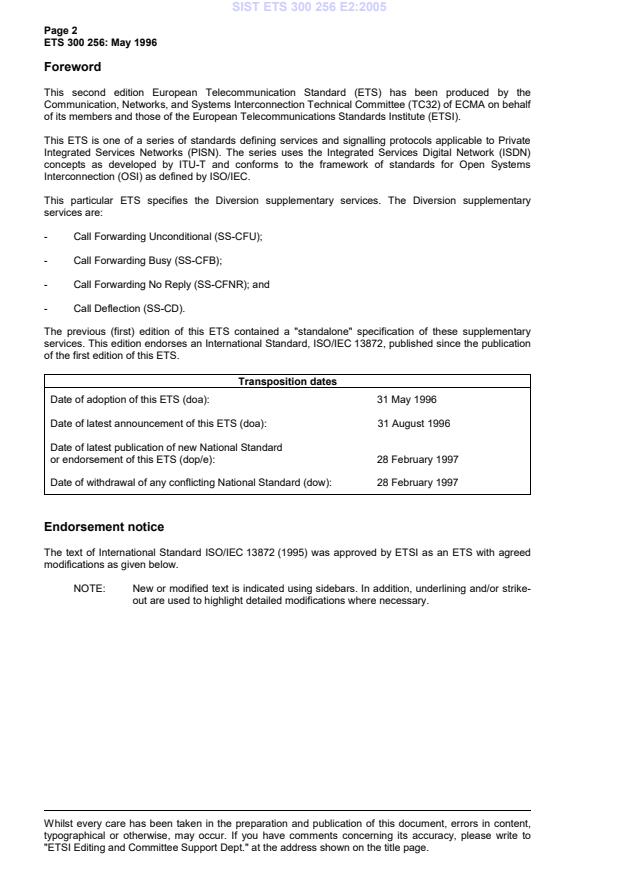
Page 2ETS 300 256: May 1996ForewordThis second edition European Telecommunication Standard (ETS) has been produced by theCommunication, Networks, and Systems Interconnection Technical Committee (TC32) of ECMA on behalfof its members and those of the European Telecommunications Standards Institute (ETSI).This ETS is one of a series of standards defining services and signalling protocols applicable to PrivateIntegrated Services Networks (PISN). The series uses the Integrated Services Digital Network (ISDN)concepts as developed by ITU-T and conforms to the framework of standards for Open SystemsInterconnection (OSI) as defined by ISO/IEC.This particular ETS specifies the Diversion supplementary services. The Diversion supplementaryservices are:-Call Forwarding Unconditional (SS-CFU);-Call Forwarding Busy (SS-CFB);-Call Forwarding No Reply (SS-CFNR); and-Call Deflection (SS-CD).The previous (first) edition of this ETS contained a "standalone" specification of these supplementaryservices. This edition endorses an International Standard, ISO/IEC 13872, published since the publicationof the first edition of this ETS.Transposition datesDate of adoption of this ETS (doa):31 May 1996Date of latest announcement of this ETS (doa):31 August 1996Date of latest publication of new National Standardor endorsement of this ETS (dop/e):28 February 1997Date of withdrawal of any conflicting National Standard (dow):28 February 1997Endorsement noticeThe text of International Standard ISO/IEC 13872 (1995) was approved by ETSI as an ETS with agreedmodifications as given below.NOTE:New or modified text is indicated using sidebars. In addition, underlining and/or strike-out are used to highlight detailed modificatio
...